I recently came to the realization that my destiny is to list and share 666 of my favorite grindhouse and exploitation film trailers. Previously, I’ve shared 12. Here’s 6 more.
1) Liquid Sky— Have you seen Liquid Sky and if the answer is no, why not? Liquid Sky is one of the great underground films of the early 80s, an epic about drugs, aliens, bisexuality, and performance art. Quite simply put, you must see this movie.
2) Blacula — When I first saw this trailer, my first thought was, “Oh, that is sooooo wrong.” But, the movie actually isn’t that bad. William Marshall is wonderfully dignified and haunted as the tragic title character.
3) Bio-Zombie — I haven’t actually seen this movie but I love this energetic trailer (and the Hello Kitty reference, as well).
4) Martin — This trailer for George Romero’s vampire movie features the film’s star, John Amplas, speaking to the audience in character. Martin is one of the unacknowledged great vampire movies. Supposedly, there’s a remake in the works which, needless to say, is not necessary in the least. The original is more than good enough.
5) Near Dark — Speaking of vampire movies, here’s Near Dark. Before Kathryn Bigelow won an Oscar for The Hurt Locker, she made her debut with Near Dark. Of the two, Near Dark is the better film.
6) Rabid — This is an early David Cronenberg film and probably one of his first stabs at being a “commercial” filmmaker (I would have to ask R-Lee for sure on this as he’s the resident Cronenberg expert). The late Marilyn Chambers plays a young woman who gets infected with rabies and proceeds to spread the disease throughout Montreal. As you might expect with a Cronenberg film, the Canadian government quickly turns fascist and a lot of Canadians die as a result. The movie’s not totally succesful but the trailer is. As a sidenote: in 2004, Marilyn Chambers Taylor was the vice-presidential candidate of the Personal Choice Party. I cast my first vote ever for her.
2007’s Eastern Promises was a film well-received by both critics and the public alike. People loved it because it was David Cronenberg dipping his artistic toe into the pulp crime genre of mob films. Some loved it because it had Viggo Mortensen in what could be his best role to date. For some the film ended just when it really got interesting. The scene in the end with Mortensen’s Nikolai Luzhin sitting alone finally reaching his ultimate goal and an unanswered question of where his loyalties truly lie now.
It’s has now been reported by Deadline Hollywood that producer Paul Webster has lined up both David Cronenberg and Viggo Mortensen for a sequel with Mortensen reprising his Russian mobster Nikolai Luzhin. Plans to have the film to start filming later this winter using a screenplay by Steven Knight (also wrote the first film) may hinge on whether Cronenberg and Mortensen can finish their current project together. This current project, their third together as a creative team, is the Sigmund Freud film The Taking Cure.
No matter how this project develops in the coming months one of the questions fans of the first film will be asking is whether Vincent Cassel will return as well to reprise his role from the first film. Not to mention Naomi Watts and Armin Mueller-Stahl. There’s also the question of how Cronenberg will top the original film’s now famous Turkish Bath House fight scene that’s now considered one of the best, if not THE BEST, fight sequence ever put on film. Or will he even try.
In the end, this is just great news. From all the talk The Taking Cure looks to continue the success the Cronenberg-Mortensen duo have had and this sequel to Eastern Promises may just keep that success going.
“You can’t always be in control.” — Nikolai Luzhin
In 2005 Canadian filmmaker David Cronenberg brought to the silver screen a film that was both a taut, smart crime-thriller and also a well-done film treatise on the nature of violence and how it changes not just witness’ perception of an individual but about themselves as well. The film also introduced what might be the newest creative pairing that could be on par as other pairings like Scorsese-DeNiro and Burton-Depp. The pairing I speak of is that of Cronenberg and his growing repertoire with actor Viggo Mortensen. They scored a critical hit with A History of Violence and in 2007 they collaborate in another crime-drama that more than lives up to their initial collaboration. Eastern Promises is a taut and meticulous drama which brings new eyes and a different approach to the mob film genre made famous by Coppola and Scorsese.
The film begins innocently enough with a very pregnant teenage Russian girl named Tatiana entering a neighborhood store. While Cronenberg chose to open up A History of Violence nary any musical cues and backgrounds to create a sense of naturalism and plant a seed of unease in the audience of what’s to come, he does the opposite with Eastern Promises by allowing long-time collaborator Howard Shore to score this opening scene with a haunting violin solo. Even right from the start Cronenberg’s propensity to use a sudden image of violence to shock the audience works well to set the tone for the film. It is not the usual filmgoing experience to see a young girl, looking lost and afraid of her surroundings, suddenly and bloodily starts to give birth in the middle of a store. It is from the diary entries of this young girl where we get glimpses of the true meaning of the film’s title and sets up the clues and tidbits that Cronenberg gradually fills in as the film progresses and the main characters investigate the girl’s death and the full contents of her diary.
We’re quickly introduced to Anna Khitrova (played with touching compassion and a certain naivete by Naomi Watts), midwife at the London hospital where Tatiana dies from bloodloss due to childbirth. Having had experienced her own personal tragedy regarding a past pregnancy Anna takes it upon herself to find the next of kin or, at the very least, close friends who might know Tatiana and thus claim the child and care for her. It was finding Tatiana’s diary and the business card tucked within amongst the young girl’s meager possessions which gives Anna a starting point for her investigation and search.
It is during this search into Tatiana’s life that Anna encounters Nikolai Luzhin (Viggo Mortensen at his most chameleonic), the personal driver of one Semyon (as played by Armin Mueller-Stahl). Semyon charms Anna with his old world grandfatherly persona yet both the audience and Anna feels something off, even sinister beneath the charm and twinkling eyes. Semyon is not just the owner of the Trans-Siberian, a Russian restaurant, but a boss in the vory v zakone also known as the Russian Mafia. It is through Nikolai that we see the underbelly of Tatiana’s life before her death.
It is during the second half of the film that the film takes a clear turn into Cronenberg territory. With all the players in play Eastern Promises starts to peel the layers on all the characters. Just like in A History of Violence every character in this unofficial follow-up to that film go on through the film living dual-lives. Even Anna’s seeming naivete, in regards to the danger she faces in Semyon and his unstable son Kirill, shows a modicum of world-weariness born out of personal tragedy and those she sees on a daily basis when working as a midwife in the hospital.
Cronenberg doesn’t just try to tell a crime drama about the mob and the subculture they live and die in but he adds his own personal stylistic and metaphorical touches on the mob film conventions. While in the past he has taken on the immutability of the body and the physical nature of man in his later years he has moved on to the amorphous nature of man’s very nature as both a civilized and reasoned animal to the primal being which lurks within each. Eastern Promises delves into this metaphysical topic by showing the natures of both Nikolai and Semyon. Both of whom, at first glance, inhabiting a particular stereotype but soon showing the opposite as the audience gets to know them. Even the twists in the story in the middle section and close to the end doesn’t seem like cheap plot tricks but a logical and almost mathematical conclusion to the very themes Cronenberg has been exploring right from the beginning.
The performances by the cast was top-notch from top to bottom. David Cronenberg’s always has had a reputation for being an actor’s director. His willingness to allow his actors to not just play the part but find ways to become their characters makes his films some of the more well-acted one’s of the last quarter-century. From Watts’ own touching performance as the moral center of the film in Anna to Cassel’s unstable and coward of a bully in Kirill the work put on by the actors adds a level of gravitas to a story that has it’s roots in pulp crime stories and not the high-brow tales prestige films like Eastern Promises has been compared to. But the two stand-out work comes from Viggo Mortensen as the enigmatic Nikolai and Armin Mueller-Stahl as Russian mob boss Semyon. Where Watt’s performance was subtle and Cassel’s literally scene-chewing both Mortensen and Mueller-Stahl bring forth nuanced performances full of life and complexities that makes both characters stand out above a cast already doing great work.
Mortensen’s work as Nikolai actually surpasses his previous Cronenberg-directed role in Tom Stalls of A History of Violence. Viggo has always been quite the Method actor and really loses himself in every role he takes on, but it took him being paired up with Cronenberg for critics and cineastes to finally realize how great an actor he really has become in the last decade. His Nikolai oozes a charisma from the moment he enters the film. He makes Nikolai not just a thug with a brain and a semblance of compassion beneath the rough surface. Mortensen literally becomes Nikolai right down to the very tattoos which tells his character’s criminal past in ink. One could not help but be mesmerized by Mortensen’s work in this film that it was easy to forget that he was playing a part and not actually living that life. To say that Mortensen may have found his creative soulmate in Cronenberg would be quite the understatement and with more projects in the future linking the two together it wouldn’t be a surprise if the two in conjuction finally get the critical awards that has eluded both.
While A History of Violence showed that Cronenberg could work beyond the genre and esoteric genres of his part works, it is with Eastern Promises that we see him move towards a more mainstream type of work. Yet despite a work more accessible than before he still was able to add his own style of storytelling and explore themes usually not seen in crime dramas and mob films. It is this ability to marry the violent pulp with the intellectual high-brow which makes Eastern Promises a delight for both the general filmgoer and the arthouse cineaste. Time will only tell if the successful streak by the duo of Cronenberg-Mortensen continues as the two continue to work together in the years to come.
“In this family, we do not solve our problems by hitting people.” — Tom Stall
David Cronenberg’s A History of Violence opens like a familiar American story but soon transforms into something far darker and more complex—a meditation on how violence reshapes identity and reality itself. The film begins in small-town Indiana where Tom Stall, a mild-mannered diner owner, becomes an overnight hero after killing two violent spree killers who attempt to rob his restaurant. These killers—Billy and Leland—serve as the initial violent intrusion that shatters Tom’s peaceful world and propels the narrative forward. Their actions attract the attention of Carl Fogarty, an East Coast mobster whose relentless pursuit gradually forces Tom and his family to confront a buried, violent history. This confrontation unravels the fragile facade of domesticity and sets the stage for the film’s profound exploration of identity, perception, and the primal tensions beneath civilization.
Cronenberg’s direction is a study in restraint and precision. Far from glamorizing violence, the film presents it as brutally efficient and intimately physical. Cronenberg himself described the action sequences as neither choreographed nor aestheticized but raw, unembellished, and quick—realistic portrayals of violence drawn from street-fighting techniques rather than cinematic spectacle. This choice heightens the emotional impact, making every outbreak of violence feel sudden, close, and devastatingly human. The opening extended shot of the spree killers, for example, follows them in a languid, almost eerie calm before revealing their cold-blooded brutality, establishing an unsettling tone early on. Cronenberg’s camera work—often tight and intimate—immerses viewers in moments where violence erupts not as a fantasy but as a harsh reality, forcing the audience to reckon with its consequences rather than its thrill.
Viggo Mortensen anchors the film with a layered performance that seamlessly navigates the duality of Tom Stall—a man striving for peaceful normalcy—and the darker instincts touched by his mysterious past. Mortensen’s portrayal moves fluidly between the affable family man and the capable, restrained force beneath, embodying the film’s exploration of how violence shapes identity and perception. His physicality and subtle shifts in tone reveal a man perpetually caught between two worlds, never fully belonging to either. Maria Bello as Edie complements Mortensen beautifully, delivering a performance rich in emotional complexity. Her character oscillates between nurturer and survivor, revealing a raw, sometimes unsettling vulnerability beneath her composed exterior. Bello’s nuanced acting gives weight to the evolving dynamics of fear, desire, and trust within their marriage, especially evident in scenes that contrast tender intimacy with underlying tension.
The supporting cast enriches the film’s moral landscape. Ed Harris brings a quiet menace to Carl Fogarty, embodying violence as a cold, business-like inevitability rather than a source of pleasure or spectacle. William Hurt’s portrayal of Richie Cusack is especially memorable—his eight-to-ten-minute screen time is electrifying, providing a darkly charismatic figure who embodies familial loyalty intertwined with brutal pragmatism. Hurt’s performance deftly balances charm and cruelty, offering one of the film’s starkest reminders of violence’s cyclical nature within families. These actors contribute to the film’s thematic depth, portraying violence as a heritage passed down and a force that both defines and corrodes.
Cronenberg’s screenplay, coupled with Howard Shore’s minimalist score, emphasizes mood and psychological tension over action set pieces. The film refuses to indulge in excessive gore or prolonged combat; instead, it presents violence as a disruptive force that shatters normalcy and forces internal reckonings. A notable subplot involving Tom’s teenage son and a school bully underscores the generational transmission of violence and fear, reinforcing the idea that violence’s impact extends beyond immediate events to shape social and familial identities.
One of the film’s most powerful effects is the way it forces viewers to reconsider notions of safety, civility, and identity. Tom’s line, “In this family, we do not solve our problems by hitting people,” starkly contrasts with his son’s chilling rejoinder, “No, in this family, we shoot them.” This exchange encapsulates the film’s core tension—the desire to reject violence while simultaneously being shaped by its inescapable presence. Moments of quiet domesticity are undercut throughout by an ever-present undercurrent of menace, illustrating Cronenberg’s thesis that violence is not merely an event but a contagion of perception and reality.
Ultimately, A History of Violence is a film of dualities—between past and present, civility and savagery, love and fear. Cronenberg’s direction delicately balances these tensions, crafting a film that is at once a taut thriller and a profound psychological study. The performances, especially those of Mortensen and Bello, give the film its emotional resonance, while the supporting cast strengthens its examination of violence’s personal and social ramifications. By the film’s haunting conclusion, viewers are left with a haunting question: can anyone truly escape the shadows cast by violence, or are we forever altered by its imprint?
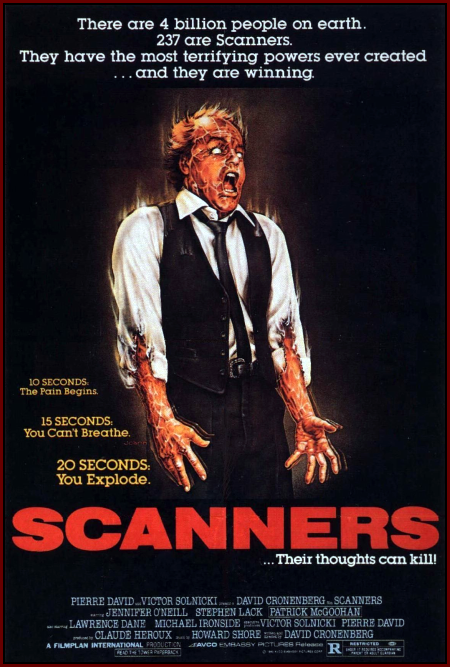
Scanners marks the emergence of David Cronenberg from low-budget horror auteur to one of the most unique voices in filmmaking of the last thirty or so years. He first came onto the scene directing such low-budget horror films such as Shivers, Rabid and The Brood. These three films were later said to have had that Cronenberg propensity to show the horror of the body-politic at its most basic. Cronenberg pretty much points out of how true horror might not be lurking on the outside, but within the the human body. Cronenberg makes the human body as forever changing and mutating against the individual person’s wants and desire of what was suppose to be the ideal. The horror that we as a people do not and will never have control over our own body was where the true horror lie.
In 1981, Cronenberg moves from the purely physical horror to one where the technology man was forever trying to create and achieve perfection would turn on the biological aspect of the human condition. This new form of techno-organic mutation was as terrifying as it was seductive in its potential to those afflicted with it. Cronenberg begins this phase in his filmmaking voice with his excellent, underappreciated and cult-classic Scanners.
The premise for Scanners had alot in common with Stephen King’s novel Firestarter in the fact that in dealt with an omnipresent and powerful organization: the CIA’s shadowy branch that dealt with experimental weapons programs for Firestarter and the ultra-powerful CONSEC multinational corporation in Scanners. These two organizations experiment on random select individuals using experimental drug treatments under the guise of helpful medications. What results from these experiments are more than what was truly expected by their handlers. In Scanners the result comes from mental abilities never seen or documented in the past. CONSEC’s experiments have yielded a unique group of individuals, 237 of them, to manifest powers of the mind that make them living weapons of mass destruction. Instead of becoming a new wonder-weapon for CONSEC to sell to their government contacts, these 237 become unstable in personality, some going as far as to develop a God-complex. Others are driven insane by these new abilities and retreat away from the rest of humanity in order to achieve a semblance of mental peace.
These two different reactions from the 237 are keenly represented by two of the main character’s in Cronenberg’s film. There’s Cameron Vale (played by Stephen Lack who had an eerie resemblance to the same named character of Stephen in Dawn of the Dead) who we first see as a vagrant who seems to be suffering from some sort of mental problem. This is farther from the truth as Dr. Paul Ruth (father of the CONSEC drug effemerol that causes the mutation and played with eccentric flair by Patrick McGoohan) soon discover that Vale’s mental problems is due to him possessing preternatural mental abilities of the highest order. Ruth’s guilt over what his experiments have done and created leads him to use Vale to counter the growing underground of those 237 who have seen their newfound abilities as a stepping stone to supplanting the normal status quo with their own in a plan of global domination that would make fans of X-Men very proud.
Leader of this underground groups of scanners (as the 237 were called) is one Darryl Revok. A scanner whose abilities rival those of Vale’s but whose mental instability for wanting to dominate the normals of the world makes him the most dangerous individual on the face of the planet. Genre veteran Michael Ironside steals the film from everyone else. His grand and classic introduction early in the film has gone down in filmmaking history as one of the most shocking scenes put on film. Ironside’s performance as the scanner with the God-complex was truly megalomaniacal and it was easy to root against him, but hard to take one’s eyes from the screen when he was on. Revok truly made for one of film history’s classic villains.
In the middle of Vale and Revok’s war for control lies Kim Obrist (played by the beautiful Jennifer O’Neill) who tries to lead those who just want to be left alone from being used by both Revok and CONSEC. O’Neill’s performance was the most grounded in reality, as much as a film about people with mental powers could be, and tries to keep the film from getting too fantastic.
This I think was what made Scanners such a great film. As ludicrous a premise as the film had to base its sotry on, there was always a sense of realism to keep everything form becoming too much like a comic book. The story paints a story that could happen in reality since similar things have occurred in the past such as the LSD testing on US military personnel during the 50’s and 60’s. Cronenberg plays on such fears of outside factors introduced by scientists looking to forever improve on what nature took eons to evolve. It’s this hubris about man’s attempt to dominate his own body which interests Cronenberg and what would happen if he did succeed in doing something nature and humanity wasn’t ready for.
Scanners marked Cronenberg’s interest in examining the effect of man’s quest for better and better technology, whether mechanical or biological, on humanity’s physical and mental existence. What he brongs forth, first with Scanners then later on with Videodrome and The Fly, was something both horrific and seductive. Who wouldn’t want to have such abilities as Vale and Revok had at their command. But by the end of Scanners the film posits the question of how much of one’s humanity must be sacrificed for such huge leaps on the evolutionary ladder. Will the resulting amalgamation of nature and technology still leave something human or just something that pretends to look like one.
Some have called Scanners a horror movie and some have called it a sci-fi thriller. It’s both those and more. It’s really hard to pin down just exactly which genre Scanners falls under since Cronenberg never tried to stay within one particular one. The film works as a thriller, as a science-fiction story, a horror flick and a philosophical exercise in examining the human condition. Cronenberg’s skill was clearly evident in keeping all these differing themes and genres from becoming out-of-place and bringing the finished product from becoming too flawed. Cronenberg’s first foray into this new phase of his filmmaking career ushered in what some have called Cronenberg at his most daring and pure. I wouldn’t argue with such an argument. Scanners is a film of great quality that would forever be used as an example of Cronenberg’s genius as a filmmaker.





 Through the Shattered Lens