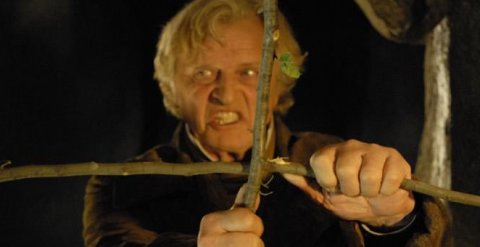
When Dario Argento’s Dracula 3D premiered at last year’s Cannes Film Festival, the reviews were almost universally negative.
But you know what?
I don’t care.
When it comes to a film like this, the critics don’t matter. Does anyone seriously think that any mainstream critic is going to give a film directed by Dario Argento a chance? No way. Film snobs hate Argento but even Argento’s worst films are usually more entertaining than anything Michael Bay has ever come up with.
What’s important is that Dracula 3D is a vampire film that’s coming out in October and, judging from the trailer, it appears that it will feature Rutger Hauer going overboard in that wonderful way that only Rutger Hauer can.
Dracula 3D will be in American theaters on October 4th. See you there!
Hi! Are y’all enjoying the Olympics? I’m not but I’m still occasionally watching them and asking myself questions like, “Why do male beach volleyball players actually get to wear clothes while competing?” and “Are there any countries other than America, Great Britain, and China competing this year?” Seriously, if you were just to judge from the coverage on NBC, it would appear that the USA is the only team competing in the majority of the events. It’s a bit unfair to those of us who, while American, are also proud of the fact that our ancestors came from Ireland, Italy, Spain, and Germany.
Therefore, this edition of Lisa Marie’s Favorite Grindhouse and Exploitation Film Trailers is dedicated to those countries that are being ignored by NBC (and probably the BBC as well). I’m talking about such worthy countries as Albania, San Marino, and especially the beautiful island republic of Chacal.
Here are 6 trailers for Team Chacal.
1) Gymkata (1985)
It’s not quite gymnastics and it’s not quite karate — instead, it’s Gymkata!
2) Jack the Ripper (1976)
From director Jess Franco comes a film that’s either about Jack the Ripper or the current Mayor of London, Boris Johnson.
3) Terrorgram (1988)
The name pretty much says it all.
4) Castle Freak (1995)
I can still remember this one on HBO when I was like 12 years old. It actually gave me nightmares, it was so scary!
5) Two Evil Eyes (1990)
I’ve been planning on seeing this movie for a while now. It was directed by both George Romero and Dario Argento!
6) Goldengirl (1979)
I’ve shared this one before but, with it being the Olympic season and all, I simply had to share this trailer again. Have you figured out her secret yet?
Much like Twilight, Deathmaster combines the true life crimes of Charles Manson with vampires. In this one, the Manson character is played by Robert Quarry. Speaking of which, did anyone see those pictures of the modern-day, incarcerated Manson that were released last week? I took one look at those and I went, “Santa Claus is really letting himself go.”
3) The Last Horror Film (1984)
Speaking of maniacs, this film reunited the two stars of the infamous movie of the same name, Caroline Munro and Joe Spinell.
4) Hercules (1983)
For the past month and a half, I’ve been watching Lou Ferrigno on The Celebrity Apprentice and, even though I’m rooting for Aubrey O’Day, it’s impossible not to like Lou. Here’s Lou starring as Hercules in a film from the infamous Luigi Cozzi. (I wanted to also include the trailer for Hercules In New York, the 1970 debut of Arnold Schwarzenegger but every single Hercules in New York YouTube video is embedding disabled. Bleh!)
5) Ironmaster (1983)
Yes, it’s yet another history lesson from the Joel Schumacher of Italian exploitation, Umberto Lenzi.
6) The Phantom of the Opera (1998)
Since it’s the holidays, let’s end with some Argento.
As I’ve mentioned before, Dario Argento’s Suspiria is one of my favorite horror films and any quick search around the Internet will reveal that I’m hardly alone in that. There’s a lot of reasons why Suspiria remains so popular: there’s Goblin’s iconic score, Jessica Harper’s performance in the lead role, and Dario Argento at the peak of his powers.
While most critics and fans always cite the film’s infamous “window scene” as its most effective set piece, I happen to think that the scene below is actually a bit more effective. While it’s certainly more low-key than some of the film’s other death scenes, this scene is the one that still leaves me uneasy no matter how many times I see it. Maybe it’s the way that Argento isolates the blind pianist in the middle of the square or perhaps it’s the way that he positions the camera in order to keep the audience uncertain of where exactly the true threat is coming from.
Then again, it could just be because I’m scared of dogs in general…
It’s time for the latest installment of Lisa Marie’s Favorite Grindhouse and Exploitation trailers and, continuing with October’s theme, they are once again all horror trailers. This week, I set out to prove that Argento’s a master and everything’s scarier in German. Let’s begin:
There’s no way I could possibly get through October without including at least one Friday the 13th trailer. I went with this one in order to specifically prove that everything’s scarier in German.
2) Paganini Horror (1989)
The trailer for this Italian horror film is in German as well and I have to be honest that, despite being a fourth German, I speak the language like not at all. Then again, considering that this is one of Luigi Cozzi’s films, it’s probably for the best that I can’t understand the trailer. All I know is that the killer’s mask is creepy and who doesn’t love Venice? Seriously, I went there the summer after I graduated high school and there’s no other place I’d more want to be stalked by Klaus Kinski. One more piece of trivia (and don’t quote me on this), I think that Cozzi may have attempted to sell this film as a part of Dario Argento’s Three Mothers trilogy.
Speaking of Dario Argento’s Three Mothers trilogy, here’s the U.S. trailer for the film that started it all, Suspiria. While you can probably guess that Suspiria is one of my favorite horror films, it’s also one of my favorite ballet movies as well. In fact, the ballet aspect of Suspiria is largely responsible for me discovering my love of Italian horror because, if not for the fact that it took place at a cursed dance academy, I doubt I would have paid as much attention to the movie the first time I saw it.
While Suspiria is definitely more fun, I still think that the second part of the trilogy — Inferno — is a better horror film. Seriously, the underwater sequence at the start of this film still freaks me out.
Twenty-seven years after Inferno, Argento finally concluded the trilogy with Mother of Tears. A lot of horror fans practically foam at the mouth going on and on about how much they hated this film. I happened to have enjoyed it. So there.
Continuing on the Argento theme, here’s a classic trailer for a classic film. George Romero may have directed the American version of Dawn of the Dead but the European version (known as Zombi) was put together by Argento and guess which one is superior? Anyway, this trailer is for the Romero version:
Suspiria is one of my favorite films for many reasons: the pre-Black Swan combination of horror and ballet, Dario Argento’s pop art-influenced direction, the infamous close-up of that beating heart, the “s is for snakes” conversation, and Alida Valli’s ferocious performance as the instructor from Hell. (That said, I would have gladly taken lessons from her because I think she would have inspired me to be more disciplined about dancing.)
And, of course, I love the music. As many critics have pointed out, the film’s soundtrack (composed by Goblin) provides this film with a structure that it might otherwise lack. Plus, it’s one of the few film soundtracks that’s actually scary if you listen to it around 3 in the morning with all the lights turned out. I speak from personal experience.
So, in honor of one of my favorite films of all time, today’s song of the day is Goblin’s brilliant Suspiria.
(The Suspiria soundtrack is apparently out-of-print in the U.S. However, it’s included in Anchor Bay’s 3-disc, 25th anniversary DVD. The DVD also comes with a featurette about the making of the soundtrack. It’s actually pretty interesting. Goblin’s Claudio Simonetti proves to be a charming and interesting interview subject.)
Early Friday morning, I found myself watching an old school made-for-TV movie, Doing Time On Maple Drive, on the Lifetime Movie Network. If you’ve heard of this film, it’s probably because it features a kinda young Jim Carrey in a supporting role.
Why Was I Watching It?
Because when it’s 3 a.m. and you’re getting hit by the old insomnia curse, what’s a girl to do put turn on the TV and change the channel to the Lifetime Movie Network?
What’s It About?
The Carters appear to be the perfect American family. They’ve got a beautiful house in the suburbs (on Maple Drive, no less), the children are all handsome and intelligent, the dad is a succesful businessman, the mom a perfect homemaker, and blah blah blah. You know how this is going to turn out already, don’t you? Dad is actually an overly competitive jerk, mom is in denial, the daughter is a neurotic mess, the youngest son is a closeted homosexual, and the oldest child is Jim Carrey. He’s also an alcoholic and he claims that his name is actually Tim but that doesn’t change the fact that he’s still Jim Carrey.
What Worked?
Tolstoy once said that all happy families are the same but that each unhappy family is unique. The family in this film is unique because — well, oh my God, how dysfunctional can you be? Not only do you have the judgmental parents and the alcoholic son but you’ve got the frigid daughter and the self-loathing gay son. Just using one of these stock characters would have made the film’s storyline seem familiar and predictable. However, tossing all of them into the mix and you’ve got an old school camp classic, complete with dramatic monologues, scary silences, and all the rest. Though this was originally made and shown by Fox, Doing Time On Maple Drive really does take the beloved Lifetime Family Drama formula to its most logical extreme.
The film is also pretty well-acted and features some familiar faces for those of us who love horror and exploitation films. For instance, the gay son is played by William McNamara who, if you’re an Argento fan, you may remember his extremely graphic death scene in Opera.
Making the film even more odd, McNamara’s character is engaged to Alison, who is played by Lori Loughlin, the mom from 90210. How often do you get to see a mix of Argento, 90210, and Jim Carrey on screen?
What Didn’t Work?
Jim Carrey! Don’t get me wrong, Jim did a good enough job playing his role but the whole time you’re watching the film, you keep thinking “that’s not Tim the alcoholic, that’s Jim Carrey.”
What’s ironic about that, of course, is that Jim Carrey is probably the only reason why anyone ever chooses to watch Doing Time On Maple Drive. Well, Jim Carrey and insomnia.
(As a sidenote, Jim Carrey had to deliver the line, “I’ve done my time on Maple Drive,” which, of course, meant I had to yell, “We have a title!”)
“Oh My God! Just Like Me!” Moments
During one dramatic moment, Alison tells her boyfriend, “What’s funny is a part of me always suspected you might be gay…” This line made me cringe just because I said the exact same thing to one of my ex-boyfriends once. He started crying. It was just kinda awkward.
I’ve been under the weather since the day after Christmas (and you probably don’t want the details though they can be found on twitter because my twitter account is my place to be all TMI) so I fear that I’ve been running behind when it comes to posting on this site. Not only have I not written my review of True Grit and Rabbit Hole, but I haven’t written anything about that video of the beaver opening up the box of tampons yet.
So, wyle ah work on gittin mah purty lil self all caught up here (and attempt to phonetically recreate my natural country girl accent), here’s the final 2010 edition of Lisa Marie’s Grindhouse and Exploitation Trailers.
I love how all the imported, soft-core films of the early 70s were always advertised as being sensitive, coming-of-age stories. Christina Lindberg later starred as the iconic One-Eye in Thriller, A Cruel Picture (a.k.a. They Call Her One-Eye.)
Yes, the trailer’s in German and no, I don’t speak German. I speak French which I guess means I’d have to surrender if this trailer ever tried to enter me. BUT ANYWAY, this is actually an Italian film. Tony Anthony plays a blind gunslinger who is hired by a bunch of mail order brides to free them from a sadistic bandit played by Ringo Starr. Yes, that Ringo Starr.
If, like my friend Elly, you live in Australia, you can watch this movie on DVD. Unfortunately, outside of “region 4,” this movie is unavailable. I’ve never seen it though I read about it in Bruce Dern’s quite frankly weird autobiography. (I say weird with affection because, seriously — how can you not love Bruce Dern?) Anyway, Dern says that in the sex scenes in this movie, he and Adams were actually doing it. Apparently, the film itself is a take-off on The Collector — Dern kidnaps Adams, covers her body in tattoos, and then has sex with her. It actually sounds like kind of a disgusting movie, to be honest and the prospect I might see it is making me reconsider my plans to eventually relocate to Australia (sorry, Elly).
As for the trailer, I just think it’s really nicely atmospheric, especially in the slow-motion sequence at the beginning.
This is the old school slasher film that I always wish I had been around to be cast in. Why? Because of all the costumes, of course! If you’re going to be a victim in one of these movies, you might as well get to play dress up beforehand.
There are two trailers for this movie. This is the mainstream version and it is a heavily cut — and I mean HEAVILY CUT — version of the one that played in the grindhouses. You can find the uncut version on Stephen Romano’s Shock Festival. Anyway, this is one of those wonderfully satirical 70s films that was marketed as a standard grindhouse film. William Smith plays an FBI agent who is sent to Peckham, California to discover why the town’s men are being fucked to death. Actually, just looking at the men of Peckham, California — they should probably be happy with what they can get.
What better way to end 2010 than with the one and only Dario Argento? This is the trailer for his first worldwide hit, the classic giallo Deep Red. This is also the film where he first met and romanced Daria Nicolodi. Plus, this movie probably features the best performance ever from the late and underrated David Hemmings (who would end his career playing a small role in Gangs of New York, a film which also features Giovanni Lombardo Radice.)
As a sidenote, I’ve really enjoyed sharing these trailers through 2010 and I look forward to sharing more in 2011. Je te donne tout mon amour, mon lecteur.
The Italian horror cinema scene has always been dominated by such names as Mario Bava, Dario Argento and Lucio Fulci. Their films became Italy’s contribution to horror cinema and one cannot find a fan of the genre who don’t hold these three gentlemen in high regard. Other names of the Italian horror scene were not as well-known beyond the most hardcore horror fans and some just don’t deserve to be in the same company as the previously mentioned trio. One filmmaker who should be part of their company is one Michele Soavi. He rose through the ranks as an actor at first before moving on to becoming assistant directors for mentors such as Joe D’Amato and Dario Argento. The latter would become a major influence in Soavi’s work and would help produce some of his films. One of those Argento would end up producing for Soavi is the 1989 supernatural horror film, The Church (known in Italy as La Chiesa).
The Church wasn’t one of Soavi’s best films, but it was still one of the better horror films to come out of Italy during the waning years of the 80’s when Italian horror began a slow decline. Starring a very young Asia Argento (hard to believe that a career which began with reports of nepotism would turn out to be a successful one in and out of Italy) and an Italian-American actor named Tomas Arana (people would know him best as the ambitious Quintus in Ridley Scott’s Gladiator), the film starts off with a cohort of Teutonic Knights who destroy and kill a town suspected of witchcraft. The bodies of all killed soon get dumped into a mass grave and sealed with a huge metal cross and prayers to keep the evil that was done from ever coming out.
The beginning does have a somewhat ambiguous tone to it as we the audience don’t know if the villagers were indeed evil. Soavi definitely leaves that up in the air until the final third of the film kicks in and most of the horror scenes appear to satisfy gore fans. The knights destroying the village was well-staged and executed with some cool kill-scenes and effects.
It’s the middle reel where the film slowed down to the point that could lose the more casual horror fan. We get the usual non-believer researcer (Arana) who stumbles upon the ancient cross sealing the mass grave beneath the church that had been built over it down the centuries. Even this researcher and another knows that they should leave it alone, but being the scientists one of them proceeds to unseal the find with the reasoning that pursuit of knowledge should triumph over supersitition. Thus, the church becomes the scene of demonic possessions of various individuals. First, the initial researcher who opens unseals the cross then the parents of Asia Argento’s character before moving on to churchgoers who become trapped in the church after some demonic force seals all exits.
The rest of the film once that church seals itself is one person either getting killed by those possessed by the demons escaping from the sealed grave or someone getting possessed. This third act actually has a touch of Fulci’s nightmarish-style and less of Argento’s more dream-like quality. There’s a beautiful scene of Tomas Aranas’ character made-up to be some verdigrised-bronze angel statue, wings and all, embracing a very naked young woman that looked straight out of a Luis Royo painting. Another scene where regular Soavi actor Barbara Cupisti was shown in sexual congress with a demonic being that should give more than a few people nightmares despite being framed and shot in a beautiful manner.
The final nightmare scene of beauty which pushes The Church over into Fulci territory is when a mass of naked, muddied bodies of all those possessed entwine and writhe to form the likeness of a demon’s head. This sequence alone was worth watching through the much slower middle section of this film and Soavi’s eye for staging and lighting the scene made it look like something out of the pages of Dante Alighieri’s Divine Comedy.
One could say that The Church just didn’t live up to the usual quality one expected out of a Michele Soavi film after a he made the excellent giallo-slasher film Stage Fright just two years prior. This second full-lenght feature by Soavi showed him still honing his talent as a filmmaker which would finally culminate five years later in one of the best Italian horror films and one of the best films in the zombie subgenre with his Dellamorte Dellamore. Plus, even when he’s not on top of his craft like with The Church it is still worth a watch and better than the stuff released by his contemporaries like Bruno Mattei.
Halloween is less than a week away and for the next few days there’ll be more song of the day choices and this time around it will all be centered on horror. To start things off I chose the theme from George A. Romero’s Dawn of the Dead which was composed by the Italian prog-rock band Goblin.
The theme’s titled “L’alba Dei Morti Viventi” and it definitely creates a dissonant tone which just creeps along and makes one feel more than just a bit uncomfortable. Goblin used a lot of their electronic music background to make this such a signature and iconic horror theme. Anyone who has seen the original Dawn of the Dead will automatically recognize this theme and the feeling it brings up. A feeling of dread and of creeping horror which perfectly describes the zombies from Romero’s grand opus.
Horror fans everywhere have Italian horror maestro Dario Argento for having gotten Goblin to create the score for Romero’s film (Argento was one of the key producers for the film and even re-cut it for the European market). Goblin had already worked with Argento on previous films with their best early work with the filmmaker being the score for ProfondoRosso (known as Deep Red in the US and English market). But no matter how many other Italian horror scores the band has made since Dawn of the Dead (and the ones after have been great in their own right) it will be their score for that film which will indelibly link the band in film music history.
PS: as an added bonus below is the band’s theme for Argento’s Profondo Rosso.