The TSL’s Grindhouse: Space Mutiny (dir by David Winters)


“Arggggh!”

— Dave Ryder (Reb Brown) in Space Mutinty (1988)

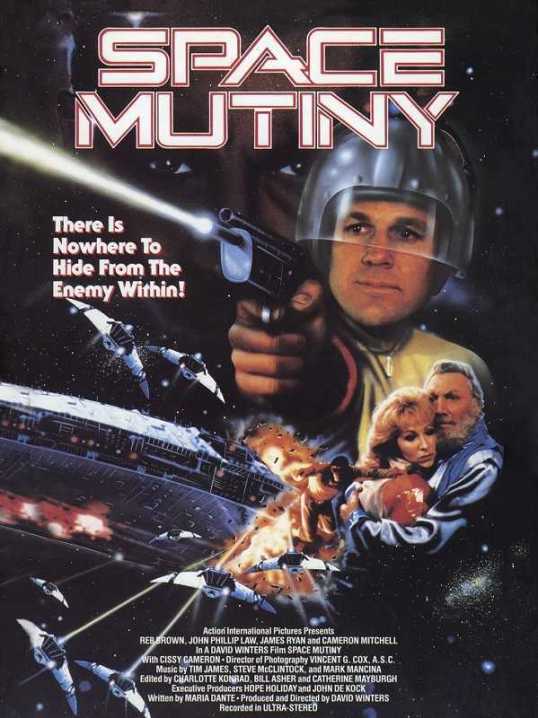
Space Mutiny, a sci-fi epic from 1988, is full of dialogue about all sorts of political and philosophical concerns but none of it is quite as memorable as the quote above.  Dave Ryder says, “Argggggh!” a lot over the course of Space Mutiny.  He’s the newly appointed head of security for the Southern Sun, a gigantic spaceship that has spent the last 260 years traveling from Earth to a new planet.  Being head of security is important because there are some people on the Southern Sun who are plotting a mutiny.  Dave Ryder decides that the most effective way to battle the mutineers is to yell loudly and frequetly.  “ARGGGGGH!’ Ryder yells whenever he’s being shot at.  “ARGGGGGGGH!” he screams when he finds himself on a very slow and gradual collision course with the head of the mutineers.

When Dave isn’t saying stuff like, “Argggggh!,” he’s saying stuff like, “Go!  Go!  Go!”  When the bad guys open fire on him and his men, it’s time for them to “Go!  Go!  Go!”  When the mutineers are being chased, Dave is quick to tell everyone to “Go!  Go!  Go!”  He’s like the physical fitness trainer from Hell.  He never actually yells “Feel the burn!” but you can be damn well sure that he’s thinking it.  In fact, there’s a point in the movie where “Feel the burn!” actually would have been a good line.  Dave and his girlfriend, Lea (Cissie Cameron), set a mutineer on fire.  It’s actually a bit of a sadistic scene and it doesn’t come across as being the big hero moment that it’s obviously meant to be.  But, then again, Dave isn’t yelling because he’s a nice guy.  He’s yelling because he’s played by Reb Brown.  Reb Brown yelled all the way through Strike Force Commando.  Why wouldn’t he do the same for Space Mutiny?

Of course, Dave isn’t the only person barking out orders on the Southern Sun.  Cameron Mitchell plays the ship’s captain, a wise old man who looks like Santa Claus.  John Phillip Law is Kalgon, the main mutineer.  He laughs a lot.  Cissie Cameron is the captain’s daughter.  She falls for Ryder, despite the fact that she appears to be old enough to be Ryder’s mother.  (In real life, Reb Brown and Cissie Cameron are married and Cissie is only a few years older than Reb.  In Space Mutiny, she’s stuck with an unflattering hair style and is made up to look like an aging cheerleading coach.)  There’s also a woman who works on the ship’s bridge.  She’s killed in one scene, just to mysteriously turn up alive in the scene that follows.  In space, no one can hear the script supervisor.  Finally, there’s a group of alien witches who board the ship and spend the entire movie dancing in front of a ball of electricity.  Since they don’t actually interact with any of the main characters, it’s obvious that they were added to pad out the film’s running time.

One of the more interesting things about Space Mutnity is that Kalgon actually has a point.  It does seem kind of stupid to spend several hundred years traveling to just one planet when there’s other planets nearby that the ship could just as easily reach.  Indeed, the mission of the Southern Sun never makes that much sense and the Captain seems to be delusional in his insistence that it does.  The Captain’s unending faith and his long-flowing beard makes him come across like a minor biblical prophet, the type who always had to ask a major prophet to interpret his visions for hm.  The Captain does not come across like someone who really knows what he’s doing.  I don’t care how much Ryder screams, Kalgon had a point!

Today, Space Mutiny is best known for being featured on an episode of Mystery Science Theater 3000 and for later being taken apart by the Rifftrax crew.  Space Mutiny, though, is such an extremely silly movie that you really don’t even need any professionals to help you snark your way through it.  The film offers up such a treasure trove of material then even the most humorless among your friends will be a comedic genius by the time it ends.  It’s a fun movie, made even more so by the fact that the filmmakers apparently meant for the film to be taken seriously.  There’s a lot of talk about important issues like freedom, duty, and faith.  In the end, what you’ll remember is the screaming.
6 Classic Trailers For January 8th, 2022


Since this week started with Sergio Leone’s birthday, it only seems appropriate that today’s edition of Lisa Marie’s Favorite Grindhouse Trailers should be dedicated to the Western.  Here are 6 classic Spaghetti western trailers!

  1. The Good, the Bad, and the Ugly (1966)

It only makes sense that we should start things off with a trailer from a Leone film and it makes further sense that film should be The Good, The Bad, and the Ugly.  It’s all here, from the classic Ennio Morricone score to the unforgettable staring contest between Clint Eastwood, Lee Van Cleef, and Eli Wallach.

2. Sabata (1969)

While Clint Eastwood was able to use his appearances in Leone’s westerns to restart his American film career, Lee Van Cleef remained in Italy.  After playing the villainous Angel Eyes, Van Cleef played the hero Sabata.  This trailer is very, very 60s.

3. Django (1966)

Franco Nero never appeared in a Sergio Leone film but he was a favorite of the famous “other Sergio,” Sergio Corbucci.  In Corbucci’s Django, Nero played the haunted title character, making his way across the west with a deadly coffin.

4. Django Kill (1967)

Django was such a hit that a number of other films were made about other haunted, amoral gunslingers named Django.  Whether or not they were all the same Django was left to the audience to decide.  In Django Kill, Tomas Milian played the title character and found himself in a surreal hellscape, surrounded by people who were obsessed with gold.

5. The Great Silence (1968)

The Great Silence was one of the greatest of the spaghetti westerns, featuring Klaus Kinski in one of his best and most villainous roles.  Unfortunately, like many of the better spaghetti westerns, it initially did not get a proper release in the States.  Fortunately, it has since been rediscovered.

6. Once Upon A Time In The West (1968)

And finally, to close things out, here’s one last Sergio Leone trailer.  Sadly underappreciated when first released, Once Upon A Time In The West has since come to be recognized as a masterpiece.

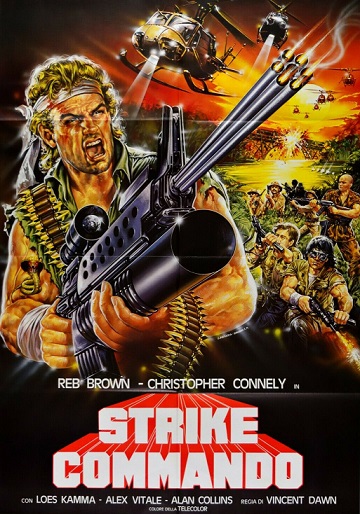
The TSL’s Grindhouse: Strike Commando (dir by Bruno Mattei)


“American,” a young Vietnamese refugee says to Sgt. Mike Ransom, “tell me about Disneyland.”

Ransom tells him all about Disneyland, a magical place where, according to Rasom, the trees are made of ice cream and genies pop out of lamps.  Ransom breaks down in tears, sobbing as he realizes that his friend will never get to experience Disneyland firsthand.

Years later, Ransom is in Manila, blowing up a former American military officer who gave aid to the communists.  “DIE!  DIE!” Ransom shrilly yells as the man literally explodes in front of him.  And while the man may not have been one of the good guys and he did a lot of bad things during the Vietnam War, it’s hard not to feel that Ransom’s attitude would get him banned from Disneyland.  Not even the ghost hitchhikers at the Haunted Mansion would want to accept a ride from the “Die!  Die!” guy.

That Mike Ransom, he’s a complicated man.  As played by Reb Brown, he’s also at the center of the 1987 Italian film, Strike Commando.  As you can probably guess from the film’s title, he’s the leader of an elite squad of soldiers, a team of strike commandoes who are determined to lead America to victory during the Vietnam War.  We’re continually told that Ransom is the best, though we don’t see much of evidence of it.  He’s the type of commando who specializes in sneaking behind enemy lines and hitting the communists before they even realize he’s there but he’s so bulky and loud that it’s hard to imagine that he’s ever been able to successful sneak around anywhere.  He has a particularly bad habit of shrilly screaming every word that he says.  Even when he’s not telling people to die, he’s yelling.  He’s like the athletic coach from Hell.

In fact, as I watched Strike Commando, I started to wonder what it would be like to live next door to someone like Mike Ransom.

“Hi, Mike, are you doing okay?”

“I’M DOING GREAT!  GREAT!  GREAT!”

“Any plans for the day?”

“I’M MOWING THE LAWN!  MOWING!  MOWING!  MOWING!”

“I think I’ve got some mail for you that accidentally left in my mailbox….”

“THE POSTAL SERVICE LIED!  LIED!  LIED!  LIED!”

At first, living next door to Mike Ransom would probably be entertaining but I imagine it would get kind of boring after a while.  Yelling can be an effective way to express yourself but it loses its power if that’s the only thing you ever do.  The same can be said for Strike Commando as a film.  It gets off to a good start, with several extremely over-the-top action sequences and, of course, Mike telling a little refugee child about Disneyland.  But the second half of the film, which involves Mike being held in a POW camp and meeting a fearsome Russian torturer named Jakoda, drags a bit because there’s only so much time you can listen to Ransom yell before you start to tune him out.  It doesn’t help that the second half of the film features some particularly nasty torture scenes.  Still, it is somewhat redeemed by a scene where the Viet Cong attempt to force Ransom to broadcast a propaganda message over their radio station.  “KEEP FIGHTING!” Ransom yells into the microphone.  Hell yeah! You tell ’em, Ransom!

Strike Commando was directed by Bruno Mattei, an Italian exploitation filmmaker who was never one to just turn things up to ten when he could turn them up to 11 instead.  Strike Commando was obviously meant to capitalize on the success of the Rambo films.  In typical Mattei fashion, the action is over-the-top, nonstop, and more than a little silly.  Mattei was never shied away from embracing excess and Strike Commando has everything that you would expect from one of his war films: lots of stuff blowing up, heavy-handed use of slow motion, and plenty of grainy stock footage.  You have to admire Mattei’s dedication to always finding something for Reb Brown to yell about.

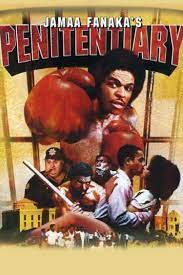
The TSL’s Grindhouse: Penitentiary (dir by Jamaa Fanaka)


In the 1979 prison/blaxploitation film Penitentiary, everyone gets a nickname.

For instance, the main character, played by Leon Isaac Kennedy, may be named Martel Gordone but everyone calls him “Too Sweet,” because he’s addicted to Mr. Goodbar candy bars.  Just because Gordone has been sent to prison for a murder that he didn’t actually commit, that’s not going to stop him from going out of his way to eat all the candy that he can.  Fortunately, all that candy has not effected his ability to throw a punch or win a fight because this prison is obsessed with boxing.

Too Sweet’s first cellmate is known as Half-Dead (Badja Dola).  Half-Dead got his name because he’s already dead on the inside.  At least, that’s what I assume the nickname means.  It could also mean that, if you find yourself sharing a cell with him, you’re already as good as dead.  Half-Dead is violent and sadistic and when he feels that Too Sweet isn’t showing him enough respect, Half-Dead attacks.  After an extremely long and grueling fight (one that is made all the more intense by the fact that it’s taking place in a cramped cell), Too Sweet succeeded in kicking Half-Dead’s ass.

Seldom Seen (Floyd Chetman) is Too Sweet’s second cellmate.  Seldom Seen is …. well, he’s seldom seen.  He has spent 50 of his 65 years in prison.  Seldom avoids all of the prison drama and instead, he spends his time in his cell, reading books while sitting in front of a poster of Malcolm X.  Seldom Seen, it turns out, used to be a boxer and, when Too Sweet decides to enter the prison boxing tournament, Seldom Seen not only serves as his trainer but also as his mentor.

Jesse “The Bull” Amos (Donovan Womack) is also entering the boxing tournament.  Jesse is know as the Bull because he’s big, he’s tough, and he never stops coming after his opponents.  He becomes angry when Too Sweet encourage the Bull’s cellmate, “Genie” (Thommy Pollard), to stand up for himself and to not let any man treat him as being “property.”  The Bull wants revenge.

Of course, there’s more to the prison boxing tournament than just getting revenge.  Win a fight and the warden will allow you an entire week of conjugal visits.  Win the tournament and you’ll get early parole and …. wait, a minute, what?  I’m all for emptying the prisons and giving people second chances but I’m pretty sure that’s not how parole works.  Oh well, it’s a movie, right?

Penitentiary was directed by Jamaa Fanaka, who also directed the very first film that I ever reviewed for this site, Welcome Home Brother Charles.  Like Brother Charles, Penitentiary is a film that is obsessed with the idea of being a prisoner of not just the legal system but also of society as a whole.  Too Sweet doesn’t just learn how to box.  He also learns, from Seldom Seen, that the key to being the “freest man in the world” is to learn how to control your desires and to exercise the self-discipline necessary to make something of yourself.  Penitentiary never quite reaches the lunatic heights of Welcome Home Brother Charles, of course.  Penitentiary is a far more straight-forward film.  Welcome Home Brother Charles featured the title character using his penis to strangle his enemies.  In Penitentiary, Too Sweet is content to just beat them up in the boxing ring.

Penitentiary gets off to a strong start.  Leon Isaac Kennedy gives a likable performance as Too Sweet and the initial fight between Too Sweet and Half-Dead is handled well.  Surprisingly enough, it’s during the boxing scenes that the film starts to run out of energy.  The boxing matches go on forever and Fanaka gets bogged down with repetitive scenes of prisoners ducking into a prison restroom to get it on while the guards are distracted by the fight.  The film’s narrative momentum stalls out long before the inevitable match between Too Sweet and the Bull.  For all the build-up, the final fight turns out to be oddly anti-climatic.

Penitentiary has some strong moments but it doesn’t really come together as a whole. Still, it did well-enough at the box office that Fanaka would go on to direct two increasingly surreal sequels.

6 Classic Trailers For January 1st, 2022


Well, it’s the first day of a new year and that means that it’ time for me to bring back a feature that was once quite popular on this site, Lisa Marie’s Favorite Grindhouse and Exploitation Film Trailers.  This is where I just share six trailers, sometimes all dealing with the same thing and sometimes not.  Unfortunately, because there’s only so many trailers available on YouTube, you’ll probably see a few trailers listed more than once.  It can’t be helped but no matter!  Trailers are fun and hopefully, watching a few of them will be an enjoyable way for you to start your day or your week or whatever.  I certainly enjoy them!

Since it’s the start of a new year and I already shared a music video for The Hustle, I figured I would continue that disco theme now.  Below are 6 trailers that will hopefully leave you dancing!

  1. Thank God It’s Friday (1978)

Considering that this film won an Oscar and was released by a major studio and featured both Jeff Goldblum and future Oscar nominee Debra Winger in the cast, it may seem odd to include this trailer in a feature about exploitation film previews.  But seriously, just watch the movie!  Yes, Last Dance is great but otherwise, this movie is pure drive-in gold.

2. Skatetown USA (1979)

“The greatest story ever rolled!”  Check out Patrick Swayze, playing a bad guy.  Swayze made his film debut here and, when he became a star, he actually tired to buy the rights to the film to keep anyone from ever seeing it again.  Honestly, though, it’s not that bad.  The music’s good.  Some of the routines are fun.  Swayze smolders with intensity.  Put on your skates and dance!

3. Roller Boogie (1979)

At the same time that Patrick Swayze was dominating Skatetown USA, Linda Blair was teaching a nation how to roll, dance, and love.

4. Disco Godfather (1979)

Of course, the disco wasn’t always a safe place.  Even in the 70s, it was a dangerous world out there.  Fortunately, Rudy Ray Moore was around to keep the peace and prevent the dancers from getting hooked on PCP.  “Put your weight on it, put your weight on it, put your weight on it!”

5. Can’t Stop The Music (1980)

You can’t stop the music …. no matter how much you try!  This was an attempt at a Village People movie.  It apparently didn’t really go very well.  I’ve never actually seen the film, though I suppose I’ll have to watch it someday.

6. Xanadu (1980)

Heh …. on YouTube, this is listed as being “A Gene Kelly movie.”  Yeah, Gene Kelly is one of the stars but I still don’t know if I’d necessarily call this “A Gene Kelly movie,” in the same way that I might use the label for Singin’ In The Rain or An American In ParisXanadu was one of the last of the big disco movies and it’ll live forever, though perhaps not in the way that it was originally intended to.

Lisa Marie’s Grindhouse Trailers: 12 Trailers For Halloween


For today’s Halloween edition of Lisa’s Marie Favorite Grindhouse Trailers, I present to you, without comment, the trailers for my 12 favorite horror movies.

Happy Halloween!

  1. The Shining (1980)

2. Suspiria (1977)

3. A Field in England (2013)

4. Night of the Living Dead (1968)

5. Zombi 2 (1979)

6. The Exorcist (1973)

7. Halloween (1978)

8. Two Orphan Vampires (1996)

9. Near Dark (1987)

10. Scream and Scream Again (1970)

11. Horror of Dracula (1958)

12. Messiah of Evil (1973)

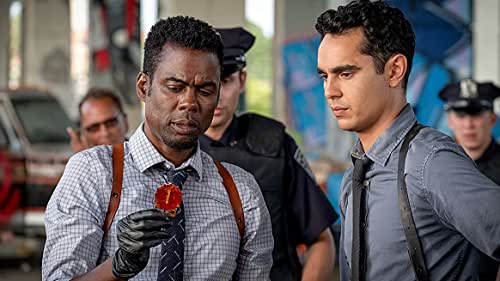
The TSL’s Grindhouse: Spiral: From the Book of Saw (dir by Darren Lynn Bousman)


I can imagine the pitch sessions for Spiral: From The Book Saw.

“What do people really like the Saw movies?”

“The Jigsaw Killer!”

“Right!  So let’s make a Saw movie without the Jigsaw Killer.  What else do people like about the Saw movies?”

“The gory but clever torture scenes!”

“Right!  So, let’s only have a few torture scenes that are gory but not particularly clever.  What else would make this a good Saw film?”

“A star in the leading role!”

“Right!  So, let’s cast a comedian who is a notoriously terrible actor.”

“YAY!”

Anyway, Spiral features Chris Rock as a hard-boiled homicide detective who spends almost the entire movie with a scowl on his face.  He does make a few jokes but they’re all of the “This is a New Jack city!” variety.  Rock is living in the shadow of his wildly popular police chief father, played by Samuel L. Jackson.  Rock is a tough cop who does things HIS WAY!  And he can’t trust anyone else on the force because he’s just so honest.

Spiral does not feature Tobin Bell, though we do briefly see a picture of him when someone mentions that the latest round of murders seem like they may have been committed by a Jigsaw copycat.  The thing with copycats is who cares?  They can’t even come up with an original idea.  They have to copy another killer.  I mean, there’s a lot of movies about killers in the woods but people remain loyal to Jason Voorhees because he was the original.  Just like with Halloween. Every reboot, except for the third one, has featured Michael because without Michael, who cares?  You can lose everyone else but Michael, and how people react specifically to Michal, is what the franchise revolves around.  So, with Saw, if Jigsaw is not there …. WHO CARES!?

Listen, I don’t even like the Saw movies but even I was annoyed by this film’s lack of Jigsaw.

Anyway, it’s a dumb movie.  It tries for a bit of political relevancy by making almost all of the victims crooked cops but it’s like Defund Copycat Serial Killers, not the police.  Chris Rock and his new partner are investigating all the murders and Rock tries so hard to give a convincing performance that it becomes painful to watch.  Seriously, if you’re good at comedy, do comedy.  Be proud of it because a lot of people are not good at comedy.  If playing a dramatic character is that much of a struggle for you, don’t do it.  That’s why we’ve got actors like …. uhmmm, that guy who was in that really dramatic movie, whatever it was called.  It was really good and dramatic.  He would have been good for the lead in Spiral.  Actually, Ethan Hawke would have been good as the lead too.  Or maybe Denzel Washington.  But good luck getting them to agree to be in a Saw movie that doesn’t feature Tobin Bell.

Anyway, Spiral was pretty disappointing.  Chris Rock is funny and likable in comedies so maybe that’s what he should stick with for now.  Leave the dramatic crime stuff to the cast of the latest Dick Wolf show, y’know?  And if there is another Saw movie, Jigsaw better come back to life because otherwise, what’s the point?

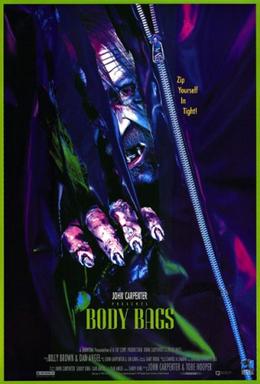
The TSL’s Grindhouse: Body Bags (dir by John Carpenter and Tobe Hooper)


An odd but mildly likable film, that’s the best description of Body Bags.

Originally, Body Bags wasn’t even meant to be a film.  Instead, in 1993, Showtime wanted to do a horror anthology show, one that would mix comedy and chills in the style of HBO’s Tales From The Crypt.  Three episodes were filmed.  Two were directed by John Carpenter.  The other was directed by Tobe Hooper.  Robert Carradine, Stacy Keach, and Mark Hamill all agreed to appear on the show.  That’s an impressive collection of talent but, for whatever reason, Showtime decided not to pursue Body Bags as a series.  So the three episodes were strung together in an anthology film.  Linking the stories was a warp-around segment where Carpenter played a coroner and Tobe Hooper and Tom Arnold played morgue attendants!

Now, it must be said that John Carpenter probably made the right decision when he decided to become a director instead of an actor.  That said, what Carpenter lacked in acting technique, he made up for with unbridled enthusiasm.  Carpenter appears to be having a blast playing an old style horror host.  Who can blame him?  In fact, I would say one the most appealing things about John Carpenter as a personality is that he always seems to be truly enjoying himself, regardless of all the crap that he’s had to put up with in Hollywood.

As for the segments …. well, they’re uneven.  That’s not really a shock. Part of the problem is that, because they weren’t originally envisioned as all airing together, a lot of ideas and story points are repeated from segment to segment.  The first segment is about a serial killer.  The second segment is about a transplant.  The third segment is about both a transplant and a serial killer.  It gets a bit repetitive.

Carpenter directed the first two segments, The Gas Station and HairThe Gas Station is a bit too simple for its own good.  Robert Carradine is a serial killer who harasses a woman at a gas station.  That’s pretty much it.  Carradine gives a good performance ad Halloween fans will get a laugh out of a reference to Haddonfield but there’s not much else going on.  Hair is a bit better.  Stacy Keach plays a businessman who gets a hair transplant, just to discover that the hair is extraterrestrial in origin.  Hair is clever and playful, like an above average episode of The Twilight Zone.  Keach plays his role with the right mix of comedic outrage and genuine horror.

The third segment is called Eyes and it was directed by Tobe Hooper.  Mark Hamill plays a baseball player who is losing his eyesight as the result of a car accident.  He gets an eye transplant.  At first, everything seems fine but soon, he’s having visions of himself murdering people!  It turns out that the eye once belonged to a serial killer.  You can guess where this is going but Mark Hamill really throws himself into the role and Tobe Hooper’s direction is appropriately intense.

Body Bags is a pretty minor entry in the filmographies of two great directors but, at the same time, it’s enjoyable in its own silly way.  There’s a likable goofiness to John Carpenter’s wrap-around segment and it lets us know that we shouldn’t take any of this too seriously.  Watch it for your own amusement.

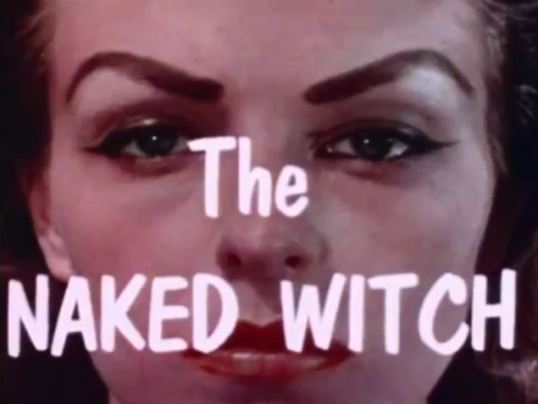
The TSL’s Grindhouse: The Naked Witch (dir by Larry Buchanan)


The 1964 film, The Naked Witch, opens with a prologue that explains the role of witchcraft throughout the ages. That, in itself, is not surprising. A lot of supernaturally-themed films opens with a prologue that’s designed to give the film some sort of historical basis. It’s one of the oldest tricks in the book. Give your cheap film some credibility by claiming that it’s “based on a true story.”

What sets The Naked Witch apart is that the prologue just goes on and on. For ten minutes, we stare at Bosch paintings while an officious sounding narrator discusses the history of witchcraft. The paintings are effectively macabre but it all goes on for so long that you can’t help but get the feeling that the prologue was mostly added to pad out the running time. It’s almost as if director Larry Buchanan was basically admitting that he didn’t really have enough of an actual story to justify a feature-length running time. Of course, this shouldn’t come as a shock to anyone who is familiar with Larry Buchanan’s filmography.

Once the narration finally ends, we find ourselves watching The Student (Robert Short) as he drives through central Texas. The Student suddenly takes over the narration, telling us that he’s driving through the Texas German Counties. He’s visiting towns and counties that were founded by German settlers. The townspeople all have German names. Most of them still speak German in private. They all dress like they’ve just returned from a night at a Munich beer hall. Interestingly enough, these counties and towns do actually exist, though I’ve never seen anyone casually wearing lederhosen or a dirndl in Central Texas. Of course, this film was made a bit before my time so maybe that used to be a tradition back in 1964. Maybe people stopped doing it after The Naked Witch came out. Or, even more intriguingly, maybe people stopped doing because The Naked Witch came out. We’ll probably never know for sure.

Anyway, the Student is kind of an idiot because he manages to run out of gas while driving out in the middle of nowhere. I guess it didn’t occur to him to fill up the tank before trying to drive through a largely empty stretch of land. Leaving his car behind, he manages to walk to the real-life town of Luckenbach, Texas. He’s shocked to discover the none of the townspeople want to talk about long-dead witch that was supposedly buried in town. Why, it’s almost as if the people of Luckenbach understand that it’s not a good idea to brag about living under the threat of a supernatural curse.

Largely due to the Student’s stupidity, the Witch (played by Libby Hall) comes back from the dead. She’s naked, which I imagine was probably the film’s main selling point back in 1964. The Witch wants revenge on the descendants of the people who put her to death. The Students just wants to hook up with The Witch.

And that’s really pretty much it. Even by the admittedly low standard set by Larry Buchanan’s other films, the plot of The Naked Witch is pretty much impossible to follow. It’s incoherent and yet, strangely enough, that incoherence sometime works in the film’ favor. The atmospheric Texas landscape, when combined with the overly theatrical performance of Libby Hall, gives the film a dream-like feel. Even the fact that the film features three separate narrators all contribute to the movie’s surreal style. At its best, The Naked Witch is an existential mood piece. At its worst, it’s just a really bad, zero-budget drive-in movie.

The Naked Witch is an odd film but, if you’re looking for a ten minute history on witchcraft followed by a Texas travelouge, the film might be for you.

The TSL’s Grindhouse: Parents (dir by Bob Balaban)


An odd little film, 1989’s Parents is.

It takes place in the 50s of the pop cultural imagination, with neatly laid out suburban neighborhoods and perfectly mowed lawns and big cars driving down the street.  Nick (Randy Quaid) and Lily (Mary Beth Hurt) seem like the perfect couple.  Lily stays at home and spends a lot of time in the kitchen.  Nick is an engineer who works for a company called Toxico and who is helping to develop what will become known, during the Vietnam War, as Agent Orange.  Nick and Lily are friendly, well-mannered, and they love to eat meat.  Lily explains, at one point, that she didn’t really love to eat meat until she married Nick and he showed her how wonderful it could be.

Their son, ten year-old Michael (Bryan Madorsky), is a bit less conventional.  He’s a quiet boy who never smiles and who, when asked to draw a picture of his family, freaks out his school’s guidance counselor (played by Sandy Dennis).  Michael has frequent nightmares.  Michael doesn’t like to eat meat and, in fact, it’s hard to think of a single scene in the movie where Michael is seen eating anything.  Michael is haunted by the sight of his parents making love in the living room.  He’s also haunted by a growing suspicion that his parents are cannibals.

Are they?  Perhaps.  It’s hard to say.  The first time you watch the movie, it seems deceptively obvious that Nick and Lily are exactly what Michael says they are.  The second time, you start to notice a few odd things.  For one thing, we never see Michael actually going from one location to another.  Instead, he just seems to magically show up wherever he needs to be to hear something that will confirm his suspicions.  When his teacher and his guidance counselor discuss his home life, Michael just happens to be in a nearby closet.  When his mother is preparing something that looks like it might be a human organ, Michael just happens to be standing in the pantry.  Are we seeing reality or are we just seeing what Michael thinks is reality?  When Nick starts to threaten Michael and later claims that there’s no way Michael is his son, is he really saying that or is Michael just imagining his fatherr confirming all of Michael’s insecurities?  How much of the film is real and how much of it is in Michael’s head?

It’s an odd film, Parents.  It’s also the directorial debut of character actor Bob Balaban.  Balaban has spent the majority of his career playing shy, slightly repressed characters.  Parents, with the withdrawn Michael as the main character, is a film that feels autobiographical.  That’s not to say that Balaban’s parents were cannibals but the scenes where Nick goes from being a loving father to an abusive monster are too intense and suffused with too much pain for them to be anything other than personal.  Balaban’s direction is heavily stylized.  At times, it’s a bit too stylized but ultimately, it works.  The final 30 minutes of the film feel like a nightmare that has somehow been filmed.

A satire of conformity and suburbia, Parents is also a portrait of an alienated child struggling to figure out where he fits into his family.  He’s given the choice of either indulging in his family’s sins or living life alone.  Except, of course, it really isn’t a choice.  Nick expects Michael to do what he’s been told, no matter what.  Randy Quaid and Mary Beth Hurt are both terrifying as the parents but, at the same time, Balaban makes good use of the fact that both of those performers — at least at the time this movie was made — were naturally likable.  You want Nick to be the perfect father that he pretends to be and you share Michael’s anger and disillusionment when he turns out to be something very different.

Parents may be a strange film but it’s not one that you’re going to forget.