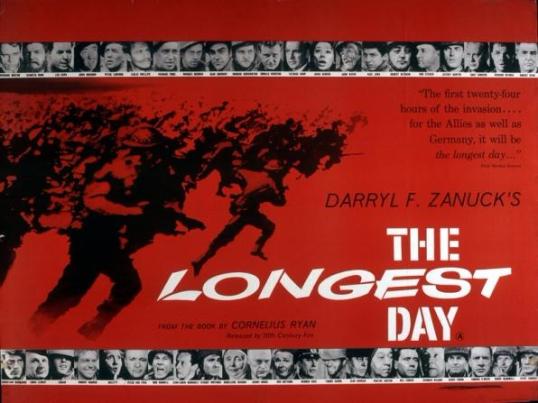
Quick Review: The Longest Day (dir. by Ken Annakin, Andrew Marton, and Bernhard Wicki)


Hey hey!! Before you read this, know that this isn’t the only review for The Longest Day. Lisa Marie also wrote about it. Read that first, and then double back here if you like.

With June 6th being the 81st Anniversary of D-Day, I decided to write about 1962’s The Longest Day, a film often discussed in my family, but surprisingly, I don’t recall ever fully watching it until today. I’ll try to get a hold of a hard copy of this in the future. The film is currently available to watch (with ads) on YouTube. This was a film my Aunt adored, as she liked seeing the Military come to the rescue in any situation (which happened often in most classic sci-fi films). This, They Died With Their Boots On, and All Quiet on the Western Front were films she raved about.

According to the National WWII Museum, “The Allies suffered over 10,300 total casualties (killed, wounded, or missing), of which approximately 2,400 were on Omaha Beach.” it was also an incredible offensive achievement, with nations gathering together to take the fight to a common enemy. 

I don’t have a whole lot to say about this. As this is a film based on actual events (which takes some movie related liberties), I can’t complain or state I loved the “story”. As my boss at my Dayjob sometimes says, “It is what it is.” In terms of presentation, however, I highly recommend it. The film never really falters, nor does it give you too much time to relax. There’s a quiet tension with all of the characters you meet (all of the Allied ones, anyway), wondering if they may make it through by the end. If nothing else, watching it reminds one of the sacrifices made and the courage of anyone deciding to run head first into battle like that. 

The film is epic in scope, with a runtime of 3 hours and an all star cast that includes Robert Mitchum (Cape Fear), Eddie Albert (Dreamscape), John Wayne (The Quiet Man), Henry Fonda (Once Upon a Time in the West) Curt Jurgens (The Spy Who Loved Me), Red Buttons and Roddy McDowall (who would later work together in The Poseidon Adventure), Richard Beymer (West Side Story), Frank Findlay (Lifeforce), Gert Frobe and Sean Connery (both two years shy of working together in Goldfinger), Richard Burton (Cleopatra) and Robert Ryan (The Wild Bunch) among others.

Much like 1970’s Tora!Tora!Tora! (which my Dad often talked about), there were multiple directors for The Longest Day. Bernhard Wiki captured the German scenes, Andrew Marton handled the American ones, and Ken Annakin handled both the English and French sequences. This is all brought together in a seamless and pretty amazing tapestry. Unlike Steven Spielberg’s Saving Private Ryan, The Longest Day only covers the time leading up to and through the Omaha Beach assault, using the bulk of the film’s 3rd hour for the event. The entire film makes wonderful use of the time with all the alternate views, and by the time the first combat starts near the start of the 2nd hour, it continues to flow from interaction to interaction. There are also some wonderful arial shots over the battles, including an classic one shot that’s pretty marvelous given the time period.

The film takes place just before the invasion. American troops are already in the water on boats. Others are ready to parachute in. The French are ready to fight, waiting for the right phrase to hit the radio to put them into action. all are waiting to hear from the Britians on when the Allied Assault should begin. The weather isn’t optimal, but with the operation already delayed once before, President Eisenhower (Henry Grace) decides the 6th is the drop date. The Germans assume nothing will happen assaults are supposedly not done in harsh weather, but this proves to be quite the mistake.

It was wonderful to see everything come together. From the French sabotaging communications, to the strange comedy of soldier toting bagpipes to lead the Scottish into battle, or the Nuns who walked right through battle to save lives, it’s quite a sight to behold. 
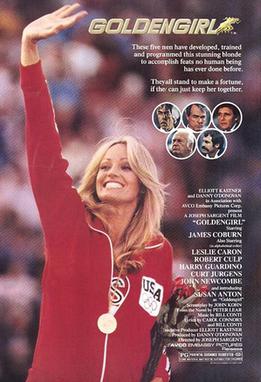
An Olympic Film Review: Goldengirl (dir by Joseph Sargent)


The 1979 film Goldengirl is a film that I had wanted to see ever since I first came across this trailer on one of the 42nd Street Forever compilation DVDs:

Wow, I wondered.  What was Goldengirl’s secret and why was she ordering James Coburn to kiss her feet?  For that matter, why did James Coburn have a haircut that made him look exactly like this old lady who used to live next door to my grandma in Fort Smith?  What did it all have to do with the villain from The Spy Who Loved Me and just how drunk was Robert Culp when he shot his scenes?  Even more importantly, why did Goldengirl keep running into that wall?  That looked painful!

I did some research.  (That’s a fancy way of saying that I looked the movie up on Wikipedia.)  I discovered that Goldengirl was made in 1979.  It was originally meant to be a television miniseries that would not only air during the 1980 Summer Olympics but which would feature Goldengirl competing at those Olympics!  However, during production, it was decided to just use the material for a feature film instead. (Hmmmm, I thought, behind-the-scenes drama!  Intriguing!)  The film was released in June of ’79 and, despite one rave review from Vincent Canby in the New York Times, the film failed at the box office.  Add to that, the U.S. ultimately boycotted the 1980 summer games, which made Goldengirl‘s Olympic-set climax a bit awkward.

I also discovered that Goldengirl is nearly impossible to see.  It’s never been released on DVD or Blu-ray or any digital or streaming service.  So, I resigned myself to the fact that I’d probably never see Goldengirl and, the more I thought about it, the more I realized that I really didn’t care that much.

However, for the past few days, I have been absolutely obsessed with the Winter Olympics.  Even though it was a Summer Olympic movie, I decided to go on YouTube and see if anyone had uploaded Goldengirl since I last checked.

And guess what?

They had!

Now, here’s the problem.  The two guys who uploaded Goldengirl also talked over the entire movie.  Don’t get me wrong.  The movie looked about as good as a VHS copy of a movie from 1979 is ever going to look.  And I could still follow Goldengirl‘s story, even if I sometimes had to really strain to hear the dialogue over the two guys “commenting” on it.  Still, it meant that I had to put a bit more effort into watching this movie than it perhaps deserved.  It was kinda hard not to resent that.

Anyway, I have finally seen Goldengirl and I can now tell you that it’s a pretty lousy movie.  Goldengirl is Goldine (Susan Anton).  Her father is a German scientist who used to work for the Nazis.  When he came to the United States, he decided to prove that his theories of eugenics were correct by adopting a daughter and breeding her to be the world’s greatest athlete.  Working with a psychiatrist named Dr. Lee (Leslie Caron, for some reason), they have not only turned Goldine into the world’s greatest athlete but they’ve also turned her into a bright, smiling media personality.  (Dr. Lee has trained Goldine, through the use of a vibrator, to always give the right answer when she’s asked a question.)  Now, they just need Goldine to win three gold medals at the Summer Olympics and for PR agent Jack Dryden (James Coburn) to make Goldine into a star.  Dryden is the only person who really cares about Goldine as something other than an experiment or a way to make money.

Goldine spends almost the entire movie running.  There’s one running montage that seems to go on forever.  Susan Anton was a model when she was cast as Goldine.  She’s got the right look to be a celebrity but she’s never convincing as an Olympic-class athlete.  Whenever Goldine competes, we either get a close-up of Anton running in slow-motion with no other runners around her or else a long-shot that’s designed to keep us from noticing that Anton isn’t really on the track.

Really, that’s entire film.  On the basis of the trailer, I was expecting that Goldengirl would turn out to be a robot or something like that.  Instead, it just turns out that her stepfather has spent years injecting her with vitamins and hormones and now, as a result, she has diabetes.  Seriously, that’s it.  She gets pretty mad when she finds out that her handlers have put her health at risk just so she could win a race.  But then she goes ahead and runs the race anyway so I guess it was all for the best.  Seriously, that’s the entire freaking movie.  It doesn’t help that Anton’s acting is amateurish and the rest of the cast seems bored.  Only Curt Jurgens really makes much of an impression, mostly because he’s too sinister not to be memorable.

The trailer is better than the movie.  That’s the secret of Goldengirl.

Lisa Reviews An Oscar Nominee: The Longest Day (dir by Ken Annakin, Andrew Marton, Bernhard Wicki, Gerd Oswald, and Darryl F. Zanuck)


As my sister has already pointed out, today is the 73rd anniversary of D-Day.  With that in mind, and as a part of my ongoing mission to see and review every single film ever nominated for best picture, I decided to watch the 1962 film, The Longest Day!

The Longest Day is a pain-staking and meticulous recreation of invasion of Normandy, much of it filmed on location.  It was reportedly something of a dream project for the head of the 20th Century Fox, Darryl F. Zanuck.  Zanuck set out to make both the ultimate tribute to the Allied forces and the greatest war movie ever.  Based on a best seller, The Longest Day has five credited screenwriters and three credited directors.  (Ken Annakin was credited with “British and French exteriors,” Andrew Marton did “American exteriors,” and the German scenes were credited to Bernhard Wicki.  Oddly, Gerd Oswald was not credited for his work on the parachuting scenes, even though those were some of the strongest scenes in the film.)  Even though he was not credited as either a screenwriter or a director, it is generally agreed that the film ultimately reflected the vision of Darryl F. Zanuck.  Zanuck not only rewrote the script but he also directed a few scenes as well.  The film had a budget of 7.75 million dollars, which was a huge amount in 1962.  (Until Steven Spielberg’s Schindler’s List, The Longest Day was the most expensive black-and-white film ever made.)  Not only did the film tell an epic story, but it also had an epic length.  Clocking in at 3 hours, The Longest Day was also one of the longest movies to ever be nominated for best picture.

The Longest Day also had an epic cast.  Zanuck assembled an all-star cast for his recreation of D-Day.  If you’re like me and you love watching old movies on TCM, you’ll see a lot of familiar faces go rushing by during the course of The Longest Day.  American generals were played by actors like Robert Mitchum, Robert Ryan, Henry Fonda, and John Wayne.  Peter Lawford, then the brother-in-law of the President of the United States, had a memorable role as the Scottish Lord Lovat, who marched through D-Day to the sounds of bagpipes.  When the Allied troops storm the beach, everyone from Roddy McDowall to Sal Mineo to Robert Wagner to singer Paul Anka can be seen dodging bullets.  Sean Connery pops up, speaking in his Scottish accent and providing comic relief.  When a group of paratroopers parachute into an occupied village, comedian Red Buttons ends up hanging from the steeple of a church.  When Richard Beymer (who is currently playing Ben Horne on Twin Peaks) gets separated from his squad, he stumbles across Richard Burton.  Among those representing the French are Arletty and Christian Marquand.  (Ironically, after World War II, Arletty was convicted of collaborating with the Germans and spent 18 months under house arrest.  Her crime was having a romantic relationship with a German soldier.  It is said that, in response to the charges, Arletty said, “My heart is French but my ass is international.”)  Meanwhile, among the Germans, one can find three future Bond villains: Gert Frobe, Curt Jurgens, and Walter Gotell.

It’s a big film and, to be honest, it’s too big.  It’s hard to keep track of everyone and, even though the battle scenes are probably about an intense as one could get away with in 1962 (though it’s nowhere near as effective as the famous opening of Saving Private Ryan, I still felt bad when Jeffrey Hunter and Eddie Albert were gunned down), their effectiveness is compromised by the film’s all-star approach.  Often times, the action threatens to come to a halt so that everyone can get their close-up.  Unfortunately, most of those famous faces don’t really get much of a chance to make an impression.  Even as the battle rages, you keep getting distracted by questions like, “Was that guy famous or was he just an extra?”

Among the big stars, most of them play to their personas.  John Wayne, for instance, may have been cast as General Benjamin Vandervoort but there’s never any doubt that he’s playing John Wayne.  When he tells his troops to “send them to Hell,” it’s not Vandervoort giving orders.  It’s John Wayne representing America.  Henry Fonda may be identified as being General Theodore Roosevelt II but, ultimately, you react to him because he’s Henry Fonda, a symbol of middle-American decency.  Neither Wayne nor Fonda gives a bad performance but you never forget that you’re watching Fonda and Wayne.

Throughout this huge film, there are bits and pieces that work so well that you wish the film had just concentrated on them as opposed to trying to tell every single story that occurred during D-Day.  I liked Robert Mitchum as a tough but caring general who, in the midst of battle, gives a speech that inspires his troops to keep fighting.  The scenes of Peter Lawford marching with a bagpiper at his side were nicely surreal.  Finally, there’s Richard Beymer, wandering around the French countryside and going through the entire day without firing his gun once.  Beymer gets the best line of the film when he says, “I wonder if we won.”  It’s such a modest line but it’s probably the most powerful line in the film.  I wish The Longest Day had more scenes like that.

The Longest Day was nominated for best picture of 1962 but it lost to an even longer film, Lawrence of Arabia.

Lisa Reviews The Oscar Nominees: Nicholas and Alexandra (dir by Franklin J. Schaffner)


Nicholas_and_Alexandra-831476012-large

(Depending on how much you know about world history, the review below may contain spoilers.)

It was nearly four years ago that I decided that my goal in life was to watch and review every single film — no matter how obscure or potentially disappointing — that had ever been nominated for best picture.  Of course, that’s not my only goal.  If anything, I may have too many, often contradictory goals in my life.  But seeing all of the best picture nominees was definitely one of them and, all these years later, it’s a goal that I’m still trying to achieve.  With the help of TCM and their nonstop schedule of movies made long before I was born, it’s also a goal on which I am slowly but surely making progress.

Last night, as I scrolled through the guide, I noticed that TCM would be showing Nicholas and Alexandra, a three and a half hour film from 1971.  Now normally, I would be hesitant about watching a film that long, if just because I have ADHD and I doubt I’d be able to concentrate on it.  In a theater, watching the action unfold on a big screen, it wouldn’t be a big deal.  However, it’s totally different when you’re talking watching a movie on TV in a house that is full of potential distractions.  Add to that, Wednesday night is when I usually watch shows like Survivor, Hell’s Kitchen, and South Park.

But, here’s the thing.  The title Nicholas and Alexandra sounded familiar to me and not just because I’m an obsessive history nerd.  I did some checking and I discovered that, regardless of how obscure the film may be today, Nicholas and Alexandra was nominated for best picture.  It lost to The French Connection but it was nominated.

So, of course, I had to watch it.

And you know what?

NA

It’s not a terrible movie.  It’s certainly not great.  It has multiple flaws and it’s hard to imagine this film being nominated alongside films like The French Connection, Last Picture Show, and A Clockwork Orange.  Watching the movie, I got the feeling it was probably nominated because it was a big, expensive epic and not because it was one of the best of the year.  But, if you stick with the film (which, if we’re going to be honest here, is much easier said than done), it’s not quite as disappointing as you might expect it to be.

Nicholas and Alexandra tells the story of the last monarch of Russia, Tsar Nicholas II (Michael Jayston).  Struggling to escape the shadow of his father and incapable of understanding what life is like for those not born into royalty, Nicholas is portrayed as being well-meaning but autocratic and blind to the fact that the days of royalty are rapidly coming to an end.  His wife, Alexandra (Janet Susman) is also unpopular with both the Russian citizenry and the royal court on account of being German.

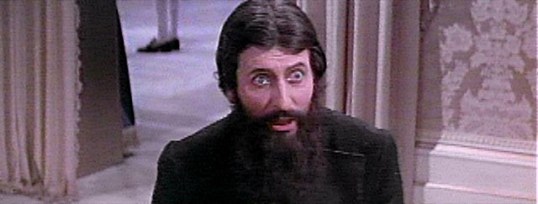
Alexandra spends most her time doting on her youngest son, Alexei, who suffers from hemophilia.  When a flamboyant Serbian monk named Rasputin (Tom Baker) claims that he has the power to heal Alexei, Alexandra immediately brings him into the court.  Soon, rumors are flying across Russia about Rasputin’s relationship with Alexandra.

Meanwhile, men with names like Lenin (Michael Bryant), Trotsky (Brian Cox), and Stalin (James Hazeldine) are plotting to lead a “worker’s revolution…”

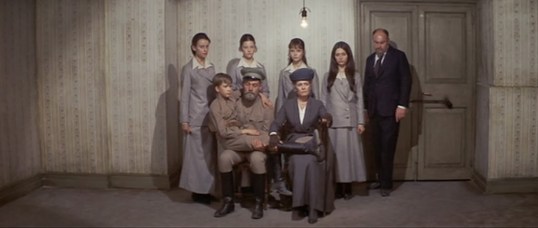
If you know anything about history, it’s not really a spoiler to reveal what happens in the second half of Nicholas and Alexandra.  (And if you’re not into history, you probably would not have any interest in watching the movie in the first place.)   Archduke Franz Ferdinand is assassinated, plunging the entire world into war.  Russia declares war on Germany and the German-born Alexandra becomes even more unpopular than before.  The rest of the royal court, jealous over the mad monk’s influence, plots against Rasputin.  The Tsar is forced from the throne and Nicholas and his family spend their last days as captives of the people they once ruled.  Now a powerless prisoner, Nicholas finally starts to understand the world beyond his palace walls.  However, in the end, Nicholas, Alexandra, their children, and their loyal servants are taken into a small room and violently executed.  End of movie.

NA2

So, there are a lot of things wrong with Nicholas and Alexandra.  Not the least of the film’s problem is an unwieldy length and generally slow pace.  (The film was directed by Franklin J. Schaffner, who also directed the still-fun original Planet of the Apes.  Little of the flair he brought to Planet of the Apes is present here.)  This is one of those films that is full of incident with various characters popping up and discussing the intricacies of international politics with little concern as to whether or not any of this is the least bit cinematic or even compelling on a narrative level.  The film has a huge cast but very few memorable characters.

Even worse is that neither Nicholas nor Alexandra never come across as being all that interesting.  The film makes the case that Nicholas’s downfall was largely a result of him being unlucky enough to rule at a time when people across Europe and Asia were rejecting the old ways for the new ways of revolution and industrialization.  Nicholas is continually portrayed as being well-meaning but isolated and that has the potential to be interesting but, at times, the film feels almost as emotionally detached as its characters.

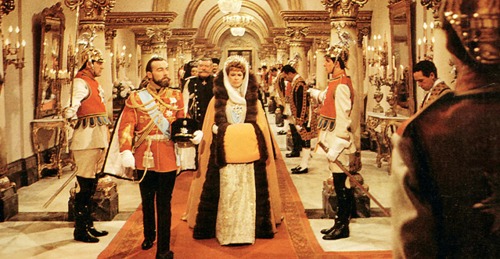
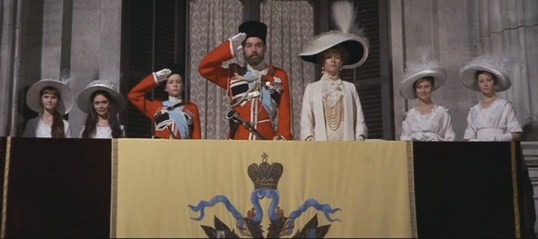
That said, Nicholas and Alexandra does work as a spectacle, as a showcase for beautiful clothing and ornate scenery.  As a character study, Nicholas and Alexandra largely fails but, as a fashion show, it’s actually a lot of fun.    Early on in the film, there’s a lengthy sequence in which Nicholas and Alexandra walk down the red-carpeted hallways of their palace.  It’s shot through Nicholas’s eyes and we see a collection of guards and noblemen and women standing to the side and bowing their heads as the Tsar and his wife walk past.  It’s a good scene and one that perfectly shows not only the life that Nicholas is used to but also why Nicholas doesn’t want to change that life.

baktna03

Perhaps not surprisingly, the first two hours of Nicholas and Alexandra work best when they focus on the flamboyant character of Rasputin.  Baker does a really go job as Rasputin, delivering all of his lines with a ferocious intensity while staring with obviously unhinged eyes.  When he’s with Alexandra, Rasputin is calculating and coldly conniving, providing just enough comfort to keep her under his control.  When he’s with Nicholas or any of the other male members of the court, he reveals himself to be an arrogant libertine, making profane jokes and bragging about his conquests.  It’s a really good performance but, as with so many other good performances in this film, it occasionally gets lost in the film’s dense production.

The best moments of Nicholas and Alexandra come towards the end, with the humbled Nicholas finally revealing his humanity and the Tsar’s family struggling to maintain their dignity even as their inevitable fate approaches.  At this point, the performers came to life.  The film suddenly had an emotional resonance.  It finally became about something!  For those final 20 or so minutes, Nicholas and Alexandra suddenly seemed worthy of being awarded.

In fact, based on those final 20 minutes, I would even be willing to see a sequel called Nicholas and Alexandra and Rasputin Makes Three.  

(Though I’m not sure how that sequel could ever be made.  As @Kev1Media pointed out when I suggested it on twitter, Adam Sandler would have to be somehow involved.)

As for Nicholas and Alexandra, it’s not a great film but if you’re into history or you’re an Oscar completist like me, the film has its occasional charms.  You just have to be willing to look for them.

Nicholas and Alexandra

James Bond Film Review: The Spy Who Loved Me (dir. by Lewis Gilbert)


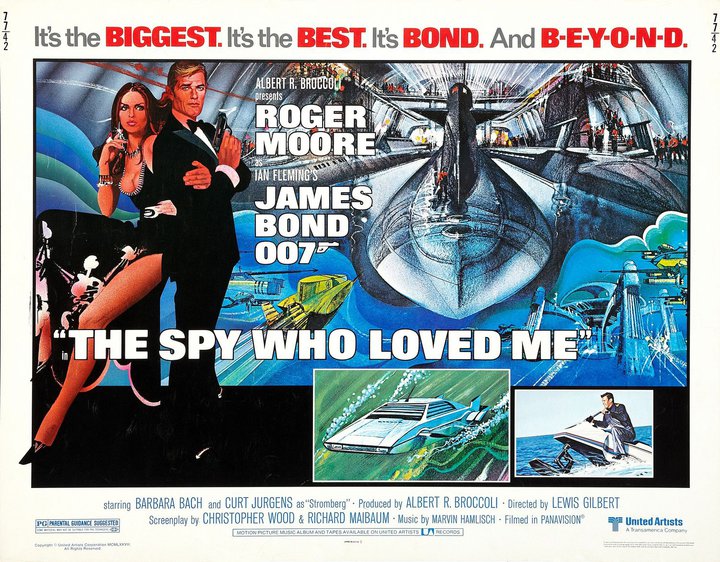
For the past few days, the Shattered Lens has been taking a journey through the history of the James Bond film franchise.  Today, we continue that journey by taking a look at 1977’s The Spy Who Loved Me.  This was the 10th film in the “official” James Bond series and the 3rd to star Roger Moore as 007.  It was also the first of Moore’s films to be embraced by contemporary critics and it’s still considered to be one of the best films in the entire series.  It’s also one of my personal favorites.

The Spy Who Loved Me opens with one of the most of brilliant pre-credit sequences in the history of the franchise.  British and Russian submarines are mysteriously vanishing.  M (a returning Bernard Lee) summons James Bond (Roger Moore) to investigate.  Not surprisingly, Bond is with a woman at a ski resort when the summons comes.  As Bond starts to leave, the woman says, “But James, I need you.”

“So does England,” Bond replies.

Now, this was long before my time so I can’t say for sure but I always like to imagine  that line got some applause when it was first heard in theaters.  It is with that line (and, even more importantly, with his self-assured but humorous delivery of that line) that Roger Moore truly claims the role of James Bond as his own.  No, this scene seemed to be telling us, Moore would never be Sean Connery.  But he would be James Bond.

After leaving the chalet, Bond finds himself being pursued by several Russian agents.  This downhill ski chase, filmed by real people who were truly putting their lives in danger in the days before CGI, is one of the most exciting of all the chases to be found in Bond films and it builds up to a perfect climax.  After Bond manages to kill one of his pursuers, he skis right over the edge of a cliff.  Luckily, he has a parachute in his backpack and, of course, it’s a union jack parachute.  Again, I like to imagine that audiences applauded at this moment.

Bond’s escape leads to the opening credits and, even more importantly, Carly Simon singing the film’s theme song, “Nobody Does It Better.”  Seriously, I love this song.

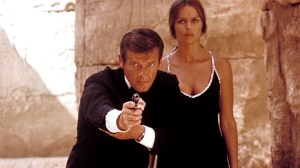
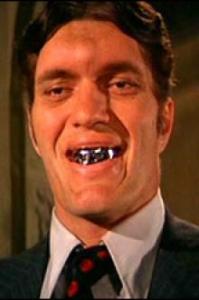
Both MI6 and the KGB discover that the plans for a submarine tracking system are being sold on the Egyptian black market.  Suspecting that this is connected to the missing submarines, both James Bond and the Russian agent Anya Asamova (Barbara Bach) are sent to Egypt.  Bond and Anya team up to find the plans.  Along the way, they are attacked multiple times by Jaws (Richard Kiel), a hulking man with steel teeth.

Eventually, Bond and Anya discover that the man responsible for the missing submarines is Karl Stromberg (Curt Jurgens), a shipping magnate who is planning on destroying the surface world so that he can start a new society underwater.  The two secret agents work together to defeat Stromberg even though Anya assures Bond that she’s going to kill him as soon as their mission is completed.  Remember the man who Bond killed during that opening ski chase?  It turns out that man was Anya’s lover and she’s only putting off getting her revenge so that she and Bond can save the world first.

With its confident mix of humor, intrigue, and spectacular action, The Spy Who Loved Me remains one of the most popular of the Bond films.  It’s certainly one of my favorites.

Along with From Russia With Love and On Her Majesty’s Secret Service, this is the most romantic of the Bond films.  Roger Moore and Barbara Bach have a very real chemistry and, as a result, you actually care about whether or not Bond and Anya will still be together after the end credits.  As played by Barbara Bach, Anya is one of the strongest of the Bond girls.  For once, Bond and his lover are truly equals.  For anyone who doubts the importance of having a strong Bond girl, I invite them to compare this movie to The Man With The Golden Gun.

For those who are more into action than romance, The Spy Who Loved Me will not leave them disappointed.  This film features some of the best set pieces in the history of the Bond franchise.  Along with the ski chase at the start of the film, there’s also a genuinely exciting car chase that features Bond and Anya being pursued by a helicopter piloted by Caroline Munro.

(Speaking of cars, this film also features one of my favorite Bond gadgets — a car that doubles as a submarine.)

Karl Stromberg makes for an interesting villain.  His plan makes absolutely no sense but he may be the first Bond bad guy to motivated by perverted idealism as opposed to pure greed.  As you would expect from a Bond film, his secret underwater HQ is quite an impressive set.  However, the best thing about Stromberg is that he employs Jaws.  With his stainless steel teeth, Jaws was the best henchman since Goldfinger‘s Oddjob and he proved to be such a popular character that he actually returned in the next Bond film.

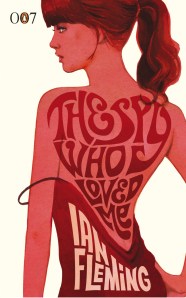
One final note: As has often been noted, The Spy Who Loved Me was the first Bond film to have absolutely nothing in common (beyond a title) with the book that it was based on.  This is largely because the literary Spy Who Loved Me wasn’t really about James Bond.  Instead, it told the life story of Vivienne Michel, a Canadian woman who just happens to meet Bond towards the end of the book.  Fleming reportedly considered this book to be a failed experiment on his part and reportedly he only sold the film rights when he was assured that only the book’s title would be used.

That said, I recently read The Spy Who Loved Me and it’s not that bad.  Vivienne Michel is a compelling character and it’s interesting to, for once, see James Bond through the eyes of a lover as opposed to the other way around.  If it is a failed experiment, it’s still an experiment that’s worth reading.

As for the cinematic James Bond, he conquered the sea in The Spy Who Loved Me so it only made sense that, in his next film, he would attempt to conquer space.  We’ll take a look at Moonraker tomorrow.