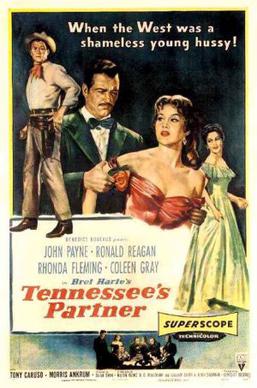
Tennessee’s Partner (1955, directed by Allan Dwan)


Tennesse (John Payne) is an old west gambler who co-owns a saloon (and bordello) with Elizabeth Farnham (Rhonda Fleming).  When Tennessee is ambushed after a poker game, he’s saved by a local man who goes by the name of Cowpoke (Ronald Reagan).  Tennessee and Cowpoke become fast friends but when Tennessee realizes that Cowpoke is about to marry a golddigger (Coleen Gray), Tennessee puts the woman on the next boat out of town.  Cowpoke vows to get vengeance but Tennessee has bigger things to worry about.  Rival businessman Turner (Tony Caruso) has framed Tennessee for the murder of a local prospector, Grubstake McNiven (Chubby Johnson).

Very loosely based on a short story by Bret Harte, Tennessee’s Partner has surprisingly high production values for a B-western.  Director Allan Dwan started his career in the 1910s and directed over 200 westerns.  He knew how to keep the action moving.  Tennessee’s Partner is also the only film that old friends John Payne and Ronald Reagan made together.  Reagan, whose days as a major studio leading man had ended by the time he made this film, gives one of his better performances in the role of the simple but honest Cowpoke and shows the likability that he was later able to translate into a political career.  Reagan could be a stiff actor but his naturally amiable manner made him perfect for best friend and sidekick roles, like in this movie.  Payne also gives a good performance as the gambler with a moral code.  However, the best thing about the film is Rhonda Fleming, giving a tough and sexy performance as Elizabeth.  Because this film came out in 1955, it couldn’t really come out and say that Elizabeth was a madam and the saloon was a bordello but Fleming’s performance and a few lines of innuendo left little doubt about what was actually going on upstairs from the bar.  Keep an eye out for Angie Dickinson, playing one of Elizabeth’s girls.

The performance elevate Tennessee’s Partner, making it a B-western that can be enjoyed even by people who aren’t necessarily into westerns.

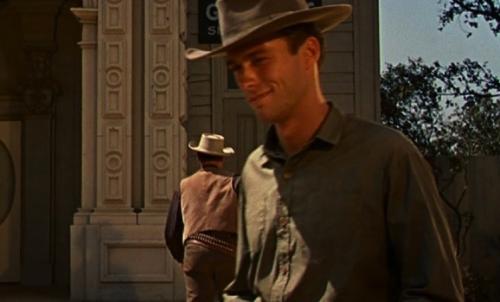
Star in the Dust (1956, directed by Charles F. Haas)


The time is the late 1800s and the place is the town of Gunlock.  Gunlock is split between the ranchers and the farmers, with the ranchers eager to buy all of the land around the town and the farmers refusing to sell.  Trying to keep the peace is Sheriff Bill Jorden (John Agar), who not only wants to keep war from breaking out in Gunlock but who also wants to live up to the example of his legendary father.

There’s a prisoner in the Gunlock city jail.  Sam Hall (Richard Boone) is a notorious gunman who has been convicted of killing three farmers.  He’s due to hang at sunset but everyone in town believes that Sam will somehow escape the executioner.  (They’re even taking bets down at the local saloon and casino.)  Everyone knows that Sam was hired by the ranchers but Sam has yet to name which rancher specifically invited him to come to town.  The farmers want to lynch Sam.  The ranchers want to break him out of jail and arrange for him to be killed in the resulting firefight.  Meanwhile, Sheriff Jorden insists that he’s going to carry out Sam’s sentence by the letter of the law.  Complicating matters for Jorden is that he’s engaged to Ellen Ballard (Mamie Van Doren), the sister of the main rancher, George Ballard (Leif Erickson).

I was really surprised by Star in the Dust, which turned out to be far better than I would normally expect a John Agar/Mamie Van Doren western to be.  Though Agar, Boone, and Van Doren get top-billing, Star in the Dust is really an ensemble piece, with several different people responding to the possible hanging of Sam Hall in their own way.  Sam’s girlfriend, Nellie Mason (Colleen Gray), tries to figure out a way to keep Sam alive.  One of the ranchers, Lew Hogan (Harry Morgan), is morally conflicted about whether or not to honor his word to help Sam escape, especially after he finds out that Sam tried to rape his wife (Randy Stuart).  Even the old deputies (played by James Gleason and Paul Fix) get a few minutes in the spotlight before the shooting begins.  The town of Gunlock comes to life and everyone, from the villains to the heroes, has a realistic motivation for reacting in the way that they do to Sam’s pending execution.

Mamie van Doren’s role is actually pretty small.  She doesn’t have enough screen time to either hurt or help the film overall.  John Agar is as stiff as always but, for once, it works for his character.  Sheriff Jorden isn’t written to be a bigger-than-life John Wayne type.  Instead, he’s just a small town lawman trying to do his job and keep the peace.  Not surprisingly, the film is stolen by Richard Boone, who brings a lot of unexpected shading and nuance to the role of Sam Hall.  Hall may be a killer but he has his own brand of integrity and, if he’s going to die, he’s determined to do it his way.

Produced by the legendary Albert Zugsmith, Star in the Dust is a surprisingly intelligent and well-acted B-western.  If you watch carefully, you might even spot Clint Eastwood playing a ranch hand named Tom who wants to know if he should put money down on Sam Hall being hanged.  Though he was uncredited in this tiny role, Star in the Dust was Eastwood’s first western.

Horror Film Review: The Vampire (dir by Paul Landres)


Headaches are a bitch!

And if you didn’t already know that, you will know it after watching the 1957 film, The Vampire.

Like many films of this kind, The Vampire starts with death.

Actually, I take that back.  Technically, it’s true but it’s also little bit too melodramatic.  And, to be honest, The Vampire starts with a 14 year-old boy, who is very much alive, riding his bicycle down the street of Anytown USA.  He has a box with him, one that has air holes.  On the back of his bike, a cardboard sign reads: “Bobs Pet Zoo!  If Its Alive We Got It!”  Apparently, the kid is smart enough to run his own zoo but not smart enough to know when to use an apostrophe.

Anyway, the kid comes up to a creepy old house, one that looks somewhat out of place in the otherwise pristine suburban neighborhood.  Originally, I thought that maybe Pennywise lived in the house but then I reminded myself that The Vampire was made decades before It.  Instead, the house belongs to Dr. Campbell, a scientist who is doing experiments with blood and who needs a never-ending supply of animal test subjects.  (Boooooo!  Animal testing!  Hiss!)  Apparently, the kid keeps Dr. Campbell supplied with animals.  When the kid enters the house, Dr. Campbell is nowhere to be seen.  It’s not until the kid enters the laboratory that he discovers Campbell, dead and slumped over his desk.

As news spreads of Campbell’s death, his friend, Dr. Paul Beecher (John Beal), searches through Campbell’s belongings and he comes across a mysterious bottle of pills, which he promptly takes home with him.  Dr. Beecher is kindly doctor, the type that we all wish we could deal with whenever we had to go in for a check up.  However, he suffers from terrible migraines.  That night, when he’s literally blinded with a headache, he asks his daughter to get him his pills.  She retrieves a bottle of pills but guess what?  They’re the wrong pills!  They’re not headache pills!  Instead, they’re Dr. Campbell’s vampirism pills!

The pills cause Beecher to blaxk out.  Whenever he comes to, he never has any memory of what he may or may not have done while he was out.  However, strange things are happening to his friends and his patients.  One of his longtime patients dies of fright when he comes by her house.  On her neck, he finds two puncture wounds…

So, it’s not a spoiler for me to tell you that Dr. Beecher has been transformed into a vampire.  And I know what you’re thinking.  Why doesn’t he just stop taking the pills?  The simplest answer is that the pills are addictive.  The more complex answer is that he doesn’t want to.  The pills have brought out his dark side and, now that it’s free, it’s not planning on going anywhere.

In a strange way, The Vampire reminded me of Nicholas Ray’s Bigger Than Life.  In Bigger Than Life, James Mason plays a gentle and good-hearted professor who, after taking steroids, turns into a monster who dreams of creating a master race.  Bigger Than Life was unsettling for the exact same reason that The Vampire is unsettling.  Both suggest that the pills didn’t turn their user into a monster.  Instead, the pills just allowed his true self to come out.

The Vampire was a low-budget film, a B-movie as many would probably call it.  The musical score is overly melodramatic and so are some of the actors.  But I would say that The Vampire is actually a bit of a subversive masterpiece.  This 1957 film suggests that behind the pristine facade of suburbia, there lurked monsters.  Even an outwardly successful and respected man like Dr. Beecher can turn into something totally different behind closed doors, this film is saying.  That’s a message that it as relevant today as it was when this film was first released.  In its own way, The Vampire is a brilliant and important movie.

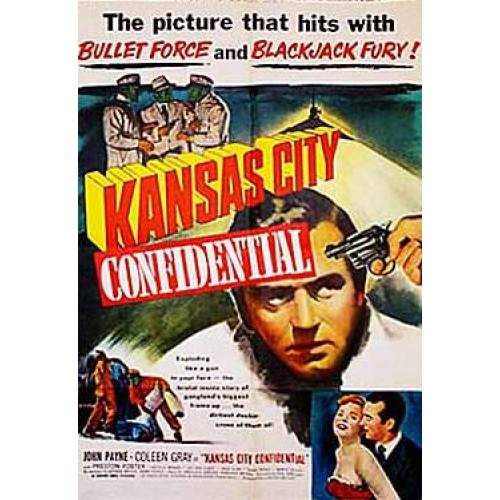
The Perfect Crime Film: KANSAS CITY CONFIDENTIAL (United Artists 1952)


gary loggins's avatarcracked rear viewer

kc1

My friend Rob suggested I review KANSAS CITY CONFIDENTIAL awhile back, and I’m sorry I waited so long. This is a film noir lover’s delight, packed with tension, violence, double-crosses, and a head-turning performance by John Payne in the lead. Made on an economical budget like the same year’s THE NARROW MARGIN , director Phil Karlson and George Diskant create a shadowy, claustrophobic atmosphere brimming with danger at every turn.

I knew Payne mainly from his 40’s musicals and his idealistic lawyer opposite Maureen O’Hara in MIRACLE ON 34TH STREET, but he’s a revelation here as Joe Rolfe, a florist truck driver who’s set up as a patsy by a gang of armored car robbers. He can dish out (and take) beatings with the best them, and delivers the tough-talking dialog with aplomb. KANSAS CITY CONFIDENTIAL helped Payne shed his lightweight image, and he went on to do other dark crime films and rugged…

View original post 468 more words