Retro Television Review: Miami Vice 2.14 “Yankee Dollar”


Welcome to Retro Television Reviews, a feature where we review some of our favorite and least favorite shows of the past!  On Mondays, I will be reviewing Miami Vice, which ran on NBC from 1984 to 1989.  The entire show can be purchased on Prime!

This week, Sonny’s latest girlfriend gets involved in the drug trade.

Episode 2.14 “Yankee Dollar”

(Dir by Aaron Lipstadt, originally aired on January 17th, 1986)

It’s another night in Miami.  Sonny Crockett is looking forward to driving out to the airport and picking up his latest girlfriend, a flight attendant named Sarah (Audrey Matson).  For two years, Sarah has been working the Miami to Bogota to Paris and back route.  She doesn’t make a lot of money but, as is typical for this show, she lives in a small but very nicely furnished house.

Unfortunately, Sarah dies shortly after Sonny picks her up.  She goes into cardiac arrest, the result of a balloon of cocaine bursting inside of her.  It turns out that Sarah was working as a drug mule, all so she could make a quick five grand and buy a used BMW.

Seriously, what are the chances that Sonny Crockett’s girlfriend would turn out to be a drug smuggler?  Maybe she thought she was dating Sonny Burnett.  Or maybe, like so many others on this show, she allowed her desire for the finer things in life — like a BMW — to lead her astray.  This is one of the major themes of Miami Vice.  In a society where conspicuous consumption rules, people will do anything to appear richer than they actually are.

When Sonny and Rico arrest Sarah’s brother, Tim (Clayton Rohner), they discover that he works for a wealthy businessman named Charlie Glide (Ned Eisenberg).  Everyone knows that Charlie Glide (a great name, by the way) is involved in the drug trade but no one has ever been able to pin anything on him.  In the past, Charlie avoided cocaine but he’s now looking to branch out.  Sonny and Rico go undercover to try to bring Charlie down.

Of course, it doesn’t work.  Charlie is smart enough to figure out that Sonny and Rico are trying to set him up.  Even after Crockett and Tubbs drag him down to the police station and Charlie makes a deal for immunity in return for setting up two other drug dealers (Anne Carlisle and Pepe Serna), he still tries to double cross the cops.  And even though the double cross doesn’t quite work, Charlie remains smug in his knowledge that he has immunity.

Except, of course, he doesn’t have immunity from all crimes.  Earlier in the episode, Charlie’s executive assistant, Max Rogo (Austin Pendleton), used Charlie’s gun to execute Tim.  Even though Crockett and Tubbs know that Max is the one who pulled the trigger and that Max is the one who decided to kill Tim, they still arrest Charlie for the murder.  (Max was apparently killed in an earlier shootout so it’s not like he’s around to tell the truth.)  “You changed the rules!” Charlie shouts as he’s dragged away.

This episode is Miami Vice at its most cynical.  Crockett and Tubbs can’t get Charlie for the crime he committed so, instead, they set him up for a crime he didn’t commit.  They did change the rules in that they decided they no longer have to follow them.  The episode is full of characters so desperate for money that they’ll do just about anything, even smuggling a lethal drug in their body.  Crockett can only watch helplessly as Sarah dies and, even as Charlie is taken away, there’s never any doubt that he’ll be replaced by someone else, the drug trade will continue, and more people will die just because they wanted to be able to afford a few extra things.  Crockett and Tubbs are fighting a war that can never be won.  Whatever victories they get ultimately feel hollow.  Arresting Charlie won’t bring Sarah back and it won’t stop more innocent people from dying.  Ned Eisenberg was wonderfully smug as Charlie Glide and Austin Pendleton was appropriately creepy as the always-smiling Max Rogo.  This was a good episode, one that challenged the traditional cop show narrative.  How long can one fight a losing war?
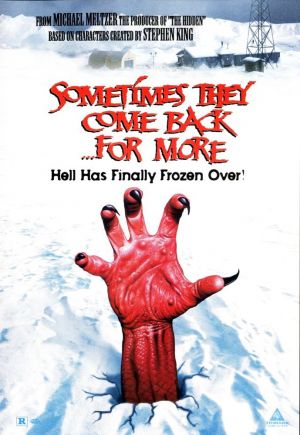
Sometimes They Come Back… For More (1998, directed by Daniel Zelik Berk)


The third and final Sometimes They Come Back film has nothing to do with the two films that preceded it.  Those two films dealt with dead juvenile delinquents who came back to life to haunt the people who they blamed for their deaths.  They came back for revenge.  The third film has more in common with The Thing than the other two movies.  If you’re going to make a movie that invites comparisons to The Thing, you better have the goods and unfortunately, this film doesn’t.

Captain Sam Cage (Clayton Rohner) and Major Callie O’Grady (Chase Masterson) are dispatched to an Arctic research center to follow up on reports that one of the researcher has snapped.  For Cage, the mission is personal because his brother-in-law is at the center.  What they discover is that almost all of the research personnel are dead and that Dr. Jennifer Wells (Faith Ford) and Lt. Brian Shebanski (Max Perlich) are the sole survivors.  Someone at the research center had been studying Satanism and that, along with a portal to Hell under the station, leads to trouble.  Soon, the dead are reanimating and stalking the living.

Sometimes They Come Back… For More gets off to a good start with the mystery at the base and a visual emphasis on the harshness of life in Antarctica.  Clayton Rohner appeared in a lot of straight-to-video horror movies and, by the time he made this one, he was a pro at handling bad dialogue.  Once Cage and O’Grady reach the base, the movie starts to go off the rails as the survivors make increasingly poor decisions, Faith Ford struggles to be a believable scientist, and an absurd twist is introduced concerning Cage and his brother-in-law (Damian Chapa).  The movie was obviously influenced by The Thing and Alien but it never duplicates the claustrophobic intensity that made those films work.  Not surprisingly, after this movie, they would not come back.

The TSL’s Horror Grindhouse: I, Madman (dir by Tibor Takacs)


In the 1989 horror film, I, Madman, Jenny Wright stars as Virginia.  Virginia’s an aspiring actress who makes ends meet by working in a used bookstore.  (I’m not sure how much money the typical used bookstore employee makes but I have to say that Virginia’s apartment is absolutely to die for.)  Virginia is also dating a police detective named Richard (Clayton Rohner), who is handsome and sweet and looks good in a suit.  In fact, the only problem with Richard is that he thinks that Virginia spends too much time reading trashy horror novels.  According to him, they give her nightmares and they cause her imagination to run wild.

Richard’s not going to be happy to discover that Virginia has a new favorite author.  His name is Malcolm Brand and, despite the fact that Virginia says that he’s better than Stephen King, he’s a mysteriously obscure author.  In fact, no one but Virginia seems to have ever heard of him.  Virginia has just finished reading Brand’s first book, Much of Madness, More of Sin.  Now, she simply has to find his second book, which was called I, Madman.

(Personally, I think Much of Madness, More of Sin is a brilliant title.  I, Madman on the other hand is a little bit bland, as far as titles go.)

When Virginia finally tracks down a copy of the book, she discovers that it is all about this mad scientist who falls in love with an actress.  Because the scientist is horribly disfigured, the actress rejects him.  So, the scientist starts killing people and stealing pieces of their faces, all so he can patch together a new face for himself.

It’s while she’s reading the book the strange things start to happen in Virginia’s life.  For instance, the people around her start dying.  When she witnesses one of her neighbors being murdered, she swears that the murder was committed by a man who had no nose …. just like in the book!  Richard thinks that she’s letting her imagination run wild but Virginia soon comes to wonder if maybe she’s being stalked by the real Malcolm Brand….

I, Madman is an entertaining little horror film, one that sometimes comes across as being an extended episode of something like Tales From The Crypt.  From the minute the movie started with Virginia curled up on her couch in her underwear, reading a trashy novel with her oversized reading glasses on and a storm raging outside, I was like, “Oh my God, they made a movie out of my life!”  And really, this is one of the reasons why I, Madman makes such a good impression.  As played by Jenny Wright, Virginia serves as a stand-in for every horror fan who has ever read a scary novel and immediately imagined themselves as either the protagonist or the victim.  If you’ve ever had a nightmare after reading Stephen King or watching a horror movie, you’ll be able to relate to Virginia.  Both Jenny Wright and Clayton Rohner give likable and quirky performances in the lead role and they’re surrounded by capable of character actors.

The film itself is a bit of an homage to the suspense classics of the past.  It’s easy to compare Malcolm Brand’s novel to The Phantom of the Opera while a scene in which Virginia watches her neighbor play piano brings to mind Hitchcock’s Rear Window.  When Virginia imagines herself as a character in one of Brand’s stories, the film even manages to work in some stop-motion animation.  All in all, I, Madman is an entertaining horror film, perfect for October and any other season.

A Movie A Day #268: Destroyer (1988, directed by Robert Kirk)


A year and a half ago, serial killer Ivan Mosser (Lyle Alzado) was sent to the electric chair for murdering 23 people.  On the night that he was electrocuted, the worst prison riot in American history broke out.  The prison was closed and abandoned.  A year and a half later, a film crew has entered the prison to make a women in prison film.  Robert Edwards (Anthony Perkins) is the sleazy director.  David Harris (Clayton Rohner) is the screenwriter who fights to maintain the integrity of his script and who is an expert on the prison’s history.  Susan Malone (Deborah Foreman) is a stuntwoman and David’s girlfriend.  And Ivan is the murderer who is still half-alive and full of electricity.
Watching a forgettable, direct-to-video movie like Destroyer, it is impossible not to feel sorry for Anthony Perkins, who went from getting nominated from Oscars and working with Hitchcock to appearing in films like this.  According to the Perkins biography, Split Image, Perkins was brought in at the last minute to replace Roddy McDowall and was miserable during most of the shoot.  Since Perkins spent a good deal of his later career working with directors like the one he plays in Destroyer, it’s not surprising that he gives one of the two good performances in Destroyer and he also gets the movie’s only memorable death scene.  The other good performance comes from Lyle Alzado, a former football player who had exactly the right look for his role and who plays Ivan like a ghost who is in the throes of roid rage.  Unfortunately, both Alzado and Perkins would die within months of each other in 1992, four years after co-starring in Destroyer.

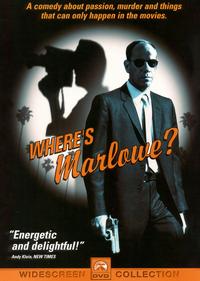
A Movie A Day #109: Where’s Marlowe? (1999, directed by Daniel Pyne)


Two documentarians (Mos Def and John Livingston) decided to make a film about two real-life private detectives, Joe Boone (Miguel Ferrer) and Kevin Murphy (John Slattery).  At first, Boone is skeptical of the two filmmakers.  He watched their last documentary, a three-hour epic about New York’s water supply, and was disappointed by the lack of sex.  However, as the two filmmakers follow him around, he warms up to them and they discover that the tough and sarcastic Boone is actually a soft-hearted idealist who can barely pay the bills.  When Boone discovers that Murphy is sleeping with the wife of one of their clients, their partnership dissolves.  It looks like Boone is going to have to shut down his agency, unless the two filmmakers can help him solve his latest case.
Where’s Marlowe? starts out strong by focusing on Miguel Ferrer’s performance as Joe Boone.  Ferrer did not get to play many leading roles but he was perfectly cast as Joe Boone.  He is completely believable as an old-fashioned private investigator struggling to survive in the modern world.  During the movie’s less interesting second half, the attention shifts to the filmmakers trying to help Boone.  Mos Def and John Livingston are good in their roles but the film’s focus should have stayed on Ferrer.  Unfortunately, the main mystery is never as interesting as Miguel Ferrer’s solid lead performance.

Where’s Marlowe? started out as a pilot and it is easy to see where it would have gone if it had become a television series.  For all of its flaws, it is worth it just to see Miguel Ferrer in a rare leading role.

The TSL’s Grindhouse: April Fool’s Day (dir by Fred Walton)


(Because of the nature of the 1986 pseudo-slasher film, April Fool’s Day, it’s impossible to really talk about the film without talking about the film’s ending.  As a result, this review will have spoilers.  The ending will be revealed.  The entire plot will be spoiled.  Do not read on if that’s going to be an issue for you.)

(Did you read the warning above?)

If not for the way that the film ends, April Fool’s Day would probably be a forgotten film.  It’s a slasher film that doesn’t feature much blood, sex, or any particularly flamboyant kills (though there’s a good reason for that).  Compared to most low-budget slasher films from the mid-80s, April Fool’s Day does have a surprisingly charismatic and likable cast but it’s rare that anyone watches a holiday-themed slasher film for the acting.  Up until the final ten minutes or so, April Fool’s Day is professionally done but somewhat generic…

But then you hit that ending and it totally changes the whole film.  It’s not a perfect ending.  In many ways, it’s probably one the most imperfect endings that I’ve ever seen.  It requires a massive suspension of disbelief.  It makes no logical sense. But dammit, I love it.  Almost despite itself, it’s a great ending and it confirms that April Fool’s Day is meant to be a satire and not a straight horror film.

For the first 80 minutes or so, April Fool’s Day plays out like the 100th variation on And Then There Were None.  Heiress Muffy St. John (Deborah Foreman, giving a wonderfully odd performance) invites a group of college friends to her island mansion.  They arrives on April Fool’s Day and they spend the first night dealing with Muffy’s strange sense of humor.  (Actually, Muffy and I both find the same things funny but I’ve been told that I have a strange sense of humor so, therefore, I assume that Muffy must have one too.)  Harvey, who prefers to be called Hal (Jay Baker), smokes an exploding cigar and discovers his bedroom has been decorated with newspaper articles about a car accident that he was involved in.  Jock Arch Cummings (Thomas F. Wilson) finds steroids hidden away in a medicine cabinet.  Nikki (Deborah Goodrich) comes across handcuffs in a dresser.  Nan (Leah Pinset), a serious-minded drama student, hears a baby crying in the distance and is reminded of her abortion, something that she believes that only Muffy knows about.

The next day, Muffy is now wandering around in a daze and her brother, Skip (Griffin O’Neal), has vanished.  Kit (Amy Steel, playing a similar role to her character in Friday the 13th Part Two) and Rob (Ken Olandt) think that they see Skip’s decaying body floating under the boathouse.  As the day progresses, Arch and Nan vanish and later turn up at the bottom of a well.  Harvey is found hanging from a rope.  Chaz (Clayton Rohner) is castrated and, while we’re not quite sure what exactly happens to Nikki, we do see that it involves a large puddle of blood.  Kit and Rob discover Muffy’s head in the basement and realize that they are being stalked by Muffy’s crazy twin, Buffy.

(Deborah Foreman is great in both of the roles.  As Muffy, she delivers all of her lines with just a hint of sarcasm and constantly seems to be silently laughing at a private joke that only she understands.  And when she’s Buffy — well, she’s totally batshit crazy.)

Being pursued by a knife-wielding Buffy, Kit runs through the mansion and finds herself in the drawing room.  And who is waiting for her but all of Buffy’s victims?  No, they’re not dead!  Instead, they’re alive and they’re all in a very good mood.  And Buffy is not Buffy.  She’s Muffy and she’s been Muffy all along.

That’s right, it’s all a huge elaborate joke!  Muffy does spend a few minutes explaining how the whole weekend was a dry run for her plan to turn her estate into a resort, one that will offer a weekend of fake horror.  But, ultimately, it all comes down to the entire movie being an elaborate joke.  I know, just from perusing some of the comments at the imdb, that there are some horror fans who hate the ending of April’s Fool’s Day.   But, really, that’s the only “honest” way that a film like April Fool’s Day could end.  If the movie was called Thanksgiving, I could understand being upset.  But this is an April Fool’s Day movie!  It has to be a joke.

Of course, if you think about it too much, the ending makes no sense.  Muffy specifically states the no one was in on the joke until the last minute.  Whenever one of her friends would wander off on their own, Muffy would grab them, explain the joke, and get them to play along.  When you consider the size of the island and where, at various points, the victims are in relation to the other characters, Muffy must be a very fast explainer, as well as being very persuasive.  (As well, Harvey brings a gun with him to island.  Muffy jokes about nearly getting shot by him but imagine if he had been successful?)  Even if you accept that all of the friends — even Arch and Harvey, who are both kinda dumbasses — would be able to play along without screwing things up, you have to wonder why Muffy thought it would be a good idea to use dark secrets from everyone’s past.

If you search far enough online, you can find all sorts of rumors about the film that April Fool’s Day was originally meant to be.  In the finished film, Skip is a bit of a cipher but, in the original script, he was a much more complex character.  While Muffy was busy playing her elaborate prank, Skip was planning on killing Muffy and claiming their parent’s inheritance for himself.  The crying baby, the drugs, the incriminating newspaper articles; all of them were originally meant to be the work of Skip.  While Skip’s subplot was dropped, the dark secrets of the past were not.  As a result, Muffy comes across as being a lot more cruel than was originally intended.

Originally, the film was also meant to end with Skip killing Muffy but the ending was apparently changed at the last-minute.  (Reports differ on whether or not the original ending was ever filmed.)  Instead, the film now ends with Muffy stumbling into her bedroom, playing with a jack-in-the-box, and then getting a knife drawn across her throat by Nan.  It’s just another elaborate practical joke and, once Muffy realizes that she’s not dying, Nan gives her a quick kiss and smiles enigmatically.

(A lot of imdb commenters — mostly males — have read a lot into that kiss, obsessing on a subtext that really isn’t there.  As opposed to being the homage to Blue Is The Warmest Colour that many commenters appear to believe it to be, it’s really just a friendly kiss, a way of saying, “I got you.”  Sorry, guys, that’s all there is to it.)

It’s an ending that would never be done today.  Today, all horror films have to end with the promise of a sequel.  Muffy might still get away with pulling an elaborate prank but Nan would definitely have killed her at the end of the film.  Her little smile would have said, “Wait for the sequel.”  And the modern version of that ending definitely would not be as effective.  In fact, it would be so expected that it would be damn near infuriating.  Instead, the ending of April Fool’s Day is good-natured and likable, which is appropriate because April Fool’s Day is a surprisingly good-natured and likable film.

After Nan’s final joke, April Fool’s Day ends with a song.  And here it is!  Enjoy and I hope everyone had a great April Fool’s Day!


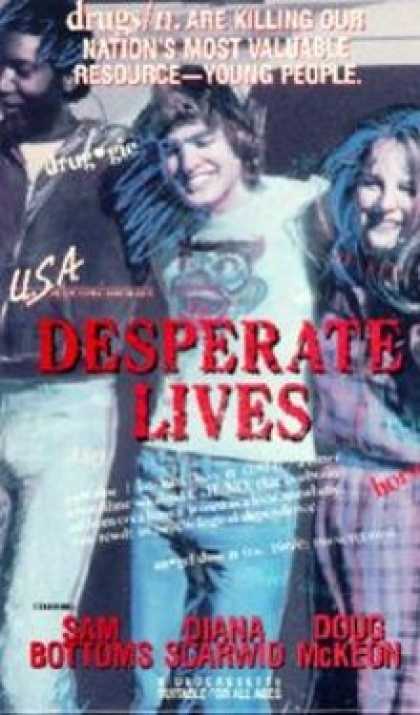
Embracing the Melodrama Part II #66: Desperate Lives (dir by Robert Michael Lewis)


DL-cov2YouTube, my old friend, you have failed me.

For the longest time, the 1982 anti-drug melodrama Desperate Lives has been available for viewing on YouTube.  I first watched it two years ago, after I read an online article about a scene in which a teenage Helen Hunt takes PCP and jumps through a window.  And, when I watched it, I was stunned.  I knew that the film was going to be over-the-top and silly, largely because it’s hard to imagine how a film featuring a teenage Helen Hunt taking PCP could be anything other than that.  But, even with my experience of watching over the top message movies, nothing could have quite prepared me for Desperate Lives.

So, I figured, for this review, that I’d say a few snarky words about Desperate Lives and then I’d just add something like, “And you can watch it below!”  And then I would embed the entire movie and all of y’all could just click on play and watch a movie on the Lens.

Unfortunately, Desperate Lives has been taken off of YouTube.  I assume the upload violated some sort of copyright thing.  And really, it’s kinda stupid because seriously, Desperate Lives is one of those films that really deserves to be seen for free on YouTube.

Oh well.  You can still watch a video of Helen Hunt jumping through that window.  The video below also features some additional elements from Desperate Lives.

For instance, you get to see Diana Scarwid playing the angriest high school guidance counselor in the world.  Scarwid knows that students like Helen Hunt are using drugs and that her fellow faculty members are turning a blind eye to everything’s that’s happening.  From the minute she first appears on screen, Scarwid is shouting at someone and she doesn’t stop screaming until the film ends.

And you also get to see Doug McKeon, playing Helen Hunt’s brother.  McKeon goes for a drive with his girlfriend, who has just taken PCP herself.  As their car goes flying off a mountain, she says, “Wheeee!”

In the video below, you also get to see that the only reason Helen Hunt used drugs was because her boyfriend begged her to.  That’s a scenario that seems to show up in a lot of high school drug films and it’s strange because it’s something that I’ve never actually seen happen or heard about happening in real life.  In fact, in real life, most users of hard drugs are actually very happy to not share their supply.

Unfortunately, the video below does not feature any scenes of Sam Bottoms as the world’s most charming drug dealer and that’s a shame because he gives the only good performance in the entire film (sorry, Helen!).

Even worse, the video doesn’t include any scenes from the film’s memorably insane conclusion, in which Scarwid searches every single locker in the school and then interrupts a pep rally so she can set everyone’s stash on fire in the middle of the gym.  Making it even better is that all the students are so moved by Scarwid’s final speech that they start tossing all of the drugs that they have on them into the fire.

Which means that the film essentially ends with the entire school getting high off of a huge marijuana bonfire.

No, that scene cannot be found in the video below.  But you can find Helen Hunt jumping through a window so enjoy.

http://www.youtube.com/watch?v=rEpyLzHeozY