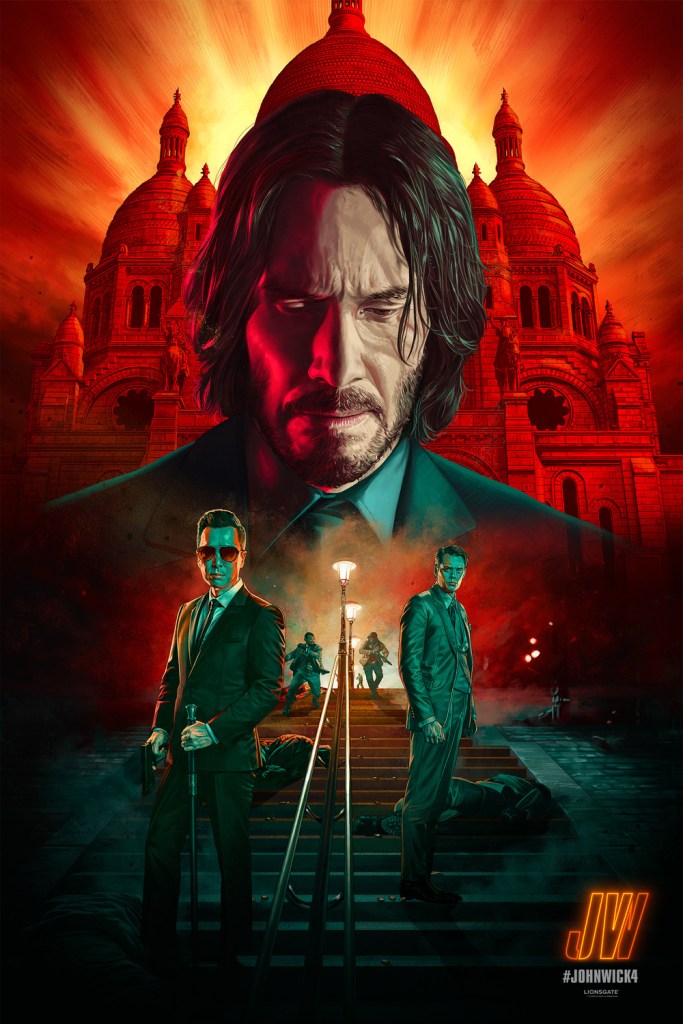
John Wick: Chapter 4 (dir. by Chad Stahelski) Review


“Those who cling to death; live. Those who cling to life; die.” – Caine

John Wick: Chapter 4 is the kind of action movie that doesn’t just lean into the spotlight—it steps into it, throws a flak vest over its suit, and then spends the next three hours filleting an entire world of assassins with brutal, balletic precision. At this point in the franchise, you’re either all‑in on the rules of the High Table, the Continental, and Wick’s endless mourning for his wife Helen, or you’re just here for the sheer spectacle of seeing Keanu Reeves beat up a continent’s worth of bad guys. The film not only respects that split audience, it tries really hard to satisfy both with a mix of operatic emotion, globe‑trotting locations, and a ridiculous amount of meticulously choreographed carnage.

One of the first things that stands out in John Wick: Chapter 4 is how much the world has expanded since the first film. The script doesn’t reinvent the core idea—Wick wants out, the system wants him broken, and the only way he can be free is by killing his way to the top—but it does layer on new zones, new factions, and a whole supporting cast of assassins who feel like they’re pulled out of their own B‑movies. From Morocco to Berlin, from New York to Paris, the film leans into a kind of hyper‑theatrical world‑building where every hotel lobby, nightclub, and underground fighting arena looks like it was designed by a comic‑book artist with a fetish for brutalism and neon lighting. That’s not a bad thing; it makes the universe feel lived‑in, even if it occasionally borders on self‑parody. The film also shuffles in a few fresh faces that give the usual assassin lineup some new flavors, including Donnie Yen as Caine, the stoic, blind assassin who carries both lethal efficiency and a quiet moral weight; Hiroyuki Sanada as the disciplined Shimazu, whose traditional demeanor and craftsmanship with a sword add a very grounded, almost old‑world element to the chaos; and Rina Sawayama as the high‑ranking assassin Akira, whose presence brings a mix of ruthless professionalism and a genuinely intriguing emotional arc that doesn’t feel like an afterthought.

There’s also Scott Adkins playing against his usual type as Killa Harkan, the head of the German Branch of the High Table, showing up in a surprisingly decent‑looking fat suit that gives him a grotesquely imposing presence while still hinting at the physicality audiences know from his other action roles. The character leans into the film’s tendency toward the theatrical, but he’s not just a walking gag; he fits into the world as one of the more visually exaggerated enforcers of the High Table’s rule. Alongside him, Shamier Anderson brings a lean, relentless energy as the Tracker, Wick’s shadowy, almost dog‑like pursuer whose loyalty to the system makes him more than just another interchangeable goon, while Marko Zaror crops up in the Berlin arena sequences as a brutal, wiry fighter whose style adds yet another distinct flavor to the movie’s unusually diverse fight roster. Taken together, these additions don’t just pad the body count; they give the film a sense that the John Wick universe is big enough to host everyone from classical swordsmen to modern martial‑arts specialists and even a few horror‑movie‑style fanatics, all orbiting the same doomed man.

The villain this time around is the Marquis Vincent Bisset de Gramont, played by Bill Skarsgård, and he’s the kind of High Table emissary who exists purely to make John’s life harder while reminding the audience that the system is more bureaucratic than it is mysterious. He’s got the cold, manipulative air of a corporate executive who’s never actually touched a gun but still has the power to ruin people’s lives on paper. His presence allows the film to spend more time on the politics of the assassin underground, which in turn forces John to pull in a wider network of allies, return favors, and, in a few cases, rebuild old friendships that were already on thin ice. That network includes the Bowery King, Caine, and the rest of the new cast, all of whom add texture to the usual slug‑fest even if the plot’s core emotional arc is still very much about a man who keeps remembering the wife he can’t get back.

Where Chapter 4 really flexes its muscles is in the action, and nowhere is that more obvious than in the extended Paris set‑piece that basically becomes the film’s centerpiece. It starts on the open city streets at night, with Wick already on the move, guns blazing and bodies piling up as the camera weaves through car‑chase energy and close‑quarters shoving. The chaos then escalates when the sequence shifts to the Arc de Triomphe roundabout, where the circular layout turns the whole area into a spinning, three‑dimensional shooting gallery. Cars whip around the monument, bullets ricochet off stone and metal, and the sheer spatial awareness of the choreography makes it feel like you’re watching a real‑time videogame map being systematically cleared in concentric circles, except the “map” is an iconic piece of Parisian infrastructure.

The escalation doesn’t stop there. The action migrates into a mostly empty, half‑abandoned apartment complex that feels like a brutalist concrete maze, each floor and hallway turning into a new arena for sprinting, reloading, and last‑minute dodges. The geography of the building becomes a character of its own, with shots that snake down stairwells, peer through doorways, and frame John as a lone figure ducking and weaving through a vertical death‑trap. It’s inside this apartment complex that the film drops one of its most memorable visual flourishes: a frenetic, prolonged shootout using dragon’s breath shotgun shells—incendiary rounds that send flaming pellets spraying outward—captured from an isometric, top‑down angle that directly evokes the look of indie action‑game favorites like The Hong Kong Massacre. The camera rides high above each room as Wick storms through, watching clusters of fire and bullets explode outward in geometric patterns, turning the interior layout into a living level map. It’s a moment that feels less like traditional cinema and more like a loving, hyper‑stylized homage to the way videogames can turn gunplay into a choreographed light show.

The final stretch of this extended Paris gauntlet is the brutal climb up the Rue Foyatier stairway to the Sacré‑Cœur steps, where the film’s choreographic and camera work reach their most expressionistic peak. The wide shots of Paris looming below, the narrowing of the stairway itself, and the way the camera sometimes drifts into an almost dreamlike, slightly elevated angle all combine to make the sequence feel like an endurance ritual rather than just another fight. By the time Wick reaches the top—after being hurled back down and forced to claw his way up again—the audience feels just as exhausted as he looks, which is exactly the point.

That’s part of what makes the film work when it isn’t just going hand‑to‑hand with you for nearly three hours. Beneath all the shooting and stabbing, John Wick: Chapter 4 is also quietly insistent on the idea that this is a tragedy. John Wick isn’t just a guy who happened to fall into a secret society of killers; he’s a man who has been reshaped by grief, loss, and the realization that every compromise he’s made along the way has only made his cage tighter. The film doesn’t over‑explain this; instead, it lets you watch him limp, cough up blood, and drag his battered frame through one more ambush, as if his body is the only thing strong enough to keep him breathing. The supporting characters—especially those tied to the High Table or to his past, including the newer faces like Caine, Shimazu, Akira, Killa Harkan, the Tracker, and the arena fighters—get a few moments to show that they’re not just cannon fodder, either. They have responsibilities, hierarchies, and codes that clash with the arbitrary cruelty of the Table, even if most of them still end up in the path of Wick’s bullets.

On the flip side, the movie is also unapologetically aware of how silly it is. There’s a knowing winking about the dialogue, the neon‑lit set designs, and the way lines like “You have until sunrise” are delivered with the gravity of a Shakespearean prophecy. The film doesn’t try to make you forget that this is ultimately a high‑end first‑person‑shooter turned into a live‑action ballet. It leans into the absurdity of escalating stakes, the way the world keeps conspiring to throw more and more assassins at John, and the fact that even when he’s bleeding out, he still insists on finishing a fight with a signature flourish. For some viewers, that will feel like a strength, a kind of self‑aware celebration of the genre. For others, it’ll feel like the moment the franchise tips from cool to camp, especially when the pacing starts to drag a bit in the middle section and the mix of formal duels, fat‑suited branch leaders, and endless negotiations begins to feel a little overstuffed.

The film’s length is its biggest liability. At around 169 minutes, John Wick: Chapter 4 is not shy about giving you more than enough time to live inside its world, but it also doesn’t always feel like it needs every last minute. The middle act, in particular, spends a lot of time on formalities, treaties, duels, and metaphysical negotiations with the High Table, which can slow the momentum when what you really want is for John to do another hallway‑fight or another truck‑pile‑up. There are times when the script feels like it’s stretching itself out to keep the spectacle going rather than tightening the storytelling, and that’s when the silliness of it all—like the deliberately over‑the‑top presence of Killa Harkan and the packed gallery of new faces—can start to work against the emotional weight the film is trying to build. A leaner, more ruthless edit would probably make the overall experience feel sharper and more focused.

Still, there’s a lot to admire in what the film manages to pull off. The sound design, the camera work, and the way the choreography is almost always shot in wide, relatively clear takes all combine to make the action feel substantial rather than edited into incomprehensible chaos. The supporting cast—Donnie Yen, Hiroyuki Sanada, Rina Sawayama, Scott Adkins, Shamier Anderson, Marko Zaror, and others—add texture and personality to a world that could otherwise feel like a series of interchangeable goons. They’re not just there to get shot; they’re there to give the film a sense of a larger, more complicated ecosystem of killers, each with their own rules and reasons.

In the end, John Wick: Chapter 4 is less a strict narrative continuation and more of a cinematic endurance event. It doesn’t reinvent the franchise, but it pushes the Wick formula into more extreme, more theatrical, and more emotionally committed territory. It’s messy in places, overstuffed in others, but it also has a few moments of pure, jaw‑dropping action that will probably end up in “best of the decade” lists among genre fans, especially that Paris mega‑set‑piece that starts on open streets, spirals through the Arc de Triomphe, invades an empty apartment complex for that dragon’s‑breath top‑down firefight, and climaxes on the Rue Foyatier stairs. If you’re someone who cares about emotional coherence and tight plotting, the film will probably test your patience. If you’re someone who’s here for the ballet of bullets, the operatic bloodshed, the eccentric new cast, and the sight of Keanu Reeves refusing to stay down no matter how many times the universe tries to kill him, then John Wick: Chapter 4 is a pretty satisfying send‑off—or at least a very loud, very stylish stop on the way there.

Weapons used by John Wick throughout the film

  • Glock 34 (TTI Combat Master Package) – His primary pistol early on, including the Morocco sequence against the new Elder and during the Osaka Continental battle.
  • Agency Arms Glock 17 – Used by Wick during the garden fight at the Osaka Continental after he takes it off a High Table enforcer.​​
  • TTI Pit Viper – The “hero gun” of the movie, custom‑built for Chapter 4, used heavily in the Paris staircase and duel lead‑up sequences.
  • Thompson Center Arms Encore pistol – custom-made single-shot pistols created specifically for the Sacre-Couer duel.
  • TTI Dracarys Gen‑12 – The dragon’s‑breath shotgun he grabs during the Paris apartment sequence, used in the isometric top‑down “videogame” style scene.
  • Spike’s Tactical Compressor carbine – Used by Wick after he takes it from High Table enforcers during the Osaka Continental fight.

John Wick Franchise (spinoffs)
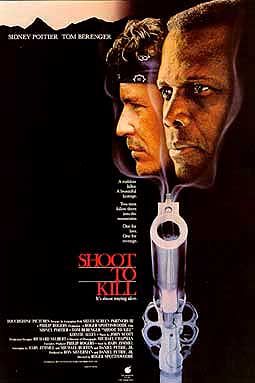
Film Review: Shoot to Kill (dir by Roger Spottiswoode)


I am not one for camping.

I’m actually kind of alone amongst my family as far as that’s concerned.  All three of my sisters enjoy spending the night outdoors, listening to sounds of nature and looking up at the stars.  They know how to set up tents and make campfires and they enjoy hiking and rafting and exploring the great outdoors.  Myself, I do enjoy occasionally spending the weekend up at Lake Texoma and I like the fact that, even though we live in the city, we still occasionally get to see wildlife running around.  I think possums are cute.  A few days ago, I squealed with delight when I saw that there was a raccoon hanging out in one of our backyard trees.  (“Don’t go near that thing, Lisa Marie!” Erin snapped as I reached for the den door.)  Growing up, I spent time in both the country and the city.  While I love living in the city, there’s still a part of me that’s still a country girl.  That said, I definitely prefer sleeping inside to outside.  The inside is safe.  The inside is comfortable.  The inside is free of creepy bugs that crawl on the ground.

Watching 1988’s Shoot to Kill definitely did not do much to change my opinion about camping.  In this thriller from director Roger Spottiswoode, Sidney Poitier plays Warren Stantin, an FBI agent who is obsessed with capturing a sadistic criminal who blackmails people into doing his work for him.  At the start of the film, the extortionist has forced a jeweler to break into his own jewelry store by taking the jeweler’s wife hostage.  Stantin’s attempt to capture the extortionist leads to the jeweler’s wife taking a bullet in the eye.  (AGCK!  Seriously, this guy is mean!)  Stantin traces the man to Washington State, where he discovers that the extortionist has committed another murder and stolen the victim’s identity.  The extortionist is now a member of a five-man fishing party that is being led by a local guide, Sarah Renell (Kirstie Alley).  Stantin teams up with Sarah’s partner, Jonathan Knox (Tom Berenger), and the two of them attempts to track down the group before the murderer among them makes his move.

The action cuts back-and-forth, between Sarah’s party and Knox and Stantin.  Most viewers will probably be able to quickly figure out which member of Sarah’s party is the killer but director Spottiswoode still creates a little suspense by casting actors like Richard Masur, Andrew Robinson, and Clancy Brown as the suspects.  All three of the actors have played their share of sinister characters.  (Andrew Robinson was the Scorpio Killer, for God’s sake!)  While Sarah leads the murderer though the wilderness, Knox teaches Stantin how to survive in the great outdoors.  As is typical with films like this, Knox and Stantin go from disliking each other to depending on each other.  Have you ever wanted to see Sidney Poitier get into a verbal altercation with a bear?  This is the film for you!

Shoot to Kill is a superior genre film.  The story’s predictable but it’s told so well that it doesn’t matter.  Kirstie Alley, Tom Berenger, and Sidney Poitier all give good performances as sympathetic characters.  As for the actor who turns out to be the killer, he gives a performance that is, at times, absolutely terrifying.  Shoot to Kill is an entertaining thriller.  Just don’t watch it if you’re going camping the next day.

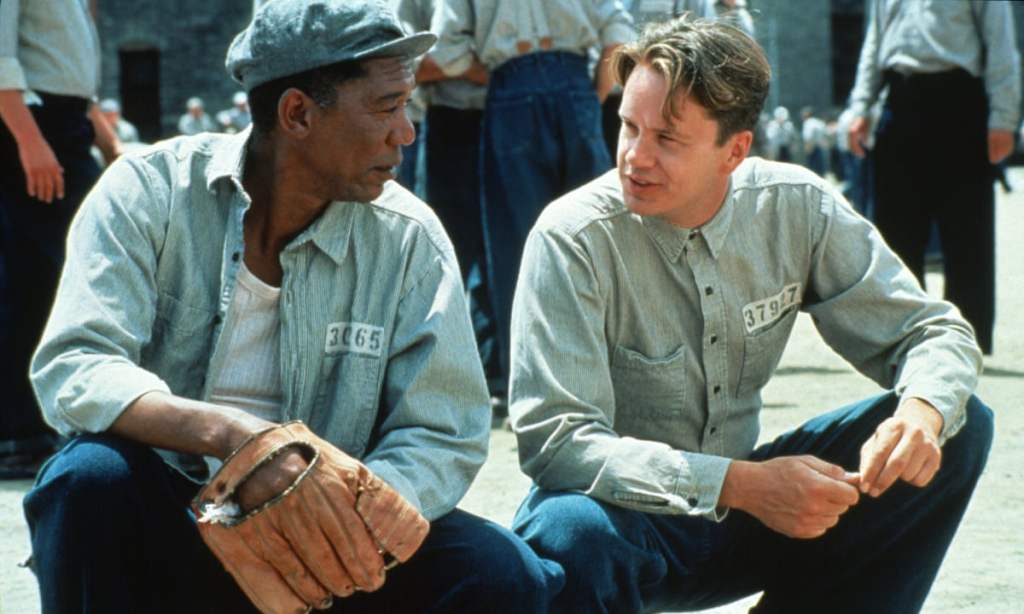
THE SHAWSHANK REDEMPTION (1994) – In honor of our son’s birthday, I review his favorite movie!


I sent our son a text the other day and asked him if he had an answer for the question “What’s your favorite movie?” I thought I knew the answer but it turns out I was only half right. I expected his answer to be THE HATEFUL EIGHT. Rather, the answer I received back was “The Hateful Eight or Shawshank Redemption!” Since I recently wrote about the time that he and I attended THE HATEFUL EIGHT roadshow in Dallas, I decided I would write about THE SHAWSHANK REDEMPTION this time around. It doesn’t hurt that it’s one of my favorite movies as well. It also doesn’t hurt that it’s the very top rated film on the Internet Movie Database.

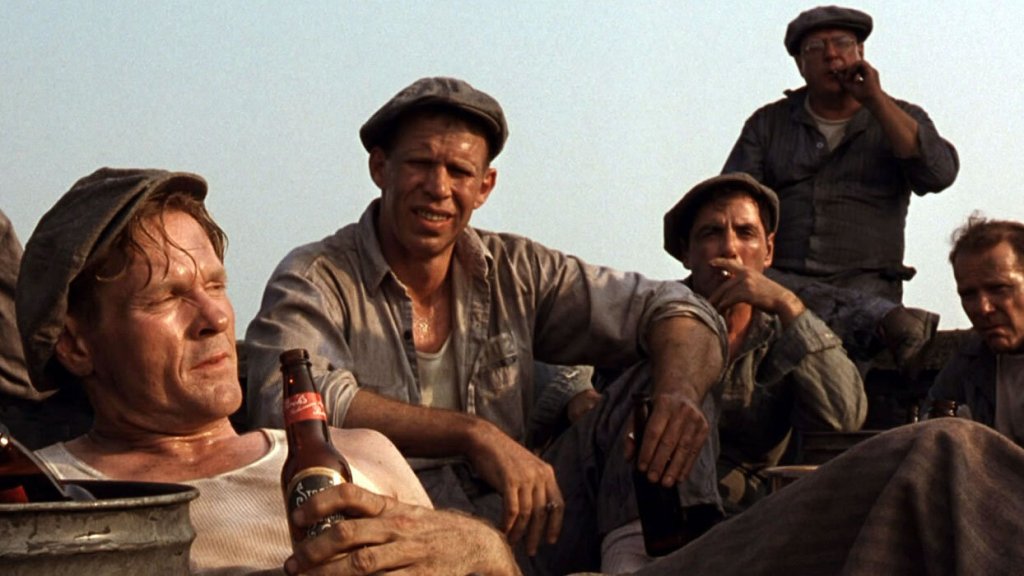
Based on Stephen King’s “Rita Hayworth and Shawshank Redemption,” the story is well known… hot shot banker Andy Dufresne (Tim Robbins) is convicted of the murder of his wife and her lover, and gets sentenced to life at the Shawshank prison. Once on the inside, we meet a variety of characters that you expect in a prison movie. We meet Warden Norton (Bob Gunton), the hypocrite who speaks of the Bible while hiding a corrupt, evil spirit. We meet Captain Hadley (Clancy Brown), the brutal chief prison guard, who rules over the inmates with intimidation and a real willingness to inflict violence and pain on anyone who shows the least bit of independence. We meet Red (Morgan Freeman), the long-time inmate who has the ability and connections to get you anything you need. We meet other inmates like Heywood (William Sadler), the inmate who seems like a jerk when you first meet him but turns out to be a pretty good fella; Tommy (Gil Bellows), the young guy who comes into prison and may know something that proves Andy’s innocence; Brooks (James Whitmore), the old man who gets released after almost a lifetime in prison, and doesn’t know how to adjust to life on the outside; and Bogs (Mark Rolston), the sadistic prisoner who wants to force himself on Andy, and is willing to kill to get what he wants. Life isn’t easy at all in Shawshank, but Andy’s intelligence and ability to prove himself useful to Warden Norton and Captain Hadley allows him to finds ways to make life more bearable for him and his friends. After nineteen years in prison, even though he maintains his innocence, it appears that Andy is content to live out his remaining years in prison. Or is he??

I’ll never forget the first time I saw the movie THE SHAWSHANK REDEMPTION. I didn’t see it until a year or two after its initial release in 1994. I was one of those guys who figured a movie that praised by the critics was probably not something that I would like that much. Plus, at the time, the title of the movie just seemed kind of weird. But I kept hearing about how great it was, so I finally decided to give it a viewing. I agree with my son, I think THE SHAWSHANK REDEMPTION is one of the most emotionally uplifting movies ever made. Why is that you might ask? My answer would be because there’s something profoundly satisfying about people who persevere through the worst times imaginable and continue to find hope where most of us would be hopeless. Prison life is shown as horrific. One prisoner is literally beaten to death by Captain Hadley on his first night in prison for crying. Andy fights off the sadistic Bogs as much as he can, but he is unable to completely fight off his advances. But no matter what he goes through, Andy Dufresne is able keep moving forward, and he does not allow the prison life to completely crush his spirit. He keeps finding ways to persevere. Andy’s actions and endurance turn simple acts like listening to Mozart or having a beer into overwhelming emotional highs for us as the audience. The film also maintains a realistic sense of humor, which might seem difficult under the circumstances. This sense of humor is found in such mundane tasks as creating a prison library, providing tax prep services for the guards, or attending multiple parole hearings over the years. These comedic moments are earned by the way the movie takes it’s time letting us really get to the know the characters and then laugh with them as the individual moments occur. And the friendship between Andy and Red is something that deeply resonates with me. I think we all would like to have that kind of friendship. These kinds of friendships aren’t built overnight, and often they require a level of shared experience that is almost impossible to find. But they find it behind Shawshank’s prison walls, and it connects them for life. In my opinion, the friendship between these two characters leads to one of the most emotionally satisfying endings to any film, ever.

Director Frank Darabont was able to obtain some of career-defining performances from his cast. As good as Tim Robbins is as an actor, in my opinion, he has never been better than he was as Andy Dufresne. And I say this knowing full well he won an Oscar for MYSTIC RIVER. He maintains his dignity against all odds and only appears to break down a time or two. Morgan Freeman is great as always as Red, but his character is so important because we see him go from a hopeless skeptic, to a man who truly has hope thanks to his friendship with Andy. Freeman seems to handle this transition effortlessly. I’m going to give a shoutout to James Whitmore as well. With a career going all the way back to the 1940’s, his performance as Brooks Hatlen is one of the more touching and heartbreaking performances of the film. I haven’t seen all of his work, but I have never seen him better than he was in THE SHAWSHANK REDEMPTION. Each additional cast member, from Bob Gunton, Clancy Brown and Mark Rolston, to Willam Sadler and Gil Bellows all have powerful moments that add to the overall effect of the film.

Looking back now, it’s hard to believe that THE SHAWSHANK REDEMPTION did not win the Academy Award for best film. It lost to FORREST GUMP when the awards were handed out in 1995. It’s even harder to believe that the film did not win a single Academy Award even though it received seven nominations. But at the end of the day, that doesn’t really matter to me. I just know that it’s a great film, and it reaches emotional heights that very few movies, if any, have ever reached before. That’s a pretty damn good legacy.

STARSHIP TROOPERS and Hell’s Half Acre – Taking my love of the movies on down the road (Part 4)!


2022 was a big year for my wife Sierra and I when it comes to “movie tourism.” I’ve already discussed our trips to Pennsylvania and Colorado to celebrate my healthy obsession with the late, great action movie icon Charles Bronson. In that same year, we spent some time in the beautiful city of Casper, Wyoming. About 40 miles from Casper is a place called “Hell’s Half Acre.” Sierra lived in Casper for 18 years, and she told me that the movie STARSHIP TROOPERS was filmed there. I had no idea. I had watched the movie way back in late 90’s because it was directed by Paul Verhoeven, the Dutch director who had made a star out of Rutger Hauer before coming to America and directing films like ROBOCOP, TOTAL RECALL, and BASIC INSTINCT. I remember it being graphically violent, but I honestly didn’t remember much about it. The fact that it was filmed out in the middle of nowhere outside of Casper piqued my interest, and I was determined to know more.

In a nutshell, STARSHIP TROOPERS stars Casper Van Dien as Johnny Rico, a young man who joins the military after graduation to become a citizen, and because of his love for his high school sweetheart Carmen (Denise Richards). As part of his service, he finds himself in a war against the bug aliens of Klendathu. Every day is a battle for survival as the soldiers try to save the human race. Aside from Van Dien and Richards, director Verhoeven has assembled an excellent supporting cast that includes veterans like Michael Ironside, Clancy Brown, and even Rue McClanahan. Maybe it’s because I visited the location, but I enjoyed the movie much more now, than I remember enjoying it back in the 90’s.

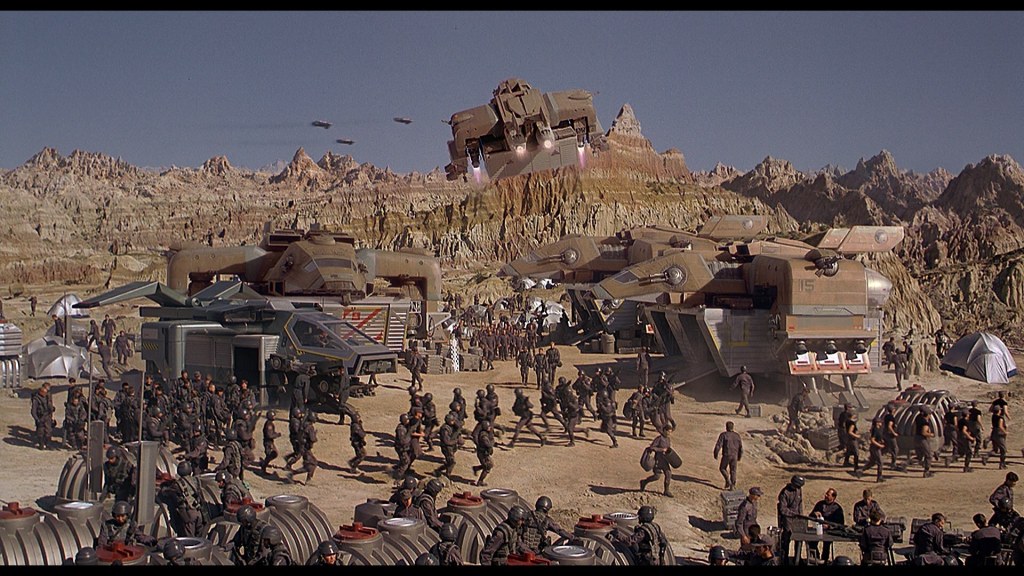
Hell’s Half Acre stood in for the alien planet of Klendathu in STARSHIP TROOPERS. It’s an interesting looking area that reminds me of the look of the Grand Canyon when viewed from afar. It turned out to be the perfect place for an alien planet, even if there was always a chance that the cast and crew might run into a rattlesnake or two. Here’s a picture I took of the sign on the premises that tells you a little more about Hell’s Half Acre.

The picture at the top of the article shows how Hell’s Half Acre is used in the movie to represent the alien planet of Klendathu. Here’s an image of the movie’s star, Casper Van Dien, on location. I met several people in Casper who remember when the actors and the crew were staying in Casper during filming, and they all spoke very positively of Van Dien. I also find it interesting that Casper Van Dien is filming this movie just outside of Casper, Wyoming. What are the chances?

Here are few of the pictures we took on our visit. I sent the picture below to my son while we were out of town and asked him if he knew where we were. His guess was The Grand Canyon!

Making movies is one hell of a business, and visiting Hell’s Half Acre was a great reminder of the imagination it takes to create movie magic. It was also a fun way to spend part of day, especially for a movie lover like me!

14 Days of Paranoia #9: Chappaquiddick (dir by John Curran)


On July 18th, 1969, while American astronauts were preparing to land on and then take their first steps on the Moon, a 28 year-old woman named Mary Jo Kopechne attended a party on Chappaquiddick Island in Massachusetts.

A former aide to Robert Kennedy who was reportedly devastated by his assassination, Mary Jo was one of several former campaign workers who gathered at an isolated cabin that night.  According to the others at the party, Mary Jo (who was described as being a devout Catholic who rarely drank) was one of the first people to leave the party.  She left with another guest.  The next morning, that guest’s car was found overturned in Poucha Pond.  Dead in the backseat was Mary Jo Kopechne, who had suffocated as the car slowly filled up with water.  It was later determined that she had been alive and trapped in the car for hours before dying.  The owner of the car was back at his hotel.  He had returned there after crashing his car and, while he had taken a shower and combed his hair and called his father, he had not bothered to call the police.

Normally, a driver in this situation would be in serious legal jeopardy.  Along with having left the scene of the accident, he also left Mary Jo to die.  It was generally agreed that if he had called the police within an hour of the accident occurring, Mary Jo could have been saved.  However, because he was Ted Kennedy and the last remaining of the fabled Kennedy brothers and a man who many expected would someday be president, he was given a slap on the wrist and the death of Mary Jo would be forever described as being a “Kennedy tragedy” as opposed to a Kopechne tragedy.

Not surprisingly, there has been a lot of speculation about what had happened in the moments leading up to the crash.  Like his brothers, Ted Kennedy was a notorious and reckless womanizer.  Unlike his brothers, Ted also had a reputation for being a heavy drinker.  Some went as far as to accuse Ted of deliberately murdering Mary Jo, as if the actions that Ted later admitted to were not, in themselves, already bad enough.  While people may disagree on the circumstances that led to the accident, it is generally agreed that, if Ted had been anyone other than a Kennedy, he would have served time in prison.  The incident ended Ted’s presidential dreams but it didn’t keep him from being described as being the “lion of the Senate” when he died in 2010.  Indeed, when Ted died, many people on twitter expressed their shock as they read or heard about Mary Jo Kopechne for the first time in their lives.

(In 2010, Mary Jo would have been seventy years old.)

Obviously, no one was going to make a movie about Mary Jo Kopechne’s death while Ted was still living.  Indeed, even after Ted died, it still took seven more years for the story to be turned into a film and producer Byron Allen struggled to even book the film in theaters.  2017’s Chappaquiddick stars Jason Clarke as Ted and, briefly, Kate Mara as Mary Jo.  The film speculates as to what happened that night and it probably gets fairly close to the truth.  The accident is an accident, a result of Ted freaking out when a cop stops him for speeding and sees him with a woman who isn’t his wife.  Ted, who is portrayed as being an immature manchild, turns to his handlers and then his family for help.  His fails to call the authorities because, to Ted, there is no greater authority than his abusive father (Bruce Dern).

For the most part, Ted passively sits by as associates of his late brothers — including Ted Sorenson (Taylor Nichols, giving the film’s strongest performance), Joe Gargan (Ed Helms), and Paul Markham (Jim Gaffigan) — take over his defense and carefully craft his every response.  Ted’s attempts to provide input are shot down and it’s made clear that his job is to shut up and concentrate on returning the Kennedys to the White House.  The film’s best scenes feature Sorenson growing frustrated at all of Ted’s mistakes.  Very little concern is shown for the fact that Mary Jo Kopechne, a Kennedy true believer, is dead due to Ted’s recklessness.  When she was alive, Mary Jo was held up as a symbol of the Kennedy youth.  When she died, she was just viewed as being an obstacle to keeping the Kennedys from reaching the power to which they felt entitled.

As you can probably guess, Ted Kennedy does not come off particularly well in this film.  At his best, he’s a wimp who is struggling with a legacy of which he knows he’s not worthy.  At his worst, he is pathologically self-absorbed and incapable of feeling empathy for the woman he left to drown in the backseat of his car.  Both he and Mary Jo and ultimately the voters who are expected to reelect him even after he leaves Mary Jo to die are ultimately portrayed as just being pawns of the shadowy men who lurk behind the scenes of every political operation.

It’s not a happy film and it certainly has its flaws but it provides an important service, reminding viewers that death of Mary Jo Kopchene was more than just as a “Kennedy tragedy.”

14 Days of Paranoia:

  1. Fast Money (1996)
  2. Deep Throat II (1974)
  3. The Passover Plot (1976)
  4. The Believers (1987)
  5. Payback (1999)
  6. Lockdown 2025 (2021)
  7. No Way Out (1987)
  8. Reality (2023)

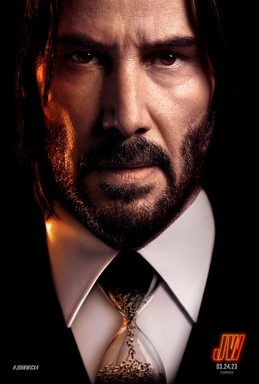
Film Review: John Wick: Chapter Four (dir by Chad Stahelski)


Yesterday, I finally watched the hit film of March 2023, John Wick: Chapter Four.  It left me overwhelmed and I mean that in the best possible way.

The film picks up where the last film left off.  John Wick (Keanu Reeves), the dog-loving, formerly retired professional hit man, is still traveling the world and killing the leaders of the High Table.  As becomes apparent from the start of the film, it’s a bit of a fool’s errand as killing one leader only leads to another leader being installed.  When John travels to Morocco to kill the leader known as “The Elder,” he discovers that the Elder he knew is gone and has been replaced with a new Elder.  He still kills the new Elder because that’s what John Wick does.  He kills people.  He’s a literal killing machine, one who audiences like because he loves dogs, is still mourning for his dead wife, and he’s played by Keanu Reeves.  On paper, the relentless and ruthless character of John Wick is horrifying.  But, when he’s played by Keanu Reeves, he becomes the killing machine that audiences can’t help but love.

The arrogant and brilliantly named Marquis Vincent Bisset de Gramont (Bill Skarsgard, giving a wonderfully hissable performance) is currently in charge of the efforts to track down and kill John.  The Marquis establishes himself as being evil by not only killing Charon (Lance Reddick) but also blowing up the Continental.  Upset by the murder of Charon and the destruction of his business, Winston (Ian McShane, playing his role with the perfect amount of wounded dignity) tells John that he can end his entire war with the High Table by challenging the Marquis to a duel.  Unfortunately, to do that, John has to convince another criminal organization to sponsor him and just about criminal organization on the planet wants John did.  To make things even more difficult, the Marquis has brought the blind assassin, Caine (the incredible Donnie Yen), out of retirement to track down John.  Caine and John are old friends but Caine knows that his daughter will be killed unless he kills John.

Clocking in at 169 minutes, John Wick: Chapter Four is a big, flamboyant, and at times overwhelming production.  John Wick travels across the world and every country in which he finds himself is home to someone who wants him dead.  And since everyone that John Wick knows seems to have a unlimited supply of guards and henchmen, the fights are nonstop and the violence is over the top but the film is so energetic and cheerfully excessive that it’s never boring.  Each fight scene feels like it could be a separate film on its own, with each member of the cast getting a chance to show off what they can do.  The water-filled fight in a Berlin night club is the film’s best moment but it’s closely followed by an extended combat sequence that’s set in a hotel in Japan.  With its vivid cinematography and ornate production design and its spectacular stunts, John Wick Chapter 4 is a work of pure cinema, an thrill ride of glorious excess.  Along with providing an ending to John Wick’s story, it also pays tribute to everything that audiences love about action cinema.  It’s a film for people who love action and, even more importantly, it’s film that has as much love for its audience as it does for itself.

The film ends on a note of apparent finality, one that becomes more ambiguous the more that one examines it.  This may be the last chapter of John Wick’s story or it may not.  (Considering the film’s box office and critical success, I suspect that it will not be the last.)  John Wick Chapter Four serves as a fitting (if perhaps temporary) end to the saga and also a tribute to both the action aesthetic and Keanu Reeves’s innate likability. 

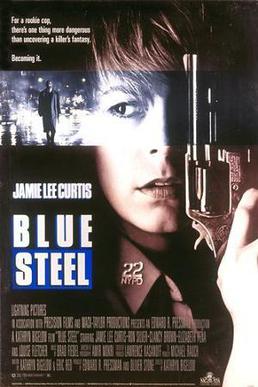
Blue Steel (1990, directed by Kathryn Bigelow)


On her first night on the job, rookie cop Megan Turner (Jamie Lee Curtis) blows away a robber (Tom Sizemore) who was holding up a convenience store.  The robber was holding a gun when he was shot but, right after his body hits the ground, the gun is stolen by a stockbroker named Eugene Hunt (Ron Silver).  Somehow, no one notices Eugene grabbing the gun from the floor and he improbably gets away from the crime scene without any of the investigating officers noticing that he’s concealing a gun in his suit.

Because Eugene stole the gun, Megan is accused of shooting an unarmed man and she is suspended from the force.  Meanwhile, Eugene becomes obsessed with the gun, hears voices, and starts to shoot random people.  He even carves Megan’s name on one of the bullets.  When the bullet is found in the body of one of Eugene’s targets, Megan becomes the number one suspect even though it wouldn’t make any sense for a murderer to carve their name on the evidence.  This isn’t The Wire.  None of the dead are going to be found with a note in their hand that says, “Tater Killed Me.”  It should be obvious to everyone that Megan is being set up but instead, everyone just assumes Megan is a stupid murderer who doesn’t know how to cover her tracks.  Eugene also starts to date Megan but when Megan rejects him after he confesses to being the murderer, Eugene starts to stalk her and her friends.  Not even Megan’s new boyfriend (Clancy Brown) can keep her safe from a stockbroker with a grudge.

Blue Steel benefits from Kathryn Bigelow’s stylish direction and Jamie Lee Curtis’s dedicated performance but it suffers because Eugene is so obviously crazy from the get go that it never makes sense that he would be able to get away with his crimes for as long as he does.  Even after Megan realizes that Eugene is crazy, she can’t get anyone to believe her even though everything about Eugene suggests that he’s the murderer.  Not even confessing to the crime is enough to keep Eugene in prison.  Somehow, Eugene is able to commit multiple murders and attempted murders right in front of Megan and then escape before Megan or anyone else can even react.  Megan’s been trained at the Police Academy while Eugene has no criminal training whatsoever but he’s still always able to outthink and outrun her.  It makes it seem as if Megan just isn’t a very good cop.  Luckily, Bigelow, Curtis, Silver, and Clancy Brown would all be involved with better movies in the future.

Keanu Reeves returns in the John Wick 4 Trailer!


The High Table would like a word with John Wick.

I’m surprised there’s anyone left to fight, but on hand, we have Natalia Tena (Game of Thrones), Bill Skarsgard (Barbarian), Hiroyuki Sanada (The Wolverine), Scott Adkins (Accident Man), Clancy Brown (Thor: Ragnarok) and the legendary Donnie Yen (Ip-Man, Rogue One). They join the original cast that includes Keanu Reeves, Laurence Fishburne, Lance Reddick, & Ian McShane.

John Wick: Chapter 4 is set to release in theatres on March 24, 2023.

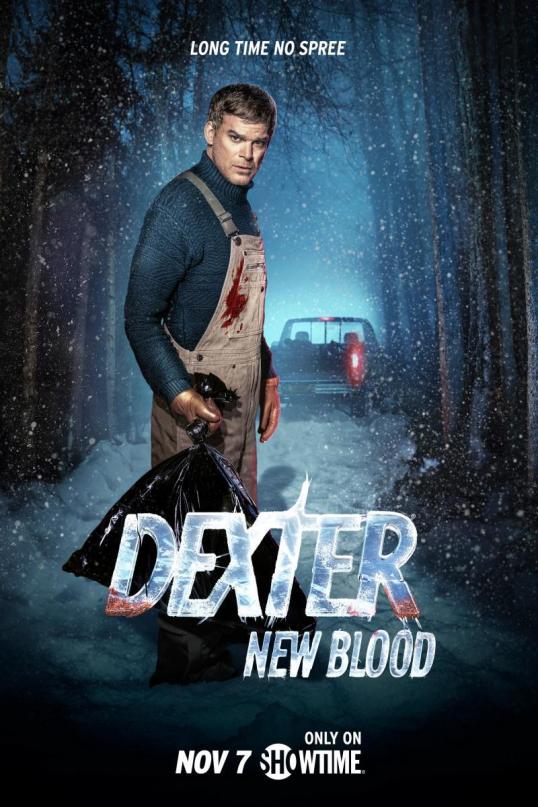
TV Review: Dexter: New Blood 1.9 “The Family Business” (dir by Sanford Bookstaver)


We all knew that, at some point, Dexter would have to welcome Harrison into the family business.  It finally happened on this week’s episode of Dexter: New Blood.

Set on Christmas day (but, oddly enough, airing during the first week of January), the ninth episode of Dexter: New Blood found Dexter and Harrison finally bonding.  Dexter told Harrison the story of Wiggles the Clown though, at the insistence of Ghost Deb, Dexter said that he just told Wiggles to stop doing what he was doing.  Even when Dexter was telling the story, it was obvious that Harrison knew there was more to it than just Dexter giving a stern lecture.

Harrison also told Dexter that he had stabbed his friend and that he wasn’t the hero that everyone made him out to be.  Yeah, we all figured that out a while ago, Harrison!  Still, it was interesting to watch Harrison discover what the rest of us take for granted.  We’re so used to the idea of Dexter tracking down serial killers and murdering them that it’s easy to forget just how weird and traumatic it would be for someone to learn about it or witness it for the first time.  One of the big problems that I had with the final season of Dexter’s original run is that Deb never seemed to be truly shocked at the discovery that her brother was a serial killer.  Fortunately, the reboot did a better job with Harrison than the original did with Deb.

And yes, Harrison did learn the truth.  He and Dexter tracked down Kurt’s secret lair and saw Kurt’s “trophies.”  And when Harrison announced that Kurt needed to die, just the slightest smile came to Dexter’s lips.  Dexter managed to bring Harrison over to his side without actually having to confess to all of the people that he had killed.  Only after Harrison had announced that he was on board with the idea that some people deserved to die, did Dexter admit to killing Wiggles the Clown and Arthur Mitchell.

Kurt met his end in this episode.  Harrison watched as Dexter killed him and then, somewhat ominously, had a flashback to Rita’s murder.  Is Harrison going to realize that, for all of Dexter’s rationalizations, his father is a serial killer as well?  If Harrison truly buys into the code, then Dexter could be in some trouble.

Actually, Dexter might be in trouble regardless.  Angela appears to have figured out that Dexter killed the drug dealer.  And, at the end of this episode, she received a letter telling her that “Jim Lindsay Killed Matt Caldwell” and one of the titanium screws that was left behind after Dexter burned Matt’s body.  If Angela learns the truth, will she arrest Dexter or will she let him and Harrison go free?  Angela has sworn to uphold the law but Kurt also murdered Angela’s best friend.  And, as we learned on Sunday, Kurt also murdered Molly.  Angela might be tempted to let Dexter escape.  I guess we’ll find out next week.

It was an excellent episode, though I have to admit that I was really disappointed when Molly showed up as one of Kurt’s trophies.  When Molly first appeared, her character annoyed me but, as the season progressed, I came to appreciate both the character and Jamie Chung’s performance.  In many ways, she was the stand-in for the viewers.  It was hard not to feel that she deserved better than to be killed off-screen.  Indeed, considering that she knew that Kurt was probably a killer, you have to wonder how he managed to ever get to her in the first place.

Still, that aside, The Family Business was Dexter at its best.  The deliberate pace and the atmospheric direction all reminded of the classic early seasons of Dexter.  Michael C. Hall perfectly captured Dexter’s love of his work while Jack Alcott played Harrison with the right mix of fascination and fear.  Still, I have to wonder what the show’s end game is going to be.  Ghost Deb was pretty adamant about Dexter not bringing Harrison into the family business and Ghost Deb usually know what she’s talking about.

We’ll find out next week!

TV Review: Dexter: New Blood 1.8 “Unfair Game” (dir by Sanford Bookstaver)


So, Dexter is going to teach Harrison “the code.”

Wow, who could have predicted that!?

Okay, okay …. I know it’s not good to gloat but let me have my moment.  From the minute that Harrison showed up at Dexter’s cabin, I’ve been waiting for him to take up the family business and it would appear that’s what is about to happen.  My prediction was correct and it’s actually kind of rare that happens so I’m definitely going to take a little bit of pride in this moment.

Kurt definitely had his chance to bring Harrison over to his side but he ruined it by snapping and trying to kill Harrison.  Big mistake there, Kurt.  Harrison is now back with Dexter and, judging from that big hug he gave him, it appears that there’s no longer any doubt in Harrison’s mind as to which father figure he should follow.

It was an exciting episode.  Along with Kurt’s attempts to bond with Harrison, we also got a lot of scenes of Dexter and the truck driver chasing each other through that abandoned summer camp.  (“Perfect place for a serial killer,” as Dexter put it.)  Why didn’t Kurt take out Dexter personally?  That was my only real question.  I get that Kurt wanted to bond with Harrison but he could have easily killed Dexter and the bonded with Harrison later.  It’s not like Harrison has anywhere to go.  Instead, Kurt made the mistake of outsourcing the murder of his biggest enemy.  Entrusting a job that important to a random truck driver doesn’t really make that much sense.  Kurt screwed that one up because, despite being shot in the leg, Dexter managed to kill that truck driver and save Harrison.  In the past, Dexter has spent so much time in its lead character’s mind that it was interesting to see that Dexter can take care of himself physically as well.

Dexter and Harrison appear to be ready to go to war with Kurt but it also appears that Angela has figured out that Dexter murdered that drug dealer a few episodes back.  Will Angela arrest Dexter?  Will Dexter have to fake his death yet again?  Let’s hope not.  There’s only so many times that one character can successfully fake his death before it starts to challenge the viewer’s suspension of disbelief.

That said, I don’t see Dexter sticking around town, regardless of how everything turns out.  I’ve seen some speculation that Dexter will sacrifice his life to save Harrison and then Harrison will be the “new” Dexter.  I don’t think that’s going to happen just because I don’t think Showtime is going to want to abandon the character of Dexter after this miniseries ends two weeks from now.  If nothing else, Dexter: New Blood has proven that there is still a sizable audience that’s interested in Dexter’s adventures.  Ask me to look into the future and I see Dexter and Harrison going on the road together and hunting killers.  It’s the family business.

Am I right?  We’ll find out in another two weeks!