Doctor Who — Destiny of the Daleks, City of Death, The Creature From The Pit, Nightmare of Eden, Horns of Nimon, Shada


Remember when I was writing about classic Doctor Who for Halloween?  Let’s get back to that with a look at the 17th season of the original series.  This season is a controversial one.  It featured some of the show’s worst serials but also one of its best.  Today, it’s remembered for introducing Lalla Ward as the second Romana and for featuring Douglas Adams as the script editor.

One frequent complaint about this season is that, under Adams’s influence, the season featured more comedy than before and it sometimes felt more like a version of Hitchhiker’s than Doctor Who.  There’s some truth to that but Adams’s influence also made Season 17 into a season unlike any other.  Many of Adams’s ideas didn’t work but he did give us City of Death.

Destiny of the Daleks (1979, directed by Kim Grieve)

Destiny of the Daleks will always have a place in my heart because it opens with Romana regenerating into Lalla Ward.  I will admit right now that, as a kid watching Doctor Who on PBS, I had a huge crush on Lalla Ward.  So did Tom Baker.  He ended up marrying Ward, though the marriage did not last for long.  The relationship between Baker and Ward often seemed to reflected in the relationship between The Doctor and Ward’s Romana.  Long before the Doctor Who reboot had people buzzing about the Doctor and Rose, fans of the original series knew that the Doctor and Romana were in love.

Destiny of the Daleks opens with Lalla Ward’s Romana cheerfully informing the Doctor that she’s decided to regenerate because she was bored and she’s decided to look like Princess Astra.  The Doctor points out that Princess Astra is a real person and Romana can’t just take on her appearance.  Romana then tries out several other appearances before The Doctor tells her to go with Astra.  This goes against everything that the show had established about Time Lords and regeneration but at least we end up with Lalla Ward as Romana.

It’s too bad that the rest of the serial itself isn’t that interesting, even if it does feature the first appearance by the Daleks since Genesis of the Daleks.  Davros returns as well, though he’s now more or less just another generic villain.  The Daleks have a new enemy, a group of robots called the Movellans.  The war between the Daleks and the Movellans are at a standstill because both are governed by logic.  That goes against everything we know about the Daleks.

This was Terry Nation’s final script for Doctor Who.  Reportedly, he was angered when Douglas Adams extensively rewrote the script.  Nation moved to America and later created the original MacGyver.

City of Death (1979, directed by Michael Hayes)

City of Death is a Doctor Who classic.  Romana and the Doctor visit modern-day Paris and the BBC found the money to allow the production to shoot on location.  The Doctor and Romana walk around Paris, hand-in-hand.  Count Scarlioni (Julian Glover) is actually an alien who wants to steal the Mona Lisa so that he can use it to fund his time travel experiments.  Countess Sacrlioni (Catherine Schell) is a classic femme fatale.  An American private investigator named Duggan (Tom Chabdon) wears a trench coat and solves problems by punching first and asking questions later.  John Cleese and Eleanor Bron appears as museum patrons who think the TARDIS is a work of modern art.  Douglas Adams later reworked bits of his script into Dirk Gentley’s Holistic Detective Agency.

Even people who cannot stand the rest of season 17 will agree that City of Death is one of the best of Tom Baker’s serials.  City of Death balances humor and drama and it features an excellent villain in the form of Julian Glover.  Tom Baker and Lalla Ward are at their best, the story is genuinely interesting, and — much like Jago and Lightfoot from The Talons of Weng-Chiang — Duggan deserved his own spin-off.

The Creature From The Pit (1979, directed by Christopher Barry)

This serial features the season’s first appearance by K-9, who is now voiced by David Brierley.  Though this serial was third to be aired, it was the first to be filmed.

It’s not much of a serial.  The TARDIS materializes on yet another feudal planet where Lady Adastra (Myra Frances) rules through fear.  Lady Adastra’s critics are thrown in the pit, which is said to be home to a great monster.  Instead, it’s home to a gentle blob that was sent to the planet as an ambassador.  The Doctor helps the blob gets its freedom while Romana and K-9 are briefly detained by a group of bandits.  Whatever potential the story had is short-circuited by the very unconvincing monster.

Nightmare of Eden (1979, directed by Alan Bromley and Graham Williams)

Two ships materialize in the same location and end up locked together.  Then the TARDIS materializes and the Doctor offers to find a way to unlock the two ships.  One of the ships is a luxury space liner and the passengers are soon being menaced by clawed monsters that look like stuntmen in rubber suits.  The other ship is a trade ship that the Doctor comes to suspect is involved in a drug-running operation.

Once again, the monsters were not at all convincing but the Doctor investigating the interstellar drug traffic was at least something different.  Much like City of Death, Nightmare of Eden, with its luxury spaceliner, had a few moments of satire that worked.  Unlike City of Death, the supporting characters were not that interesting and Tom Baker himself just seemed to be going through the motions.  Nightmare of Eden was better than a lot of Season 17 but it still ultimately comes across as being rather muddled.

The Horns of Nimon (1979 — 1980, directed by Kenny McBain)

The Horns of Nimon, is it terrible or is it great?  Some defend it because of its allusions to Greek mythology, its deliberate humor, and the over-the-top performance of Graham Crowden as Soldeed, the leader of the Skonnan Empire.  Others, like me, point out the turgid pacing, the bad creature effects, and the fact that the majority of the serial is just people walking around.  Based on the myth of the minotaur, The Horns of Nimon looks and feels cheap.  Crowden splits his pants at one point and I guess there was no time to stitch them back up.  The whole thing is just too slapdash.

Shada (2018, directed by Pennant Roberts and Charles Norton)

For decades, Shada was the Holy Grail of Doctor Who.  The final serial of the 17th century, Shada was in the process of filming when the BBC’s technicians went on strike.  With 50% of the serial filmed, production was suspended and eventually canceled.

Afterwards, Shada developed a legendary reputation.  It was often described as being a potential masterpiece, despite the fact that Season 17 was not one of Doctor Who‘s best.  Footage of the Doctor and Romana visiting Cambridge was widely released and even used in The Five Doctors.  The footage itself did look good but that was because it was mostly just Tom Baker and Lalla Ward relaxing and trading funny quips.  There was very little of the actual plot to be found in those scenes.

Finally, in 2017, Shada aired.  Animation was used for the unfilmed sequences and a white-haired Tom Baker even returned to shoot some new linking scenes.  Shada was finally broadcast in the U.S.  And, it wasn’t bad.  It may not have been the masterpiece that so many assumed it would be but it was certainly an improvement on The Creature From The Pit, Nightmare on Eden, and the Horns of Nimon.  

The Doctor and Romana travel to Cambridge to help out another timelord, Prof. Chronitis (Denis Carey).  After Chronitis is apparently killed, The Doctor and Romana discover that space criminal Skagra (Christopher Neame) is seeking a Time Lord named Salyavin who is somewhere on the prison planet, Shada.  Things get muddled once the Doctor actually travels to Shada but the Cambridge scenes are a definite highlight of the serial, a very British diversion for a very British show.  Much as with City of Death, the best moments are the ones where Tom Baker and Lalla Ward just get to play off of each other without having to deal with any sort of intergalactic menace.  Also, as with City of Death, Douglas Adams would borrows bits and pieces of Shada for Dirk Gentley’s Holistic Detective Agency.

Shada may not have been a masterpiece but it would have been a decent end for the seventeenth season.

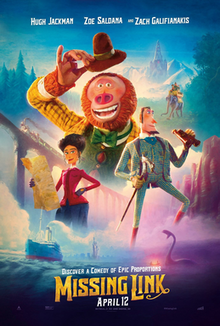


Film Review: Missing Link (dir by Chris Butler)


The year is 1886 and Sir Lionel Frost (Hugh Jackman) is the world’s greatest adventurer.

Or, at least, that’s what he says.  Actually, Sir Lionel may have made a name for himself and gained some popularity as a result of his many adventures but his fellow explorers and adventurers don’t take him seriously.  They view Sir Lionel as being little more than a self-promoter and they’re largely unimpressed with the all the time that he’s devoted to searching for mythical beasts like The Loch Ness Monster and lost lands like El Dorado.  Sir Lionel desperately wants to join the London-based Society of Great Men but the snobbish Lord Piggot-Dunceby (Stephen Fry) refuses to accept his application.

When Sir Lionel receives a letter from someone in America who claims to have tracked down the legendary Sasquatch, Sir Lionel and Lord Piggot-Duncey make a bet.  If Sir Lionel can prove that the Sasquatch exists, he will be allowed to join the Society.  Sir Lionel heads off to America while Lord Piggot-Dunceby promptly hires an evil bounty hunter named Willard Stenk (Timothy Olyphant) to prevent him from accomplishing his mission.  As Lord Piggot-Dunceby explains to his assistant, Mr. Collick (Matt Lucas), the world is changing too quickly.  If Sir Lionel isn’t stopped, people might start to believe in things like evolution or women’s rights.

When Sir Lionel arrives in America, he promptly starts searching for the Sasquatch and, amazingly enough, it doesn’t take him very long to find him.  It turns out that the Sasquatch — who Sir Lionel names Mr. Link — not only speaks remarkably good English but he’s also the one who wrote to Sir Lionel in the first place.  As played by Zach Galifianakis, Mr. Link is a rather laid back and good-natured Sasquatch.  In some ways, Mr. Link is surprisingly worldly and, in other ways, he’s rather naive.  He takes everything that he hears literally, which poses a problem since Sir Lionel has a tendency towards sarcasm.  It also turns out that Mr. Link is lonely but he thinks that he might be related to the Himalayan Yetis.  And Mr. Link thinks that Sir Lionel is just the man to help him get from America to Asia!

Sir Lionel reluctantly agrees.  Accompanying them on their journey is Sir Lionel’s former girlfriend, Adelina Fortnight (Zoe Saldana).  And pursuing them, every step of the way, is Lord Piggot-Dunceby and Willard Stenk.

Missing Link is an enjoyable and undeniably cute stop-motion animated film.  It was produced by Laika, the same animation outfit that previously gave us Kubo and The Two Strings.  While Missing Link is never as memorable or emotionally resonant as Kubo, it’s still a good-hearted film and entertaining enough that an adult can watch it without wanting to tear their hair out.  Blessed with impressively detailed animation and the comedic vocal talents of Hugh Jackman, Stephen Fry, Timothy Olyphant, and Zach Galifianikis, Missing Link has enough funny moments and clever lines that most audiences should be able to overlook the fact that the story itself sometimes feels a bit haphazard in its construction.  Much like the Sasquatch at the center of its story, Missing Link is a rather laid back film.  If Kubo was a carefully-constructed work of art, Missing Link feels like it was almost thrown together at random.  The film is at its best once it reaches the Himalayas, where the humor becomes very barbed and Emma Thompson steals the show in a sharp-witted cameo.

I enjoyed Missing Link.  It’s just too sweet-nartured not to like.

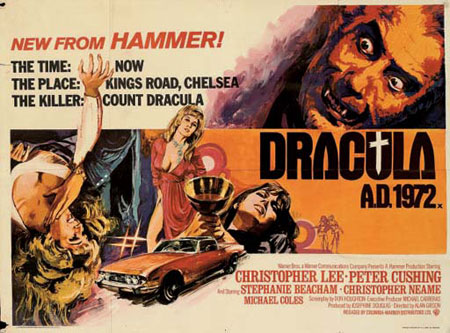
Horror Film Review: Dracula A.D. 1972 (dir by Alan Gibson)


(I originally wrote and posted this on February 5th, 2011.  Seeing as how we’ve been taking a look at the other Hammer Dracula films, I figured I might as well repost it for Halloween!)

Dracula A.D. 1972 opens in 1872 with a genuinely exciting fight on a runaway carriage that ends with the death of both Count Dracula (Christopher Lee) and his nemesis, Prof. Van Helsing (Peter Cushing).  However, as Van Helsing is buried, we see one of Dracula’s disciples (played by Christopher Neame, who had an appealingly off-kilter smile) burying Dracula’s ashes nearby.  The camera pans up to the clear Victorian sky and, in a sudden and genuinely effective jumpcut, we suddenly see an airplane screeching across the sky.

Well, it’s all pretty much downhill from there.  Suddenly, we discover that a hundred years have passed and we are now in “swinging” London.  The city is full of red tourist buses, hippies wearing love beads, and upright policemen who always appear to be on the verge of saying, “What’s all this, then?”  We are introduced to a group of hippies that are led by a creepy guy named Johnny Alculard (also played — quite well, actually — by Christopher Neame). One of those hippies (Stephanie Beacham) just happens to be the great-great-granddaughter of Prof. Van Helsing.  Apparently, she’s not really big on the family history because she doesn’t notice that Alculard spells Dracula backwards.  Then again, her father (played by Peter Cushing, of course) doesn’t either until he actually writes the name down a few times on a piece of a paper.

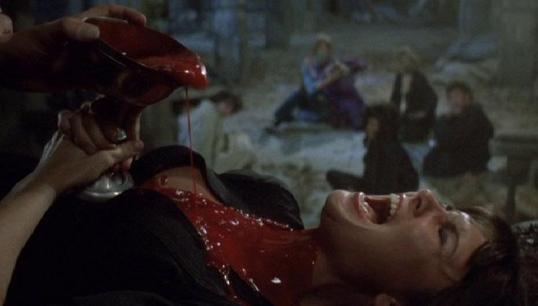
Anyway, the film meanders about a bit until finally, Alculard convinces all of his hippie friends to come take part in a black mass.  “Sure, why not?” everyone replies.  Well, I don’t have to tell you how things can sometimes get out-of-hand at black mass.  In this case, Dracula comes back to life, kills a young Caroline Munro, and eventually turns Johnny into a vampire before then setting his sights on the modern-day Van Helsings.

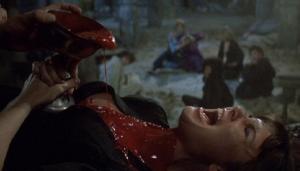
Poor Caroline Munro

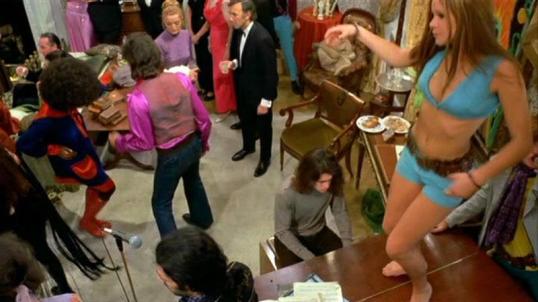
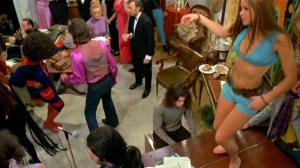
Dracula A.D. 1972 was Hammer’s attempt to breathe some new life into one of its oldest franchises and, as usually happens with a reboot, its critical and (especially) commercial failure ended up helping to end the series.  Among even the most devoted and forgiving of Hammer fans, Dracula A.D. 1972 has a terrible reputation.  Christopher Lee is on record as regarding it as his least favorite Dracula film.  And the film definitely has some serious flaws.  Once you get past the relatively exciting pre-credits sequence, the movie seriously drags.  There’s a hippie party sequence that, honest to God, seems to last for about 5 hours.  As for the hippies themselves, they are some of the least convincing middle-aged hippies in the history of fake hippies.  You find yourself eagerly awaiting their demise, especially the awkward-looking one who — for some reason — is always dressed like a monk.  (Those crazy hippies!)  But yet…nothing happens.  All the fake hippies simply vanish from the film.  Yet, they’re so annoying in just a limited amount of screen time that the viewer is left demanding blood.  Add to that, just how difficult is it to notice that Alculard is Dracula spelled backwards?  I mean, seriously…

To a large extent, the charm of the old school Hammer films comes from the fact that they’re essentially very naughty but never truly decadent.  At their heart, they were always very old-fashioned and actually quite conservative.  The Hammer films — erudite yet campy, risqué yet repressed — mirrors the view that many of my fellow Americans have of the English.  For some reason, however, that Hammer naughtiness only works when there’s the sound of hooves on cobblestone streets and when the screen is populated by actors in three-piece suits and actresses spilling out of corsets.  Dracula A.D. 1972 did away with the support of the corset and as a result, the film is revealed as a formless mess with all the flab revealed to the world.

The Party Scene

Still, the film isn’t quite as bad as you may have heard.  First off, the film — with its middle-aged hippies — has a lot of camp appeal.  It’s the type of film that, once its over, you’re convinced that the term “groovy” was uttered in every other scene even though it wasn’t.  As with even the worst Hammer films, the film features a handful of striking images and Christopher Neame is surprisingly charismatic as Alculard.

As with the majority of the Hammer Dracula films, the film is enjoyable if just to watch the chemistry between Christopher Lee and Peter Cushing.  Both of these actors — so very different in image but also so very stereotypically English — obviously loved acting opposite of each other and whenever you see them on-screen together, it’s difficult not to enjoy watching as each one tried to top the other with a smoldering glare or a melodramatic line reading.  As actors, they brought out the best in each other, even when they were doing it in a film like Dracula A.D. 1972.  In this film, Cushing is like the father you always you wished you had — the stern but loving one who protected you from all the world’s monsters (both real and cinematic).

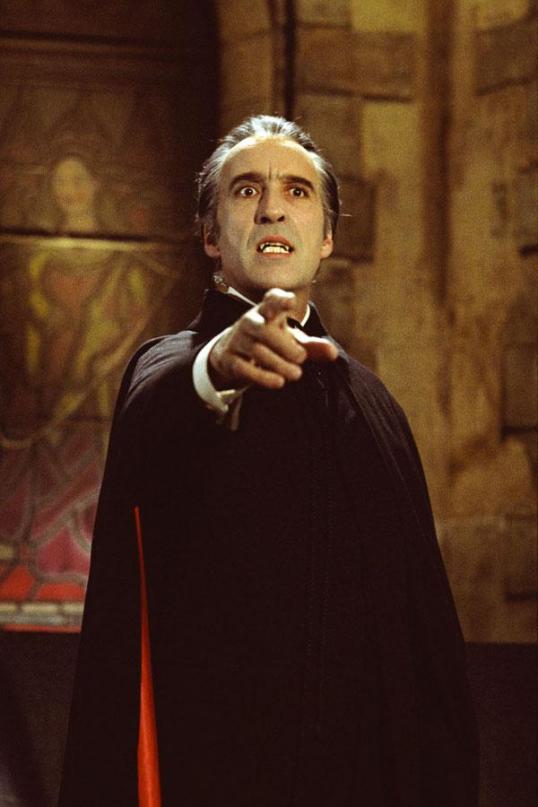
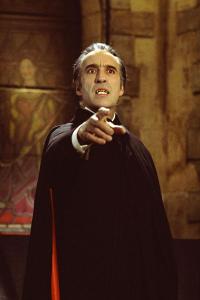
Christopher Lee as Dracula

As for Lee, he’s only in six or seven scenes and he has even fewer lines but, since you spend the entire film wondering where he is, he actually dominates the entire movie.  Lee apparently was quite contemptuous of the later Hammer Dracula films and, oddly enough, that obvious contempt is probably why, of all the Draculas there have been over the years, Lee’s version is the only one who was and is actually scary.  F0rget all of that tortured soul and reluctant bloodsucker crap.  Christopher Lee’s Dracula is obviously pissed off from the minute he first appears on-screen, the embodiment of pure destructive evil.  And, for whatever odd reason, the purity of his evil brings a sexual jolt to his interpretation of Dracula that those littleTwilight vampires can only dream about.  Even in a lesser films like Dracula A.D. 1972, Christopher Lee kicks some serious ass.

So, in conclusion, I really can’t call Dracula A.D. 1972 a good film nor can I really suggest that you should go out of your way to see it..  I mean, I love this stuff and I still frequently found my mind wandering whenever Cushing or Lee wasn’t on-screen.  However, it’s not a terrible movie to watch if you happen to find yourself trapped in the house with 90 minutes to kill.

Dracula A.D. 1972


Film Review: Dracula A.D. 1972 (dir. by Alan Gibson)


If you’re following the news then you probably heard that Dallas got hit with like a 100 inches of snow yesterday.  Seriously, more snow fell yesterday than has even fallen in recorded history (or, at the very least, in my recorded history).  You want to talk about Snowmageddon?  Well, we had a Snowpocalypse.

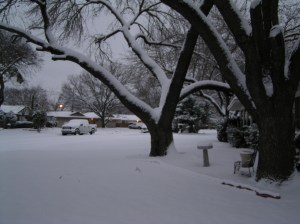
The neighborhood on Friday morning (picture taken by Erin Nicole Bowman)

So, I spent most of yesterday cooped up inside with my sister and our cat and once we got over the whole fun of being able to go outside and scream, “SNOW DAY!” at the top of our lungs, there really wasn’t much to do.  So, in an attempt to fight off cabin fever, I raided my DVD collection and we ended up watching one of the old Christopher Lee-as-Dracula-films from Hammer Studios.  Specifically, we ended up watching Dracula A.D. 1972.

The film opens in 1872 with a genuinely exciting fight on a runaway carriage that ends with the death of both Count Dracula (Christopher Lee) and his nemesis, Prof. Van Helsing (Peter Cushing).  However, as Van Helsing is buried, we see one of Dracula’s disciples (played by Christopher Neame, who had an appealingly off-kilter smile) burying Dracula’s ashes nearby.  The camera pans up to the clear Victorian sky and, in a sudden and genuinely effective jumpcut, we suddenly see an airplane screeching across the sky.

Well, it’s all pretty much downhill from there.  Suddenly, we discover that a hundred years have passed and we are now in “swinging” London.  The city is full of red tourist buses, hippies wearing love beads, and upright policemen who always appear to be on the verge of saying, “What’s all this, then?”  We are introduced to a group of hippies that are led by a creepy guy named Johnny Alculard (also played — quite well, actually — by Christopher Neame). One of those hippies (Stephanie Beacham) just happens to be the great-great-granddaughter of Prof. Van Helsing.  Apparently, she’s not really big on the family history because she doesn’t notice that Alculard spells Dracula backwards.  Then again, her father (played by Peter Cushing, of course) doesn’t either until he actually writes the name down a few times on a piece of a paper.

Anyway, the film meanders about a bit until finally, Alculard convinces all of his hippie friends to come take part in a black mass.  “Sure, why not?” everyone replies.  Well, I don’t have to tell you how things can sometimes get out-of-hand at black mass.  In this case, Dracula comes back to life, kills a young Caroline Munro, and eventually turns Johnny into a vampire before then setting his sights on the modern-day Van Helsings.

Dracula A.D. 1972 was Hammer’s attempt to breathe some new life into one of its oldest franchises and, as usually happens with a reboot, its critical and (especially) commercial failure ended up helping to end the series.  Among even the most devoted and forgiving of Hammer fans, Dracula A.D. 1972 has a terrible reputation.  Christopher Lee is on record as regarding it as his least favorite Dracula film.  And the film definitely has some serious flaws.  Once you get past the relatively exciting pre-credits sequence, the movie seriously drags.  There’s a hippie party sequence that, honest to God, seems to last for about 5 hours.  As for the hippies themselves, they are some of the least convincing middle-aged hippies in the history of fake hippies.  You find yourself eagerly awaiting their demise, especially the awkward-looking one who — for some reason — is always dressed like a monk.  (Those crazy hippies!)  But yet…nothing happens.  All the fake hippies simply vanish from the film.  Yet, they’re so annoying in just a limited amount of screen time that the viewer is left demanding blood.  Add to that, just how difficult is it to notice that Alculard is Dracula spelled backwards?  I mean, seriously…

To a large extent, the charm of the old school Hammer films comes from the fact that they’re essentially very naughty but never truly decadent.  At their heart, they were always very old-fashioned and actually quite conservative.  The Hammer films — erudite yet campy, risqué yet repressed — mirrors the view that many of my fellow Americans have of the English.  For some reason, however, that Hammer naughtiness only works when there’s the sound of hooves on cobblestone streets and when the screen is populated by actors in three-piece suits and actresses spilling out of corsets.  Dracula A.D. 1972 did away with the support of the corset and as a result, the film is revealed as a formless mess with all the flab revealed to the world.

Still, the film isn’t quite as bad as you may have heard.  First off, the film — with its middle-aged hippies — has a lot of camp appeal.  It’s the type of film that, once its over, you’re convinced that the term “groovy” was uttered in every other scene even though it wasn’t.  As with even the worst Hammer films, the film features a handful of striking images and Christopher Neame is surprisingly charismatic as Alculard. 

As with the majority of the Hammer Dracula films, the film is enjoyable if just to watch the chemistry between Christopher Lee and Peter Cushing.  Both of these actors — so very different in image but also so very stereotypically English — obviously loved acting opposite of each other and whenever you see them on-screen together, it’s difficult not to enjoy watching as each one tried to top the other with a smoldering glare or a melodramatic line reading.  As actors, they brought out the best in each other, even when they were doing it in a film like Dracula A.D. 1972.  In this film, Cushing is like the father you always you wished you had — the stern but loving one who protected you from all the world’s monsters (both real and cinematic). 

As for Lee, he’s only in six or seven scenes and he has even fewer lines but, since you spend the entire film wondering where he is, he actually dominates the entire movie.  Lee apparently was quite contemptuous of the later Hammer Dracula films and, oddly enough, that obvious contempt is probably why, of all the Draculas there have been over the years, Lee’s version is the only one who was and is actually scary.  F0rget all of that tortured soul and reluctant bloodsucker crap.  Christopher Lee’s Dracula is obviously pissed off from the minute he first appears on-screen, the embodiment of pure destructive evil.  And, for whatever odd reason, the purity of his evil brings a sexual jolt to his interpretation of Dracula that those little Twilight vampires can only dream about.  Even in a lesser films like Dracula A.D. 1972, Christopher Lee kicks some serious ass.

So, in conclusion, I really can’t call Dracula A.D. 1972 a good film nor can I really suggest that you should track down a copy of the DVD.  I mean, I love this stuff and I still frequently found my mind wandering whenever Cushing or Lee wasn’t on-screen.  However, it’s not a terrible movie to watch if you happen to find yourself trapped in the house by a mountain of snow.