Is It Too Late To Hate On Movie 43?


Originally,  I wasn’t planning on ever seeing Movie 43.

Remember Movie 43?  That’s the comedy with the huge ensemble cast that came out in January and stayed in theaters for about a week.  The trailers looked terrible, the commercials looked terrible, and finally, the reviews were terrible.  In fact, the reviews were so terrible (Richard Roeper called it the Citizen Kane of bad movies) that, at first, I was perfectly content never to see it.

However, as time passed, I continually heard Movie 43 referred to as being one of the worst films ever made.  Every 12 months, I post my picks for the 26 worst films of the year and I knew that Movie 43 was one of those films that would either appear on that list or, if it didn’t, I would have to be willing to defend the title’s absence.

I realized that before I could either defend or condemn, I would have to sit through the movie.  After all, I figured, it’s only 90 minutes of my life.

90 minutes that I’ll never get back, I might add.

Movie 43 is an anthology film in which 13 separate comedic sketches are loosely linked together by one overarching story.  For the most part, this is a film that was presumably made both for adolescent boys and for men who still think like adolescent boys.  Most of the humor is derived from bodily functions and there’s a real strain of misogyny running through the entire film.  However, the film’s problem is not that it’s crude and misogynistic but that it manages to be so dull about being crude and misogynistic.  If you think its hilarious when Meg is insulted on Family Guy or when Seth McFarlane smirks after making an anti-Semitic comment, you might enjoy Movie 43 but the rest of us are going to find far less to enjoy.

Oddly enough, there are actually two different versions of Movie 43 in circulation.  In the version that was released in U.S. theaters, the various vignettes are tied together by a story in which an insane director (Dennis Quaid) pitches scene after scene to a callous movie executive (Greg Kinnear).  In the version that was released in the UK, they’re linked together by a story about 3 teenagers searching for the most offensive film ever made.  To be honest, both versions are pretty stupid but I prefer the one about the 3 teenagers, if just because that way I can pretend that neither Dennis Quaid nor Greg Kinnear had anything to do with this movie.

As for the sketches themselves, there’s 13 of them and they are a mixed bag as far as both humor and quality are concerned:

1)      The Catch (dir by Peter Farrelly)

Kate Winslet and Hugh Jackman go on a blind date.  Jackman has testicles hanging from his neck and only Winslet thinks this is an odd thing.  This skit goes on forever.

2)      Homeschooled (dir by Will Graham)

Liev Schreiber and Naomi Watts explain how they’re making sure that their teenage son is getting the full high school experience despite the fact that he’s being homeschooled.  They do this through a combination of hazing and incest.  This skit worked pretty well, mostly because of the dedication that Schreiber and Watts brought to their absurd roles.

3)      The Proposition (dir by Steve Carr)

Uhmm…yeah.  So, this is the skit that opens with Anna Faris asking Chris Pratt to defecate on her.  I skipped over it because, quite frankly, life is too short.

4)      Veronica (dir by Griffin Dunne)

Neil (Kieran Culkin) is working the night shift at a depressing grocery store when his ex-girlfriend Veronica (Emma Stone) comes in.  They argue about who infected who with an STD.  Little do they realize that Neil has accidentally turned on the intercom and everyone in the store can hear them.  I actually kind of liked this short skit.  Culkin and Stone had a lot of chemistry and it was well-directed by Griffin Dunne.  Plus, it only lasted 2 minutes and, therefore, ended before the joke got old.

5)      iBabe (dir by Stephen Brill)

The iBabe is an MP3 player that happens to look like a life-size nude woman.  Unfortunately, a fan was built into the iBabe’s vagina and now, teenage boys are being dismembered while fingering and fucking iBabe.  Richard Gere plays the President of the company that makes iBabe.  I’ve never thought of Richard Gere as being a comedic actor and his performance here does nothing to change that.

6)      Superhero Speed Dating (directed by James Duffy)

Robin (Justin Long) goes speed dating and Batman (Jason Sudekis) tries to mess things up for him.  This skit – which also features (and wastes) Uma Thurman, Kristen Bell, and Bobby Cannavale – is so incredibly bad that I don’t even know where to begin.  Between this film and his appearance in last year’s The Conspirator, I’m having to rethink my slight crush on Justin Long.

7)      Machine Kids (directed by Jonathan Von Tulleken)

This commercial parody asks us to consider the children who work inside copiers and vending machines and how they are effected when we criticize those machines for not accepting our dollar.  This was actually so weird that I couldn’t help but love it.

8)      Middleschool Date (dir by Elizabeth Banks)

7th grader Amanda (Chloe Moretz) is having her first “middle school” date with Nathan (Jimmy Bennett) when she starts her first period.  In response, Nathan and his older brother (Christopher Mintz-Plasse) panic.  Believe it or not, this was actually one of the better parts of Movie 43, if just because the scene’s humor comes not from Amanda getting her period but instead from how every male around her descends into histrionics as a result.   It helps that this was the only part of Movie 43 that was both written and directed by women.  It also helps that director Elizabeth Banks is so clearly on Amanda’s side.  The end result is one of the few moments in Movie 43 that doesn’t feel misogynistic. 

9)      Tampax (dir by Patrik Forsberg)

This is another fake commercial.  Two girls are at the beach.  One uses tampax tampons and the other doesn’t.  Guess which one gets eaten by a shark?  As opposed to the previous skit, this bit of menstrual humor was obviously written and directed by a man (and the message, not surprisingly, is “Ewww!  Girls are scary and dangerous!”) but I’m going to have to admit that this one made me laugh if just because, like Middleschool Date, it reminded me of some of the period horror stories that I used to hear (and believe) back when I was younger.  (Though I was raised to be more concerned about bears than sharks…)

10)  Happy Birthday (dir by that noted comedian, Brett Ratner)

Pete (Johnny Knoxville) kidnaps an angry leprechaun (Gerard Butler) and gives it to Brian (Seann William Scott).  The leprechaun’s equally angry brother (also played by Gerard Butler) shows up and violence ensues.  Watching this skit was like being told a joke by someone who has no sense of humor.

11)  Truth or Dare (dir by Peter Farelly and Patrik Forsberg)

Halle Berry and Stephen Merchant are on a first date and Merchant has testicles on his neck…oh wait.  Sorry, that was Hugh Jackman and Kate Winslet’s skit.  In this skit, Berry challenges Merchant to game of truth or dare.  It escalates as the dares get continually more and more outrageous.  Whoops?  Did I say outrageous?  I meant to say stupid and oddly dull.  Watching this skit was like listening to a someone who has no sense of humor continue to tell a joke even though everyone else has already guessed the punchline.

12)  Victory’s Glory (dir by Rusty Cundieff)

In this parody of “inspirational” sports movies, Coach Jackson (Terrence Howard) speaks to his basketball team before they play their first game against an all-white team.  The gist of the speech is that Jackson’s team is going to win because they’re black and the other team is white.  This skit started out strong but, like a lot of Movie 43, it ran on for a bit too long.

13)  Beezel (dir by James Gunn)

This was actually my favorite part of Movie 43.  Unfortunately, since Beezel shows up in the middle of the end credits, I get the feeling that a lot of disappointed audience members had probably already walked out of the theater before it even began.  Beezel is a cartoon cat who has an unhealthy obsession with his owner (Josh Duhamel).  When Duhamel’s girlfriend (played by Elizabeth Banks) catches Beezel masturbating to pictures of Duhamel in a swimsuit, Beezel responds by plotting her demise.  Beezel was actually the only part of Movie 43 that truly felt edgy and unpredictable.  This is largely because this segment was directed by James Gunn, one of the few truly transgressive artists currently working in mainstream film.

So, here’s the question: is Movie 43 the worst film of 2013 as so many critics have claimed?  A few isolated moments aside, Movie 43 is pretty bad.  Even the parts of the film that do work can’t hope to compete with the pure horrifying incompetence of that parts that don’t.  However, thanks largely to James Gunn and Elizabeth Banks, it’s still a smidgen or so better than Tyler Perry’s Temptation.  (For all of its failings, Movie 43 never suggests that AIDS is God’s way of punishing wives who stray.  Nope, for that message, you have to go to Tyler Perry.)

Movie 43 is not the worst film of 2013.

It just seems like it.
Review: Kick-Ass (dir. by Matthew Vaughn)


Comic books which have been adapted for the big-screen have had an uneven track record. For every excellent film-incarnations like Spider-Man 2, X-Men 2, The Dark Knight and Iron-Man we get dregs like Elektra, Ghost Rider and Daredevil. The last couple years filmmakers have gravitated towards the deconstruction side of comic book superheroes. Christopher Nolan’s The Dark Knight was as much an action-thriller as it was a meditation on the superhero psyche and mythmaking. Then there was 2009’s Watchmen which tried admirably (though failed in the end) to adapt Alan Moore’s epic deconstruction of the superhero archetypes.

It’s now 2010 and we get the first comic book film of the year. The film is an adaptation of Mark Millar (writer) and John Romita, Jr.’s (artist) ultraviolent comic book title from Marvel’s Icon Comics (their creator-owned publishing line). Kick-Ass was optioned and adapted by British-director Matthew Vaughn and screenwriter Jane Goldman. Unlike most comic book films of the past decade, Vaughn’s Kick-Ass was independently-financed (with help from Brad Pitt and his Plan B Studio) and made which was the best thing that could’ve happened to this project. With a free rein to make the film he wanted without corporate studio meddling, Matthew Vaughn was able to craft a fun and violent romp of a film mashup that collides superhero archetypes and conventions with “real world” grounding.

The story and premise for Kick-Ass is actually quite simple enough to follow. We have high-schooler and avid comic book fan Dave Lizewski asking his best friends and fellow comic book fans why no one has actually tried to be a superhero. The answer he gets from his like-minded friends doesn’t instill hope in his dream. While they are huge fans of superheroes and comic books they stop at actually trying to be one in real-life. Dave, on the other hand, knows that it’s possible for one to try and be a superhero even without powers. He believes that determination, conviction and the need to help those in need would be all that someone requires to become a superhero. With these criteria in mind he sets off to do the very thing he had asked his friends about. He accomplishes this by ordering (for the amount of $99.99) a green and yellow wet-suit and head cover plus a pair of batons and a taser gun. His first attempt at superherodom fails spectacularly as he’s stabbed and violently run over in the street. This near-fatal introduction to the world of superheroes doesn’t deter Dave when deep down even he knows that he’ll get killed if he continues on his quest to become the next Spider-Man.

The story moves on to Dave finally getting his superhero fame by stopping a beatdown of a stranger and having this event caught on a bystander’s camera phone and uploaded said video on Youtube. With this amateur video on Youtube getting millions of hits and views, plus Dave’s own creation of a MySpace page for his alter-ego the world finally gets it’s real-life superhero in the form of Kick-Ass. A name that spurs not just tens of thousands of fans on Kick-Ass’ MySpace page but also a boom in sudden Kick-Ass merchandise in Dave’s local comic book shop. Through it all Dave revels in the attention his alter-ego has been getting even the unexpected attention of the girl of his dreams, Katie Deauxma (played by the lovely Lyndsy Fonseca). An attention born out of a misunderstanding where Katie believes Dave to be gay because of circumstances revolving around his near-death experience of his very first attempt at crimefighting.

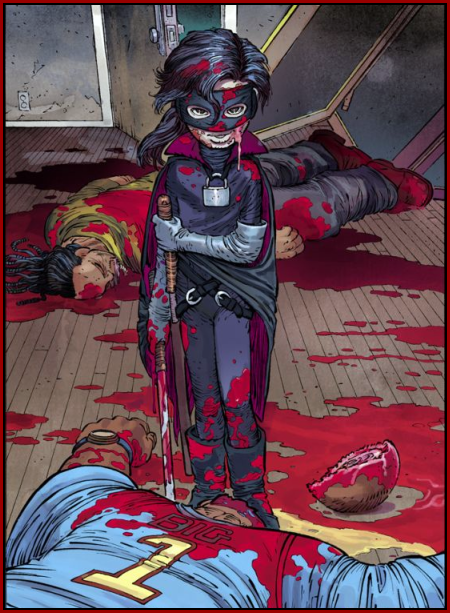
On the sidelines of all this we get introduced to the film’s real “superheroes” in the form of Big Daddy (played by Nicolas Cage) and his sidekick and 11-year old daughter, Hit-Girl (Chloe Moretz). We see early on that both Big Daddy and Hit-Girl are the real thing though calling them superheroes would be a stretch since they seem to be more vigilantes who happen to wear costumes and with no compunction at all about killing the criminals. These two are definitely not Batman and Robin (one of many easter egg-like references to comic book characters and storylines). Their story parallels that of Kick-Ass’ but where Dave seems to enjoy just playing at being a superhero and the adoration such role-playing gives him both Big Daddy and Hit-Girl actually have a focus and mission in their own attempts. These are two individuals who believe in the superhero roles they’ve taken on themselves and have prepared and trained themselves well for the violent consequences and ramifications of their mission.

The rest of the film takes the audience on a peculiar coming-of-age journey for one Kick-Ass. As stated earlier he’s pretty much all talk with a rose-tinted view of a superhero’s life. What he has read in his comic books doesn’t prepare him for the reality of actually trying to act and become a true superhero. While writer Mark Millar takes a dim and cynical view of what Kick-Ass is trying to figure out and accomplish (most of the comic’s morality ends up being that bad things happen to good people with the best of intentions), director Matthew Vaughn and screenwriter Jane Goldman take a more hero’s journey approach (sprinkled liberally with foul language and bloody violence). While Dave Lizewski’s attempts to live up to his hero persona of Kick-Ass range from succeeding through luck to failing miserably and at times fatally, by the end of the film circumstances (which have spiralled out of his own control) forces him to finally face up to the fact that if he really wanted to be a superhero he needed to finally do more than just talk and pretend to be one and actually act and perform like one.

This is in contrast to Hit-Girl’s own journey which doesn’t start her off as clumsy and unsure of herself. Instead we see in Hit-Girl the type of individual Kick-Ass wants to be but is unable to through most of the film. Where Kick-Ass suddenly realizes that he’s way over his head once the bodies start dropping in bloody ways, Hit-Girl doesn’t lack in confidence but is in control of every situation she’s confronted with. Whether it’s rescuing Kick-Ass from death (more than once) or finally launching the climactic assault on her and Big Daddy’s focus and reason for being. Hit-Girl is the true superhero with Big Daddy really her sidekick. Everyone else, from Kick-Ass to Red Mist (Christopher Mintz-Plasse), just pretend and play at being costumed superheroes. Hit-Girl is the personification of the female antihero of the recent comics, but unlike most female characters in comic books she’s not the fringe character or the one in need to help. She’s the one who rescues everyone and willing to sacrifice her very life to live up to the ideals (however twisted they may be to the audience) she has set for herself.

Kick-Ass may have been an post-modern exercise in trying to deconstruct and then acknowledge the superhero archetype and themes, but first and foremost it is a very fun and exhilarating rollercoaster ride of an action film. Vaughn and Goldman were able to capture the exciting and fun side of the original comic despite leaving behind some of the meanspiritedness of Millar’s writing. Goldman definitely has an ear for inserting comedy beats into the film to keep the story from becoming too serious and thus slowing down the film. In fact, I would say that Kick-Ass was a very fast-paced two-hour film that would alternate between comedy and action with a tender moment spliced in at the last third of the film. Much of the comedy in Kick-Ass come at the expense of Kick-Ass himself as he stumbles his way through most of the film either out of his league or just pantshitting scared of what he’s gotten himself into. Nicolas Cage’s characterization of Big Daddy also drew some major laughs as he alternated from a twisted version of Mr. Rogers as Damon MacReady to channeling Adam West’s “Batman” when dressed up as Big Daddy.

One thing which Matthew Vaughn has shown with is third feature-length film was the ability to create and shoot some very good action sequences. He even made an interesting stylistic choice to film his action sequences differently depending on whether it was Kick-Ass who was the focal point in the fight or whether it was Hit-Girl or Big Daddy doing the mayhem. Vaughn chose to shoot Kick-Ass’ fight sequences with comedy in mind as the character clumsily fought his way through his opponents. Even when he finally finds his inner superhero in the final fight with his newly discovered nemesis Kick-Ass still fought more on instinct and blindly swinging away instead of actually fighting like an expert. The same couldn’t be said about when Hit-Girl or Big Daddy were the main focus in the action scenes. These two characters were trained killers pure and simple. Their fight choreography was the exact opposite of Kick-Ass’. Hit-Girl’s was especially well-choreographed to show just how honed a fighter and killer Big Daddy’s 11-year old daughter really was even when confronted by over a dozen heavily-armed gangsters and drug dealers. It’s the Hit-Girl action scenes which drew the biggest positive reactions from the audience and rightfully so. Chloe Moretz truly sold the idea of an 11-year old costumed vigilante killer and the film was better for it.

Chloe Moretz star-making performance brings us to the overall performances of the film’s cast. While pretty much everyone who sees this film will agree that Chloe Moretz as Hit-Girl pretty much steals every scene she’s in Aaron Johnson as Dave Lizewski/Kick-Ass also does a very good job in his performance. He anchors the film as the everyman, or everyboy for this film, the audience will gravitate towards. He’s believable as the stumbling and naive teen whose dream of becoming a superhero turns his life upside-down and rightside-up. We can sympathize with his teen need to be accepted and, ultimately, find his identity. It just happens that he find it in the midst of playing at being his dream girl’s fake gay BFF and then as the superhero he finally became in the end. Nicolas Cage, Clark Duke and Lyndsy Fonseca were good at their “sidekick” roles. On the other side of the superhero spectrum we have Mark Strong as mob boss Frank Dimico doing a wonderful job. Christopher Mintz-Plasse as Chris Dimico/Red mist makes for a great counterpoint and mirror to Dave Lizewski/Kick-Ass. But where Dave finally learns to be a hero and take the role seriously, Mintz-Plasse’s Chris never learns the true meaning of what a hero is and just continues to be the wannabe that Dave started off as but finally shed in the end.

Kick-Ass does a better job at deconstructing the superhero world of comic books than Zack Snyder’s Watchmen of 2009. While the comic book version of Kick-Ass will never be in the same league and level as Alan Moore’s Watchmen the film version flip-flop and shows that sometime the simpler story makes for a better film. Vaughn and Goldman did a great job in adapting the darker and more nihilistic writing of Millar. But while changes were made to allow the story to be more accesible to the general public, the film still manages to keep the spirit of the original source material intact but minus the cuckolding the story’s intrepid hero gets hit with twice to end the story.

Even with the controversy over the Hit-Girl character and of Chloe Moretz protrayal of this blood-soaked and foul-mouthed killer it shouldn’t diminish the fact that Kick-Ass set out to be both thought-provoking, fun and entertaining and succeeds in accomplishing all three. While the film has flaws they’re not so glaring or even distracting that they take away from one’s enjoyment of the film. Even for an “origins” tale Kick-Ass manages to escape being too overly reliant on dialogue to explain everything that’s going on to the audience. The fact that a sequel was already being talked about even before the film’s release shows confidence in both Millar and Vaughn that there’s further adventures and stories to show and tell about Kick-Ass and Hit-Girl. I, for one, will be there to see what they will be up to next.