Music Film Review: The Rocky Horror Picture Show (dir by Jim Sharman)


It feels strange to actually watch The Rocky Horror Picture Show without an audience.

I say this because the film is actually far better known for its fans than anything else.  First released in 1975 to middling reviews and, at first, anemic box office returns, The Rocky Horror Picture Show went on to become the first great cult film.  It’s literally been playing in theaters for 25 years, which has to be some sort of record.  When one sees Rocky Horror Picture Show in a theater, one does not merely sit back and watch in a state of suspended animation.  Instead, most of the audience becomes a part of the show.  They yell, they dance, and many of them return night-after-night.  I have been to two midnight showings of the Rocky Horror Picture Show and I have to admit that it was actually pretty intimidating both times.  The people in the audience — the veterans who knew every line and knew exactly what to do — were, more or less, friendly.  I’ve read some online horror stories about people who felt like they weren’t welcome the first time they attended a showing.  I had the opposite experience.  No one was rude, no one glared.  It was definitely a cliquey group but I felt as if they had earned the right to be in their clique.  No one seemed to be bothered by the fact that I was mostly there just to observe.  (I should also mention that neither showing that I attended demanded that the first-time watchers stand up or go to the front of the theater or anything like that.  Apparently, there’s quite a few people online who got upset over being singled-out as “virgins” and never got over it.)  But it was intimidating in much the same way as meeting a friend of a friend is intimidating or exploring a new town is intimidating.  I was surrounded by people who had a deep connection with each other, one that had been forged by sharing the same experience for years.  It was a communal experience that was actually touching to see, even if I never stopped feeling like an outsider.

It’s interesting to compare the midnight showings of The Rocky Horror Picture Show to the midnight showings of The Room.  I attended several midnight showings of The Room and I have to admit that I eventually soured on them as it became clear that many people were showing up to taunt the film as opposed to enjoying it for the odd, communal experience that it was.  The last few The Room showings that I attended were filled with a hostility that left me feeling a bit uncomfortable.  Whereas The Room’s cult has often felt a bit mean-spirited (as if everyone had gathered together to laugh at Tommy Wiseau for thinking he could make a movie), The Rocky Horror Picture Show‘s cult is based on a genuine love for the film.

As for the film itself, I watched it last month without an audience and I judged it solely as a film.  The pacing is a bit off and, without the group experience, it’s a lot easier to notice that the film’s storyline doesn’t make a bit of sense, though that was undoubtedly deliberate on the part of the filmmakers.  That said, Tim Curry’s performance still gives the film a jolt of energy, recapturing your attention and holding it until the film comes to a close.  (The genius of Curry’s performance as that, as flamboyant as it is, he still plays Dr. Frank-n-Furter as being an actual characters with feelings and emotions.  He doesn’t just coast on attitude.  One need only compare him to Laverne Cox in the 2016 TV production to see how strong Curry’s performance is.)  Susan Sarandon brings some depth to her performance as Janet and, if Barry Bostwick is a little on the dull side of Brad …. well, the heroes who appeared in the film that Rocky Horror sends up were rarely that exciting.  I enjoyed the snarky humor of Richard O’Brien’s performance and the energy that Meat Loaf brought to the production.  Charles Gray, in the role of the Criminologist, really doesn’t get enough credit for holding the film’s disparate parts together.

In the end, when viewed as a film as opposed to a communal experience, The Rocky Horror Picture Show is undoubtedly flawed but it’s still energetic enough to work.  The love for the old sic-fi films comes through and Tim Curry’s uninhibited performance works with or without an audience.  The Rocky Horror Picture Show is a film that brings people together and I hope it continues to do so.
The TSL Horror Grindhouse: The Beast Must Die (dir by Paul Annett)


You have 30 seconds to decide who is the werewolf.  Is it the professor?  Is it the wife of the big game hunter?  Is it the long-haired hippie who has a history of cannibalism?  Is it the concert pianist?  Is it the diplomat?  Make your guess and then….

This is the challenge that is presented to the viewers of the 1974 film, The Beast Must DieThe Beast Must Die is a werewolf film.  Calvin Lockhart stars as millionaire big game hunter Tom Newcliffe.  Tom has invited a group of people to his English mansion because, according to him, one of them is a werewolf and he plans to hunt down whoever it is.  It’s not a terrible premise and I imagine that, in 1974, it was probably quite revolutionary to cast a black actor as a millionaire with a large British estate.  (In America, the film was marketed as being a blaxploitation film under the title Black Werewolf.)

That said, The Beast Must Die is still best-known for its “Werewolf Breaks.”  At certain points in the film, a stopwatch appears on the screen and a narrator asks us if we’ve figured out who the werewolf is yet.  The viewer is given 30 seconds to make a guess before the film continues.  The “Werewolf Breaks” were apparently added to the film after production was completed and director Paul Annett was not happy about them.  The Beast Must Die is, in many ways, a pretty grim film or, at least, it would be if not for the campy narrator telling us that it’s up to us to solve the mystery.

But you know what?  I like the Werewolf Breaks.  They’re fun and, without them, The Beast Must Die would come across as being a film that takes itself way too seriously.  Calvin Lockhart, who was so good in Melinda, overacts to a tremendous degree as Tom Newcliffe and, as the film progresses, he goes from being merely eccentric to actually coming across as being rather unhinged in his attempts to discover who is the werewolf.  It’s never really clear how he settled on his suspects.  (All of them are described as being in the area of several unexplained deaths but it seems like the same could be said of probably hundreds of other people as well.)  But once he has them at the mansion, he’s determined to keep them there until he figures out which is infected with lycanthropy.  (In this film, the werewolf curse is described as basically being a virus.)

Fortunately, the suspects are played by an interesting gallery of British and American character actors.  Charles Gray plays the shady diplomat.  Malene Clark is Tom’s wife.  Michael Gambon is the pianist while Ciaran Madden plays his wife.  Tom Chadbon plays the hippie cannibal while Anton Diffring shows up as the head of security for the mansion.  Best of all, Peter Cushing plays the professor who is an expert on werewolves.  It’s always a joy to see Peter Cushing in any film.  He’s particularly good here, handling his often overwritten dialogue like the pro that he was.

The Beast Must Die is an uneven film.  The opening sequence, which features Tom testing the mansion’s security systems, seems to go on forever and the plot is full of twists that fall apart if you give them too much thought,  But the Werewolf Breaks made me smile and the supporting cast is a delight.  It’s a fun film to watch during the Halloween season.

Wild Rovers (1971, directed by Blake Edwards)


In Montana, Walter Buckman (Karl Malden) runs his ranch with an iron hand, warning his neighbor, Hansen (Sam Gilman) not to even think of allowing his sheep to graze on his land.  Walter has two sons, hot-headed John (Tom Skerritt) and the laid back and good-natured Paul (Joe Don Baker).  When Walter learns that two of his ranch hands — aging Ross Bodine (William Holden) and young Frank Post (Ryan O’Neal) — have robbed a bank and are heading down to Mexico, he sends John and Paul to bring them back.  Walter is a big believer in the law and he’s not going to allow any of his people to get away with breaking it.

Ross is a veteran cowboy, who only robbed the bank after Walter withheld his pay to cover the damage of a saloon fight between Ross and Hansen’s men.  Frank is the wilder of the two.  He looks up to Ross and Ross is protective of Frank, even if he has a hard time admitting it.  Ross and Frank are heading down to Mexico so Ross can retire in peace.  Instead of going straight to Mexico, though, they make the mistake of stopping by a small town so Frank can play a little poker and visit the town’s brothel.

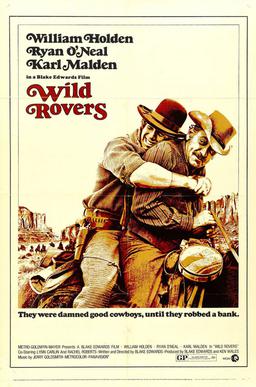
Wild Rovers was Blake Edwards’s attempt to make an epic, revisionist western and he includes plenty of shots of the sun setting over the mountains as well as several violent shoot-outs that are shot in Peckinpah-style slow motion.  Unfortunately, the story itself isn’t really strong enough to support Edwards’s ambitions and all of the shots of the countryside, while nice to look at, don’t really add up too much.  Wild Rovers was also a troubled production, with MGM slashing Edwards’s original three-hour film down to 106 minutes and advertising it with a poster featuring O’Neal hugging Edwards from behind, making the film look like a buddy comedy in the style of Butch Cassidy and the Sundance Kid (or an early version of Brokeback Mountain) as opposed to a violent and elegiac western.  (In 1986, a director’s cut was released, which ran for 136 minutes.)  If you only know Blake Edwards from his Pink Panther movies, the grim and tragedy-filled Wild Rovers will come as a surprise.

One thing that Wild Rovers does have going for it is a good cast.  William Holden and an energetic Ryan O’Neal are a solid team and Karl Malden, Tom Skerritt, Rachel Roberts, James Olson, and Moses Gunn all give good performances too.  This movie also provides Joe Don Baker with a sympathetic role and he’s very likable as the laid back Paul Buckman.  It’s not the type of role that Baker often got to play and it’s obvious that a lot of scenes between John and Paul were cut from the film but, in the truncated version, Joe Don Baker’s Paul Buckman becomes the moral center of the film’s story.

Wild Rovers was a disappointment at the box office, one of many that Edwards suffered in the 70s before he and Peter Sellers brought back Inspector Clouseau.

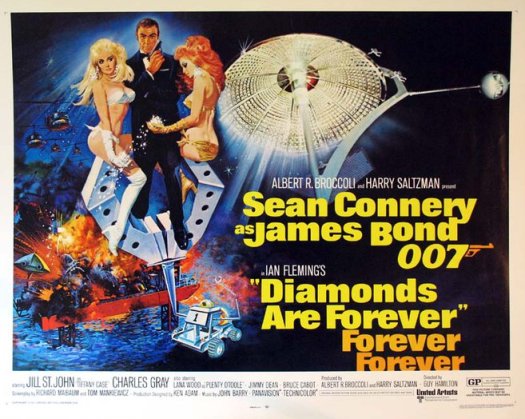
The Return of 007: Sean Connery in DIAMONDS ARE FORVER (United Artists 1971)


gary loggins's avatarcracked rear viewer

007 fans all over the world cheered when Sean Connery returned to the role that made him famous in DIAMONDS ARE FOREVER, the 6th James Bond screen outing. Connery left the series in 1967 (YOU ONLY LIVE TWICE), and was replaced by George Lazenby for 1969’s ON HER MAJESTY’S SECRET SERVICE. Lazenby was actually pretty good, if a bit boring, but he was one-and-done, choosing not to be typecast as cinema’s most famous spy (how’d that work out, George?). Producers Albert Broccoli and Harry Saltzman offered Connery an unprecedented $1.25 million dollars to come back, which the smart Scotsman snapped up in a heartbeat… who wouldn’t? Well, except for George Lazenby.

The opening sequence has Bond searching the globe to fins Ernst Stavro Blofeld, SPECTRE’s megalomanical leader who ordered the death of Bond’s wife in the previous movie. 007 hunts down his arch nemesis and ends his villainous career in…

View original post 538 more words

The Game’s Afoot: THE SEVEN-PER-CENT SOLUTION (Universal 1976)


gary loggins's avatarcracked rear viewer

71

Sherlock Holmes has long been a favorite literary character of mine. As a youth, I devoured the Sir Arthur Conan Doyle stories, marveling at the sleuth’s powers of observation and deduction. I reveled in the classic Universal film series starring Basil Rathbone and Nigel Bruce as Holmes and Watson, and still enjoy them today. I read Nicholas Meyer’s 1974 novel “The Seven-Per-Cent Solution” as a teen, where a coked-out Holmes is lured by Watson to Vienna to have the famed Sigmund Freud cure the detective of his addiction, getting enmeshed in mystery along the way. I’d never viewed the film version until recently, and while Meyer’s screenplay isn’t completely faithful to his book, THE SEVEN-PER-CENT SOLUTION is one of those rare instances where the movie is better than the novel.

72

This is due in large part to a pitch-perfect cast, led by Nicol Williamson’s superb performance as Sherlock. We see Holmes at his worst…

View original post 393 more words

Halloween Havoc!: Christopher Lee in THE DEVIL’S BRIDE (Hammer 1968)


gary loggins's avatarcracked rear viewer

db1

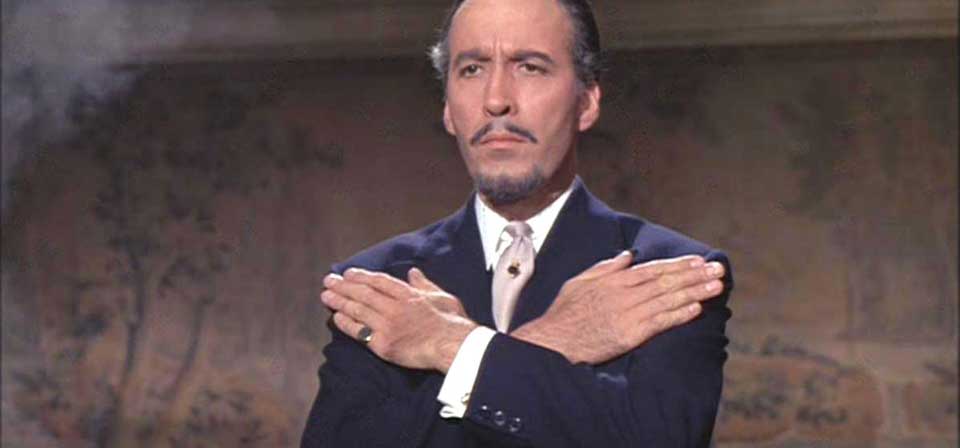
Satan worship was all over the big screen back in 1968.  There was ROSEMARY’S BABY of course, that Oscar-winning fright fest from Roman Polanski and William Castle. WITCHFINDER GENERAL found Vincent Price on the hunt for daughters of the devil, while CURSE OF THE CRIMSON ALTAR boasted an all-star horror cast of Boris Karloff, Christopher Lee, Barbara Steele, and Michael Gough. Lee starred in a Hammer tale of satanism that year titled THE DEVIL’S BRIDE, as an occult expert pitted against a cult led by Charles Gray. That’s right- it’s Dracula vs Blofeld in a battle for souls!

db2

Sir Christopher’s  on the side of the angels for a change as the Duc de Richleau, who along with army buddy Rex Van Ryn, find their late chum’s son Simon Aron. Simon’s been “meddling with black magic” in a coven of devil worshippers led by Mocata, an adept Satanist. They manage to spirit Simon away…

View original post 471 more words

Horror on the Lens: The Beast Must Die (dir by Paul Annett)


For today’s horror on the lens, we have The Beast Must Die.  In this 1974 film, millionaire Tom Newcliffe (Calvin Lockhart) invites a group of people to spend the weekend at his mansion.  Tom explains that one of them is a werewolf and therefore “must die.”

But who is the werewolf?  Tom has come up with several werewolf tests but, actually, it turns out that the easiest way to discover the identity of the werewolf is to just let the werewolf kill everyone who isn’t a werewolf.  Or, at least, that’s the way it seems to me.

The best thing about The Beast Must Die is that it features a 30-second werewolf break where the audience is encouraged to announce who they think the werewolf is before the actual solution is revealed!

Seriously, many movies would be greatly improved with a werewolf break.

Enjoy!

http://www.youtube.com/watch?v=BVuIYlDHkLQ

James Bond Review: Diamonds Are Forever (dir. by Guy Hamilton)


I think it’s a well-known fact that the Austin Powers series was spoofing the spy film of the 60’s and 70’s with it’s main target for laughs being the iconic James Bond character and his international adventures of action and intrigue. The James Bond films with each successive entry became more and more fantastic as the megalomania of each new villain became more and more cartoonish and over-the-top and the gadgets themselves started entering the realm of science-fiction (for that time and era, at least) and back-of-the-comic-book ingenuity. I think the tipping point for the series that took James Bond from action thriller to spoofing it’s own past was with Sean Connery’s last official film as James Bond with Diamonds Are Forever.

To say that Sean Connery was truly getting tired and bored with playing the character James Bond on the big screen would be an understatement. His previous Bond entry with You Only Live Twice showed him pretty much disinterested with the role and one would almost think he was phoning in his performance. After that film Connery had announced his retirement from playing Bond, but after George Lazenby also retired from the role after just one film Connery was soon back for one more ride on the James Bond train.

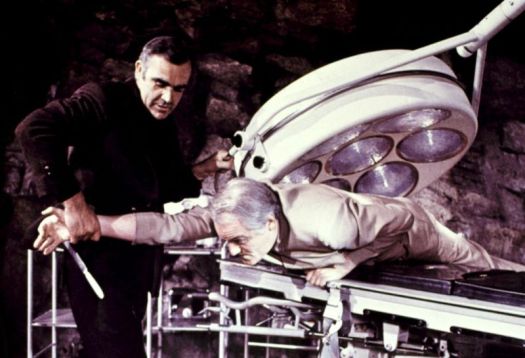
Diamonds Are Forever once again pits James Bond against his arch-nemesis, the leader of SPECTRE and feline connoisseur, Ernst Blofeld. This time around the role of Blofeld was played by the actor Charles Gray and the film does a good job in explaining why the character has been played by so many different actors in each entry he appeared in. It is in this early sequence in the film that we begin to see that this latest James Bond entry had jumped the shark when it came to trying to keep things even remotely believable. It’s the film’s biggest flaw an, at the same time, what made it such an interesting, fun ride.

Even the plot of the film owes more to the spoofs of the Blofeld character by way of the Austin Powers films as Bond must try to stop SPECTRE from using smuggled South African diamonds from being used to create  weaponized satellite with a massive “laser” that SPECTRE will use to destroy the nuclear arsenal of every superpower then auction off the rights to be the only nuclear power to the highest bidding country. It’s pretty much the the basic foundation of what would be the plot for the first Austin Powers, but with this film filmmaker Guy Hamilton still tried to treat the script as something that was of the serious Bond when it was more 60’s camp through and through.

Diamonds Are Forever may be the weakest of all the Connery Bond films, but it’s groovy sensibilities that celebrated the 60’s (despite the film having been made in 1971) psychedelic, swinging lifestyle poked fun at Bond’s predilection as a suave and charismatic womanizer that wouldn’t have looked out of place in a 60’s love-in. Even the action sequences was something that looked more humorous than thrilling whether it was Bond escaping SPECTRE henchmen on a moon buggy to the inept duo assassins Mr. Wint and Mr. Kidd looked more at home in an action comedy than a series that was known for serious action.

I would be remiss to not mention that this was the only time the Bond series had a redhead as a Bond Girl in the vivacious form of Jill St. John as Tiffany Case. I would also like to think that the other Bond Girl in the film, played by Lana Wood (Natalie Wood’s younger sister), was also a redhead but I’m not entirely sure since most audiences probably didn’t pay too close attention to Plenty O’Toole’s hair color. Either way this would be the only Bond film that would cast what fellow writer Lisa Marie calls the 2%.

Diamonds Are Forever might not have been the sort of return Sean Connery envisioned for himself when he agreed to return as James Bond after taking a film off, but then again this wouldn’t be the first time he would retire from the role only to come back again. Yet, despite all it’s flaws (there were many of them) the film does entertain though probably not in the way it’s filmmakers hoped it would. I do believe that it was this film that finally brought in Roger Moore as the next Bond, but also convinced the film’s producers to tailor the Bond films using some of the humorous aspect of Diamonds Are Forever but tempered to accompany the action in the story.

James Bond will soon return in Live And Let Die….

James Bond Film Review: You Only Live Twice (dir. by Lewis Gilbert)


In the days leading up to the American release of Skyfall, the Shattered Lens has been taking a look at the previous films in the James Bond franchise.  Today, we take a look at the 5th official James Bond film, 1967’s You Only Live Twice.

Released two years after the critically derided but financially succesful Thunderball, You Only Live Twice was a step in a new direction for the Bond series.  As Sinclair McKay explains in his brilliant book on the Bond films, The Man With The Golden Touch,  both the world and the movies changed a lot between 1965 and 1967 and You Only Live Twice reflected that change.  Director Lewis Gilbert and screenwriter Roald Dahl were newcomers to the Bond series and the film they created would serve as a prototype for the flamboyant, big budget espionage fantasies that would come to epitomize many of the later entries in the franchise.

You Only Live Twice begins with one the Bond franchise’s more elaborate precredit sequences.  During these first few minutes, the film rather boldly announces that You Only Live Twice is going to be a bit of a departure from the previous Bond films.  The film begins not with Bond but with two anonymous American astronauts orbiting the Earth in a small capsule.  The two astronauts are blandly chatting with mission control on Earth when, suddenly, another spacecraft approaches and literally swallows the American capsule whole.  One of the astronauts is hurled into space as a result and, as his body spins away, it’s obvious that Bond’s not going to be dealing with something bigger than just another guy looking to hold up Fort Knox.

The Americans blame the Russians while the Russians claim that they’re being framed by Americans and the entire world appears to be on the verge of war.  But as always happens in the Bond films, the British are there to keep everyone from overreacting.  A British diplomat is seen calming down the belligerent super powers and assuring them that MI6’s “best man” is already on the case.

(One of the undeniably charming things about the Connery and Roger Moore  Bond films is the way that the United Kingdom is portrayed as being the world’s unofficial third superpower.)

Cut to Hong Kong, where James Bond is lying in bed and asking his latest conquest, “Why do Chinese girls taste different?”  And, at this point, I think it’s fair to say that Bond is really lucky that he looks like a young Sean Connery.  Suddenly, gunmen storm the bedroom and open fire, apparently killing 007.

Oh no!  I guess the world is doomed, right?  We’re left to consider this sad reality as we watch the opening credits and listen to Nancy Sinatra sing the film’s excellent theme song.

Well, of course, James Bond isn’t really dead.  He faked his death so that he can safely go to Tokyo and investigate who was behind the attack on the space craft.  You Only Live Twice was filmed almost entirely on location in Japan and a good deal of the film’s first half is devoted to scenes of Bond simply observing Japanese culture.  It’s a bit like Lost In Translation with an espionage subplot.

After fighting a few random henchmen, Bond meets Tiger Tanaka (Tetsuro Tamba), the head of the Japanese secret service.  Tanaka seems to spend the majority of his time getting massages from the dozen or so young women who wait on him hand-and-foot.  “In Japan,” he tells Bond, “men come first, women come second.”  “I might just retire here,” Bond replies.  Uhmmm…okay.  Thank you, 1967.

In order to continue the ruse that Bond’s dead, Tanaka arranges for Bond to take on an assumed identity.  After being trained on all aspects of Japanese culture and on how to fight like a ninja, Bond is heavily disguised to look like a Japanese fisherman.  Tanaka arranges for Bond to fake marry a local girl named Kissy (Mie Hama).  Kissy is probably one of the least interesting Bond girls in the history of the franchise.  Beyond walking around in a bikini while wearing high heels, Kissy just doesn’t have much of a personality.

Bond and Tanaka’s investigation lead them to a shady industrialist named Osato and his secretary Helga Brandt (Karin Dor).  Helga is about as close as You Only Live Twice comes to featuring a strong female character.  Not only is she an assassin who has no problem with killing a man who she’s just had sex with but she’s also a redhead, just like me!

Anyway, it’s not until very late in the film that we finally meet Helga’s boss.  If for no other reason, You Only Live Twice will always be remembered for featuring one of the great Bond villains.  After being seen in the previous Bond films as just a hand stroking a white cat, Ernest Stavros Blofeld makes his first on-screen appearance here and fortunately, he’s played by Donald Pleasence.

Looking at Pleasence’s performance today, the natural tendency is to compare his Blofeld to the iconic character that he inspired, Mike Myers’ Dr. Evil.  However, one reason that Dr. Evil became such a popular character is because Donald Pleasence’s Blofeld is one of the great film bad guys.  As delivered by Pleasence in his casually off-center way, every line of Blofeld’s dialogue drips with the promise of perversion and hints of the neurosis that fuels his every action.  Blofeld spends most of the movie hiding out in a secret base that’s hidden inside a hollow volcano.  He strokes that ever-present white cat and uses a pool of piranhas to punish failure.  It is a credit to Pleasence’s performance that you never, for a second, doubt that Blofeld could very well be living in a hollow volcano.

I have to admit that You Only Live Twice is not my favorite James Bond film, though there are plenty of things that I do like about it.  Bernard Lee, Lois Maxwell, and Desmond Llewelyn all make welcome appearances and there is a genuinely exciting scene where Bond flies around in a toy helicopter.  Working on his first and only Bond film, Oscar-winning cinematographer Freddie Young captured some beautiful images of Japan and Blofeld’s volcano lair is one of the franchise’s best locations.

That said, You Only Live Twice often moves a bit too slowly for its own good and, with the exception of Blofeld and occasionally Helga Brandt, none of the film’s supporting characters are all that interesting.  Charles Gray, who later took over the role of Blofeld in Diamonds Are Forever, has a nice cameo as a decadent retired intelligence agent but he’s killed off before he can make too much of an impression.  Perhaps worst of all, Connery spends most of this film looking like he’d rather be doing anything other than play James Bond for the fifth time.  By his own account, Connery eventually grew bored with the role and that’s certainly obvious in You Only Live Twice.

Connery’s boredom can perhaps explain why, during the shooting of You Only Live Twice, it was announced that he would not be returning to play the role in the 6th Bond film.  The Bond franchise would continue with On Her Majesty’s Secret Service but it appeared that Connery would no longer be a part of it.

We’ll be taking a look at that film tomorrow.