Norwood (1970, directed by Jack Haley, Jr.)


Norwood Pratt (played by country singer Glenn Campbell) is a just a good old boy who has just returned home from serving in the Marines over in Vietnam.  After saying goodbye to his Marine buddy, Joe William Reese (played by quarterback Joe Namath), Norwood heads to his hometown of Ralph, Texas.  Norwood discovers this his sister (Leigh French) has married an idiot named Bill (Dom DeLuise!)

Norwood gets a job working at the local garage but he’s got his guitar and he’s got his dreams.  All he wants to do is play his music on the Louisiana Hayride radio program.  But with no money and no connections, how is he going to make it there?  When a shady businessman (Pat Hingles) offers to pay him fifty bucks to drive a car and prostitute (Carol Lynley) to New York City, Norwood agrees.  When Norwood discovers the car is stolen, he abandons both the vehicle and the girl but he still heads up to New York City.

Norwood has plenty of adventures and he meets plenty of people, like a hippie (Tisha Stirling) who invites him to open mike night at a coffee house in the Village.  Later, she invites him to join her in a bathtub by asking him if his guitar plays underwater.  “No, ma’m,” Norwood says, “but I do.”  He also meets a pregnant teenager (Kim Darby, Campbell’s co-star from True Grit) and a little person (Billy Curtis) who is traveling with a super intelligent chicken.

There have been a lot of very good films made about the struggle of military veterans to transition back to civilian life after their tour of duty comes to an end.  Unfortunately, Norwood is not one of those films.  Both Norwood and Joe have just returned from Vietnam but neither one of them seems to carry any lingering effects from their time overseas.  Neither of them shares any war stories or any thoughts on war in general.  (Someone does point out that Norwood has a scar.  Norwood says it’s a war wound that he got when he accidentally fell off a water truck.)  There’s no hint that the war itself was not going well for the United States in 1970 or that it wasn’t a popular war and that returning veterans often felt as if they had been rejected by the same country that asked (or forced) them to serve.  Even when Norwood meets the hippies in the Village, there’s no mention of protests.  Instead, Norwood presents 1970 as a time with no real conflicts, which is the perfect era for someone as forgettable as Norwood Pratt to become a star.

Norwood has the same basic and episodic structure as an Elvis movie, except that Elvis could actually act when he wanted to.  No one can deny Glenn Campbell’s talent as a singer but as an actor, he had very little screen presence.  In True Grit and this movie, the best that he could come up with was an amiable dullness.  In True Grit, it didn’t matter because John Wayne was in the movie.  But in Norwood, Campbell had to carry the story and his acting limitations were much more obvious.  Campbell even managed to get outacted by Joe Namath, who, as far as pro football player-turned-actors were concerned, was no Alex Karras.  Wisely, Campbell didn’t further pursue a career as an actor and instead concentrated on singing.  When Campbell died in 2017, he was praised for both his musical legacy and his honesty and courage while facing Alzheimer’s.  He may not have made it as an actor but he still touched a lot of lives.

Spirits (1990, directed by Fred Olen Ray)


In this sex-filled take on The Haunting of Hill House, Robert Quarry leads a group of researchers to a haunted house. Amy Goldwyn (Brinke Stevens) is the smart psychic who knows the house isn’t safe but who still gets possessed by a demon and ends up hammering a nail through her palm. Beth (Kathrin Lautner) is the self-described “bitch” who has a lesbian past because this is a direct-to-video 90s film. Harry (Oliver Darrow) is the cocky womanizer who gets seduced by a succubus. The house is haunted by the spirit of a fallen priest and his demonic nuns. Only another priest, Father Anthony Vicci (Erik Estrada!), can save the researchers but that holy water that he’s carrying around is only going to work if he regains his faith and seeks forgiveness for his past sins.

As far as I know, Spirits is only available on VHS. So, if you do watch it, you’re going to need a VCR that works. Considering how easily an old VCR can break down and how it’s nearly impossible to get them repaired, you’re going to need to realize that Spirits could very well be the last tape you ever watch on the old machine. Do you want to take the risk? I took the risk and, for what it is, Spirits is not that bad. It’s a Fred Olen Ray films and it’s got Brinke Stevens and Michelle Bauer in it so you know what you’re going to get. Still, after I finished it, I realized that, if Spirits had been the last thing I ever watched on that old VCR, I would have been pissed. If my VCR is going to break, I’d rather it break while I was watching a tape full of hours of Must See TV from 1996.

Spirits has a few things to recommend it. Brinke Stevens was one of the best of the direct-to-video scream queens and she actually does give a “real” performance as Amy. The sight of Erik Estrada, playing a tortured a priest as if he was a character on a particularly racy telenovela, was certainly entertaining. Finally, there was Count Yorga himself, Robert Quarry, as the main ghost hunter. Otherwise, Spirits is a typical direct-to-video Fed Olen Ray film, with cheesy music, terrible special effects, and laughable dialogue. There’s a lot of nudity, of course but you can find the same amount of nudity in films that you can safely watch on DVD or Blu-ray. If you’re going to risk the VCR, the movie is going to need to have more to offer.

Cotter (1973, directed by Paul D. Stanley)


Cotter (Don Murray) is an alcoholic Native American who works as a rodeo clown.  One day, when he’s too drunk to do his job, a bull rider is killed as a result.  All of the other bull riders track Cotter down in his trailer and tell him that his days of being a clown are over.  They tell him that if they ever see him anywhere near another rodeo, they’ll kill him.  It’s a dramatic scene that would probably be more powerful if Cotter wasn’t wearing a clown make-up while rolling around on the floor in a drunken stupor.

With nowhere else to go, Cotter returns to his hometown and tries to surprise his old friend Roy (Rip Torn) by jumping through Roy’s front door while wearing his clown make-up.  However, when Cotter jumps into the living room, the only person he meets is Roy’s half-naked wife, Leah (Carol Lynley) and she promptly fire two barrels worth of buckshot at him.  Showing the reflexes that would have saved that bull rider’s life if only Cotter had been sober, he manages to duck out of the way.

When Roy comes home, he’s at first excited to see his old friend.  He even invites Cotter to stay with them.  Leah slowly warms up to Cotter.  However, the other townsfolk are suspicious of Cotter because of his heritage and his reputation for being a hard drinker.  When a local rancher turns up dead, almost everyone immediately assumes that Cotter must be responsible.  Not even Roy is willing to stand up for his friend.

Made for a low-budget, Cotter is a well-intentioned film that doesn’t work.  A large part of the problem is that, while Don Murray and Rip Torn were both good actors, they both overact in Cotter.  For some reason, both of them yell the majority of their lines.  Torn was a good bellower but Don Murray, who was usually a far more low-key actor, seems uncomfortable in his role.  While it is true that Don Murray first found stardom playing a headstrong cowboy in Bus Stop, it’s also that, from the 60s onward, Murray was always best cast as men of authority and it’s hard to buy him as an irresponsible character like Cotter.  Maybe the film would have worked better if Torn and Murray had switched roles.  Carol Lynley seems more comfortable with her role than either one of the two male leads, though she doesn’t get to do much beyond suffer at the hands of Roy and eventually fall in love with Cotter.  Also giving a good performance is Sherry Jackson, cast as a sympathetic barmaid, though she’s also not given much to do beyond reacting to Cotter and Roy.

Cotter doesn’t have a bad message and it at least acknowledges that Cotter’s alcoholism is largely his way of dealing with the prejudice that he’s suffered his entire life, though Cotter’s monologue on the subject would have probably been more effective if it had been delivered by an actual Native American actor instead of the very white Don Murray.  Unfortunately, good intentions aside, Cotter just never really comes together as a movie.

Recipe for Disaster: THE POSEIDON ADVENTURE (20th Century-Fox 1972)


gary loggins's avatarcracked rear viewer

Although 1970’s AIRPORT is generally credited as the first “disaster movie”, it was 1972’s THE POSEIDON ADVENTURE that made the biggest splash for the genre. Producer Irwin Allen loaded up his cast with five- count ’em!- Academy Award winners, including the previous year’s winner Gene Hackman (THE FRENCH CONNECTION ). The special effects laden extravaganza wound up nominated for 9 Oscars, winning 2, and was the second highest grossing film of the year, behind only THE GODFATHER!

And unlike many of the “disasters” that followed in its wake, THE POSEIDON ADVENTURE holds up surprisingly well. The story serves as an instruction manual for all disaster movies to come. First, introduce your premise: The S.S. Poseidon is sailing on its final voyage, and Captain Leslie Nielsen is ordered by the new ownership to go full steam ahead, despite the ship no longer being in ship-shape. (You won’t be able to take…

View original post 539 more words

Horror on the Lens: The Night Stalker (dir by John Llewelyn Moxey)


For today’s horror on the lens, we have a real treat!  (We’ll get to the tricks later…)

Long before he achieved holiday immortality by playing the father in A Christmas Story, Darren McGavin played journalist Carl Kolchak in the 1972 made-for-TV movie, The Night Stalker.  Kolchak is investigating a series of murders in Las Vegas, all of which involve victims being drained of their blood.  Kolchak thinks that the murderer might be a vampire.  Everyone else thinks that he’s crazy.

When this movie first aired, it was the highest rated made-for-TV movie of all time.  Eventually, it led to a weekly TV series in which Kolchak investigated various paranormal happenings.  Though the TV series did not last long, it’s still regularly cited as one of the most influential shows ever made.

Anyway, The Night Stalker is an effective little vampire movie and Darren McGavin gives a great performance as Carl Kolchak.

Enjoy!

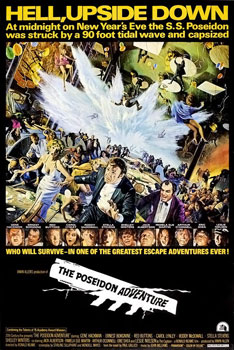
Embracing the Melodrama Part II #44: The Poseidon Adventure (dir by Ronald Neame)


PoseidonAdventure

A few years ago, when I first told Arleigh that I had recently watched the 1972 film The Poseidon Adventure, I remember him as being a bit shocked and amazed that I had made it through the entire film.  This was because Arleigh knows that I have a morbid obsession with drowning and that the mere sight of someone struggling underwater is enough to send me into a panic attack.

And The Poseidon Adventure is a film that is totally about drowning.  The majority of the cast drowns over the course of the film.  The few who survive spend all of their time trying not to drown.  The main villain in The Poseidon Adventure is the ocean.  The Poseidon Adventure is a film specifically designed to terrify aquaphobes like me.

And there are certain parts of The Poseidon Adventure that freaked me out when I first watched it and which continue to freak me out whenever I rewatch it.

For instance, just the film’s plot freaks me out.  On New Year’s Day, an ocean liner is capsized by a huge tidal wave.  With the boat upside down, a small group of survivors struggle to make their way up to the hull where, hopefully, they might be rescued.  That involves a lot of fighting, arguing, climbing, and drowning.

It freaks me out whenever I see the huge tidal wave crash into the bridge and drown Captain Leslie Nielsen.  That’s largely because it’s impossible for me to look at Leslie Nielsen without smiling.  (I’ve already written about my reaction to seeing him in the original Prom Night.)  When he suddenly drowns, it’s not funny at all.

It freaks me out when the boat turns over and hundred of extras are tossed around the ballroom.  I always feel especially bad for the people who vainly try to hold onto the upside down tables before eventually plunging to their deaths.  (Did I mention that I’m scared of heights as well?)

It freaks me out when Roddy McDowall plunges to his death because who wants to see Roddy McDowall die?  Whenever I see him in an old movie, he always come across as being such a super nice guy.  (Except in Cleopatra, of course…)  Plus, Roddy had an absolutely chilling death scream.  They need to replace the Wilhelm Scream with the Roddy Scream.

It freaks me out when survivor Shelley Winters has a heart attack right after swimming from one part of the ship to another.  Because seriously, Shelley totally deserved the Oscar nomination that she got for this film.

And it really freaks me out when Stella Stevens plunges to her death because I related to Stella’s character.  Stella was tough, she didn’t take any crap from anyone, and she still didn’t make it.  If Stella Stevens can’t make it, what hope would there be for me?

And yet, at the same time, The Poseidon Adventure is such an entertaining film that I’m willing to be freaked out.  The Poseidon Adventure was one of the first of the classic disaster films and it’s so well done that even the parts of the film that don’t work somehow do work.

For instance, Gene Hackman plays the Rev. Frank Scott, the leader of the group of survivors.  And Hackman, who can legitimately be called one of the best actors ever, gives an absolutely terrible performance.  His performance is amazingly shrill and totally lacking in nuance.  When, toward the end of the film, he starts to angrily yell at God, you actually feel sorry for God.  And yet, Hackman’s terrible performance somehow works perfectly for the film.  It’s such an over-the-top performance that it sets the tone for the whole film.  The Poseidon Adventure is an over-the-top film and, if Hackman had invested his character with any sort of nuance, the film would not have worked as well as it did.

And then there’s Ernest Borgnine, who plays Stella Stevens’s husband.  Borgnine spends the entire film arguing with Gene Hackman.  Whenever something bad happens, Borgnine starts acting like Edward G. Robinson in The Ten Commandments.  He never actually says, “Where is your God now!?” but it wouldn’t have been inappropriate if he had.  And yet, again, it’s exactly the type of performance that a film like this needs.

And finally, there’s that theme song.  “There has to be a morning after…”  It won an Oscar, defeating Strange Are The Ways Of Love from The Stepmother.  And is it a good song?  No, not really.  It’s incredibly vapid and, while it does get stuck in your head, you don’t necessarily want it there.  But you know what?  It’s the perfect song for this film.

The Poseidon Adventure is not a deep film, regardless of how many times Hackman and Borgnine argue about the role of God in the disaster.  It’s an amazingly shallow film about people drowning.  But it’s so well-made and so perfectly manipulative that you can’t help but be entertained.

The Poseidon Adventure totally freaks me out.  But I will probably always be willing to find time to watch it.