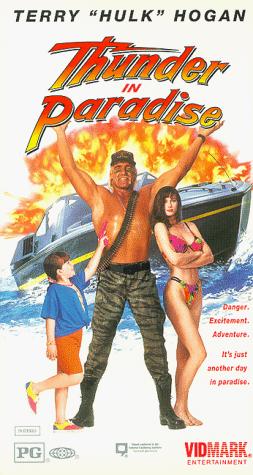
R.J. “Hurricane” Spencer (Hulk Hogan) is a former Navy SEAL who now lives in Florida and makes his living with his superboat, Thunder. Spencer’s best friend, Bru (Chris Lemmon), is also his business partner. There’s nothing that Spencer and Bru can’t do. This movie starts with Spencer taking the boat down to Cuba so he can rescue the family of a dissident and bring them back to Florida. It ends with his using his boat to save the lives of his wife (Felicity Waterman) and his stepdaughter (Robin Weisman) from some treasure hunters who have made the mistake of kidnapping them. Spencer’s marriage is one of convenience. His wife needed a husband to get her fortune and he needed a rich wife to keep his business going. His father-in-law (Patrick MacNee) doesn’t trust him but Spencer’s a top-notch American hero.
Though it was initially released direct-to-video, ThunderinParadise was actually a pilot for a syndicated television show that started a few months later. Both the film and the show were from the producers of Baywatch and it shows with the emphasis on the beach, the bikinis, the corny humor, and the cartoonish villains (led, in this case, by Flash Gordon himself, Sam Jones). Of course, it’s a Hulk Hogan movie so none of that is really a negative. Hogan might be playing Hurricane Spencer but he’s really playing himself and there’s enough self-aware humor to make ThunderInParadise entertaining in a way thatNo Holds Barreddefinitely was not. (I liked that, during a fight on another boat, there just happened to be a wooden chair sitting on the deck that Hogan could break across his opponent’s back.) Chris Lemmon and Hulk Hogan are a surprisingly good team (Lemmon’s brain provide a needed contrast to Hogan’s bawn) and Carol Alt is on-hand as the owner of a beach bar. Naturally, a handful of Hogan’s fellow wrestlers shows up as well, Brutus Beefcake, Jim “The Anvil” Neidhardt, Giant Gonzalez, Jimmy Hart, and others. As a fan of The Avengers, I was happy to see Patrick MacNee, even if his character was just a typical distrustful father-in-law.
Corny, silly, dumb, and more fun than it probably should be, ThunderInParadise is an entertaining product of its time.
After Olympics-bound fencer Alex Freyer (Robert Chapin) accidentally kills his opponent, he is blacklisted from the sport. His career seems like it’s over until he’s saved from a mugging by the mysterious Man In Black (Joe Don Baker). The Man In Black says that he’s been watching Alex and he knows that Alex could be “the best.” The Man In Black isn’t talking about the Olympics, though. He’s talking about taking part in a series of underground sword fights, know as the Ring of Steel. Alex is all for it, until he learns how high the stakes actually are. The Man In Black is determined to keep Alex fighting so he abducts Alex’s girlfriend (Darlene Vogel).
This is one of the many “underground fighting films” that were made in the 90s. The plot is nothing special but the use of swords instead of fists does add an unexpected spark to the fight scenes. Robert Chapin, who also came up with the film’s story (and who wrote an original draft of the screenplay that was considerably darker than the film that was eventually made), was a stuntman and an accomplished swordfighter so the fights in RingofSteel feel authentic and are exciting even if the story is predictable. Joe Don Baker plays the villain, a character who actually is credited as being “The Man In Black,” and he does a good job tempting Alex to the dark side and then mocking his attempts to escape. Though I prefer Baker as a hero, he always really threw himself into his villainous roles.
RingofSteel used to show up on cable when I was a kid. I always made a point to watch it. It’s on YouTube now and it’s still an entertaining fight film.
Welcome to Late Night Retro Television Reviews, a feature where we review some of our favorite and least favorite shows of the past! On Tuesdays, I will be reviewing Baywatch Nights, an detective show that ran in Syndication from 1995 to 1997. The entire show is currently streaming on Tubi!
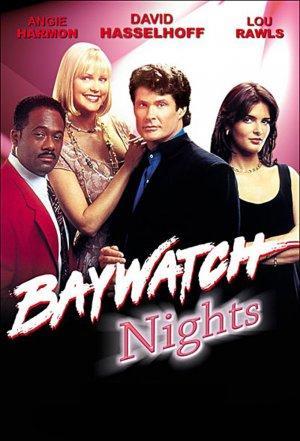
The year was 1995 and Baywatch, a show about lifeguards, was the most popular in the world. Even though the critics never cared for the show, it got monster ratings. Having played head lifeguard Mitch Buchanan for 6 years, star David Hasselhoff was growing tired with Baywatch’s format. He wanted to try something new and that new thing was Baywatch Nights. During the two years that Baywatch Nights aired, Mitch would spend his days as a lifeguard and his nights as a private investigator!
Baywatch Nights ran for two seasons. The second season is remembered for featuring Mitch battling aliens, ghosts, and vampires. The first season featured Mitch dealing with more traditional villains. For our latest Late Night Retro Television Review, we’ll be looking at both seasons of Baywatch Nights!
Episode 1.1 “Pursuit”
(Dir by Gus Trikonis, originally aired on September 30th, 1995)
The very first episode of Baywatch Nights opens with Mitch Buchanan (played, of course, by David Hasselhoff) speaking directly to the audience. He’s standing at his lifeguard stand, wearing his signature red Baywatch swim trunks.
“Some people,” Mitch says straight to the camera, “think that the beach closes when the sun goes down. Uh-uh. That’s when it really starts to heat up.” Mitch goes on to explain that he’s working a second job as a private investigator. His old friend, Garner Ellerbee (Gregory Alan Williams), is a partner in a detective agency with Ryan McBride (Angie Harmon), who was born in Texas, became a detective in New York, and recently moved to California. Mitch is working with them. Suddenly, Mitch says that he hopes those watching will enjoy this “new show.”
This brings up an interesting question. Are we listening to Mitch or are we listening to David Hasselhoff? If it’s David Hasselhoff talking directly to the audience, his monologue would seem to suggest that he thinks that Baywatch is real life, even though it’s a TV show. He talks about Garner and Ryan as if they’re real people. If we’re listening to Mitch Buchanan, that means that he has somehow become aware that he’s a character on a television show. Has Mitch become self-aware? Or has he realized that he’s living in some sort of Truman Show-style situation?
These are all questions that will probably never be answered.
As for the episode, it jumps right into things. Mitch, Garner, and Ryan have their private detective offices located right above a nightclub called — wait for it — “Nights.” Occasionally, they are helped by Destiny Desimone (Lisa Stahl), a perky blonde who spends her days doing Tarot card readings on the beach and her nights hanging out around the office. When Ryan can’t figure out how to use a computer, Destiny is there to help When Mitch and Garner can’t figure out how to have multiple landlines in one office, Destiny figures it all out! It’s all very 90s, with boxy computers and long telephone cords.
Mitch’s first case involves serving as a bodyguard for a model named Cassidy (Carol Alt). Cassidy says that someone is stalking her and she’s especially worried because another model has recently been murdered. (“Her name was Alexa,” Mitch muses as he looks at the murdered model’s body, “This was her last photo session.”) Mitch protects Cassidy and, of course, he falls for her but, in the end, he realizes that Cassidy has actually been stalking herself and was responsible for the other model’s death. Mitch is shaken by his discovery of Cassidy’s guilt, even though the exact same thing previously happened to him during the first season of Baywatch, when he fell in love with a woman who turned out to be a black widow murderer. Mitch muses that he knows how to be a lifeguard but he’s still learning how to be a private eye.
(Mitch, seriously, just watch reruns of Baywatch! I mean, you’re only one episode into Baywatch Nights and you’re already recycling old plots so I imagine you should just keep doing what you did the first time.)
This episode’s plot is pretty predictable but, for a pilot, it’s likable. Angie Harmon, Gregory Alan Williams, and David Hasselhoff all have a likable chemistry and, as a Texas girl, I appreciated the fact that Angie Harmon’s accent was authentic. Mitch narrates the episode in a hard-boiled, private eye manner and David Hasselhoff’s earnest delivery is so at odds with his words that it becomes rather charming. As a friend of mine once said when we watched him in Starcrash, “Every country should have a Hoff!”
As far as first episodes go, Pursuit does everything it needs to do. It introduces us to the characters and their personalities. Ryan is supercool and has really pretty hair. Destiny is quirky. Garner is determined. And Mitch …. well, Mitch is David Hasselhoff. Wisely, the first episode didn’t spend too much time trying to rationalize the idea of Mitch working all day as a lifeguard and then all night as a private eye. Realistically, it seems like he would end up too exhausted to be good at either job. Instead, the first episode simply tells the audience that Mitch is now a detective and that the audience better be willing to accept it.
(Unfortunately, most of the audience didn’t accept it, which is why the second episode featured Mitch dealing with sea monsters and resurrected Vikings. We’ll get to that in a while.)
Next week, Mitch battles a group of thieves on skates! Seriously, you know that’s going to be fun!
The world which started to end in the 1998 film Apocalypse continues to end in its first sequel, 1999’s Revelation!
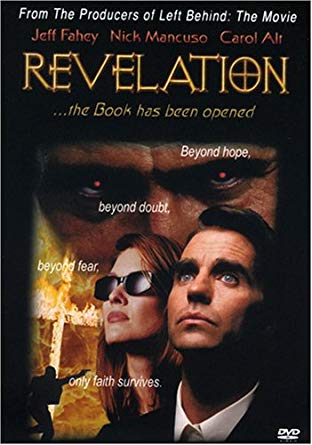
Revelation beings three months after the end of Apocalypse. The people of the world worship the president of the European Union, Franco Macalousso (Nick Mancuso, replacing Sam Bornstein from the first film). The world is ruled over by O.N.E., which stands for One Nation Earth. Those who oppose Macalousso’s claim to the messiah are known as “The Haters.” At the start of the film, a school bus has been bombed and all of the children aboard have been killed. O.N.E. claims that the Haters bombed the bus but counterterrorist agent Thorold Stone (Jeff Fahey) comes across evidence that it was actually an inside job. When Macalousso’s second-in-command, Len Parker (David Roddis), attempts to murder Thorold, he’s forced to go on the run.
The Day of Wonders is approaching. On this day, everyone on Earth is to put on a VR headset. Macalousso hasn’t made clear what the headset will do but everyone’s planning on doing it because Macalousso has told them to do it and everyone on the planet does what Macalousso says. Thorold tracks down Willy Spino (Tony Nappa), a wheelchair-bound programmer (in the 90s sense of the term, of course) who is somehow involved with setting up The Day of Wonders. Willy says that O.N.E. is not the benevolent organization that everyone thinks it is. You would have thought that Thorald would have figured that out after Parker attempted to kill him but Thorald remains convinced that Maclousso is the messiah and that his wife and daughter previously vanished not because they were Christians but because they were abducted by aliens.
Anyway, long story short, it turns out that Willy’s stepsister is Helen Hannah (Leigh Lewis), the news anchor from the first film. Helen is now a leader in the Hater underground. While she tries to convince Thorold that Macalousso is actually the Devil, Willy spends his time flirting with a cynical blind woman named Cindy (Carol Alt). Both Willy and Cindy find themselves tempted to put on the VR headset, just to see what the Day of Wonders will hold for them….
Revelation is a marked improvement on Apocalypse though, considering how shoddy the production of that first film was, that’s really not saying much. As opposed to the first film’s stiff performances and reliance on stock footage, Revelation features actual actors, actual sets, and an actual script. There’s even a few action sequences and some attempts at intentional humor. That said, if you’re a nonbeliever, Revelation isn’t going to convert you and, about halfway through the film, all of the action stops so that Thorold and Hannah can have a very long discussion about faith and whether or not God should prove his existence by turning over a glass of water.
Like the first film, Revelation actually works better as a political allegory than a religious tract. Today, it’s kind of easy to laugh at the bulky computers that fill O.N.E.’s headquarters and the scenes where Willy carefully explains what virtual reality and computer viruses are serve as a reminder that, apparently, there was a time when all of this stuff was still viewed as being somehow exotic. I mean, it’s easy to be snarky about this movie. But let’s be honest — it’s probably easier today than it was when this film was first released to imagine a world where everyone blindly does whatever the government tells them to do. And the idea of a group running a false flag operation — like blowing up a school bus and blaming it on unseen enemies — no longer seems quite as outlandish as it perhaps did it 1999.
Revelation was apparently enough of a success that it was followed by yet another sequel. This one was called Tribulation and I’ll be posting a review of it in about 15 minutes. Hope to see you then!
 R.J. “Hurricane” Spencer (Hulk Hogan) is a former Navy SEAL who now lives in Florida and makes his living with his superboat, Thunder. Spencer’s best friend, Bru (Chris Lemmon), is also his business partner. There’s nothing that Spencer and Bru can’t do. This movie starts with Spencer taking the boat down to Cuba so he can rescue the family of a dissident and bring them back to Florida. It ends with his using his boat to save the lives of his wife (Felicity Waterman) and his stepdaughter (Robin Weisman) from some treasure hunters who have made the mistake of kidnapping them. Spencer’s marriage is one of convenience. His wife needed a husband to get her fortune and he needed a rich wife to keep his business going. His father-in-law (Patrick MacNee) doesn’t trust him but Spencer’s a top-notch American hero.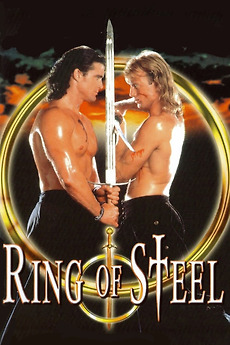
 Through the Shattered Lens