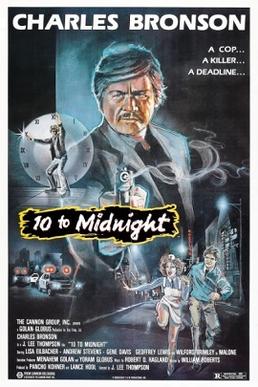
Charles Bronson is Leo Kessler, a veteran detective who’s seen it all and has grown sick of a system of justice that he thinks favors criminals over their victims. When girls start getting murdered, he immediately suspects the arrogant Warren Stacy, played by Gene Davis in the best role of his career. When Kessler and his partner Paul McCann (Andrew Stevens) start putting the pressure on Stacy, the killer responds by going after Kessler’s daughter Laurie (Lisa Eilbacher). Needless to say, our hero will do anything to stop the madman, ANYTHING!
10 TO MIDNIGHT is a special movie in my house because it’s my wife’s favorite Charles Bronson film, even when she didn’t have any overall appreciation for Bronson as an actor. Luckily for her, she had me to introduce her to the rest of the iconic actor’s voluminous catalog of movies. I saw 10 TO MIDNIGHT myself when I was pretty young, probably 13 or so. I remember being scared that first night after I watched the movie when I was trying to go to sleep. My wife and I watched it today on my old VHS tape that I’ve owned going back to the late 1980’s.
There are several elements that elevate 10 TO MIDNIGHT above the average cop / slasher thrillers of the 1980’s. First, it’s Charles Bronson in the lead role. Bronson has such a strong presence on screen that his presence alone elevates almost any material. He looks great in the film, and the role gives him some good opportunities, as both a mentor to the young cop, and even more importantly, as a dad who wants to do better for his daughter. It’s a solid role that seems to fit Bronson like a glove. Second, we know from the very beginning of the movie that Warren Stacy is in fact the killer. We also know that the law seems to be working in his favor. And because of that, we’re on Kessler’s side as he goes to extreme lengths to stop his reign of terror. Finally, the script and director J. Lee Thompson go all in on the sex and violence. Examples include Stacy killing his often naked victims while he himself is in the nude. There is much talk in the film about items of a sexual nature and Stacy even has a sexual release device that almost has to be seen to be believed. It definitely adds a decadent and voyeuristic feel to the proceedings. And I haven’t even mentioned yet that it has one of the very best endings of any Bronson film, second only to THE MECHANIC, in my humble opinion.
I highly recommend 10 TO MIDNIGHT!
For a more detailed review of 10 TO MIDNIGHT, check out Lisa’s review from a couple of years back below:
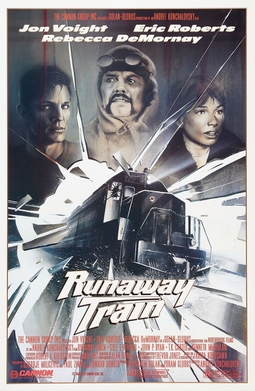
In 1985’s Runaway Train, Eric Roberts plays Buck McGeehy, a prisoner at Stonehaven Maximum Security Prison in Alaska.
Like the majority of the prisoners, Buck looks up to Manny (Jon Voight), a bank robber who has just been released from spending three years in solitary confinement. Manny is a tough guy who refuses to allow the prison system to beat him down. Warden Ranken (John P. Ryan) views Manny as being a threat to his authority and he’s especially angry that it was the courts that ordered that Manny finally be released from solitary. When Ranken tries to arrange for Manny to be assassinated at a prison boxing match, it’s Buck who saves Manny’s life. When Manny later manages to escape from the prison, Buck tags along.
Manny and Buck are a study in contrasts. Manny is as cold as the Alaskan landscape. He’s ruthless and doesn’t allow himself to get too close to anyone but, at the same time, he does live by a definite code. Buck is simple-minded, an earnest guy who talks too much and who probably wouldn’t have survived a day in prison if it wasn’t for his skill as a boxer. Buck and Manny manage to make their way across the frozen wilderness but, when they hop on a train, they soon find themselves trapped on the out-of-control locomotive, along with a railroad engineer named Sara (Rebecca De Mornay). The three of them have to find a way to either escape from or stop the train. At the same time, the obsessed Warden Ranken is determined to recapture Manny and, if that means flying a helicopter over the train so that Ranken can lower himself onto it, so be it.
Runway Train, which was based on a script by Akira Kurosawa, was one of the few Cannon films to find success with not just critics but also audiences and the industry. The Golden Globes nominated it for Best Film. The Academy didn’t go quite that far but they did nominate the film for Best Editing, along with also nominating Jon Voight for Best Actor and Eric Roberts for Best Supporting Actor. While Voight is a multiple-Oscar nominee (and one-time winner for Coming Home), Runaway Train is, so far, the only film for which Eric Roberts has been nominated. (He should have been nominated for Star 80 but his character in that film was a bit too realistically sleazy for the Academy to honor.) Roberts has described Runaway Train as being one of his favorite films and he even used the title for his autobiography. It was on this film that he met Danny Trejo, who not only trained Roberts for the boxing scenes but also helped Roberts kick his addiction to cocaine.
And Roberts has every reason to be proud. Runaway Train is a fast-moving, visually stunning thrill ride, a masterpiece of the pulp imagination. Yes, the symbolism of the runaway train is a bit obvious. Yes, the philosophical edge of the film’s dialogue can sometimes feel a bit out-of-place. Who cares? John Voight and Eric Roberts sell their characters with such skill that you don’t care that they’re both criminals who have done terrible things. From the minute we see that frozen jail and the prisoners tossing burning pieces of paper at the guards, we know why both Manny and Buck have to escape. John P. Ryan turns the warden into everyone’s worst nightmare of a small, pretty man with power, an authoritarian who uses the system to control the lives of others and who resents anyone who does not bow down before him. Even though her role is largely limited to reacting to what everyone else does around her, Rebecca de Mornay still turns Sara into a compelling character and never allows her to become merely a damsel in distress. Runaway Train is a heart-pounding action film and one that still holds up today.
Previous Eric Roberts Films That We Have Reviewed:
Goddard Bolt (Mel Brooks), the massively wealthy CEO of Bolt Enterprises, wants to buy up a huge area of Los Angeles’s slums and tear them down, transforming the area into a chic neighborhood and moving all of the poor residents and street people out. Rival businessman Vaughn Craswell (Jeffrey Tambor), who grew up in the slum and dreams of destroying it himself, has the same plan. He and Bolt make a bet. If Bolt can survive for 30 days on the streets, Craswell will allow Bolt to have the property. Bolt agrees and soon, he is penniless and sleeping in alleys. While Bolt befriends Sailor (Howard Morris) and Fumes (Theodore Wilson) and falls in love with a former dancer named Molly (Lesley Ann Warren), Craswell schemes to take over Bolt’s company and keep Bolt on the streets permanently.
Life Stinks was one of Mel Brooks’s attempts to make a straight comedy that wasn’t a parody and which had a serious message underneath the laughs. The mix of comedy and drama doesn’t really gel, because the drama is too dark and the comedy is too cartoonish. Life Stinks is often guilty of romanticizing living on the streets. With the exception of two muggers, everyone whom Bolt meets is a saint. It is still interesting to see Brooks creatively at his most heartfelt and humanistic.
Life Stinks does feature some of Mel Brooks’s best work as an actor and it’s also features an excellent turn from Lesley Anne Warren. At first, I thought Warren would be miscast as a woman who spent her days in a soup kitchen and her nights sleeping in an alley. But she actually gives a very sweet and believable performance.
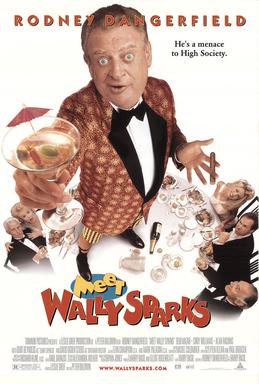
Wally Sparks (Rodney Dangerfield) is a talk show host with a program that is so raunchy that even Jerry Springer says, “At least this isn’t The Wally Sparks Show!”
Despite being a huge hit amongst teens and college students, the show is on the verge of being canceled by the head of the network, Mr. Spencer (Burt Reynolds, wearing a fearsome toupee). He is tired of Wally’s antics and he tells Wally and his producer, Sandy Gallo (Debi Mazar), that they have a week to make the show respectable.
Wally doesn’t know what to do. Wally Sparks act respectable? Wally’s a guy who don’t get no respect, no respect at all. Then Sandy finds a letter inviting Wally to attend a party at the home of Georgia Governor Floyd Patterson (David Ogden Stiers), a noted critic of the show. Hoping to get the interview that will save the show, Wally and Sandy head down south.
At the party, Wally acts like Wally and scandalizes all of the politicians and socialites. He also shares a bottle of whiskey with a horse and then rides the horse through the mansion. The party is a disaster but, after Wally claims that he can’t walk because of a spinal injury he suffered when he fell off the horse, the Governor allows him to recuperate in the mansion. Wally causes more chaos while also teaching the Governor’s wife (Cindy Williams) how to play strip poker and eventually exposing a scheme to blackmail the Governor into building a Confederate-themed amusement park.
Rodney Dangerfield playing a talk show host sounds like a great idea and there are a lot of talented people to be found in Meet Wally Sparks. Debi Mazar is an actress who should have appeared in a lot more movies and she and Rodney Dangerfield make a good team. The movie actually gets off to a funny start, with a montage of actual talk show hosts talking about how much they hate Wally Sparks and his show. Gilbert Gottfried has a cameo as a manic guest and Wally repeats some of Rodney Dangerfield’s classic jokes.
Unfortunately, the movie starts to fall apart as soon as Burt Reynolds threatens to cancel the show for being too lowbrow. No network executive has ever threatened to cancel a show that’s bringing in the ratings, regardless of how lowbrow it might be. Things get even worse after Wally goes to Atlanta and ends up staying there. The movie tries to recreate the Snobs vs. the Slobs dynamic of previous Dangerfield films but the Governor comes across as being such a decent man that there’s no joy to be found in watching his life get turned upside down. The movie has a surprisingly large number of subplots, including one about Wally’s son (Michael Weatherly) falling for the Governor’s daughter (Lisa Thornhill), but most of them go nowhere and just distract from the man who should have been the film’s main attraction, Rodney Dangerfield. By the end of the movie, even the usually irrepressible Dangerfield seems to have been neutered.
Rodney Dangerfield was a national treasure but Meet Wally Sparks was not the best showcase for his persona or his style of humor. Fortunately, Caddyshack and Back To The School are available to watch anytime that we need a good laugh and we want to show Rodney Dangerfield a little respect.
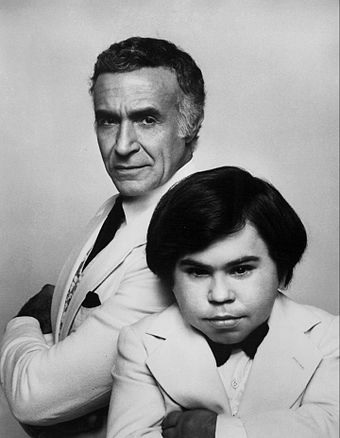
Welcome to Retro Television Reviews, a feature where we review some of our favorite and least favorite shows of the past! On Tuesdays, I will be reviewing the original Fantasy Island, which ran on ABC from 1977 to 1986. Almost the entire show is currently streaming is on Youtube!
This week, Fantasy Island goes to ancient Egypt!
Episode 3.22 “My Fair Pharaoh/The Power”
(Dir by George McCowan, originally aired on May 10th, 1980)
This week, Mr. Roarke welcomes two people with two very different fantasies. Neither one of their fantasies really make much sense but you know Mr. Roarke. He’s going to give the people what they want, unless he takes some sort of personal dislike to them. Then, they’re totally going to get screwed.
Lucy Atwell (Joan Collins), for instance, has always fantasized about going back to ancient Egypt and living the life of Cleopatra. Now, you may wonder why that is, seeing as how Cleopatra lost every man that she ever loved and was eventually killed by an asp. But no matter! Mr. Roarke sends Lucy into the past and Lucy quickly discovers that …. wait a minute! She’s not Cleopatra! Instead, she’s a part of the harem of Ptolemy (Michael Ansara)! What the Hell, Mr. Roarke!? What part of “I want to be Queen of Egypt” sounds like “I want to be a part of some old guy’s harem?”
However, Lucy does look exactly like the real Cleopatra and that might be useful, seeing as how the real Cleopatra is currently being held prisoner. After a proper amount of royal training, Lucy fills in for Cleopatra and gets to meet and fall in love with Marc Anthony (Ron Ely). When the real Cleopatra is killed by an asp, the fake Cleopatra gets to rule Egypt and it all works out nicely until …. the fantasy ends.
Oh well, it was a nice weekend. Time for Lucy to go home except …. who is that waiting for the airplane? Why, it’s Marc Anthony! Except his real name is Eric Williams and apparently, he was just a guy living out a fantasy of his own. He always wanted to know what it would be like to be Marc Anthony because who hasn’t fantasized about briefly ruling Rome and then being exiled and hounded to death by the forces of Augustus? Anyway, Lucy finds her love and Joan Collins finally gets to play Cleopatra, the role that she was nearly awarded in 1960 before Elizabeth Taylor was selected instead.
Meanwhile, in the episode’s comedic fantasy, dorky Fred Webster (Larry Linville) wants to impress his girlfriend, Laura (Julie Sommars) by being telekinetic. What? Seriously, that’s how he wants to impress her? I mean, it’s Fantasy Island! Ask for a better job or a nicer car or something. Anyway, Fred gets his power of telekinesis and uses it to cheat at gambling. This brings him to the attention of Stephanie (Carol Lynley) and her goons. When Fred realizes that Stephanie is evil, Stephanie has Laura kidnapped but she’s forgotten that Fred has telekinesis and can just mentally cause a fishing net to wrap up her and her men. This was an extremely silly fantasy. In fact, it was too silly for its own good, right down to the scenes where Fred’s eyes take on a green glow while he uses his powers.
This was a pretty forgettable episode but at least there were some nice costumes in the Egyptian fantasy. Next week, season 3 comes to an end.
The 1983 film, 10 to Midnight, opens with LAPD detective Leo Kessler (played by legendary tough guy Charles Bronson) sitting at his desk in a police station. He’s typing up a report and taking his time about it. A reporter who is in search of a story starts to bother Leo.
“Jerry,” Leo tells him, “I’m not a nice person. I’m a mean, selfish son-of-a-bitch. I know you want a story but I want a killer and what I want comes first.”
It’s a classic opening, even if Leo isn’t being totally honest. Yes, he can be a little bit selfish but he’s really not as mean as he pretends to be. He may not know how to talk to his daughter Laurie (Lisa Eilbacher) but he is also very protective of her and he wants to be a better father than he’s been in the past. He may roll his eyes when he discovers that Detective Paul McAnn (Andrew Stevens) is the son of a sociology professor but he still tries to act as a mentor to his younger partner. Leo may complain that the criminal justice system “protects those maggots like they’re an endangered species” but that’s just because he’s seen some truly disturbing things during his time on the force and, let’s face it, Leo has a point. When one of Laurie’s friends is murdered, Leo is convinced that Warren Stacy (Gene Davis) is the murderer and he’s determined to do whatever he has to do to get Warren off the streets. “All those girls,” Leo snarls when he sees Warren, his tone letting us know that his mission to stop Warren is about more than just doing his job.
Warren Stacy is handsome, athletic, and he has good taste in movies. (He’s especially a fan of Butch Cassidy and the Sundance Kid. Just don’t try to trick him by saying Steve McQueen played the Sundance Kid.) Warren is also a total creep, the type of guy who complains that a murder victim “wasn’t a good person,” because she trashed him in her diary. When Leo takes a look around Warren’s apartment, he finds not only porn but also a penis pump. (“It’s for jacking off!” Leo yells at Warren, enunciating the line as only Charles Bronson could.) Warren is also a murderer but he’s a clever murderer, the type who sets himself up with an alibi by acting obnoxiously in a movie theater. Warren strips nude before killing his victims, in order to make sure that he doesn’t leave behind any evidence. (This film was made in the days before DNA testing.)
Leo knows that Warren is guilty but, as both his gruff-but-fair captain (Wilford Brimley, naturally) and the D.A. (Robert F. Lyons) point out, he has no way to prove it. When Warren starts to stalk Laurie and her friends (including Kelly Preston), Leo decides that he has no choice but to frame Warren. But when Warren’s amoral attorney, Dave Dante (Geoffrey Lewis, giving a wonderfully sleazy performance), threatens to call McAnn to the stand, McAnn has to decide whether to tell the truth or to join Leo in framing a guilty man.
10 to Midnight is a violent, vulgar, and undoubtedly exploitive film, one that features a ham-fisted message about how the justice system is more concerned with protecting the rights of the accused as opposed to lives of the innocent. And yet, in its gloriously pulpy way, this is also one of Bronson’s best films. It’s certainly my personal favorite of the films that he made for Cannon.
Director J. Lee Thompson and Charles Bronson were frequent collaborators and Thompson obviously knew how to get the best out of the notoriously reserved actor. Bronson was not known for his tremendous range but he still gives one of his strongest performances in 10 to Midnight, playing Leo as being not just a determined cop but also as an aging man who is confused by the way the world is changing around him. Stopping Warren isn’t just about justice. It’s also about fighting back against the the type of world that would create a Warren Stacy and then allow him to remain on the streets in the first place. Interestingly, though Leo doesn’t hesitate when it comes to framing Warren, he is also sympathetic to McAnn’s objections. Unlike other Bronson characters, Leo doesn’t hold a grudge when his partner questions his methods. Instead, he simply know that McAnn hasn’t spent enough time in the real world to understand what’s at stake. McAnn hasn’t given into cynicism. He hasn’t decided that the best way to deal with his job is to be a “mean son of a bitch.” Bronson and Andrew Stevens, who had worked together in the past, have a believable dynamic. McAnn looks up to Leo but is also conflicted by his actions. Leo may be annoyed by McAnn’s reluctance but he also respects him for trying to be an honest cop. Their partnership feels real in a way that sets 10 to Midnight apart from so many other films about an older cop having to deal with an idealistic partner.
One of the most interesting things about the film is Leo’s relationship with his daughter, Laurie. Over the course of the film, Leo and Laurie go from barely speaking to bonding over liquor and their shared regrets about the state of the justice system. When McAnn first meets Laurie, she’s offended when McAnn suggests that she takes after her father. But, as the film progresses, she comes to realize that she and Leo have much in common. (To be honest, I related quite a bit to Laurie, especially as I’ve recently come to better appreciate how much of my own independent nature was inherited from my father.) Lisa Eilbacher and Charles Bronson are believable as father-and-daughter and they play off of each other well. The scenes between Laurie and Leo give 10 to Midnight a bit more depth than one might otherwise expect from a Bronson Cannon film. Leo isn’t just trying to protect his daughter and her roommates from a serial killer. He’s also trying to be the father who he wishes he had been when she was younger. He’s trying to make up for lost time, even as he also tries to keep Warren Stacy away from his family.
As played by Gene Davis, Warren Stacy is one of the most loathsome cinematic villains of all time. Warren’s crimes are disturbing enough. (Indeed, the surreal sight of a naked and blood-covered Warren Stacy stalking through a dark apartment is pure nightmare fuel.) What makes Warren particularly frightening is that we’ve all had to deal with a Warren Stacy at some point in our life. He’s the sarcastic and easily offended incel who thought he was entitled to a phone number or a date or perhaps even more. As I rewatched this movie last night, I wondered how many Warrens I had met in my life. How many potential serial killers have any of us unknowingly had to deal with? Warren tries to strut through life, smirking and going out of his way to let everyone know that he knows more than they do but the minute that Leo turns the table on him, Warren starts whining about he’s being treated unfairly. During his final, disturbing rampage, Warren yells that his victims aren’t being honest with him, blaming them for his actions. The film deserves a lot of credit for not turning Warren into some sort of diabolical and erudite supervillain. He’s not Hannibal Lecter. Instead, like all real-life serial killers, he’s a loser who is looking for power over those to whom he feels inferior and for revenge on a world that he feels owes him something. He’s a realistic monster and that makes him all the more frightening and the film all the more powerful. Warren is the type of killer who, even as I sit here typing this, could be walking down anyone’s street. He’s such a complete monster that it’s undeniably cathartic whenever Leo goes after him.
How delusional is Warren Stacy? He’s delusional enough to actually taunt Charles Bronson! At one point, Warren informs Leo that he can’t be punished for being sick. Warren announces that, when he’s arrested, he might go away for a while but he’ll be back and there’s nothing Leo can do about it. (The suggestion, of course, is that Warren will be back because he committed his crimes in California and all the judges were appointed by a bunch of bleeding heart governors. Warren may not say that out loud but we all know that is the film’s subtext. Some people may agree with the film, some people may disagree. Myself, I’m against the death penalty because I think it’s a prime example of government overreach but I still cheered the first time that I heard Clint Eastwood say, “Well, I’m all torn up about his rights,” in Dirty Harry.) How does Leo react to Warren’s taunts? I can’t spoil the film’s best moment but I can tell you that 10 to Midnight features one of Bronson’s greatest (and, after what we’ve just seen Warren do, most emotionally satisfying) one-lines.
The title has nothing to do with anything that happens in the film. In typical Cannon fashion, the film’s producers came up with a snappy title (and 10 to Midnight is a good one) and then slapped it onto a script that was previously called Bloody Sunday. Fortunately, as long as Bronson is doing what he does best, it doesn’t matter if the title makes sense. And make no mistake. 10 to Midnight is Bronson at his best.


 Through the Shattered Lens