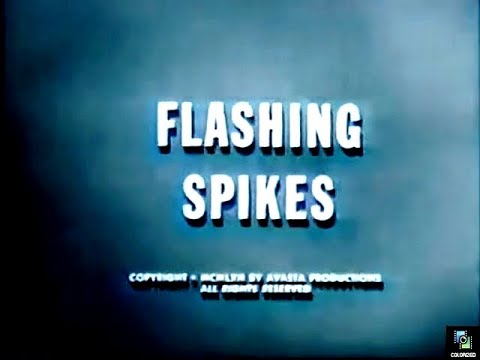
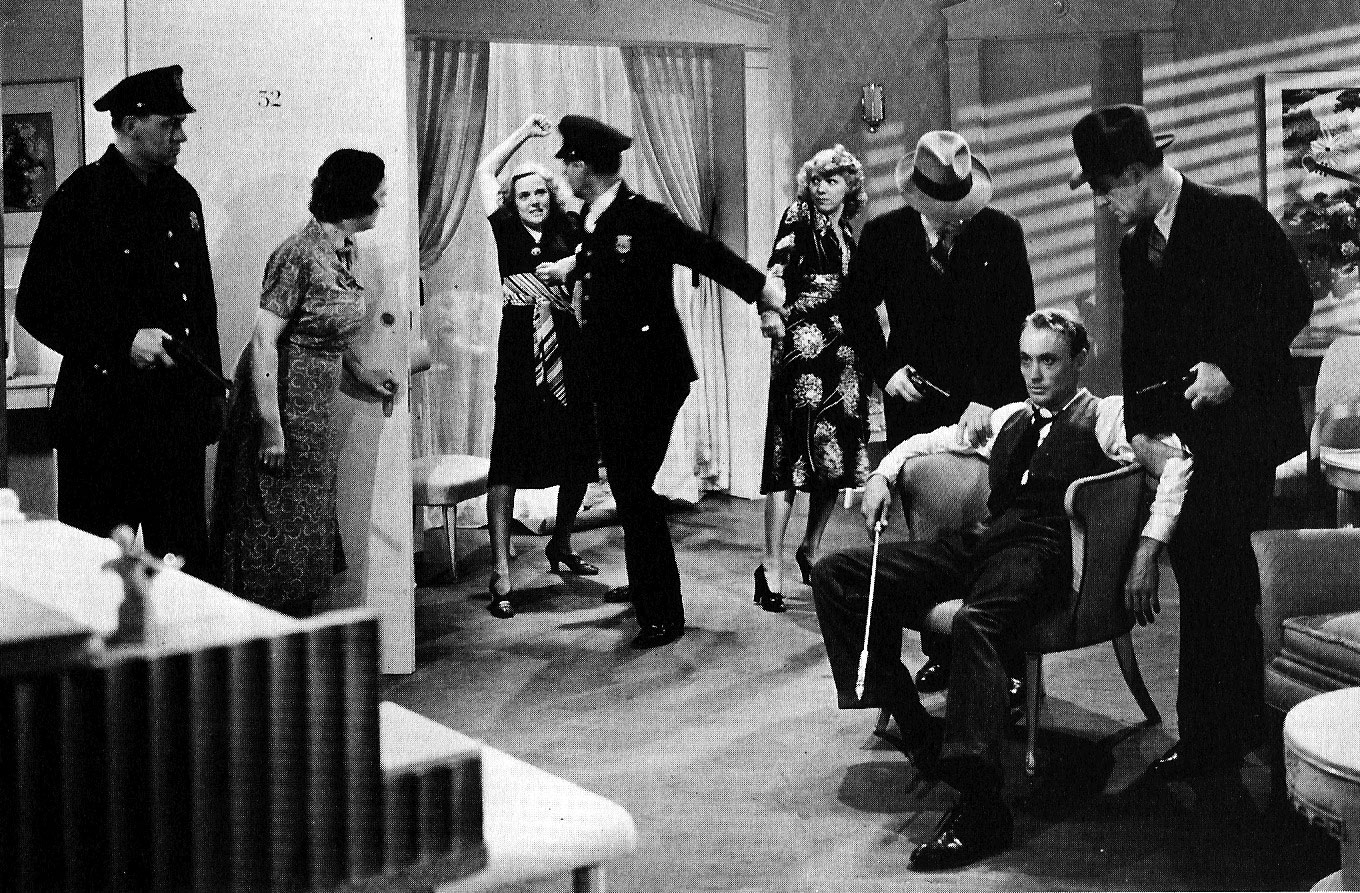
I Watched Flashing Spikes (1962, Dir. by John Ford)


When infielder Bill Riley (Patrick Wayne) makes an error that costs his team the game, sports columnist Rex Short (Carleton Young) claims that he witnessed Bill being paid off by Slim Conway (James Stewart).  Slim is a former player who was banned from Major League Baseball after he was accused of taking a bribe from a gambler.

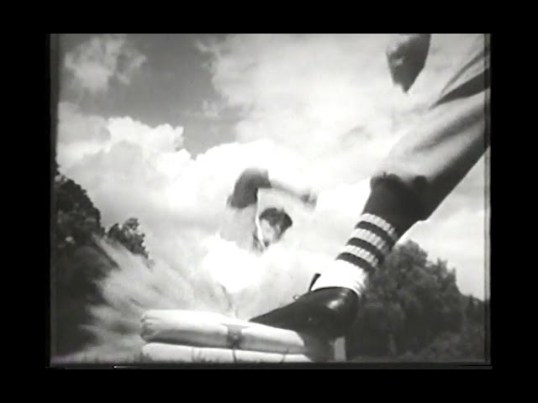
Most the movie is a flashback, showing how Bill first met Slim when Slim was playing for a barnstorming team of former major leaguers.  That was my favorite part of the movie.  Slim and a collection of old, worn-out men stumble out of their bus and even though they might move a little slower and they might need to stretch a little more before swinging a bat, they still show up a cocky team made up of young local players.  Even after the crowd nearly riots when they realize that Slim is one of the players, the old players keep their cool and their eye on the game.  After Bill spikes Slim while sliding into home plate, Bill apologizes.  Slim remembers the young man’s humility and, working with one of the few friends that he has left in the game, Slim helps Bill get his chance in the Majors.

Usually, when my sister yells at me to come watch something because “it’s got baseball!,” I’m prepared for it turn out to just be a movie with one scene of someone holding a bat.  I’m glad that she called me to come watch Flashing Spikes with her because it really is a good and loving celebration of my favorite game.  Even after Slim is treated so unfairly by the press, the League, and even some of the fans, he never stops loving the crack of the bats and the cheers of the crowd.  Flashing Spikes is unabashedly pro-baseball and Slim stands in for every player who was ever unfairly railroaded out of the game by scandal mongers like Rex Short.

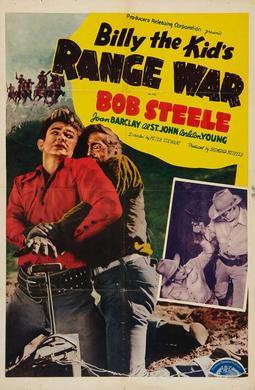
Billy The Kid’s Range War (1941, directed by Sam Newfield)


Billy the Kid was a big damn hero.

At least that’s the claim of Billy The Kid’s Range War, in which Billy (played by middle-aged Bob Steele) is a do-gooder with a comedic sidekick named Fuzzy (Al St. John) and a hankering to help Ellen Gorman (Joan Barclay) bring a new stagecoach line to town.  Williams (Karl Hackett) does want to the Gorman family to success so he hires Buck (Rex Lease) to dress up like Billy the Kid and ride a horse that looks like Billy the Kid’s and commit crimes, like killing Ellen’s father.  Framed for all those crimes that he didn’t commit and with his best friend (Carleton Young) ordered to arrest him, Billy decides to go under cover so that he can clear his good name.  Someone pretending to be Billy the Kid got him into this mess.  Now, Billy’s going to get out of it by pretending to be someone else.

The action is pretty standard for a B-western.  Mostly, it’s interesting to see a movie where Billy the Kid is actually a nice guy who gets framed.  No wonder a whole generation grew up with no idea about true history of the American frontier.  Sam Newfield directed a handful of Billy the Kid films and the capable Bob Steele starred in most of them but this is the only one that I’ve sat down and watched and it actually left me missing the production values of the Johnny Mack Brown films.  For fans of these type of westerns, there’s the promise of seeing familiar actors like George Cheseboro and Ted Adams doing there thing.  Even the outstanding character actor Milton Kibbee makes an appearance.  For those who do not like westerns, this film is not going to change their minds.

Despite the promise of the title, there is no range war in this movie.  There’s just Billy the Kid, trying to clear his good name.

Lisa Marie Reviews An Oscar Winner: From Here To Eternity (dir by Fred Zinnemann)


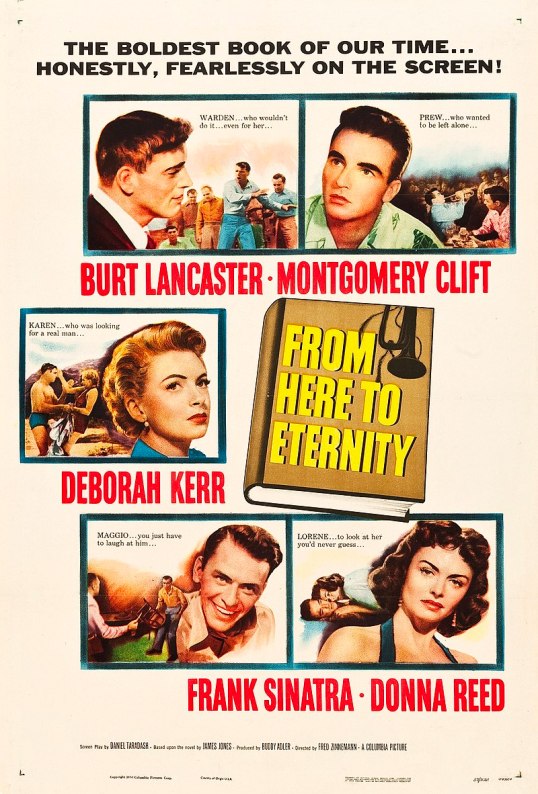
“The boldest book of our time,” shouts the poster art for 1953’s From Here To Eternity, “honestly, fearlessly brought to the screen!”

And indeed, James Jones’s novel was brought to the screen about as boldly as a studio film could be brought in 1953.  The book told the story of several soldiers in the days immediately before the attack on Pearl Harbor.  The Production Code was still in effect and, as a result, a few changes were made to the film’s plot.  Donna Reed played Lorene, a character who is described as being a “hostess” at social club but who, in the book, worked at a brothel that was popular with the soldiers from a nearby army base.  In the book, an unfaithful husband gives his wife a venereal disease that leads to her getting a hysterectomy.  In the movie, Karen’s (Deborah Kerr) hysterectomy was the result of a miscarriage that occurred after she discovered her husband was being unfaithful.  The book was critical of the Army and featured officers who faced no consequences for their actions.  The movie definitely presents the enlisted men as being at the mercy of officers but the worst of the officers is ultimately disciplined.  The movie was made with the cooperation of the U.S. Army and, as a result, the film’s villains — like Captain Holmes (Philip Ober) and the monstrous Fatso Judson (Ernest Borgnine) — were portrayed as being aberrations who did not represent the Army as a whole.  That said, the film version of From Here To Eternity is still a powerful, moving, and daring film.  What couldn’t be shown on screen is still suggested.  One might not see the specifics of what Fatso Judson does to Maggio (Frank Sinatra) in the stockade but it’s not difficult to figure out.

The film follows one company of soldiers as they laugh, fight, and fall in love while stationed in Hawaii.  They spend time training for a war that most of them think will never come.  Captain Holmes is more concerned with his regimental boxing team than the prospect of going to war and is confused when Private Prewitt (Montgomery Clift) refuses to stop back into the ring.  Prewitt, who takes pride in his ability as a bugler, quit boxing after he blinded an opponent in the ring but Holmes doesn’t care.  Holmes wants another trophy for his office.  He orders Sgt. Warden (Burt Lancaster) to make life Hell for Prewitt until Prewitt agrees to box.  Warden, who has seen a lot of officers come and go and who has been tempted to become an non-commissioned officer himself, is having an affair with Holmes’s wife, Karen.  Meanwhile, Prewitt and his friend Maggio spend their time looking forward to the weekends they’re allowed to spend off the base.  Prewitt has fallen in love with Lenore but, as with all the men in From Here To Eternity, Prewitt’s true love is for the army.  Even with Holmes pressuring him to box, Prewitt’s loyalty is to the men with whom he serves.  There’s a lot of drama, a lot of death, and a lot of romance.  This is the film in which Burt Lancaster and Deborah Kerr make out on the beach while the tide rolls in.  But, when Pearl Harbor is attacked, all of the drama and all of the romance is forgotten as America goes to war.

From Here To Eternity is one of the best films of the 1950s and certainly one of the more worthy winners for Best Picture.  Intelligently directed, wonderfully acted, deliriously romantic, and finally rather sad, it’s a film that embraces the melodrama without ever hitting a false note.  Burt Lancaster’s rugged weariness, Montgomery Clift’s method sensitivity, Frank Sinatra’s naturalism, Ernest Borgnine’s crudeness, Deborah Kerr’s classiness, and Donna Reed’s earnestness all come together to create a film in which the characters feel real and alive.  Warden, Prewitt, Lenore, Karen, and Maggio are all interesting, multi-faceted people, trying to find some sort of happiness in the shadow of an inevitable war.  The viewer may sometimes have mixed feelings about their actions (and Borgnine’s Judson is one of the most loathsome roles that the normally likable Borgnine ever played) but you never cease to care about them and their stories.  With all of the characters and the affairs and the secrets, From Here To Eternity can feel like a soap opera but it’s also a portrait of a world that is on the verge of changing forever.

A few years ago, I attended a screening of From Here To Eternity at the Dallas Angelika.  This is a film that definitely deserves to be seen on the big screen.  From the famous scene on the beach to the attack on Pearl Harbor to the tragic final moments, this is a big movie that deals with big emotions and big moments.  It’s one of the best.

Horror on TV: The Twilight Zone 3.24 “To Serve Man” (dir by Richard L. Bare)


“It’s a cookbook!”

During the month of October, we like to share classic episodes of horror-themed television.  That was easier to do when we first started doing our annual October horrorthon here at the Shattered Lens because every single episode of the original, black-and-white Twilight Zone was available on YouTube.  Sadly, that’s no longer the case.  In fact, there is exactly one episode of the original Twilight Zone on YouTube.

Fortunately, that episode is a classic.  In 1962’s To Serve Man, an alien (Richard Kiel) comes to Earth and invites people to return to his home planet with him.  He leaves behind a book.  When everyone learns that the title of the book is To Serve Man, they excitedly decide that the book must be an instruction manual on how to help mankind.  The truth, as we learn in the episode’s classic finale, is something a little bit different.

Here’s the episode!  Watch it before YouTube yanks it down.

(This episode originally aired on October 2nd, 1962.  It was directed by Richard L. Bare from a script by Rod Serling.  It was based on a short story by Damon Knight.)

Enjoy!

Horror on TV: The Twilight Zone 3.24 “To Serve Man” (dir by Richard L. Bare)


“It’s a cookbook!”

During the month of October, we like to share classic episodes of horror-themed television.  That was easier to do when we first started doing our annual October horrorthon here at the Shattered Lens because every single episode of the original, black-and-white Twilight Zone was available on YouTube.  Sadly, that’s no longer the case.  In fact, there is exactly one episode of the original Twilight Zone on YouTube.

Fortunately, that episode is a classic.  In 1962’s To Serve Man, an alien (Richard Kiel) comes to Earth and invites people to return to his home planet with him.  He leaves behind a book.  When everyone learns that the title of the book is To Serve Man, they excitedly decide that the book must be an instruction manual on how to help mankind.  The truth, as we learn in the episode’s classic finale, is something a little bit different.

Here’s the episode!  Watch it before YouTube yanks it down.

(This episode originally aired on October 2nd, 1962.  It was directed by Richard L. Bare from a script by Rod Serling.  It was based on a short story by Damon Knight.)

Enjoy!


Horror on TV: The Twilight Zone 3.24 “To Serve Man”


On this day, 58 years ago, one of the most influential shows in the history of television, The Twilight Zone, premiered on CBS.  Created by Rod Serling, this anthology show not only featured some of the best actors and writers in the business but it also used tales of the unexpected to address some of the most pressing issues of the day.  (Many, if not all, of those issues remain relevant today.)  The Twilight Zone inspired a countless number of future filmmakers and writers and it remains popular today.  The annual New Year’s Eve and 4th of July marathons on SyFy continue to delight viewers both new and old.

When we first started doing our annual October horrorthon here at the Shattered Lens, every single episode of the original, black-and-white Twilight Zone was available on YouTube.  Sadly, that’s no longer the case.  As I sit here writing this, while several episodes from the show’s later (and largely unsuccessful) revivals have been uploaded,  there is exactly one episode of the original Twilight Zone on YouTube.

Fortunately, that episode is a classic.  In 1962’s To Serve Man, an alien (Richard Kiel) comes to Earth and invites people to return to his home planet with him.  He leaves behind a book.  When everyone learns that the title of the book is To Serve Man, they excitedly decide that the book must be an instruction manual on how to help mankind.  The truth, as we learn in the episode’s classic finale, is something a little bit different.

Here’s the episode!  Watch it before YouTube yanks it down.

Enjoy!

Horror on TV: The Twilight Zone 3.24 “To Serve Man”


You know what?

I’ve spent this October irritated by the lack of episodes of the Twilight Zone on YouTube.  I mean, I understand the importance of copyright laws and everything but seriously, how can you take away the Twilight Zone in October!?

However, I finally managed to find one — and exactly one — episode of The Twilight Zone on YouTube.  And it’s a classic!  (And who knows how long it’ll be available so don’t hold off on watching it!)  Here is the classic “To Serve Man” episode of The Twilight Zone!

Enjoy and bon appetit!


The Fabulous Forties #40: Smash-Up, The Story of a Woman (dir by Stuart Heisler)


Smash-Up_(1947)

The 39th film in the Fabulous Forties box set was 1947’s Smash-Up, the Story of a Woman.  I have to say it was a little bit strange going from watching the hilarious and life-affirming My Man Godfrey to watching the very serious and rather depressing Smash-Up.

Smash-Up is pure, tear-jerking Hollywood melodrama.  When the film starts, Angie Evans (Susan Hayward) is in a hospital, with her face totally covered in bandages.  Just by looking at her, we already know that her story is not going to be a happy one.

Flash back time!  Angie was a nightclub singer and a pretty good one at that.  The audiences loved her and she loved performing but she loved one thing more.  (See how overwrought my prose was there?  That’s a reflection of Smash-Up’s style.)  She loved Ken Conway (Lee Bowman, who may be related to me but probably isn’t).  Ken was a singer himself, though he was nowhere near as successful as Angie.  However, after Ken and Angie married, Angie put her career on hold while Ken went on to become a huge success.

Angie was already a drinker before she met Ken.  Having a few drinks before going out on stage helped to calm her nerves.  It helped her to relax and become the performer that the audiences loved.  However, once Ken became a star and Angie found herself continually alone in their home, she started to drink because it was the only thing that made her happy.  Whenever she started to regret giving up her career, she drank.  When she was worried that Ken was having an affair with his secretary (Marsha Hunt), Angie drank.  Ken’s best friend and songwriter, Steve (Eddie Albert), could see that Angie was losing control.  However, Ken refused to accept that his wife had a drinking problem.  Accepting that Angie was drinking to be happy would mean accepting that she wasn’t happy in the first place.

Trapped in the middle of all this was their daughter, Angel (Sharyn Payne).  When Ken, finally admitting that his wife could not control her drinking, demanded custody of Angel, Angie was determined to get back her daughter.

But, even though she wanted to, Angie could not stop drinking.  Or smoking.  And the smoking, the drinking, and the kidnapping did not make for a particularly good combination.

According to Wikipedia, Smash-Up was a failure at the box office and I can actually see why.  1940s American cinema can basically be divided between the earnest, patriotic, and optimistic films that were released during World War II and the dark and pessimistic films that came out after the war ended and the world realized just how evil and dangerous human beings could be.  Smash-Up is one of those dark films.  It’s not a happy film, nor is it at all subtle.  In fact, as much as I love a good melodrama, Smash-Up occasionally seems like a bit much.  Absolutely every bad thing that could happen does happen and it’s typical of the approach of Hollywood in the 40s that, for all the trouble Angie suffers as a result of her drinking, the film still has to find an excuse to send her to hospital with her face in bandages.  The film is often very empathetic in its treatment of Angie but, in the 1940s, mistakes still had to be punished.

Fortunately, Susan Hayward gives a great performance in the role of Angie, capturing the aching sadness that leads her to drink in the first place.  She saves the entire film and, quite justifiably, she received a nomination for best actress for her performance here.  She didn’t win but she still made Smash-Up worth seeing.

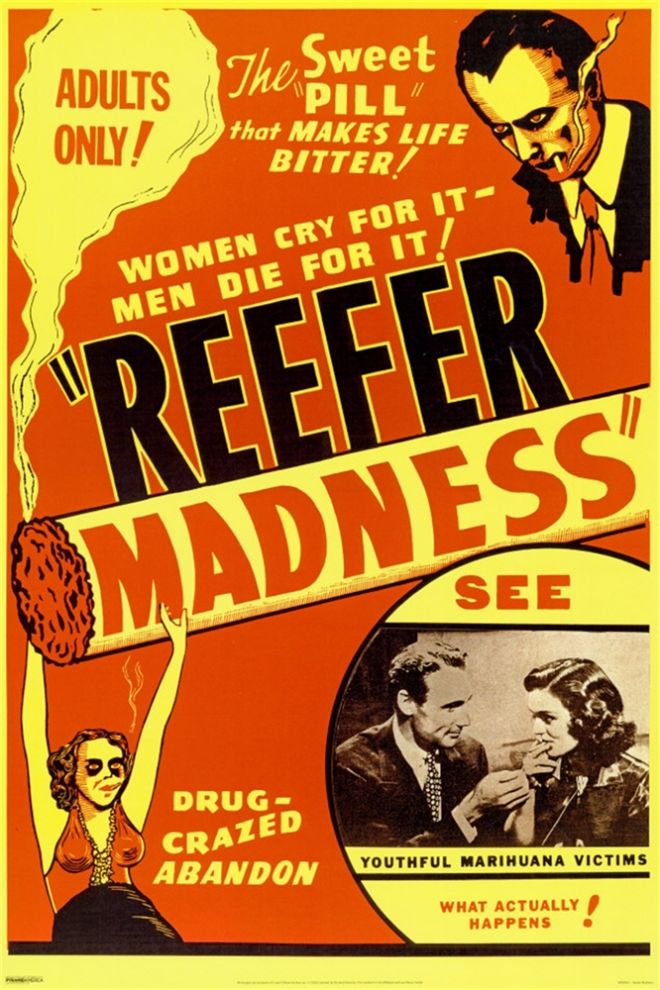
One Toke Over the Line: REEFER MADNESS (G & H Productions 1936)


gary loggins's avatarcracked rear viewer

reef1

I’m writing this post while battling a nasty case of the flu, so it’s probably going to be a short one. That’s okay though, because really, what can I say about REEFER MADNESS? It’s terrible filmmaking, and dull as dishwater. There are plot holes so wide you could drive a semi through them. This little exploitation number would’ve been long forgotten after making the rounds on the grindhouse and roadshow circuits, until it was rediscovered by the stoner crowd in the 70’s and turned into an ironic midnight cult movie.

reef2

The movie itself finds stodgy Dr. Carroll lecturing the local School-Parent Group to help “stamp out this frightful assassin of youth” marijuana. He recounts what happened when some kids got hooked on the stuff. Seems this gang of drug pushers were out to corrupt American youth by turning them on at an apartment run by no-goods Mae and Jack. Sweet Mary’s brother…

View original post 380 more words

Horror on TV: Twilight Zone 3.24 “To Serve Man”


TheTwilightZoneLogo


I shared this episode of The Twilight Zone two years ago for Halloween but the YouTube video has since been taken down. So, here it is again!


There’s a lot I could say about To Serve Man but really, all that needs to be acknowledged is that it’s a classic and features one of the best endings ever.


To Serve Man was written by Rod Serling and directed by Richard L. Bare. It originally aired on March 2nd, 1962.


Bon appetit!