Lisa Reviews A Palme d’Or Winner: M*A*S*H (dir by Robert Altman)


With the Cannes Film Festival underway, I have been watching some of the past winners of the prestigious Palme d’Or.  On Thursday night, Jeff and I watched the winner of the 1970 winner of the Grand Prix (as the Palme was known at the time), Robert Altman’s M*A*S*H.

There are, of course, three versions of M*A*S*H.  All three of them deal with the same basic story of Dr. Hawkeye Pierce and his attempts to maintain his sanity while serving as a combat surgeon at the 4077th Mobile Army Surgical Hospital during the Korean war.  All three of them mix comedy with the tragedy of war.  However, each one of them takes their own unique approach to the material.

The one that everyone immediately thinks of is the old television series, which ran for 11 seasons and which can be found on Hulu and on several of the retro stations.  The television series starred Alan Alda as Hawkeye.  I’ve watched a handful of episodes and, while the episodes that I’ve seen were undeniably well-acted and well-written and they all had their heart in the right place, the show’s deification of Hawkeye can get to be a bit much.  Not only is Hawkeye the best surgeon at the 4077th, he’s apparently the best surgeon in all of Korea.  In fact, he may be the best surgeon on the entire planet.  Not a single thing happens in the camp unless Hawkeye is somehow involved.  When a nurse is killed by a landmine in one episode, the focus is not on the other nurses but instead on how Hawkeye feels about it.  When bombs are falling too close to the camp, the focus is again only on Hawkeye and how much he hates the war.  If you didn’t already know that he hated the war, Hawkeye will let you know.  Wish Hawkeye a good morning and he’ll yell at you about how many people are going to be wounder by the end of the day.  Even when one agrees with Hawkeye, the character’s self-righteousness can be a bit much.

Less well-known is the first version of M*A*S*H, a short and episodic novel that was published in 1968.  The novel was written by Dr. Richard Hornberger, who actually had served in Korea at a M*A*S*H unit and who reportedly based Hawkeye on himself.  The book is a rather breezy affair.  Reading it, one can definitely tell that it was inspired by someone telling Hornberger, “Your stories about Korea are so funny and interesting, you should write them down!”  The book avoids politics, reserving most of its ire for military red tape.  Hornberger was a Republican who so disliked Alan Alda’s interpretation of Hawkeye that, when he wrote a sequel to M*A*S*H, he included a scene in which Hawkeye talked about how much he enjoyed beating up hippies.

And then there’s the version that came in between the book and the television series, the 1970 film from Robert Altman.  The film retains the book’s episodic structure while also throwing in the anti-war politics that would define the television series.  (Though the film was set in the 50s, Altman purposefully made no attempt to be historically accurate because he wanted it to be clear that this film was more about Vietnam than Korea.)  From its opening, the film announces its outlook, with shots of helicopters carrying severely wounded (possibly dead) soldiers to the camp while a song called Suicide is Painless plays on the soundtrack.  The song was written by director Robert Altman’s fourteen year-old son, Mike.  Reportedly, it took Mike five minutes to come up with the lyrics.  When the instrumental version of the song was later used as the theme song for the television series, Mike Altman made over a million dollars in royalties.

The film opens with Hawkeye Pierce (Donald Sutherland) and Duke Forrest (Tom Skerritt) arriving at the 4077th MASH in a stolen jeep and it ends with them getting sent home in the same jeep.  Though Duke is set up to be a major character, he soon takes a backseat to another surgeon, the unfortunately nicknamed Trapper John (Elliott Gould).  Much as with the television series, the movie centers around Hawkeye and Trapper John’s antics.  When they’re not in the operating room, they’re drinking, carousing, and playing pranks that are far more mean-spirited than anything the television versions of the characters would have ever done.  (Indeed, the book and movie versions of Hawkeye probably would have hated Alan Alda’s Hawkeye.)  Unlike the television version of Hawkeye, the film’s Hawkeye is not the best surgeon in Korea.  In fact, he’s not even the best surgeon at the 4077th.  (That honor goes to Trapper.)  Instead, he’s just one of many doctors on staff.  They’re rotated in and then, at the end of their tour, they’re rotated out.  Hawkeye loses as many patients as he saves.  The film’s doctors are not miracle workers, nor are they crusaders.  Instead, they are overworked, neurotic, often exhausted, and frequently bored whenever there aren’t any wounded to deal with.  The film emphasizes that the doctors are as professional inside the Operating Room as they’re rambunctious outside of it.  Unlike the television series, Hawkeye doesn’t joke while working.  He’s usually too busy trying to stop his patients from bleeding to death to tell jokes or to complain about the war that brought them to the OR.

Indeed, the film version of M*A*S*H communicates its anti-war message not through indignant speeches but instead through bloody imagery.  The operating room scenes don’t shy away from showing the ugliness of war and they are occasionally so visceral that they almost seem to shame the audience for have laughed just a few minutes earlier.  One of the film’s more famous (and controversial) sequences features Hawkeye driving Frank Burns (Robert Duvall) to insanity by crudely taunting him about his affair with head nurse Margaret Houlihan (Sally Kellerman).  Burns attacks Hawkeye, a response that actually seems rather justified even if it is played for laughs.  A scene of Burns being driven out of the camp in straitjacket is followed by a close-up of a geyser of blood erupting from a wounded soldier’s throat.  It’s a jarring transition but one that makes a stronger anti-war statement than any self-righteous monologue would have.  While Hawkeye and Trapper are taunting Burns and Margaret, soldiers are still being sent off to die.

The humor in M*A*S*H is often brutally misogynistic.  Margaret is described as being “a damn good nurse” but is continually humiliated because she believes in maintaining military discipline.  One can disagree with her emphasis on following all of the proper regulations while also realizing the Hawkeye and Trapper’s treatment of her is unreasonably cruel.  The scene where Trapper and Hawkeye expose her while she’s taking a shower is especially difficult to watch and there’s no way to justify their actions.  It’s frat boy humor, the type of stuff that you would expect from a bunch of former college football players, which is what we’re told Hawkeye and Trapper are.  (That, of course, is another huge difference between the film and television versions of the characters.)  That said, it’s debatable whether or not were supposed to find either Hawkeye or Trapper to be heroic or even likable.  As a director, Robert Altman shied away from making films with unambiguous heroes or villains.  Just as Margaret could be a “damn good nurse” and a “regular army clown” at the same time, Hawkeye can be both a dedicated doctor and a bit of a jerk.
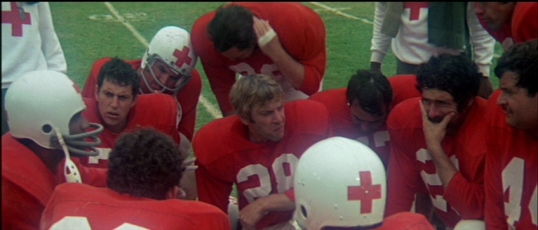
After 90 minutes of bloody operating room scenes and Trapper and Hawkeye making crude jokes, M*A*S*H suddenly becomes a sports film as the the 4077th plays a football game against their rivals, the 325th Evac Hospital.  The change of tone can be a bit jarring but it’s perhaps the most important sequence in the film.  For a few hours, the doctors bring “the American way of life” to Korea and the end result is a game that’s played for money and which is only won through cheating and deception.  (Future blaxploitation star Fred Williamson made his film debut as the ringer who the 4077th recruits for the game.)  For all of the broad comedy of the game, it’s followed by a shot of the doctors playing poker while a dead soldier is transported out of the camp, wrapped in a white sheet.  Football may provided a distraction.  The money may have provided an incentive.  But the war continued and people still died.

Much of M*A*S*H‘s humor has aged terribly but the performances still hold up and the anti-war message is potent today.  Though Sutherland and Gould are undeniably the stars of the film, M*A*S*H is a true ensemble film, full of the overlapping dialogue and the small character performances that Robert Altman’s films were known for.  One reason why the film works is because it is an immersive experience, the viewer truly does feel as if they’ve been dropped in the middle of an operating field hospital.  Though Hawkeye and Trapper may be at the center of the action, every character, from the camp’s colonel to the lowliest private, seems to have their own story playing out.  This a film where paying attention to the little things happening in the background is often more rewarding than paying attention to the main action.  I particularly liked the performances of David Arkin as the obsequies Staff Sergeant Vollmer and Bud Cort as Pvt. Warren Boone.  Boone, especially, seems to have an interesting story going on in the background.  The viewer just has to keep an eye out for him.  Also be sure to keep an eye out for Rene Auberjonois, who reportedly improvised one of the film’s best-known lines when, after Margaret demands to know how Hawkeye reached a position of authority in the army medical corps, he deadpanned, “He was drafted.”

One of the first major studio films to be openly critical of the military and the war in Vietnam, M*A*S*H won the Palme d’Or, defeating films like Investigation of a Citizen Above Suspicion and The Strawberry Statement.  Unlike many Palme winners, it was also a box office success in the United States.  Though controversial, it received an Oscar nomination for Best Picture.  However, unlike the Cannes jury, the Academy decided to honor a different film about war, Patton.

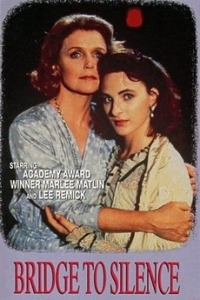
4 Film Reviews: Bridge To Silence, The Chocolate War, Kiss The Bride, Wedding Daze


Last week, I watched six films on This TV.

Which TV?  No, This TV!  It’s one of my favorite channels.  It’s not just that they show a lot of movies.  It’s also that they frequently show movies that are new to me.  For instance, last week, This TV introduced me to both Prison Planet and Cherry 2000.

Here are four other films, two good and two not so good, that This TV introduced to me last week.

First up, we have 1989’s Bridge to Silence.

Directed by Karen Arthur, Bridge To Silence was a made-for-TV movie.  Lee Remick plays Marge Duffield, who has a strained relationship with her deaf daughter, Peggy (Marlee Matlin).  After Peggy’s husband is killed in a traffic accident, Peggy has a nervous breakdown.  Marge and her husband, Al (Josef Sommer) take care of Peggy’s daughter, Lisa, while Peggy is recovering.  However, even as Peggy gets better, Marge still doesn’t feel that she can raise her daughter so Marge files a lawsuit to be named Lisa’s legal guardian.  While all of this is going on, Peggy is starring in a college production of The Glass Menagerie and pursuing a tentative romance with the play’s director (Michael O’Keefe).

Bridge to Silence is one of those overwritten but heartfelt melodramas that just doesn’t work.  With the exception of Marlee Matlin, the cast struggles with the overwrought script.  (Michael O’Keefe, in particular, appears to be miserable.)  The film’s biggest mistake is that it relies too much on that production of The Glass Menagerie, which is Tennessee Williams’s worst play and tends to be annoying even when it’s merely used as a plot device.  There’s only so many times that you can hear the play’s director refer to Peggy as being “Blue Roses” before you just want rip your hair out.

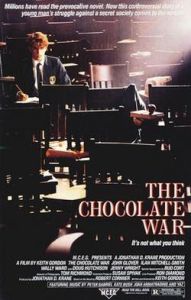
Far more enjoyable was 1988’s The Chocolate War.

Directed by Keith Gordon, The Chocolate War is a satirical look at conformity, popularity, rebellion, and chocolate at a Catholic boys school.  After the manipulative Brother Leon accidentally purchases too much chocolate for the school’s annual sale, he appeals to one of his students, Archie Costello (Wallace Langham), to help him make the money back.  Archie, who is just as manipulative as Leon, is the leader of a secret society known as the Vigils.  However, Archie and Leon’s attempt to manipulate the students runs into a roadblack when a new student, Jerry Renault (Illan Mitchell-Smith) refuses to sell any chocolates at all.  From there, things get progressively more complicated as Archie tries to break Jerry, Jerry continues to stand up for his freedom, and Leon … well, who knows what Leon is thinking?

The Chocolate War was an enjoyable and stylish film, one that featured a great soundtrack and a subtext about rebellion and conformity that still feels relevant.  John Glover and Wallace Langham both gave great performances as two master manipulators.

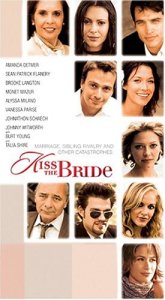
I also enjoyed the 2002 film, Kiss The Bride.

Kiss The Bride tells the story of a big Italian family, four sisters, and a wedding.  Everyone brings their own personal drama to the big day but ultimately, what matters is that family sticks together.  Directed by Vanessa Parise, Kiss The Bride featured believable and naturalistic performances from Amanda Detmer, Talia Shire, Burt Young, Brooke Langton, Monet Mazur, and Parise herself.

I have to admit that one reason why I liked this film is because it was about a big Italian family and it featured four sisters.  I’m the youngest of four sisters and, watching the film, I was reminded of my own big Irish-Italian family.  The movie just got everything right.

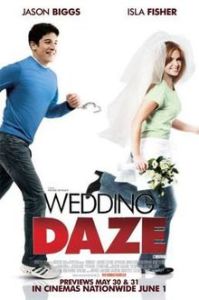
And then finally, there was 2006’s Wedding Daze.

Wedding Daze is a romantic “comedy.”  Anderson (Jason Biggs) asks his girlfriend to marry him, just to have her drop dead from shock.  Anderson’s best friend is afraid that Anderson will never get over his dead girlfriend and begs Anderson to not give up on love.  Anderson attempts to humor his friend by asking a complete stranger, a waitress named Katie (Isla Fisher), to marry him.  To everyone’s shock, Katie says yes.

From the get go, there are some obvious problems with this film’s problem.  Even if you accept that idea that Katie would say yes to Anderson, you also have to be willing to accept the idea that Anderson wouldn’t just say, “No, I was just joking.”  That said, the idea does have some comic potential.  You could imagine an actor like Cary Grant doing wonders with this premise in the 30s.  Unfortunately, Jason Biggs is no Cary Grant and the film’s director, comedian Michael Ian Black, is no Leo McCarey.  In the end, the entire film is such a misjudged failure that you can’t help but feel that Anderson’s ex was lucky to die before getting too involved in any of it.

A Movie A Day #323: Ted & Venus (1991, directed by Bud Cort)


Strange movie, Ted & Venus.

Actor Bud Cort (you remember him from Harold and Maude) both directs and stars as Ted.  Ted is a homeless poet who lives on the beach and only has one friend, a mellow beach bum named Max (Josh Brolin).  Kim Adams plays Linda, who is the Venus of the title, a social worker who has a bodybuilder jerk for a boyfriend (Brian Thompson, who you might remember as the main villain in Cobra).  When Ted sees Linda, it is love at first sight and at first, the movie seems like it is going to be a quirky romantic comedy where Ted eventually wins Linda over.  When Linda turns down Ted’s advances, Ted does not give up.  Instead, Ted starts following her everywhere and making harassing phone calls.  Ted starts out as a nuisance and goes on to become a full-out stalker.  Everyone, even Max, tells Ted to stop bothering Linda but he is convinced that he can make her fall in love him.  He’s wrong.

Because of the presence of Cort both in front of and behind the camera, Ted & Venus sometimes seems like Harold and Maude: The Later Years.  Harold, the iconoclast that everyone loved, has grown up and become Ted, the unemployable stalker.  It’s an interesting idea and Cort pulls it off as an actor but not as a director.  You have to admire Cort’s devotion to his vision but it’s impossible to be certain what that vision was because the film’s tone is all over the place.  Cort gets a far better performance from himself than he does from the rest of the cast.

Speaking of the cast, the movie is full of familiar faces.  In fact, there are almost too many familiar faces.  It’s hard not to get distracted by all of the cameos.  If you somehow see this obscure movie, keep an eye out for: Woody Harrelson (who gets two lines and five seconds of screen time), Rhea Pearlman, Carol Kane, Martin Mull, Gena Rowlands, Pat McCormick, Vincent Schiavelli, Cassandra Peterson, and Andrea Martin.  When Ted is hauled into court, charged with stalking, the judge is played by LSD guru Timothy Leary.  I am not sure what Ted & Venus was trying to say but Bud Cort assembled an impressive cast to say it.

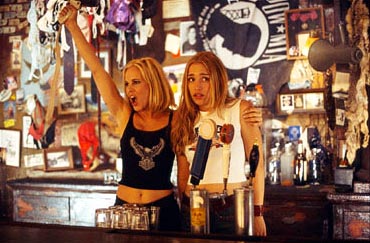
Embracing the Melodrama #48: Coyote Ugly (dir by David McNally)


coyote_ugly

“Never give up on your dreams!” is such a familiar movie cliché that I have to admit that there’s a part of me that really wants to see a mainstream, big budget studio film that proudly declares, “Give up!”  We’ve seen so many films about photogenic people who leave pretty but predictable small towns and end up in big, scary New York City that we pretty much know exactly what’s going to happen as soon as they step off that bus.  They’re going to get robbed.  They’re going to end up at an all-night dinner.  They’re going to meet the lover of their dreams.  They’re going to get quirky friends.  They’re going to become a success.  And, most importantly, they’ll be advised to “never give up on your dreams!”  It’s not that I’m cynical or that I don’t enjoy watching people succeed.  It’s just all so predictable that I found myself yearning for a film that will not slavishly follow the formula.

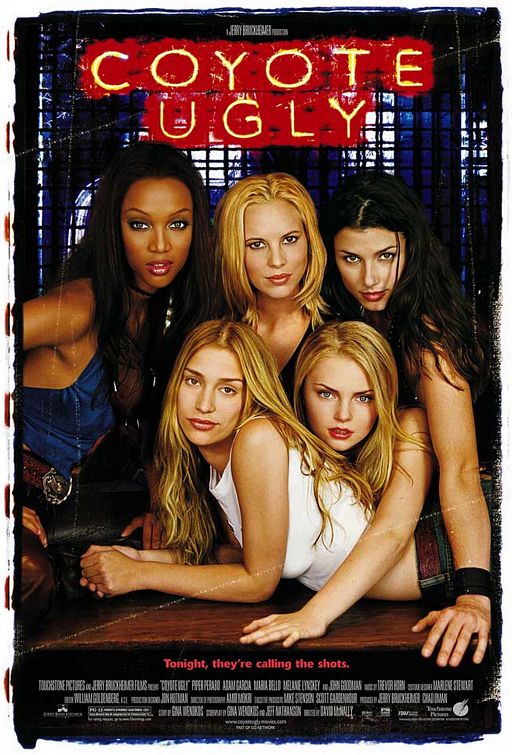
Unfortunately, 2000’s Coyote Ugly is not that film.  In fact, Coyote Ugly is such a thoroughly predictable film that it’s perhaps not surprising to discover that it’s also a film that’s been embraced by a lot of people.  It never ceases to amaze me how, whenever Coyote Ugly shows up on cable, twitter is full of viewers declaring their love.

Coyote Ugly tells the story of  Violet (Piper Perabo), who may look like an ordinary waitress from New Jersey but who aspires to be a songwriter in New York City.  As the film begins, she is in the process of leaving her loving but overprotective father (John Goodman) and her best friend (Melanie Lynesky) so that she can move to the big city and never give up on her dream.  Before she leaves, she’s asked to sign a piece of paper so that it can be tacked to the wall of the local pizza place.  It’s a tradition, apparently.  Before anyone leaves town for New York, they’re asked to leave behind an autograph.  The wall is covered with signatures, indicating that apparently every waitress in New Jersey thinks that she’s a songwriter.

Violet moves to New York and, at first, it seems like she might not make it.  Her apartment is a dump and her neighbors get mad whenever she sings.  (Violet responds by setting up a small recording studio on the roof of her building.)  Nobody is willing to listen to her demo.  About the only good thing that happens to Violet is that she meets Kevin (Adam Garcia), an Australian who encourages her to never give up on her dreams.

Eventually, Violet finds herself in one of those all-night diners that always seem to pop up in movies like this.  She notices that the girls seated at a table near her seem both to be happy and to have a lot of money.  It turns out that they work at the Coyote Ugly Saloon and since one of them (played by Tyra Banks, in a cameo) is quitting so she can go to law school, that means that there’s soon going to be an opening at the bar.

After talking to the Coyote’s owner, Lil (Maria Bello), Violet manages to get a job as a bartender.  Along with serving drinks to a combination of hipsters, frat boys, and stock brokers, another part of Violet’s job is to jump up on the bar and dance.  Eventually, she even gets a chance to sing when it’s discovered that the sound of her voice (or, to be technical about it, LeAnn Rimes’s voice since Rimes provided Violet’s singing voice) can somehow inspire drunks to stop fighting and act civilized.  Violet bonds with her fellow bartender Cammie (Izbella Miko) while the other bartender, Rachel (Bridget Moynahan) takes an instant and almost pathological dislike to her.  Lili is tough, Cammie is a flirt, and Rachel likes to set things on fire.  That’s about all we find out about them.

Even when her father disowns her for working at the Coyote and even when she and Kevin have a fight over her extreme stage fight and Kevin’s refusal to talk about his troubled past, Violet never gives up on her dreams!

And, if you can’t guess every single thing that happens in Coyote Ugly before it happens, then you really need to start watching more movies.

Despite the fact that the movie is named after the Coyote Ugly Saloon and it’s full of scenes of Violet and her co-workers dancing on top of that bar, the Coyote Ugly itself is actually pretty superfluous to the overall film.  The film itself is all about Violet pursuing her dream to become a songwriter and the bar itself really doesn’t play that major of a role into her eventual success.  Instead, it’s just a place where she works.  Violet could just as easily have worked at a particularly rowdy Dave and Buster’s and the overall film would have turned out the same.

And that’s a shame because, while watching the film, it’s hard not to feel that a movie about either Lil, Cammie, or Rachel (or, for that matter, a film about Tyra Banks going to law school) would be a thousand times more interesting that any film about boring old Violet.  I mean, here we have a film named after a business that is owned by a woman and that specifically employs and potentially empowers other women and what does the movie do with all of this material?

It tells a story so predictable and so simplistic that it could just as easily been generated by a computer program.

Coyote Ugly is a massive mixed opportunity but, for whatever reason, some people seem to love it.

https://twitter.com/jhali_/status/487998680163561472

And good for them.

ii7t6bbe89ch6tbi