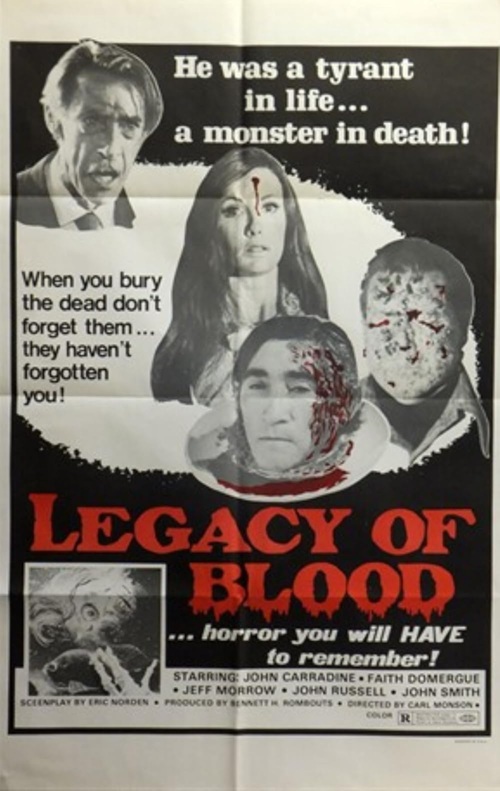
In this 1971 film, John Carradine briefly plays Christopher Dean, a wealthy man who hated his family and his servants. He dies before the film actually begins but we do get to see him in flashbacks and we also hear his voice at the reading of his will. Dean leaves a fortune to his children and his servants, but he does so only on the condition that they spend a week at Dean’s estate. If anyone dies or leaves the estate, they will lose their inheritance and the money will be split amongst those who stayed and/or survived. You can see where this is leading, right?
This is actually a promising premise and it’s easy to imagine how it could have inspired an American version of Mario Bava’s Bay of Blood, where one person is killed by another just for that killer to then be killed by someone else until eventually, there’s no one left. Unfortunately, while the characters are all unpleasant and greedy, none of them are as memorable as anyone in Bava’s classic shocker. They’re all generic jerks and, as such, it’s hard to have much of a reaction when they start dying. The film does feature several familiar B-movie stars. Jeff Morrow and Faith Domergue (both of whom were in This Island Earth) appear as brother and sister. Richard Davalos (who played James Dean’s brother in East of Eden) has an eccentric role. Western character actor Rodolfo Acosta plays the sheriff who eventually takes an axe to the forehead. B-movie veteran Buck Kartalian plays Igor, the butler. (His name is actually Igor!) Some of the members of the cast were good actors but few of them are particularly good in this film. I did appreciate the weird energy of Buck Kartalian. John Carradine doesn’t do much but he does deliver his lines with the proper amount of contempt.
The film does have a few vaguely interesting kills. Bees are used as a weapon at one point. A head is found in a refrigerator and Richard Davlos says, “This is just like a horror movie.” Wow, Richard, thanks for sharing! There’s a big twist ending but it really not that impressive of a twist.
Probably the most interesting thing about Blood Legacy is that it’s essentially a remake of Andy Milligan’s The Ghastly Ones. (Director Carl Monson had a habit of ripping off other films. In 1973, he remade Roger Corman’s Little Shop of Horrors. Monson called his remake Please Don’t Eat My Mother. The film starred Buck Kartalian.) Blood Legacy was originally released under the title Legacy of Blood but Milligan was so annoyed at being ripped-off that he later made his own remake of The Ghastly Ones and decided to give it the same title as Carl Monson’s rip-off. Monson changed his film’s title and distributed it under the names Will To Die and Blood Legacy so that it wouldn’t be confused with Andy Milligan’s Legacy of Blood. It makes sense. Why would anyone want their Andy Milligan rip-off to be confused with an actual Andy Milligan film?
Towards the end of 1976’s The Outlaw Josey Wales, Josey (played by Clint Eastwood) says, “I guess we all died a little in that damned war.”
He’s referring to the American Civil War and the film leaves you with no doubt that Wales knew what he was talking about. A farmer living in Missouri, Josey Wales wasn’t involved in the Civil War until a group of guerillas, the Redlegs, raided his home and killed his family. Seeking vengeance, Wales joined the Bushwackers, a group of Confederate guerillas that were led by the infamous “Bloody Bill” Anderson. After Anderson’s death and the South’s surrender, Senator James H. Lane (Frank Schofield) offers amnesty to any of the Bushwackers willing to surrender and declare their loyalty to the United States. Fletcher (John Vernon), the leader of the surviving Bushwackers, thinks it’s a good idea and his men eventually agree to surrender.
Everyone except for Josey Wales.
Fletcher tells Josey that he’ll be an outlaw and that Lane will send his men to capture and execute him. “I reckon so,” Josey Wales replies. It’s not that Josey was particularly a fan of the Confederate cause. Instead, having lost his family and his home and having seen hundreds of men killed, Josey no longer cares. He’s got a death wish, something that becomes apparent when he later sneaks over to Lane’s camp and discovers that the leader of the Redlegs, Terrill (Bill McKinney), has been made a captain in the Union Army. The surrendering Bushwackers, with the exception of Fletcher and a young man named Jamie (Sam Bottoms), are gunned down as they swear allegiance to the United States. Joey springs into action, hijacking a Gatling gun and mowing down soldiers. It’s a suicidal move and Josey appears to be willing to die, until he sees that Jamie has been wounded. Josey and Jamie go on the run, pursued by soldiers and bounty hunters.
It sounds like the start of typical Clint Eastwood film and, make no mistake about it, The Outlaw Josey Wales features everything that most people have come to expect from Eastwood. Josey Wales is an expert shot, often firing two guns while charging forward on his horse. Josey has a way of words, explaining the purpose of getting “plain man dog mean” and telling a bounty hunter that there are better ways to make a living. The main difference, though, is that Josey is no longer seeking revenge. He’s lost his family and his home and he knows nothing is going to bring them back. He sought revenge during the Civil War and saw so many people killed that, much like Jimmy Stewart in Broken Arrow, he just wants to disappear from civilization.
The problem is that men like Lane and Terrill have no intention of letting Josey Wales disappear. The sociopathic Terrill sees it as almost being his God-given duty to kill Josey Wales and anyone else that he dislikes. The bounty hunters are also after Josey Wales. As Fletcher explains it, bounty hunting is the only way that many former soldiers can make money and feed their families. As Josey moves through the southwest, his legend grows. Every town that Josey stops in, he hears stories about the growing number of men that he has supposedly killed.
Josey also discovers that he can’t do it all alone. He soon finds himself as a part of a new family, a collection of misfits that don’t have a home in Senator Lane’s America. Lone Waite (Chief Dan George) is an elderly Cherokee man who suggests that Josey head for Mexico. Little Moonlight (Geraldine Keams) is a Navajo woman who Josey rescues from two bounty hunters. Sarah Turner (Paula Trueman) and her granddaughter, Laura Lee (Sondra Locke), are rescued from Comancheros. Josey negotiates the release of two of Sarah’s ranch hands and befriends Chief Ten Bears (Will Sampson) while doing so. Slowly, Josey comes out of his shell and starts to embrace life once again. Josey goes from searching for death to searching for peace.
It’s one of Eastwood’s best films, ending on a note of not violence but instead sad regret. It’s not only a portrait of a man learning to embrace life but it’s also a portrait of a country trying to figure out how to come back together after the bloody savagery of the Civil War. Some, like Fletcher and Josey, want to move on. Others, like Terrill, don’t have an identity beyond fighting and killing. Eastwood gives a good performance but, as a director, he gives every member of the cast a chance to shine. If you only know John Vernon as Dean Wormer from Animal House, his sad-eyed performance here will be a revelation.
Originally, The Outlaw Josey Wales was meant to be directed by Phillip L. Kaufman but Eastwood felt that Kaufman was taking too long to set up his shots and worrying about details that really didn’t matter. Reportedly, while Kaufman was away from the set, spending hours searching for a historically-correct beer bottle to be used in a bar scene, Eastwood directed the scene himself and then convinced producer Robert Daley to fire Kaufman and allow Eastwood to direct the film. (Kaufman also objected to the script’s anti-government subtext but seriously, that’s pretty much the subtext of every film that Eastwood has ever been involved with.) The DGA later instituted a rule that, on productions in which the director was fired, the replacement could not be a member of his crew or an actor in the cast but that was too late to help out Kaufman.
(Rumor has it that another reason Kaufman was fired was because he and Eastwood both “liked” Sondra Locke. This was the first of six films that Eastwood and Locke would do together.)
To be honest, I think it worked out in the film’s favor. It’s a little surprising that someone other than Eastwood was ever considered as director to be begin with, so perfectly does the story and the lead character fit with Eastwood’s persona. Eastwood captures both the beauty of the untouched land and also the bloody violence of combat. In many ways, this film almost feels like a prequel to Unforgiven. The Outlaw Josey Wales is Eastwood at his best.
Due to a chemical spill that is spreading through the ocean, life on Earth is going to end in five years unless something is done. A group of friendly alien offer to give Earth either the “Good Package” or the “Big Gun.” The Good Package can clean up the ocean. The Big Gun is a big gun. They both sound good to me! The aliens only want a glass of water in return and they want that glass to be delivered by CIA Agent Pillbox.
Unfortunately, Pillbox has been killed in the field so the government tracks down a meek office worker named Bob Wilson (John Ritter) who looks just like Pillbox. Tough and streetwise Nick Pirandello (Jim Belushi) is sent to recruit Bob and take him to the aliens. Trying to stop Nick and Bob are a group of rogue CIA agents who would rather get the Big Gun than the Good Package. Nick teaches Bob how to be a “real man” and Bob teaches Nick how to be a real friend. They also beat up clowns.
A box office failure that did even worse with the critics, Real Men is a movie that was saved by cable. When I was a kid, Real Men used to show up on HBO all the time. Whatever flaws the film may have had, the mix of John Ritter’s physical comedy, Jim Belushi’s wiseguy attitude, and the action scenes made it the type of movie that was ideal for home viewing, especially if you had just gotten out of school and wanted to watch something before your parents came home and asked if you had done your homework. Real Men was fun enough to hold up to repeat viewings but it was also slight enough that it wasn’t a huge tragedy if the channel got changed before the movie ended.
When I rewatched Real Men, I thought the film’s storytelling could have been tighter but it still turned out to be better than I was expecting. There were a lot of classic buddy movies released in the 80s and while Real Men may not be the equivalent of a 48 Hours or a Midnight Run, John Ritter and Jim Belushi are still an entertainingly mismatched team. Ritter again shows that he was a master at physical comedy while Belushi provides sarcastic commentary from the side. A lot of the odd couple-style banter is predictable (Bob doesn’t smoke but Nick does) but Ritter and Belushi deliver their lines with enough conviction to still make it work. Nick teaches Bob to believe in himself and Bob is able to both save the world and tell off the neighborhood bullies. The film’s mix of action, science fiction, and broad comedy confounded critics in 1987 but it holds up today.

 Through the Shattered Lens