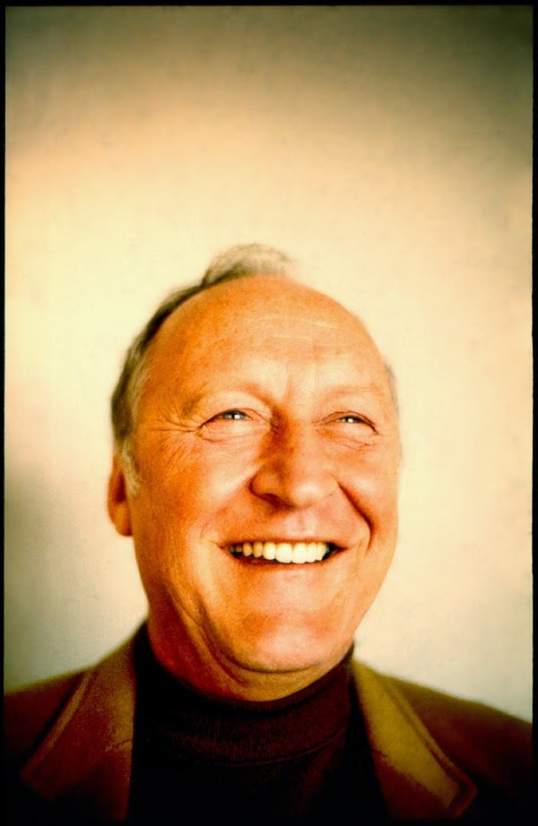
98 years ago today, director Herk Harvey was born in Lawrence, Kansas. Today, Harvey is best-remembered for his only feature film, 1962’s Carnival of Souls. Carnival of Souls is a Halloween favorite here at the Shattered Lens and it’s a film that has been cited as being an influence on everyone from Sam Raimi to Martin Scorsese to David Lynch.
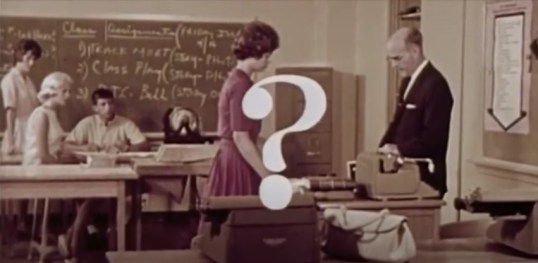
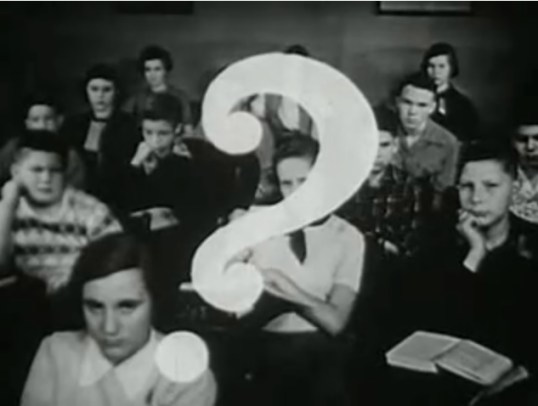
However, before and after he directed that ground-breaking film, Herk Harvey made his lesson directing educational short films. Today, in honor of what would have been his birthday, the Shattered Lens presents Why Study Speech? This 1954 short film explains why all high school seniors should study speech when they get to college. It opens with a somewhat quirky montage that, if nothing else, serves to remind us that we’re watching a short film from the man who, just 8 years later, would direct Carnival of Souls.
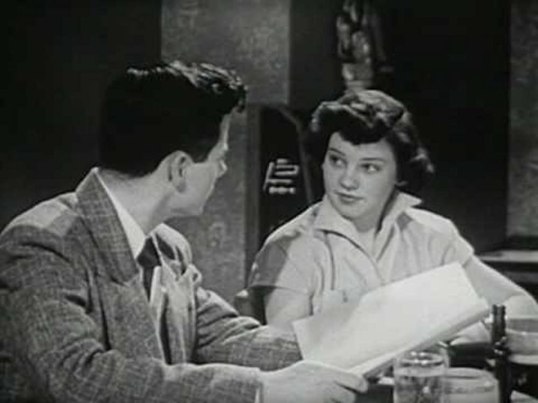
OUCH! That had to hurt, though I’m totally on Nora’s side here. Jack is coming on way too strong. I mean, they were having a perfectly pleasant time and then suddenly Jack has to bring “love” into it all. They’ve only been dating a few weeks!
Jack and Nora are the two “teenagers” at the heart of How Do You Know It’s Love?, an educational film from 1950. After Nora’s mother informs her that she’s too young and immature to understand anything about love and after Jack’s brother taunts him for falling in love with a new girl every week, Jack and Nora decide to go on a double date so that they can see what mature love is all about. The main message of the film is that one shouldn’t mistake attraction for love and that teenagers should date a lot of people before settling down. It’s not a bad message but it’s one that will probably be missed by many viewers due to the fact that Jack and Nora are both kind of goofy.
Believe it or not, this film was not directed by Herk Harvey. Instead, this one of the 33 educational films that former journalist Ted Peshak directed in the 1950s for Coronet films. Though Peshak made a lot of films for Coronet, he was never paid more than $190 a week and, perhaps understandably, he abandoned the educational film game in the 60s and instead went to work in real estate. I don’t blame him.
Anyway, here’s the film. Watch and ask yourself the big questions.
Price was born 111 years ago, in St. Louis, Missouri. When he first began his film career in the 1930s, he was promoted as a leading man and he was even tested for the role of Ashley Wilkes in Gone With TheWind. (Imagine that!) However, Price would find his greatest fame as a horror icon.
Among the fans of Price’s horror films was a young animator named Tim Burton. In 1982, Price and Burton would work together for the first time, with Price providing the narration for a short, stop motion film that Burton had written and directed. Called Vincent, the film was about a seven year-old boy named Vincent who wanted to be — can you guess? — Vincent Price! The six-minute film follows Vincent as he gets involved in all sorts of macabre activities. Of course, as Vincent’s mom points out, Vincent isn’t actually a monster or mad scientist. He’s just a creative child with an overactive imagination. (To say the short feels autobiographical on Burton’s part would be an understatement.) The animation is outstanding and full of wit but it really is Vincent Price’s wonderful narration that makes this short film a classic.
Both Price and Burton would later call making this film one of the most creatively rewarding collaborations of their respective careers.
Screen icon John Wayne was born 115 years ago, on this date, in Winterest, Iowa.
Best-known for his appearances in western films, Wayne spent the last decade of his life battling cancer and serving as a spokesman for The American Cancer Society. He made his final film appearance in 1976, starring in The Shootist as a veteran gunslinger who was, just like Wayne, facing his own mortality. The film not only provided a capstone to Wayne’s film career but the footage of Jimmy Stewart (as a doctor) informing Wayne that he didn’t have long to live was used in one of the commercials that Wayne did for The American Cancer Society.
Of course, in the commercial, the footage was followed by Wayne encouraging viewers to get tested and also threatening to “take you apart” if they didn’t. Three years after the release of The Shootist and this commercial, Wayne would succumb to cancer but his efforts would lead to more people getting tested and more cancers being detected early.
Today, we celebrate May Day with this short film from 1974. A Good Days Work: Selling is all about how exciting it is to work in a fish market. I guess these film were made so that children in school could mentally prepare for the careers that were ahead of them and, indeed, I imagine a few kids in 1974 probably grew up to work in a New England fish market.
Anyway, I find this short film to be kind of moody and …. I don’t know, weird. The grainy images and the voyeuristic children are, to be honest, kind of unsettling. There’s a lot of ennui to be found in this film. Though it’s not the film’s fault, it’s hard to watch anything that was filmed in New England without expecting some sort of weird Stephen King thing to start happening. But, at the same time, it also taught children about fish markets so I guess that’s a good thing.
The 1963 educational short film, Big Man on Campus, tells the story of Jerry, a 13 year-old with the attitude of a 16 year-old.
Jerry thought he was the coolest kid at his middle school. He thought throwing a milk carton was no big deal. He thought not studying for his classes wasn’t the worst thing in the world. He thought all of his classmates would like him if he rode his bicycle into traffic. He thought starting fights was no biggie. He thought everyone wanted to listen to another chorus of Grease Lightning. He thought Sandy was just a summer fling and that having the Ramones play at the local high school wouldn’t be a big deal. Jerry thought a lot of things.
Jerry was wrong.
Fortunately, the Vice Principal was there to set Jerry straight. That’s right, the vice principal. Jerry may thing he’s a big man on campus but he’s not even important enough to rate a meeting with the principal. Instead, he has to make due with the guy who teaches Chemistry. It takes a while for the vice principal to step out of his office but when he does, it’s obvious that the vice principal, with his navy haricut and his eyeglasses, isn’t going to stand for any nonconformity. Most afternoons, the vice principal would be busy tracking down and tearing up flyers for the Fair Play for Cuba Committee. Instead, on this day in November of 1963, the vice principal is having to discipline Jerry. Not only has Jerry caused a disruption at the school but he’s also allowed for the proliferation of pro-Castro propaganda. Can Jerry be saved or is he destined to become a pinball wizard with his own holiday camp?
You probably already know the answer. This educational film comes to us from Sid Davis, whose films were best known for their use of an extremely judgmental and rather dramatic narrator. The Sid Davis narrators were the ones who wouldn’t only explain what had happened but who would also offer up questions like, “You never thought one little action could ruin your life and the lives of so many others, did you?” That narrator is heard in Big Man on Campus but we also hear the voice of Jerry, trying to convince himself that his actions were no big deal and that everyone is totally overreacting.
Of course, deep down, Jerry knows that he’s no good. He knows that his mother is setting him up for a life of crime by arguing that “boys will be boys.” He knows that he’s destined to end up at juvenile hall and, after that, a life of unemployment. He knows all of this but he needs the help of a seriously annoyed adult to help him truly understand it. He needs the hard-earned, war-scarred, and apparently nearsighted wisdom of the vice principal.
Can Jerry be saved or is he destined to end up working a prop comic in Wichita Falls? Watch and find out!
How many directors does it take to put together a 13-minute film about bicycles?
Apparently, it takes seven! At least that’s the amount that received credit for 1978’s I Like Bikes But…. I guess some of them did the live action shots and some of them did the animation and maybe one of them was in the recording booth with the narrator but still, seven seems like a lot. But I guess it takes a lot of manpower to make people like cyclists.
Anyway, this film was meant to encourage people to not only ride bicycles but to also observe all of the safety rules that surround riding bikes in public. A bicycle named Ike is convinced that he can make you love overlook the slow-moving nuisance of the public cyclist if he just keep repeating, “I like bikes over and over again….” That may have worked for Eisenhower but he won a war so everyone already liked him. Whereas bicyclists are usually the people you dread getting stuck behind in traffic.
I have to admit that, after watching this short film, I found myself hating bikes even more than I did before. But I do appreciate Ike’s enthusiasm. He tried.
The year is 1963 and Nancy is the editor of the high school newspaper. She’s upset that so many students are settling their disagreements through fighting. She wants to run a story about the fights and she wants to publish the pictures of the two students who were involved in the latest brawl. When her faculty advisor points out that a high school newspaper is supposed to be positive and that publishing the pictures of the combatants would be an invasion of their privacy, Nancy argues that she has a responsibility as a journalist….
NANCY, IT’S A HIGH SCHOOL NEWSPAPER! YOU’RE NOT A JOURNALIST!
Anyway …. what would you do?
This film is from 1963 and it seems to be a bit biased in Nancy’s favor. Of course, Nancy should publicly shame any student caught fighting! Myself, I have to disagree. I’m reminded of the old but very true saying: “No one likes a snitch.” Add to that, judging from the opening shots of this film, the entire school witnessed the fight so it’s not like Nancy is going to be telling her readership something that they didn’t already witness firsthand. Seriously, what is Nancy’s problem?
I’m against censorship but I’m also against being a snitch. Honestly, I think Nancy has gone a little power mad.
However, if you want to consider for this issue for yourself, here, from 1963, is Censorship: A Question of Judgment:
Since today is David Lynch’s birthday, it only seems appropriate to share what may be the most obscure of David Lynch’s early short films.
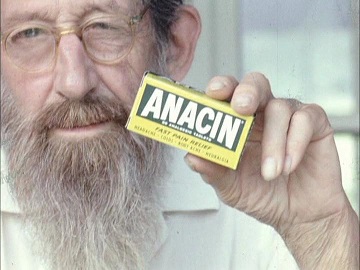
From 1967, Fictitious Anacin Commercial is a one-minute short film and a commercial for a real product. Jack Fisk, an early David Lynch collaborator who would later marry Sissy Spacek, plays a man in pain. God shows up, holding some aspirin. Suddenly, Jack Fisk is feeling a lot better. However, the audience is a little bit disturbed because God seems kind of menacing.
That’s my interpretation, anyways! David Lynch was 21 when he directed this film and it really is basically just a spoof of how commercials always act as if their product is the ultimate and only solution to whatever problem you’re having. One gets the feeling that, for the most part, Lynch and Fisk were just amusing themselves. And yet, because it is a Lynch film, there’s still a definitely unsettling vibe to it all. The man with Anacin almost seems like he could be an inhabitant of the Black Lodge.
Anyway, for your viewing pleasure, here is Fictitious Anacin Commercial!
She says it’s because Jack “won’t stop teasing me.” Is Jack to blame or does Judy need to toughen up? Should Jack’s classmates have said, “Lay off?” Should Judy’s friends have tattled to the teacher? Should Judy have teased Jack back? What would you do?
This short film from 1951 considers all of those issues and yet, it’s hard not to feel that the ultimate message is that Judy needs to stop taking everything so personally. Sorry, movie. Sorry, judgmental narrator. I disagree. Myself, I think the skinny kid with the glasses should have followed through with his threat to beat Jack up. Up until I was 12, I had a really severe stutter so I know what Judy was going through. Fortunately, in my case, I also had three older sisters and a bunch of overprotective cousins that were always looking after me. Judy doesn’t seem to have that type of support system. To be honest, in most cases like this, I put the blame on the teachers. Jack and Judy are sitting up at the front of the class so there’s really no excuse for no one noticing what was going on.
This short film is another one that feels like a Herk Harvey production but it was actually directed by Arthur Wolf. My favorite shot is the entire class staring at the camera while the narrator asks, “What would you do?” Seriously, someone’s in a lot of trouble once these kids come to a consensus on who is to blame.
From 1951, it’s time to consider …. The Other’s Fellow’s Feelings.


 Through the Shattered Lens