In this song, Billy Idol remembers the year 1977, fighting in the streets and upsetting the establishment. A time traveling Avril Lavigne helps out.
Enjoy!
In this song, Billy Idol remembers the year 1977, fighting in the streets and upsetting the establishment. A time traveling Avril Lavigne helps out.
Enjoy!
I like The Doors.
That can be a dangerous thing to admit, about both the band and Oliver Stone’s 1991 film. Yes, both the band and the film could be a bit pretentious. They both tended to go on for a bit longer than necessary. They were both centered around a guy who wrote the type of poetry that I used to love back in my emo days. It’s all true.
But, with The Doors as a band, I find that I can’t stop listening to them once I start. Even if I might roll my eyes at some of the lyrics or if I might privately question whether any blues song really needs an organ solo, I can’t help but love the band. They had a sound that was uniquely their own, a psychedelic carnival that brought to mind images of people dancing joyfully while the world burned around them. And say what you will about Jim Morrison as a poet or even a thinker, he had a good voice. He had the perfect voice for The Doors and their rather portentous style. From the clips that I’ve seen of him performing, Morrison definitely had a stage presence. Morrison died young. He was only 27 and, in the popular imagination, he will always look like he’s 27. Unlike his contemporaries who managed to survive the 60s, Morrison will always eternally be long-haired and full of life.
As for The Doors as a movie, it’s definitely an Oliver Stone film. It’s big. It’s colorful. It’s deliberately messy. Moments of genuinely clever filmmaking and breath-taking visuals are mixed with scenes that are so heavy-handed that you’ll be inspired to roll your eyes as dramatically as you’ve ever rolled them. Stone loved the music and that love comes through in every performance scene. Stone also loves using Native Americans as symbols and that can feel a bit cringey at times. Why would Jim Morrison, whose was of Scottish and Irish ancestry, even have a Native American spirit guide? At its best The Doors captures the chaos of a world that it’s the middle of being rebuilt. The 60s were a turbulent time and The Doors is a turbulent movie. I’ve read many reviews that criticized The Doors for the scene in which Morrison gets involved in a black magic ceremony with a journalist played by Kathleen Quinlan. I have no idea whether or not that scene happened in real life but the movie is so full of energy and wild imagery that the scene feels like it belongs, regardless of whether it’s true or not. Stone turns Jim Morrison into the warrior-artist-priest that Morrison apparently believed himself to be and the fact that the film actually succeeds has far more to do with Oliver Stone’s enthusiastic, no-holds-barred direction and Val Kilmer’s charismatic lead performance than it does with Jim Morrison himself.
The Doors spent several years in development and there were several actors who, at one time or another, wanted to play Morrison. Everyone from Tom Cruise to John Travolta to Richard Gere to Bono was considered for the role. (Bono as Jim Morrison, what fresh Hell would that have been?) Ultimately, Oliver Stone went with Val Kilmer for the role and Kilmer gives a larger-than-life performance as Morrison, capturing the charisma of a rock star but also the troubled and self-destructive soul of someone convinced that he was destined to die young. Kilmer has so much charisma that you’re willing to put up with all the talk about opening the doors of perception and achieving a higher consciousness. Kilmer was also smart enough to find the little moments to let the viewer know that Morrison, for all of his flamboyance, was ultimately a human being. When Kilmer-as-Morrison winks while singing one particularly portentous lyric, it’s a moment of self-awareness that the film very much needs.
(When the news of Kilmer’s death was announced last night, many people online immediately started talking about Tombstone, Top Gun, and Top Secret. For his part, Kilmer often said he was proudest of his performance as Jim Morrison.)
In the end, The Doors is less about the reality of the 60s and Jim Morrison and more about the way that we like to imagine the 60s and Jim Morrison as being. It’s a nonstop carnival, full of familiar faces like Kyle MacLachlan, Michael Madsen, Crispin Glover (as Andy Warhol), Frank Whaley, Kevin Dillon, and a seriously miscast Meg Ryan. It’s a big and sprawling film, one that is sometimes a bit too big for its own good but which is held together by both Stone’s shameless visuals and Val Kilmer’s charisma. If you didn’t like the band before you watched this movie, you probably still won’t like them. But, much like the band itself, The Doors is hard to ignore.
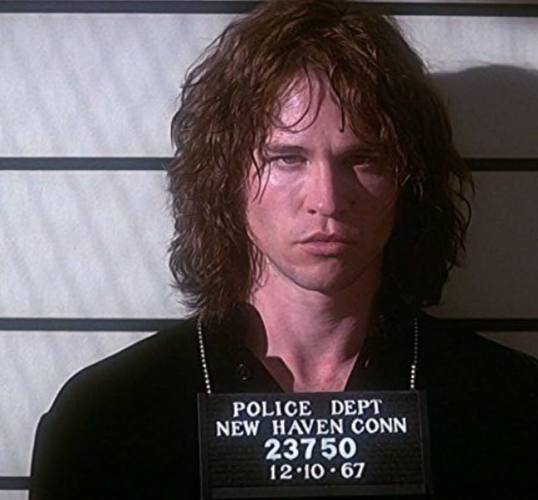
After all this time, Billy Idol is still out there, making music and making videos. Cage is his latest and it features Billy singing about dealing with his own demons while breaking free of a straight-jacket. Harry Houdini has nothing on Billy!
The video was directed by SRS, which I assume is a pseudonym. Remember when music videos used to be directed by guys with names like Nigel and Spike? Now every music video appears to have been directed by a computer program.
Right now, this video only has 419,000 views on YouTube. Times are forever changing and musical tastes change with them but that’s still no way to treat Billy Idol!
Enjoy!
The cover of a song by Tommy James & The Shondells would be Billy Idol’s only number one hit in the United States. As hard as it may be to believe, other Idol songs like White Wedding, Rebel Yell, and Dancing With Myself failed to even crack the top 30. Interestingly enough, when Mony Mony hit number one, the song that it replaced was another song that was originally recorded by Tommy James, Tiffany’s cover of I Think We’re Alone Now.
A good deal of the success of Billy Idol’s Mony Mony can probably be linked back to this music video, which features Billy Idol at his most energetic. During performances of Mony Mony, audience members would regularly shout, “Hey Motherfucker … Get Laid! Get fucked!” in between the lines. How this became a tradition is not known but it did lead to this otherwise innocuous song getting banned from several high school dances.
This video was directed by Larry Jordan, who has also done videos for Shania Twain and Mariah Carey.
Enjoy!
Hi! Lisa here, filling in for Val, with today’s music video of the day!
On Saturday night, fans of both film and horror were saddened to learn of the death of Tobe Hooper. Tobe Hooper was a Texas original, a fiercely iconoclastic director who totally changed the face of horror when he directed a low-budget shocker called The Texas Chainsaw Massacre.
When it came time to pick today’s music video of the day, I decided to see if Tobe Hooper had ever directed a music video. It turned out that he directed exactly one and here it is:
According to almost everyone online, Dancing With Myself is a song about masturbation. However, Idol himself says that the song’s lyrics are actually meant to be quite literal. The song actually is about dancing with yourself. Here’s how it’s explained over on Songfacts:
“This song is commonly thought to be about masturbation, but it’s really more about dancing by yourself. Billy got the idea after watching Japanese kids at a Tokyo disco “dancing with themselves” in a nightclub. The kids would dance in a pogo style up and down, and there were mirrors in the club so they could watch themselves doing it… This song is about more than just dancing. Idol told Rolling Stone: “The song really is about people being in a disenfranchised world where they’re left bereft, dancing with their own reflections.”
As for how Tobe Hooper came to direct the video … well, I have no idea. I imagine he was hired because of his fame as the director of The Texas Chainsaw Massacre. This video came out a year after the original Poltergeist, a film that Hooper is credited with directing but which many people believed was actually directed by producer Steven Spielberg. (Poltergeist was a huge hit but the rumors of Hooper being a director-in-name-only permanently and unfairly damaged Hooper’s reputation.) As far as I know, this is the only music video that Tobe Hooper directed.
As for the video, it features neither masturbation nor Japanese nightclubs. Instead, it appears to be taking place in a post-apocalyptic setting. The beginning of the video reminds me a bit of Hooper’s underrated slasher film, The Funhouse.
Anyway, enjoy!
But behind the scenes, it was more like Face Without Eyes. I’m not abridging this story. Thank you Rob Tannenbaum and Craig Marks for writing the book I Want My MTV. Also, thank you John Diaz and Billy Idol for sharing this story.
John Diaz: On “Eyes Without a Face,” I brought in Tony Mitchell as DP–that was one of the first videos he shot. David Mallet directed, and David always shot in 16mm. I said, “I don’t care what else you do, but we have to shoot this in 35mm and Billy has to look like a beauty queen.”
Billy Idol: The video was super-important because we had large hopes for “Eyes Without a Face.” We poured into it not only ideas, but also money and time. For three days, I didn’t see anything but dry ice, smoke, fire, and naked bodies. We hardly slept.
John Diaz: Bill Aucoin brought some new contact lenses for Billy. I said, “You can’t give them to Billy, they might redden his eyes during the shoot.” Well, he gave them to Billy. David Mallet liked to use lots of dry ice in videos. So Billy was laying in dry ice for quite some time, and he was really tired, and his eyes dried out. The contact lenses fused to his eyeballs.
Billy Idol: We’d been up all night finishing the video and got straight on a plane to do a gig in Arizona. It was boiling hot so I laid down on the grass outside the venue, and when I woke up, a sheriff was standing with his gun drawn. I’d never really had a gun barrel in my face.
I almost couldn’t think because of the pain in my eyes. I’d fallen asleep with my contact lenses in, and they were dried from being on set, then on an airplane. I said, “I’m with the band that’s sound-checking inside that building.” My eyes were tearing, pouring water. So we go inside and the sheriff made my road crew line up. He said, “Who is this?” And they said, in unison, “The boss.” So he left me alone. Then they had to take me the hospital because I’d scraped the cornea so badly. I had my eyes bandaged for three days, until the cornea grew back. It was stupid, really. But I wasn’t thinking too much, I was just trying to get the video done.
According to the authors of I Want My MTV, during this period, “the average budget had been $30,000 to $40,000, but videos now became more sleek and elaborate–and so grueling that three different people went temporarily blind.” This wasn’t even the only time somebody went temporarily blind on a Billy Idol video.
Stories like this are something to keep in mind the next time you see a music video you love that isn’t in IMDb. People temporarily lost the ability to see in order to get these made. So, submit.
Enjoy!
30 Days Of Surrealism:
I have to admit that there was some strong competition for the music video to feature today. There was the CGI fun of Money For Nothing by Dire Straits, the Michael Bay directed song about masturbation, Ice Ice Baby, and Shania Twain’s remake of a Robert Palmer video staring at me in the same list. However, I decided to just go with something that is pure fun.
I remember when MTV oddly decided to celebrate their 20th anniversary in 2001 rather than their 25th 5 years later. They invited back a bunch of musicians who had been big on the network. It seemed that all of them had lost it. I remember TLC sounding awful. Then Billy Idol came onstage. He was amazing, and so was his guitarist Steve Stevens. They played the living hell out of this song. They didn’t need to, but they did anyways. I remember them sounding as good as in this music video except they did it live.
I have nothing to say except that director Jeff Stein certainly captured Billy and his crew perfectly. A well-filmed concert video is one done by someone who knows the musician’s style. Jeff Stein obviously did. The music video was produced by Kathy Doherty who doesn’t appear to have done anything else. Jeff Stein on the other hand is another director we’ll see again.
ENJOY!!!
 Remember how, in the 1990s, every aspiring indie director tried to rip off Quentin Tarantino by making a gangster film that mixed graphic violence with quirky dialogue, dark comedy, and obscure pop cultural references? That led to a lot of terrible movies but not a single one (not even Amongst Friends) was as terrible as Mad Dog Time.
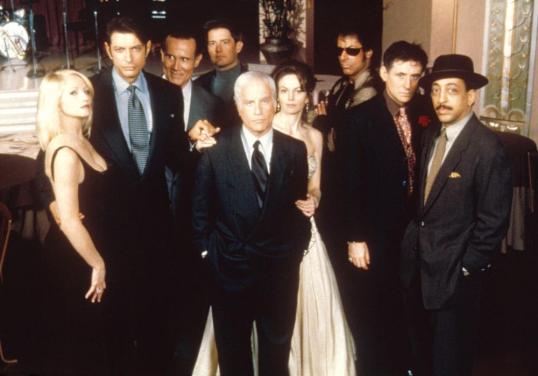
That Mad Dog Time was terrible should come as no surprise. Most directorial debuts are. What made Mad Dog Time unique was the sheer amount of talent that was assembled and wasted in the effort to bring this sorry movie to life. As the son of Joey Bishop, director Larry Bishop was Hollywood royalty and was able to convince several ridiculously overqualified actors to play the thinly drawn gangsters and rouges who populated Mad Dog Time. Much like the Rat Pack movies that his father once starred in, Larry Bishop’s debut film was full of familiar faces. Some of them only appeared for a few seconds while others had larger roles but they were all wasted in the end. Hopefully, everyone was served a good lunch in between filming their scenes because it is hard to see what else anyone could have gotten out of appearing in Mad Dog Time.
Mob boss Vic (Richard Dreyfuss) has just been released from a mental hospital. With the help of his main enforcer, Mick (Jeff Goldblum), and a legendary hitman named Nick (Larry Bishop, giving not only the worst performance in the film but also the worst performance of the 1990s), Vic is going to reassert his control over the rackets. Vic also wants to find his former mistress, Grace Everly (Diane Lane) but he doesn’t know that Grace is now with Mick and that Mick is also having an affair with Grace’s sister, Rita (Ellen Barkin).
(Grace and Rita are the Everly Sisters! Ha ha, between that and all the rhyming names, are you laughing yet?)
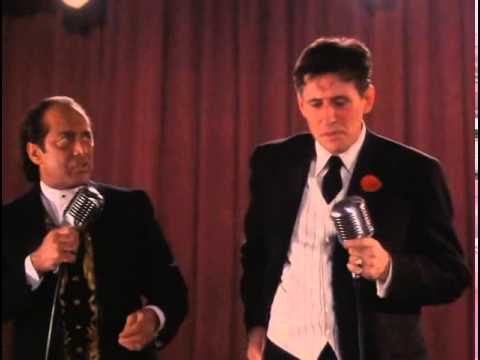
Ben London (Gabriel Byrne) has taken over Vic’s nightclub and, while singing My Way with Paul Anka, tells Vic that he should take an early retirement because he’s a paranoid schizophrenic. Before he can deal with Ben, Vic has to kill all of his other rivals, all of whom are played by actors like Michael J. Pollard, Billy Idol, Kyle MacLachlan, Gregory Hines, and Burt Reynolds. The bodies start to pile up but Jimmy the Undertaker (Richard Pryor, looking extremely frail in one of his final roles) is always around to make sure that everyone gets a proper burial.
And there are other cameos as well. Joey Bishop is the owner of a mortuary. Henry Silva is wasted as one the few gangsters to stay loyal to Vic. Christopher Jones, who previously co-starred with Larry Bishop and Richard Pryor in Wild In The Streets before dropping out of a society, plays a hitman who pretends to be Nick Falco. Even Rob Reiner shows up a limo driver who talks too much.
Almost every poorly paced scene in Mad Dog Time plays out the same way. Three or more men confront each other in a room. Hard-boiled dialogue is exchanged for an interminable length of time until someone finally gets shot. You would think, at the very least, it would be watchable because of all the different people in the cast but none of the actors really seem to be into it. Richard Dreyfuss and Jeff Goldblum resort to smirking through their scenes while Gabriel Byrne often appears to be drunk. Whenever he’s in a scene, Burt Reynolds seems to be trying to hide his face and it is hard to blame him. There were many terrible movies released in the 90s but none were as bad as Mad Dog Time.
 Through the Shattered Lens