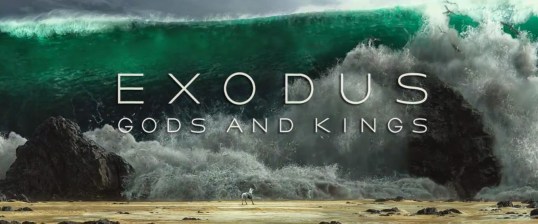
Ridley Scott has been hit-or-miss (mostly misses) of late and response to the trailers and news about Exodus: Gods and Kings doesn’t seem to be helping.
Yet, despite all the indifference to Scott’s upcoming Biblical epic (and calls of whitewashing) I am quite intrigued about this take on the Book of Exodus. Will it have the pageantry of Demille’s The Ten Commandments (both of them)? Or will it be another CGI-overload? Or will it be a piece of entertaining pulp a la Gladiator? I guess we will find out this Holiday season.
Exodus: Gods and Kings is set for a December 12, 2014 release date.
Ridley Scott has been instrumental in bringing back the sword-and-sandal epic when he unleashed Gladiator to audiences everywhere in the summer of 2000. Since then he has made many films which range from black comedy to historical epic right up to horror and a war film.
With Exodus: God and Kings, Scott returns to the sword-and-sandal epic but now with a heavy dose of the Biblical as he adapts the Old Testament Book of Exodus. A film working on the same scope and scale as Cecil B. Demille The Ten Commandments released in 1956, this latest adaptation of Moses, Ramses and the exodus of the Israelites from Egypt looks to put the epic back in 2014.
With each passing year, more and more of Scott’s films have taken on the unavoidable sheen of the CGI as his visuals attempt to recreate time and places of Earth’s past. For some, Scott’s been more miss than hit with the last couple films yet they all remain visual feasts and Exodus: Gods and Kings looks to continue that streak. Whether the film will be good storytelling will be something that’s still to be decided.
Exodus: Gods and Kings is set for a December 12, 2014 release date.
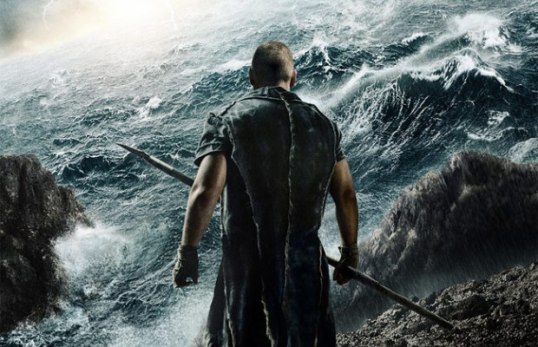
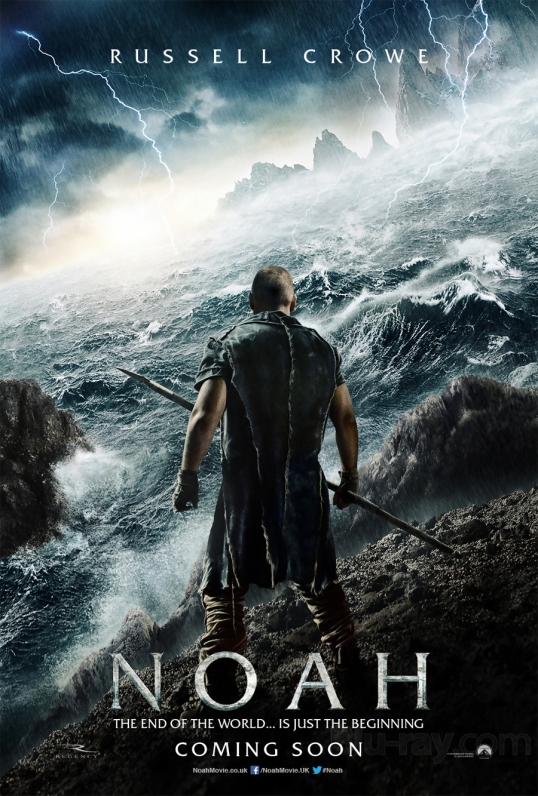
One of the best films (at least in this blogger’s honest opinion) of the year also happens to be one of it’s most controversial. It’s Darren Aronofsky’s follow-up to his equally critically-acclaimed and just as controversial Black Swan. I am speaking of his Biblical epic Noah and the story of the Flood.
It’s a film that doesn’t feel religious yet full of spirituality. It’s a film that dares to take a look at text seen as hallowed by billions in a way that doesn’t take a stand on the debate of science versus religion (though some feel that Aronofsky’s atheist background paints the film on the side of science). Noah has a scene in the beginning of it’s third act (one that some have called the dealbreaker for how they thought of the film in the end) that best exemplifies the conjoining of science and religion. It’s the best retelling of the Creation Story that I’ve heard and/or seen.
Courtesy of Protozoa Pictures…The Creation scene from Noah.
Noah is Darren Aronofsky’s follow-up to his critically-acclaimed film Black Swan(which was reviewed by Lisa Marie Bowman herself) and he looks to tell the tale of Noah’s Ark from the Book of Genesis.
When news first came out that Aronofsky would follow-up Black Swan with a biblical epic that retold the Flood and Noah’s role in saving those not corrupted according to Heaven was a sort of headscratcher. The teasers and trailers that has come out about the film hasn’t really fired up the masses. Some think it as another sword-and-sandals epic that’s late to that particular subgenre’s resurgence. Some think too much fantasy elements has been added.
One thing I’m sure of is that Aronofsky will not make an uninteresting film.
As part of my mission to view every film — good or bad — ever nominated for best picture, I spent last night watching 1953’s The Robe (which was nominated for best picture but lost to From Here To Eternity.) The Robe is an old school biblical epic, the type of film that used to regularly get nominated for best picture but which you don’t see much of anymore. If you’re wondering why that genre hasn’t stood the test of time, I’d suggest watching The Robe.
Richard Burton stars as Marcellus, a womanizing Roman centurion who falls in love with young, pure noblewoman Diana (Jean Simmons). Unfortunately, Diana is set to marry the decadent Caligula (Jay Robinson). (Yes, that Caligula…) Burton’s rivalry with Caligula leads to him being reassigned to Jerusalem where he not only witnesses the crucifixion but also wins Jesus’ robe in a dice game. However, Marcellus soon finds himself being haunted by nightmares of the crucifixion and he discovers that he can’t even wear the robe without having a seizure. His slave, Demetrius (played by musclebound Victor Mature) has secretly become a Christian and steals The Robe before disappearing into the Holy Land. As Marcellus, who believes that only by destroying the robe can he free himself from his guilt, searches for Demetrius, he is reunited with Diana and, since this is an old school biblical epic, he also ends up converting as well. Unfortunately, he does all this around the same time that Caligula becomes Emperor and (in this film if not in actual history) begins to persecute the early Christians.
The Robe was the first film to made in “Cinemascope” and, while that may have been an amazing development back in 1953, when watched today, it’s obvious how much of the film is really just made up of filler designed to show off the new process. Again, it may have been amazing at the time but today, it just seems like a slow movie. Even more importantly, The Robe itself is so reverent and respectful of its subject that it’s just not that interesting. Speaking as a nonbeliever, I’ve still sometimes feel that a lot of contemporary films make it a point to ridicule Christians because they’re an easy target. Unlike a certain other world-wide religion, most Christians aren’t going to blow you up just because you featured an image of Jesus in your movie. However, movies like The Robe were not only extremely reverent and respectful but they went out their way to let you know how reverent and respectful they were being. The result is a film that lack any hint of nuance or anything that might actually challenge the audience. It’s like Avatar with Jesus.
Since he’s best known for being an alcoholic and marrying Elizabeth Taylor, Richard Burton might seem like an odd choice to play an idealistic Christian martyr. And, quite frankly, he is. Throughout the film, he’s visibly uncomfortable and, quite frankly, he didn’t have the legs necessary to pull off the ancient Roman look either. Jean Simmons is also stuck playing a stock character — the virtuous maiden. As with a lot of the old school biblical epics, the lead characters are so boring that you can’t help but feel they had more fun as pagans. Meanwhile, poor Victor Mature wanders through the film struggling to show anything resembling emotion. I mean, he tries so hard that its impossible not to like him. At the very least, The Robe proves that any film featuring Victor Mature will have some sort of camp value.
(As I watched The Robe, I kept thinking about a comment that Groucho Marx supposedly made. Apparently, he said he wouldn’t watch any movie starring Victor Mature because “I won’t watch any movie where the guy’s tits are bigger than the girl’s.”)
The Robe does feature some interesting supporting performances from several wonderful B-movie character actors. Jay Robinson is obviously having the time of his life playing the Emperor Caligula. Robinson’s version isn’t quite as effective as Malcolm McDowell’s but Robinson is a lot more fun to watch. Richard Boone is effectively slovenly in the role of Pilate and there’s a nice little throw-away scene where Pilate absent-mindedly washes his hands twice. Meanwhile Ernest Thesiger (who played Dr. Pretorious in the Bride of Frankenstein) is an oddly benevolent Emperor Tiberius while Michael Rennie, the alien from the original The Day the Earth Stood Still, plays none other than St. Peter. Even Jeff Morrow (from This Island Earth) has a small role.
Like most of the old school Hollywood biblical epics, The Robe seems pretty hokey when viewed today and I get the feeling it probably seemed hokey when it was first released back in 1953. Still, I remember that my Grandma Meehan used to love to watch these movies whenever they would show up on television. She would have deep theological debates with the images that flickered across the screen. I can still remember spending multiple Easters listening to her argue with The Ten Commandments. I don’t know if Grandma ever saw The Robe but I do know that she believed that the Holy Tunic was presently located in France and not at the Cathedral of Trier in Germany. Seriously, you did not want to question her on this point.
To be honest, watching this type of film is always an odd experience for me. Up until recently, I described myself as a “fallen Catholic” and I always felt so proud of myself afterward. I could spend hours telling you why I no longer believed in the faith of my childhood and I could get quite smug about it. I guess I still can but, as of late, I’ve discovered that humility goes well with a lack of faith. I’ve also been forced to admit that when you’re raised Catholic, you’re a Catholic for life regardless of whether you believe in the Holy Trinity or not. If pressed, I guess I’d call myself “an agnostic Catholic.” I’m the type of nonbeliever who still feels the need to go to confession after a long weekend. It’s not so much that I doubt my doubt as much as I wish that I could still go back to a time in my life when I actually could have faith without feeling like I was in denial. So, even as I openly scoff at these films, there’s always that small part of my heart that wants to embrace the film in all of its simplistic and hokey glory.
That said, it’s also true that The Robe is a lot easier to resist than a film like Pasolini’s The Gospel According to Saint Matthew or, for that matter, The Exorcist.
 Through the Shattered Lens