What Lisa Marie Watched Last Night: Trader Horn (dir. by W.S. Van Dyke)


Last night, as I attempted to drift off to sleep, I switched over to TCM and watched the 1931 film Trader Horn.

Why Was I Watching It?

I’m on a mission to see every film ever nominated for best picture and Trader Horn was nominated back in 1931.  (It lost to the first western ever to win best picture, Cimarron.)  Trader Horn is a bit of an oddity among Oscar contenders in that it received no other nominations save for best picture and it has never been released on DVD.  When I saw it on TCM’s schedule last night, I figured that might very well be my only chance to see this forgotten best picture nominee.

What’s It About?

So Trader Horn (Harry Carey) is a heroic ivory hunter.  Yes, this film was made a long time ago. He makes his living in Africa where he spends his time killing animals and explaining how, whenever the natives start playing their drums, it means that “every black devil is in the bush.”  Again, this film was made a very loooooooong time ago.

Anyway, at the start of the film, Trader Horn is introducing his apprentice (Duncan Renaldo) to the facts of life in Africa.  Eventually, they meet a missionary (Olive Golden) who is looking for daughter who was kidnapped by a tribe years ago.  When Golden is killed, Trader Horn takes it upon himself to find her daughter (played by Edwina Booth) and bring her back to civilization.

What Worked?

Trader Horn was the first non-documentary to be filmed on location in Africa and, as you watch the movie, it quickly becomes apparent that the film’s plot is really just an excuse to show off all the nature footage that director W.S. Van Dyke managed to capture.  Countless time the film’s story comes to a complete halt while Carey and Renaldo simply stop to watch a grazing giraffe or to watch a leopard hunt a wildebeest.  Normally, this is the sort of thing I would complain about but, in this case, the story was so predictable and silly that I was happy for the interruption.  It helps that the 80 year-old nature footage is still visually impressive and exciting to watch.   According to the research I did on the Internet after seeing the film, Trader Horn’s footage was used as a stock footage in countless “jungle” films over the next three decades in much the same way that the same old distressing mondo footage tends to show up in every single Italian cannibal film.

There’s a scene were Renaldo finds a lion cub and oh my God, it’s just the most adorable little kitty ever!

Trader Horn actually has an interesting production history and I enjoyed reading about it after I watched the movie.  Apparently, Van Dyke spent seven months in Africa making this film and almost the entire crew ended up falling ill.  At least two cameramen were killed while filming the wild animals and Edwina Booth returned so sick that her film career was pretty much ended. 

On one final note, there was apparently a pornographic remake of this film in the late 60s.  Its title?  Trader Hornee.

What Didn’t Work?

Did I mention this film was made a really looooooong time ago?  Because, seriously, it was.  On occasion, I’ve heard an old film described as being “creaky.”  I never really understood what that meant until I saw Trader Horn because, quite frankly, this film is amazingly creaky.   It moves slowly, the performers are rather melodramatic (though Harry Carey does a good job), and. while the cultural attitudes may have been acceptable in 1931, they now come across as extremely racist and its hard not to feel really uncomfortable with scenes where Renaldo ogles the bare-breasted native women and says, “Why, they’re not savages at all!  They’re like little children!”

Bleh.

“Oh My God!  Just Like Me!” Moments:

I would have wanted to adopt that lion cub too.

Lessons Learned:

1931 was a long, long time ago.
Film Review: Network (dir. by Sidney Lumet)


With the recent passing of director, Sidney Lumet, I decided to watch one of Lumet’s best-known films, the 1976 best picture nominee Network.

Network tells the story of Howard Beale (played by Peter Finch).  Howard is a veteran news anchor at a fictional television network.  Because his ratings are in decline, Howard is fired.  Howard reacts to this by announcing that he will commit suicide at the end of the next broadcast.  Ironically, so many people tune in to see Howard kill himself that his ratings improve and Howard gets to keep his job under the watchful eyes of news director Max Shumacher (William Holden) and network executive Dianne Christiensen (Fay Dunaway). 

At the same time, Max and Dianne are adulterous lovers.  The course of the film’s narrative finds Max abandoning his wife (Beatrice Straight) and Dianne, who is described as a “child of the tube,” enthusiastically trying to produce an early reality television show starring a group of Marxist revolutionaries.  They do this under the paranoid eyes of network president Frank Hackett (Robert Duvall) and Frank’s boss, the corrupt Arthur Jenson (Ned Beatty).

However, Howard Beale isn’t just an over-the-hill news anchor.  He’s actually a seriously mentally ill man who hears voices and who starts to see himself as some sort of messiah.  Eventually, this leads to a disheveled Howard giving a crazed speech in which he encourages viewers to yell, “I’m as mad as Hell and I’m not going to take it anymore!”  Yes, this is the famous scene that is always used whenever some pompous media jackass wants to criticize the current state of television.  Even though I think it’s one of the most overrated scenes in history, here it is:

Anyway, after this scene, Dianne starts to promote Howard as the “Mad Prophet of the Airwaves” and Max gets all outraged over how the news no longer has any integrity (bleh, Max is kinda full of himself) and eventually, Howard’s mad rantings get the attention of Arthur Jenson who has plans of his own for Howard.  The whole thing eventually ends on one of those rather dark notes that’s impressive the first time you watch it but just seems more heavy-handed and clumsy with subsequent viewings.

As you might be able to tell from my review, I almost felt as if I was watching two different movies when I watched Network.  For the first hour, the movie is a sharp and clever satire on the media.  The characters are sharply drawn, the performance are full of nuance, and even the villainous Dianne is allowed a bit of humanity.  And then, Howard gives his famous “mad as Hell” speech and the entire freaking film pretty much just falls apart as suddenly, all the characters start to act like cartoons.  The film’s satire becomes so heavy-handed that you actually find yourself wanting to watch something mindless and brainless just because you know it would piss off self-righteous old Max.  The actors stop acting and instead concentrate on shouting.  Whatever humanity Dianne had been allowed suddenly vanishes and she just becomes yet another stereotypical “castrating bitch.”  Max gets to spend a lot of time telling her why she’s worthless and it pretty much all comes down to the fact that 1) she’s under 40 and 2) she has a vagina.  (Never mind the fact that Max has abandoned his wife, apparently men are allowed to be assholes.)  By the time the 2nd half of the film ends, you don’t care about whatever the film’s message may have been.  You’re just happy that everyone has finally shut up.

As I sat through the second half of this film, it soon became apparent to me why Aaron Sorkin has continually cited Network‘s screenwriter Paddy Chayefsky as a major influence.  Chayefsky won an Oscar for writing Network and he’s constantly cited as one of the greatest screenwriters of all time but, quite frankly, his script isn’t that good.  Much like Sorkin’s work, you’re aware of the screenplay not because of what the characters say but because they say so much.  This is the type of film that is often wrongly called prophetic by bitter old men.  This is largely because the script itself was written by a bitter old man.  The only true insight one gets from this movie is the insight that the old will always view the young and the new as a threat.

And yet, even as the second half of the film collapses around us, Network still holds our attention.  We’re still willing to stick around to see how all of this ends (and keep an eye out for a 17 year-old Tim Robbins who made his uncredited film debut at the end of Network).  This has nothing to do with anything written by Paddy Chayefsky and everything to do with the direction of Sidney Lumet.  I once read somewhere that you can’t make a good film out of a bad script.  I’m not sure who said that though it has a definite William Goldman sound to it.   Well, if nothing else, Network proves that this is not always the case. 

To me, there is no more fitting tribute to Sidney Lumet than to say that he somehow managed to create something worthwhile out of Network.

Lisa Marie Laughs and Cries Over Love Story (dir. Arthur Hiller)


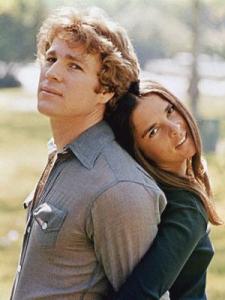
They are so freaking pretty!

I’ve discovered something as I’ve pursued my mission to see every single film ever nominated for best picture.  Quite a few of the nominees (perhaps the majority of them) are no longer impressive because they’ve simply become dated by the passage of time.  We can still watch these films and understand (and believe) that they were probably quite groundbreaking and impressive when initially released.

And then there’s the films like the 1970 best picture nominee, Love Story.  These are the nominees that you quickly realize were never good.  These are the films that were nominated because they either dominated the box office or perhaps they just lucked out and were released in a bad year for cinema in general.  At least that’s what we tell ourselves.  In all honesty, the circumstances of how they came to be nominated are often enigmatic and shrouded in mystery.  I have yet to read a single critic — from either 1970 or the present day — who has had a single kind thing to say about Love Story and, after sitting through it last night, I can say that for once, me and the critical establishment are in agreement.

The plot of Love Story is pretty simple and I’m going to go ahead and include the entire story here because quite frankly, it’s impossible to spoil something this predictable.  Oliver (Ryan O’Neal) meets Jenny (Ali MacGraw).  Oliver is a rich jock who is attending Harvard.  Jenny is a poor music student.  Upon first meeting her, Oliver calls Jenny a “bitch.”  Jenny calls Oliver “a dumb jock.”  Oliver falls in love with Jenny.  Jenny calls Oliver “a dumb jock.”  Oliver and Jenny get married.  Oliver’s father (Ray Milland) disapproves.  Jenny’s father (John Marley) is just kind of confused.  Cut off from the family fortune, Oliver struggles to provide for Jenny.  (Apparently, the 70s were a tough time to be a graduate of Harvard Law School.)  Jenny and Oliver have a fight.  Oliver cries.  Jenny says, “Love means never having to say you’re sorry,” which seems to be an underhanded way of admitting that most guys aren’t ever going to say that anyways.  Oliver is happy.  Jenny comes down with a never-named terminal illness and dies.  The end.

I know that I’m supposed to watch a movie like Love Story and just shrug my shoulders and go, “Oh well, it’s not very good but I’m a girl so I’ll love it unconditionally.”  And God knows, I tried my best,  I tried so very hard to just shut down my mind and give control over to my heart.  Because, believe it or not, I’m just a dorky, asthmatic romantic.  I’m the type of girl who gets all giggly and excited when she gets flowers, despite all of my allergies.  I can remember every sunset I’ve ever watched.  The rare times we actually do have a winter down here in Texas, I’m all about the snowball fights that end with a long, passionate kiss.  I love Valentine’s Day and I remember anniversaries.  I still have every gift that I’ve ever been given, even the really cheap and ugly things that I wouldn’t be caught dead wearing in public.  Every trinket, every stuffed animal, every card, every piece of jewelery, every note, every article of lingerie, every movie ticket — if it’s an artifact of a past or current relationship, I have it all safely stored in a place of honor. 

Yes, I adore everything that Love Story was selling and yet, as I watched Love Story, I felt myself growing more and more cynical with each passing moment.  Fortunately, the movie only last 99 minutes because if it had gone on for a few 120, I probably would have ended up “an old maid…closing up the library!” like Donna Reed in It’s a Wonderful Life.  The problem with Love Story isn’t that it’s not romantic; it’s that it takes the standard clichés of romance and embraces them to such an extent that I didn’t feel as if I was being manipulated by the film as much as I felt like I was being brutally violated by it.

Seriously, the entire time I was watching, I felt like the film was screaming at me, “Look at how beautiful they are!  Look at that sunset!  Listen to that music!  Cry, damn you, cry!”  Never mind the fact that MacGraw and O’Neal — pretty as they are to look at — generate close to zero chemistry.  Never mind that  MacGraw responds to being terminally ill by laying in bed with her hair artfully spread on the pillow behind her while director Arthur Hiller practically bathes her in a warm, saintly glow.  Never mind that “Love means never having to say you’re sorry,” doesn’t make any freaking sense at all.  Trust me, if you love me and yet you still insist on acting like an asshole, you sure as Hell have to apologize to me. 

On the plus side, the film’s got one of those overdone, lush soundtracks; the type that can make you cry as long as you don’t pay attention to what’s happening on-screen.  (That said, Taylor Swift is nowhere to be found.)  Ryan O’Neal is surprisingly likable as Oliver but Ali MacGraw — oh my God, where do I begin?  Actually, I don’t think I will because there’s simply no way I can explain just how bad of a performance she gives here.  Instead, I’ll just point out that Love Story also features the film debut of Tommy Lee Jones.  He’s credited as Tom Lee Jones here and he plays Oliver’s roommate.  He’s an on-screen for about 12 seconds and he delivers exactly one line. 

Needless to say, he pretty much steals the entire film.

Lisa Marie Goes Down On Mildred Pierce (dir. by Michael Curtiz)


A quick note: By titling this post “Lisa Marie Goes Down On Mildred Pierce” I have now not only proven that there’s no dare I will not accept but I’ve also won a small but useful sum of cash.  Never let them tell you that blogging doesn’t pay off.

Like a lot of people, I was looking forward to HBO’s remake of Mildred Pierce, featuring Kate Winslet in the role made famous by Joan Crawford.  And I hate to say it but, as hard as I’ve tried, I simply can not get into this remake.  Maybe it’s because the remake’s director, Todd Haynes, has apparently decided to use five hours to tell the exact same story that the original film told in less than two.  All I know is that the HBO version has, so far, been slow, ponderous, and ultimately a rather dull affair.

As I attempted to stay awake through the remake, I found myself wondering how the original 1945 film compared to the remake.  Fortunately, I just happened to have the original on DVD.  As well, by watching the original Mildred Pierce, I could continue my current mission to see every single film ever nominated for best picture.  (Joan Crawford won the Oscar for Best Actress for her performance as Mildred but the film itself lost Best Picture to Billy Wilder’s The Lost Weekend.)

 Mildred Pierce opens with the murder of sleazy playboy Monty Beragon (Zachary Scott).  Monty’s wife, Mildred (Joan Crawford), responds to the murder by attempting to frame her ex-business partner, the equally sleazy Wally Fay (Jack Carson).  However, the police arrest Mildred’s 1st husband, the well-meaning but really, really dull Bert (Bruce Bennett).  This leads to Mildred going to the police in an attempt to clear Bert’s name.  As the police interrogate Mildred, she tells them (and the film uses flashbacks to show us)  how she went from being a dissatisfied housewife to a succesful businesswoman to finally becoming Monty’s wife.  Through it all, Mildred is motivated by the need to take care of and spoil her manipulative daughter Veda (Ann Blyth).

Seen now, Mildred Pierce is an artifact of different time but, as a secret history nerd, I happen to love studying artifacts.  Like many of the films of the late 40s, Mildred Pierce‘s melodramatic plot serves as a reflection of a culture that, in the wake of World War II, was no longer as smugly complacent about how the world worked.  As I watched Mildred Pierce, the thing I immediately noticed was just how much the film seemed to be suspended between pre-War and post-War culture.  It’s the type of film that goes out of it’s way to acknowledge Mildred’s role as a “new woman” but, at the same time, still finds time to include numerous “comedic” scenes of various men leering at Mildred’s ankles. 

(Actually, I guess they were supposed to be staring at her legs but, since this was the 40s, this could only be represented by an occasional flash of ankle.  Personally, my ankles are okay but I like my legs better.)

Mildred Pierce is often cited as being a forerunner to feminist cinema and I have to admit I have some issues with that.  Yes, the film does acknowledge that a woman can be tough and that a woman can be a succesful businesswoman.  However, the film’s message ultimately seems to be that mothers who work will ultimately raise daughters who will become burlesque dancers and potential killers.  Mildred Pierce doesn’t so much celebrate female independence as much as it fears it.  If only Mildred had remained married to boring and predictable Bert than Veda would never have ended up as a murder suspect.

The question of ideology aside, the original Mildred Pierce remains an entertaining example of old school melodrama.  Director Michael Curtiz was one of those “craftsmen” who, in the 30s and 40s, seemed to direct hundreds of films without ever really establishing any sort of unique style of their own.  Instead, they simply used whichever style that would be most efficient towards dramatizing the script.  For Mildred Pierce, Curtiz imitated the style of a B-movie film noir.  It’s a good approach for this story even if Curtiz doesn’t seem to understand  the shadows of noir quite as well as his contemporaries Billy Wilder or Robert Siodmak.

Of course, Mildred Pierce is best known as the film that won Joan Crawford an Oscar.  I haven’t seen many of Crawford’s films (though I have seen Faye Dunaway playing her in Mommie Dearest) and I’ve got an unapologetic girlcrush on Kate Winslet but I honestly have to say that I prefer Crawford’s version of Mildred to Winslet’s.  Because, as much as I idolize Kate Winslet, she doesn’t seem to so much be playing Mildred Pierce as much as she’s observing her.  Crawford, meanwhile, sank her perfectly manicured nails into the role and pretty much refused to let go until she got her Oscar.  Crawford plays Mildred as a woman so obsessed with survival that she seems to be perfectly willing to destroy the rest of the world if that’s what it takes.  To be honest, it’s really not a great acting job but it certainly is fun to watch. Technically, Winslet gives the better performance but Crawford is a lot more entertaining.

(That said, I still love Kate and I actually would probably fall at her feet and say, “Thank you,” if I ever met her in real life because she’s really one of my heroes.  Physically, I developed early and I had to deal, at way too early an age, with a combination of a physical maturity and emotional immaturity.  By the time I was 13, I was so totally overwhelmed by the insecurity and uncertainty but then I read an interview with Kate Winslet in which she said, “I like having tits and an ass.”  And that, to be honest, was the first time I had ever come across anyone saying that it was okay to like your body.  So, anyway, the point of all that is that I love Kate Winslet.)

Crawford pretty much dominates the entire film but a few of the other performers do manage to make an impression.  As Mildred’s ex-husband, Bruce Bennett is pretty boring but the other men in Mildred’s life are well-played by Jack Carson and Zachary Scott.  Scott especially was well-cast as the type of guy that we always says we’re done with just to end up hooking up with them whenever we’re at our weakest.  As Veda, Anne Blyth gives such a driven and intense performance that you actually believe that she could be the daughter of Mildred Pierce.

In the end, Mildred Pierce isn’t really a great film but it is a lot of fun and that’s a definite improvement on the current remake.

Lisa Marie Looks At The Front Page (dir. by Lewis Milestone)


As part of my efforts to watch every film ever nominated for best picture, I recently watched 1931’s The Front Page (which lost to Cimarron, the first western to ever win best picture). 

The Front Page, which is based on a broadway play by Ben Hecht and Charles MacArthur, is the story of Chicago newspaper editor Walter Burns (Adolphe Menjou) and his favorite reporter, Hildy Johnson (Pat O’Brien).  Hildy is planning on retiring from the newspaper business so he can get married and take a job in advertising.  Walter is determined to keep his star reporter.  Walter’s attempts to keep Hildy from quitting are played out against a larger background of civil corruption, cynical reporters, and an escaped death row inmate who ends up hiding out at the newspaper. 

It’s odd to watch a film like The Front Page today.  It’s not just the fact that the movie is technically primitive but that the film is such a product of its time and a lot has changed since 1931.  This is one of those old films where African-Americans are continually referred to as being “colored” and the modern-day audience cringes in discomfort and tries to figure out the correct way to react.  As a reviewer, I guess I’m supposed to explain how you should react but I really can’t say.  Personally, I look at a film like this as a reflection of its time and the casual, unthinking racism that was a part of the culture back then.  Then again, I’m not the one being called “a pickaninny.”  This is also another one of those old films where women are presented as distractions and the only work that’s worth doing is man’s work.  Oddly enough, the sexism didn’t surprise me as much as the racism.  Then again, sexism is still socially acceptable while our modern, patriarchal society now insists that people, at the very least, pretend not to be racist.

Still, as dated as many of the film’s attitudes may be, the movie’s cynicism and it’s portrayal of journalists as essentially being a bunch of biased, blood-sucking leeches does give the film a slightly more contemporary feel than most films from the 30s.  As Hildy and Walter, Pat O’Brien and Adolphe Menjou are both well cast and the rest of the film’s characters are played by a strong collection of character actors.  A surprisingly large amount of the cynical one-liners still work and, once you get used to the film’s pre-CGI style of filmmaking, it occasionally show some genuine visual flair.

Personally, I think that The Front Page makes a lot more sense once you acknowledge the unstated fact that Walter and Hildy are former lovers.  Hollywood realized the same thing because The Front Page was later remade as His Girl Friday with Rosalind Russell taking over the Hildy Johnson role.

Anyway, for the curious, here’s The Front Page

Lisa Marie Finds A Place In The Sun (dir. by George Stevens)


As part of my mission to see every film ever nominated for best picture, I watched George Stevens’ A Place In The Sun this weekend.  A Place in the Sun was released in 1951.  It was a front-runner for best picture but in an upset, it lost to An American In Paris.  (Another best picture loser that year: A Streetcar Named Desire.)

Montgomery Clift plays George Eastman, a poor man with a religious fanatic mother and a wealthy uncle.  Looking to make his fortune (i.e., to find his “place in the sun), George gets a job working in his uncle’s factory and quickly starts a romance with one of his co-workers, the shy and insecure Alice (Shelley Winters).  However, even as he and Alice settle down to a life of dreary romantic bliss, George discovers that the Eastman name also allows him to mingle with (if never truly belong to) high society.  He meets the rich (and shallow) Angela Vickers (played by Elizabeth Taylor) and soon, he’s also romancing her.  Neither Angela or Alice is aware of the other’s existence and for a while, George has the best of both the  world he desires and the world in which he actually belongs.  Eventually, George decides that he wants to marry Angela and become a part of her world.  However, there’s a problem.  Alice is pregnant and demanding that George marry her or else.  The increasingly desperate George quickly decides that there’s only one way to get Alice out of his life…

A Place in the Sun was based very loosely on Theodore Dreiser’s 1925 novel, An American Tragedy.  While the movie remains (more or less) faithful to the novel’s plot, director Stevens jettisons most of Dreiser’s heavy-handed Marxism and instead concentrates on the more melodramatic elements of the story.  The end result is a glorious soap opera that is occasionally a bit tacky and heavy-handed but always watchable and entertaining.

Stevens is helped by the three lead performances.  As Angela, a stunningly beautiful Elizabeth Taylor manages to be both calculating and clueless,   seductive and innocent.  As her counterpart, Shelley Winters gives a really brave performance as Alice.  The film is structured that its impossible not to feel sorry for Alice.  The genius of Winters performance is that she (and director Stevens) allowed Alice to become a real, flawed human being as opposed to just a symbol of victimization.  However, the film is truly dominated by Montgomery Clift.  Clift is in just about every scene and his own rather fragile persona translates wonderfully in the role of George.  Was Montgomery Clift ever as handsome as he was in A Place In The Sun?  He gives a perfect performance as the type of guy that every girl has known, the guy that we fell in love with not because of who he was but who we thought he could be.  These are the guys who always end up breaking our hearts, they’re the ones who we still can’t help but think about years later, always wondering “why?”

Unlike a lot of older films, A Place in the Sun remains remarkably watchable and relevent today.  Perhaps its most famous scene involves a capsized rowboat and oh my God, that scene freaked me out so much.  Admittedly, a lot of that had to do with the fact that I have this morbid fear of drowning (and, like one of the characters in this film, I can’t swim) but director Stevens also does a great job building up the scene’s suspense.  He makes brilliant use of sound especially, in much the same way that Francis Ford Coppola would later use that roaring train in The Godfather.  Seriously, I watched that scene with my hands literally over my eyes, just taking an occasional peek until it was all over. 

One last note — there’s an actor in this film who plays a detective.  You’ll see him if you play the trailer at the top of the post.  His big line is “You’re under arrest.”  I have no idea who this actor was but he had one of the most authentic and memorable faces that I’ve ever seen in a movie, regardless of when the movie was made.  He had the type of presence that reminded me why I love character actors.

Film Review: Dog Day Afternoon (dir. by Sidney Lumet)


Last night, as part of my continuing mission to see every film ever nominated for best picture, I watched Sidney Lumet’s Dog Day AfternoonDog Day Afternoon was released in 1975.  Though nominated for best picture, it lost to One Flew Over the Cuckoo’s Nest.

In Dog Day Afternoon, Al Pacino plays Sonny, a nervous Viet Nam vet who, along with the dim-witted and possibly crazy Sal (John Cazale), attempts to rob a bank.  Unfortunately for him, Sonny doesn’t really know what he’s doing and literally within minutes of him first drawing his gun, the bank is surrounded by cops.  The robbery quickly descends into a hostage situation.  As Pacino negotiates with a NYC police detective (Charles Durning), a crowd of onlookers gathers around the bank and starts to cheer with every defiant word that comes out of Sonny’s mouth.  Sonny discovers he likes his new-found fame.  In the film’s most famous scene, he stands outside the bank and leads the crowd in a chant of “Attica!  Attica!”   Eventually, Durning learns that Pacino’s motive for robbing the bank was to steal enough money for his suicidal lover (Chris Sarandon) to get a sex change operation.  However, now that the robbery has failed, Pacino has a new plan.  He demands a flight out of the country.  Meanwhile, the hostages inside the bank start to form their own odd kinship with the two bank robbers and Durning finds himself being challenged by the F.B.I., who have a much more drastic plan for how to end the situation.

Dog Day Afternoon is a remarkable film, a dark comedy of desperation and human nature that, by the final scene, reaches a certain tragic grandeur.  Sidney Lumet (who made his directorial debut in 1957 with 12 Angry Men and whose most recent film, Before the Devil Knows Your Dead, was released 51 years later) was one of the most important (if underrated) filmmakers of the 1970s and he proves it here.  From the opening montage of New York City looking so wonderfully sordid at the height of the grindhouse era to Pacino’s bumbling initial attempt to rob the bank to the film’s violent and abrupt conclusion, Lumet captures your attention and, much like Al Pacino in this movie, he holds it hostage until the movie ends. 

Dog Day Afternoon is probably one of the best acted films that I’ve ever seen.  This is one of those films where every role — regardless of how large or how small — fills like an actual human being.  By the end of the film, you feel as if you know the bank managers and the tellers almost as well as you know Pacino, Durning, Sarandon, and Cazale.  Pacino is simply amazing here, giving a nervous, jittery performance as a character who manages to be both selfish and selfless at the same time.  Durning, meanwhile, is hilarious as the frazzled detective who finds himself steadily overwhelmed by the circus around him.  Much as you can’t help but root for Pacino no matter how self-absorbed he might act, you can’t help but sympathize with During, even if he is a member of the establishment.  As Pacino’s transsexual lover, Sarandon plays his role with a fragile dignity that prevents the role from becoming a stereotype.  However, for me, the film truly belongs to John Cazale who is both scary and oddly child-like as Sal.  As seen below, Cazale improvised one of the best lines in the movie when he replies to Pacino’s question regarding to which country Cazale wants to make his escape.

Now, this is going to be difficult for me to admit but, as thrilling as it was to watch Pacino shout, “Attica!  Attica!,” I honestly had no idea why that phrase was the one he chose to use to work up the crowd.  In fact, if I had written this review right after seeing (or while watching) the film last night, I probably would have doubled embarrassed myself by claiming that Pacino was shouting “Ateka.”  However, for once, I decided to be a responsible reviewer and I actually did some research as opposed to just going with my first conclusion.  So, as a result of this film, I can now say that I know about the Attica Prison Riots of 1971.

But what’s truly significant about that “Attica” chant is that it’s the only part of this film (beyond a few fashion choices) that feels dated.  As I watched the movie, it was easy for me to imagine myself jumping on twitter and seeing “#Attica” as a trending topic.  We’ve all seen the famous “Attica!” scene in countless compilations but what’s often forgotten is how that sequence ends.  When Pacino, obviously a bit star struck by all the attention, goes outside and start chanting a second time, he is suddenly tackled from behind by one of the bystanders who has decided to play hero.  And as Pacino goes down to the ground, the same crowd that was previously cheering him now cheers for the new object of their affection.  If nothing else, Dog Day Afternoon showed why sometimes we all need to escape to Wyoming.

Film Review: The Private Life of Henry VIII (dir. by Alexander Korda)


This afternoon, as part of my mission to see every single film ever nominated for best picture, I watched Alexander Korda’s 1933 biopic The Private Life of Henry VIII.

Now, I have to admit that I’ve never been a big fan of the historical King Henry VIII as I have a hard time finding much sympathy for a man who beheads one wife, not to mention two of them.   I like to imagine that he met his end in much the same way that Joe Spinell meets his end at the end of Maniac, with all of his dead wives suddenly showing up and ripping off his head.  But, Henry is one of those larger-than-life historical figures that always seems to end up as the subject of movies, speculative fiction, and, of course, Showtime television series. 

The Private Life of Henry VIII is one of the better known recreation of Henry’s life on-screen.  For the most part, the film ignores Henry’s policies as king and instead is a darkly humorous recreation of his relationships with five of his six wives.  (His first marriage, to Catherine of Aragon, is ignored.)  The episodic film opens with the execution of Anne Boyelen (Merle Oberon).  This sequence establishes the film’s tone early and it’s actually a lot more cynical than we usually expect a film from 1933 to be.  In between shots of Boyelen waiting to meet her fate, we get extended scenes of two executioners — one French and one English — arguing about which nationality is better when it comes to chopping off heads.  Meanwhile, the members of Henry’s court spend their time whispering innuendo about Henry’s new wife, Jane Seymour (Wendy Barrie).  When Henry (played by Charles Laughton) finally shows up on the scene, he turns out to be a buffoon, a childish man who happens to control the destiny of England.  After Jane dies in childbirth, Henry marries Anne of Cleves (played by Laughton’s wife, Elsa Lanchester).  Anne, however, finds Henry to be repulsive and, in the film’s most obviously comedic segment, she goes out of her way to make herself as sexually unappealing as possible in order to convince Henry to give her a divorce.  (This, of course, led to the split between England and the Catholic Church but the film doesn’t dwell on that.  This is a comedy, not Man For All Seasons.)  After the divorce, Henry finally marries Catherine Howard (Binnie Barnes) who has spent the whole movie pursuing Henry.  For the first time in the movie, Henry is portrayed as being truly in love, unaware (at first) that Catherine only married him for his crown and is actually having an affair with Thomas Culpepper (Robert Donat). 

The Private Life of Henry VIII was not the first movie to be made about Henry VIII but it’s probably the most influential because of Charles Laughton’s Oscar-winning performance in the title role.  Laughton’s performance pretty much set the standard as far as future Henry’s were concerned.  His Henry is buffoonish womanizer who does everything to excess.  (This is the film that pretty much created the whole image of monarchs as men who don’t use forks, knives, or spoons.)  However, as over-the-top as Laughton’s performance may seem, it’s actually full of very subtle moments that suggest the actual human being lurking underneath all of the bluster.  It’s hard not to sympathize with Laughton’s Henry as he struggles to explain what sex is to Anne of Cleves or with his obvious pain when he discovers that he’s been betrayed by the only one of his wives that he actually loved.

(Of course, any similarity between Laughton’s Henry and the real-life Henry is probably a coincidence.)

The Private Life of Henry VIII was the first British film ever nominated for best picture and, perhaps because it wasn’t made by the Hollywood establishment, it hasn’t aged as terribly as most films from the 30s.  While the film does have its slow spots, the performances of Laughton, Oberon, and Lanchester still hold up well and some of the film’s dark comedy almost feel contemporary.  Oddly enough, this British film about English history lost to an American film about English history, Cavalcade

(I should mention that I haven’t seen Cavalcade so I can’t say whether it was a better film.  I’m going to have to see Cavalcade eventually but it’ll be later than sooner as the movie is only available as part of a DVD boxed set that costs close to 300 dollars.  Agck!)

A Quickie With Lisa Marie: The Robe (dir. by Henry Koster)


As part of my mission to view every film — good or bad — ever nominated for best picture, I spent last night watching 1953’s The Robe (which was nominated for best picture but lost to From Here To Eternity.)  The Robe is an old school biblical epic, the type of film that used to regularly get nominated for best picture but which you don’t see much of anymore.  If you’re wondering why that genre hasn’t stood the test of time, I’d suggest watching The Robe.

Richard Burton stars as Marcellus, a womanizing Roman centurion who falls in love with young, pure noblewoman Diana (Jean Simmons).  Unfortunately, Diana is set to marry the decadent Caligula (Jay Robinson).  (Yes, that Caligula…)  Burton’s rivalry with Caligula leads to him being reassigned to Jerusalem where he not only witnesses the crucifixion but also wins Jesus’ robe in a dice game.  However, Marcellus soon finds himself being haunted by nightmares of the crucifixion and he discovers that he can’t even wear the robe without having a seizure.  His slave, Demetrius (played by musclebound Victor Mature) has secretly become a Christian and steals The Robe before disappearing into the Holy Land.  As Marcellus, who believes that only by destroying the robe can he free himself from his guilt, searches for Demetrius, he is reunited with Diana and, since this is an old school biblical epic, he also ends up converting as well.  Unfortunately, he does all this around the same time that Caligula becomes Emperor and (in this film if not in actual history) begins to persecute the early Christians.

The Robe was the first film to made in “Cinemascope” and, while that may have been an amazing development back in 1953, when watched today, it’s obvious how much of the film is really just made up of filler designed to show off the new process.  Again, it may have been amazing at the time but today, it just seems like a slow movie.  Even more importantly, The Robe itself is so reverent and respectful of its subject that it’s just not that interesting.  Speaking as a nonbeliever, I’ve still sometimes feel that a lot of contemporary films make it a point to ridicule Christians because they’re an easy target.  Unlike a certain other world-wide religion, most Christians aren’t going to blow you up just because you featured an image of Jesus in your movie.  However, movies like The Robe were not only extremely reverent and respectful but they went out their way to let you know how reverent and respectful they were being.  The result is a film that lack any hint of nuance or anything that might actually challenge the audience.  It’s like Avatar with Jesus

Since he’s best known for being an alcoholic and marrying Elizabeth Taylor, Richard Burton might seem like an odd choice to play an idealistic Christian martyr.  And, quite frankly, he is.  Throughout the film, he’s visibly uncomfortable and, quite frankly, he didn’t have the legs necessary to pull off the ancient Roman look either.  Jean Simmons is also stuck playing a stock character — the virtuous maiden.  As with a lot of the old school biblical epics, the lead characters are so boring that you can’t help but feel they had more fun as pagans.  Meanwhile, poor Victor Mature wanders through the film struggling to show anything resembling emotion.   I mean, he tries so hard that its impossible not to like him.  At the very least, The Robe proves that any film featuring Victor Mature will have some sort of camp value. 

(As I watched The Robe, I kept thinking about a comment that Groucho Marx supposedly made.  Apparently, he said he wouldn’t watch any movie starring Victor Mature because “I won’t watch any movie where the guy’s tits are bigger than the girl’s.”)

The Robe does feature some interesting supporting performances from several wonderful B-movie character actors.  Jay Robinson is obviously having the time of his life playing the Emperor Caligula.  Robinson’s version isn’t quite as effective as Malcolm McDowell’s but Robinson is a  lot more fun to watch.  Richard Boone is effectively slovenly in the role of Pilate and there’s a nice little throw-away scene where Pilate absent-mindedly washes his hands twice.  Meanwhile Ernest Thesiger (who played Dr. Pretorious in the Bride of Frankenstein) is an oddly benevolent Emperor Tiberius while Michael Rennie, the alien from the original The Day the Earth Stood Still, plays none other than St. Peter.  Even Jeff Morrow (from This Island Earth) has a small role.

Like most of the old school Hollywood biblical epics, The Robe seems pretty hokey when viewed today and I get the feeling it probably seemed hokey when it was first released back in 1953.  Still, I remember that my Grandma Meehan used to love to watch these movies whenever they would show up on television.  She would have deep theological debates with the images that flickered across the screen.   I can still remember spending multiple Easters listening to her argue with The Ten Commandments.  I don’t know if Grandma ever saw The Robe but I do know that she believed that the Holy Tunic was presently located in France and not at the Cathedral of Trier in Germany.  Seriously, you did not want to question her on this point. 

To be honest, watching this type of film is always an odd experience for me.  Up until recently, I described myself as a “fallen Catholic” and I always felt so proud of myself afterward.  I could spend hours telling you why I no longer believed in the faith of my childhood and I could get quite smug about it.  I guess I still can but, as of late, I’ve discovered that humility goes well with a lack of faith.  I’ve also been forced to admit that when you’re raised Catholic, you’re a Catholic for life regardless of whether you believe in the Holy Trinity or not.  If pressed, I guess I’d call myself “an agnostic Catholic.”  I’m the type of nonbeliever who still feels the need to go to confession after a long weekend.  It’s not so much that I doubt my doubt as much as I wish that I could still go back to a time in my life when I actually could have faith without feeling like I was in denial.  So, even as I openly scoff at these films, there’s always that small part of my heart that wants to embrace the film in all of its simplistic and hokey glory.

That said, it’s also true that The Robe is a lot easier to resist than a film like Pasolini’s The Gospel According to Saint Matthew or, for that matter, The Exorcist.

A Quickie With Lisa Marie: Crossfire (dir. by Edward Dmytryk)


I recently decided that I wanted to watch and review every single movie ever nominated for the Academy Award for best picture.  As part of that mission, I recently rewatched one of my favorite also-rans, 1947’s Crossfire.

Crossfire is a message movie disguised as a B detective flick.  A group of soldiers who have just returned from World War II decide to get together for a drink.  At the bar, they run into a civilian named Joseph Samuels (Sam Levine).  The soldiers end up going back to Samuels’s apartment and the next morning, Samuels is found dead.  Obviously, he was killed by one of the soldiers but which one.  Suspicion falls on the meek (and missing) Floyd Bowers (Steve Brodie) but police detective Finlay (Robert Young) and Sgt. Peter Keeley (Robert Mitchum) both (correctly) suspect that Samuels was actually murdered by the far more outspoken and imposing Montgomery (Robert Ryan).  It quickly becomes obvious that Montgomery is an anti-Semite who killed Samuels solely because he was Jewish.  However, neither Finlay or Keeley can prove it.  The film quickly becomes a darkly intense duel between these three men as Finlay and Keeley attempt to trick Montgomery into implicating himself while Montgomery attempts to further frame Bowers for the murder.

Before Crossfire, director Edward Dmytryk specialized in making low-budget “B” movies and he brings that noir, near-grindhouse sensibility to Crossfire.  As a result, Crossfire is a one of those rare “message” films that is actually entertaining.  Only a few times does the film start to feel preachy and luckily, Robert Mitchum is there being his usual cynical self.  If anyone could deflate the pompous nature of the mid-40s message movie, it was Robert Mitchum.  The film says, “Love one another.”  Mitchum replies, “Baby, I just don’t give a damn,” and he keeps things from getting too heavy-handed.  Mitchum is one of three Roberts to star in this film.  Robert Young plays the police inspector with just the right amount of world-weary indignation while Robert Ryan is a force of nature as the film’s brutal murderer.  Don’t get me wrong.  You can pretty much peg Ryan as a killer from the first minute he shows up on-screen.  If Mitchum and Young smartly underplay their roles, Ryan goes the exact opposite direction.  He’s an obvious brute but he’s also totally believable.  You look at his character and it’s not difficult to imagine him passing the collection plate at Westboro Baptist Church.  As well, Crossfire also features an excellent supporting term by one of my favorite noir actresses, the great and wonderful Gloria Grahame.  She plays Bowers’ married girlfriend and gives a compellingly, real performance that suggests that maybe Hollywood in the 40s wasn’t quite as clueless as we all like to assume.

Crossfire was nominated for Best Picture of 1947 but it lost to another film about anti-Semitism, Elia Kazan’s Gentleman’s Agreement.  (Oddly enough, both Kazan and Dmytryk would end up naming names during the McCarthy Era.)  Like Gentleman’s Agreement, Crossfire was based on a novel.  However, in the original novel, the victim was not Jewish but instead was gay.  However, back in the 1940s, the Hollywood Production Code specifically forbade any open depiction of homosexuality and so, the crime went from being motivated by homophobia to anti-Semitism.