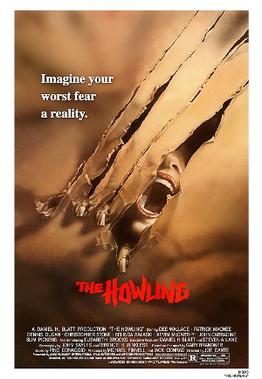
Horror Film Review: The Howling (dir by Joe Dante)


The 1981 film, The Howling, takes place at The Colony.

The Colony is a lovely place, a nice resort out in the middle of the countryside.  It’s a place that celebrity therapist George Waggener (Patrick Macnee) sends his clients so that they can recover from trauma.  It’s a bit of a grown-up version of the ranch to which Dr. Phil used to send juvenile delinquents.  Of course, the Colony is full of adults and they’re an eccentric bunch.  I mean, one of them — named Erle Kenton — is actually played by John Carradine!  That’s just how eccentric the place is.  Sheriff Sam Newfield (Slim Pickens) keeps an eye on the place but everyone knows that there’s nothing to worry about when it comes to The Colony.  Dr. Waggner does good work.

Karen White (Dee Wallace) is a Los Angeles news anchor who was held hostage by a serial killer named Eddie Quist (Robert Picardo).  While she was with Eddie, she was forced to not only watch videos of Eddie’s crimes but she also saw something happen with Eddie that terrified her to such an extent that she has blocked it from her mind.  Karen was rescued by the police but she is haunted by nightmares.  Dr. Waggner arranges for Karen and her husband, Bill Neill (Christopher Stone, who was married to Dee Wallace when they co-starred in this film), to spend some time at the Colony.

Bill loves the Colony, especially after he attracts the eye of Marsha (Elisabeth Brooks), the resort’s resident seductress.  Karen, however, is less enamored of the place.  The Colony feels off to her and she’s not happy about the howling in the distance or the fact that Bill has suddenly started to grow distant from her.  Could it be that The Colony is actually crawling with werewolves and that Bill has become one of them?  (It’s totally possible and, to The Howling‘s credit, it doesn’t waste any time letting us know that.)  Karen’s friend, Terry Fisher (Belinda Balanski), and her boyfriend, Chris Halloran (Dennis Dugan), do some research of their own into Eddie Quist, The Colony, and whether or not werewolves exists and they meet a helpful bookstore owner named Walter Paisley (Dick Miller).

To understand the approach that director Joe Dante and screenwriter John Sayles take to The Howling, one needs to only consider the names of some of the characters.  George Waggner.  Bill Neill. Terry (which can be short for Terence) Fisher.  Fred (or is that Freddie) Francis.  Erle Kenton.  Sam Newfield.  Jerry Warren.  All of these characters are named after horror film directors.  This is the type of werewolf film where Chris Halloran has a copy of The Three Little Pigs sitting on his desk.  Veteran actors like Kevin McCarthy, John Carradine, Slim Pickens, and Kenneth Tobey show up in small roles.  Roger Corman mainstay Dick Miller plays yet another character named Walter Paisley and he kicks Forrest J. Ackerman out of his bookstore.  Roger Corman himself plays a man making a phone call.  After a werewolf is shot on live TV, the program immediately cuts to a dog food commercial and we see a blank-faced child telling his unconcerned parents that someone just turned into a wolf.  The Howling was made by people who obviously love B-horror and that love is present in every frame of the film.

Like Dante’s Piranha, The Howling is a film with a sense of humor but it’s not a comedy.  The werewolves are still impressive, even forty-two years after the film was first released.  The character of Eddie Quist (“I’m going to give you a piece of my mind”) is a terrifying monster and the sight of his signature smiley face will fill you with dread, especially when it shows up in a place where it really shouldn’t be.  The film cynically ends on a note of noble sacrifice that will apparently not make much difference, with the suggestion being that human beings are either too distracted or too jaded to realize that there are monsters among them.  The Howling is a fast-paced and well-directed homage to B-horror and it’s still terrifically entertaining.
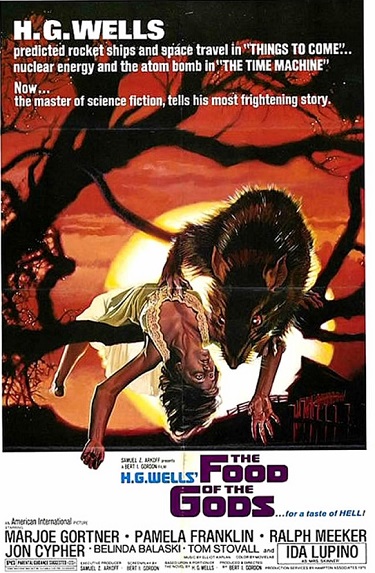
The TSL’s Horror Grindhouse: Food Of The Gods (dir by Bert I. Gordon)


Uh-oh! Something weird has bubbled up to the ground on an island near British Columbia and a farmer and his wife (played by John McLaim and Ida Lupino) foolishly decided to feed it to their farm animals! Soon, they’ve got giant chickens! And listen, that might sound like a good thing to some but I’ve spent enough time around farms to know that giant chickens are not a good thing! Seriously, normal-sized chickens are messy enough. Giant ones? I don’t even want to thinking about it.

Unfortunately, it’s not just the chickens that are eating the food. Rats are eating the food. Wasps are eating the food. All of the animals are turning into giants and now, they’re hunting humans! After his best friend is attacked and killed by giant wasp, a football player named Morgan (Marjoe Gortner) decides to investigate on his own. You would think that a football player would be busy preparing for his next game or something like that but no, not Morgan! Morgan’s determined to find out why there are giant animals off the coast of Canada.

Of course, Morgan isn’t the only one interested in the so-called Food of the Gods. There’s also Jack Bensington (Ralph Meeker), who owns a dog food company. Jack wants to sell the food. Why would Jack want to do that? Does he actually think that causing dogs to transform into giants who would undoubtedly try to kill their masters is somehow going to be good for his company’s reputation? Jack’s main motivation seems to be that he’s a businessman and, in this film’s moral universe, that automatically makes him one of the bad guys. But it seems like even an evil businessman would know better than to kill off all of his customers.

This 1976 film, which is loosely (very loosely) based on a novel by H.G. Wells, was directed by Bert I. Gordon and, if you think the plot sounds a little ludicrous …. well, it is. Nothing about the film really makes much sense but that’s kind of to expected from a Bert I. Gordon film. Gordon specialized in making films about giants destroying stuff. The films were never particularly good but Gordon obviously understood that American filmgoers love big things. Food of the Gods, as silly as it may be, apparently made a lot of money when it was first released.

Today, of course, it’s impossible to watch the film without noticing just how terrible the special effects are. Between the unconvincing use of super-imposed images and the obviously fake rats that are tossed at some of the actors, there’s not a single shot that doesn’t somehow look totally ridiculous. In fact, it’s all so silly and obviously done on the cheap that it becomes rather charming, or at least as charming as the superimposed image of giant wasp ever could possibly be. You have to admire the film’s determination to tell its story despite not having the resources to do so. As for the rest of the film, it’s dumb but it doesn’t take itself too seriously. If you’re specifically searching for a bad giant animal movie, The Food of the Gods is fun in its own goofy, nonsensical, low-budget way.

Horror Film Review: Piranha (1978, dir by Joe Dante)


At the height of the Vietnam War, the U.S. Government came up with a plan that could have changed the course of the war.

What if the government developed gigantic, super-fast, occasionally jumpy piranha?  And what if they set those killer fish loose in the rivers of Vietnam?  Would those fish swim through North Vietnam and take out the VC?  Sadly, the war ended before the government got a chance to test out Operation Razorteeth.  With the war over, the government was stuck with a bunch of killer fish.  Scientist Robert Hoak (Kevin McCarthy) ignored all orders to destroy his mutant fish because they were his life’s work.  (Awwwwwwwww!)  He kept an eye on them and did everything he could to prevent them from getting into the nearby river.

Unfortunately, Dr. Hoak’s best wasn’t good enough.  Because the piranha have gotten loose and now they’re making their way down to the river!  They start out eating skinny dipping teenagers, fisherman, and Keenan Wynn.  (They’re good enough not to eat Wynn’s adorable dog, which I appreciated.)  Further down the river, there’s a summer camp and a water park!  It’s definitely not safe to get back in the water but sadly, that’s what several people insist on doing throughout this film.  Even when the water is full of blood, people will jump in.  (It’s easy to be judgmental but it is a pretty river.  I don’t swim but I honestly wouldn’t mind living near a river that looked that nice.  Instead, I have to make due with a creek.)

Floating down the river on a raft and trying to warn everyone is the unlikely team of Maggie (Heather Menzies) and Paul (Bradford Dillman).  Maggie is a detective who has come to town to track down the two teenage skinny dippers who were eaten at the start of the film.  Paul is a drunk.  Well, technically, Paul is a wilderness guide and he does spend the entire movie wearing the type of plaid shirt that would only be worn by someone who goes camping every weekend but really, Paul’s main personality trait seems to be that he enjoys his booze.  Paul’s daughter is away at the summer camp.  Yes, that’s the same summer camp that’s about to be visited by a school of piranha.  AGCK!

Produced by Roger Corman and obviously designed to capitalize on the monster success of Jaws, Piranha was an early directorial credit for Joe Dante.  Dante would later go on to direct films like The Howling and GremlinsPiranha was also an early screenwriting credit for the novelist John Sayles, who would use his paycheck to launch his own directing career.  As a director, Sayles specializes in politically-themed ensemble pieces, which is something you might not guess while watching Piranha.  (Piranha does have an anti-military subplot but then again, it’s a film from the 70s so of course it does.)  Like the best of Corman’s film, Piranha works because it sticks to the basics and it delivers exactly what it promises.  Piranha promises killer fish biting away at anyone dumb enough to get in the water and that’s what it gives us.  As an added bonus, we also get some occasionally witty dialogue and Joe Dante’s energetic, self-aware direction.

As is typical with the films of both Corman and Dante, the cast is full of familiar faces.  Along with Kevin McCarthy as the mad scientist and Keenan Wynn as the eccentric fisherman, Dick Miller shows up as the waterpark owner.  Richard Deacon, who made a career of playing bosses and neighbors on various sitcoms in the 50s and 60s, plays the father of a missing teenager.  Director Paul Bartel plays the head of the summer camp, who may be a jerk but who still heroically jumps in the water to save several campers.  (Bartel’s moment of heroism is one of Piranha’s best scenes and, significantly, it’s played without irony.  You’ll want to cheer for the guy.)  Finally, the great Barbara Steele plays the government scientist who shows up to clean up Operation Razorteeth.

Piranha is simple but entertaining.   Dante’s direction is energetic and, despite the film’s self-referential tone, the killer fish are just savage enough to be scary.  It’s a film that tell us not to get back in the water but which understands that the temptation might just be too strong.

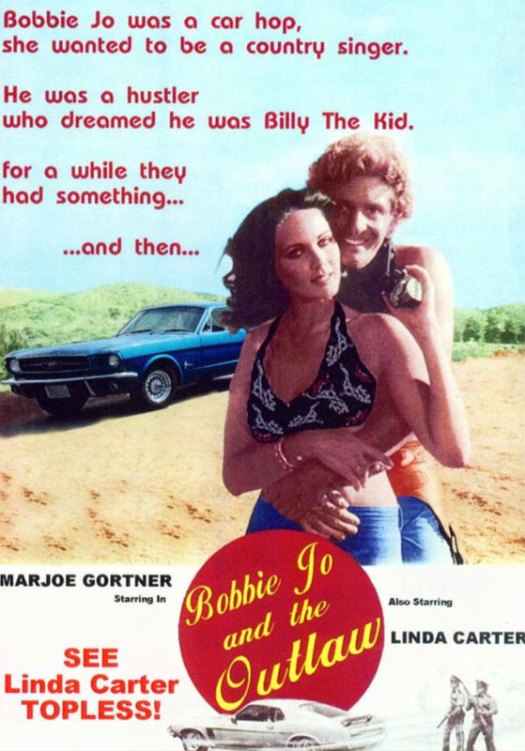
Existential Exploitation: BOBBIE JO & THE OUTLAW (AIP 1976)


gary loggins's avatarcracked rear viewer

I discussed filmmaker Vernon Zimmerman in a post on his UNHOLY ROLLERS back in January. Zimmerman wrote the script (but did not direct) for 1976’s BOBBIE JO & THE OUTLAW, which on the surface is just another sex’n’violence laden redneck exploitation film. Yet after a recent viewing, it seemed to me Zimmerman was not just delving into exploitation, but exploring something more: disaffected youth, gun culture, the cult of personality, and violence in America, themes that still resonate today.

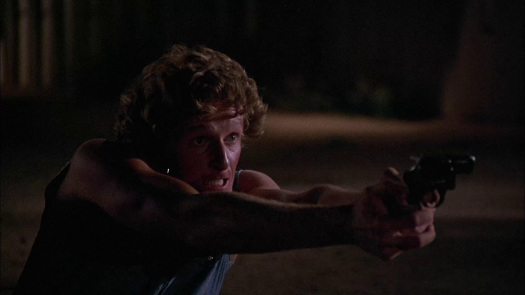
Former child evangelist turned rock star turned actor Marjoe Gortner is Lyle Wheeler, a drifter who enters quick draw contests and idolizes Billy the Kid. Lyle’s a hustler, as we find out as he pulls into a gas station and steals a Mustang from a travelling salesman. Lyle outruns a police car hot on his tail, causing the cop to go off the road, and revs into the next town, where…

View original post 458 more words