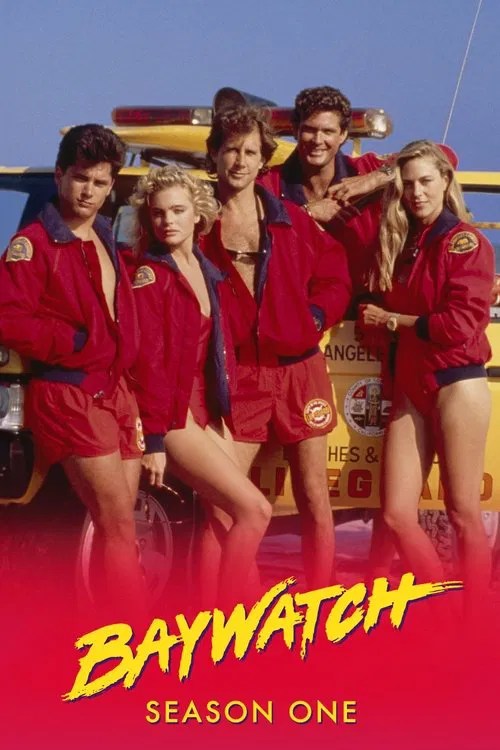
Welcome to Retro Television Reviews, a feature where we review some of our favorite and least favorite shows of the past! On Saturdays, I will be reviewing Baywatch, which ran on NBC and then in syndication from 1989 to 2001. The entire show can be viewed on Tubi.
Cort needs money!
Episode 1.19 “The Big Race”
(Dir by Kevin Inch, originally aired on March 16th, 1990)
This episode opens with Cort trying to impress a woman who is convinced that he’s rich. He and Eddie illegally break into someone else’s yacht and Eddie dressed up in a tuxedo so he can pretend to be Cort’s butler. The meeting goes well into the woman asks Cort to donate $10,000 to a retirement home and Cort impulsively says yes.
Now, he has to come up with $10,000!
Luckily, there’s a water ski race coming up and the grand prize is $15,000. Cort, Mitch, and Craig enter and …. well, do you need me to tell you that they win despite the efforts of a bunch of snobby vandals?
Meanwhile, Shauni is scared to get in the water. She’s haunted by slow motion flashbacks of Jill getting attacked by that shark. (This is the rare episode of Baywatch that actually acknowledges that something that happened in another episode.) I guess Shauni’s going to have to quit being a lifeguard now. Oh wait — luckily, someone almost drowns and Shauni’s instincts overpower her fear. With the help of Michael Newman — NEWMIE! — Shauni finds the courage to do her job.
At least Shauni is still mourning Jill. No one else seems to care. Seriously, if you think about it — two lifeguards have died in the line of duty over the past two weeks and no one really seems that upset about it.
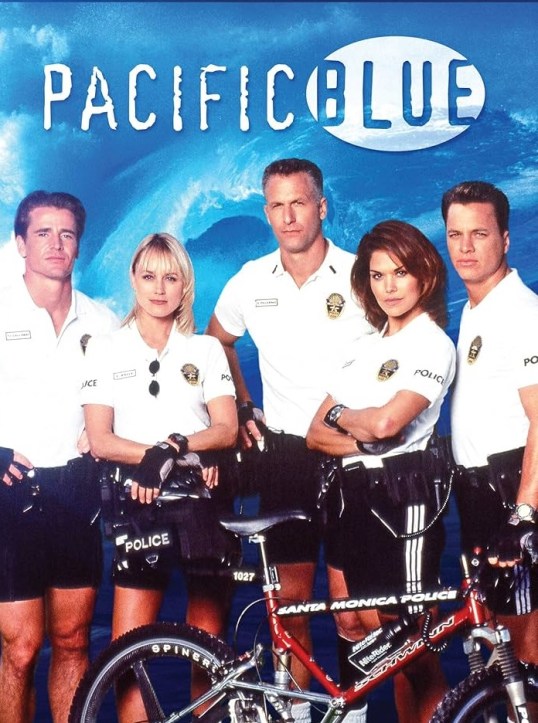
Welcome to Late Night Retro Television Reviews, a feature where we review some of our favorite and least favorite shows of the past! On Tuesdays, I will be reviewing Pacific Blue, a cop show that aired from 1996 to 2000 on the USA Network! It’s currently streaming everywhere, though I’m watching it on Tubi.
This week, Chris goes undercover.
Episode 2.8 “Undercover”
(Dir by Terrence H. Winkless, originally aired on October 13th, 1996)
A smarmy detective wants Chris to go undercover to help investigate a suspected money launderer, Tim Wakefield (Scott Plank). Palermo argues that Chris doesn’t have enough experience to work undercover but the detective asks Chris, “What do you want to do? You ready to get out of those bicycle shorts and do some real police work?”
I have to admit that line cracked me up. It really made the whole episode. Palermo got offended, as he always does whenever anyone points out that bike cops look silly with their shorts and their crisp white shirts. What was great about the line was that it was true. The detective may have been smarmy but he was right about Chris being invited to do “real police work” and he was right about bike cops not being real policemen. Everyone know it’s true! Seriously, if a bicycle cop ever tries to pull you over, just slam down on the accelerator. What are they going to do? Chase you when you’re going over 30 mph? I think not!
(Seriously, two seasons in and the show is still trying to convince us that bike cops are real cops. Sorry, Palermo, it’s not going to happen!)
That said, this episode’s main plot still ended up falling flat because Chris is not a very interesting character and her whole undercover thing wasn’t particularly credible. When she went undercover, she still came across as being just as stiff, humorless, and unlikable as when she’s riding her bike and threatening people with arrest. Tim Wakefield, of course, fell for her and Chris was supposed to be attracted to him and conflicted about her assignment and I never bought it for a second.
(As for Wakefield, he turned out to be not as bad of a guy as everyone assumed. He was arrested but his lawyer got him off and the episode ended with him sending Chris a postcard from some tropical beach. I think Chris was supposed to be wistful as she looked at the postcard but, since Darlene Vogel was apparently only capable of one facial expression, who knows for sure?)
Meanwhile, Cory dealt with being stalked by a mentally unstable ex-boyfriend, Wasn’t it just last week that Cory’s partner was being stalked by a mentally unstable woman? This show certainly does enjoy repeating itself. While Palermo worried about Chris, TC and Victor chased some roller-blading teens who were shooting random tourists with paintballs. The roller-blading scenes were kind of exciting but, unfortunately, they had to share space with all of the awkward bicycle scenes.
This episode had its moments. The roller-blading was cool. The detective making fun of Palermo was gratifying. Overall, though, the fact that the show centers around bicycles continues to be a flaw that simply cannot be overcome. There’s simply no way to make anyone riding a bicycle look impressive, I don’t care how serious they try to look.
Charles Bronson is Leo Kessler, a veteran detective who’s seen it all and has grown sick of a system of justice that he thinks favors criminals over their victims. When girls start getting murdered, he immediately suspects the arrogant Warren Stacy, played by Gene Davis in the best role of his career. When Kessler and his partner Paul McCann (Andrew Stevens) start putting the pressure on Stacy, the killer responds by going after Kessler’s daughter Laurie (Lisa Eilbacher). Needless to say, our hero will do anything to stop the madman, ANYTHING!
10 TO MIDNIGHT is a special movie in my house because it’s my wife’s favorite Charles Bronson film, even when she didn’t have any overall appreciation for Bronson as an actor. Luckily for her, she had me to introduce her to the rest of the iconic actor’s voluminous catalog of movies. I saw 10 TO MIDNIGHT myself when I was pretty young, probably 13 or so. I remember being scared that first night after I watched the movie when I was trying to go to sleep. My wife and I watched it today on my old VHS tape that I’ve owned going back to the late 1980’s.
There are several elements that elevate 10 TO MIDNIGHT above the average cop / slasher thrillers of the 1980’s. First, it’s Charles Bronson in the lead role. Bronson has such a strong presence on screen that his presence alone elevates almost any material. He looks great in the film, and the role gives him some good opportunities, as both a mentor to the young cop, and even more importantly, as a dad who wants to do better for his daughter. It’s a solid role that seems to fit Bronson like a glove. Second, we know from the very beginning of the movie that Warren Stacy is in fact the killer. We also know that the law seems to be working in his favor. And because of that, we’re on Kessler’s side as he goes to extreme lengths to stop his reign of terror. Finally, the script and director J. Lee Thompson go all in on the sex and violence. Examples include Stacy killing his often naked victims while he himself is in the nude. There is much talk in the film about items of a sexual nature and Stacy even has a sexual release device that almost has to be seen to be believed. It definitely adds a decadent and voyeuristic feel to the proceedings. And I haven’t even mentioned yet that it has one of the very best endings of any Bronson film, second only to THE MECHANIC, in my humble opinion.
I highly recommend 10 TO MIDNIGHT!
For a more detailed review of 10 TO MIDNIGHT, check out Lisa’s review from a couple of years back below:
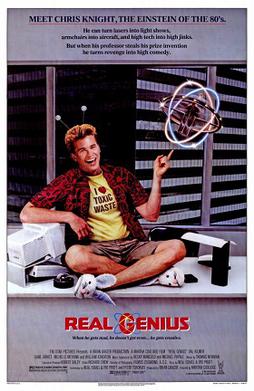
Mitch Taylor (Gabriel Jarrett) is a teenage genius who is recruited by Prof. Jerry Hathaway (William Atherton) to study at Pacific Tech University. The real reason why Hathaway has recruited Mitch is because Chris Knight (Val Kilmer), another genius, has been slacking on developing the power source for an experimental laser called “crossbow.” Hathaway hopes that Mitch can get Chris to take his work seriously and to focus on the project. Instead, Chris teaches Mitch that he has to learn how to enjoy life or his great intelligence will become a burden and he’ll end up burned out and living in the tunnel underneath the university. That’s what happened to Laszlo Holyfield (Jon Gries). That’s what nearly happened to Chris. Chris is determined not to let it happen to Mitch.
Real Genius combines college hijinks with a serious examination of the pressures of being a “real genius.” Mitch knows everything about laser physics but he still misses his parents and cries after getting yelled at by Prof. Hathaway. He’s just a kid, no matter how smart he is. Chris proves himself to be a good friend, encouraging Mitch to relax and enjoy life. Just because you’re a genius doesn’t mean that you can’t have fun. As played by Val Kilmer, Chris Knight is the best friend that everyone wishes they could have, whether they’re a genius or not. Even when the film gets sophomoric, Kilmer plays his role seriously and never loses sight of Chris’s humanity or why it’s so important to Chris that Mitch not become consumed by the pressure of being smarter than almost everyone else in the room. This is one of the early Val Kilmer performances that showed just how good an actor he truly was. With Chris’s encouragement, Mitch pursues a romance with Jordan Cochran (Michelle Meyrink) and gets revenge (more than once) on the arrogant Kent (Robert Prescott).
Eventually, Chris and Mitch realize that their research is being used to construct a weapon for the CIA and this leads to the film’s famous ending. Ever since this movie came out, there’s been a debate over whether or not a laser could be used to make popcorn and, even more importantly, whether or not a gigantic amount of popcorn could actually destroy someone’s house. I don’t know the answers to those questions but I’d like to think that Real Genius got it right and I have no interest in any evidence that suggests otherwise. Sometimes, you owe it yourself to believe in the power of lasers and popcorn. The next person who takes advantage of your hard work, destroy his house with popcorn and then sing Everybody Wants To Rule The World. Learn the lessons of Real Genius.
Finally, when I was growing up, Real Genius was one of those films that seemed to be on HBO all the time. Somehow, I always turned it on right when the popcorn started popping. That popcorn-filled house, followed by Everybody Want To Rule The World, was a huge part of my childhood. Real Genius will always bring back good memories for me.
Way back in October, around the same time that I first decided that I would do a series of reviews of political films and that I would call it Lisa Gets Preachy (subsequently changed to Shattered Politics), I noticed that the 1995 film The American President was scheduled to be shown on TVLand.
“Hey,” I said, “I’ve definitely got to watch and review that!”
So, I set the DVR and I recorded The American President.
And then, I just left it there.
You have to understand that it’s rare that I ever leave anything unwatched on my DVR. Usually, within an hour of recording a program, I’ll be watching it. I have even been known to go so far as to make out very long lists of everything that I have on the DVR, just so I can make check them off after I’ve watched. As a general rule, I am way too obsessive compulsive to just leave anything sitting around.
But, for whatever reason, I could never work up any enthusiasm for the prospect of actually watching The American President. I knew that, eventually, I would have to watch it so that I could review it. Unlike those folks criticizing American Sniper on the basis of the film’s trailer, I never criticize or praise a film unless I’ve actually watched it. But I just couldn’t get excited about The American President.
Can you guess why? I’ll give you a hint. It’s two words. The first starts with A. The second starts with S.
If you guessed Aaron Sorkin, then you are correct! Yes, I do know that Sorkin has a lot of admirers. And, even more importantly, I know that it’s dangerous to cross some of those admirers. (I can still remember Ryan Adams and Sasha Stone insanely blocking anyone who dared to criticize the underwritten female characters in Sorkin’s script for The Social Network.)
But what can I say? As a writer, Aaron Sorkin bothers me. And since Sorkin is such an overpraised and powerful voice, he’s that rare scriptwriter who can actually claim auteur status. The Social Network, for instance, was not a David Fincher film. It was an Aaron Sorkin film, through and through.
And, after having to deal with three seasons of the Newroom and countless Aaron Sorkin-penned op-eds about why nobody should be allowed to criticize Aaron Sorkin, I’ve reached the point where dealing with all of Aaron Sorkin’s signature quirks is a bit like listening to the drill while strapped into a dentist’s chair. I am weary of pompous and egotistical male heroes who answer every question with a sermon. I am tired to endless scenes of male bonding. I have had enough with the quippy, quickly-delivered dialogue, all recited as characters walk down an endless hallways. I have no more sympathy for Sorkin’s nostalgic idealism or his condescending, rich, white dude version of liberalism.
Most of all, I’m sick of people making excuses for an acclaimed, award-winning, highly-paid screenwriter who is apparently incapable of writing strong female characters. I’m tired of pretending that it doesn’t matter that Aaron Sorkin is apparently incapable of viewing female characters as being anything other than potential love interests or silly distractions who need to be told to go stand in a corner while the menfolk solve all the problems of the world.
Fortunately, as a result of The Newsroom, quite a few critics are finally starting to admit what they always knew to be the truth. Aaron Sorkin is not the messiah. Instead, he’s a somewhat talented writer who doesn’t understand (or, in my opinion, particularly like) women. At his best, he’s occasionally entertaining. At his worst, he’s pompous, didactic, and preachy.
And, of course, Aaron Sorkin is the man who wrote The American President.
So, The American President just sat there until a few days ago when I sighed to myself and said, “Okay, let’s watch this thing.” As I watched it, I promised myself that I would try to see past the fact that it was an Aaron Sorkin-penned film and just try to judge the film on its merits.
But here’s the thing. It’s nearly impossible to separate one’s opinion of Sorkin from The American President. If you didn’t know that Sorkin had written The American President, you’d guess it after hearing the first few lines of dialogue. The film, itself, was directed by Rob Reiner but it’s not as if Reiner is the most interesting of directors. (What’s odd is that Reiner’s first films — This Is Spinal Tap, The Princess Bride, Stand By Me — are all so quirky and interesting and are still so watchable decades after first being released that you have to wonder how Reiner eventually became the man who directed The Bucket List.) In short, The American President is totally an Aaron Sorkin film.
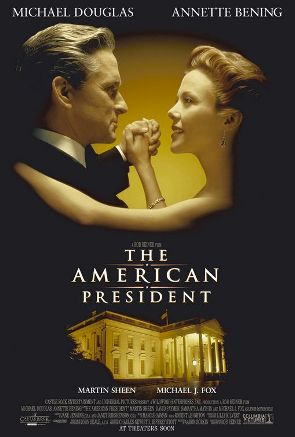
President Andrew Shepherd (Michael Douglas) is a liberal Democrat who, as he prepares to run for a second term, has a 63% approval rating. However, when Shepherd decides to push through a gun control bill, he finds that approval rating threatened. And then, when he listens to environmental lobbyist Sydney Wade (Annette Bening) and tries to push through legislation to reduce carbon emissions, his approval rating is again threatened. And then, to top it all off, he starts dating Sydney. It turns out that Sydney has protested American policy in the past. And, since this is an Aaron Sorkin film, everyone outside of the Northeast is scandalized that President Shepherd is having premarital sex in the White House.
And, to top it all off, there’s an evil Republican named Bob Rumson (Richard Dreyfuss) who wants to be President and is willing to use the President’s relationship with Sydney to further his own evil Republican ambitions.
But, ultimately, it’s not just those evil Republicans who make it difficult for Sydney and the President to have a relationship. It’s also the fact that the President agrees to a watered down crime bill and that he does not hold up his end of the bargain when it comes to reducing carbon emissions.
“You’ve lost my vote!” Sydney tells him.
But — fear not! There’s still time for President Shepherd to give a speech that will be so good and so brilliant that it will, within a matter of minutes, totally change every aspect of American culture and save the day. How do we know it’s a great speech? Because it was written by Aaron Sorkin!
Actually, I’m being too hard on the film and I’ll be the first admit that it’s because I’m personally not a huge fan of Aaron Sorkin’s. But, to be honest, The American President is Aaron Sorkin-lite. This film was written before the West Wing, before the Social Network, before that Studio Whatever show, and before The Newsroom. In short, it was written before he became THE Aaron Sorkin and, as such, it’s actually a lot less preachy than some of his other work. It’s true that, much like The Newsroom, The American President is definitely Sorkin’s fantasy of how things should work but at least you don’t have to deal with Jeff Daniels throwing stuff or Emily Mortimer not knowing how to properly forward an email.
Instead, it’s a film that will probably be enjoyed by those who share its politics. (And, make no mistake, The American President is more interested in politics than it is in the love story between Andrew and Sydney.) Michael Douglas does well in the role of the President. Meanwhile, Annette Bening is so likable and natural as Sydney that it almost make up for the fact that she’s yet another Sorkin woman whose existence is largely defined by looking up to her man while inspiring him to do the right thing and forgiving him when he doesn’t. Personally, I would have been happy if the film had ended with Sydney telling the President, “Thanks for finally doing the right thing but I have a life of my own to lead.”

 Through the Shattered Lens