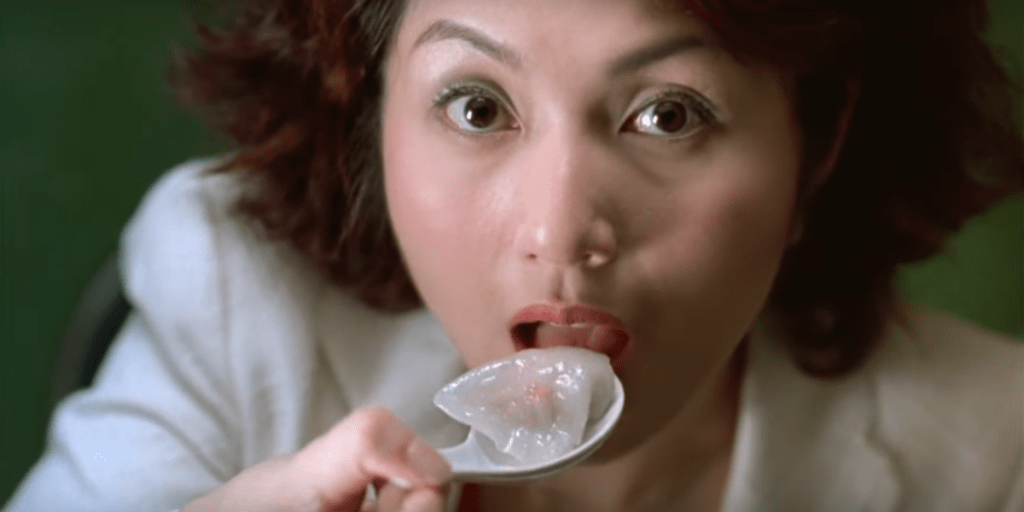
The Hong Kong Film Corner – What are in those DUMPLINGS (2004)?


DUMPLINGS (2004) centers on Mrs. Li (Miriam Yeung), a former actress now in her forties, who’s struggling with getting older and no longer being attractive to her husband, Mr. Li (Tony Leung Ka-Fai). It seems he’s more interested in his beautiful young masseuse than he is in her, which leads Mrs. Li to seek out Aunt Mei (Bai Ling), an ex-gynecologist from mainland China who has a reputation in the underground for her expensive “miracle” dumplings that promise a fountain of youth. Initially appalled by Aunt Mei’s not-so-secret ingredients, once she starts looking better, Mrs. Li begins to not only accept the recipe, but she also starts to relish it. Soon she’s making passionate love to her husband and finding herself the envy of her friends again. But what is that fishy smell and why is she so itchy all of a sudden? And does it even matter if she feels young and beautiful again?!! Expanded into a feature length movie from a segment of the 2004 anthology film, THREE…EXTREMES (2004), DUMPLINGS ponders just how far we’re willing to go to defy the aging process. 

I recently reviewed the category III Hong Kong film THE UNTOLD STORY, one of the most graphically violent films I could possibly imagine. Today, I’m discussing the category III film DUMPLINGS. While receiving the same rating, these movies couldn’t be more different. While THE UNTOLD STORY presents murderous violence in horrific detail, DUMPLINGS makes us imagine what it’s like to be so vain that unspeakable and immoral acts against others are meaningless as long as we feel good about the way we look. Even though the film gives away the “secret” of the dumplings somewhere in the first twenty minutes, I’m not going to give it away here. Just know that it’s repulsive, and the gleeful manner with which Aunt Mei goes about her work is every bit as sick to me as serial killer Wong in THE UNTOLD STORY. At the end of the day, each of us must ask what we’re willing to do to feel good about ourselves. In DUMPLINGS, it appears that the characters will do anything it takes! 

This is the first time I’ve ever watched a film directed by Fruit Chan, whose MADE IN HONG KONG (1997) swept all the major Hong Kong Film awards a number of years before this film came out. Blending culinary horror with human self-obsession, his DUMPLINGS is a patient film, willing to let his gruesome story seep into our bones without relying on a lot of graphic shock value. Chan doesn’t flinch from showing the extreme subject matter a number of times, but he still crafts an almost elegant film that deals with real world human emotions, albeit extremely selfish and morally bankrupt ones. He also gets really strong performances from the cast. Bai Ling’s casually demented and sexualized turn as the eternally young Aunt Mei is the showpiece of the film, with her cleavage practically in a supporting role all to themselves. Her performance was strong enough to earn her the Hong Kong Film Award for Best Supporting Actress for this movie. Miriam Yeung, who was best known at the time for her fluffy romantic comedies like LOVE UNDERCOVER (2002) and THREE OF A KIND (2004), is solid as the lady whose desire for beautiful, tight skin allows her to willingly abandon basic human dignity, transforming into a remorseless monster just below the surface of that skin. And finally, Tony Leung Ka-Fai, as the philandering husband who thinks with his male anatomy more than he does with his heart, is suitably effective in the way he makes us wish Mrs. Li would have just accepted the aging process and left his sorry ass from the very beginning. 

Overall, DUMPLINGS is a slow burn that will reward patient and attentive viewers with a tale of madness that touches on real world petty concerns while using extremely sick and twisted subject matter. As viewers, our discomfort with both that subject matter and the unchecked evolution of the characters seem to almost be the point. I don’t know how much you’ll truly enjoy the film, but I can’t imagine it not provoking a reaction.
Brad’s “Scene of the Day” – Chow Yun-Fat dances with Jodie Foster!


Chow Yun-Fat is one of the most charismatic men on earth. I’ve always enjoyed his performance in ANNA AND THE KING (1999) with Jodie Foster. He’s wonderful in this big budget American film, and he doesn’t even have to fire two guns! I know several women here in Arkansas who don’t know the first thing about Hong Kong movies, but they still love Chow based on this one film. On a side note, ANNA AND THE KING made over $113 Million at the worldwide box office, which means quite a few people in this world appreciate a more romantic Chow.

Enjoy this scene where the King of Siam surprises Foster’s English schoolteacher, and breaks all kinds of cultural norms, when he asks her to dance. It’s quite a charmer.

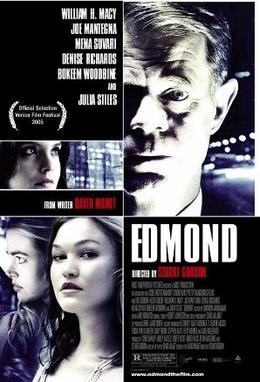
Days of Paranoia: Edmond (dir by Stuart Gordon)


Based on a one-act play by David Mamet, 2005’s Edmond tells the story of Edmond Burke (William H. Macy).

Edmond shares his name (if not the actual spelling) with the philosopher Edmund Burke.  Edmund Burke was a strong believer that society had to put value in good manners to survive and that religious and moral institutions played an important role in promoting the idea of people treating each other with respect and decency.  Edmund Burke knew what he believes and his writings continue to influence thinks to this day.  Edmond Burke, on the other hand, doesn’t know what he believes.  He doesn’t know who he wants to be.  All he knows is that he doesn’t feel like he’s accomplished anything with his life.  “I don’t feel like a man,” he says at one point to a racist bar patron (played by Joe Mantegna) who replies that Edmond needs to get laid.

On a whim, Edmond steps into the shop of a fortune teller (Frances Bay), who flips a few Tarot cards and then tells Edmond that “You’re not where you’re supposed to be.”  Edmond takes her words to heart.  He starts the night by telling his wife (played by Mamet’s wife, Rebecca Pidgeon) that he’s leaving their apartment and he won’t be coming back.  He goes to the bar, where he discusses his marriage with Mantegna.  He goes to a strip club where he’s kicked out after he refuses to pay $100 for a drink.  He goes to a peep show where he’s frustrated by the glass between him and the stripper and the stripper’s constant demand that he expose himself.  He gets beaten in an alley by three men who were running a three-card monte scam.  Edmond’s problem is that he left home without much cash and each encounter leads to him having less and less money.  If he can’t pay, no one wants to help him, regardless of how much Edmond argues for a little kindness.  He pawns his wedding ring for $120 but apparently, he just turns around and uses that money to buy a knife.  An alley-way fight with a pimp leads to Edmond committing his first murder.  A one-night stand with a waitress (a heart-breaking Julia Stiles) leads to a second murder after a conversation about whether or not the waitress is actually an actress leads to a sudden burst of violence.  Edmond ends up eventually in prison, getting raped by his cellmate (Bookem Woodbine) and being told, “It happens.”  Unable to accept that his actions have, in one night, led him from being a businessman to a prisoner, Edmond says, “I’m ready to go home now.”  By the end of the film, Edmond realizes that perhaps he is now where he was meant to be.

It’s a disturbing film, all the more so because Edmond is played by the likable William H. Macy and watching Macy go from being a somewhat frustrated but mild-mannered businessman to becoming a blood-drenched, racial slur-shouting murderer is not a pleasant experience.  Both the play and the film have generated a lot of controversy due to just how far Edmond goes.  I don’t see either production as being an endorsement of Edmond or his actions.  Instead, I see Edmond as a portrait of someone who, after a lifetime of being willfully blind to the world around him, ends up embracing all of the ugliness that he suddenly discovers around him.  He’s driven mad by discovering, over the course of one night, that the world that is not as kind and well-mannered as he assumed that it was and it all hits him so suddenly that he can’t handle it.  He discovers that he’s not special and that the world is largely indifferent to his feelings.  He gets overwhelmed and, until he gets his hands on that knife, he feels powerless and emasculated.  (The knife is an obvious phallic symbol.)  It’s not until the film’s final scene that Edmond truly understands what he’s done and who he has become.

Edmond is not always an easy film to watch.  The second murder scene is truly nightmarish, all the more so because the camera remains on Edmond as he’s drenched in blood.  This is one of William H. Macy’s best performances and also one of his most disturbing characters.  That said, it’s a play and a film that continues to be relevant today.  There’s undoubtedly a lot of Edmonds out there.

Retro Television Review: Homicide: Life On The Street 1.8 “And the Rockets’ Dead Glare”


Welcome to Retro Television Reviews, a feature where we review some of our favorite and least favorite shows of the past!  On Sundays, I will be reviewing Homicide: Life On The Street, which aired from 1993 to 1999, on NBC!  It  can be viewed on Peacock.

This week, Detective Munch takes a stand!

Episode 1.8 “And the Rockets’ Dead Glare”

(Dir by Peter Markle, originally aired on March 17th, 1993)

Is John Munch a stoner?

That’s the question that Stanley Bolander finds himself considering during this week’s episode of Homicide: Life On The Street.  At a crime scene, Munch displays an encyclopedic knowledge of marijuana and later, while talking to a narcotics detective at the station house, both Munch and Bayliss argue that drugs should be legalized.  That night, as they wait to bust a man who earlier killed a drug currier, Bolander flat out asks Munch if he gets high.  Munch refuses to answer.

Of course, those of us watching already know.  Of course, John Munch gets high!  He’s played by Richard Belzer, the thin, middle-aged man who never takes off his sunglasses and who is continually rattling off trivial knowledge in a mellow tone of voice.  Munch not only gets high but he was probably high through this entire episode.  Whenever Munch appeared on another television show, he was probably high then.  And when he eventually ended up on Law & Order: SVU, he was probably so stoned that I’m surprised Stabler didn’t put him in a headlock and start yelling about how he didn’t want Munch serving as a bad example for the youth of New York City.

There’s no surprise that Munch would be in favor of legalizing drugs.  (It’s a bit more surprising that straight-laced Bayliss would agree but whatever.)  What was surprising, to me, was how I reacted to his argument.  There was a time when I was 100% enthusiastically in favor of legalizing all drugs, or at least leaving it up to individual states.  As I’ve gotten older, I’ve come to realize that it’s not that simple.  Legalizing drugs is not the societal cure-all that many of us assumed it would be.  Then again, weed is kind of boring now that it’s socially acceptable so maybe the best way to keep people off of drugs is to broadcast nonstop YouTube commercials featuring middle-aged suburbanites talking about how much they love their edibles.

(To be honest, Munch and Bayliss’s sudden advocacy for drug legalization reminded me of one of the things that always makes me laugh about Law & Order, i.e. the tendency to have blue-collar cops, who are not exactly the most liberal of constituencies, suddenly start talking like MSNBC pundits.)

While Munch argued for drug legalization, Pembleton considered whether or not to accept a promotion, Kay testified in a murder trial and accepted the offer of a dinner date from State’s Attorney Ed Danvers (Zeljko Ivanek), and Corsetti and Lewis drove to Washington D.C. to investigate the murder of a Chinese dissident.  Officially, they went to D.C. so that they could question the people at the Chinese embassy about the victim and the possibility that his murder was related to politics.  However, the real reason they went to D.C. was so that Crosetti could visit some historical sites and expound on his theories about who really killed Abraham Lincoln.  A somewhat sinister secret service agent (played by Ed Lauter) was happy to show them around in return for them not making trouble at the embassy.  Crosetti was excited.  Lewis was considerably less impressed.  I enjoyed the DC storyline, if just because I’m both a history and a conspiracy nerd and, when Jeff and I last went to our nation’s capital, I got excited about seeing some of the same locations that Crosetti got excited about.

This episode was a day-in-the-life episode, with all of the detectives getting their share of attention.  (Even Felton, who accompanied Kay to the courthouse, got a few moments to shine.)  If the episode didn’t have the emotional impact of Night of the Dead Living, it still did a good job of portraying the comradery of a group of people who are linked by their knowledge of what it’s like to see others at their worst.  In the end, Pembleton turns down the promotion and finally, joins his fellow detectives for an after-work drink.  I’m glad he did.  They’re good company.