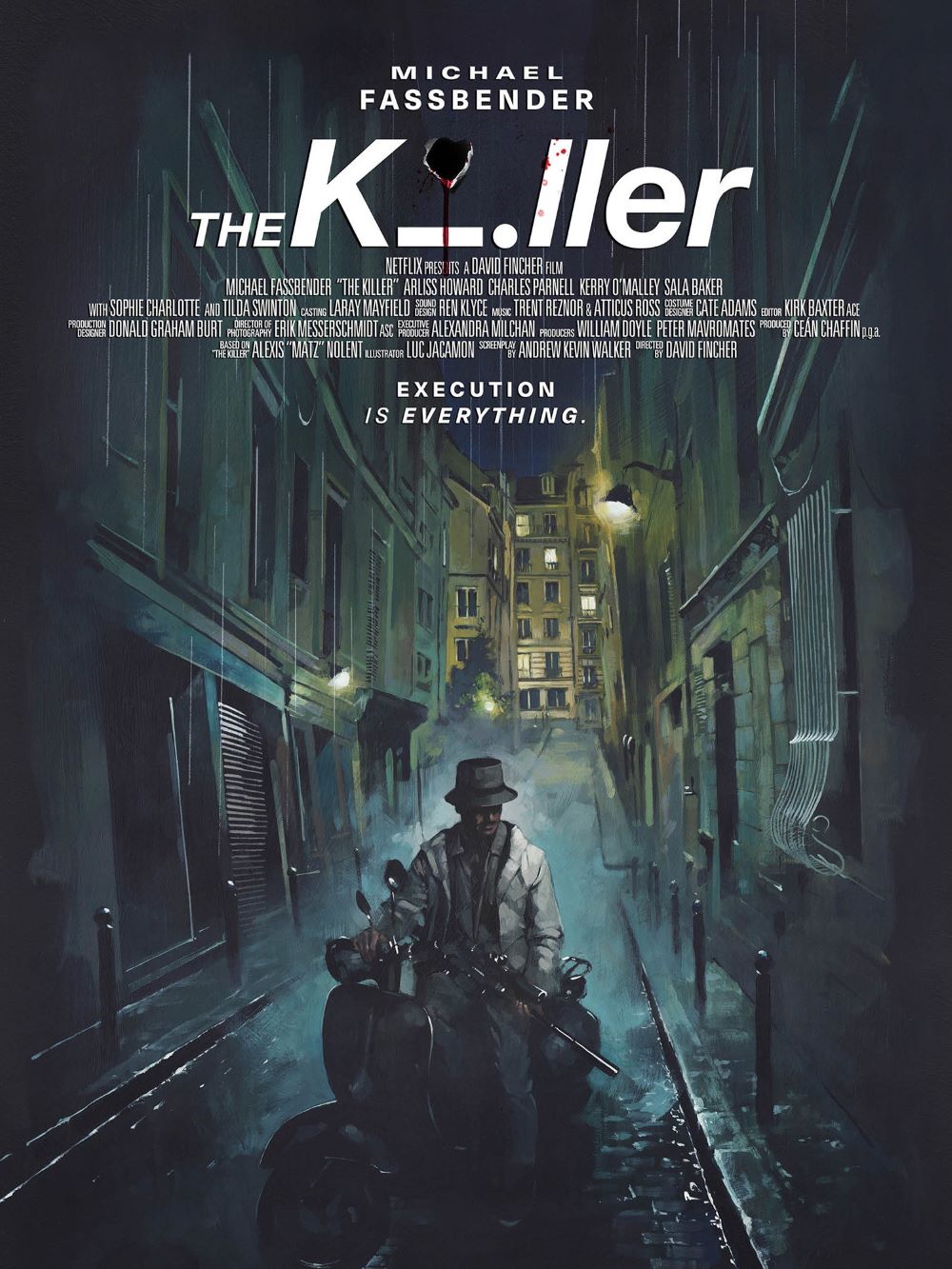
Review: The Killer (dir. by David Fincher)


“Stick to your plan. Anticipate, don’t improvise. Trust no one. Never yield an advantage. Fight only the battle you’re paid to fight. Forbid empathy. Empathy is weakness. Weakness is vulnerability.” — The Killer

David Fincher’s The Killer lands like a perfectly aimed shot: clean, methodical, and laced with just enough twist to make you rethink the whole trajectory. At its core, the film follows an elite assassin—brilliantly played by Michael Fassbender—who suffers a rare professional failure during a high-stakes hit in Paris. After days of obsessive preparation in a WeWork cubicle, complete with hourly surveillance checks, yoga breaks, protein bar sustenance, and a nonstop loop of The Smiths, he pulls the trigger only to miss his target entirely.

This one slip shatters his world of ironclad redundancies and contingencies. Retaliation soon hits close to home, striking his secluded Dominican Republic hideout and drawing in his girlfriend. What begins as a routine job quickly escalates into a personal cleanup mission, spanning cities like New Orleans, Florida, New York, and Chicago. Fincher transforms these stops into taut, self-contained vignettes, layering precise bursts of violence over the protagonist’s gradual psychological fraying—all while keeping major reveals under wraps to maintain the film’s coiled tension.

The structure dovetails perfectly with Fassbender’s commanding performance. He embodies a man radiating icy zen on the surface, while a relentless machine churns underneath. His deadpan voiceover delivers self-imposed rules like a deranged productivity gospel—”forbid empathy,” “stick to your plan,” “anticipate, don’t improvise”—even as he slips seamlessly into civilian guises: faux-German tourist, unassuming janitor, casually ordering tactical gear from Amazon like it’s toothpaste.

The result is darkly hilarious, conjuring a corporate bro reborn as high-functioning sociopath, where bland covers clash absurdly with lethal intent. Yet as stakes mount, subtle cracks appear: split-second hesitations, flickers of unexpected mercy that betray buried humanity. Fassbender nails this evolution through sheer minimalism—piercing stares, economical gestures, weaponized silence—morphing the killer from untouchable elite into a flawed, expendable player in the gig economy’s brutal grind.

These nuances echo the film’s episodic blueprint, quintessential Fincher territory. On-screen city titles act as chapters in a shadowy assassin’s handbook, with tension simmering through drawn-out prep rituals: endless surveillance, gear assembly, contingency mapping that drags just enough to immerse you in the job’s soul-numbing tedium. The Paris mishap ignites the chase—he evades immediate pursuit, sheds evidence, and races home to fallout, then pursues leads through handlers, drivers, and rivals in a chain of escalating confrontations.

Fincher deploys action sparingly but with devastating impact. A standout brawl erupts in raw, prolonged chaos—captured in extended, crystal-clear shots with improvised weapons and no shaky-cam crutches—perfectly embodying the killer’s ethos even as it splinters around him. Each sequence builds without excess, from tense interrogations to standoffs that flip power dynamics, underscoring how the world’s rules bend unevenly.

This kinetic progression meshes flawlessly with Fincher’s visual command. Cinematographer Erik Messerschmidt crafts a hypnotic palette of cool desaturated blues, sterile symmetries, and digital hyper-reality, evoking unblinking surveillance feeds into an emotional void. Tactile details obsess: the rifle case’s satisfying zip, suppressed gunfire’s sharp snick, shadows creeping across WeWork pods, dingy motels, and gleaming penthouses—all mirroring the killer’s frantic grasp for order amid encroaching disarray.

Sound design heightens every layer, sharpening ambient clacks of keyboards, hallway breaths, and gravel footsteps to a razor’s edge. Integral to the immersion is the minimalist electronic score by Trent Reznor and Atticus Ross, Fincher’s trusted collaborators from The Social Network to Mank. Their eerie ambient drones and ominous rhythmic pulses bubble like a suppressed heartbeat—swelling subtly in stakeouts, throbbing through violence, threading haunting motifs into voiceovers. It mirrors the protagonist’s inner turmoil without overwhelming the chill precision, turning silences between notes into weapons as potent as any sniper round.

This sonic and visual restraint powers the film’s bone-dry irony, which methodically punctures the protagonist’s god-complex. He preaches elite status among the “few” lording over the “many sheep,” yet reality paints him as sleep-deprived, rule-bending, and perpetually improvising—empathy leaking through denials in quiet, humanizing beats. Fincher weaves these into his signature obsessions—unmasked control freaks, dissected toxic masculinity, exposed capitalist churn—but with playful lightness, sidestepping the heavier preachiness of Fight Club or Seven.

The killer’s neurotic Smiths fixation injects quirky isolation amid globetrotting nomadism; their melancholic lyrics (“How Soon Is Now?”) punctuate stakeouts and flights like wry commentary on his fraying detachment. It all resolves in a low-key homecoming: no grand redemption or downfall, just weary acknowledgment that even “perfect” plans crack under chaos’s weight.

This sleight-of-hand elevates The Killer beyond standard assassin tropes into a sharp study of elite evil’s banality. Supporting roles deliver pitch-perfect economy: Tilda Swinton’s poised, lethal rival in mind-game restaurant tension; Arliss Howard’s obliviously entitled elite; Charles Parnell’s wearily betrayed handler; Kerry O’Malley’s poignant bargainer; Sala Baker’s raw, physical menace. Under two hours, Fincher packs density without bloat—layered subtext, rewatchable craft everywhere.

Gripes about its procedural chill or emotional distance miss the sleight entirely: this is a revenge thriller masking profound dissection of a borderless mercenary world, where pros prove as disposable as their untouchable clients. Fans of methodical slow-burns like ZodiacThe Game, or Gone Girl will devour the razor wit, process immersion, and unflinching thematic bite.

Ultimately, The Killer crystallizes as a sly late-period Fincher gem, fusing pitch-black humor, visceral horror, and surprising humanism into precision-engineered sleekness. It dismantles mastery illusions in unforgiving reality, leaving Fassbender’s killer stubbornly human: loose ends mostly tied, slipping back to obscurity as a survivor adapting. In a flood of bombastic action sludge, it offers bracing cerebral air—proving restraint, dark laughs, and surgical insight remain the filmmaker’s deadliest tools. For obsessive breakdowns of the human machine at its breaking point, it’s Netflix essential.
Film Review: The Killer (dir by David Fincher)


The Killer open with the film’s title character (played by Michael Fassbender) in an abandoned office in Paris.

He spends every day sitting in front of a window, watching the the luxury hotel across the street from him.  As is evident from the film’s title and the character’s voice-over narration, the man is a professional killer.  Sometimes, he kills up close-and-personal.  Sometimes, he kills in a way that makes the death look like it occurred naturally.  In Paris, he’s just waiting in an abandoned WeWork office with a sniper rifle.  The Killer informs us that a good deal of his time is spent waiting and getting bored.  Sometimes, he passes the time by listening to the Smiths.  Sometimes, he takes a moment or two to glance at all of the “normies” living their lives with no idea about what’s happening in the otherwise empty office above their heads.  The Killer spends a lot of time thinking about his philosophy of life and how that effects the way he does his job.  Through his voice-over narration, he talks about the huge amount of people in the world.  He talks about how an assassin should never improvise and how an assassin should never allow any feelings of empathy for other people.

That may sound like the beginning of a rather grim movie and certainly, there have been a lot of recent assassin films that have taken themselves way too seriously.  Indeed, when the movie started with the Killer going on and on and on about how he prepares for a job, I started to have unwelcome flashbacks to Andrew Dominik’s mind-numbingly pretentious Killing Them Softly.  (Really, I can only assume that everyone who was shocked by the mean-spirited ugliness of Blonde must have previously blocked Killing Them Softly from their memory.)

I need not have worried.  Fortunately, The Killer is directed by David Fincher and Fincher is far too clever a director to take any the character’s nonsense seriously.  The Killer may be obsessed with his inner monologue but Fincher clearly is not.  From the start, Fincher pokes fun at the Killer’s self-importance by having him do things like use the names of sitcom characters whenever he has to buy a plane ticket.  More often than not, the Killer’s narration is interrupted by someone proving that, despite what he may believe, the Killer does not have complete control over every situation.  All of the character’s philosophizing is ultimately his way of denying that, just like the people that he is hired to kill, he is also subject to the whims of fate.

For instance, in Paris, the job gets botched.  The Killer does not kill his target and, when he calls his handler (Charles Parnell), he’s informed that there probably will be consequences for his failure.  When the Killer returns to his home in South America, he discovers that his girlfriend has been assaulted and left near death by two other assassins.  The Killer heads to America, to confront the people that he holds responsible.  Some of those people are professionals who have offices and who live in the suburbs.  Some of them live on the fringes of society.  But all of them, like the Killer, exist in a shadowy and amoral world that makes sense to only them and which is invisible to most of the people around them.

It’s a revenge plot, the type that has been popular for decades.  (Indeed, one could easily imagine The Killer being made in the 70s with Charles Bronson playing the title role.)  The story may not be unique but the action plays out with Fincher’s signature visual style and a welcome amount of wit.  The Killer travels from Paris to South America to New Orleans to Florida to New York and eventually Chicago and each location has its own unique feel.  As always, Fincher has a terrific eye for detail and this film is at its strongest when it captures the feel of everyone else’s life going forward while The Killer remains focused on his mission.  Even the worst characters are allowed moments that humanize them.  Meanwhile, The Killer is so coldly determined that he often becomes as frightening as the people that he is pursuing.

The film is dominated by Fassbender, who is in every scene and who brings a feral intensity to the character.  The Killer may have a friendly smile but the viewer only has to look at his eyes to see just how shut off from any sort of human warmth that he actually is.  (Indeed, the Killer only seems to genuinely care about his girlfriend and, even then, we don’t learn much about his relationship with her.)  Over the course of the film, Fassbender shares scenes with Tilda Swinton, Charles Parnell, Arliss Howard, and an actress named Kerry O’Malley, who gives a sympathetic performance as a secretary who knows too much.  Everyone makes a strong impression, bringing the world of The Killer to life.

The Killer can be viewed on Netflix.  It’s a triumphant exercise in pure style.

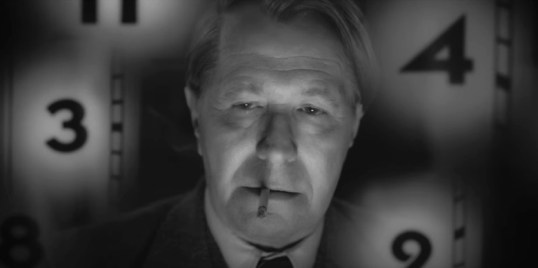
The Films of 2020: Mank (dir by David Fincher)


As I watched David Fincher’s latest film, Mank, my main feeling was one of wanting to like the film more than I actually did.

I mean, really, the film sounds like it was specifically made to appeal to me.  It’s a film about the Golden Age of Hollywood, which is an era that has always fascinated me as both a film lover and history nerd.  Even more specifically, it’s a film about the writing of Citizen Kane, which is one of my favorite movies.  (On one of our first dates, Jeff and I snuck into a showing of Citizen Kane at the Magnolia.  The crime was fun and finally getting to see the movie on the big screen was even better.)  It’s a film that features a host of historical figures, everyone from Louis B. Mayer to Irving Thalberg to Orson Welles to William Randolph Hearst to Marion Davies to the title character himself, the self-destructive screenwriter Herman J. Mankiewicz.

Those historical figures are played by a truly impressive collection of actors, almost all of whom give memorable performances.  Gary Oldman plays Mankiewicz, lurching about Hollywood in a drunken haze and calling out the system while, somewhat hypocritically, also attempting to profit from it.  Charles Dance is compellingly arrogant as William Randolph Hearst.  Tom Burke captures Orson Welles’s trademark voice and charisma, making an impression despite having surprisingly little screen time.  Ferdinand Kingsley plays Irving Thalberg and steals nearly every scene in which he appears.  Arliss Howard is a marvel as the manipulate Mayer while Amanda Seyfried gives the best performance of her career so far as Marion Davies.  The film portrays Davies as being intelligent, witty, and perhaps the only truly honest person in Hollywood.  If it can be argued that Citizen Kane robbed Davies of her dignity, it can also be argued that Mank makes a sincere attempt to give it back to her.  With the exception of a distracting cameo from Bill Nye (yes, the science guy), Mank is perfectly cast.

And yet, despite all of that, the film never really engaged me on either an emotional or an intellectual level.  The black-and-white cinematography is gorgeous but the film plods from one incident to another, skipping back and forth in time and trying to convince us that Herman J. Mankiewicz was a more fascinating figure than he comes across as being.  For the most part, Mankiewicz comes across as being a bit of a bore and the film makes the classic mistake of assuming that we’ll naturally like him just because he’s the main character.  Gary Oldman is as charismatic as ever but the film doesn’t give him much of character to play.  Mankiewicz stumbles from scene to scene, searching for a drink and always complaining about one thing or another.  A little bit of Herman J. Mankiewicz goes a long way and, once it becomes apparent that he’s going to spend the entire film perpetually annoyed, Mankiewicz becomes a rather uninteresting character.  Long before this film even reached the halfway mark, I was on the side of everyone who wanted Mankiewicz to stop talking and just finish writing the damn script.

If you’re one of the ten or so people who is still outraged over the failure of Upton Sinclair’s 1934 gubernatorial campaign, you’ll probably enjoy this film.  For those of you haven’t read Greg Mitchell’s The Campaign of the Century: Upton Sinclair’s Race for Governor of California and the Birth of Media Politics, Upton Sinclair was a writer and longtime socialist activist who won the 1934 Democratic nomination to run for governor of California.  Despite garnering a lot of national attention with his End Poverty In California (EPIC) platform, Sincliar was overwhelmingly defeated by Republican Frank Merriam.  Mank argues that Sinclair’s defeat was largely due to dirty tricks and negative campaigning, most of it masterminded by Mayer and Hearst.  Mankiewicz is a Sinclair supporter who is angered by the underhanded efforts of Mayer and Hearst.  The script for Citizen Kane is, at least partially, Mankiewicz’s revenge on Hearst and Mayer for working against Sinclair and it’s something that Mankiewicz feels so strongly about that he’s willing to demand that Orson Welles give him credit for his work on the screenplay.  It’s a legitimate theory, but the film’s exploration of it feels rather shallow and intellectually lazy.  Just as it did with the character of Mankiewicz, the film makes the mistake of assuming the audiences will automatically find the candidacy of Upton Sinclair to be as inspiring as the film does.  The film continually insists that we should care but, when it finally has a chance to show us why Upton Sinclair’s campaign was important, all it can provide is Bill Nye The Science Guy, standing on a platform and complaining about religious hypocrisy.  It’s the cinematic equivalent of a casual acquaintance demanding to know why his twitter feed didn’t convince you to vote for Bernie Sanders.

From a historical point of view, the film does itself no favors by creating a fictional friend of Mankiewicz’s, one who is so consumed with guilt over his part in defeating Upton Sinclair that he ends up committing suicide.  It feels rather cheap and predictable, an easy way to give Mankiewicz some sort of motivation beyond being infatuated with Marion Davies.  Historically, the truth of the matter is that Frank Merriam turned to the left as soon as he was elected and Upton Sinclair went on to win the Pulitzer Prize for writing a series of now-unreadable books about an international do-gooder named Lanny Budd.  Meanwhile, director Felix E. Feist (who was responsible for shooting many of the anti-Sinclair newsreels that MGM released into cinemas) went on to have a very long career and never indicated that he felt any guilty for playing a part in Sinclair’s defeat.

Like many of David Fincher’s film, Mank works best as an exercise in style.  The black-and-white cinematography is to die for.  Some of the shots — especially early in the film — are breathtaking.  Mankiewicz may spend the majority of the film railing against the excesses of Hollywood but, visually, Fincher can’t get enough of them.  Indeed, much as with The Social Network, Fincher seems to be spend the majority of the film at odds with the the film’s overwritten and rather pompous script.  (Of course, Mank was written by Fincher’s late father while The Social Network was written by Aaron Sorkin.  While there’s a lot to criticize about Jack Fincher’s script, one can still be thankful that he wrote the script instead of Sorkin.  One can only imagine how Marion Davies would have been portrayed if Aaron Sorkin had been involved.)  Mank is narratively deficient but visually stunning.  The film’s script rather snarkily dismisses Orson Welles as being a mere “showman” but, as film, Mank proves that sometimes a showman is exactly what’s needed.

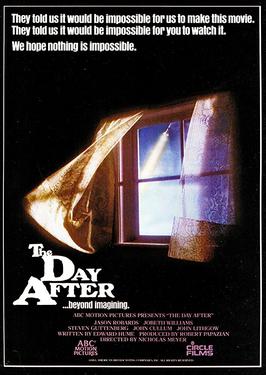
Film Review: The Day After (dir by Nicholas Meyer)


“This is Lawrence. This is Lawrence, Kansas. Is anybody there? Anybody at all?”

The words of Joe Huxley (John Lithgow) hang over the ending of The Day After, a 1983 film that imagines what the aftermath of a nuclear war would be like not on the East or the West Coasts but instead in the rural heartland of America.  Huxley is a professor at the University of Kansas and, as he explains early on in the film, Kansas would be an automatic target in any nuclear war because it houses a number of missile silos.  When he explains that, it’s in an almost joking tone, largely because the missiles haven’t been launched yet.  Instead, the only thing we’ve heard are a few barely noticed news stories about growing tensions between America and Russia.  About halfway through The Day After, the bombs go off and there are suddenly no more jokes to be made.

When the bombs drop over Kansas, we watch as cities and field and people burst into flames.  In a matter of minutes, several thousands are killed.  I’m almost ashamed to admit that I was probably more upset by the image of a horse being vaporized than I was by the death of poor Bruce Gallatin (Jeff East), the college student who was planning on marrying Denise Dahlberg (Lori Lethin).  I guess it’s because horses — really, all animals — have nothing to do with the conflicts between nations.  Humans are the ones who take the time to build bigger and better weapons and The Day After is one of the few films about war that’s willing to acknowledge that, when humans fight, it’s not just humans that die.

The bombing sequence is lengthy and I have to admit that I was a bit distracted by the fact that I recognized some of the footage from other movies.  A scene of panicked people running through a building was taken from Two-Minute Warning.  A scene of a building exploding and a construction worker being consumed by flames was lifted from Meteor.  As well, there’s some stock footage which should be familiar to anyone who has ever seen a documentary about the early days of the Cold War.  Still, despite that, it’s an effective sequence simply because it’s so relentless.  Some of the film’s most likable characters are vaporized before our eyes.  Steve Guttenberg, of all people, is seen ducking into a store.

Guttenberg plays Stephen Klein, a pre-med student who manages to survive the initial attack and takes shelter with the Dahlberg family at their ranch.  At first, it’s a bit distracting to see Steve Guttenberg in a very serious and very grim film about the nuclear apocalypse but he does a good job.  The sight of him losing both his teeth and his hair carries a punch precisely because he is reliably goofy Steve Guttenberg.

If the film has a star, it’s probably Jason Robards, the doctor who witnesses the initial blast from the safety of his car and then treats the dying in Lawrence, Kansas.  He does so, despite the fact that he doesn’t know if his wife, son, and daughter are even still alive.  He continues to do so until he also falls ill with radiation poisoning.  Knowing that he’s dying, he heads home just to discover that there is no home to return to.

Home is reccuring theme throughout The Day After.  Everyone wants to return to their home but everyone’s home has been wiped out.  “This is my home,” Jim Dahlberg (John Cullum) tries to explain before he’s attacked by a group of feral nomads.  Home no longer exists and trying to pretend like life can go back to the way it once was is an often fatal mistake.

Real happy film, right?  Yeah, this isn’t exactly a film that you watch for fun.  I have to admit that I made a joke about how I wouldn’t want to die while wearing the unfortunate blue jumpsuit that Jason Robards’s daughter chooses to wear on the day of the nuclear attack and I felt guilty immediately.  (Well, not that guilty.  Seriously, it was a terrible fashion choice.)  The Day After is a film that gives audiences zero hope by design.  It was made at a time when it was generally assumed that nuclear was inevitable and it was designed to scare the Hell out of everyone watching.  And while I can’t attest to how audience may have reacted in 1983, I can say that, in 2020, it’s still a powerful and disturbing film.

“Is anybody there? Anybody at all?” Joe Huxley asks and by the end of the film, the answer doesn’t matter.  The damage has already been done.

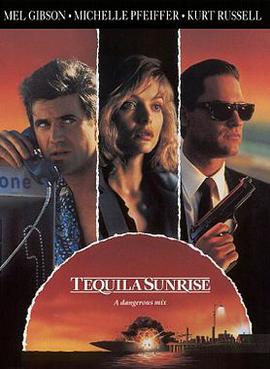
Tequila Sunrise (1988, directed by Robert Towne)


Mac (Mel Gibson) and Nick (Kurt Russell) are old friends who are on opposite sides of the law.  Mac was once a legendary drug dealer though he says that he’s now retired.  Nick is a narcotics detective with the Los Angeles County Sheriff’s Department.  Early on, Nick warns Mac that, if he is dealing again, he’s going to have to arrest him.  Mac says that he has no interest in getting back into the business but no one believes him.

Mac is actually more interested in Jo Ann Valleneri, who owns his favorite restaurant.  Since Jo Ann is played by Michelle Pfeiffer, who can blame him?.  After tracks Mac to the restaurant, he becomes attracted to Jo Ann too and again, it’s impossible to blame him.  Soon, Jo Ann and Nick are a couple but is Nick just using her to find out about Mac’s relationship with a mysterious drug lord named Carlos?  And when Mac moves in and starts his own relationship with Jo Ann, does he really love her or is he using her to throw Nick off of his trail?

Tequila Sunrise should be a great film but instead, it’s only a good one.  It has all the elements of greatness — Michelle Pfeiffer at her sultriest, Kurt Russell at his coolest, and Mel Gibson before he lost his mind.  It also has a good supporting cast, including Raul Julia, J.T. Walsh, and Arliss Howard.  Ultimately, it doesn’t really come together because the film’s director and screenwriter, Robert Towne, doesn’t seem to be sure what type of story he wants to tell.  Tequila Sunrise could have either been a great crime thriller or a steamy love story but, by trying to be both, it gets bogged down in its own convoluted plot.  That probably won’t matter to most viewers, though.  Not when Russell, Gibson, and Pfeiffer are all on screen together at the same time.  Tequila Sunrise tries to be many things but it works best as a celebration of movie star charisma.

One final note: The film looks great.  Visually, this is one of the ultimate California films.  Cinematographer Conrad Hall received an Oscar nomination for his work on this film and it was more than deserved.

Playing Catch-Up: Crisscross, The Dust Factory, Gambit, In The Arms of a Killer, Overboard, Shy People


So, this year I am making a sincere effort to review every film that I see.  I know I say that every year but this time, I really mean it.

So, in an effort to catch up, here are four quick reviews of some of the movies that I watched over the past few weeks!

  • Crisscross
  • Released: 1992
  • Directed by Chris Menges
  • Starring David Arnott, Goldie Hawn, Arliss Howard, Keith Carradine, James Gammon, Steve Buscemi

An annoying kid named Chris Cross (David Arnott) tells us the story of his life.

In the year 1969, Chris and his mother, Tracy (Goldie Hawn), are living in Key West.  While the rest of the country is excitedly watching the first moon landing, Chris and Tracy are just trying to figure out how to survive day-to-day.  Tracy tries to keep her son from learning that she’s working as a stripper but, not surprisingly, he eventually finds out.  Chris comes across some drugs that are being smuggled into Florida and, wanting to help his mother, he decides to steal them and sell them himself.  Complicating matters is the fact that the members of the drug ring (one of whom is played by Steve Buscemi) don’t want the competition.  As well, Tracy is now dating Joe (Arliss Howard), who just happens to be an undercover cop.  And, finally, making things even more difficult is the fact that Chris just isn’t that smart.

There are actually a lot of good things to be said about Crisscross.  The film was directed by the renowned cinematographer, Chris Menges, so it looks great.  Both Arliss Howard and Goldie Hawn give sympathetic performances and Keith Carradine has a great cameo as Chris’s spaced out dad.  (Traumatized by his experiences in Vietnam, Chris’s Dad left his family and joined a commune.)  But, as a character, Chris is almost too stupid to be believed and his overwrought narration doesn’t do the story any good.  Directed and written with perhaps a less heavy hand, Crisscross could have been a really good movie but, as it is, it’s merely an interesting misfire.

  • The Dust Factory 
  • Released: 2004
  • Directed by Eric Small
  • Starring Armin Mueller-Stahl, Hayden Panettiere, Ryan Kelly, Kim Myers, George de la Pena, Michael Angarano, Peter Horton

Ryan (Ryan Kelly) is a teen who stopped speaking after his father died.  One day, Ryan falls off a bridge and promptly drowns.  However, he’s not quite dead yet!  Instead, he’s in The Dust Factory, which is apparently where you go when you’re on the verge of death.  It’s a very nice place to hang out while deciding whether you want to leap into the world of the dead or return to the land of the living.  Giving Ryan a tour of the Dust Factory is his grandfather (Armin Mueller-Stahl).  Suggesting that maybe Ryan should just stay in the Dust Factory forever is a girl named Melanie (Hayden Panettiere).  Showing up randomly and acting like a jerk is a character known as The Ringmaster (George De La Pena).  Will Ryan choose death or will he return with a new zest for living life?  And, even more importantly, will the fact that Ryan’s an unlikely hockey fan somehow play into the film’s climax?

The Dust Factory is the type of unabashedly sentimental and theologically confused film that just drives me crazy.  This is one of those films that so indulges every possible cliché that I was shocked to discover that it wasn’t based on some obscure YA tome.  I’m sure there’s some people who cry while watching this film but ultimately, it’s about as deep as Facebook meme.

  • Gambit
  • Released: 2012
  • Directed by Michael Hoffman
  • Starring Colin Firth, Cameron Diaz, Alan Rickman, Tom Courtenay, Stanley Tucci, Cloris Leachman, Togo Igawa

Harry Deane (Colin Firth) is beleaguered art collector who, for the sake of petty revenge (which, as we all know, is the best type of revenge), tries to trick the snobbish Lord Shabandar (Alan Rickman) into spending a lot of money on a fake Monet.  To do this, he will have to team up with both an eccentric art forger (Tom Courtenay) and a Texas rodeo star named PJ Puznowksi (Cameron Diaz).  The plan is to claim that PJ inherited the fake Monet from her grandfather who received the painting from Hermann Goering at the end of the World War II and…

Well, listen, let’s stop talking about the plot.  This is one of those elaborate heist films where everyone has a silly name and an elaborate back story.  It’s also one of those films where everything is overly complicated but not particularly clever.  The script was written by the Coen Brothers and, if they had directed it, they would have at least brought some visual flair to the proceedings.  Instead, the film was directed by Michael Hoffman and, for the most part, it falls flat.  The film is watchable because of the cast but ultimately, it’s not surprising that Gambit never received a theatrical release in the States.

On a personal note, I saw Gambit while Jeff & I were in London last month.  So, I’ll always have good memories of watching the movie.  So I guess the best way to watch Gambit is when you’re on vacation.

  • In The Arms of a Killer
  • Released: 1992
  • Directed by Robert L. Collins
  • Starring Jaclyn Smith, John Spencer, Nina Foch, Gerald S. O’Loughlin, Sandahl Bergman, Linda Dona, Kristoffer Tabori, Michael Nouri

This is the story of two homicide detectives.  Detective Vincent Cusack (John Spencer) is tough and cynical and world-weary.  Detective Maria Quinn (Jaclyn Smith) is dedicated and still naive about how messy a murder investigation can be when it involves a bunch of Manhattan socialites.  A reputed drug dealer is found dead during a party.  Apparently, someone intentionally gave him an overdose of heroin.  Detective Cusack thinks that the culprit was Dr. Brian Venible (Michael Nouri).  Detective Quinn thinks that there has to be some other solution.  Complicating things is that Quinn and Venible are … you guessed it … lovers!  Is Quinn truly allowing herself to be held in the arms of a killer or is the murderer someone else?

This sound like it should have been a fun movie but instead, it’s all a bit dull.  Nouri and Smith have next to no chemistry so you never really care whether the doctor is the killer or not.  John Spencer was one of those actors who was pretty much born to play world-weary detectives but, other than his performance, this is pretty forgettable movie.

  • Overboard
  • Released: 1987
  • Directed by Garry Marshall
  • Starring Goldie Hawn, Kurt Russell, Edward Herrmann, Katherine Helmond, Roddy McDowall, Michael G. Hagerty, Brian Price, Jared Rushton, Hector Elizondo

When a spoiled heiress named Joanne Slayton (Goldie Hawn) falls off of her luxury yacht, no one seems to care.  Even when her husband, Grant (Edward Herrmann), discovers that Joanne was rescued by a garbage boat and that she now has amnesia, he denies knowing who she is.  Instead, he takes off with the boat and proceeds to have a good time.  The servants (led by Roddy McDowall) who Joanne spent years terrorizing are happy to be away from her.  In fact, the only person who does care about Joanne is Dean Proffitt (Kurt Russell).  When Dean sees a news report about a woman suffering from amnesia, he heads over to the hospital and declares that Joanne is his wife, Annie.

Convinced that she is Annie, Joanne returns with Dean to his messy house and his four, unruly sons.  At first, Dean says that his plan is merely to have Joanne work off some money that she owes him.  (Before getting amnesia, Joanne refused to pay Dean for some work he did on her boat.)  But soon, Joanne bonds with Dean’s children and she and Dean start to fall in love.  However, as both Grant and Dean are about to learn, neither parties nor deception can go on forever…

This is one of those films that’s pretty much saved by movie star charisma.  The plot itself is extremely problematic and just about everything that Kurt Russell does in this movie would land him in prison in real life.  However, Russell and Goldie Hawn are such a likable couple that the film come close to overcoming its rather creepy premise.  Both Russell and Hawn radiate so much charm in this movie that they can make even the stalest of jokes tolerable and it’s always enjoyable to watch Roddy McDowall get snarky.  File this one under “Kurt Russell Can Get Away With Almost Anything.”

A remake of Overboard, with the genders swapped, is set to be released in early May.

  • Shy People
  • Released: 1987
  • Directed by Andrei Konchalovsky
  • Starring Jill Clayburgh, Barbara Hershey, Martha Plimpton, Merritt Butrick, John Philbin, Don Swayze, Pruitt Taylor Vince, Mare Winningham

Diana Sullivan (Jill Clayburgh) is a writer for Cosmopolitan and she’s got a problem!  It turns out that her teenager daughter, Grace (Martha Plimpton), is skipping school and snorting cocaine!  OH MY GOD!  (And, to think, I thought I was a rebel just because I used to skip Algebra so I could go down to Target and shoplift eyeliner!)  Diana knows that she has to do something but what!?

Diana’s solution is to get Grace out of New York.  It turns out that Diana has got some distant relatives living in Louisiana bayou.  After Cosmo commissions her to write a story about them, Diana grabs Grace and the head down south!

(Because if there’s anything that the readers of Cosmo are going to be interested in, it’s white trash bayou dwellers…)

The only problem is that Ruth (Barbara Hershey) doesn’t want to be interviewed and she’s not particularly happy when Diana and Grace show up.  Ruth and her four sons live in the bayous.  Three of the sons do whatever Ruth tells them to do.  The fourth son is often disobedient so he’s been locked up in a barn.  Diana, of course, cannot understand why her relatives aren’t impressed whenever she mentions that she writes for Cosmo.  Meanwhile, Grace introduces her cousins to cocaine, which causes them to go crazy.  “She’s got some strange white powder!” one of them declares.

So, this is a weird film.  On the one hand, you have an immensely talented actress like Jill Clayburgh giving one of the worst performances in cinematic history.  (In Clayburgh’s defense, Diana is such a poorly written character that I doubt any actress could have made her in any way believable.)  On the other hand, you have Barbara Hershey giving one of the best.  As played by Hershey, Ruth is a character who viewers will both fear and admire.  Ruth has both the inner strength to survive in the bayou and the type of unsentimental personality that lets you know that you don’t want to cross her.  I think we’re supposed to feel that both Diana and Ruth have much to learn from each other but Diana is such an annoying character that you spend most of the movie wishing she would just go away and leave Ruth alone.  In the thankless role of Grace, Martha Plimpton brings more depth to the role than was probably present in the script and Don Swayze has a few memorable moments as one of Ruth’s sons.  Shy People is full of flaws and never really works as a drama but I’d still recommend watching it for Hershey and Plimpton.

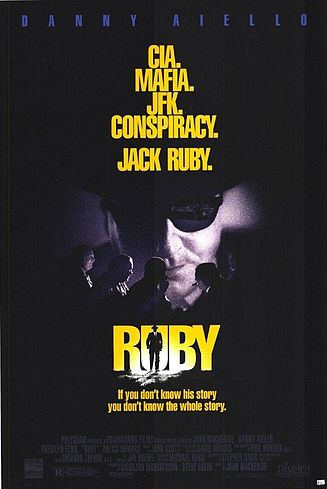
A Movie A Day #91: Ruby (1992, directed by John Mackenzie)


Of all the stars to come out of Twin Peaks, Sherilyn Fenn’s star briefly shined the brightest and sadly, she was the most misused by Hollywood.  While it is true that Fenn has worked regularly since Twin Peaks went off the air, she has rarely gotten the great roles that someone with her talent deserves.  Instead, her performances have far too often been the best thing about an otherwise mediocre film.

For example, Ruby.

In this very speculative biopic about the strip club owner who killed Lee Harvey Oswald and whose organized crime background has put him at the center of a thousand conspiracy theories, Danny Aiello plays Jack Ruby and Sherilyn Fenn plays his only friend, Sheryl Ann Dujean (or, when she’s stripping in the Carousel Club, Candy Cane).  The film portrays Jack Ruby as being a low-level mobster who is never as valuable or as important to his superiors as he thinks he is.  In this movie, Ruby is always on the outside looking in on the conspiracy and, when he kills Oswald, it is because he wants to prove that he is more than just a small time hood.  Candy, who was a composite of several Carousel Club dancers, maintains a strong platonic friendship with Jack and is always there for him to talk to, except for when she goes to Vegas to perform for and sleep with the President.

Ruby came out as the same time as JFK and it often seems like a fanfic based on Stone’s film.  Low budget and overwritten, Ruby never works as a movie but Danny Aiello is perfectly cast as the bombastic but insecure Jack Ruby.  Unfortunately, Ruby‘s screenplay often does not seem to know what it wants to say about its main character.  As Candy, Fenn is not given nearly enough to do but she still manages to show the same natural spark that made her a star on Twin Peaks.

Sherilyn Fenn is not the only Twin Peaks cast member to have a role in Ruby.  Keep an eye out for a post-Twin Peaks, pre-X-Files David Duchovny, playing the role of J.D. Tippit.

Review: True Blood 6.6 “Don’t You Feel Me”


450x254xtrue-blood-promo-dont-you-feel-me_450x254.jpg.pagespeed.ic.APWbfzSQrC

Before I review tonight’s episode of True Blood, I have to apologize for not reviewing last week’s episode.  For the past six months, I have been basically working, writing, and dancing nonstop and last week, it finally caught up with me and I nearly collapsed from exhaustion.  I’m still in the process of recovering but hopefully, I’ll be more active this week than last week.

Going into tonight’s episode, I knew that there had been a lot of speculation online about the possibility of one or more major characters dying.  A lot of people though that it might be Lafayette, especially since he was in the process of trying to drown Sookie when last week’s episode ended.  Some people thought Alcide would kill Sam and still others insisted on breaking my heart by speculating that Eric might experience the true death.

Instead, it turned out to be Terry.  That’s right.  After spending all of last season dealing with that stupid Iraqi fire demon and then spending most of this season feeling guilty for having murdered his friend Patrick, Terry appeared to have finally found some peace tonight.  Arlene and Holly recruited a vampire to erase Terry’s memory (which is really what they should have done in the first place) and Terry was cheerfully taking out the trash when his friends kept their promise to him and shot him in the neck.  Arlene rushed outside and held Terry as he died, no longer aware of why he had asked to be killed in the first place.

To a certain extent, Terry’s death was not that surprising.  If there was any major character that True Blood could afford to lose, it was Terry.  And, hopefully, his death will mean we won’t ever have to hear about that Iraqi fire demon ever again.  However, even if it wasn’t totally unexpected, it was still a perfect example of how True Blood, at its best, can so gracefully walk across the thin line between heartfelt melodrama and over-the-top satire.  We all knew that Terry was doomed as soon as he told Arlene that he had never been happier but the scene worked because both Todd Lowe and Carrie Preston gave such heartfelt performances in the roles of Terry and Arlene.  Even if there was little left for the show to do with Terry as a character, I will still miss Todd Lowe’s likable presence.

However, Terry was not the only character to meet an abrupt end tonight.  After putting himself into a coma and having a typically cryptic meeting with Lilith, Bill drank a vial of Warlow’s blood.  Now even more powerful than before, Bill confronted Governor Burrell and demanded to know why he had been having visions of all of the vampires being burned to death in a white room.  When Burrell didn’t answer quickly enough, Bill responded by ripping the Governor’s head off of his body.  And while Burrell certainly deserved the punishment, I doubt that’s going to do much to help human/vampire relations.

Governor Burrell was played by Arliss Howard and, in just six episodes, Howard had transformed Burrell from simply being a standard evil politician to being one of the best villains in the history of True Blood.  While I knew that Burrell was too evil to eventually not suffer some sort of violent death, I was surprised that it occurred at the mid-point of this season as opposed to the end of it.  I have a feeling that Sarah Newlin will take his place as the main human villain and I’m sure that Anna Camp is more than up to the job but I’m still going to miss Arliss Howard’s brand of evil.

Meanwhile, Sookie continues to consistently make the worst choices in men.  After Warlow saved Sookie from being drowned by the possessed Lafayette, Sookie took Warlow to a fairy dimension where, after she tied him up to keep him from losing control, she proceeded to let him feed on her and then did the same to him.  As they made love, their respective lights glowed together and it would have been a beautiful image if not for the fact that we know that the only Sookie gave herself over to Warlow was because Bill’s found religion, Eric’s prison, and Alcide’s off searching for Sam.

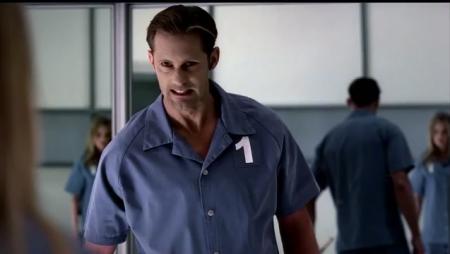
As for Eric, after he and Pam refuses to fight to death gladiator-style, Gov. Burrell forced him to watch as Nora was injected with some sort of vampire virus known as Hep V.  Then, like a typical short-sighted villain, Burrell left before Nora actually died.  While Burrell was busy having his head ripped off, Eric was summoning Willa and getting her to free both him and Nora.  Disguised as a guard, Eric discovered that the all of the new Tru Blood is being spiked with Hep V.

Jessica is also in the prison.  Sarah Newlin attempted to force her to have sex with a new vampires named James.  I don’t know if we’ll ever see James again but I hope that we do because, seriously, he’s really hot and, as opposed to every other male character on this show, he actually seems to respect women.

Meanwhile, Jason has infiltrated the LAVPD.  I just loved Ryan Kwanten’s performance tonight as he attempted to out-fascist the fascists.

Finally, Sam and Nicole … wow.  Just typing the words “Sam and Nicole” makes me want to close my eyes and go to sleep.  Seriously, I love Sam and all but he doesn’t need to be running around with a new girlfriend when Luna hasn’t even been dead for more than a week.  Anyway, Sam ended up giving Emma back to Martha and Alcide allowed Sam and Nicole to leave town but told them that if they ever returned, they would be killed by the pack.

Tonight’s episode pretty much epitomized everything that I love about True Blood.  It was over-the-top and melodramatic but, if you weren’t touched by Arlene singing as Terry died, then you just don’t have a heart.  That was True Blood at its best.

Finally, the Emmy nominations were announced last Thursday and, not surprisingly, both the Walking Dead and True Blood were pretty much ignored.  (Instead, space was made to honor the predictable political blathering of House of Cards because I guess the Emmy voters love to feel smart without actually being challenged.)  The lack of respect for televised horror ultimately say nothing about the quality of shows like True Blood and everything about the lack of guts on the part of the Academy of Television Arts and Sciences.

What’s important is that we, the viewers, know what the best shows on television truly are.

Random Thoughts and Observations:

  • Tonight’s unofficial scene count: 42
  • Before I watched True Blood, I had to sit through a  commercial for the Newsroom.  I was just like, “Oh yay!  A chance to relive Occupy Wall Street!”  BLEH!
  • Can Lafayette ever go for two episodes without getting possessed?
  • I want to do bad thing with you, Eric.
  • I love that Jason responds to his name by saying, “The one and only.”
  • That was a sweet scene between Andy and his last remaining faerie daughter.  I would have named her Bernadette, after the patron saint of asthma sufferers.  (I’ve been praying to Bernadette a lot this past week…)
  • Arliss Howard made a wonderfully hissable villain.
  • “I just think we have the type of friendship where we  can give each other keys!”
  • “I love you, brother.”  “I love you, sister.” *Sob*

Review: True Blood 6.4 “At Last”


true-blood-season-6-episode-4_0

(BEWARE!  SPOILERS!)

I knew it!

Seriously, I suspected the truth from the minute that Ben (Ryan Kazinsky) conveniently first showed up.  And it was even more obvious when Niall (Rutger Hauer) just happened to find Ben hanging out in that field.

Even before I saw Ben open up his veins and allow his blood to drip into Jason’s open mouth at the beginning of tonight’s episode, I knew that Ben was Warlow.

Fortunately, for once, Sookie (Anna Paquin) figured things out ahead of time as well.  After inviting Ben to her house for dinner, Sookie ended up in her underwear, straddling Warlow on the couch, and holding a ball of deadly faerie light in her hand.

Of course, before all this happened, Jason (Ryan Kwanten) ended up drinking Warlow’s blood and then started having a dream where he helped Warlow shave. (Jason’s panicked reaction — and the way Kwanten played that panic — was a definite highlight of tonight’s episode.)

Niall (Rutger Hauer) also attempted to kill Warlow but, for all of his trouble, he ended up getting tossed into another dimension.  Hopefully, this won’t be the end of Niall because Rutger Hauer’s permanently disheveled appearance has been a highlight of the season so far.

As I said, I’m not surprised that Ben turned out to be Warlow.  His sudden appearance at Bon Temps was just too convenient.  I am, however, happy that Sookie figured everything out on her own for once.

While the revelation of Ben’s true identity was the main thing that happened last night, it was hardly the only thing.  It wouldn’t be True Blood if there weren’t a hundred little subplots running through every episode.

First off, in the storyline that I really don’t care about, Alcide and the werewolves continued to search for Emma while Sam and Nicole continued to bond.  I’m not a huge fan of Nicole’s self-righteous character, nor am I that happy about the idea of Sam getting a new love interest when it’s only been a few days since Luna died.  I also don’t care much for the one-dimensional way that Alcide’s been portrayed this season.

Far more interesting was what went on between Eric and Willa Burrell tonight.  Having escaped from the governor’s storm troopers, Willa asked Eric to turn her into a vampire.  Eric proceeded to do just that in a scene that proves — as if there was any doubt — that nobody makes blood sucking as sexy as Alexander Skarsgard.  If season 5 underused Eric, season 6 is definitely making up for it!

Once Willa was transformed into a vampire, Eric ordered her to go to her father and show him what she had become.  This angered the previously virginal Willa who, now that she had been transformed into a vampire, had discovered the joys of being decadent.  However, Eric pulled the “as your maker, I order you” card and Willa went to confront her father.

When Willa arrived at the governor’s mansion, she discovered Gov. Burrell (Arliss Howard) with his lover, Sarah Newlin (Anna Camp).  The governor was shocked by what had been done to his daughter and, for a few brief moments, it was obvious that the usually smooth Burrell had no idea what to do.  However, Sarah handled Burrell’s hesitation by grabbing a gun and shooting Willa with a silver bullet.

Meanwhile, Bill (Stephen Moyer) has kidnapped Dr. Takahashi, imprisoned him in a laboratory and ordered him to synthesize a new form of blood.  Bill sent Jessica (Deboran Ann Woll) to kidnap Andy’s (Chris Bauer) four faerie daughters.  Andy’s daughters, of course, are aging at the rate of several years a day and, by the time Jessica tracked them down, they had magically transformed from being a group of mildly bratty 12 year-old to a bunch of wild teenagers.

(While I’ve been critical of this storyline in the past, tonight’s episode made perfect use of the faerie girls, as both a plot device and as a symbol of the parental fear of waking up to discover that your children have become strangers.  Add to that, there are four wild faerie girls and there are four Bowman sisters.  A coincidence, you say?  Well … yeah, probably…)

However, after getting the faeries to the mansion, Jessica lost control and ended up attacking all four of them.  As tonight’s episode  came to an end, Jessica and Bill were in the mansion, surrounded by four apparently dead faeries.  Meanwhile, Andy — having figured out where his daughters were taken — was outside, holding a silver-loaded shotgun and demanding that Bill come outside.

And that’s how things ended tonight.  Between Eric being all sexy and dangerous, Sookie seducing Warlow, and Jason acting like Jason, it was a pretty good episode.

But, seriously, here’s hoping that Rutger Hauer isn’t gone for good…

Random Thoughts and Observations:

  • Scene Count: 52
  • For those keeping count, the latest two vampires to be captured and arrested for breaking curfew are Nora and Pam.
  • Gerald Webb, one of my favorite actors and a veteran of several Asylum and SyFy films, had a small role in tonight’s episode!
  • Rutger Hauer kicks so much ass.  He needs a show next fall where he solves crimes.
  • I loved how hyper Jason was after he first woke up.
  • I related to Andy’s faerie daughters tonight.  Waking up and discovering that you apparently developed big boobs overnight?  I know what that’s like.
  • Sam made a regal horse, didn’t he?
  • “We might be thirty by the time we wake up!”
  • “Is it going to hurt?”  “Not the way I do it.”
  • “What happens next?  Are we going to fuck!?”

Review: True Blood 6.3 “You’re No Good”


TrueBlood_season6_020-660x330

I just finished watching the latest episode of True Blood and I have to admit that I have mixed feelings.

On the one hand, Bill’s acting evil again and I hate it when Bill acts evil.

On the other hand, Eric is being all dangerous and sexy and you know how much I love that.

So, as often happens when it comes to True Blood, I’m conflicted.

After spending most of the previous episode in a catatonic state, Bill spent most of this latest episode acting like a jerk.  First off, he decided to test his new powers by standing outside while the sun rose and ignoring Jessica as she pleaded with him to come back inside.  At first, it looked like Bill might actually be onto something but then the sun actually rose, Bill burst into flames, and barely managed to make it back inside the mansion.

Once Bill had healed, he sent Jessica to kidnap one of the men who first created true blood so that Bill could force the man to synthesize a new type of blood.  Not surprisingly, this involved Jessica dressing up all trampy (though I have to say that I own that same outfit and I’m thinking about being Jessica for Halloween this year, again) and flirting with the man until they were alone and she could grab him.

Bill’s plan also involved finding the perfect donor for this new blood and, as always, this led to him showing up at Sookie’s.  Even though Sookie refused to invite him in, Bill was able to enter her house and cause Jason to float in the air while he talked to Sookie.  Only after Sookie emphatically refused to be his donor did Bill leave the house.

However, Sookie isn’t the only faerie around.  As Bill walks back to his home, he runs into dumbass Andy.  While Andy explains to Bill that the governor’s curfew is in effect, he lets slip that he now has four half-faerie daughters.  A small smile comes to Bill’s lip as he congratulates Andy on his luck.

See what I mean?  Bill is acting totally evil!

Meanwhile, Eric has gained entry to the bedroom of Willa, the Governor’s daughter.  Despite initially saying that he’s going to kill her, Eric instead kidnaps her and, with the reluctant help of Pam and Tara, holds her prisoner.  Willa (who actually looks a lot like Eric’s “sister,” Nora) doesn’t really seem to mind the idea of being Eric’s prisoner and you know what?  I don’t blame her!  Seriously, for those of us who love True Blood when Eric is being all sexy and dangerous, tonight’s episode was for us!

Along with all of that, we also had Niall (played, perfectly, by Rutger Hauer) attempting to recruit a faerie army so that he could defeat Warlow.  However, it turned out that Warlow had already found most of the faeries before Niall did.  The only faerie that Niall was able to find and recruit was Ben, who — with Bill crazy and Eric kidnapping — appears to be destined to become Sookie’s love interest for the season.

Speaking of love interests, Nicole and those annoying activists showed up in tonight’s episode but the majority of them ended up getting killed by the werewolves.  A wounded Nicole was last spotted (by Sam, who was there to rescue Emma) stumbling into the woods.  Saying that Nicole needed their help, Sam followed after her.  As I said last week, I think Sam could do better.

And finally — Rev. Newlin’s back!  In case you were wondering what happened to everyone’s favorite spokesvamp, he’s currently being held prisoner and interrogated about Eric by the creepiest government doctor that I’ve ever seen.

As I said, I had mixed feelings about tonight’s episode.  On the one hand, I could tell that it was obviously laying the groundwork for something pretty spectacular.  On the other hand, Bill’s evil and I don’t want that.

So, as of this writing, I’m conflicted but hopefully, things will be a bit more clear after next week.

Random Thoughts and Observations:

  • Unofficial scene count: 58
  • Alexander Skarsgard is so freaking hot.  I know I point that out a lot but seriously…
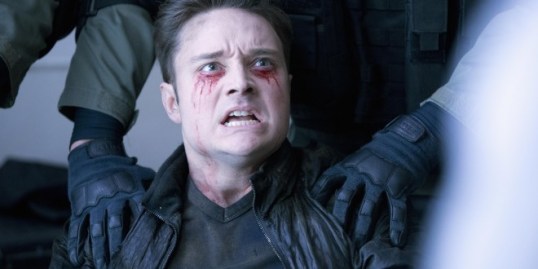
  • Whenever I watch True Blood, I’m reminded of how happy I am that I don’t cry bloody tears.
  • Did anybody else instantly hate Nicole’s boyfriend?
  • Unlike Jessica, I was actually surprised when Bill burst into flames.
  • As far as fan service goes, I got Eric seducing the governor’s daughter and Arleigh got Jessica’s entrance at the lecture.
  • “The girl is sleeping with me because I don’t trust you not to kill her!”
  • “Fuckin’ science!”
  • “Do they have names?” “Right now, I’m just using numbers.  It seems to work.”
  • “You’re not God, Bill.  You’re just an asshole!”