Shattered Politics: The Front Runner (dir by Jason Reitman)


Based (loosely, I assume) on a true story, 2018’s The Front Runner tells the story of a politician named Gary Hart (played by Hugh Jackman).

The year is 1987 and former U.S. Sen. Gary Hart is preparing to announce that he will be seeking the Democratic nomination for the Presidency of the greatest nation of all time, the United States!  (YAY!)  Hart is widely seen as the front runner, for both the nomination and the general election.  He’s got the youth vote sewn up.  He’s energetic.  He’s supposed to be intelligent.  We are told that he is handsome and charismatic.  (I say “told” because, in this film, they seem to be informed attributes as Hugh Jackman is given a truly terrible haircut and his performance here is a bit on the dull side.)  Hart announced his candidacy while standing in the Rocky Mountains.  His wife (Vera Farmiga) is behind him, even if she chooses not to join him on the campaign trail.  His campaign manager (J.K. Simmons) is welcoming new and idealistic volunteers to the campaign headquarters and encouraging them to remember that all of the difficulties of the campaign will be worth it after Gary Hart is elected president.  As for the press, they’re investigating long-standing rumors that Hart is a womanizer.  “Follow me around, you’ll get bored,” Hart says.  So, two reporters from the Miami Herald (Bill Burr and Steve Zissis) do just that they catch a young woman named Donna Rice (Sara Paxton) apparently staying over at Gary Hart’s Florida townhouse.

“It’s nobody’s business!” Hart snaps, when asked about his private life and it’s obvious that the film expects us to take Hart’s side.  The problem, as Hart’s campaign manager points out, is that a lot of people are volunteering for Hart’s campaign and have sacrificed a lot to help him out and now, if Hart doesn’t figure out some way to deal with the story, it looks like it was all for nothing.  Even if Hart didn’t cheat with Rice, he still showed remarkably poor judgment in spending time alone with her in Florida while his wife was back in Colorado.  The film argues that the press went overboard pursuing the story and perhaps they did.  The press tends to do that and really, no politician has any excuse not to realize that.  But, even if we accept the argument that the press acted unethically, that doesn’t exactly exonerate Gary Hart, though this film certainly seems to think that it does.  To a certain extent, this film reminded me a bit of James Vanderbilt’s Truth, in which it was assumed we would be so outraged that Cate Blanchett’s Mary Mapes was fired for producing a story about George W. Bush’s time in the National Guard that we would overlook that Mapes and CBS news tried to build a major story around a bunch of obviously forged documents.

(Of course, if Hart had been running today, I doubt the scandal would have ended his campaign.  If anything, Donald Trump’s personal scandals seemed to play to his advantage when he ran in 2016 and 2024.  To a find a 21st Century equivalent to Hart’s scandal, you’d probably have to go all the way back to John Edwards in 2008.  Of course, Edwards was cheating on his wife while she was dying of breast cancer, which makes Edwards a special type of sleaze.)

As for the film itself, director Jason Reitman tries to take a Altmanesque approach, full of overlapping dialogue and deceptively casual camera moments.  There are a few moments when Reitman’s approach work.  The start of the film, in which the camera glided over hundreds of journalists reporting from outside the 1984 Democratic Convention, was so well-handled that I briefly had hope for the rest of the film.  Reitman gets good performances from dependable veterans like J.K. Simmons and Alfred Molina.  But, at the heart of the film, there’s a massive blank as Hugh Jackman gives an oddly listless performance as Hart.  The film expects us to take it for granted that Gary Hart would have been a good President but there’s nothing about Jackman’s performance to back that up.  It’s odd because, typically, Hugh Jackman is one of the most charismatic actors around.  But, as Gary Hart, he comes across as being petulant and a bit whiny.

It’s an interesting story but ultimately, The Front Runner doesn’t do it justice.
 

Embracing the Melodrama #51: Mystic River (dir by Clint Eastwood)


mystic-river

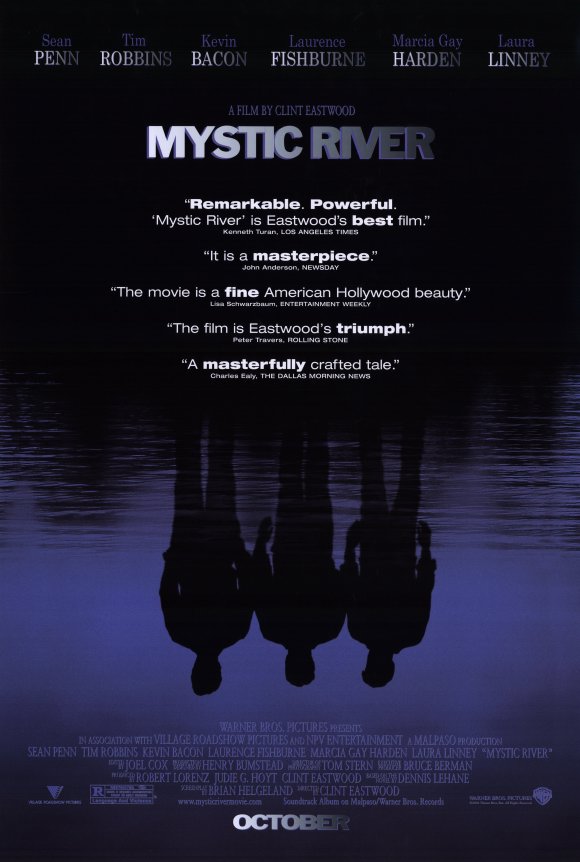
Much like In The Bedroom, 2003’s Mystic River is a film that deals with guilt, murder, and vengeance in New England.  Whereas In The Bedroom deals with the guilt of just four people, Mystic River deals with the guilt of an entire neighborhood.

Mystic River opens in Boston in 1975.  Three young boys are writing their names in wet cement when a car pulls up beside them.  An angry-looking man (played by the always intimidating John Doman) gets out of the car and announces that he’s a police officer and that the three boys are under arrest.  He orders them to get in the car.  Of the three boys, Jimmy and Sean refuse but meek Dave gets into the car, where he’s greeted by a leering old man.  Jimmy and Sean watch as the car drives away with their friend trapped in the back seat.  Dave is held prisoner and abused by the two men for four days until he finally manages to escape.

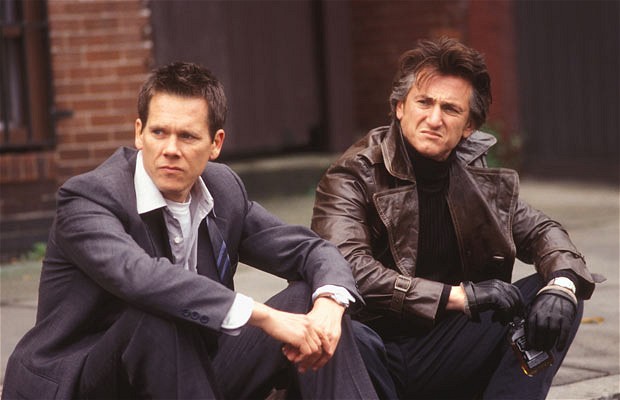
Twenty-five years later, the three boys have grown up but are still haunted by what happened.  Sean is now a detective with the Massachusetts State Police.  Jimmy is an ex-con who now owns a local store and who, despite being married to Annabeth (Laura Linney), the daughter of a local gangster, is trying to lead a law-abiding life.  As for Dave (Tim Robbins),  he is married to Celeste (Marcia Gay Harden) and manages to hold down a job but he’s also the neighborhood pariah.

Mystic River 1

When Jimmy’s daughter Katie (Emmy Rossum) is brutally murdered, Sean and his partner Whitey Powers (Laurence Fishburne) are assigned to the case.  The distraught Jimmy, however, starts to investigate the murder himself and, after talking to Celeste, he discovers that, on the night Katie died, Dave came home with blood on his clothes and claiming that he had a fight with a mugger.  That’s all the evidence that Jimmy and his friends need to believe that Dave is the murderer…

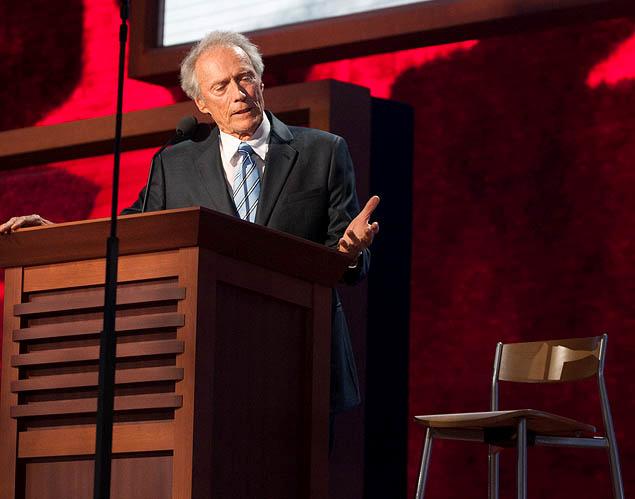
I have a lot of friends who will probably never forgive Clint Eastwood for not only endorsing Mitt Romney in 2012 but for also giving the “empty chair” speech at the Republican Convention.  From the way that a lot of them reacted, you would think that Eastwood had filmed himself drowning puppies as opposed to simply expressing his own cantankerous opinions about current events.  (Honestly, do you know any 82 year-olds who weren’t disgruntled in 2012?)  Myself, I thought the empty chair speech was an act of brilliant performance art, one that not only highlighted the fact that most politicians really are just empty chairs but also exposed just how humorless most political activists truly are.  (Admit it — if John Fugelsang had done that same routine at the 2004 Democratic convention and referred to the empty chair as being President Bush, most of the people who went on and on about how terrible it was that Eastwood was being disrespectful to the President would still be using it to create Facebook memes.)

Eastwood

Unfortunately, I sometimes find myself wondering why Clint Eastwood the director sometimes seem to struggle to be as interesting, innovative, and thought-provoking as the empty chair speech.  It sometimes seems that for every Eastwood film that works, there’s a handful films like Hereafter, Changeling, and Jersey Boys.  These aren’t bad films as much as they’re just uninspired films.  (Well, Hereafter is pretty bad…)  Ultimately, Eastwood is more of a storyteller than a Martin Scorsese-style innovator.  If Eastwood has a good story to tell, the film will work.  If he has a weak story — well, then the film will be weak.

Fortunately, with Mystic River, Eastwood has a good story and the end result is one of the best films of his uneven directorial career.  Eastwood uses a fairly standard murder mystery to explore themes of guilt, redemption, and paranoia.  Jimmy may be looking for revenge and Sean may be doing his job but ultimately, both of them are trying to absolve themselves from the consequences of their childhood decisions.  If Dave is guilty, then Jimmy will justified in having let him get in that car.  If Dave is innocent, Sean can finally step up and save him.

And complicating all of this is the Neighborhood, which is as much a character in this film as Jimmy, Dave, and Sean.  The Neighborhood will never allow anyone to forget or live down the past.  When, towards the end of the film, Jimmy is declared to be the “king of the neighborhood” by Annabeth, there’s little doubt that she’s right.  The question is whether Jimmy’s kingdom is one worth ruling.

Mystic River

Trailer: The Sitter (Red Band)


To say that I’m not a big Jonah Hill fan would be an understatement. The characters he has played on film have ranged from annoyingly nebbish to downright obnoxious. An almost irrational rage builds up in me whenever I see a trailer with him in it either as a supporting cast member or one of the leads. To my surprise when I saw the red band trailer of his upcoming R-rated comedy, The Sitter, the rage I was feeling petered out the more I watched the trailer.

The Sitter stars Jonah Hill and is directed by one David Gordon Green who also made the hilarious Pineapple Express and also one of the creators of the HBO comedy series, Eastbound & Down. Unfortunately, Green also directed the very unfunny comedy earlier in 2011 called Your Highness. Here’s to hoping that The Sitter is more of the very hilarious kind and not the unfunny that was his latest comedy film this year.

From what I could tell in the trailer this film looks almost like a remake of the 80’s comedy, Adventures in Babysitting starring Elisabeth Shue. That was a funny film and if Jonah Hill and Green can deliver the raunchiness and laughs then I have a feeling The Sitter may just be worth a look-see.

The Sitter is set for a December 9, 2011 release.