There are people in this world who only know Jimmy Stewart from his performances in movies like IT’S A WONDERFUL LIFE (1946) and REAR WINDOW (1958). Those are both great movies to be sure, but I contend that Stewart was also one of the great “cowboys,” with his string of excellent westerns with director Anthony Mann, as well as his work with other great directors like John Ford and Delmer Daves.
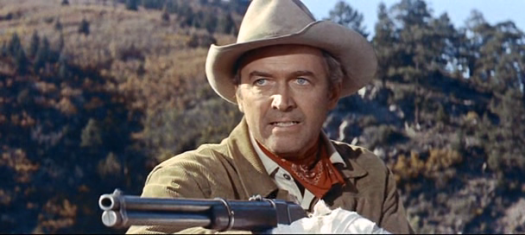
Stewart’s performance in THE MAN FROM LARAMIE is one of my personal favorites. In this scene, his hand is shot from point blank range by a crazy man who’s never had to pay the consequences for his actions. That changes when the man from Laramie comes to town. I couldn’t imagine a more powerful performance than Stewart’s work here. He’s incredible and truly one of the great actors of all time!
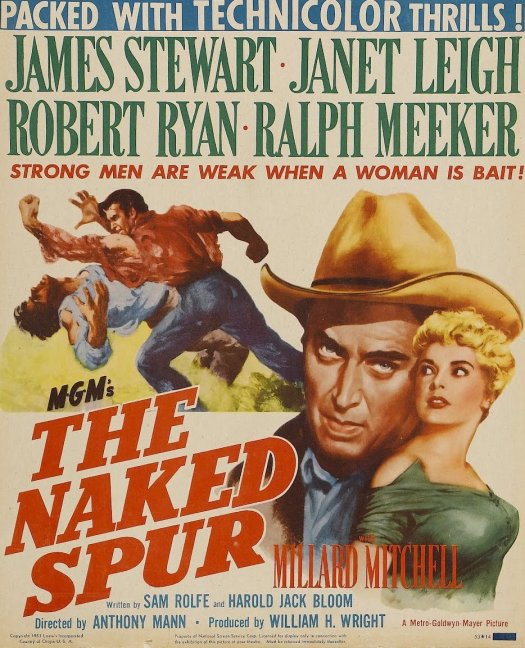
First released in 1953, The Naked Spur is one of the most cynical and downbeat movies that I’ve ever seen.
It’s also one of the most visually beautiful. Filmed in the Rockies and presented in glorious Technicolor, The Naked Spur is a western that is full of amazing scenery, from green forests to snow-capped mountains to a river that, under different circumstances, would probably be a wonderful place to just sit down and think for a spell. Director Anthony Mann crafts an image of the American frontier that makes it easy to understand why anyone would want to explore it and build a new life there. Mann contrasts the beauty of nature with the ugliness of the people who trample across it.
Jesse Tate (Millard Mitchell) is a grizzled and somewhat sickly prospector who runs into a stranger named Howard Kemp (James Stewart). Kemp is, at first, antagonistic and paranoid but soon, he offers to pay Tate $20 if Tate will help him track down an outlaw named Ben Vandergroat. Vandergroat, wanted for the murder of a U.S. marshal, is believed to be hiding in the mountains. In need of the money, Jesse agrees. Soon, he and Kemp are joined by another wanderer, a recently discharged soldier named Roy Anderson (Ralph Meeker). From the minute that Roy shows up, it’s obvious that he’s not being totally honest about why he’s wandering around the Rockies.
As for Ben Vandergroat (Robert Ryan), he is indeed hiding in the mountains. He’s accompanied by Lina Patrch (Janet Leigh), a naive young woman whose late father was one of Ben’s partners-in-crime. Lina looks up to Ben as a father figure and refuses to believe that he could possibly be guilty of any of the things that he’s been accused of doing. Ben, meanwhile, manipulates Lina into doing his bidding.
After being captured by Kemp, Jesse, and Roy, Ben proves himself to be far more clever than he initially seems. After revealing that Kemp isn’t who Jesse assumed him to be, Ben works to try to turn the three men against each other. There’s a reward on Ben’s head and, after Kemp reluctantly agrees to share the money with Jesse and Roy, Ben mentions that there will be a lot more money if its split two ways instead of three. Soon, Ben has the three men distrusting each other even more than they already did. However, Lina finds herself falling in love with Kemp.
TheNakedSpur is a great film. Featuring only five-speaking parts, it plays out like a particularly intense play and every single member of the cast does a great job of bringing the film’s characters to life. Robert Ryan is coolly manipulative as the cocky Ben while Ralph Meeker is crudely menacing as the untrustworthy Roy Anderson. Millard Mitchell is, at times, heart-breaking as the sickly prospector. Janet Leigh reveals the strength underneath Lina’s naive persona. Of course, the film is stolen by James Stewart, who is convincingly bitter and ultimately rather poignant as Howard Kemp. Kemp feels like a continuation of the character that Stewart played in BrokenArrow. He’s seen the worst that humanity has to offer. Even in the beautiful Rockies, Stewart’s character cannot escape the ugliness that he’s witnessed firsthand. Stewart’s performance as that haunted and angry Howard Kemp is one of his best.
TheNakedSpur is an intelligent and well-acted western and one of eight movies that Stewart made with director Anthony Mann. It’s psychological complexity, beautiful scenery, compelling script, and brilliant cast make it a true classic.
James Stewart is one of the great movie stars of all-time. His work with Frank Capra (MR. SMITH GOES TO WASHINGTON, IT’S A WONDERFUL LIFE) and Alfred Hitchcock (REAR WINDOW, VERTIGO) is legendary. In my household, Stewart’s work with director Anthony Mann is celebrated just as much as those other classics. Mann and Stewart made five classic westerns, beginning with WINCHESTER ‘73 in 1950 and ending in 1955 with THE MAN FROM LARAMIE. I own them all on DVD and watch them quite often. It’s very cold in Arkansas today, so I decided to write about the Yukon-set THE FAR COUNTRY, from 1954.
Jeff Webster (James Stewart) and his crusty ol’ coot of a partner Ben Tatem (Walter Brennan) head North towards Dawson City, in the Yukon Territory, with a herd of cattle. The two men encounter a variety of problems along the way, with the biggest being the corrupt Judge Gannon (John McIntire) of Skagway, Alaska. When Jeff finds himself in front of the judge for killing two cowhands who tried to steal his herd, Gannon acquits him on the charges but decides to keep his herd as payment for the court fees. With their cattle taken away from them, Jeff and Ben sign up to help business lady Ronda Castle (Ruth Roman) take supplies to Dawson City, where she plans to set up shop. After their first day on the trip, Jeff and Ben double back to Skagway and re-take their herd and take off towards Dawson as fast as they can go, with Gannon and his men in hot pursuit. They’re able to make it into Canada, so Gannon and his goons turn back, determined to hang the men if they ever come back through Skagway.
So Jeff and Ben make it to Dawson City with their cattle where they sell them off for $2 per pound to Ronda. Suddenly flush with cash, the two partners buy a gold claim and proceed to find some nice golden nuggets! When they head back into town, they find that Judge Gannon has now come to Dawson City and is in partnership with Ronda. Of course, that bastard immediately starts cheating the miners out of their claims, this time with gunman Madden (Robert J. Wilke) by his side, enforcing his corrupt actions with lead. Jeff and Ben decide they’re going to sneak out of town with their loot, but Gannon finds out about it and sends his men to stop them. Ben is killed in the process and Jeff is seriously injured. Jeff has tried his best up to this point to not get involved with the mess in Dawson City, but with his best friend now dead, he decides it’s time for Judge Gannon and his thugs to be stopped.
James Stewart is just so good as Jeff Webster. The best thing about his work with Mann is how each of the movies would give him a meaty role that capitalized on his basic decency, while simultaneously making him a more complex, layered man, miles away from the likes of Mr. Smith or George Bailey. In THE FAR COUNTRY, he’s as tough as nails, but he really doesn’t want to get involved with the people around him. It takes the death of his best friend for him to finally commit to helping them stand up against the bad guys. Stewart’s work here, and in the other Mann westerns, ranks with his very best.
The remainder of the cast is uniformly excellent. Three time Oscar winner Walter Brennan is always a welcome presence in a movie I’m watching. While he’d pretty much settled into the “old coot” role that would come to personify the later part of his career, his character is a valuable conscience for Stewart a couple of times in the story. I thought that John McIntire and Ruth Roman really stood out in their respective roles as the corrupt Judge Gannon and the stubbornly, independent businesswoman Ronda Castle. Both give excellent performances. The cast is rounded out with a who’s who of character actors like Jay C. Flippen, Harry Morgan, Robert J. Wilke, Royal Dano, and Jack Elam. It’s always nice seeing these familiar faces pop up in these old westerns.
I love it when movies are filmed on location in beautiful places. THE FAR COUNTRY was filmed at the Jasper National Park in Alberta, Canada, which added another interesting element to the film. The final thing I want to say about the film is that the screenplay for THE FAR COUNTRY was written by Borden Chase, who had penned RED RIVER a few years earlier. Not only would Chase write this movie, he would also write the screenplays for WINCHESTER ‘73 and BEND OF THE RIVER, both westerns that paired Anthony Mann and Jimmy Stewart. Chase was an excellent writer of western material, and his strong work in this group of films is crucial to their enduring success.
Overall, I confidently recommend THE FAR COUNTRY to any person who enjoys westerns or Jimmy Stewart. I might rank THE NAKED SPUR and THE MAN FROM LARAMIE slightly above this one in the Mann / Stewart westerns, but the truth is that you can’t go wrong with any of them.
I’m sharing the trailer for THE FAR COUNTRY below:
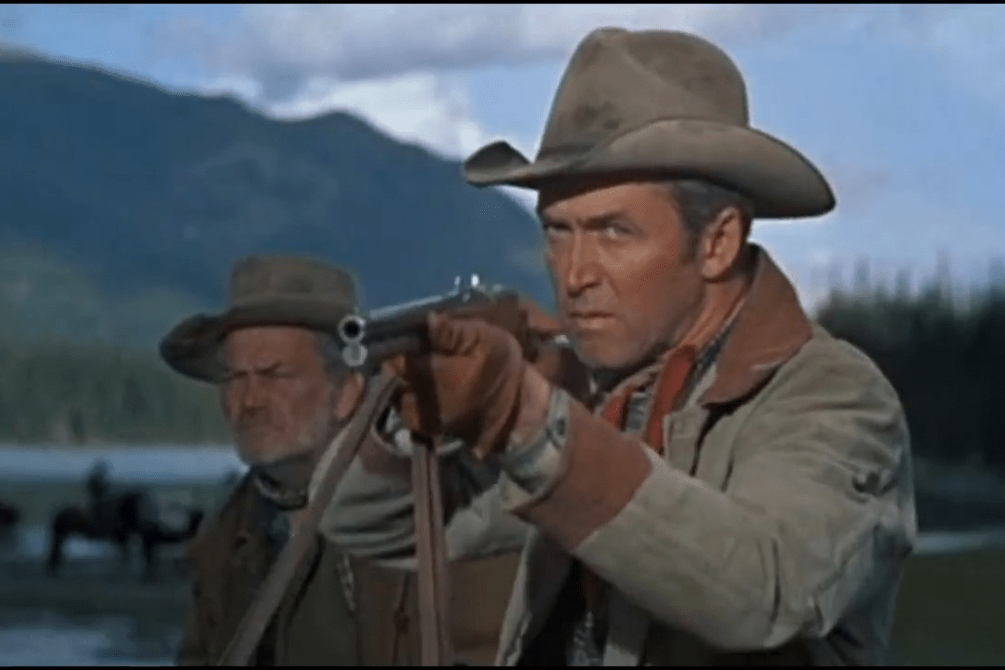
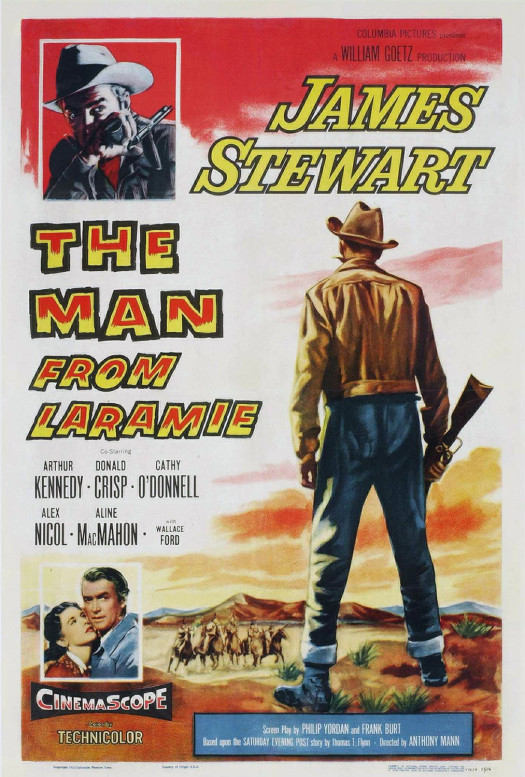
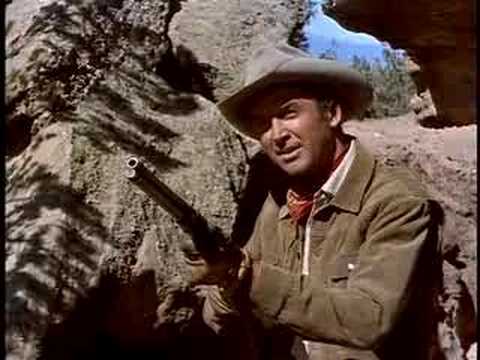
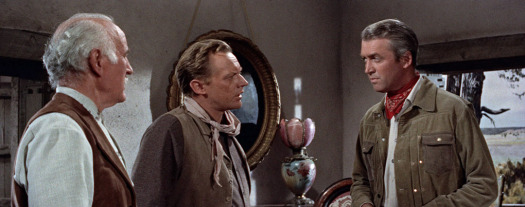
I’ve covered several of the Anthony Mann/James Stewart Western collaborations here. Their final sagebrush outing together THE MAN FROM LARAMIE was shot in Cinemascope and gorgeous Technicolor, features a bunch of solid character actors, has beautiful New Mexico scenery… yet felt like a letdown to me. Maybe it’s because Mann and Stewart set the bar so high in their previous Westerns, but THE MAN FROM LARAMIE is an anti-climactic climax to the director/star duo’s pairings.
Stewart’s good as always, playing bitter Will Lockhart, whose brother was killed by Apaches and whose mission is to find out who’s selling the guns to them. But the film came off flat, feeling like just another routine Western – good, but not in the same category as WINCHESTER ’73 or BEND OF THE RIVER. Those Mann film noir touches are nowhere to be found, replaced by (dare I say it!)… soap opera elements!
Well, historically, there were several reasons but they can all basically be boiled down to the fact that the Empire got too big to manage and that having two separate capitols certainly didn’t help matters. The Empire got so large and overextended that the once fabled Roman army was no match for the barbarians.
Of course, if you’ve ever watched a movie about the Roman period, you know exactly why the Empire fell. It all had to do with decadence, gladiators, human sacrifices, and crazed emperors with unfortunate names like Caligula and Commodus. The Roman Empire fell because the imperial government descended into soap opera, complete with love triangles, betrayals, and whispered plotting inside the Senate.
Another thing that we’ve learned from the movies is that the fall of the Roman Empire was damn entertaining. Between the orgies and the men wearing those weird helmets with the brushes on top of them, there’s nothing more fun that watching the Roman Empire fall.
Case in point: the 1964 film, The Fall of the Roman Empire.
This three and a half hour epic begins with the last of the good Roman emperors, Marcus Aurelius (Alec Guiness), battling to keep the Germanic barbarians from invading the empire. Marcus is a wise man and a great leader but he knows that his time is coming to an end and he needs to name a successor. His daughter, Lucilla (Sophia Loren), is an intelligent and compassionate philosopher but, on the basis of her sex, is not eligible to succeed him. His son, Commodus (Christopher Plummer), may be a great and charismatic warrior but he’s also immature and given to instability. Marcus’s most trusted adviser, Timonides (James Mason), would never be accepted as a successor because of his Greek birth and background as a former slave. (Add to that, Timonides is secretly a Christian.)
That leaves Livius (Stephen Boyd). Livius is one of Marcus’s generals, a man who is not only renowned for his honesty and integrity but one who is also close to the royal family. Not only is he a former lover of Lucilla’s but he’s also been a longtime friend to Commodus. Unfortunately, before Marcus can officially name Livius as his heir, the emperor is poisoned. Commodus is named emperor and things quickly go downhill. Whereas Marcus ruled with wisdom and compassion, Commodus is a tyrant who crushes anyone who he views as being a potential threat. Lucilla is married off to a distant king (Omar Sharif). Timonides is declared an enemy after he suggests that the conquered Germans should be allowed to peacefully farm on Italian land. Rebellion starts to ferment in every corner of the Empire and Livius finds himself trapped in the middle. Which side will he join?
Despite all the drama, Commodus is not necessarily an unpopular emperor. One of the more interesting things about The Fall of the Roman Empire is that Commodus’s popularity grows with his insanity. The crueler that he is, the more the people seem to love him. Soon, Commodus is fighting as a gladiator and having people burned at the stake. While some Romans are horrified, many more love their emperor no matter what. People love power, regardless of what it’s used for. Perhaps that’s the main lesson and the main warning that the final centuries of the Roman Empire have to give us.
The Fall of the Roman Empire is surprisingly intimate historical epic. While there’s all the grandeur that one would normally expect to see in a film about the Roman Empire, the film works best when it concentrates on the characters. While Boyd and Loren do their best with their thinly drawn roles, the film is stolen by great character actors like Alec Guinness, James Mason, and Christopher Plummer. Plummer, in particular, seems to be having a blast playing the flamboyantly evil yet undeniably charismatic Commodus. Even with the Empire collapsing around then, both Plummer as an actor and Commodus as a character seems to be having a blast. Add to that, there’s all of the usual battles and ancient decadence that you would expect to find in a film about the Roman Empire and the end result is a truly enjoyable epic.
As I watched The Fall of the Roman Empire, it was hard for me not to compare the film to Ridley Scott’s Gladiator. That’s because they’re both basically the same damn movie. The main difference is that The Fall of the Roman Empire is far more entertaining. The Fall of the Roman Empire, made in the days before CGI and featuring real people in the streets of Rome as opposed to animated cells, feels real in a way that Gladiator never does. If Gladiator felt like a big-budget video game, The Fall of the Roman Empire feels like a trip in a time machine. If I ever do go back to 180 A.D., I fully expect to discover James Mason giving a speech to the Roman Senate while Christopher Plummer struts his way through the gladiatorial arena.
Finally, to answer the question that started this review, why did the Roman Empire fall?
It was all Christopher Plummer’s fault, but at least he had a good time.
The 1948 film noir, He Walked By Night, opens with a policeman named Rawlins on his way home from work. As he drives down the street, he sees a man walking alone at night. Because there’s been a number of recent burglaries in the area and the man’s a stranger, Rawlins decides to pull over and ask the man for his ID.
What Rawlins doesn’t realize is that the man is Roy Morgan (Richard Basehart) and yes, Roy is indeed the burglar. Roy is something of a mystery man. (Needless to say, Morgan is not his real last name.) In the pre-Internet age, he has very carefully and very meticulously avoided leaving any sort of paper trail. He lives, by himself, in a small apartment, his only companion being an adorable dog and the police scanner that Roy uses to always stay a few steps ahead of the cops. When Rawlins pulls him over, it’s the closest that Roy has ever come to being caught. Roy get out of the situation by shooting the cop and then running into the night.
The rest of the film deals with the efforts of two police detectives (played by Scott Brady and James Cardwell) and their captain (Roy Roberts) to discover who shot Rawlins and bring him to justice. It’s not easy because not only has Roy done a good job of obscuring his very existence but his police scanner always gives him advanced warning whenever they cops start to close in on him. The only lead that the cops have is a salesman named Paul Reeves (Whit Bissell). Reeves has been buying and reselling the electronic equipment that Roy’s been stealing from houses all over Hollywood. When Reeves tells the cops that he had no idea the stuff was stolen, the cops all share a weary roll of the eye. No matter whether Reeves is telling the truth or not, he’s now the key to tracking down a cop killer….
He Walked By Night is a police procedural and, while the plot may sound familiar, the film is elevated by the atmospheric direction of Alfred Werker and an uncredited Anthony Mann. As visualized by Werker and Mann, the streets of Los Angeles have never been darker and more menacing. Roy emerges from the fog to commit his crimes and then disappears back into the mist, like some sort of paranormal spirit. The film reaches its high point when the police chase their quarry through the sewers of Los Angeles, a scene that will remind many of the famous finale of The Third Man.
Though the film offers up clues to Roy Morgan’s motivation, he remains an enigma for much of the film. Richard Basehart plays him as a paranoid man who only seems to be confident and happy when he’s stealing or when he’s outsmarting the police. In many ways, regardless of whether he escapes the police or not, Roy’s destined to spend his life trapped in a prison of his own design. Even hiding out on the fringes of society, Roy knows that his time is limited. There’s only so many times one person can escape their fate. Until he’s either captured or killed, Roy is destined to always walk the night, alone.
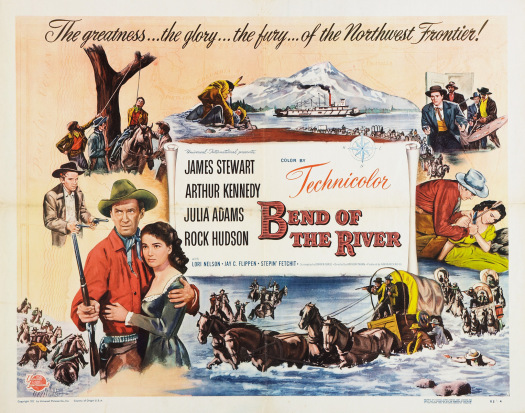
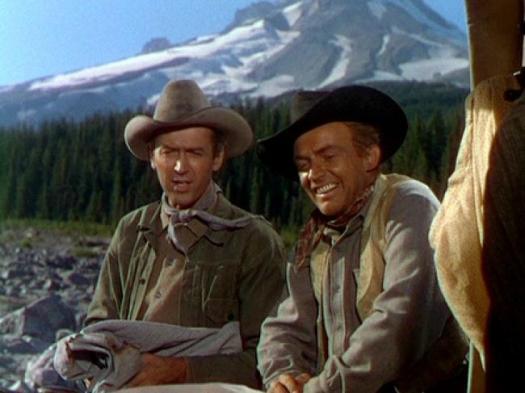
BEND OF THE RIVER, the second of the James Stewart/Anthony Mann Westerns, isn’t quite as good as the first, WINCHESTER ’73 . That’s not to say it isn’t a good film; it’s just hard to top that bona fide sagebrush classic. Stewart continues his post-war, harder edged characterizations as a man determined to change his ways, and is supported by a strong cast that includes a villainous turn by the underrated Arthur Kennedy .
Jimmy plays Glyn McLyntock, an ex-outlaw now riding as trail boss for a group of farmers heading to Oregon to begin a new life. He encounters Kennedy as Emerson Cole, a horse thief about to be hanged, and enlists his help on the trail west. Both men know each other’s reputations; they were both once raiders along the Missouri/Kansas border. The wagons are attacked at night by Shoshone, an arrow piercing young Laura Baile, daughter of…
James Stewart and Anthony Mann’s fourth Western together, 1955’s THE FAR COUNTRY, takes them due North to the Klondike during the Gold Rush of 1896. It’s a bit more formulaic than other Stewart/Mann collaborations, but a strong cast and some gorgeous Technicolor photography by William H. Daniels more than make up for it. The film is definitely worth watching for Western fans, but I’d rank it lowest on the Stewart/Mann totem pole.
Jimmy is Jeff Webster, a headstrong cattleman who drives his herd from Wyoming to Seattle to ship up north to the beef-starved gold miners for a huge profit. Webster killed two men along the way who tried to desert the drive, and barely escapes Seattle before arriving in Skagway, Alaska. There, he unintentionally interrupts a hanging being conducted by crooked town boss ‘Judge’ Gannon, who confiscates Webster’s herd as a fine for spoiling his fun. Webster and his two…
(By sheer coincidence, this post coincides with the birthday of character actor Millard Mitchell (1903-1953), who plays Tate in the film. Happy birthday, Millard! This one’s for you!)
James Stewart and Anthony Mann moved from Universal-International to MGM, and from black & white to Technicolor, for THE NAKED SPUR, the third of their quintet of Westerns together. The ensemble cast of five superb actors all get a chance to shine, collectively and individually, creating fully fleshed out characters against the natural beauty of the Colorado backdrop.
Bitter Howard Kemp, whose wife sold their ranch and ran off while he was serving in the war, is hunting down killer Ben Vandergroat for the $5,000 bounty in hopes of rebuilding his life. Along the trail he meets old prospector Jesse Tate and recently discharged (dishonorably) Lt. Roy Anderson. The trio manages to capture Vandergroat, but he’s not alone… he’s accompanied by pretty wildcat Lina…
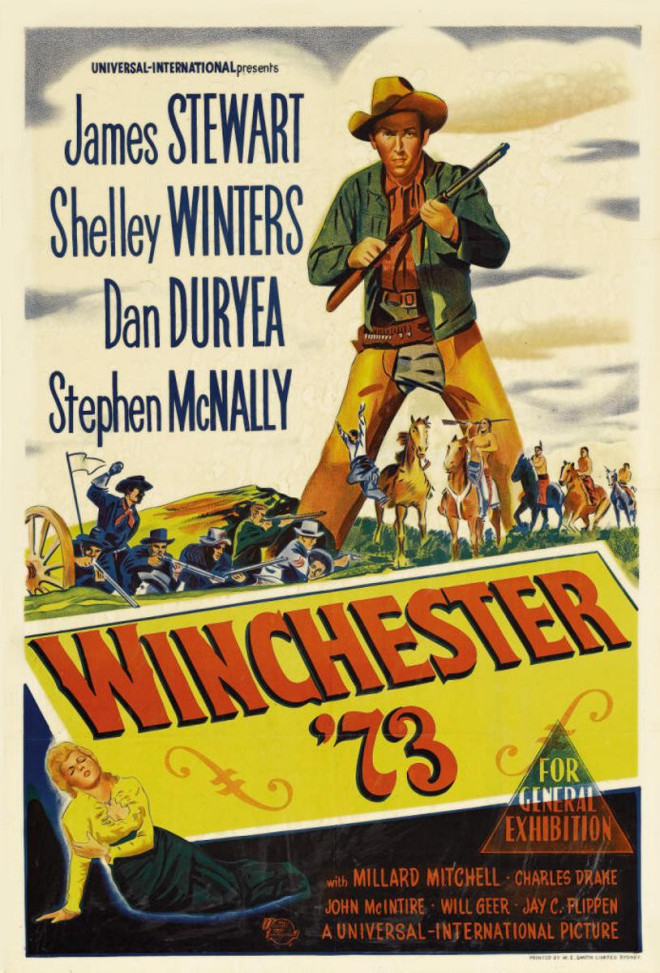
James Stewart and Anthony Mann made the first of their eight collaborations together with the Western WINCHESTER ’73, a film that helped change both their careers. Nice guy Stewart, Hollywood’s Everyman in Frank Capra movies like MR. SMITH GOES TO WASHINGTON and IT’S A WONDERFUL LIFE, took on a more mature, harder-edged persona as Lin McAdam, hunting down the man who killed his father, Dutch Henry Brown (Stephen McNally ). As for Mann, after years of grinding out B-movie noir masterpieces (T-MEN, RAW DEAL ), WINCHESTER ’73 put him on the map as one of the 1950’s top-drawer directors.
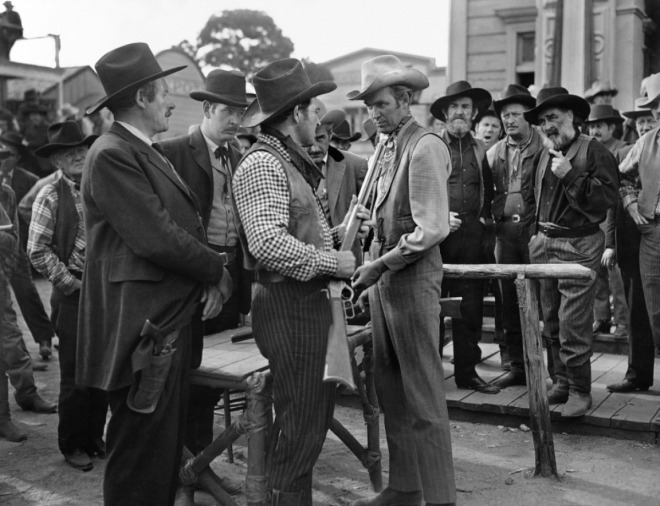
The rifle of the title is the movie’s McGuffin, a tool to hold the story together. When McAdam and his friend High Spade (the always welcome character actor Millard Mitchell) track Dutch Henry to Dodge City, the two mortal enemies engage in a shooting contest judged by none other than Wyatt Earp (Will Geer)…





 Through the Shattered Lens