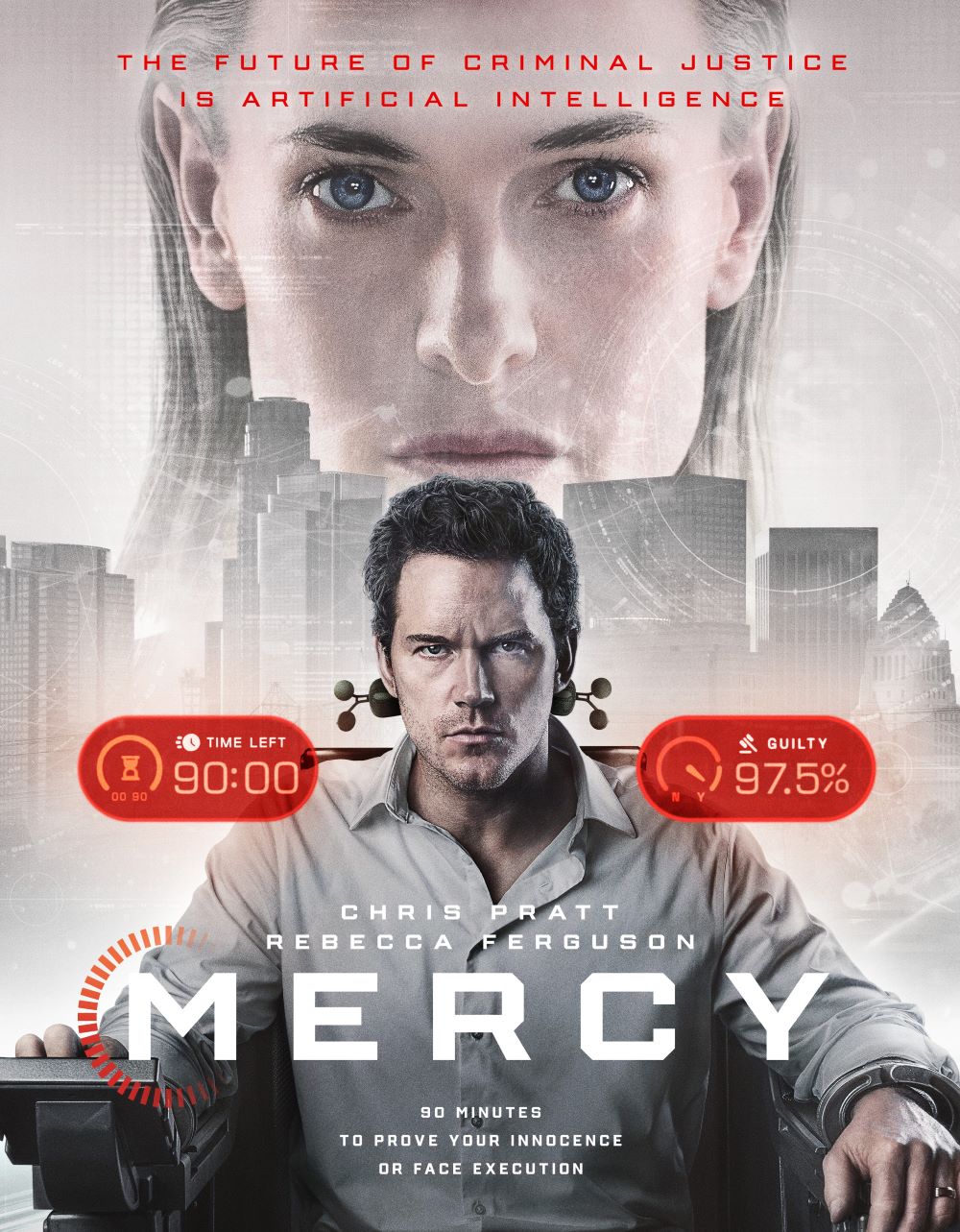
Review: Mercy (dir. by Timur Bekmambetov)


“You and I both know that this clock is bullshit. You make your decisions about the people in this courtroom before they’re even in this chair.” — Det. Chris Raven

Mercy is the kind of movie that looks great in a trailer and promises a slick, high‑concept thriller, but then sputters once you sit through it. It’s set in a near‑future Los Angeles where the LAPD relies on a program called the “Mercy Court,” in which AI judges rapidly process violent crime cases, and the whole thing is framed as a techno‑noir twist on the courtroom thriller. The central gimmick is compelling on paper: detective Chris Raven wakes up strapped into a high‑tech chair, accused of brutally murdering his wife, and has 90 minutes to prove his innocence before being executed by a sonic blast. That setup alone should guarantee at least a tense, scrappy B‑movie; instead, the film keeps undercutting itself with lazy writing, cluttered subplots, and a surprising lack of nerve.

The biggest problem is the script, which feels like it’s trying to be three different movies at once and doesn’t really commit to any of them. On one level, Mercy wants to be a real‑time investigation, where Raven works with an AI judge to access security feeds, social media, emails, and police databases to piece together his wife’s murder. In practice, this becomes a series of exposition dumps—Raven talking out his thought process, the AI reciting rules, and side characters popping in just long enough to drop information before the movie rushes on. It’s not building tension; it’s building a checklist. The film’s pacing stays brisk, but that’s because so much of the middle act feels like procedural filler rather than a genuine mystery.

Tonally, Mercy swings wildly between modes. At times it’s going for something like a sleek, dystopian Minority Report–style narrative, then it veers into a revenge‑driven character drama about a cop who may be too reliant on an authoritarian justice system, and then it suddenly transforms into a generic bomb‑plot action movie. The initial setup—a world where people suspected of murder are strapped into a chair, presumed guilty, and given a brutally short window to prove themselves—feels genuinely unsettling. But the movie doesn’t really sit with those implications; it flirts with the moral and ethical questions and then rushes off to a more conventional, physical threat. What should be a caustic, uncomfortable critique of automated justice reduces to another last‑minute rescue mission.

The central mystery is another missed opportunity. The evidence stacked against Raven is substantial—blood on his clothes, footage from cameras, his drinking problem, and a history of violent outbursts—but the film telegraphs the real culprit so early that the final reveal feels less like a twist and more like a completion of prior signposting. The story tries to make the framing of Raven seem like a master‑plan‑level conspiracy, but the plan hinges on an almost impossible level of predictability on his part. The more the movie explains, the harder it becomes to buy into the logic of the setup. Instead of feeling like the net has tightened around him in a sophisticated way, it feels like the script is forcing contrivances to land on top of him.

Chris Pratt’s performance is an odd fit for the material. The movie seems determined to present him as a darker, more tortured version of himself, and there are a few moments where that dynamic works—Raven’s vulnerability, his self‑loathing, his conflicted belief in the system he helped create. But the script never really lets him live in the morally grey space it clearly wants him to inhabit. Instead, it keeps reassuring us that he’s essentially a good cop who’s been wronged, which undercuts any real tension about whether he might actually be guilty or at least dangerous. You get glimpses of a more interesting character, but they’re constantly being smoothed over by the need for a likable protagonist.

The AI judge, voiced and embodied by Rebecca Ferguson, is one of the few genuinely strong elements here. She plays the voice and presence of the system with a cool, clipped rationality that occasionally shades into dry wit, and her interactions with Raven hint at a more ambitious film lurking underneath. The idea of an AI judge slowly questioning its own assumptions—pushing back on emotional appeals, probing inconsistencies, and gradually developing something resembling curiosity—is inherently compelling. Ferguson gives the character enough personality and nuance to make that arc feel plausible, but the script mostly treats her as a glorified search engine and a moral referee for the final act, when she should be the co‑lead driving the film’s central conflict.

The supporting cast is fine, but underused. Raven’s partner mostly exists to run errands off‑screen—tracking suspects, raiding houses, reacting over the comms—so the movie can cut away from the courtroom whenever it gets bored. Raven’s AA sponsor is saddled with a mix of clumsy foreshadowing and heavy‑handed motivation, which only becomes relevant when the revenge angle kicks in. Raven’s daughter functions almost entirely as emotional leverage and a hostage, escalating the stakes in a way that feels mechanical rather than organic. You can tell the film wants these relationships to carry weight, especially when it leans on family flashbacks and guilt, but they play out like bullet points instead of lived‑in dynamics.

Visually, the film leans into its creator’s usual fondness for screens within screens, overlay graphics, and multimedia collage. The Mercy Court itself is a striking concept—an almost clinical chamber where Raven is strapped into a chair while the AI’s interface shifts around him—yet the movie keeps cutting away to external action once the premise might otherwise grow too tense or claustrophobic. The pacing is brisk, and there are a few set‑pieces—an intense raid on a suspect’s house, the final assault on the courthouse—that deliver a basic level of genre competence. The issue is that competence is about as high as Mercy ever aims; it never really experiments with the form or stakes of its own setup.

Where the film stumbles most is in its attempt at commentary. The world it presents is, on paper, horrifying: defendants are presumed guilty, strapped into a chair, surveilled across every aspect of their digital life, and given a brutally short window to clear their name before being executed. That’s fertile ground for a scathing critique of mass surveillance, algorithmic justice, and the erosion of due process. But the movie is oddly kind to the system itself; by the end, the AI judge is portrayed as more reasonable and “fair” than most humans, and the real villain is just an individual with a personal grudge. The film nods at privacy violations and the moral grey zones of automating justice, then quickly moves on to a more traditional, physical threat. For something that positions itself as a provocative AI courtroom thriller, it ends up feeling strangely apolitical and conflict‑averse.

To be fair, there are a few things Mercy gets right. The core structure—a detective investigating his own case against a clock—remains inherently watchable, even when handled clumsily. Ferguson’s performance gives the material a center of gravity whenever it threatens to spin out into nonsense. And there’s an occasionally interesting tension between Raven’s instinct‑driven, emotionally charged approach and the AI’s cold, probabilistic logic, suggesting a better film that really pits those worldviews against each other instead of letting them conveniently converge. If you go in with low expectations and a tolerance for generic sci‑fi thrillers, you might find it mildly diverting.

But for anyone hoping Mercy would be a sharp, nasty, high‑concept genre piece with something to say about AI, policing, and due process, it’s a disappointment. The movie leans on an admittedly strong premise, some slick production design, and a few scattered performances, yet it never commits to either being a full‑tilt B‑movie or a genuinely thoughtful techno‑thriller. It’s not unwatchable, just frustratingly timid—content to skim the surface of its own ideas and then blow something up when things get complicated. By the time the credits roll, you’re left with the sense that the AI judge wasn’t the only one operating on a strict time limit; somewhere along the way, the film seems to have run out of patience with itself, too.
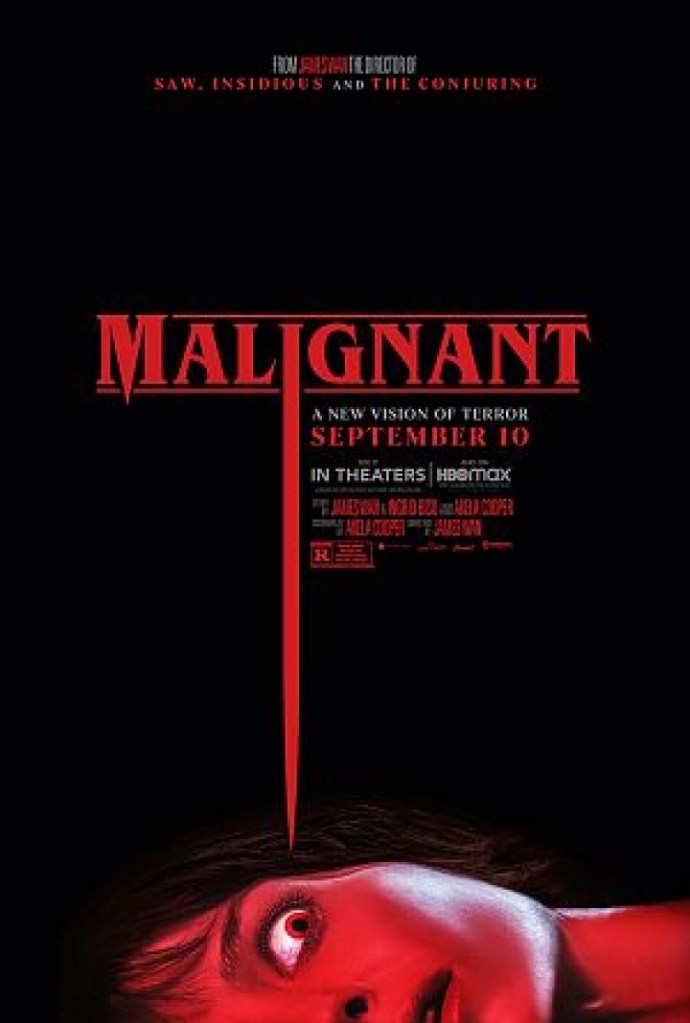
Quick Review: Malignant (dir. by James Wan)


James Wan’s newest horror film, Malignant is something that really needs to be seen without any prior input on it. If there’s any way you can watch it – whether you see it in theatres or on HBO Max up until October 10th – It’s definitely worth it. Right after watching it, I contacted my cousin and begged her to watch it without moviepooping it. She never watches a movie without already knowing the outcome – who lives, who dies. If she doesn’t, the anxiety that hits her is great. She twitches in her chair, covers her face, screams and gives every reaction you to hope to experience in a movie theatre. She agreed to do so, and I can’t wait to hear her thoughts on this. I’m almost compelled to head out to a theatre, sit in the back and watch the audience.

You’re better off not reading this and just coming back later, after you’ve seen it. I’ll try not to give too much away.

When I think of popular couples in horror, the first one that comes to mind is Mike Flanagan and Kate Siegel. James Wan & his wife, Ingrid Bisu may be joining that group. Along with screenwriter Akela Cooper (The 100), the three writers provide Malignant with enough jumps and mouth covers for me to enjoy the ride. Is it perfect? No. It might actually be offensive and/or triggering to a few people, depending on what they’re going through in life, but every movie has the capacity to do that without realizing it.

When mother to be Madison (Annabelle Wallis, Annabelle) suffers an injury, she begins to have visions of a figure causing murders. Much like Neil Jordan’s In Dreams, Madison visions give her a tie to the killer, who may be someone from her past. With the police involved in the form of Agent Kekoa Shaw (George Young, Containment) and his partner, Regina Moss (Michole Briana White, She Hate Me), they work with Annabelle to pursue the killer.

Malignant has it’s share of great shots. There’s one wonderful overhead sequence that takes place which reminded me a little of Minority Report, along with Wan’s usual work with lights and shadow. Smoky alleyways and barely lit hallways just add to Malignant’s creepiness. All of this is anchored by both Wallis’ performance, a mix of quiet tension and wide eyed horror, and by Maddie Hasson (Underdogs), who plays her sister Sidney. Sidney is the source of Malignant‘s more comedic quips, along with Ingrid Bisu, who plays the Forensic Investigator. The movie strikes a good balance there, I felt.

From a writing standpoint, there’s enough misdirection to keep the audience guessing, but it doesn’t do in a way that lies to them. On my 2nd viewing (I’m on my 3rd while writing this), the elements that seemed strange really do make sense. There’s also tidbits of humor placed throughout the movie. It doesn’t make it a comedy by any means, but it’s nice to be to chuckle once in a while. It does make one huge mistake (for me, anyway) that almost completely lost me early on, a conversation between sisters that made me wonder why such information wasn’t already known between them over all the time they knew each other. You’ll probably be able to recognize it when it occurs.

Malignant is a tight 1 hour and 51 minutes, but it’s paced so well that the film feels like it’s almost over before you know it. As much as I enjoyed it, that was one of the other problems I had with the film. Not a terrible thing in any way. It hooks you from the start, gives you some great jumps and reveals through the middle. The 2nd half of the movie kind of pushes the pedal to the floor and guns it. I can think of at least two films that Malignant references, but I’ll maybe write about them some other time.

Overall, Malignant is a great Halloween treat, with James Wan & Co. showing everyone how it’s done. It gets strange, but when all’s said and done, you’ll be thankful for the ride. Just go in blind, turn off all the lights, take it for what it is and enjoy.

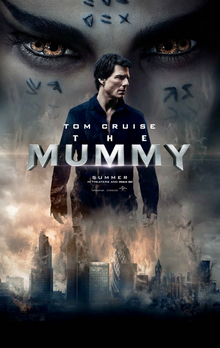
Horror Film Review: The Mummy (dir by Alex Kurtzman)


Oh, where to start?

The Mummy was promoted as being the first entry in Universal’s new Dark Universe, a shared cinematic universe that would supposedly do for the classic monsters what the MCU did for super heroes.  (Of course, horror fans with a good memory remember that Dracula Untold was originally supposed to be the first part of the Dark Universe franchise but, after that film bombed with both critics and audiences, Universal announced, “We were just kidding.  The Dark Universe starts with The Mummy.”)  The Mummy was released in June and it got absolutely decimated by critics.  That wasn’t too surprising.  One could tell from the commercials that, even with 2017 being a good year from horror, The Mummy was not going to be a critical favorite.  But then, audiences rejected it as well, throwing the whole future of the Dark Universe franchise into limbo.

To be honest, I think The Mummy could have been a fun little movie if it had only been 90 minutes long and hadn’t gotten bogged down with all that Dark Universe nonsense.  There are a few moments that actually do work, though they are few and far between.  The film stars Tom Cruise, who is a veteran at handling nonsense and who gives a somewhat lighter version of his standard Mission Impossible performance.  Jake Johnson shows up as a talking corpse and he has a way with a sarcastic line.  Some of the special effects are effective, though The Mummy is often far too dependent upon them.

The plot is damn near incoherent and it didn’t take long for me to give up on trying to follow it.  The film started with a bunch of crusaders moving in slow motion and then it jumped forward to modern-day Iraq, where Sgt. Nick (Cruise) and Cpl. Chris (Johnson) uncovered an ancient tomb.  Apparently, opening the tomb unleashes Princess Ahmanet (Sofia Boutella), who is thousands of years old and is still alive because she was cursed to be both immortal and buried alive.  So, now, she’s free and apparently, she wants Nick to merge with Set, the Egyptian god of all things evil.  But Nick doesn’t want to be evil.  He just wants to save the lives of Chris and Jenny (Annabelle Wallis), an archeologist who basically has the same role that Natalie Portman had in the first Thor film.

Meanwhile, Russell Crowe is wandering around as Dr. Jekyll.  This is where the whole Dark Universe things kicks.  Dr. Jekyll is in charge of this secret organization that keeps tabs on all the paranormal stuff that’s happening in the world.  However, if Dr. Jekyll doesn’t regularly get his injection, he turns into evil Mr. Hyde.  In this movie, that means that Crowe suddenly starts talking with a cockney accent.  I’m assuming that, much like Samuel L. Jackson did for the MCU, Russell Crowe is meant to link all of the Dark Universe films together.  Of course, the difference is that the early MCU films usually only had Jackson show up at the end of the movie, often in a post-credits scene.  Crowe, on the other hand, pops up out of nowhere, takes over a huge chunk of the film, and then vanishes.  I was already having enough trouble trying to keep up with the Mummy’s schemes without having to deal with a random Mr. Hyde sighting.

The Mummy is a mess.  When it starts, it’s a likable mess, with Cruise and Johnson exchanging silly lines.  But then the movie gets caught up in trying to launch a franchise and it all goes downhill from there.  There’s even a scene where Ahmanet stands in the middle of a London streets and starts throwing cars around.  It’s such an MCU scene that I was surprised Robert Downey, Jr. didn’t come flying by.  If The Mummy had just been a content to be a silly monster movie, it could have been fun.  But instead, The Mummy tried to launch an entire universe and it just wasn’t up to the task.

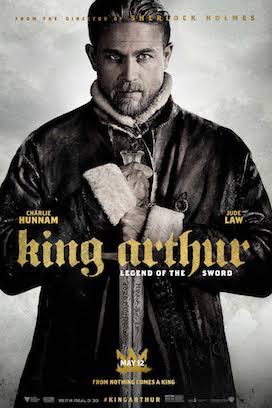
Quick Review: King Arthur – Legend of the Sword (dir. by Guy Ritchie)


KingArthur-LegendoftheSwordUsually, when I go to the movies, I either eat before I get there, or after the movie is done. This way, I don’t have to get up at all and miss anything. If it’s a film I’ve seen before, I’ll take the weakest part to use as a bathroom / food break, if I have to go. It’s one way I can tell if I like what I’m watching.
I got up twice for King Arthur: Legend of the Sword. Once to go downstairs and get a popcorn and drink, and a second time for a free refill. I even left my stuff behind in my chair for anyone to take on the second trip out. That’s how low my interest in this film fell after about 30 minutes in. I trusted the fates not to have someone steal my motorcycle jacket (keys, gear and all) to take a break from this film.

This may not be the best review to read about King Arthur: Legend of the Sword.

The Arthurian Legend has been captured in film a number of times. The Last Legion, First Knight, Monty Python and the Holy Grail, Excalibur (my personal favorite), and most recently, Antoine Fuqua’s King Arthur starring Clive Owen. There’s nothing wrong with a retelling of the story, but Guy Ritchie’s King Arthur: Legend of the Sword is all over the place and feels like it has nothing to do with the legends. This isn’t anything against Ritchie. I own Rock-N-Rolla and Sherlock Holmes: A Game of Shadows and I loved Snatch. King Arthur was just off to me. Even the Sherlock Holmes films seemed more grounded than this one does. None of the actors are truly able to save this film, and a few people actually left in the middle of my showing. It’s not the worst thing I’ve ever watched, but Ritchie’s made better films than this.

Granted, I didn’t really walk in with a lot of expectations. The film had it’s release date changed, being sandwiched right between Guardians of the Galaxy Vol. 2 the week before and Alien: Covenant the week after. It really didn’t have a chance, though I thought maybe it could at least hold the weekend. On the other hand, the movie did feel like a lot of the sword and sorcery films I grew up with in the ‘80s, such as Hawk The Slayer, Beastmaster, Ridley Scott’s Legend, The Sword & the Sorcerer, hell, even Barbarian Queen. In that sense, I might say that the film holds up. If you’re not trying to compare it with anything Arthur/Camelot related, you may actually enjoy it.

Legend of the Sword is the story of Arthur (Charlie Hunnam), who needs to save his land from the evil King Vortigern (Jude Law) after reclaiming the great sword Excalibur. I could say more, but I’d give too much away. He’s aided by his friends, Sir Bedivere (Djimon Hounsou) and Goosefat Bill (Aidan Gillen), along with a Mage (Àstrid Bergès-Frisbey) that takes the place of Merlin, who’s absent here. Everyone’s performances are okay, particularly Law and Gillen, who chew up any scene they’re in. Hunnam does just as good with what he’s given, but his Arthur is a bit of an ass at the start. Everyone seems to enjoy what they’re doing here. Even David Beckham gets a moment as a henchman. Of them, the only character I really cared about was Goosefat Bill. Aiden Gillen can play the hero, and play one well.

To his credit, Guy Ritchie’s direction is as quick and sharp as it ever was. When there’s action, it’s fast and fluid. You’ve got great running sequences, and giant CGI animals. Even the swordplay is fun, particularly when Excalibur is involved (those are really the best parts). It’s stylish, and looks awesome in some scenes. The dialogue is rapid, with quick cuts along whole segments. It’s what we’ve come to know and expect from Guy Ritchie. Though it worked well for his modern crime films, it come across as being a little disjointed here. I was hoping for King Arthur, not Underworld Boss Arthur who could be Robin Hood, along with his would be Merry Men of Sherwood Forest.

While I’m not saying that every element of the Arthur tale needed to be expanded upon, Legend of the Sword suffers from a few jump cuts that say “Don’t worry about all of this info, just know we reached point B from point A.” It’s efficient, but also turns the entire tale into a Cliffs Notes / Wikipedia summary. The film moves that quick. The film is peppered with these abbreviations that’s supposed to move the narrative along, but does this so fast that you almost have a tough time believing this movie was actually 2 hours long. I’m not asking for Hamlet, but at least allow your characters to flourish or grow or gain something about them that’s endearing. I’ll also admit to having a short attention span, it’s not that short that it requires quick-cut bursts to keep me enthralled.

Overall, King Arthur: Legend of the Sword was a miss for me. If you have to catch it, you may want to wait for the VOD edition.

Horror Film Review: Annabelle (dir by John R. Leonetti)


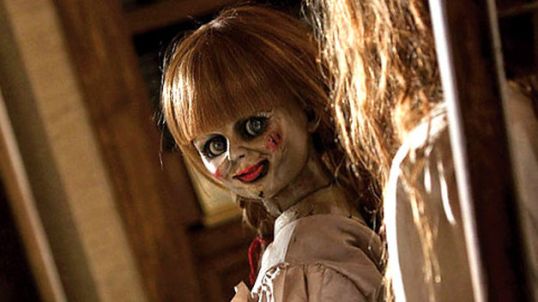
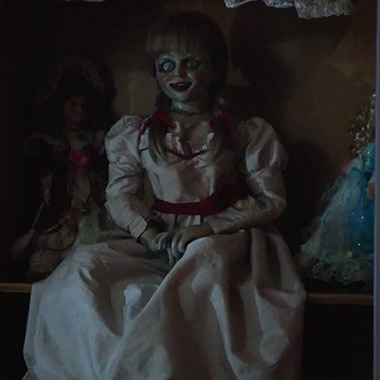
Annabelle

Remember Annabelle, the tres creepy doll from The Conjuring?

Well, she’s back and she’s starring in a film of her very own!  Annabelle is the first horror film to be given a wide release this October and, judging from the commercials, New Line Cinema and Warner Bros. are really hoping that you’ll remember just how scary and effective The Conjuring was when it comes time to decide whether you want to see Annabelle or Gone Girl this weekend.

Of course, Annabelle actually have very little do with The Conjuring.  Though Father Perez, the token concerned priest played by Tony Amendola, mentions Ed and Lorraine Warren, neither one of them actually appears in the film.  Neither do any of the other characters or ghosts from The Conjuring.  The only link between the two films is that doll.

Taking place in 1969, Annabelle is an origin story of sorts.  Doctor John Gordon (Ward Horton) buys a doll for his pregnant wife, Mia (Annabelle Wallis).  The doll looks evil from the minute that Mia unwraps it but, according to the film, it was actually harmless until a psychotic hippie girl (Tree O’Toole) bled on it.  That blood seeped into the doll’s eye and the next thing you know…

Annabelle2

No,  I’m not going to spoil it for you.  In fact, it’s really not necessary for me to spoil it for you because I imagine you can probably guess everything that’s going to happen.  If you’ve ever seen a haunted house film, you know exactly what’s going to happen when John goes to work and Mia gets left in the house alone.  If you’ve ever seen a demonic possession film, you can guess what’s going to happen when Mia happens to stumble across the occult book store next door.  And, if you’ve ever seen any film, you can guess that the book store is managed by a sassy mystic played by Alfre Woodard.

That’s right!  There’s nothing surprising about Annabelle!

But that’s not necessarily a bad thing. Horror films are unique in that they often times actually benefit from being so predictable.  You watch in dread because you know that something terrible is going to happen even though the characters in the film do not.  You know enough to yell, “Don’t open that door!” but the characters in the film don’t.  That’s exactly what makes a film like Annabelle scary.

The Conjuring, I thought, was not only a great horror film but it was also one of the best films of 2013.  That’s because, along with being a scary movie, The Conjuring also dealt quite intelligently with very real issues of faith and family.  The Conjuring was fun to watch because it was scary but it stayed with you because it was full of subtext.  Annabelle, on the other hand, is a film without subtext.  Everything important about Annabelle can be found right on the surface.

Annabelle is a film that exists solely to scare you and how much you enjoy it will probably depend on how much you enjoy  horror films to begin with.  The shock scenes are handled well, with an emphasis on sudden noise on the soundtrack and intimidating shadows appearing in the background.  Everything that distinguished The Conjuring — the attention to detail, the lively performances, and the imaginative plotting — has been pushed to the side to make room for the next scare.

As a result, Annabelle is one of those films that makes you jump while you’re watching it but doesn’t stick around in your head afterwards.  If you’re a fan of the horror genre and like a good scare, you’ll probably find something to enjoy in Annabelle.  (It’s no Devil’s Due but it’s still better than the latest Paranormal Activity film.)  If you’re not a horror fan — well, then you probably weren’t planning on seeing Annabelle in the first place.

1408696589_annabelle-oo4