Retro Television Review: Miami Vice 4.2 “Amen …. Send Money”


Welcome to Retro Television Reviews, a feature where we review some of our favorite and least favorite shows of the past!  On Mondays, I will be reviewing Miami Vice, which ran on NBC from 1984 to 1989.  The entire show can be purchased on Prime!

This week, Miami Vice takes an unwelcome detour.

Episode 4.2 “Amen …. Send Money”

(Dir by James Quinn, originally aired on October 2nd, 1987)

This was pretty dumb.

Tubbs, working undercover, busts Leona Proverb (Anita Morris), who just happens to be the wife of Billy Bob Proverb (Brian Dennehy).  Billy Bob is a television preacher who continually asks his followers to send him cash so he can live the lifestyle that he says God wants him to live.  On paper, this sounds like a great role for Brian Dennehy but this episode’s script lets him (and, for that matter, everyone else in the cast) down.  Somehow, the fact that the guy is named Billy Bob Proverb is the least heavy-handed aspect of this episode.

Faye Nell (Jo Anderson), who is one of Billy Bob’s followers, calls Tubbs to the studio and says she has information on what the Proverbs are doing.  As soon as Tubbs shows up, Faye tosses herself on him, rips her dress, and starts to yell, “Rape!”  Tubbs finds himself being investigated by Internal Affairs while Faye claims that God told her to call Tubbs down to the studio and she even passes a lie detector test.

“I’m being set up by a preacher!” an angered Tubbs says but it turns out that Billy Bob Proverb is not the one behind all of Tubbs’s problems.  In fact, Billy Bob is actually sincere, in his own strange way.  Instead, the villain turns out to be another television preacher, Mason Mather (James Tolkan).  Mather has the ability to make himself go into a coma, which makes it difficult to arrest him.

Before I started watching this season, I read online that season 4 featured some of Miami Vice‘s worst episodes.  Amen …. Send Money feels almost like a parody of Miami Vice.  The episode itself is meant to be largely comedic and perhaps if this episode had centered on Switek and Zito instead of Crockett and Tubbs, it would have worked.  Unfortunately, the show killed off Zito last season so instead, it’s Crockett and Tubbs making odd jokes and rolling their eyes in shock.  The thing is, Miami Vice has — up until this episode — been a show about ruthless dealers and the futility of the War on the Drugs.  The thing that set Miami Vice apart from other 80s cop shows was that it was thematically dark, the endings were frequently unhappy, and Crockett and Tubbs were always the epitome of cool, no matter what happened.  This episode features cartoonish villains and a silly plot and both Crockett and Tubbs come across as being a little …. well, dorky.

(On the plus side, the show does continue its tradition of featuring future stars by giving Ben Stiller a small role as a con artist.)

Oh well.  Not every episode can be a great one.  Hopefully, next week will be an improvement.
RUTHLESS PEOPLE (1986) – In remembrance of Jim Abrahams


It made me sad when I saw that writer/director Jim Abrahams had passed away on November 26, 2024 at 80 years of age. Growing up in the 1980’s, Mr. Abrahams is responsible for some of my favorite comedies. AIRPLANE, TOP SECRET, and THE NAKED GUN would not exist without Jim Abrahams. As much as I love all of those movies, my personal favorite film that Jim Abrahams co-directed is RUTHLESS PEOPLE. I remember when our family rented this film and watched it in the ‘80’s. We thought it was so funny. I specifically remember my mom laughing out loud on multiple occasions as the ridiculous scenario played out. That was a fun movie night in the Crain household. 

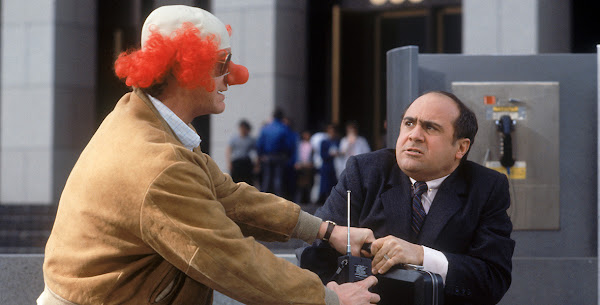
RUTHLESS PEOPLE is about a rich businessman named Sam Stone (Danny DeVito) who truly hates his wife Barbara (Bette Midler), and hatches a plan to kill her so he can inherit her money. Unfortunately he runs into a couple of problems. First, his mistress Carol (Anita Morris) knows about the plan, so she and her dimwitted boy toy Earl (Bill Pullman) want to film Sam dumping his wife’s body so they can blackmail him for millions. Second, before Sam can execute his plan, Barbara is kidnapped and held for a ransom of $500,000 by Ken and Sandy Kressler (Judge Reinhold and Helen Slater). It seems that Sam stole Sandy’s idea for the spandex miniskirt, screwed them out of millions with a handshake deal, and then kept the money for himself. This seems like an answer to prayer at first for Sam because they threaten to kill Barbara if he doesn’t meet their needs or if he calls the police or the media. After saying no to their demands, and then immediately calling the police and the news, Sam realizes that they don’t want to kill her when they keep coming back with lower demands. Sandy tells Barbara that Sam refuses to pay even $10,000 for her safe return. Eventually the kidnappers and Barbara join together to try to take the unfaithful and unethical Sam for everything he’s worth!! 

RUTHLESS PEOPLE is one of my favorite comedies of the 1980’s. It has such a great cast. Danny DeVito and Bill Pullman are especially hilarious and have some of the film’s best lines. At the time the movie came out in 1986, DeVito was already established as a master of comedy, so Pullman’s performance as Earl, the dumbass Sonny Crockett wannabe, was the real revelation to me. Pullman made his film debut in RUTHLESS PEOPLE, and I never see him to this day that I don’t think of his character Earl’s excitement over the prospect of his newfound blackmail money:

“And then we’re off, to Haiti!”

“It’s Tahiti, you moron!”

One of the most interesting things about RUTHLESS PEOPLE is just how different it is from the directing trio’s (Zucker / Abrahams / Zucker) other popular films like THE KENTUCKY FRIED MOVIE and AIRPLANE. Those films are based on non-stop visual and verbal gags. I love those films, but this is quite different. The comedy of RUTHLESS PEOPLE is based on the story itself, which is a comedy of confusion, coincidence, and character. I know it’s awesome because I still think of the film often. “Give the bag to bozo” and “a little poke in the whiskers” are phrases I’ll remember up to the point I go to my grave. 

Even though the film is almost 40 years old, if you’re looking for a laugh, I don’t think you can do much better than RUTHLESS PEOPLE. 

Holiday Film Review: Little Miss Millions (Dir by Jim Wynorski)


A Jim Wynorski Christmas movie!?

Yes, there is such a thing.  First released in 1993, Little Miss Millions tells the story of a cynical but good-hearted private investigator named Nick Frost (Howard Hesseman) who is hired to track down a 9 year-old runway named Heather (Jennifer Love Hewitt, making her feature debut at the age of 12).  Nick is hired by Heather’s stepmother, Sybil (Anita Morris), who only wants Heather back because she’s worth several million dollars.  After Sybil hires Nick, she also decides to frame him for kidnapping Heather so that she can both get back her stepdaughter and get out of having to pay any reward money.  Soon, Nick has two federal agents (played by James Avery and Robert Fieldstell) on his trail.  For her part, Heather just wants to find and live with her birthmother, Susan (Terri Treas).

It’s a pretty simple film, one that borrows heavily from It Happened One Night (minus the romantic element, of course) and every single Christmas film that has ever been made.  This is one of those rather corny family films where you will pretty much be able to guess everything that is going to happen before it happens but that’s not necessarily a bad thing.  It’s a holiday film and no one watches a holiday film to get depressed.  They watch holiday films for the sentimental moments and the heart-warming comedy and the moments that create an idealized portrait of life during the holiday season.  For all of the violence to be found in them, both Die Hard and Die Hard 2 end with John McClane being reunited with his wife for the holidays.  As dark as It’s A Wonderful Life occasionally is, it still ends with that bell ringing and Clarence getting his wings.  Miracle on 34th Street never answers for sure whether or not Kris Kringle is who he says he is but Natalie Wood still gets her house with a tree in back.  A Christmas Story‘s Ralphie does not shoot his eye out.  Lethal Weapon‘s Riggs finds a new family.  And don’t even get me started on Santa Claus Conquers The Martians.  We watch holiday movies for holiday cheer and, in its unpretentious way, Little Miss Millions is full of that cheer.

Of course, it’s still a Jim Wynorski film.  So, while this is definitely a family film without many of the things that are typically associated with the Wynorski brand, Little Miss Millions still finds time for a sudden rainstorm that leaves everyone drenched.  And, of course, Nick and Heather stop off at a biker bar that is inhabited by Rick Dean, Toni Naples, and wrestler Queen Kong.  Peter Spellos, who played the much-abused Orville Ketchum in Sorority House Massacre 2 and Hard To Die, shows up as a bus driver.  It’s still a Wynorski film but it’s also a sweet-natured film, featuring likable performances from Howard Hesseman and Jennifer Love Hewitt.  It’s not a holiday classic but it’s diverting enough for those looking for something with which to pleasantly pass the time.

A Movie A Day #191: Blue City (1986, directed by Michelle Manning)


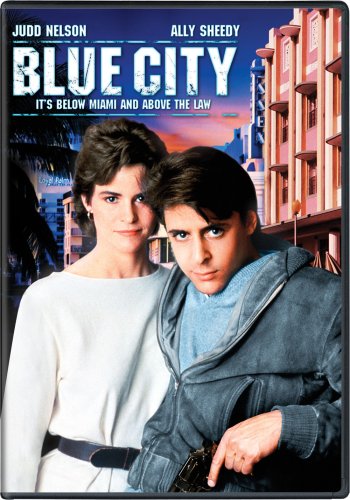
Billy Turner (Judd Nelson) has always been the bad boy but now he just wants to return to his Florida hometown and reconnect with his estranged father.  As soon as he rolls into town, Billy gets into a bar brawl and is arrested.  The chief of police (Paul Winfield) informs Billy that his father has been murdered and that his stepmother has since married the local gangster, Perry Kerch (Scott Wilson).  Everyone knows that Perry murdered Billy’s father but no one can prove it.  He is told to get out-of-town but Billy’s not going out like that.  Instead, he gets together with his childhood friends, gimpy legged Joey (David Caruso) and Annie (Ally Sheedy), and seeks his revenge.

No, it’s not a picture of Judd Nelson hanging out with the a member of the Heaven’s Gate cult.  It’s the DVD cover for Blue City.

An infamous flop, Blue City was meant to show that the members of the infamous Brat Pack could play serious, adult roles.  Unfortunately, Blue City was released right at a time when everyone was starting to get sick of the Brat Pack.  (Even John Hughes had moved on, casting Matthew Broderick as Ferris Bueller, instead of Anthony Michael Hall.)  After countless magazine covers and the monster success of The Breakfast Club and St. Elmo’s Fire, a backlash was brewing and Blue City walked (or, in Joey’s case, limped) straight into it.

It also did not help the film’s prospects that it matched up the least interesting Brat Packer, Judd Nelson, with the member of the Brat Pack most likely to take herself too seriously, Ally Sheedy.  Playing roles that would have been played by Alan Ladd an Veronica Lake in the 40s, both Nelson and Sheedy are miscast and, strangely considering this was their third film together, have no chemistry.  Nelson, in particular, gives one of the most annoying performances in film history.  He never stops smirking, even when there is no reason for Billy Turner to be smirking.  With his wide-eyed stare and his attempts to speak like a tough guy, Nelson comes across like John Bender auditioning for West Side Story.  The scene where he manages to floor Tiny Lister with one punch is simply beyond belief.

When Judd Nelson can beat you up, there is only one thing left to do:

Thanks, Duke.

On a more positive note, David Caruso, long before he could usher in the Who by simply putting on his sunglasses, is better cast as Joey but there is nothing surprising about what eventually happens to him.  The best performance is from Scott Wilson, showing why he used to always play villains before reinventing himself as Herschel on The Walking Dead.  Wilson was so good that I realized, halfway through Blue City, that I actually would not have minded if he succeeded in killing Billy.

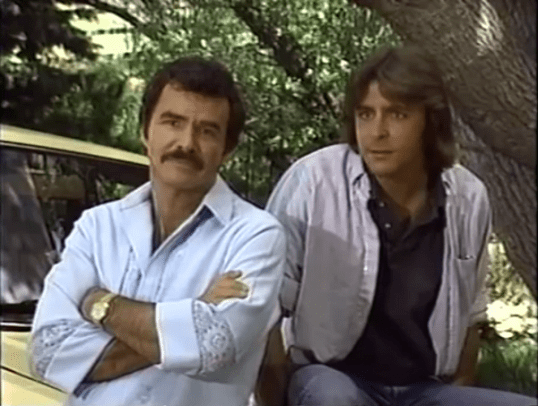
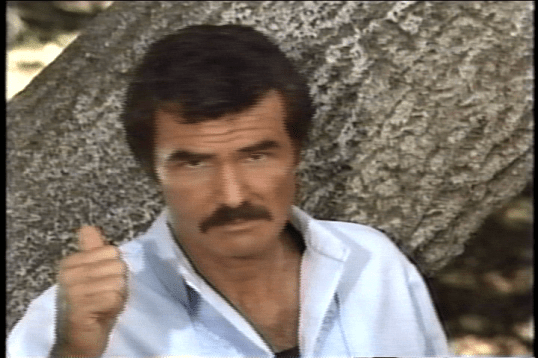
The most disappointing thing about Blue City is that it is a Florida noir from the 80s that somehow does not feature even a cameo appearance by Burt Reynolds.  Couldn’t Judd have taken just a few seconds during the filming of Shattered: If Your Kid’s On Drugs to convince Burt to drop by Blue City?

They could have used the help.