14 Days of Paranoia #2: Extreme Justice (dir by Mark L. Lester)


What type of justice?

Extreme justice, y’all!

In this 1993 film, Lou Diamond Phillips stars as Jeff Powers.  Who is Jeff Powers?  He’s a cop!  He wants to keep the street safe!  Sometimes, he knows that you have to be willing to break the rules!  He’s a cop who does things his way!

Okay, is that enough exclamation points?  I’m not just using them to be obnoxious.  The film is pretty much just one big exclamation point.  The action is hyperintense and the film is full of characters who always seem like they’re just one step away from exploding.  No one in this film is particularly calm or laid back.  From the start, everything is dialed to eleven and it just keeps going higher and higher.

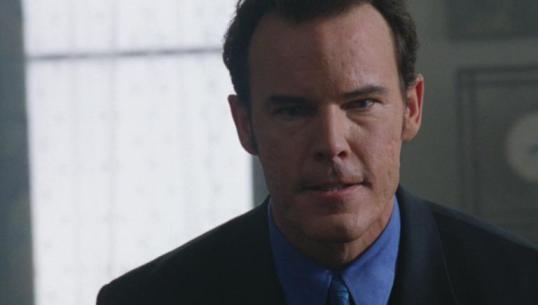
After Jeff is put on probation for roughing up a suspect, he receives an invitation to join an elite squad of detective.  Led by the charismatic Detective Dan Vaughn (Scott Glenn, giving a performance that is so over-the-top that he yells straight at the camera at one point), the Special Investigative Section is the best of the bed.  Upon joining, Jeff finds himself a member of a sacred fraternity of law enforcers.  Working with men like the always amused Detective Larson (Yaphet Kotto) and the somewhat paranoid Angel (Andrew Divoff), Jeff finds himself tracking some of the biggest criminals in the city.

What Jeff also discovers is that SIS does more than just arrest criminals.  The SIS has been given an unofficial license to kill and they end up executing as many people as they take to jail.  Often times, Vaughn will tells the men to allow a crime to be committed so that they can then dispense their own brand of justice.  In the film’s most disturbing scene, the members of SIS wait until after a woman has been raped in an alley before they move to neutralize her attackers.  When Jeff finally decides that he can’t be a part of all this and tries to reveal what’s going on, he discovers that the SIS has some support in some very high places.  Who cares if the SIS is allowing crimes to be committed or if an innocent person occasionally gets caught in the crossfire?  At least they’re taking care of the criminals!

Extreme Justice is a crude and energetic film and one that is based on some of the stories that spread about the LAPD’s RAMPART division in the 90s.  That the film works is a testament to the performances of Phillips, Kotto, and Glenn and also the direction of Mark L. Lester.  An exploitation vet who occassionally made big studio action films as well, Lester keeps the pace moving at breakneck speed and, even more importantly, he allows both sides to have their say.  While Jeff is upset about SIS’s methods, Detective Vaughn is correct when he says that his unit is targeting the worst of the worst.  It makes for an unusually intelligent exploitation film, one that leaves the audience with a lot to consider.  How far would you go to keep your neighborhood safe?

Previous entries in 2025’s 14 Days Of Paranoia:
  1. The Fourth Wall (1969)

Horror Scene That I Love: The Wishmaster grants a wish in Wishmaster 2


I can’t let this Horrorthon pass without sharing a scene featuring one of my favorite horror movie characters, the Whishmater (Andrew Divoff)!

In the scene, from 1999’s Wishmaster 2, our favorite literal-minded Djinn grants another wish to someone who did not choose his words carefully.  Andrew Divoff really makes this scene work.  That smile is a thing of terrifying wonders.

Scenes That I Love: The Wishmaster Meets A Security Guard In Wishmaster


Today, the Shattered Lens wish a happy birthday to character actor Andrew Divoff!

Today’s scene that I love comes from 1997’s Wishmaster and features Divoff in his best-known role.  The Wishmaster films were kind of silly but Divoff always made them worth watching.

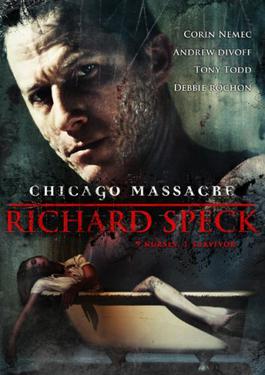
October True Crime: Chicago Massacre: Richard Speck (dir by Michael Feifer)


Richard Speck was the worst of the worst.

A petty criminal-turned-drifter, Richard Speck fled Texas to avoid being sentenced to prison for his part in a grocery store robbery.  He eventually ended up in Chicago, where he lived with his sister and her husband and found occasional work as a seaman.  When he couldn’t get work on a boat, the alcoholic Speck supported himself by mugging and burglarizing.  It’s not known when he committed his first murder, though it is suspected that it occurred back in Texas.  It is known that, in July of 1966, Speck’s sister and brother-in-law finally got sick of dealing with him as a houseguest and Speck ended staying in a series of rooming houses and homeless shelters.  On July 13th, the 24 year-old Speck mugged and raped at 53 year-old woman before then breaking into a townhouse that was occupied by nine student nurses.  Over the course of the night, he raped and murdered eight of nurses.  The only survivor hid underneath a bed until Speck left.  She later told police that Speck spoke with a soft Southern accent, had an acne-scarred face, and a tattoo that read Born to Raise Hell.

It was the tattoo that led to his capture.  Two days after the murders, with the city of Chicago in an uproar and the police launching a city-wide manhunt to catch the killer, Richard Speck attempted to kill himself by slitting his wrists.  He was taken to Cook County Hospital, where Dr. LeRoy Smith saw Speck’s tattoo and called the police.

Though protesting his innocence, Speck was convicted of the murders and sentenced to die.  He was spared the death sentence when the Supreme Court briefly outlawed capital punishment.  From prison, Speck eventually admitted that he had killed the nurses but he claimed that he was so drunk and high that he had no idea what he was doing.  After Speck died of heart failure in 1991, a videotape would emerge of a cocky Speck telling his fellow prisoners that he knew exactly what he was doing and he never felt a bit of guilt.  “Just wasn’t their night,” was Speck’s explanation for why the murders happened.  Speck also said that if the public knew how much fun he was having in prison, they would have released him for sure.  Richard Speck is the type of evil specter who seems to exist to specifically challenge those of us who are opposed to the death penalty.  If anyone has ever deserved to be executed in the most painful way possible, it was Richard Speck.

The 2007 film Chicago Massacre stars Corin Nemec as Richard Speck and the film’s makeup department deserves a lot of credit for transforming the handsome and normally quite personable Corin Nemec into the horribly poc-marked Richard Speck.  Sometimes, monsters truly do look like monsters and that was definitely the case of Speck.  Nemec plays Speck as being a natural-born deviant, a soulless sociopath who has no control over his impulses and who never seems to understand why the world is so disgusted by his crimes.  It’s a truly frightening performance.

The rest of the film is a flawed and heavily fictionalized account of Speck’s crimes, imagining that Speck was actually a casual acquaintance of one of the nurses that he killed and suggesting that she was the main reason why he broke into the townhouse to begin with.  The history nerd of me cringed when a police chief (Tony Todd) announced that his lead detective (Andrew Divoff) only had two days to solve the murders because the Democratic Convention was coming up.  (Speck committed the murders in 1966, two years before the Democrats came to Chicago for their ill-fated convention.)  Todd’s police chief says that he’ll be forced to sweep the murders under the rug if they’re not solved quickly but I’m not really sure how that would happen, given the enormity of the crime and the panic that reportedly swept through Chicago as a result.  As much as I hate to single out any one performer for criticism (because I usually assume that a bad performance has more to do with the director and the editor than the actor), Joanne Chew, cast in the role of the sole survivor of Speck’s rampage, delivers her dialogue so awkwardly that it sabotages what should have been some of the strongest moments of the film.  (Then again, even the best actress would perhaps be challenged by a line like, “I will look the devil in the eye.”)

Filled with flashbacks to both the murder of the nurses and Speck’s life as Texas criminal, Chicago Massacre is an undeniably icky film but given that it’s about Richard Speck, it really should be.  When it comes to a criminal like Richard Speck, it’s always tempting to try to look at his life for clues as how to prevent a future Richard Speck from committing a similar crime.  But, with Speck, there’s little to be learned beyond the fact that he did what he did because he had no conscience or sense of guilt to mitigate his impulses.  Speck had a terrible childhood but many people have had terrible childhoods without turning into mass murderers.  Speck was mentally unwell but many people deal with their mental health without turning into mass murderers.  In the end, he was a monster.  Thankfully, he was also enough of a dumbass to get a tattoo that made it impossible for him to hide from his crimes.

Horror Scenes That I Love: Andrew Divoff in Wishmaster


Andrew Divoff is a talented character actor who has been making films since 1986.  He’s been played a countless number of different characters, some of whom are villainous and some of whom are sympathetic.  On Lost, he was the most menacing of the Others.  That said, for a certain generation of horror fans, Andrew Divoff will always be known for starring as the tricky Djinn in the Wishmaster films.

In this scene, from 1997’s Wishmaster, The Djinn finally confronts Alexandra (Tammy Lauren) and grants her wish to see the Djinn as he truly is.  In the hands of Andrew Divoff, the Djinn becomes a truly classic horror movie villain.  Who can ever forget the gleam in his eye when he asks, “Is this something that might interest you?”

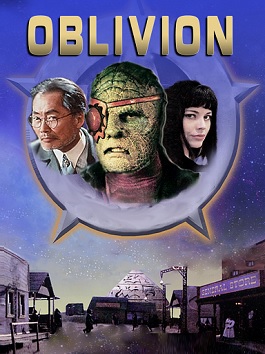
Oblivion (1994, directed by Sam Irvin)


In the far, far future, Earth has set up colonies all across the universe.  One of those colonies is the dusty town of Oblivion, which looks just like an old west town except the deputy is a cyborg and there’s an ATM outside the saloon.  A humanoid lizard named Red Eye (Andrew Divoff, covered in green scales) comes to town and kills the marshal.  Red Eye and his gang take over Oblivion, planning to turn it into their own personal pleasure palace.

The marshal’s son, Zack (Richard Joseph Paul), comes to town for the old man’s funeral.  Everyone thinks that Zack is a coward because he refuses to avenge his father’s death.  Zack, however, is no coward.  He’s just an empath who can’t handle the negative emotion that are generated by violence.  But seeing as how his father is dead, his best friend Buteo (Jimmie F. Skaggs) is being tortured in the town square, and lovely Mattie Chase (Jackie Swanson) wants Red Eye and his gang to get out of town, Zack knows that he’s going to have to do the right thing and conquer his empathy.

Oblivion is a haphazard mix of comedy, science fiction, and the western genre.  Some of the ideas come close to being clever but it never makes sense why an Earth colony in 3031 would resemble a one-horse town from a singing cowboy movie.  (The film probably would have worked better if it had been about Red Eye invading an actual Old West town in the 1800s instead of a colony designed to look like one.)  Andrew Divoff is entertaining as he hams it up as the main desperado but, as far Old West charisma is concerned, Richard Joseph Paul is no John Wayne or Henry Fonda.  Quite a few familiar names were somehow roped into appearing in this low-budget space oater, though most of them only appear for a few minutes and don’t contribute much to the overall story.  George Takei plays the alcoholic town doctor.  Julie Newmar is Miss Kitty, the owner of Oblivion’s “social” club.  In a nod to her most famous role, Newmar hisses at Red Eye and his gang but that’s all she gets to do.  It feels like a waste of a cameo.  Isaac Hayes and Meg Foster also make appearances, though again neither really gets to do anything interesting.

The idea of a space western isn’t a bad one and there actually have been a few good ones.  (Outland, for example.)  But Oblivion can never escape the drag of its low budget and its bland lead.

Film Review: The Stranger (dir by Fritz Kiersch)


In the desert of Arizona, there sits a town.

That town is named Lakeview, despite the fact that there is no lake nearby.  There aren’t many buildings in the town.  There’s a service station.  There’s a diner.  There’s a sheriff’s office.  There’s a general store.  There are a few houses.  Lakeview is a place that people rarely visit and which no one can escape.

There is a sheriff.  His name is Cole (Eric Pierpoint) and he spends most of his days in an alcoholic stupor.  He’s been depressed ever since his girlfriend, Bridget, was murdered.  Now, Bridget’s younger sister, Gordet (Robin Lyn Heath), is living like a feral animal while the local shopkeeper, Sally (Ginger Lynn Allen), is determined to have Cole for herself.  Cole’s deputy (Ash Adams) is in love with Sally and wants Cole’s job for his own.  That’s a lot of drama for a small town.

Of course, the real drama in Lakeview comes from the fact that the town is run by a group of bikers!  The head biker is named Angel (Andrew Divoff).  By terrorizing the citizens, Angel and his gang make their own wishes come true without ever asking anyone else if that’s something they would be interested in.  Cole is too drunk and depressed to stand up to them.  The other townspeople are …. well, I don’t know what their problem is.  One assumes that they have to be tough, as they’re living in a harsh and inhospitable desert.  But none of them them are willing to stand up for themselves.  Maybe they’ve recently moved to Arizona from California and they’re not used to the idea of self-defense.  But, for whatever reason, Angel controls Lakeview.

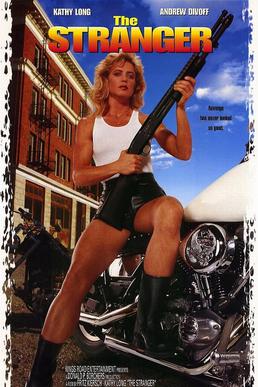
But then the Stranger (Kathy Long) rides up on her motorcycle.  Dressed in black leather and wearing a corset that looks like it would actually be really uncomfortable in the desert heat, The Stranger has no name but she does know how to kick ass.  She has come to kill all the members of Angel’s gang.  Unfortunately, the majority of the gang is out-of-town when The Stranger arrives.  So, the Stranger waits in Lakeview and kills who she can.  The townspeople, led by Sally, want her to leave before things get too violent.  Meanwhile, Cole comes out of his drunken stupor just long enough to notice that the Stranger looks a lot like his dead girlfriend….

1995’s The Stranger was an attempt to a modern-day spaghetti western, with a woman playing the type of mysterious figure who would traditionally have been played by Clint Eastwood or Charles Bronson.  That, in itself, is a pretty good idea.  Unfortunately, The Stranger itself is abysmally paced and the filmmakers seem to have overlooked that, in the best spaghetti westerns, the silent, nameless heroes were usually paired with a more talkative (and often much more amusing) partner.  The Good, The Bad, and the Ugly had Eli Wallach.  Once Upon A Time In The West had Jason Robards.  In The Stranger, there’s not really anyone around to fill that role.  (Cole is too full of self-pity to be amusing.  Gordet spends most of the movie running from one abandoned car to another.)  As such, The Stranger becomes fairly grim and slow.  Things are only livened up when The Stranger beats people up.  Kathy Long was a kickboxing champion and she’s strong enough in the action scenes that it makes up for the fact that she doesn’t have a particularly compelling screen presence.  She and Eric Pierpoint also have next to no romantic chemistry, making the whole question of whether or not she’s Bridget’s ghost seem a bit moot.

The best reason to see the film is to watch Andrew Divoff play Angel.  Divoff is always a good villain and he’s memorably unhinged in The Stranger.  Unfortunately, he’s not in the film as much as the viewer might hope.  Watching the film, I half expected the Wishmaster to ask if I wanted Andrew Divoff’s role to be larger.  I would have said no while thinking yes.  You know how that Wishmaster is.

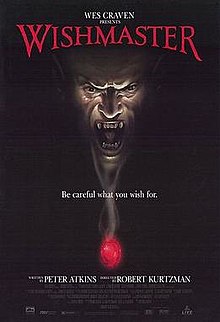
Horror Film Review: Wishmaster (dir by Robert Kurtzman)


Do you all remember Wishmaster?

Played by Andrew Divoff, the Wishmaster was a genie (or a djinn) who made his film debut in the 1997 film of the same name. The Djinn’s schtick is to randomly approach people and say something like, “Would you like to be rich?” or “Would you like all of your enemies to suffer?” He grants wishes but he does so in ironic ways. So, if you say want to be rich, you might very well turn into someone named Rich who is on the verge of getting hit by a bus. If you say that you want to escape from your mundane life, you might end up in a straight-jacket under water, struggling to perform one of Harry Houdini’s signature escapes.

I rewatched Wishmaster a few months ago and what I immediately discovered was the the Djinn wasn’t really that good at his job. He pretended to be clever in the way that he would fool humans but, honestly, it often seemed less like he was tricking people and more like he really wasn’t playing fair. Take the security guard who made the mistake of wishing for an escape. As I just mentioned, The Djinn immediately put him underwater in a straight-jacket. But the guard’s wish was not to have to escape. The guard’s wish was to simply escape. So, putting him in a life-and-death situation and telling him to figure it out for himself wasn’t fulfilling the guard’s wish. It just seemed like the Djinn wanted to drown someone and he decided to use his wish-granting job as an excuse.

The guard, by the way, was played by Tony Todd, one of the many horror icons who appeared in small roles in Wishmaster. (Today, Tony Todd is best known for the Final Destination films but, when Wishmaster came out, he was known for playing the Candyman.) Among the other cameos:

From Phantasm, Angus Scrimm provided the narration while Reggie Bannister played an unlucky pharmacist.

From Friday the 13th, Kane Hodder played a security guard who made the mistake of saying that he wished he could see the Djinn try to walk straight through him.

Day of the Dead’s Joseph Pilato played a crane operator.

John Carpenter vet George “Buck” Flower played an angry homeless man.

Sam Raimi’s brother, Ted Raimi, showed up long enough to get crushed by a crate.

And finally, Robert Englund played the somewhat pretentious professor who was responsible for bringing the Djinn to America in the first place.

As you can probably guess by looking at all of the cameos, Wishmaster is not a film that’s meant to be taken seriously. It’s often deliberately campy. Wes Craven may have produced it and was undoubtedly responsible for recruiting many of the actors who appeared in it but the film’s direction was handled by special effects maestro, Robert Kurtzman and he puts more emphasis on the visual effects than on any sort of serious exploration of the somewhat random series of events that make up the film’s storyline. Of course, when seen today, the film’s special effects look a bit cheap but, for many viewers (like me!), that’s actually a part of the film’s grisly charm.

Wishmaster does have a plot but it’s not particularly important. The Djinn tries to make Alexandra (Tammy Lauren) make three wishes so that he can unleash the forces of Hell. Why he spends all of his time granting wishes to other people instead of just concentrating on Alex is never really explained. It may be an often dumb movie but it’s also undeniably entertaining when taken on its own terms. Andrew Divoff is enjoyably sinister as the Djinn, playing the character with a sarcastic wit to go along with his evil schemes. It’s a fun movie to watch, even if it does feel like it was basically slapped together in a handful of days.

You should always be careful what you wish for but Wishmaster is still an entertaining piece of 90s horror.

(Author’s Note: Wow, this is embarrassing.  Right after I posted this review, I discovered that I previously reviewed Wishmaster in 2018!  Whoops!  Well, it’s nice to see that my thoughts on the film have remained consistent. — LMB)

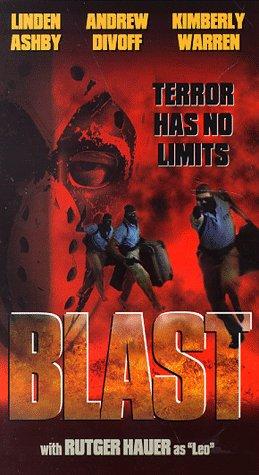
Cinemax Friday: Blast (1997, directed by Albert Pyun)


Blast opens with a title card telling us that what we’re about to see is based on a true story except that it’s not.  In the days leading up to the 1996 Atlanta Olympics, the FBI thwarted many potential terrorist plots.  Only one of the plots was a domestic terror plot.  Blast is the story of what would have happened if that plot had not been disrupted.

(What about Eric Rudolph and the Olympic Park bombing?  That’s not mentioned, probably because this film went into production before the Atlanta Olympics actually began.)

Omodo (Andrew Divoff of Wishmaster fame) is a terrorist who does evil things because he’s evil.  He and his group have taken the American Olympic swim team and their coach, Diane Colton (Kimberly Warren), hostage in an Atlanta gym.  They’re demanding money and an opportunity to escape.  The police (led by Tim Thomerson) don’t know what to do.  The FBI (represented by Rutger Hauer with braided hair) are not much help either.  Fortunately, the gym’s janitor, Jack Bryant (Linden Ashby), is a former Olympic gymnast who is a master of Tae Kwon Do!  Jack also happens to be Diane’s ex-husband!

Blast comes from us the time when every action movie was a blatant rip-off of Die Hard and we were all cool with that because Die Hard was so awesome that it deserved to be remade a thousand times.  Blast is more of the usual.  Jack sneaks around the facility, defuses bombs, and picks the terrorists off.  Omodo kills two hostages in cold blood.  Shannon Elizabeth of American Pie fame plays one of the hostages but she doesn’t get many lines beyond, “Help us!”  Why does Rutger Hauer have his hair in braids?  Because he was Rutger Hauer and everyone was probably so happy to have him on set for a few hours that they were willing to let him do whatever he wanted to do with his hair.  Rutger Hauer only gets about five minutes of screentime but he makes the most of them.

Lindsen Ashby is convincing in the fight scenes but I think the movie would have been better if he had just been an ordinary janitor, instead of a Tae Kwon Do supstar who has fallen on hard times.  That would have added some suspense to the story because, as it is, Jack is so obviously superior to his opponents that there’s never really any question as to whether or not he’s going to succeed.  Andrew Divoff is a good actor but his villain isn’t given any good lines and the people working for him are all pretty bland.  One of the best things about the first three Die Hard films was that the villains were just as interesting as the hero but the same cannot be said for Blast.

Blast is forgettable but still, five minutes of Rutger Hauer is better than no Rutger Hauer at all.

Horror Film Review: Wishmaster (dir by Robert Kurtzman)


Remember the Wishmaster films?

There were four of them and they all deal with this ancient Djinn (Andrew Divoff) who, during each film, would escape from his magical prison and then wander around granting people their wishes.  Of course, since the Djinn was evil, there was always a catch.  He would either interpret the wish very literally or he would manipulate people into asking for the wish in the wrong way.  As a result, people would always get their wish but they’d get in a way that would make them suffer.

For instance, a typical Wishmaster conversation would go something like this:

“I wish I was a better actor.”

“Am I to understand that you wish you were John Wilkes Booth?”

“Wait …. what?”

“As you wish.”

Sic semper tyrannis!”

The first Wishmaster was released in 1997 while the fourth (and, to date, last) installment was released in 2002.  They’ve never gotten as much attention as some of the other horror franchises from that period, largely because there was really only so much that you could do with a character like the Djinn.  Part of the problem was that almost every scene depended on someone not understanding the importance of being clear when making a wish.  There’s only so many times that you can watch the Djinn trick people into saying, “I wish I never get old,” before the whole novelty of it all wears off.

That said, the Wishmaster films did have one thing going for them and that was Andrew Divoff.  A veteran character actor (and one who you might recognize from Lost, where he played a member of the Others who was both Russian and who had only one eye), Divoff was always creepy as fug in the role of the Djinn.  Whenever someone made the mistake of making a wish, this little smile would appear on Divoff’s face and you knew that someone was about to learn an important lesson about being careful what you wish for.  Divoff was seriously frightening of the Djinn, so much so that you regretted that the films themselves could never quite keep up with his performance.

Last night, I watched the first Wishmaster film for the first time in six years and it was actually a little bit better than I remembered.  The plot itself is typical Wishmaster stuff.  The Djinn is trapped inside of a gem that eventually makes it way to the United States.  An idiot lab worker attempts to experiment on it, which leads to the gem exploding, the Djinn getting free, and an epidemic of mass wish granting.  Nobody seems to have learned the lesson that the first thing you wish for is more wishes.

Wishmaster is stupid but fun.  The first film was produced by Wes Craven and perhaps that explains why the film is full of cameos from everyone who was anyone in low-budget 90s horror.  As a result, you’ve got Kane Hodder saying that he would “love it if” the djinn “tries to go right through him,” and Robert Englund playing a businessman and Tony Todd showing up as a doorman.  It’s nice to see them all, though ultimately the main reason to watch the film is for Andrew Divoff’s wonderfully smirky turn as the Djinn.  It’s hard not to wish that he had another horror franchise to dominate.

Be care what you wish for!

(Sorry, had to do it….)