Horror Film Review: Black Sabbath (dir. by Mario Bava)


For my latest horror review, I will be reviewing another classic film from one of my favorite directors, Mario Bava.  Following the suggestion of my twitter friend Tom, I spent last night watching Bava’s 1963 classic Black Sabbath.

Starring Boris Karloff, Black Sabbath is a compilation film that’s made up of three different horror-themed stories.  Originally entitled Three Faces of Fear, Black Sabbath has been released in many different versions over the years.  Depending on which version you seen, the stories may be in a different order than in the order that Bava intended.  The version I watched was the original, uncut, Italian-language version that was released by Anchor Bay.  For those of you who want to truly experience the genius of Mario Bava, this is the version to see.
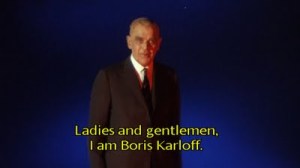
Black Sabbath begins with Boris Karloff playing himself, giving a deliberately over-the-top introduction and informing us that there could very well be vampires and werewolves sitting next to us in the theater.  Yes, it’s silly and yes, it’s campy but it’s also a lot of fun.  A lot of this is because these words are delivered by Karloff, an actor who could make even the silliest of dialogue sound important.  The other part is that, as silly as the introduction may be, it’s beautiful to look at.  Instead of going for the standard spooky narrator in a cobweb-filled library approach, Bava frames Karloff standing against a brilliant dark blue backdrop that establishes that this isn’t just your typical horror host … this is BORIS FREAKIN’ KARLOFF!

After Karloff’s introduction, we move on to the first of Black Sabbath’s three separate stories, The Telephone.
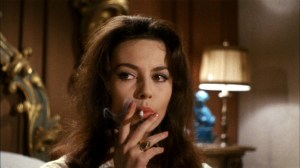
In The Telephone, Michele Mercier plays a Parisian prostitute who returns to her apartment after an evening out.  As she tries to change for bed, her bright red telephone rings.  Every time Mercier opens the phone, she hears a man’s voice taunting and threatening her.  Finally, the caller claims to be Frank, Mercier’s former pimp who has just escaped from prison.  The terrified Mercier calls her estranged lesbian lover (Lydia Alfonsi).  Alfonsi comes over to the basement to comfort Mercier.  However, what Mercier doesn’t realize is that it wasn’t Frank calling her.  It was Alfonsi, pretending to be Frank.  However, needless to say, there’s more twists to come before the night’s over.

Of the three segments, The Telephone is probably the least succesful if just because it has the most pedestrian plot.  At the same time, this segment also show just how good Bava was at creating tension even with so-so material.  Speaking as someone who has been stalked in the past, I can say that both Mercier and Bava perfectly captures the way that one seemingly simple intrusion on your privacy can leave you suddenly feeling very isolated and very alone.  Finally, even after the segment’s over, it’s impossible to forget the sight of that vibrantly red phone sitting like a lurking monster in that artfully drab apartment.

The Telephone is followed by probably the film’s most famous segment, The Wurdalak.
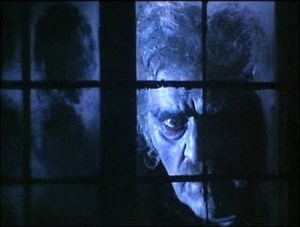
Based on a short story by Tolstoy, The Wurdalak opens with a Russian nobleman (played Italian exploitation mainstay Mark Damon) on a long trip through the Russian wilderness.  He comes across a headless corpse with a dagger plunged into its heart.  Damon takes the dagger as a morbid souvenir of his trip.

As night falls, Damon comes across a small cottage and asks the family inside for shelter.  Inside the cottage, Damon discovers a wall that is covered with daggers similar to the one he found earlier.  His hosts explain that the daggers belong to the family patriarch, Gorcha (Boris Karloff).  Gorcha left five days earlier to kill a wurdolak (or vampire, by any other name).  As the family waits for Gorcha to return, not knowing whether or not he himself is now a vampire, Damon finds himself falling in love with Gorcha’s daughter.  When Gorcha finally does return, it’s obvious that he’s not the same man he was when he originally left.

Of the three segments, The Wurdolak is probably the most obviously Bavaesque and a whole lot of the same images and themes would later turn up in Bava’s masterwork, Kill, Baby, Kill.  Everything, from the constantly howling wind to the sense of isolation to the well-meaning but ultimately impotent upper-class hero, is classic Bava.  Special mention should also be made of Boris Karloff’s performance here.  Because Karloff was best known for appearing in “monster” movies, he never gets enough recognition for being a pretty good actor.  His performance here, which is full of malice and threat, is just as menacing as his earlier appearance in the introduction was fun and campy.

The final segment of the film is entitled The Drop of Water.
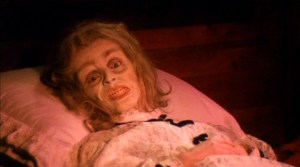
In many ways, The Drop of Water is the simplest segment of the film but for me, personally, it’s also the scariest.  In London, a nurse (Jacqueline Pierreux) is called to a large house to prepare a medium for burial.  While doing this. the nurse notices a large (and, quite frankly, kinda gaudy) ring on the medium’s finger.  The nurse steals the ring and returns to her own apartment.  As soon as she goes to her apartment, she finds herself haunted by increasingly ominous events: a buzzing fly refuses to leave her alone, the sound of water dripping echoes through the apartment, the lights go on and off, and — naturally — a mysterious figure suddenly appears in her bedroom.

Mixing the sense of growing paranoia that characterized The Telephone with Wurdolak’s sense of predestined, metaphysical doom, The Drop of Water is the perfect concluding chapter of Black Sabbath.  It also happened to scare the Hell out of me.  Along with Bava’s usual superb direction, this film was distinguished by some wonderfully creepy make-up work.  Seriously, once that mysterious figure reveals itself, you’ll wish it hadn’t.

I usually don’t enjoy compilation films because, too often, it seems that you’re lucky if you get just one above average story surrounded by a bunch of forgettable filler.  Far too often, the stories themselves don’t seem to go together.  Instead, they just appear to have been tossed together randomly with the weakest of possible connection.  Black Sabbath is an exception and that’s largely because of Mario Bava’s iconic direction.  The stories aren’t linked together by plot as much as their linked together by motif and theme.  Each story — from the emphasis on isolation to the creative use of color to suggest mood and menace — is linked by Bava’s style.  Boris Karloff may have been the name emphasized in the credits but the true star of Black Sabbath is Mario Bava.

The genius of Bava wasn’t in the originality of the stories he told but instead, in the new ways that he found to tell familiar stories.  Usually, I hate it when directors describe themselves as being about “style” as opposed to “substance.”  Too often, it seems like that’s just an excuse to not come up with an interesting story.  However, Bava is one of the few directors about whom the term “style over substance” can be used as a compliment.  Bava knew how to make style into art and he certainly did that in Black Sabbath.
Song of the Day: Suspiria (performed by Goblin)


Suspiria is one of my favorite films for many reasons: the pre-Black Swan combination of horror and ballet, Dario Argento’s pop art-influenced direction, the infamous close-up of that beating heart, the “s is for snakes” conversation, and Alida Valli’s ferocious performance as the instructor from Hell.  (That said, I would have gladly taken lessons from her because I think she would have inspired me to be more disciplined about dancing.)

And, of course, I love the music.  As many critics have pointed out, the film’s soundtrack (composed by Goblin) provides this film with a structure that it might otherwise lack.  Plus, it’s one of the few film soundtracks that’s actually scary if you listen to it around 3 in the morning with all the lights turned out.  I speak from personal experience.

So, in honor of one of my favorite films of all time, today’s song of the day is Goblin’s brilliant Suspiria.

(The Suspiria soundtrack is apparently out-of-print in the U.S.  However, it’s included in Anchor Bay’s 3-disc, 25th anniversary DVD.  The DVD also comes with a featurette about the making of the soundtrack.  It’s actually pretty interesting.  Goblin’s Claudio Simonetti proves to be a charming and interesting interview subject.)

10 (Plus) Of My Favorite DVD Commentary Tracks


It seems like I’m always taking a chance when I listen to a DVD commentary track.  Occasionally, a commentary track will make a bad film good and a good film even better.  Far too often, however, listening to a bad or boring commentary track will so totally ruin the experience of watching one of my favorite movies that I’ll never be able to enjoy that movie in the same way again.  I’ve learned to almost always involve any commentary track that involves anyone credited as being an “executive producer.”  They always want to tell you every single detail of what they had to do to raise the money to make the film.  Seriously, executive producers suck. 

However, there are more than a few commentary tracks that I could listen to over and over again.  Listed below are a few of them.

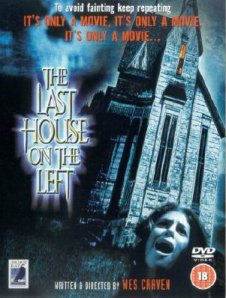
10) Last House On The Left (The Original) — Apparently, there’s a DVD of this film that features a commentary track in which stars David Hess and Fred Lincoln nearly come to blows while debating whether or not this movie should have been made.  The DVD I own doesn’t feature that commentary but it does feature a track featuring writer/director Wes Craven and producer Sean S. Cunningham.  The thing that I love about their commentary is that they both just come across as such nice, kinda nerdy guys.  You look at the disturbing images onscreen and then you hear Cunningham saying, “We shot this scene in my mom’s backyard.  There’s her swimming pool…”  Both Craven and Cunningham are remarkably honest about the film’s shortcomings (at one point, Craven listens to some of his more awkward dialogue and then says, “Apparently, I was obsessed with breasts…”) while, at the same time, putting the film’s controversy into the proper historical context.

9) Burnt Offerings — When Burnt Offerings, which is an occasionally interesting haunted house movie from 1976, was released on DVD, it came with a commentary track featuring director Dan Curtis, star Karen Black, and the guy who wrote the movie.  This commentary track holds a strange fascination for me because it, literally, is so mind-numbingly bad that I’m not convinced that it wasn’t meant to be some sort of parody of a bad commentary track.   It’s the commentary track equivalent of a car crash.  Curtis dominates the track which is a problem because he comes across like the type of grouchy old man that Ed Asner voiced in Up before his house floated away.  The screenwriter, whose name I cannot bring myself to look up, bravely insists that there’s a lot of nuance to his painfully simple-minded script.  Karen Black, meanwhile, tries to keep things positive.  The high point of the commentary comes when Black points out that one actor playing a menacing chauffeur is giving a good performance (which he is, the performance is the best part of the movie).  She asks who the actor is.  Curtis snaps back that he doesn’t know and then gets testy when Black continues to praise the performance.  Finally, Curtis snaps that the actor’s just some guy they found at an audition.  Actually, the actor is a veteran character actor named Anthony James who has accumulated nearly 100 credits and had a prominent supporting role in two best picture winners (In the Heat of the Night and Unforgiven).

8 ) Cannibal Ferox — This is a good example of a really unwatchable movie that’s made watchable by an entertaining commentary track.  The track is actually made up of two different tracks, one with co-star Giovanni Lombardo Radice and one with director Umberto Lenzi.  Lenzi loves the film and, speaking in broken English, happily defends every frame of it and goes so far as to compare the movie to a John Ford western.  The wonderfully erudite Radice, on the other hand, hates the movie and spends his entire track alternatively apologizing for the movie and wondering why anyone would possibly want to watch it.  My favorite moment comes when Radice, watching the characters onscreen move closer and closer to their bloody doom, says, “They’re all quite stupid, aren’t they?”

7) Race With The Devil Race with the Devil is an obscure but enjoyable drive-in movie from the 70s.  The DVD commentary is provided by costar Lara Parker who, along with providing a lot of behind-the-scenes information, also gets memorably catty when talking about some of her costars.  And, let’s be honest, that’s what most of us want to hear during a DVD commentary.

6) Anything featuring Tim Lucas — Tim Lucas is the world’s foremost authority on one of the greatest directors ever, Mario Bava.  Anchor Bay wisely recruited Lucas to provide commentary for all the Bava films they’ve released on DVD and, even when it comes to some of Bava’s lesser films, Lucas is always informative and insightful.  Perhaps even more importantly, Lucas obviously enjoys watching these movies as much as the rest of us.  Treat yourself and order the Mario Bava Collection Volume 1 and Volume 2.

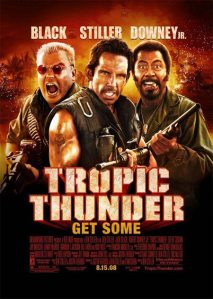
5) Tropic Thunder — The commentary track here is provided by the film’s co-stars, Jack Black, Ben Stiller, and Robert Downey, Jr.  What makes it great is that Downey provides his commentary in character as Sgt. Osiris and spends almost the entire track beating up on Jack Black.  This is a rare case of a great movie that has an even greater commentary track.

4) Strange Behavior — This wonderfully offbeat slasher film from 1981 is one of the best movies that nobody seems to have heard of.  For that reason alone, you need to get the DVD and watch it.  Now.  As an added bonus, the DVD comes with a lively commentary track featuring co-stars Dan Shor and Dey Young and the film’s screenwriter, Bill Condon (who is now the director that Rob Marshall wishes he could be).  Along with providing a lot of fascinating behind-the-scenes trivia, the three of them also discuss how Young ended up getting seduced by the film’s star (Michael Murphy, who was several decades older), how shocked Condon was that nobody on the set seemed to realize that he’s gay, and why American actors have so much trouble speaking in any accent other than their own.  Most memorable is Young remembering the experience of sitting in a theater, seeing herself getting beaten up onscreen, and then listening as the people sitting around her cheered.

3) Imaginationland — As anyone who has ever listened to their South Park commentaries knows, Matt Stone and Trey Parker usually only offer up about five minutes of commentary per episode before falling silent.  Fortunately, those five minutes are usually hilarious and insightful.  Not only are Parker and Stone remarkably candid when talking about the strengths and weaknesses of their work but they also obviously enjoy hanging out with each other.  With the DVD release of South Park’s Imaginationland trilogy, Matt and Trey attempted to record a “full” 90-minute commentary track.  For the record, they manage to talk for 60 minutes before losing interest and ending the commentary.  However, that track is the funniest, most insightful 60 minutes that one could hope for.

2) Donnie Darko — The original DVD release of Donnie Darko came with 2 wonderful commentary tracks.  The first one features Richard Kelley and Jack Gyllenhaal, talking about the very metaphysical issues that the film addresses.  Having listened to the track, I’m still convinced that Kelley pretty much just made up the film as he went along but its still fascinating to the hear everything that was going on his mind while he was making the film.  However, as good as that first track is, I absolutely love and adore the second one because it features literally the entire cast of the movie.  Seriously, everyone from Drew Barrymore to Jena Malone to Holmes Osborne to the guy who played Frank the Bunny is featured on this track.  They watch the film, everyone comments on random things, and it’s difficult to keep track of who is saying what.  And that’s part of the fun.  It’s like watching the film at a party full of people who are a lot more interesting, funny, and likable than your own actual friends.

1) The Beyond — This movie, one of the greatest ever made, had one of the best casts in the history of Italian horror and the commentary here features two key members of that cast — Catriona MacColl and the late (and wonderful) David Warbeck.  The commentary, which I believe was actually recorded for a laserdisc edition of the film (though, to be honest, I’ve never actually seen a “laserdisc” and I have my doubts as to whether or not they actually ever existed), was recorded in 1997, shortly after the death of director Lucio Fulci and at a time when Warbeck himself was dying from cancer.  (Warbeck would pass away two weeks after recording this commentary).  This makes this commentary especially poignant.  Warbeck was, in many ways, the human face of Italian exploitation, a talented actor who probably deserved to be a bigger star but who was never ashamed of the films he ended up making.  This commentary — in which MacColl and Warbeck quite cheerfully recall discuss making this underrated movie — is as much a tribute to Warbeck as it is to Fulci.  Highpoint: MacColl pointing out all the scenes in which Warbeck nearly made her break out laughing.  My personal favorite is the scene (which made it into the final film) where Warbeck attempts to load a gun by shoving bullets down the barrel.  The wonderful thing about this track is that Warbeck and MacColl enjoy watching it too.

Film Review: Zombie 5: Killing Birds (dir. by Claudio Lattanzi and Joe D’Amato)


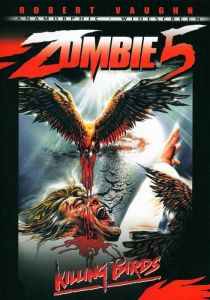
Thanks to the wonderful people at Anchor Bay, I recently watched Zombie 5: Killing Birds, one of the last of the old school Italian horror films.

Admittedly, when I first hit play on the DVD player, I was expecting the worst.  Of all the various official and unofficial sequels to Lucio Fulci’s masterpiece Zombi 2 (which, of course, was itself an unofficial prequel to Dawn of the Dead), Zombie 5: Killing Birds has the worst reputation.  While most Italian horror fans seem to agree that Zombie 4 is enjoyable on its own stupid terms and even Zombi 3 has a few brave defenders, its hard to find anyone willing to defend Killing Birds.  The general consensus has always seemed to be that Killing Birds is a generic and rather forgettable splatter film that, title aside, had absolutely nothing in common with the Fulci classic.

Having now seen Killing Birds, I can say that the general consensus, in this case, is largely correct.  Killing Birds is generic, predictable, and ultimately forgettable.  However, taken on its own terms, it’s a perfectly enjoyable way for a lover of zombie cinema to waste 90 minutes.  As long as you don’t compare it to Zombi 2, i’ts a perfectly tolerable piece of trash that actually has one or two memorable moments tossed randomly through its running time.  At the very least, its a hundred times better than Umberto Lenzi’s similar Black Demons.

The film deals with a bunch of grad students who, while searching for a nearly extinct species of Woodpecker, end up spending the night at a deserted house in Louisiana.  Many years ago, a brutal murder was committed at this house and, well, you can guess the rest.  The grad students end up falling prey to a bunch of zombies, largely because the students are all remarkably stupid.  Meanwhile, B-movie veteran Robert Vaughn shows up as Dr. Fred Brown, a blind man who spends his days studying birds.  There’s a lot of birds in this movie and its never quite clear how they link up to the living dead but they certainly do look menacing flying past the camera.

With the exception of Vaughn (who overacts just enough to keep things interesting without going so far over the top as to become ludicrous), the film’s cast is likeable but not memorable.  Everyone’s playing a stereotype (i.e., the leader, the computer geek, the slut, the girl with looks and brains) and no one makes much of an effort to be anything more than a stereotype.  While this certainly keeps Killing Birds from displaying anything resembling nuance, it’s also strangely comforting.  Its lets a neurotic viewer like me know, from the start, that there’s no need to think too much about anything she might see for the next hour and a half.  Since this movie was made in the late 80s, most of the men sport a mullet and all of the women wear those terribly unflattering khaki pants that I guess were all the rage back then.

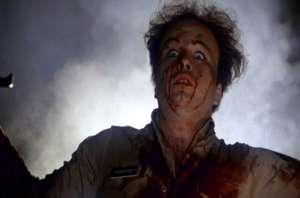
As I stated before, the film does have its occasional strengths.  Some of the deaths are memorably nasty (even if the gore effects are decidedly cut-rate, pun not intended).  As well, the film does an excellent job at capturing the hot, humid atmosphere of the Louisiana bayous.  I’ve spent enough time in that part of the country that I can attest that the movie perfectly captures the stagnant heat and the way dehydration can cause your mind to play tricks on you.  While the zombies themselves are hardly as impressive as Fulci’s, the filmmakers wisely keep them in the shadows for most of the film and, if nothing else, this allows the viewer to imagine something scarier than what they’re actually seeing.  Finally, this movie does have one of the most effective nightmare sequences that I’ve ever seen.  Lasting barely a minute and not really having much to do with the overall plot, this nightmare still features some rather disturbing imagery.  One image, in particular, has so stuck with me that I found myself paying homage to it in a my own writing.

Though the movie’s director is credited as being Claudio Lattanzi, it is pretty much an open secret that the movie was actually directed by the infamous Joe D’Amato (who, regardless of what else he may have done during his storied life, also directed one of my favorite movies ever, Beyond The Darkness).  I’ve read a few interviews where D’Amato said that he allowed Lattanzi to be credited as director because he wanted to help Lattanzi’s launch his own career.  To judge by the movie itself, however, it seems more probable that Lattanzi wasn’t delivering the movie that D’Amato wanted and D’Amato stepped in as a result.  Regardless, Killing Birds is hardly the best example of D’Amato’s work but, at the same time, it’s hardly the worst either. 

In the end, Killing Birds is a movie that will probably be best appreciated by those who already have a good working knowledge of Italian exploitation films.  It’s hardly a masterpiece (and, despite enjoying it, I would hesitate to even call it a “good” movie) but it’s not really deserving of all the criticism that it’s received over the years either.  As a bonus, the Anchor Bay DVD come with a lengthy interview with Robert Vaughn in which he discussed his career in B-movies and, while Vaughn says nothing about Killing Birds during the interview, he’s still interesting and enjoyable to listen to.  Unlike a lot of “reputable” actors who have made B-movies, Vaughn never condescends to the films that both started and ended his movie career.

6 Exploitation Film Trailers That I Love


The only thing I love more than a good exploitation film is a good exploitation film trailer.  I’ve been known to buy Anchor Bay DVDs of films that I hate just to see what trailers will be included in the extras.  Often times, when I find myself suffering from writer’s block, I cure it by watching 42nd Street Forever.

Below are 6 exploitation film trailers.  They are six of my personal favorites though I could easily list 666. 

Enjoy!

1) Teenage Mother (1967)This trailer (if not the actual film, which is pretty dull) is pure exploitation perfection.

2) They Call Her One Eye (1974)They Call Her One Eye is the American title for a Sweedish film called Thriller, A Cruel Picture.  It’s an appropriate title but its also one of the best movies ever made in the history of cinema.

3) Ms. 45 (1981)I love this movie.  Whenever I break up with a boyfriend or just find myself annoyed with men in general, this is the movie that I end up popping into my DVD player.  Consider yourself warned. 🙂

4) The House With The Laughing Windows (1976) This giallo, directed by Pupi Avati, is probably one of the best films ever to come out of Italy period.  The trailer only begins to hint just how girm, dark, depressing, disturbing, and downright odd this little gem really is.

5) Starcrash (1979) — Starcrash was Luigi Cozzi’s attempt to cash in on Star Wars.  For what its worth, Starcrash is actually a lot more fun and, as played by Caroline Munro, intergalactic priate Stella Starr is actually one of the few truly strong women to appear in Italian exploitation cinema.  (The next Halloween party I’m invited to, I’m going to go as Caroline Munro in Starcrash.)  The special effects pretty much define the whole concept of “That’s a great movie when you’re stoned.”

6) Spasmo (1974) Our final trailer is for that rarest of things, a good movie directed by Umberto Lenzi. 

Review: Evilspeak (dir. by Eric Weston)


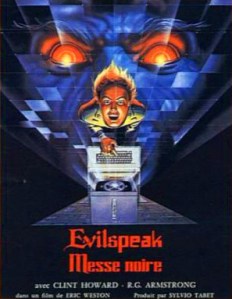
I first came across Evilspeak a few months ago when I was browsing through the selection of used DVDs at the Movie Trading Company in Plano, Texas.  Why did I feel so compelled to buy this movie that I had previously never heard of?  Of course, a lot of it was due to the fact that Evilspeak was a horror movie.  I have to admit that the vagueness of the title intrigued me.  I’ve long been planning on writing the ultimate slasher film and giving it the similarly vague title of Deathurge.  It also helped that the Evilspeak DVD was released by Anchor Bay and that it only cost $1.99.

A few nights ago, I sat down and watched Evilspeak for the first time.    It turned out to be, in many ways, typical of the horror films that were released in the early 80s.  (Evilspeak came out in 1981.)  However, thanks to a strong lead performance from Clint Howard and a few surprisingly dark touches on the part of director Eric Weston, Evilspeak turns out to be an oddly compelling little horror film.

Evilspeak opens with a lengthy prologue in which we see a Satanist named Esteban beheaded, along with several of his followers, by the Spanish Inquisition.  Jump forward several hundred years to a soccer game being played by teams representing two separate military academies.  The players are all typical jocks except for one pudgy, awkward fellow named Stanley Coopersmith (played by a very young Clint Howard).  Coopersmith manages to lose the game for his team.  The team’s angry response establishes that 1) this is not the 1st game that Coopersmith has lost and 2) all of his teammates are apparently psychotic.  His fellow players complain to their coach about Coopersmith’s lack of ability.  The coach replies that school policy requires that Coopersmith be allowed to play but if Coopersmith were to suffer some sort of injury (hint, hint) then they wouldn’t have to worry about school policy.  Seriously, has anything good ever come from soccer?

In many ways, Stanley Coopersmith might seem typical of the horror movie pariahs who always seem to end up asking Satan to kill their peers.  However, there are a few things that set Stanley apart.

First of all, he has one of the best last names in film history.  Coopersmith.  Just say it five times straight and see if it doesn’t get stuck in your head.  I’ve known plenty of Coopers and more than a few Smiths but I’ve never known a Coopersmith.  At first, I thought that maybe Stanley had one of those really cool hyphenated names and I was instantly jealous.  I’ve always wished my mom had done that when she got married so I could introduce myself as “Lisa Marie Marchi-Bowman.”  Of course, it’s probably for the best that she didn’t because if she had, I would have become obsessed with finding a mate with a hyphenated last name of his own just to see how long I could eventually make my last name.  But I digress.  Even though the film clearly establishes that there is not hyphen in Coopersmith, it’s still a great name.  When Stanley’s classmates insist on calling him “Cooperdick,” it just makes them all the more loathsome because not only are the insulting Stanley but they’re failing to recognize the beauty of a good name.

The other thing that sets Stanley apart from other movie outcasts is that he actually looks like an outcast.  He’s not a teen idol wearing a bad wig and prop glasses.  This is largely because Stanley Coopersmith is played by Clint Howard (as opposed to Ron Howard).  Pudgy with visible acne and a somewhat whiny voice, Clint Howard transforms Stanley Coopersmith into every kid that you ever felt sorry for but never dared to befriend.  Watching the movie, you feel sorry for Stanley but you never quite like him.  You’re on his side because every other character in the movie appears to be subhuman.

The film follows Stanley as he is continually attacked and humiliated by basically everyone else in the entire movie.  Now, as someone who did time at more than one Catholic school, I have personally experienced the fact that private schools really are a world of their own.  That said, however, Evilspeak’s military academy appears to be less a school and more some sort of elaborate and sadistic sociological experiment.  Seriously, is there anyone at this school who isn’t obsessed with tormenting Stanley?  (Actually, Stanley does have one friend but he’s kinda useless.)

Of course, one of the school’s problems might be that it has apparently been built on land that was once owned by — you guessed it — Esteban!  As the film opens, Coopersmith has found himself assigned to clean up the school’s chapel as part of a “punishment detail.”  While doing this, Coopersmith happens to stumble upon Esteban’s tomb and, in that tomb, he finds a lot of candles, what appears to be a fetus in a jar, and a black book that happens to have a Satanic symbol on the cover.  Intrigued, Coopersmith steals the book despite the fact that it’s written in Latin.

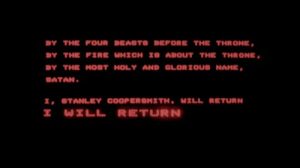
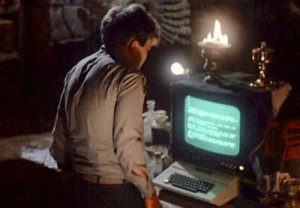
Luckily, this school has a computer!  Admittedly, Evilspeak came out four years before I was born so perhaps I’m not capable of understanding what the world was like in the early 80s.  Still, I’m always amazed to see the awe that computers were apparently regarded with back then.  Apparently, at the time, a personal computer was the ultimate elite status symbol.  All one needed to rule the world apparently was one bulky computer.  Fortunately, Coopersmith doesn’t want to rule the world.  He just wants to read his book.  He does this by typing the latin phrases into the computer and magically getting an English translation in response.  Thanks to his magic computer, Coopersmith discovers that the book was written by Esteban and  that Esteban worshipped Satan.

Coopersmith, of course, is amazed to discover this but we, the viewers are not.  After all, we’ve already sat through the entire prologue.  Unfortunately, it takes Coopersmith almost the entire movie to catch up to where we are from the beginning.  Fortunately, Clint Howard gives a good enough performance to keep the movie vaguely interesting even when it starts to drag.

Fortunately, after Coopersmith gets his translation, the action starts to pick up a bit.  For one thing, the book is stolen by the headmaster’s secretary (who, in an amusingly odd moment, smiles to herself as she listens to the headmaster paddling Coopersmith in his office).  For another thing, Coopersmith decides to get back at his enemies by conducting a black mass.  He does this by turning on his computer (which has now somehow been moved down to the tomb) and asking what he needs for a black mass.  Naturally enough, the computer tells him because it’s a computer and it knows everything.

But before Coopersmith can perform his black mass, he still has to be humiliated a few hundred more times by his classmates.  He also has to deal with a drunk janitor (played by R.G. Armstrong).  On top of that, he adopts a puppy.  Unfortunately, since Coopersmith is the school outcast, that also means that the puppy is fair game too.  After one night of heavy drinking, Coopersmith’s classmates (led by a kid named Bubba, so you know he’s evil) find his hideaway in the tomb and, for reasons that don’t quite make sense, they sacrifice his puppy.

(At this point, I was wondering if maybe it would turn out that the military academy was actually an insane asylum.  I mean, seriously —  on which level of Hell is this place located?)

Meanwhile, you remember that sadistic secretary that stole Coopersmith’s book?  Well, for whatever reason, she is obsessed with trying to pry that Satanic symbol off the cover.  Unfortunately, since she’s the only prominent female in an early 80s horror movie, this can only mean that she’s destined to meet a bloody end while taking a shower.  Which, in this movie’s best known scene, is exactly what happens.  However, she doesn’t meet her end at the hands of a knife-wielding psycho.  Instead, she’s attacked and ripped to pieces by a bunch of rampaging pigs.  And yes, the whole thing is faintly ludicrous and yes, the low-budget gore effects are undeniably crude, but it’s still an undeniably effective sequence.  Perhaps its due to the fact that pigs, in general, are filthy.  Don’t even get me started on pigs.  However, it must also be admitted that, though his direction is often time uninspired, Eric Weston shows an undeniable talent for capturing chaos.  I am not ashamed to admit that I had pig-related nightmares after seeing this movie.

Following the death of the secretary, the book mysteriously reappears in Esteban’s tomb.  Coopersmith finds it the next morning along with the corpse of his puppy.  Obviously, this is all it takes for Coopersmith (with the help of his computer) to carry out his black mass and to finally take his revenge.

Of course, the whole point of a Nerd-With-Powers movie is the finale where that nerd takes vengeance on his tormentors.  If this scene is pulled off with even the slightest amount of panache, it can make up for almost everything that’s come before it.  The prom inferno from Carrie pretty much set the standard by which all others are judged.  Personally, it’s hard for me to think of any movie that could improve on the final house party massacre in The Rage: Carrie 2.  After all, how can you top a blinded Rachel Blanchard accidentally shooting the oldest Home Improvement kid in the balls with a spear gun?

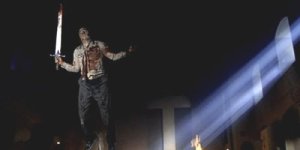
Evilspeak doesn’t quite reach those heights in its finale but it’s still pretty effective.  If nothing else, the sight of Clint Howard wielding a sword while flying above his tormentors is a lot more effective than you might think.  Over the next few minutes, spikes are drilled into foreheads, heads are chopped off, hearts are ripped out of chests, and those pigs show up again.  The gore effects here are undeniably crude but oddly effective.  This sequence (along with the previous pig shower attack) actually inspired a few nightmares the night after I saw Evilspeak.

In the end, Evilspeak is an odd little movie.  While the plot should be familiar to anyone who has ever seen a horror film, there’s a real nastiness at the core of Evilspeak that distinguishes it from other genre offerings that came out during the same period.  At times, Evilspeak almost feels like an Italian film which is probably why I found it to be so oddly compelling.

The Evilspeak DVD features a commentary track featuring both Clint Howard and the film’s director.  I always feel some trepidation before listening to a commentary track.  Too often, the track turns out to just be some jerk explaining how he financed the film for two hours while commenting not at all on the action on-screen.  (For the most part, if a commentary track features any anecdote that begins with, “We had the same lawyer…” you know you’re in trouble.)  However, the Evilspeak track is surprisingly enjoyable.  Clint Howard comes across as a surprisingly likable, levelheaded guy and its interesting to contrast his odd wholesomeness with the action onscreen.

In the end, Evilspeak may be a piece of junk but it’s an enjoyable piece of junk.

10 Films I Must See Before I Die


I love movies.  I love watching movies, reading about movies, and talking about movies.  Perhaps most of all, I love the hunt.  I love discovering movies or finding movies that had previously, for me, only existed in reviews or as a collection of screen captures.  To me, there is no greater experience the watching a movie for the first time.  (Even if, as often happens, that first time turns out to be the only time.)  Listed below are ten movies that I have yet to see but desperately hope to at some point in my life. 

1)  Giallo a Venzia (1979) — This is supposedly one of the most graphically depraved Italian horror films ever made.  If that’s not a recommendation, I don’t know what is.  Actually, I haven’t heard a single good thing about this movie but it has still become something of a Holy Grail in my quest to see as much Italian horror as possible.  This is largely because the movie is nearly impossible to find.  When it was first released, it was banned in the UK as part of the so-called “video nasties” scare.  (Trust the English to not only ban a movie but to come up with an annoying name for doing so in the process.)   This led to it never really getting much of a release in the English-speaking world and, now years later, it’s only available on bootleg DVDs.  As such, I imagine that if I ever do see it, it’ll be because I made a deal in a back alley with some bald guy who speaks with a Russian accent.  Much as with drug prohibition, the fact that its “forbidden” has made this movie rather attractive.

The few people who have seen this always mention that towards the end of the movie, Mariangela Giordano’s legs are graphically sawed off.  This makes sense as Giordano was always meeting grotesque ends in Italian horror movies.  In Patrick Lives Again, she is impaled (through her vagina no less) by a fireplace poker while in Burial Ground, she makes the mistake of breast feeding her zombie son.  In many ways, Giordano was like a female Giovanni Lombardo Radice.  However, its odd to consider that while the sight of Giordano’s legs getting sawed off was enough to get the film banned, the sight of poker being graphically driven into her crotch was apparently totally acceptable.  Censorship is a strange thing, no?

One last reason I want to see this movie — its filmed in Venice.  When I was in Italy, I fell in love with Venice.  (I also fell in love with a tour guide named Luigi but that’s another story.)

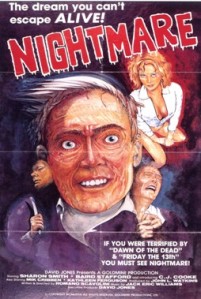
2) An uncut version of Nightmares in a Damaged Brain (1981) — This is another banned Italian movie.  When Nightmares was originally released, Tom Savini was credited as being behind the special effects.  Savini, however, has long claimed to have had little to nothing to do with the movie.  As Savini, to his credit, has never been embarrassed to claim ownership for his effects (regardless of the movie they appear in), I’m inclined to believe him.

In many ways, Nightmares reminds me of a film that Savini actually did work on, Maniac.  Not so much as far as the plot is concerned but just in the same bleak worldview and almost palpable sleaze that seems to ooze from every scene.  The version that is most widely available on DVD (and the one that I own) appears to be the cut version that was eventually okayed for release in the UK and even cut, this is a film that remains oddly compelling in just how much its willing to immerse itself in sleaze.  The uncut version remains elusive but someday, I will find it.

3) The Day The Clown Cried (1972) — You knew this one was coming, didn’t you?  I think everyone wants to see Jerry Lewis’s never released Holocaust comedy.  Supposedly, Lewis keeps the movie in a locked vault which I just find to be oddly hilarious.  My hope is that, if nothing else, some enterprising filmmaker will make a movie about a crack team of thieves who break into Jerry Lewis’s estate just to steal the only copy of The Day The Clown Cried and sell it to the people at Anchor Bay.  Jerry could play himself.  I also think this film will see the light of day sooner or later.  At some point, either Jerry Lewis or his estate is going to need the money.

4) The Other Side of the Wind — Orson Welles apparently spent the last few decades of his life making this movie.  At the time of his death, the movie was reportedly 95% film but only 40% edited.  Apparently, because of a whole lot of complicated legal things, the movie has spent the last 30 years under lock and key in Iran.  Even if somebody could rescue it, the remaining footage still needs a strong hand to put it together.  While I’m sure that many directors would be happy to volunteer to provide that hand, the two names most frequently mentioned — Peter Bogdonavich and Henry Jaglom — do not fill me with confidence.  I’d rather see the final film put together by Jess Franco, who was assistant director on Chimes at Midnight.

5) The Fantastic Four (1994) — This is not the dull movie that came out in 2005.  This apparently an even duller version of the same film that was made 11 years earlier for legal reasons.  Apparently, Roger Corman would have lost the movie rights to the comic book if he didn’t start production on a film by a certain date.  So, this film was made on the cheap and then promptly shelved.  My main desire to see it comes from the same morbid desire that makes me look at crime scene photos.  How bad can it be?

6) Le Cinque Giornate (1973) — This Italian film is apparently many things.  It’s a comedy.  It’s a historical epic.  It’s a satire of then contemporary Italian politics.  And most of all, it’s also apparently the only non-horror film directed by Dario Argento.  This was Argento’s fourth  film, coming after his celebrated animal trilogy and it was apparently an attempt, on Argento’s part, to break away from the giallo genre that he has since come to symbolize.  Though the film apparently did well enough in Italy, it failed to establish Argento as a director of comedy and that’s probably for the best as Argento’s fifth film would be the classic Deep Red.  Still, it’s hard not to play the “What If?” game, especially when it involves an iconic a figure as Dario Argento.  It’s also interesting to compare Argento’s attempts to go from horror to comedy with the career of Lucio Fulci, who went from comedy to horror.

7) Cocksucker Blues (1972) — Robert Frank’s documentary of the Rolling Stone touring America was officially unreleased because of its title.  While that title certainly played a role, it also appears that the film was unreleased because of just how much hedonism Frank managed to capture backstage.  The Stones apparently went to the court to block the film’s release.  Somehow, this resulted in a ruling that the movie can only be shown if Robert Frank is physically present.  Mr. Frank, if you’re alive and reading this, you have an open invitation to come down to Texas and stay with me anytime you want.  Seriously.

8 ) The Profit (2001) — The Profit is a satiric film about a cult.  The film’s cult is known as The Church of Scientific Spiritualism and is led by a recluse named L. Conrad Powers.  Sound familiar?  The film’s release was (and continues to be) prevented by a lawsuit brought by the Church of Scientology.  Say what you will about the Vatican, at least you can attack them in a movie without having to worry about getting sued or blown up.

9) Superstar: The Karen Carpenter Story (1987) — Probably one of the most famous film that most of us will never see, Superstar tells the story of Karen Carpenter through the use of Barbie dolls.  Director Todd Haynes supposedly failed to get the rights to the music he used in the film and, obviously enough, nobody in the Carpenter camp was all the eager to give him permission. 

9) Can Hieronymous Merkin Ever Forget Mercy Humppe And Find True Happiness (1969) — God, don’t you hate that title?  And, honestly, are you surprised that a film with that title is apparently history’s 1st X-rated musical?  Anyway, this is a movie I’ve come across in various film reference books where it’s either described as a masterpiece or (more often) one of the worst movies ever made.  Myself, I love musicals and if the musical numbers are mixed in with explicit sex — well, why not?  But that title — that title just gives me a bad feeling.  Another thing that gives me a bad feeling is that the movie was apparently the brainchild of Anthony Newley.  I don’t know much about Mr. Newley but what I do know seems to indicate that he personified everything that most people hate about musicals.  The film is apparently autobiographical and its about a really talented composer who treats the women in his life terribly but has a lot of reasons (or excuses) that we learn about in elaborate flashbacks and — wait, I’ve seen this movie.  Oh wait, that was Nine.  Anyway, Merkin was a huge flop and it has never been released on any type of video format.  Yet, it has not been forgotten which can only mean that it must have really traumatized the critics who saw it.  In other words, this is another one of my “how-bad-can-it-be” crime scene movies.

10) The uncut, original, 9-hour version of Erich Von Stroheim’s Greed (1924) — A girl can dream, can’t she?