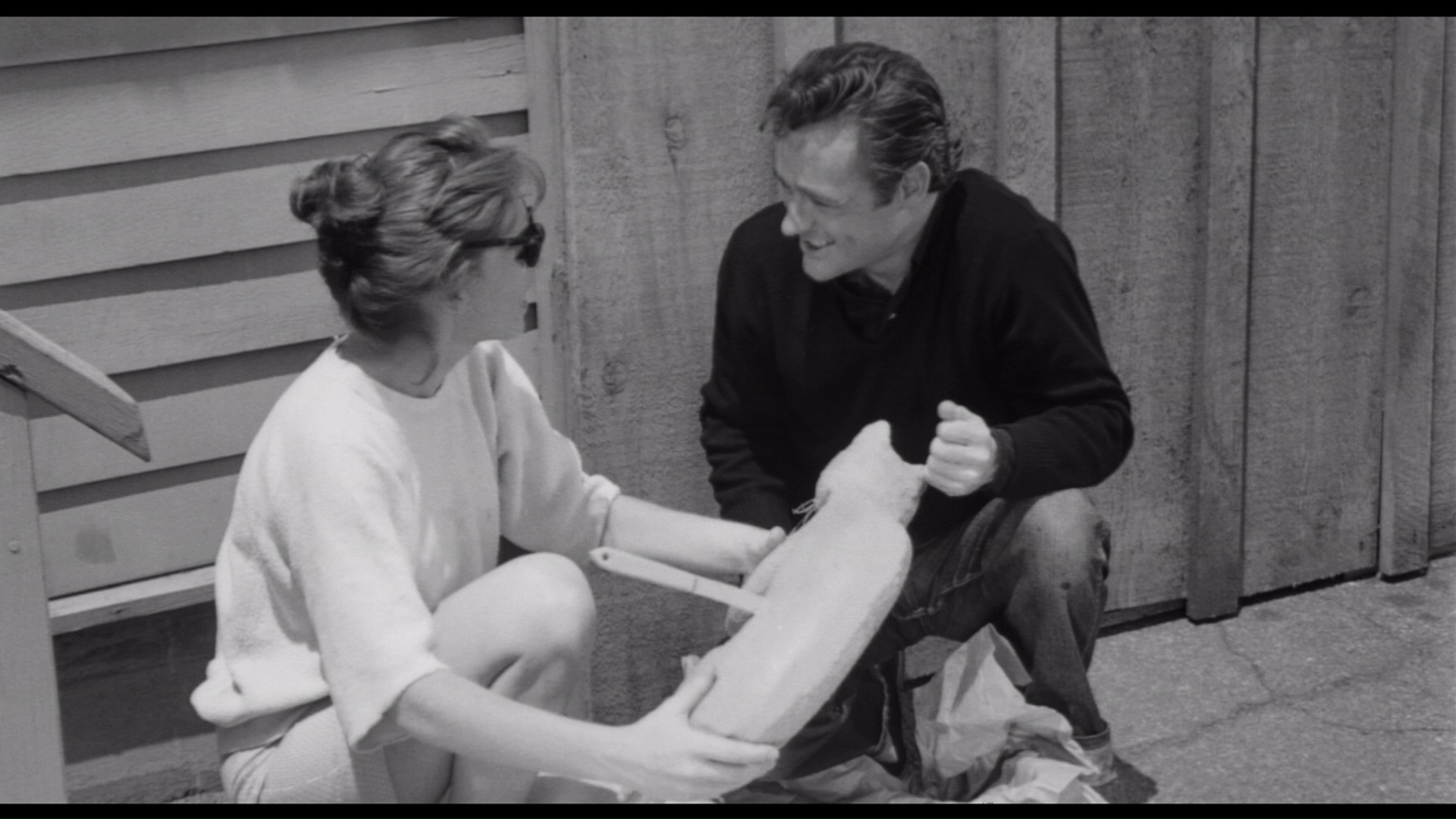
We can’t have Halloween without a good Roger Corman movie, and A BUCKET OF BLOOD is one of my favorites. This 1959 black comedy is a precursor to Corman’s THE LITTLE SHOP OF HORRORS, and I actually prefer it over that little gem. A BUCKET OF BLOOD skewers the pretentiousness of the art world, the 50’s beatnik scene, and the horror genre itself with its story of nerdy Walter Paisley, a busboy at a hipster coffee house learns making it as a famous artist can be murder!
Walter’s a no-talent nebbish longing to be accepted by the pompous clientele at The Yellow Door, especially beautiful hostess Carla. When he accidentally kills the landlady’s cat, Walter covers it in clay (with the knife still protruding in poor little Frankie!), and brings it in to work. The grotesque sculpture causes a stir among the patrons, and Walter is congratulated for his brilliant work ‘Dead Cat’. Beatnik…
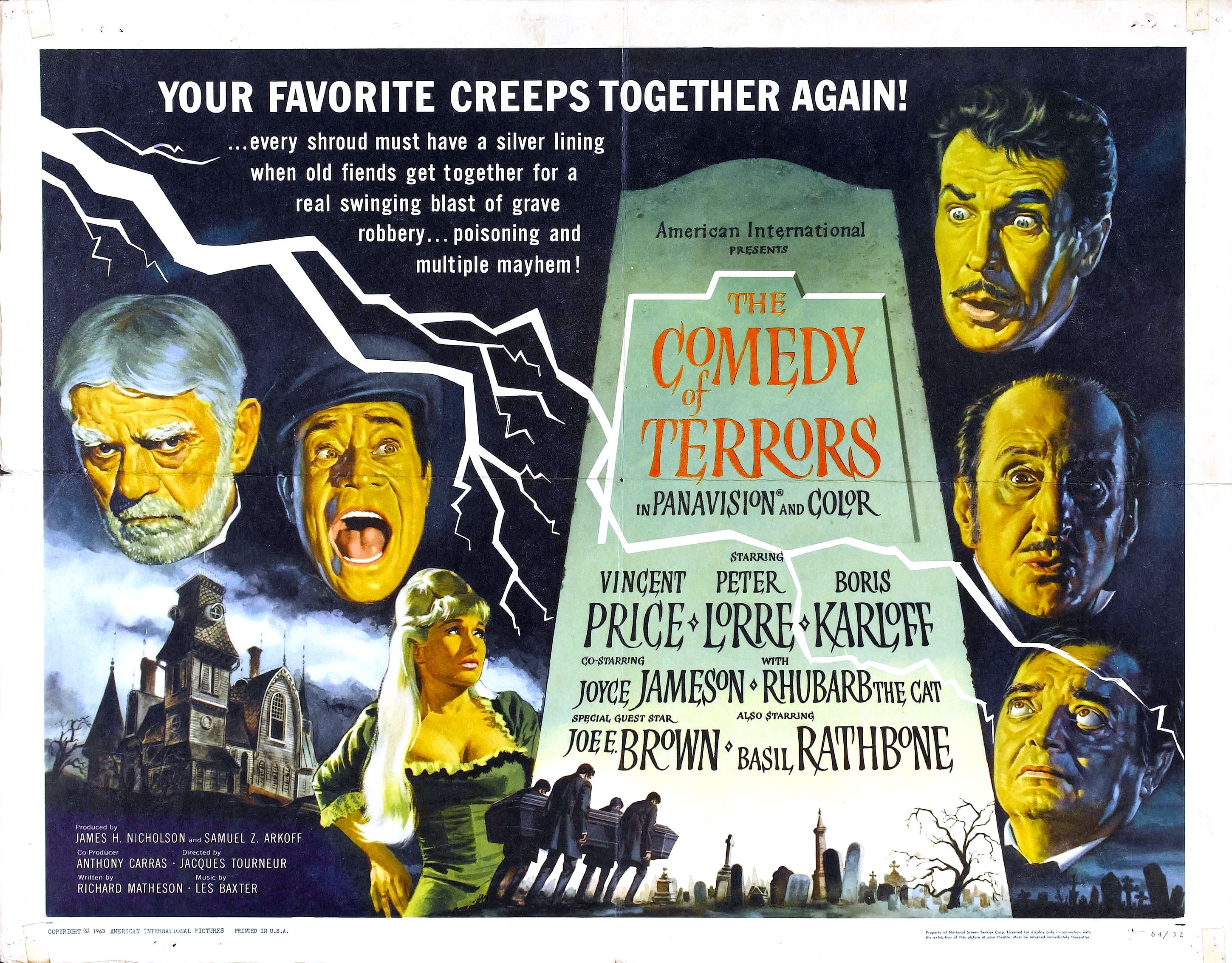
Vincent Price, Peter Lorre, Boris Karloff, and Basil Rathbone had all appeared together on film in various combinations seven different times, but never all at once until THE COMEDY OF TERRORS. This black comedy masterpiece spoofs AIP’s own Poe flicks and Shakespeare, with the quartet of chiller icons having a grand old time playing Richard Matheson’s delicious screenplay to the hilt. Horror and noir vet Jacques Tourneur gets to direct the old pros, and the supporting cast features classic comic Joe E. Brown and Rhubarb The Cat (more on him later!).
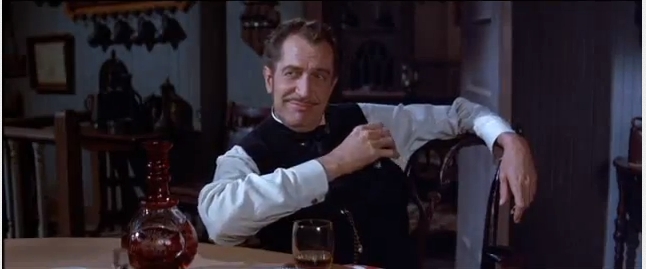
Price is Waldo Trumble, the besotted, greedy proprietor of Trumble & Hinchley Funeral Parlor. He’s cruel to wife Amaryllis (Joyce Jameson), a failed opera singer (“I wish her vocal chords would snap”) who he married only to gain control of the company from her doddering old, half-deaf father Amos. “Demon rum will get you yet!”, she tells Waldo, to which…
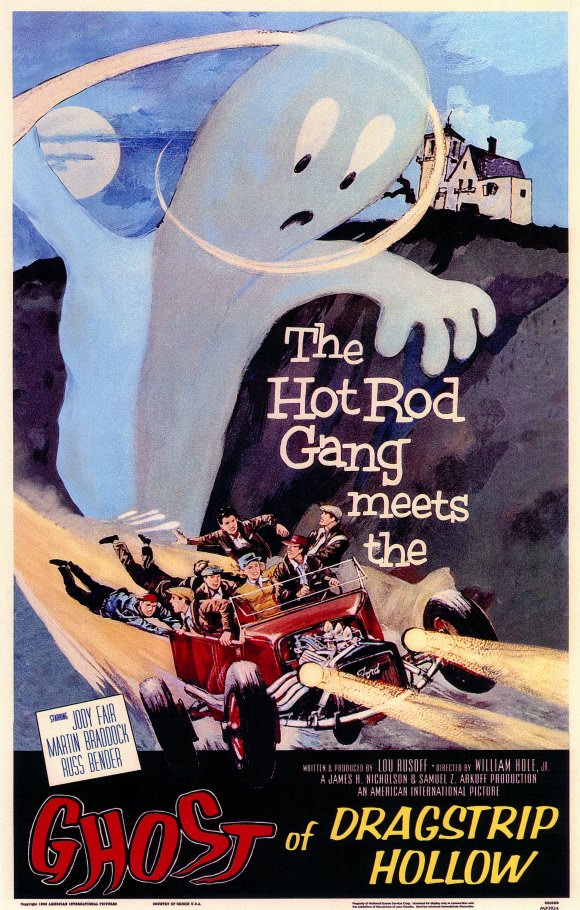
Hey all you Halloween hepcats and creepy chicks! Are you ready for THE GHOST OF DRAGSTRIP HOLLOW? And by ready I mean prepared to watch a really lousy movie redeemed only by the in-joke twist ending that’s sure to please horror fans. All you’ve got to do is slog through the rest of this nonsense… so let’s slog on!
THE GHOST OF DRAGSTRIP HOLLOW is a sequel of sorts to HOT ROD GIRL, and starts off as your basic hot rod drive-in flick. Pretty young Lois Cavendish is a member of the Zenith Club, a group of hot rod enthusiasts being interviewed by magazine writer Mr. Hedley. Lois gets busted drag racing against her rival Nita, and her parents (who just don’t understand) ground her. This means she’s gonna miss the big wing-ding at the club Saturday night, but not to worry… Mom suggests moving the party to their house…
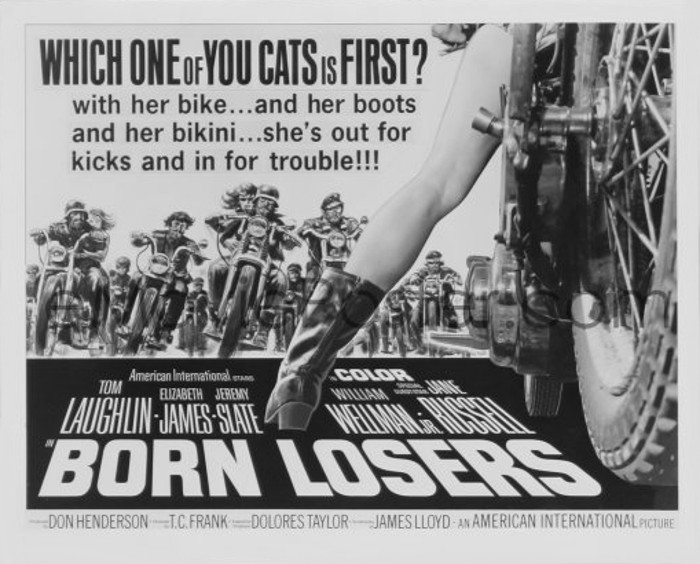
The character Billy Jack, star of the wildly popular 1971 film (and its two sequels), made his debut in this 1967 exploitation flick about a sociopathic biker gang and the lone man who stands up to them. Tom Laughlin, a minor figure in Hollywood at the time who had appeared in GIDGET and THE DELINQUENTS, conceived the character way back in 1954. Unable to get his original screenplay produced, he and co-star Elizabeth James banged out this motorcycle drama and he was given the opportunity to direct by American International Pictures, always on the lookout to make a quick exploitation buck.
The Born Losers are a degenerate gang of outlaw bikers terrorizing the small town of Big Rock. Ex-Green Beret Billy Jack, a half-breed Indian back from ‘Nam, saves a local kid from getting an ass kicking by breaking out his rifle, winds up the one locked up and given 120 days in jail or $1,000…
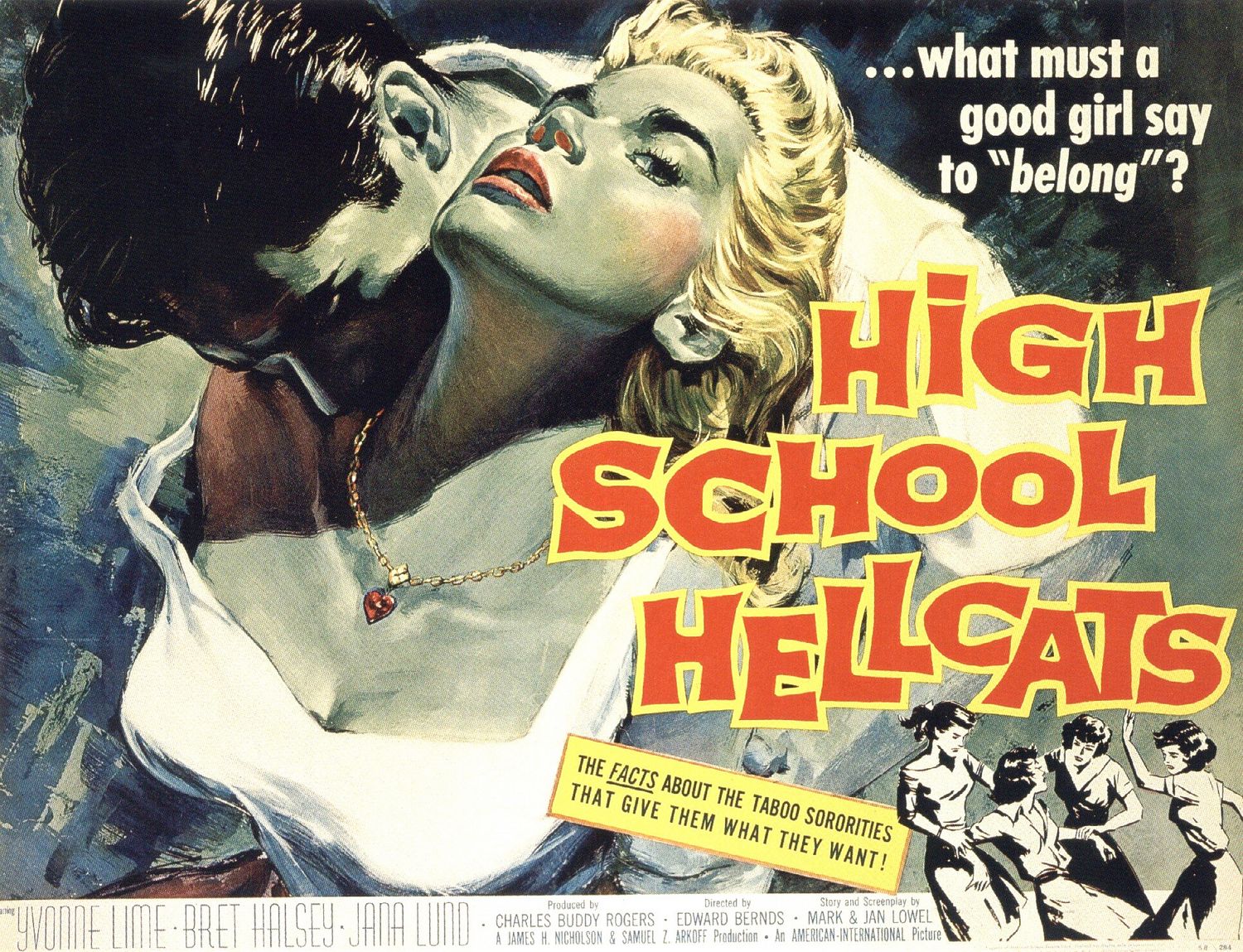
One of the most popular 50’s exploitation subgenres was the “Teenage Girl Gang” movie, with titles like THE VIOLENT YEARS (script by Ed Wood ) and Roger Corman’s TEENAGE DOLL. The plots are pretty much interchangeable: rebellious high school chick, misunderstood by her parents, falls in with the wrong crowd. Soon she’s smoking butts, drinking booze, stealing, staying out late. There’s usually a wild party where something bad happens, and our heroine is placed in peril. If you’re into exploitation flicks, you’ll immediately recognize the storyline, and it’s reused again here to good advantage in HIGH SCHOOL HELLCATS.
Our heroine here is Joyce, the new kid at High School USA. Joyce’s parents just don’t understand her: mom’s always out playing bridge, and dad is just a prick. Joyce longs to be accepted, and is invited to join the Hellcats by anti-social Connie, a rebellious vixen whose attitude seems to be fuck the adult…
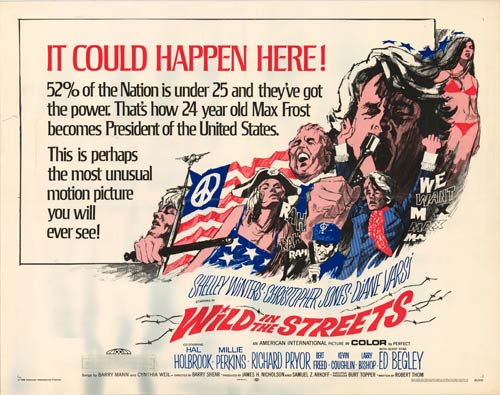
If you think today’s political climate is tumultuous and crazy, wait’ll you get a load of WILD IN THE STREETS. Filmed in the chaotic year 1968, this satirical look at the counter-culture vs the establishment revolves around a power-mad rock star whose call to lower the voting age to 14 results in him becoming President of the good ol’ USA, and sticking it to the over 30 crowd by interring them in concentration camps loaded with LSD-spiked water supplies!
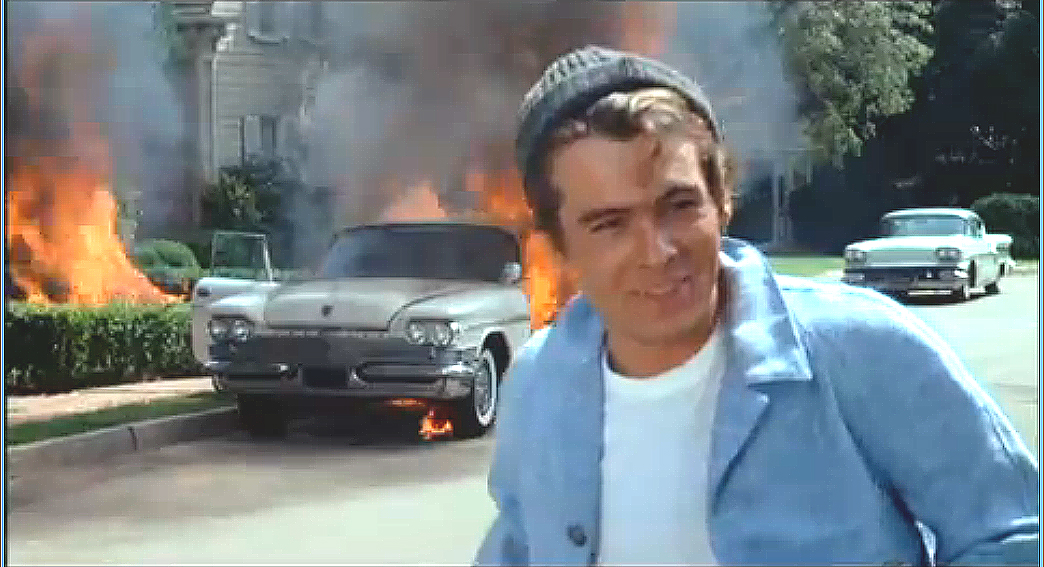
Christopher Jones is Max Frost, née Flatow, the charismatic leader of rock band Max Frost and the Troopers. Pre-credits flashbacks show Max’s unhappy childhood with an overbearing mother (Shelley Winters at her over-the-top best) and abrasive dad (Bert Freed). Max learns to hate all adults and dabbles in making LSD and bombs. After he blows up dad’s car, the rebellious Max leaves home and winds up becoming a mega rock star rivaling the…
In 1964, American International Pictures released the first concert film, The T.A.M.I. Show. After the success of T.A.M.I, AIP followed up with a second concert film. This one would be shot in front of a live audience at Los Angeles’s Moulin Rouge club on the night of November 29th, 1965. The line-up included Ray Charles, Petula Clark, The Lovin’ Spoonful, Bo Diddley, Joan Baez, The Ronettes, Roger Miller, The Byrds, Donavon, and Ike and Tina Turner. Phil Spector was recruited to produce the show and he brought with him a live orchestra. Conducting the orchestra and serving as the night’s emcee was The Man From UNCLE‘s David McCallum.
Originally announced as The T.A.M.I. Show Part II, the title was briefly changed to This Could Be The Night (after a song written by Spector and Harry Nilsson and performed by The Modern Folk Quartet) until AIP finally went with The Big TNT Show, an appropriate title considering the explosive performances that were recorded that night. The Big TNT Show also recorded the growing division between the rock and roll of the 50s and early 60s and the music of the emerging counter culture, with Ray Charles, Bo Diddley, and Ike Turner sharing the same stage as The Byrds and Donavon.
In one of the show’s best moments, Joan Baez sings You’ve Lost That Loving Feeling while Phil Spector accompanies her on piano.
Other highlights include the Byrds performing Turn, Turn, Turn,
Roger Miller performing his novelty hit King of the Road,
Petula Clark singing Downtown,
The Ronettes performing Be My Baby,
Donavon’s Universal Soldier,
and Ike and Tina Turner’s entire set.
At the end of the film, the viewers are told to “be sure to tune in for next year’s show!” but, one year later, both the world and music would be very different. The Big TNT Show captures that one final moment before things changed forever.
It seems a little bit strange that today was, for many people, the first day of Spring Break.
First off, it was cold and rainy today and, whenever I found myself glancing out a window and being confronted by the gray weather, it was very hard for me to imagine having any fun on a beach.
Secondly, for reasons that I never quite understood, the University of North Texas’s Spring Break was always a week after everyone else’s. As a result, I’ve been conditioned to think of Spring Break as starting during the third week of March.
I always looked forward to Spring Break, despite the fact that we always got out a week late. In fact, it was kind of nice to know that, when my friends and I got down to that year’s beach, the most obnoxious of the alcoholic frat boys would already be back in Oklahoma. I’ve always loved the beach, which is odd because I’m scared of drowning. Fortunately, you don’t have to swim to look good in a bikini.
Now, of course, I’m an adult and I don’t get a Spring Break. But that doesn’t mean that I can’t relive the fun of it all by spending the next few days watching and reviewing beach movies!
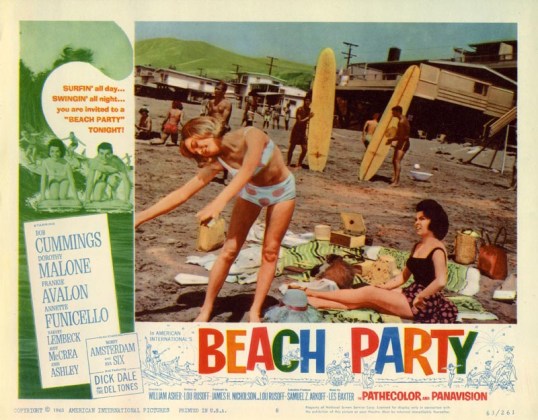
For instance, earlier today, I discovered that the 1963 film Beach Party was available on Netflix. I watched the first 40 minutes during my lunch and then, as the day progressed, I watched the rest of it in bits and pieces until finally, nearly 8 hours after starting the film, I finished it. Needless to say, this is absolutely the worst way to watch a film like Beach Party. Beach Party was designed to be a film to be enjoyed but not thought about. It’s the cinematic equivalent of fast food. Watching Beach Party in increments of 2 or 3 minutes at a time is a bit like buying a Wendy’s bacon cheeseburger and not eating it until the next day.
(Or so I assume. I would never do that because, seriously, Wendy’s makes the best bacon cheeseburgers!)
It feels kind of silly to try to describe the plot of something like Beach Party but here goes: Frankie (Frankie Avalon) and Delores (Annette Funicello) are two teenagers in love. Or, at the very least, Delores is in love. Frankie, however, has a hard time saying it. Frankie and Delores are planning on spending the weekend at a beach house where, Frankie tells her, it will be just like they’re married. Though it’s never explicitly stated (like many films from the early 60s, Beach Party is all about the euphemisms), Frankie is obviously expecting that he and Delores will finally be having sex in that beach house. However, Delores had the same idea so she invited all of their friends to stay at the beach house as well, specifically to keep her from giving in during a moment of weakness.
Meanwhile, Prof. Robert Sutwell (Robert Cummings) is also hanging out on the beach. He’s an anthropologist who has a rather prominent beard. He’s studying the sex lives of teenagers. Since they’re adults, Robert and his assistant Marianne (Dorothy Malone) are actually allowed to say the word “sex.”
Speaking of which, that’s one thing that nobody on the beach seems to be doing. Robert is too obsessed with his work, Marianne is too frustrated with his lack of interest, Frankie is too busy surfing and singing, and Delores says she’s not interesting in “being a woman” until she’s married. There’s constant flirting going on, of course but, for the most part, these teenagers make the spring breakers from From Justin To Kelly look wild. (One can only guess what would happen if any of them ever ran into the spring breakers from Spring Breakers….)
That said, I do think that I did spot Frankie and his friends passing around a joint during one scene. According to some comments at the imdb, it was probably meant to be a cigarette that Frankie was sharing with his friends Ken (John Ashley) and Deadhead (Jody McCrea) but it sure looked like a joint to me. Plus, Frankie was listening to beatnik poetry at the time and we all know those crazy kids loved the poetry and loved the marijuana.
Oh! And did I mention that there’s a motorcycle gang in this film? Because there so totally is. The Rat Pack is led by a guy named Erich Von Zipper (Harvey Lembeck) and they pretty much show up whenever the film starts to run out of ideas…
Now, it may sound like I’m being pretty critical of Beach Party but actually, I thought it was fun in a time capsule sort of way. This is one of those films that is so obviously a product of the time in which it was made that watching it is a bit like getting to take a ride in a time machine. Everything about this film — from the dialogue to the cultural attitudes to the clean-cut teenagers to the music to the bizarrely modest bikinis — practically screams 1963. As a secret history nerd, I loved the part of Beach Party.
Add to that, Vincent Price has a cameo! That’s always fun.
Anyway, Beach Party is currently available to be watched on Netflix and Hulu. If you can’t get to the beach this year, you can always watch Frankie Avalon getting high in Beach Party.
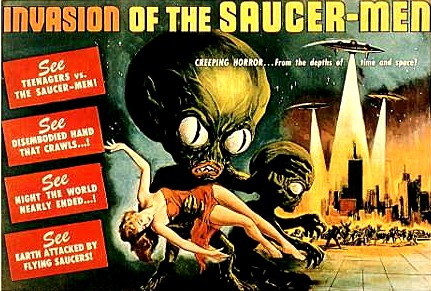
The poster above pretty much epitomizes everything that I love about old B-movies. Between the aliens and the poster’s promise that we’re being given the chance to “SEE (the) night the world nearly ended…!,” it’s hard to resist the temptation to give Invasion of the Saucer Men a chance.
First released in 1957, Invasion of the Saucer Men is, in many ways, a standard alien invasion film. Aliens land in a small town and cause a lot of inconvenience for a bunch of all-American teenagers who are just looking for a place to make out. What sets Invasion of the Saucer Men apart is that it’s meant to intentionally humorous and the aliens totally kick ass.
So, here is today’s edition of Horror On The Lens: Invasion of the Saucer Men!
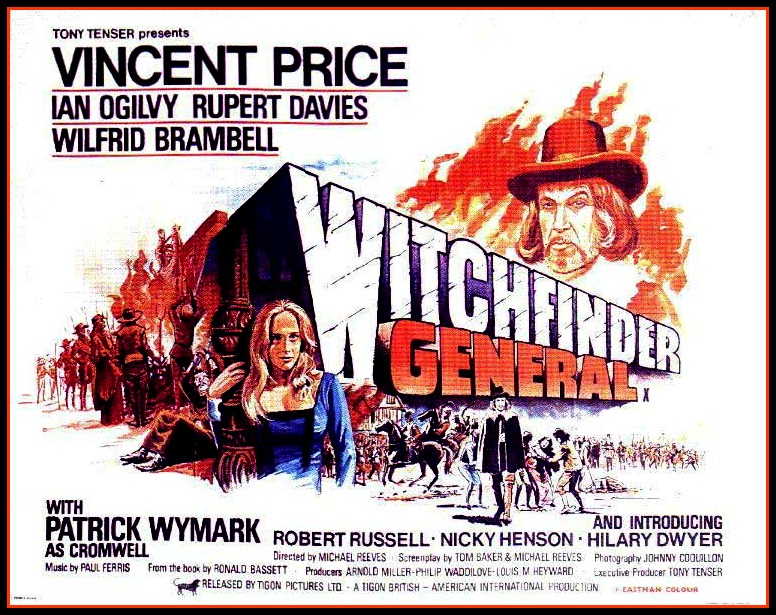
The late 1960’s saw a major shift in horror films. There have always been horror films which had an inordinate amount of gore and violence, but were always relegated to the niche cinemas which catered to horror exploitation films. In 1968 it all changed with the release of George A. Romero’s Night of the Living Dead. Not only did this film graphically show gore and violence on the screen it also paired it with a well-told story. Another film which became infamous the very same year for it’s portrayal of torture, rape and sadism on the screen was British filmmaker Michael Reeves’ horror film, Witchfinder General.
Witchfinder General starred horror icon Vincent Price in the title role as Matthew Hopkins who was tasked as the Witchfinder General by the Cromwell government during the English Civil War of the 17th-century. His Hopkins would travel the region of East Anglia (Cromwell-controlled territory) rooting out witchcraft and sorcery wherever they might be found. Assisting him in this task is the thuggish, brute Stearne (played by Robert Russell) who relished in torturing suspected witches in towns the two visit. It’s during one such visit to the town of Brandeston, Suffolk that Hopkins and Stearne begin a sequence of events which would pit them against the soldier Richard Marshall (who also happens to fight on the same side as Hopkins and Stearne) whose fiancee and her uncle became the latest victims of the Witchfinder General’s sadistic methods of rooting out confessions.
The film as a horror has less to do with the supernatural, but more of the hypocritical horror which begets a political environment where powerful men contest for more power and uses fear and the superstitious ignorance of a populace to cement their power. In this amoral vacuum comes in the opportunistic Matthew Hopkins who uses the power given to him by his government to not just do his duty to eradicate witchcraft but also abuse it for his own personal (and as seen in the film a way to sate his own personal lusts) gain. It’s this hypocritical nature of who was suppose to be a Puritanical and righteous agent of God which emphasizes the true historical horror of religion and politics becoming one and the same.
Vincent Price as Matthew Hopkins was at the top of his game in Witchfinder General. He gives his role not just an air of superiority over everyone he meets and deals with, but he also makes Hopkins’ truly an amoral character who sees nothing wrong in taking advantage of his position and actually feels like he deserves the desperate attentions of those willing to do anything to save their loved ones from his machinations. Robert Russell as his licentious and sadistic assistant Stearne also does a great job in portraying an individual who might seem brutish and thuggish, but who was also more honest with is situation than his master. It makes for an interesting pair despite their roles being the film’s prime antagonists.
The film more than truly earned the outcry it received upon it’s release in 1968 as scenes of torture and sadism was extreme for a British horror film industry so used to the Gothic sensibilities of the Hammer Films of the era. Graphic depictions of burnings, torture and drowning were done not to seem gratuitious or to cater to the burgeoning gorehound crowd of the era, but done so matter-of-factly that they seem even more horrific.
The Witchfinder General really helped usher in the death of gothic horror which dominated the genre with the Hammer Films in the UK and the Edgar Allan Poe films of Roger Corman in the US. The film continues to impress new generations of horror fans and is still considered by older fans of the genre as one of the best horror films ever made. For some the film might look dated due to the acting (most of the actors of the era were stage actors first and film ones second) and the effects work, but they also fail to look at the film in context of the era and how even by today’s standard it would still shock those not well-versed in the genre of horror. They definitely don’t make horror films like this anymore and that’s a shame on many levels.





 Through the Shattered Lens