On the planet of Arous, Taura (Sandy Brooke) leads a group of dwarf miners in rebellion against the international empire. The empire sends Captain Bantor (Ross Hagen), Krago (Michael D. Sonye), and the Inquisitor (Aldo Ray) to capture Taura and put down the revolution. When Bantor attempts to attack Taura, he sticks his hand in a volcanic acid plume and screams as it dissolves. Taura is arrested. Judge John Carradine sentences her to a term on Vehemence, a spaceship that serves as an intergalactic women’s prison.
StarSlammer is a Women In Prison film that happens to be set in space. Taura makes an enemy of the sadistic warden (Marya Grant) and her henchwoman, Muffin (Dawn Wildsmith). Taura also befriend Mike (Susan Stokey) and the two of them plot to overthrow the guards and make their escape. When the now crazed Bantor boards the ship, Taura sees her chance. Meanwhile, the prisoners have to deal not only with pervy guards but mutant rats.
Legend has it that Fred Olen Ray had rented Roger Corman’s New World Pictures studio for four days so that he could shoot some extra scenes for his film Biohazard. Ray finished his Biohazard work in one day and then spent the other three days filming promotional footage for the film that would become StarSlammer. He used props that were left over from Galaxy of Terror and was able to get Aldo Ray to come in for a day so that the footage would feature “a name.” Producer Jack H. Harris looked at the footage and put up the money to shoot the rest of the film on the condition that Ray change the title from PrisonShip to Star Slammer.
Amazingly, the resulting film itself is not that bad. Ray used the outer space setting as a way to both indulge in and poke fun at the common tropes of the Women In Prison genre and Sandy Brooke and Susan Stokey both turn in committed performances. Ross Hagen laughs like a maniac and demands vengeance for his missing hand while trying to get his remaining hand on a mind control device. The prisoners are kept in check by promises of prizes and free trips in return for good behavior. A thoroughly deformed guard is promoted as a sex symbol and there’s a sharp wit to many of the scenes. Star Slammer is much more clever and fun than anyone would have any right to expect it to be.
How dumb can one movie be without becoming unwatchable?
1985’s Evils of the Night is here to answer that question!
Three space alien vampires (John Carradine, Julie Newmar, and Tina Louise) have led an expedition to Earth. They’ve taken over a hospital and they’re stealing the blood of their patients so that it can be sent back to their dying planet. They especially want young blood, which is why they specifically came to a college town. Unfortunately, their intelligence was faulty and they arrived during the summer, when the campus was closed. (I guess this is one of those rare colleges that don’t offer a summer term.) There’s actually a very lengthy scene in which Carradine explains the faulty intelligence to Newmar and Louise and then Newmar complains about how the alien intelligence service just isn’t that good. What makes this scene so special is that Carradine delivers his lines with a straight face and Newmar actually seems to be sincerely annoyed. Aliens — they’re just like us!
Just because college is out of session, that doesn’t mean that there aren’t any young people hanging out down at the lake. There’s actually quite a few, though all of them look to be a little bit too old for high school or college or whatever they’re supposed to be attending. Several of them are played by veterans of the adult film industry, including Amber Lynn and Jerry Butler. Everyone wants to get laid down at the lake, which is probably the most realistic thing about Evils of the Night. However, John Carradine needs their blood so he has Julie Newmar hire two slovenly mechanics, Kurt (Neville Brand) and Fred (Aldo Ray), and sends them out to kidnap any young people that they find. Kurt and Fred are very good at their job. Newman pays them and mocks them for caring so much about coins. Little do the mechanics realize that the aliens are planning on shooting them with their space laser as soon as they leave the planet.
Evils of the Night is a good example of a bad movie that is oddly watchable just because the viewer finds themselves curious as to just how stupid things can get. The answer here is very stupid and very nonsensical It never seems to occur to anyone just go to a different lake or maybe just do their skinny dipping in a pool somewhere. The plot has a “make it up as you along” feel to it and that, at the very least, keeps things vaguely interesting. The actors playing the “teen” victims are enthusiastic without being particularly good while most of the veterans in the cast are all obviously just there for the paycheck.
That said, John Carradine. Wow. What a career. A trained Shakespearean actor who made his stage debut in 1925 and went on to appear in a countless number of movie, Carradine was a favorite of both John Ford and Fred Olen Ray. Carradine appeared in hundreds of a theatrical films. In fact, his final film was released seven years after Carradine’s death. Carradine was one of the great actors, with that deep voice and that commanding stare. But he was also one of those actors who was apparently willing to appear in just about anything and that’s one reason why he’s still such a beloved icon. Playing an outer space vampire-turned-doctor was definitely not the strangest role that Carradine ever played. Carradine handles his scenes like a pro!
Evils of the Night is dumb but I dare you to look away.
Welcome to Late Night Retro Television Reviews, a feature where we review some of our favorite and least favorite shows of the past! On Mondays, I will be reviewing CHiPs, which ran on NBC from 1977 to 1983. The entire show is currently streaming on Prime!
This week, CHiPs deals with the oil crisis!
Episode 3.4 “High Octane”
(Dir by John Florea, originally aired on October 6th, 1979)
Tonight’s episode of CHiPs is a real history lesson.
The episode was aired at a time when the U.S. was suffering from a shortage of gasoline. Conflict in Iran had led to both the Shah fleeing the country and Americans being taken hostage. Oil production fell, OPEC raised its prices, and people panicked and started to hoard gasoline. Many states instituted odd-even gas rationing, which meant that only people with an odd-numbered license plate could purchase gas on an odd-numbered day and only people with an even-numbered license plate could purchase gas on an even-numbered day. As so often happens when the government attempts to micromanage a crisis, this only made things worse as there were soon long lines at the pump and reports of fights breaking out between people at gas stations. Even with the rationing, many gas stations ran out of gasoline before they could serve every customer. If you didn’t arrive early enough, chances were that you would not be able to put gas in your car,
California was one of the many states to institute odd-even rationing and this episode of CHiPs is all about the battle over gasoline. Two crooks are siphoning gas from independent gas stations and then reselling it to other stations. (Their biggest customer is played by veteran screen tough guy, Aldo Ray.) Getraer is injured when he crashes his bike while chasing the two crooks, which makes this case personal for Ponch and Baker. Meanwhile, Ponch and Baker have to break up fights at the gas station, chase yet another guy who was caught siphoning gas from a car, and save yet another motorist who passes out from the fumes of all the gas cans that he had in the backset of his car. Ponch even starts to date Beth (Ellen Bry), because she works at a gas station and can tell him the best time to show up to make sure that he and Baker are able to fill up their bikes. Meanwhile, at headquarters, Harlan is giving lessons on the best way to keep unused fuel from evaporating.
Of course, it wouldn’t be CHiPs if there wasn’t also a light-hearted sports angle. This week, everyone’s into roller hockey. Ponch serves as the referee for the CHP-sponsored kids’ roller hockey game and everyone agrees that he’s the best referee that they’ve ever seen. And why not? He’s Ponch and, by the time the third season rolled around, CHiPs was definitely The Ponch Show. Later, the adult officer play roller hockey as well. It’s the show’s way of saying, “California’s still fun, even with the gas rationing!”
I enjoyed this episode because I’m a history nerd and it was interesting to see how the show dealt with the 1979 oil crisis while it was occurring. It’s interesting that this episode was a bit cynical about rationing, as CHiPs was usually a show that portrayed the government and its policies as positively as possible. In 1979, even the audiences of CHiPs was fed up with having to pay — let me check my notes to make sure I have this right — nearly a dollar a gallon for gas.
Really? Just 90 cents for a gallon gas? Get me a time machine. I’m going to 1979!
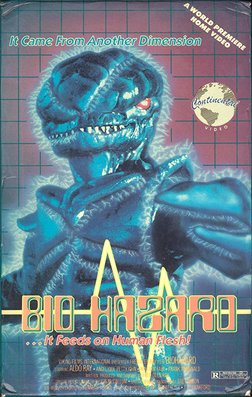
At a government research lab in the middle of the desert, Lisa (Angelique Pettyjohn) is a psychic who has the ability to go into different dimensions and bring things back with her. While demonstrating her abilities for Gen. Randolph (Aldo Ray), she accidentally brings back a container that is carrying a small, humanoid/lizard hybrid. (Inside the costume was director Fred Olen Ray’s six year-old son, Christopher.) The monster goes on a rampage, killing hoboes and other random people who live in a nearby town. Lisa and Carter (William Fair) try to track down the creature before it can cause too much damage and kill too many people. Meanwhile, the town drunk wants to sell the monster’s story to the newspapers.
Biohazard is a typical early Ray film. Hire some veterans, like Aldo Ray and Carroll Borland. (Fred Olen Ray, if nothing else, was good about finding work for Hollywood veterans who, otherwise, would have spent their final years in obscurity.) Unleash someone in a monster costume. Toss in some gratuitous nudity. Spill some fake blood. Pad it out so that the film reaches feature-length. Biohazard goes the Hal Needham route when it comes to padding out the film and gives us several minutes of blown takes and other mistakes. The takes start out amusing but, eventually, there’s only so many times you can watch actors blow lines that weren’t that good to begin with. It’s still not as bad as having to watch Burt Reynolds slap Dom DeLuise a hundred times during the closing credits of Cannonball Run. At least most of the actors actually look like they enjoyed being on the set of Biohazard.
With Fred Olen Ray, you know what you’re going to get and Biohazard delivers all of Ray’s trademark moments, including ineptly lit day-for-night scenes, overacted comedy relief, and one or two scenes that work despite themselves. As bad as the end result was, the film does have a DIY aesthetic that will appeal to anyone who has ever thought about getting a couple of friends together and just making a movie. Supposedly, it took Ray two years to complete Biohazard. Today, an aspiring filmmaker could just film it on his phone over two weekends and then upload it to YouTube and get a few thousand likes. In some ways, independent filmmakers like Fred Olen Ray were ahead of their time.
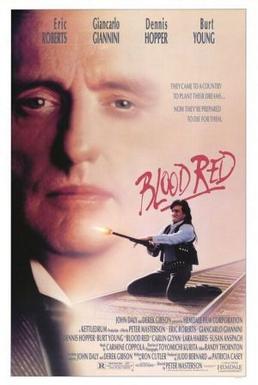
The time is the 1890s. The place is California. Sicilian immigrant Sebastian Collogero (Giancarlo Giannini) has just been sworn in as an American citizen and owns his own vineyard. When Irish immigrant William Bradford Berrigan (Dennis Hopper) demands that Sebastian give up his land so Berrigan run a railroad through it, Sebastian refuses. Berrigan hires a group of thugs led by Andrews (Burt Young) to make Sebastian see the error of his ways. When Sebastian ends up dead, his wayward son, Marco (Eric Roberts), takes up arms and seeks revenge.
Have you ever wondered what would have happened if the famously self-indulgent directors Michael Cimino and Francis Ford Coppola teamed up to make a movie about the American Dream? The end result would probably be something like Blood Red. Like Cimino’s The Deer Hunter and Heaven’s Gate, Blood Red begins with a lengthy celebration (in this case, in honor of Sebastian’s naturalization ceremony) that doesn’t have much to do with the rest of the film but which is included just to make sure we know that what we’re about to see is more than just a mere genre piece. Like many of Coppola’s films, Blood Red features a tight-knit family, flowing wine, and a score composed by Carmine Coppola. The only difference between our hypothetical Cimino/Coppola collaboration and Blood Red is that the Cimino/Coppola film would probably be longer and more interesting than Blood Red.Blood Red is only 80 minutes long and directed by Peter Masterson, who seems lost. There’s a potentially interesting story here about two different immigrants fighting to determine the future of America but it gets lost in all of the shots of Eric Roberts flexing his muscles.
For an actor known for his demented energy, Eric Roberts is surprisingly dull as the lead but Blood Red is a film that even manages to make veteran scenery chewers like Dennis Hopper and Burt Young seem boring. (Hopper’s bizarre attempt at an Irish brogue does occasionally liven things up.) The cast is full of familiar faces like Michael Madsen, Aldo Ray, Marc Lawrence, and Elias Koteas but none of them get to do much. Of course, the most familiar face of all belongs to Eric’s sister, Julia. Julia Roberts made her film debut playing Marco’s sister, Maria. (Because the film sat on the shelf for three years after production was completed, Blood Red wasn’t released until after Julia has subsequently appeared in Mystic Pizza and Satisfaction.) She gets three lines and less than five minutes of screen time but she does get to briefly show off the smile that would later make her famous. Today, of course, that smile is the only reason anyone remembers Blood Red.
Spastic Colon, an up-and-coming metal band, desperately needs a new guitarist, so much so that they allow a nerdy pizza boy named Martin (Stephen Quadros) to come in off the street and audition. Martin, with his thick glasses and his total lack of talent, blows the audition and is told to leave and never return. Not only does Martin lose his chance to be a rock star but he also loses his job when his boss (Aldo Ray) fires him for leaving work to audition. While wandering around dejected, Martin runs into the local voodoo priestess (Tyger Sodipe), who offers to make him a rock star in exchange for his soul.
Martin agrees and after a ceremony involving a double neck guitar, Martin wakes up to discover that he is now an extremely talented guitarist who lives in a gigantic mansion with three outrageously hot groupies. Martin now has big, heavy metal hair and no longer needs to wear his glasses. Renaming himself Angel Martin, he not only becomes Spastic Colon’s new guitarist but he also pulls the band’s manager (Traci Lords) away from her boyfriend. The only problem is that Martin cannot eat normal food and has to regularly feast on the souls of his groupies in order to stay alive.
Shock “Em Dead is the 1000th retelling of the old Faust legend, about the man who gets everything that he desires but loses his soul in the process. A real product of its time, it’s impossible to watch Shock “Em Dead without thinking about how Martin sold his soul to become the type of musician that, in just a few months, would be made obsolete by Kurt Cobain and Nirvana. I have fond memories of Shock “Em Dead because it always used to air on HBO back when I was growing up but, for the most part, this is a really crummy movie, with a bad script, bad acting, and bad special effects. Shock “Em Dead does prove that Traci Lords had enough talent that, if not for her background as an underage porn star, she probably could have had a mainstream film career. The film also provided small roles for Aldo Ray and Troy Donahue while the legendary Michael Angelo Batio served as Angel’s “guitar double.”
There’s a lot of good stuff being broadcast this month, so it’s time once again to make some room on the ol’ DVR. Here’s a quartet of capsule reviews of films made in that mad, mad decade, the 1960’s:
THE FASTEST GUITAR ALIVE (MGM 1967; D: Michael D. Moore) – MGM tried to make another Elvis out of rock legend Roy Orbison in this Sam Katzman-produced comedy-western. It didn’t work; though Roy possessed one of the greatest voices in rock’n’roll, he couldn’t act worth a lick. Roy (without his trademark shades!) and partner Sammy Jackson (TV’s NO TIME FOR SERGEANTS) peddle ‘Dr. Ludwig Long’s Magic Elixir’ in a travelling medicine show, but are really Confederate spies out to steal gold from the San Francisco mint to fund “the cause” in the waning days of the Civil War. The film’s full of anachronisms and the ‘comical Indians’ aren’t all that funny…
All last week, I was laid up with sciatic nerve pain, which begins in the back and shoots down my left leg. Anyone who has suffered from this knows how excruciating it can be! Thanks to inversion therapy, where I hang upside down three times a day on a table like one of Bela Lugosi’s pets in THE DEVIL BAT , I’m feeling much better, though not yet 100%.
Fortunately, I had a ton of movies to watch. My DVR was getting pretty full anyway, so I figured since I could barely move, I’d try to make a dent in the plethora of films I’ve recorded.., going all the way back to last April! However, since I decided to go back to work today, I realize I won’t have time to give them all the full review treatment… and so it’s time for the first Cleaning Out the DVR post…
(Hi there! So, as you may know because I’ve been talking about it on this site all year, I have got way too much stuff on my DVR. Seriously, I currently have 180 things recorded! I’ve decided that, on February 1st, I am going to erase everything on the DVR, regardless of whether I’ve watched it or not. So, that means that I’ve now have only have a month to clean out the DVR! Will I make it? Keep checking this site to find out! I recorded the 1967 film, Riot on Sunset Strip, off of TCM on September 28th, 2017!)
“Dig that scene!”
That’s a line that’s heard more than once in Riot on Sunset Strip, a film that’s all about digging that scene.
In this case, the scene is Hollywood’s Sunset Strip in 1966. All the kids are going to the clubs and dancing to that strange rock and roll music. Protesters are walking up and down the sidewalk, carrying signs that carry radical messages like: “Be Nice” and “Make Peace.” (As far as I could tell, no one had a “Join the Conversation” sign.) Some of the so-called “long hairs” are wearing red armbands to show that they are a member of the counter-culture police force, determined to keep peace on the Strip. Meanwhile, the real police are a constant presence. There’s a 10 o’clock curfew for anyone under the age of 18 and if the cops catch you, you’re going to the station where your parents will be called and your mom will probably freak out over the length of your skirt. The kids want the police to change their attitude. The local business owners — the ones who don’t own a club and who all look like they might be related to Dwight Eisenhower — want the police to get even more aggressive.
Stuck in the middle of it all is the local police captain, Walt Lormier (Aldo Ray). Sure, Walt might be a member of the establishment, with his neckties and his J. Edgar Hoover haircut. But Walt knows that the kids aren’t all bad. Sure, their music sounds like noise to him. And some of the boys may wear their hair a little bit longer than Walt thinks they should. (In some scenes, it’s easy to imagine Walt thinking, “That haircut would have gotten you shot if you’d been in my unit in Korea…”) But mostly, Walt wants to keep peace. He’s even willing to meet with one of the protesters and listen to his concerns.
“Are you in college?” Walt asks the protester.
“Third year,” the protester replies, “Straight A’s.”
Of course, what Walt doesn’t realize is that his own daughter, Andy (Mismy Farmer, before she relocated to Italy), is one of the kids who is hanging out on the strip! Of course, it’s been a while since he’s seen Andy. Walt is divorced from Andy’s mother and says he really isn’t even sure where either Andy or his ex-wife lives now. Of course, we know that they’re living in a shack, one that has only one room and where wet clothes are hung from the ceiling so that they can dry. Andy’s mom is always drunk. Can you blame Andy for wanting to spend all of her time on the Strip?
Of course, not everyone on the Strip is as reasonable as a third year college student. Some of the kids actually are bad. One of them slips Andy LSD, which leads to Andy staring at her hand and then doing an interpretive dance at a house party. After discovering that his drugged daughter has been raped, Walt attacks her three rapists, which leads to the riot promised by the title. Being a good middle-of-the-road liberal, Walt realizes that he now has to make amends with the good kids but can he stop things before they get out of control? After all, those protesters are already passing out signs…
Based on an actual event. Riot on Sunset Strip is a real time capsule of a film. Regardless of whether the film itself is any good or not, it’s worth watching as just a reflection of the time in which it was made. Like a lot of the “social problem” films made in the mid-60s, it deals with a very real issue and then resolutely refuses to come down on either side. Older viewers could watch Mimsy Farmer freaking out on LSD and say, “See, that’s why we need a curfew!” Younger viewers could look at Andy’s drunk mother and the parents picking up their children at the station and say, “See, that’s why we need to burn down the establishment and move to Cuba!” In the end, the film declares that the kids are all right except for the ones that aren’t. Ultimately, it’s all the parents’ fault except for the parents who aren’t at fault.
(That said, I imagine that any truly committed 60s revolutionary would have rolled their eyes at the way they were portrayed in the film. The protesters and their signs automatically made me think about the infamous Kendall Jenner Pepsi commercial.)
Seen today, the main thing that I noticed about Riot on Sunset Strip is that all of the wild kids on the Strip looked more like missionaries than revolutionaries. One of Andy’s friend’s did occasionally let his hair fall in his eyes but otherwise, they were an amazingly clean-cut group of delinquents, the type who, today, would probably get blocked by every member of Resistance Twitter because everyone would assume that they were actually undercover Russian bots.
(At the end of the film, a narrators informs us, “Soon, half the world’s population will be under 25 years of age. What will happen to them? Where will they go?” The answer, of course, is that most of them will go to the suburbs.)
Today, it’s easy to roll your eyes at something like Riot on the Sunset Strip. Our modern culture of snark almost demands that you do. But, honestly, I enjoyed this film. Watching it was like having my own little time machine.
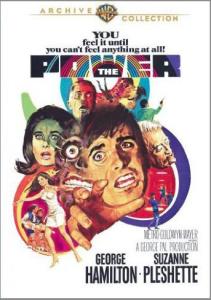
That is the mystery that Professors Jim Tanner (George Hamilton) and Margery Lansing (Suzanne Pleshette) have to solve. Someone is using psychic powers to kill their co-workers in a research laboratory. The police think that Tanner is guilty but Tanner knows that one of his colleagues is actually a super human named Adam Hart. Hart is planning on using his super powers to control the world and, because Tanner is the only person who has proof of his existence, Hart is methodically framing Tanner for every murder that he commits.
The Power is underrated by entertaining movie, a mix of mystery and science fiction with a pop art twist. It was also one of the first attempts to portray telekinesis on film. Similar films, like Scanners, may be better known but all of them are directly descended from The Power. George Hamilton may seem like an unlikely research scientist but he and Suzanne Pleshette are a good team and The Power makes good use of Pleshette’s way with a one liner. Also keep an eye out for familiar faces like Arthur O’Connell, Nehemiah Persoff, Michael Rennie, Gary Merrill, Yvonne DeCarlo, Vaughn Taylor, Aldo Ray, and even Forrest J. Ackerman as a hotel clerk.
 On the planet of Arous, Taura (Sandy Brooke) leads a group of dwarf miners in rebellion against the international empire. The empire sends Captain Bantor (Ross Hagen), Krago (Michael D. Sonye), and the Inquisitor (Aldo Ray) to capture Taura and put down the revolution. When Bantor attempts to attack Taura, he sticks his hand in a volcanic acid plume and screams as it dissolves. Taura is arrested. Judge John Carradine sentences her to a term on Vehemence, a spaceship that serves as an intergalactic women’s prison.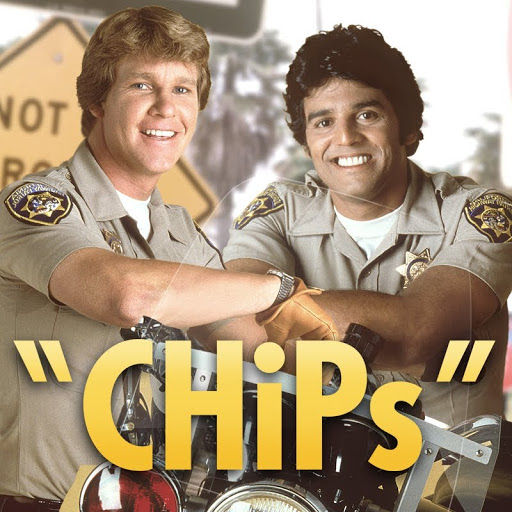
 The time is the 1890s. The place is California. Sicilian immigrant Sebastian Collogero (Giancarlo Giannini) has just been sworn in as an American citizen and owns his own vineyard. When Irish immigrant William Bradford Berrigan (Dennis Hopper) demands that Sebastian give up his land so Berrigan run a railroad through it, Sebastian refuses. Berrigan hires a group of thugs led by Andrews (Burt Young) to make Sebastian see the error of his ways. When Sebastian ends up dead, his wayward son, Marco (Eric Roberts), takes up arms and seeks revenge.




 Who is Adam Hart?
 Through the Shattered Lens