Today would have been Diane Keaton’s 80th birthday.
In today’s scene that I love, from 1972’s The Godfather, Keaton plays Kay Adams Corleone, the wife of Michael (Al Pacino). In this scene, Michael has “allowed” Kay to ask him about the family business. She asks him if he had his brother-in-law, Carlo, killed. Michael says, “No.” Kay is relieved …. until she steps out into the hallway and realizes, as the door is shut in her face, that her husband just lied to her.
This is a beautifully acted scene and one of the most powerful endings in film history.
Well, the clock has now struck midnight on the West Coast and that officially means that it is 2026 in the United States! What better way to start things off than by sharing a scene that I love from one of the greatest and most important films of all time, 1974’s The Godfather Part II?
The scene below takes place on New Year’s Eve. The scene starts in 1958 and it ends in 1959. Michael Corleone (Al Pacino) and his brother Fredo (John Cazale) are in Havana at the invitation of Hyman Roth (Lee Strasberg). Roth know that Cuba could be a gold mine for the American mob but Michael, from the start, realizes that the country’s corrupt government is on the verge of collapse and that it’s about to be replaced by something even worse. (Admittedly, that’s my opinion. Director Francis Ford Coppola had a much higher opinion of Castro and the communists than I did.) Tragically, it’s also in Havana that Michael realizes that Fredo betrayed him to his enemies. On December 31st, 1958, as the new year is celebrated in Havana, the rebels ride into the city. While the President of Cuba prepares to announce that he will be fleeing the country, Michael confronts his brother and tells him that he knows the truth. Later, as they both attempt to flee the country, Michael and Fredo see each other on the streets. Fredo runs from Michael, refusing his offer to help. Though Fredo would eventually return to the family, the film’s ending revealed Fredo’s first instinct was the correct one.
Here’s a scene that I love, featuring great work from both Al Pacino and the brilliant John Cazale:
Today’s scene that I love comes from my favorite film of all time, 1972’s The Godfather.
In this scene, Kay Adams (Diane Keaton) has moved on and is working as a teacher. Suddenly, Michael Corleone (Al Pacino) shows up. He’s been back from Sicily for a year and he’s working with his father. Michael promises her that the Corleone family is getting out of the rackets. We, of course, know that is never going to happen.
First released in 1979, ….And Justice For All will always be remembered for one scene.
Yell it with me, “YOU’RE OUT OF ORDER! THE WHOLE TRIAL IS OUT OF ORDER! THEY’RE OUT OF ORDER!”
When attorney Arthur Kirkland (Al Pacino) starts screaming in the middle of the courtroom, it’s a cathartic moment. We’ve spent nearly two hours watching as Arthur deals with one insane situation after another. One of Arthur’s partners, Warren (Larry Bryggman), cares more about his car than actually delivering the right documents to a judge. Another of Arthur’s partners, Jay (Jeffrey Tambor), has a nervous breakdown and, after shaving his head, ends up throwing cafeteria plates at people in the courthouse. Arthur has three clients, one of whom is indigent, one of whom is innocent, and one of whom is a wealthy and despised judge (John Forsythe) who has been accused of a rape that Arthur suspects he committed. The system offers no mercy for Arthur’s innocent (or, at the very least, harmless) clients while going out of it’s way to defend the judge. Meanwhile, another judge (Jack Warden), is driven to take suicidal risks, like flying a helicopter until it runs out of fuel and comes down in a nearby harbor. The assistant district attorney (Craig T. Nelson) only cares about his political ambitions and finally, after one incident after another, Arthur snaps. And it’s cathartic because we’re all on the verge of snapping as well.
That final moment, with its signature Al Pacino rant, is such a strong and iconic scene that it’s easy to forget that the film itself is actually rather uneven. The script, by Barry Levinson and Valerie Curtin, owes a good deal to the work of Paddy Chayefsky. Just as Chayefsky often wrote about men being driven mad by institutional failure, ….And Justice For All features character after character snapping when faced with the screwed-up realities of the American justice system. The final “out of order” speech is obviously meant to be this film’s version of Howard Beale’s “I’m as mad as Hell and I’m not going to take it!” speech from Network and, much like George C. Scott in the Chayefsky-written The Hospital, Arthur spends a lot of time talking about what he doesn’t like about his job. The thing that sets ….And Justice For All apart from the best works of Chayefsky is that Levinson, Curtin, and director Norman Jewison all take Arthur Kirkland at his word while one gets the feeling that Chayefsky would have been a bit more willing to call out Arthur on his self-righteousness. Arthur has every right to be angry when Warren forgets to give a judge an important document while Warren is substituting for him in court. At the same time, Arthur is the one who trusted Warren to do it. In the end, the document was not about one of Warren’s client. In fact, Warren knew absolutely nothing about the case or Arthur’s client. The document was about Arthur’s client and Arthur was the one who decided trust someone who had consistently shown himself to not be particularly detailed-orientated. One gets the feeling that Chayefsky would not have let Arthur off the hook as easily as Levinson, Curtin, and Jewison do. Arthur’s perpetual indignation can sometimes be a little hard to take.
It’s a very episodic film. Arthur goes from one crisis to another and sometimes, you do have to wonder if Arthur has ever had any human or legal interactions that haven’t ended with someone either going insane or dying. There’s no gradual build-up to the film’s insanity, it’s right there from the beginning. And while this means the narrative often feels heavy-handed, it also makes that final speech all the more cathartic. It’s an uneven film and, of all of the characters that Pacino played in the 70s, Arthur is probably the least interesting. But that final rant makes up for a lot and, fortunately, Pacino was just the actor to make it memorable. For all it’s flaws, the final few minutes of ….And Justice For All make the film unforgettable.
In 1973’s Serpico, Al Pacino plays a cop who doesn’t look like a cop.
Indeed, that’s kind of the start of Frank Serpico’s problems. He’s a New York cop who doesn’t fit the stereotype. When we see him graduating from the Academy, he’s clean-shaven and wearing a standard patrolman uniform and he definitely looks like a new cop, someone who is young and enthusiastic and eager to keep the streets safe. However, Serpico is an outsider at heart. The rest of the cops have their homes in the suburbs, where they spend all of their time with their cop buddies and where they go also go out of their way not to actually live among the people that they police. Serpico has an apartment in Greenwich Village and, as a plainclothes detective, he dresses like a civilian. He has a beard. He has long hair. He has a succession of girlfriends who don’t have much in common with the stereotypical (and there’s that word again) cop’s wife. Serpico is an outsider and he likes it that way. In a world and a career that demands a certain amount of conformity, Frank Serpico is determined to do things his own way.
However, the real reason why Serpico is distrusted is because he refuses to take bribes. While he’s willing to silently accompany his fellow officers while they collect their payoffs from not only the people that they’re supposed to be arresting but also from the storeowners that they’re meant to be protecting, Serpico refuses to take a cut. Serpico understands that the small, everyday corruption is a way of forcing his silence. The corruption may help the cops to bond as a unit but it also ensures that no one is going to talk. Serpico’s refusal to take part makes him untrustworthy in the eyes of his fellow cops.
Serpico and Bob Blair (Tony Roberts), a politically-connected detective, both turn whistleblower but it turns out that getting people to listen to the truth is not as easy as Serpico thought it would be. The Mayor’s office doesn’t want to deal with the political fallout of a police conspiracy. Serpico finds himself growing more and more paranoid, perhaps with good reason. When words gets out that Serpico has attempted to turn into a whistleblower, his fellow cops start to turn on him and, during a drug bust, Serpico finds himself deserted and in danger.
Serpico opens with its title character being rushed to the hospital after having been shot in the face. This actually happened to the real Serpico as well. What the film leaves out is that hundreds of New York cops showed up at the hospital, offering to donate blood during Serpico’s surgery. That’s left out of the film, which at times can be more than a little heavy-handed in its portrayal of Serpico as an honest cop surrounded by nonstop corruption. Filmed just three years after Serpico testified before New York’s Knapp Commission (which was the five-man panel assigned to investigate police corruption in the city), Serpico the movie can sometimes seem a bit too eager to idealize its title character. (Vincent J. Cannato’s excellent look at the mayorship of John V. Lindsay, The Ungovernable City, presents far more nuanced look at the NYPD corruption scandals of the early 70s and Serpico’s role as a whistleblower.) Director Sidney Lumet later expressed some dissatisfaction with the film and even made other films about police corruption — The Prince of the City, Q & A, Night Falls On Manhattan — that attempted to take a less heavy-handed approach to the subject.
That said, as a film, Serpico works as a thriller and as a portrait of a man who, because he refuses to compromise his ideals, finds himself isolated and paranoid. Al Pacino, fresh from playing the tightly-controlled Michael Corleone in The Godfather, gives an intense, emotional, and charismatic performance as Serpico. (One can see why the image of a bearded, hippie-ish Pacino was so popular in the 1970s.) Sidney Lumet brings the streets of New York to vibrant and dangerous life and he surrounds Pacino with an excellent supporting cast, all of whom bring an authentic grit to their roles. Serpico may not be a totally accurate piece of history but it is a good work of entertainment, one that works as a time capsule of New York in the 70s and as a portrait of bureaucratic corruption. It’s also the film in which Al Pacino announced that he wasn’t just a good character actor. He was also a movie star.
Al Pacino finally won his long overdue Oscar with his excellent performance as Lt. Colonel Frank Slade in SCENT OF A WOMAN. This scene where he’s “just getting warmed up” is a personal favorite and no doubt helped him bring home the gold.
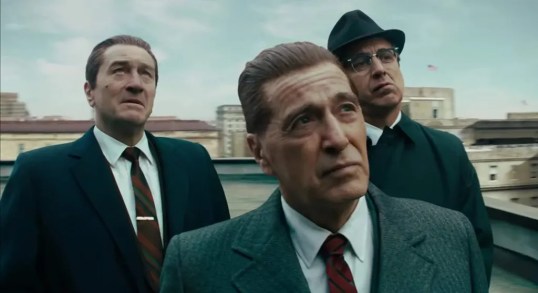
Today’s scene comes from 2019’s The Irishman. In this scene, Jimmy Hoffa (Al Pacino) asks a former rival for an endorsement to once again be president of the Teamsters union. Needless to say, things don’t get well. I’m on Hoffa’s side here. Showing up 12 and a half minutes late? Wearing shorts to meeting? Someone is definitely owed an apology.
Once you get over the admittedly jarring de-aging effect, this scene reminds us of what a great actor Al Pacino truly is.
4 Shots From 4 Films is just what it says it is, 4 shots from 4 of our favorite films. As opposed to the reviews and recaps that we usually post, 4 Shots From 4 Films lets the visuals do the talking!
Today, the Shattered Lens wishes a happy birthday to Al Pacino! It’s time for….
4 Shots From 4 Al Pacino Films
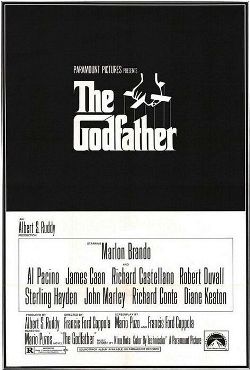
The Godfather (1972, dir by Francis Ford Coppola, DP: Gordon Willis)
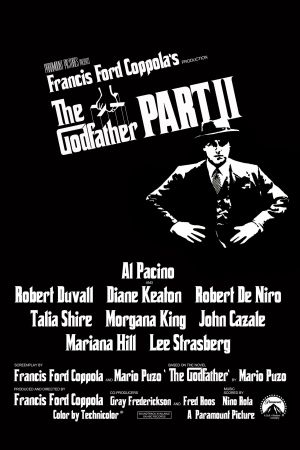
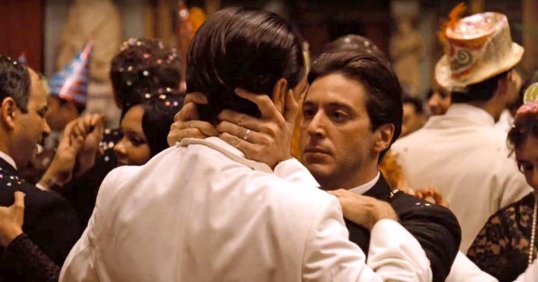
The Godfather Part II (1974, dir by Francis Ford Coppola, DP: Gordon Willis)
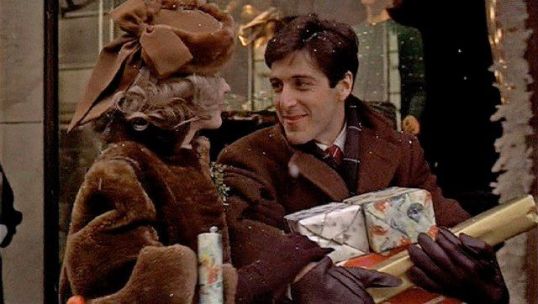
The Irishman (2019, dir by Martin Scorsese, DP: Rodrigo Prieto)
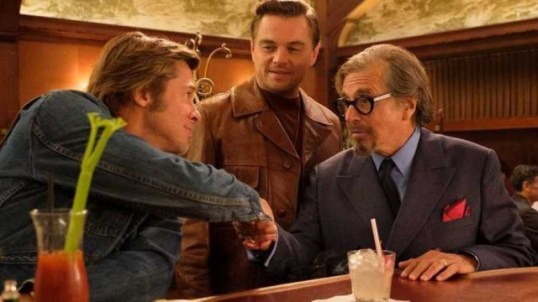
Once Upon A Time In Hollywood (2019, dir by Quentin Tarantino, DP: Robert Richardson)
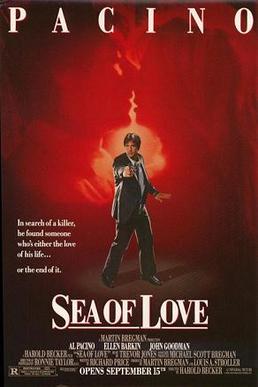
In New York City, someone is ritualistically murdering the men who are placing rhyming personal ads in a tabloid newspaper. Assigned to the case is Frank Keller (Al Pacino), an alcoholic burn-out whose wife just left him for another cop. Keller and his partner (John Goodman) decide to go undercover. Frank places a rhyming personal ad of his own and then goes to a restaurant to see who shows up. When Helen Cruger (Ellen Barkin) answers the ad, it leads to a relationship between Frank and Helen. Frank is falling for Helen but what if she’s the murderer?
Sea of Love is a superior thriller, even though it doesn’t really work as a mystery. As soon as you see a certain person’s name in the cast list, you’re going to guess who the killer is because that person is always the killer. Sea of Love isn’t really about the mystery, though. It’s about people looking something that’s missing from their lives and realizing that the world is passing them by. The movie works because of the performances of Al Pacino and Ellen Barkin, cast as two lonely middle-aged people who are desperately looking for some sort of connection. Helen and Frank are both in their 40s and wondering if their current situation is really as good as it’s going to get. The film uses Frank’s fear that Helen could be the killer as a metaphor for the fear that anyone feels when they are first starting to open up to someone. Both Pacino and Barkin give emotionally raw and poignant performances. I don’t think I’ve ever seen Al Pacino look as miserable as he did for the majority of Sea of Love. This was Pacino’s first film role after the disaster of Revolution and the movie’s box office success was revived Pacino’s career and convinced him to give movies a try again.
Director Harold Becker captures the feel of New York at its grittiest and least welcoming and Richard Price’s script is full of priceless dialogue. This is one of the rare films in which everyone has something intelligent or meaningful to say. Featuring a strong supporting cast and career-best performances from Ellen Barkin and Al Pacino, Sea of Love is much more than just another cop film.
 Through the Shattered Lens