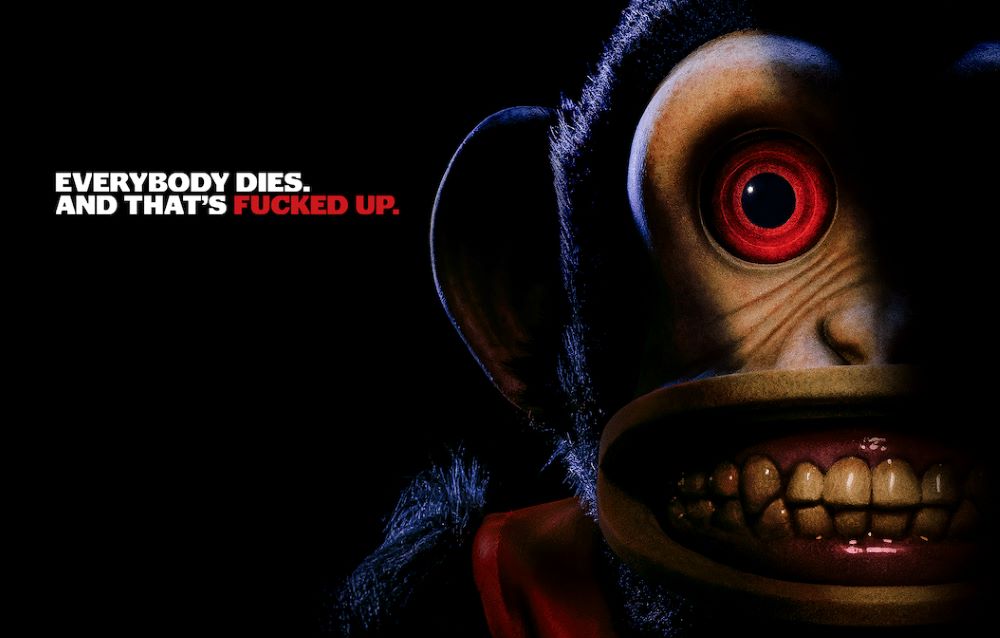
Yes, dying is quite fucked up and Osgood Perkins follow-up to his 2024 horror cult-hit Longlegs points and shows this to the audience in spades (and buckets of blood).
The Monkey, based on the Stephen King short story of the same name, tells the story of a drum-playing toy monkey which happens to cause the the deaths of random individuals when it stops playing the drums. Right from the start we see that The Monkey veers away from Perkins usual moody and atmospheric horror language and goes for the absurdist take on the genre.
Anyone who has seen the supernatural horror series Final Destination will recognize the Rube Goldberg-esque ways each kills in that series has become its signature will appreciate how truly absurd some of the kills in The Monkey turns out. To say more would be too much of a spoiler and should be experience by anyone willing to watch this film.
Osgood Perkins still brings to the table his own brand of horror comedy by exploring the ideas and themes of death’s inevitability and randomness, but also childhood trauma and how it impacts the lives of those children even to their adulthood. Where some films would be more subtle in exploring these themes, Perkins decides on drumming it on thickly which, at time, does come off as cringe.
Yet, despite the heavy-handedness of Perkins’ screenplay (he also wrote the screenplay adaptation of King’s tale), The Monkey still succeeds in delivering an early horror hit for 2025 that should be seen with a crowd. this is a film that is actually better when seen as part of a collective experience rather than with a small group.
Cassie Webb (Dakota Johnson) is a paramedic in New York City. Haunted by the fact that her mother died while giving birth to her while looking for a special spider in Peru (and I cannot believe that I just wrote that), Cassie struggles with showing her emotions and opening up to people. In fact, her only friend appears to be her fellow paramedic, Ben Parker (Adam Scott). Ben’s sister-in-law is pregnant and Cassie tells him, “You’ll be a great uncle, Ben.”
After a near-death experience, Cassie discovers that she has the ability to see into the future. She also discovers that a strange man named Ezekiel (Tahar Rahim) wants to kill three teenage girls, Mattie (Celeste O’Connor), Anya (Isabela Merced), and Julia (Sydney Sweeney). Cassie does what anyone would do. She kidnaps the three girls to keep them safe and then hops on a plane to Peru to find out how Ezekiel is connected to her mother’s death.
Madame Web is the latest entry in Sony’s Spider-Man Universe. Because Sony has the rights to Spider-Man, all of the MCU films featuring Spider-Man have been co-productions with Columbia Pictures and have been distributed by Sony. With Spider-Man emerging as one of the few characters to remain a strong box office draw for Marvel, Columbia has produced a series of Spider-Man-adjacent films that feature characters who have appeared in Spider-Man-related media. While Marvel and Disney have Tom Holland swinging his way through New York, Sony has to settle for Adam Scott and Dakota Johnson in an ambulance.
I always assume that the folks at Marvel and Disney probably groan a little whenever they hear that a new Sony film is coming out. The MCU Spider-Man films have been consistently strong, with all three of them proving popular with both audiences and critics. The Sony Spider-Man films, on the other hand, often seem like throwbacks to the bad old days of the early aughts, when most comic book films were still cheap and kind of embarrassing. Madame Web doesn’t do much to change this perception. In fact, the film is even set in 2003, complete with a Blockbuster Video store prominently featured in one scene, Britney Spears’s Toxic playing in a roadside diner, and a totally random reference to American Idol. (What’s funny is that the jokey reference to American Idol would really only work if the show were no longer on the air but actually, it’s still airing on CBS. No one ever seems to notice anymore but it’s still there. If the movie really had any guts, it would have had Dakota Johnson says that she was going home to watch Paradise Hotel.)
Slow-paced and featuring some of the most awkward line readings this side of a community theater production of Bus Stop,Madame Web is not a particularly engaging film. After a truly abysmal prologue set in Peru, the film spends about half-an-hour giving us a tour of Cassie’s not particularly interesting life as a tough New York paramedic before finally getting started on the main story. And even then, the film leaves the viewer feeling cheated because none of three girls — who we are told are all destined to become super heroes — actually become super powered over the course of the film. The film basically says, “They’re all going to be Spiderwoman …. BUT NOT TODAY!” The problem with that approach is that it’s hard not to feel that the only interesting thing about the three girls is that they’re eventually going to have super powers. Without the powers, they’re just kind of boring. Cassie is the only one who has a super power but being able to see three minutes into the future isn’t that much of a power. Dakota Johnson and the rest of the cast all seem to be bored out of their minds and who can blame them?
The main problem with Madame Web is that it’s just not much fun. The best super hero films are fun to watch. That goes for the Marvel films, the DC films, and even the Sony films. (Admit it, the first Venom was kind of fun.) Even with The Dark Knight films, Christopher Nolan understood that the villains had to be flamboyant to make up for Christian Bale’s rather dour Batman. In this film, we’re never quite sure what Ezekiel wants or even who he is. He’s just a random evil guy and not a particularly memorable one. Madame Web does make some attempts at humor but the sitcom-style jokes are negated by Dakota Johnson’s flat delivery. (Oddly enough, sitcom veteran Adam Scott is stuck playing a serious character.) Overall, there’s an overwhelming blandness to Madame Web. It doesn’t engage,. It doesn’t thrill. It doesn’t make you cheer or even jeer. It’s just kind of there.
The film sets up a sequel but, judging from how the film did at the box office and how not even the film’s cast has pretended to be happy with how the film turned out, I’d expect to see Morbius 2 before another installment of Madame Web.
“It’s a subtle, political thing. Michael specifically mentions the term ‘bush-whacked’. But if you want to take it like ‘Stand’, that’s cool, too. You like to think that you can appreciate these songs on any level you want to. I have a lot of records I listen to when I’m just doing the dishes. Like Ride records. I really like Ride a lot. And I have no idea what the songs are about. And I really don’t care. I don’t even worry about it. Lyrics are the last thing I listen to, unless someone is hitting me over the head with it.”
— R.E.M.’s Peter Buck on Drive
Drive may have written to encourage young people to get involved in politics and to vote but I have always thought that the video was about the dangers of crowd surfing. The video was filmed over two nights at Los Angeles’s Sepulveda Dam. According to Michael Stipe, both Oliver Stone and actor River Phoenix showed up for the filming: “Oliver had been drinking and they got into a fight in my trailer. It was fun to watch. And it kind of fueled the energy that this video, from beginning to end, kind of carries through it.”
This video was one of several videos that Peter Care directed for R.E.M. Care also directed videos for Bruce Springsteen, Tina Turner, Depeche Mode, and Fine Young Cannibals. Care has also directed one feature film, The Dangerous Lives of Altar Boys.
Supposedly, Adam Scott is an extra in the video. I have yet to spot him.
You know how sometimes you watch a movie and you’re happy because you know it’s a good movie but, at the same time, you end up feeling slightly disappointed because, as good as it may be, it never quite becomes the great movie that you were hoping for?
That was kind of my reaction to Black Mass.
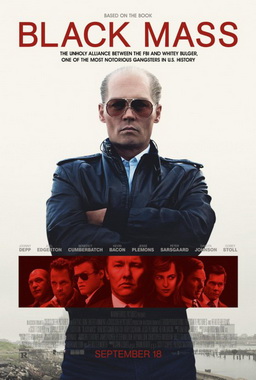
Black Mass tells the true story of James “Whitey” Bulger, the gangster who controlled the Boston underworld from the late 70s to the mid-90s. Bulger was both famous and feared for his ruthless brutality and his willingness to murder just about anyone. Bulger was also famous for being the brother of Billy Bulger, a powerful Democratic politician. When it appeared that Whitey was finally on the verge of being indicted, he vanished into thin air and, for 2 decades, remained missing until he was finally captured in Florida. Whitey Bulger is now serving two life sentences.
Black Mass is a solid gangster film. We watch as Whitey (Johnny Depp) takes over Boston and essentially murders anyone who gets on his nerves. Helping Whitey out is a local FBI Agent, John Connolly (Joel Edgerton), who grew up in South Boston with the Bulger brothers. While Connolly originally only appears to be using Whitey as an informant to help take down the Italian mob, it quickly becomes obvious that Connolly envies the power and influence of both Whitey and Billy (played by Benedict Cumberbatch). Soon, Connolly has become something of a Bulger groupie and is protecting Whitey from prosecution and even leaking him the names of anyone who attempts to inform on Bulger’s crime.
Indeed, the film’s best scenes are the ones in which it is shown how the FBI’s determination to take down the Mafia allowed the far more violent Bulger to move into their place. Bulger was a criminal who worked for and was protected by the U.S. government and, as such, his story serves as a metaphor for a lot of what is currently messed up about America. While I appreciated the time that Black Mass devoted to exploring Whitey’s relationship with the FBI, I do wish it had spent more time exploring his relationship with his brother, Billy. The film places most of the blame for Whitey’s reign of terror on the FBI but it defies common sense not to assume that Whitey was also protected by his well-connected, politically powerful brother.
Black Mass contains all of the usual gangster film tropes. There are sudden and violent executions. There are drug addicted criminals who turn out to be less than trustworthy. (Poor Peter Sarsgaard.) There’s the usual talk of honor and respect. Beefy men with pockmarked faces stand in the shadows and shout random insults at each other until someone finally snaps. And, of course, we get the countless scenes where Bulger’s demeanor goes from friendly to threatening and we’re left wondering if he’s going to smile or if he’s going to kill someone. It may all be a little bit familiar but director Scott Cooper handles it all well and keeps things watchable.
In this 122-minute film, there are exactly two scenes in which Whitey is in any way sympathetic. In one scene, he breaks down after the death of his son and, in the other, he deals with the death of his mother. These are the only two scenes in which Whitey shows any hint of humanity. Otherwise, Bulger is presented as being almost pure evil. He’s no Michael Corleone, trying to go straight and making excuses for the family business. Nor does he possess the enjoyable flamboyance of Scareface‘s Tony Montana or The Departed‘s Frank Costello. Instead, he’s a pure sociopath and the film’s most effective shots are the ones that focus on Whitey’s expressionless gaze. They say that the eyes are the windows to the soul and one only has to look into Bulger’s to see that they are windows without a view.
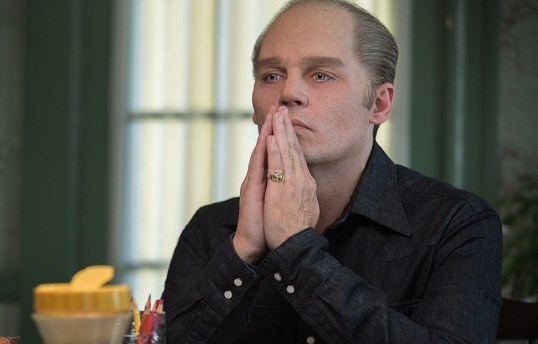
Johnny Depp deserves all the credit in the world for making Whitey into a compelling character. Wisely, Depp underplays Whitey’s most threatening scenes. He rarely raises his voice and the only time he loses control of his emotions is when he’s confronted with something — like the death of his son — that even he can’t change. Otherwise, Depp plays Whitey as always being in control. (It’s mentioned, at one point, that Whitey was the subject of 50 LSD experiments while serving time in prison and Depp plays Whitey as if he’s always staring at something that nobody else can see.) It’s his confidence that makes Whitey Bulger an interesting character. You may not like him but you can’t look away because you know that he’s literally capable of anything. Ever since the trailer for Black Mass was first released, Depp has been at the center of awards speculation. Having seen the film, I can say that the Oscar talk is more than deserved. He’s even better than people like me thought he would be.
Depp is so good that he overshadows the rest of the cast. There’s a lot of good actors in this film, including Kevin Bacon, James Russo, Peter Sarsgaard, Corey Stoll, Jesse Plemons, and Rory Cochrane. But few of them get as much of a chance to make an impression as Johnny Depp. Much as Whitey dominated Boston, Depp dominates this film. Joel Edgerton has several great moments as the not-as-smart-as-he-thinks-he-is Connolly but even he is thoroughly overshadowed by Depp’s performance. (That said, I did appreciate the fact that Edgerton’s too-eager-to-please Connolly came across like he might be a cousin to The Gift‘s Gordo the Weirdo.)
As I said at the beginning of this review, Black Mass is good but it was never quite as great as I was hoping it would be. There’s a few too many scenes where you get the feeling that Scott Cooper woke up the day of shooting and said, “Let’s Scorsese the shit out of this scene.” As a result, Black Mass sometimes struggles to escape from the shadow cast by Goodfellas, Casino, The Departed, American Gangster, and the countless other mob films that have been released over the past few decades. Black Mass is well-made and will forever be remembered for Johnny Depp’s amazing lead performance but it never quite reaches the status of a classic.
Finally, on a personal note, I did enjoy the fact that Black Mass dealt with the Irish mob. I’m a little bit torn in my loyalties because I’m Irish-Italian but, if I ever had to pick a mob to which to serve as a cheerleader, I would go Irish Mafia all the way!
One of this year’s most-anticipated films (well, at least when it comes to award season) has a new trailer.
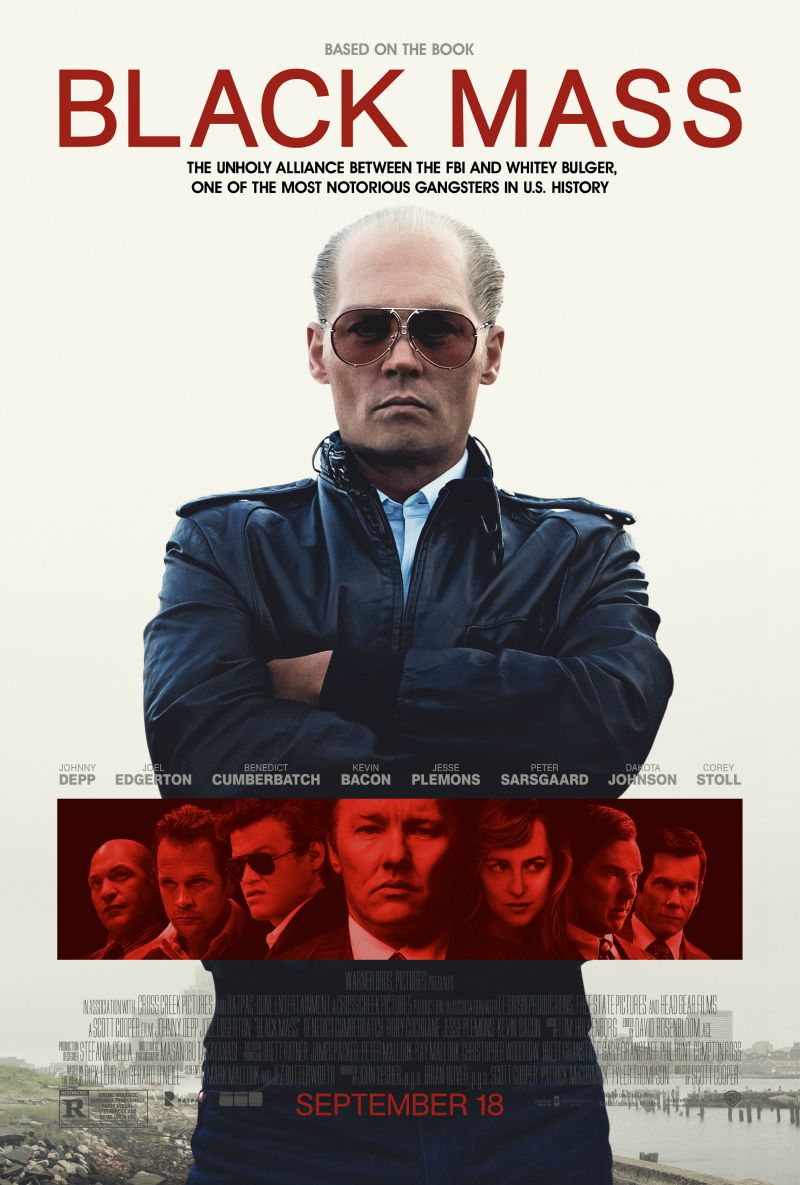
Black Mass stars Johnny Depp in the role of the infamous gangster Whitey Bulger who, as the film’s tagline states, became the most notorious gansgter in U.S. history. This is bold claim considering other gangsters in U.S. history such as Lucky Luciano, Bugsy Siegel, Vito Genovese and Meyer Lansky to name a few.
What makes this film so interesting is the fact that we finally get to see Depp return to acting real, complex characters instead of just acting like a character these past decade. Plus, have you seen this cast supporting Depp: Benedict Cumberbatch, Kevin Bacon, Joel Edgerton, Corey Stoll and Jesse Plemons just for starters.
Black Mass is set for a September 18, 2015 release date.
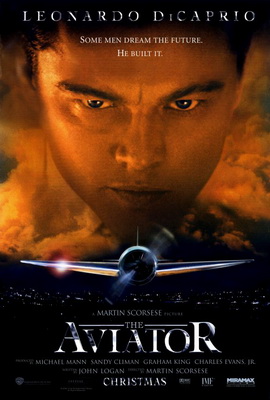
“The way of the future.” — Howard Hughes (Leonardo DiCaprio) in The Aviator (2004)
As I recently rewatched the 2004 best picture nominee, The Aviator, I realized that, in the film’s scheme of things, Ava Gardner was far more important than Katharine Hepburn. (Or, perhaps it would be more appropriate to say that Kate Beckinsale’s Ava Gardner was far more important than Cate Blanchett’s Katharine Hepburn.)
Over the course of the film, both Hepburn and Gardner are involved with billionaire-turned aviator-turned film director Howard Hughes (Leonardo DiCaprio). Throughout the film, Katherine is portrayed as being flighty, pretentious, and overdramatic. There’s a lot of dark humor to the scene where Katherine breaks up with Howard, largely because Katharine is incapable of not acting as if she’s making a film. Her every word is so carefully rehearsed that you have to agree when Howard says that she’s incapable of not giving a performance. Ava, on the other hand, is always direct. She has a sense of humor. She has no trouble telling Howard off. Whereas Katharine put on airs of being an incurable romantic, Ava tells Howard flat out that she doesn’t love him and is only using him to forward her career.
But, while Katharine Hepburn gets more screen time, it’s Ava Gardner who actually saves Howard’s business. Towards the end of the film, after Howard has had a nervous breakdown and has locked himself in a hotel room, it’s Ava who suddenly shows up, cleans him, and dresses him. She’s the one who gives Howard the strength to leave his room and to face down the corrupt senator (Alan Alda) who is investigating his business.
Of course, Howard Hughes is best known for once being the world’s richest recluse. In the 1960s, Howard locked himself away in a hotel room in Las Vegas and spent the next decade laying naked in bed and watching television. The Aviator doesn’t deal with this period of Howard’s life but it’s full of scenes where we catch glimpses of Howard’s future. Throughout the film, we watch as Howard obsessively washes his hands. We watch as he gives precise instructions on how even the simplest of tasks are to be accomplished. We watch as he grows increasingly paranoid about the germ-filled outside world. The film suggests that Howard’s obsessive compulsive disorder both served to make him a great engineer and a great filmmaker while, at the same time, ultimately destroying him.
The Aviator was the second film that DiCaprio made with Scorsese. And, as bad as DiCaprio may have been in Gangs of New York, he’s absolutely brilliant in The Aviator. As a character, Howard Hughes has so many quirks and tics that it would have been easy for DiCaprio to go overboard. Instead, he gives a surprisingly subtle performance. And, even more importantly as far as I’m concerned, he actually sounds authentically Texan when he speaks.
In many ways, much of The Aviator reminds me of Gangs of New York. Both films are gorgeously produced period epics that try to cover a lot of material. Both films are absolute cat nip for history nerds like me. But, whereas Gangs of New York leaves one feeling vaguely dissatisfied, The Aviator actually improves with subsequent viewings. Whereas the action in Gangs had no center, The Aviator revolves around Howard and the actor playing him.
While the Aviator starts off with Howard making movies and romancing Katharine Hepburn, it’s at its best when Howard appears before a committee chaired by Sen. Owen Brewster (Alan Alda) and passionately defends both himself as an engineer and a businessman and the right of innovators everywhere to freely pursue their passion. The film suggests that Brewster was bribed by Howard’s main business rival, Juan Trippe (Alec Baldwin, in unapologetic villain mode), and it’s hard not to applaud when Howard stands up for himself.
Speaking of which, it’s odd, so soon after reviewing Alan Alda in The Seduction of Joe Tynan, to see Alda playing a far less ethical politician in The Aviator. That said, Alda’s corrupt performance in The Aviator is a hundred times better than his cutesy work in Joe Tynan. If anything, Alda gives a performance here that will remind everyone of why they don’t care much for their congressman.
The Aviator was nominated for best picture but it lost to the far more low-key Million Dollar Baby. Scorsese would have to wait until the release of The Departedfor one of his films to finally win best picture.
Well, it’s that time of year when I look at the list of the films that I’ve seen over the past 12 months and I realize that there’s quite a few that I haven’t gotten around to reviewing yet. Here are my thoughts on six of them.
The Call (dir by Brad Anderson)
Abigail Breslin is kidnapped by a serial killer. While trapped in the trunk of the killer’s car, Breslin manages to call 911. Breslin’s call is answered by Halle Berry, a veteran operator who is recovering from a trauma that — by an amazing and totally implausible coincidence — was caused by the same guy who has just kidnapped Breslin.
Before it became a feature film, The Call was originally developed as a weekly TV series and, as I watched, it was easy to imagine weekly episodes that would all feature a different guest star calling 911 and needing help. For the first hour or so, The Call is well-made and acted but undistinguished. However, during the final 30 minutes, the entire film suddenly goes crazy with Breslin running around in her bra, Berry turning into a blood thirsty vigilante, and the killer suddenly getting very verbose. However, those 30 minutes of pure insanity were just what The Call needed to be memorable. There are some films that definitely benefit from going over-the-top and The Call is one of them.
Copperhead (dir by Ronald Maxwell)
Copperhead is a historical drama that takes place during the Civil War. In upstate New York, farmer Abner Breech (Billy Campbell) is ardently opposed to both the Civil War and the union cause. In most movies, this would make Abner the villain but, in Copperhead, he’s portrayed as being a man of principle who, by refusing to compromise on his views, is ostracized and ultimately persecuted by the rest of his village. Abner’s views also bring him into conflict with his own son, who is pro-Union.
Copperhead is a slow-moving film that features some rather good performances along with some fairly bad ones. However, I’m a history nerd so I enjoyed it. It certainly tells a different story from what we’ve come to expect from American films about the Civil War.
It’s A Disaster (dir by Todd Berger)
Of the six films reviewed in this post, It’s A Disaster is the one to see. In this darker than dark comedy, Julia Stiles brings her new boyfriend (David Cross) to Sunday brunch with 6 of her closest friends. During the brunch, terrorists explode a dirty bomb in the city. With everyone trapped inside the house and waiting for the world to either end or somehow revert back to normal, long-simmering resentments come to the forefront.
To say anything else about It’s a Disaster would be unfair so I’ll just say that it’s a very funny film, featuring excellent work from both Stiles and Cross. If Jean-Paul Sartre was alive and writing today, he would probably end up writing something very similar to It’s a Disaster.
See Girl Run (dir by Nate Meyer)
Bleh! That’s probably the best description I can give you of this film. It’s just a whole lot of bleh.
Emmie (Robin Tunney) is unhappy with her boring marriage so she runs back to her Maine hometown, stops wearing makeup and washing her hair, and pines for her high school boyfriend, Jason (Adam Scott), who works at a sea food restaurant. Jason also happens to be friends with Emmie’s depressed brother, Brandon (Jeremy Strong). It’s the same basic plot as Young Adult, just with no humor and a lot more talking. In Young Adult, it was hard not to admire Charlize Theron’s wonderfully misguided character. In See Girl Run, you just want to tell Robin Tunny to take a shower, put on some clothes that don’t look like they were stolen from a hospital storage closet, and stop whining all the time.
It’s difficult to put into words just how much I hated this movie. This is one of those films that critics tend to describe as being “a film for adults.” I have to agree — this is a movie for really boring, depressing adults who like to talk and talk about how their lives haven’t worked out. If See Girl Run is what being an adult is like, I’ll just continue to be an immature brat, thank you very much.
UnHung Hero (dir by Brian Spitz)
So, this is not only the worst documentary of 2013 but it’s also quite probably one of the worst documentaries ever made. The film opens with footage of Patrick Moote (who claims to be a comedian) asking his girlfriend to marry him. As Moote goes on (and on) to tell us, she turns down his proposal and then dumps him because, according to her, his penis is too small. Moote spends the rest of the film talking to various people and asking them whether size really matters.
Well, he could have just asked me and saved a lot of time. I’m sorry if this endangers any fragile male egos but yes, size does matter. If Moote’s penis really is as tiny as he claims it is, I probably would have turned down his proposal as well. Then again, Moote could be hung like Jamie Foxx and I’d probably still refuse to marry him because, quite frankly, he’s the whiniest and most annoying person that I’ve ever seen. He’s like an even less charming version of Morgan Spurlock. What Patrick Moote never seems to understand is that size matters but personality matters even more.
Would You Rather (dir by David Guy Levy)
Would you rather have a root canal or sit through this piece of crap? Having seen Would You Rather, I can tell you that it’s not an easy question to answer.
Jeffrey Combs plays a sadistic millionaire who invited a bunch of strangers (including Brittany Snow, John Heard, June Squibb, and Sasha Grey) to his mansion and forces them to play an elaborate and deadly game of Would You Rather. Unfortunately, none of the characters are interesting, the film’s sadism is more boring than shocking, and talented actor Combs is totally wasted as the one-note villain.

 Through the Shattered Lens