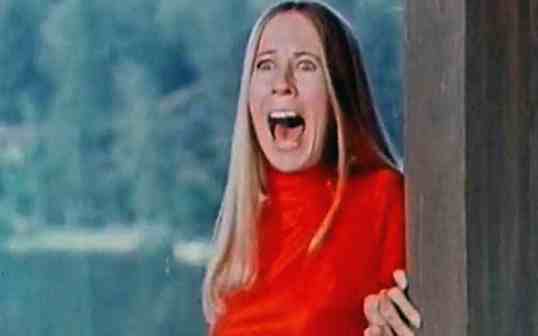
Horror On The Lens: Satan’s School For Girls (dir by David Lowell Rich)


For today’s horror on the lens, we have a 1973 made-for-TV movie called Satan’s School For Girls.

After her sister turns up dead, Elizabeth (Pamela Franklin) refuses to accept that official conclusion that it was a suicide.  Instead, Elizabeth is convinced that it was murder and that it has something to do with the exclusive school that her sister attended, the Salem Academy for Women.

Well, honestly, the Salem part is a dead giveaway.  I think we can all agree on that.

Anyway, this movie features a Satanic cult, an old school clique, and plenty of early of 70s fashion choices.  It may be silly but it’s also definitely entertaining.


Retro Television Review: Fantasy Island 7.4 “God Child/Curtain Call”


Welcome to Retro Television Reviews, a feature where we review some of our favorite and least favorite shows of the past!  On Tuesdays, I will be reviewing the original Fantasy Island, which ran on ABC from 1977 to 1984.  Unfortunately, the show has been removed from most streaming sites.  Fortunately, I’ve got nearly every episode on my DVR.

This week, the curse of Lawrence continues.

Episode 7.4 “God Child/Curtain Call”

(Dir by Ted Lange, originally aired on October 29th, 1983)

Tori Spelling is in this episode.  She was only ten years old at the time but she was already a terrible actress.   In the role of Laurie, a poor little rich girl whose fantasy is to ask God why her parents died in a crash, Spelling gives a performance that is overly cutesy.  There’s nothing authentic about her or her delivery.  Her role on the show was obviously a result of her father being the producer.

Laurie doesn’t find God.  (At first, she assumes Roarke is God but he assures her that he is not, despite the fact that he has God-like powers.  Ricardo Montalban, for his part, said that he always felt that Roarke was a fallen angel who was doing penance on Fantasy Island.)  Laurie does however find Adam Cobb (George Kennedy), a former circus clown-turned-alcoholic who briefly pretends to be God.  At first, Laurie hates Adam for lying about being God.  Then Mr. Roarke explains that Adam’s wife died in a circus fire and that his own daughter was adopted by another family.  Laurie feels sorry for him and invites Adam to come live in her mansion with her aunt.  Adam considers it but ultimately decides that he needs to instead search for his own daughter.  In a rather bizarre turn of events, he dances with Laurie while singing Funny Face to her.

As for Laurie meeting God, Adam suggests that maybe there’s a bit of God in everyone and therefore, we’re all God.  Whatever, you hippie.

This storyline was ugh.  Like seriously, just ugh.  Laurie didn’t get her fantasy.  She just met some old alcoholic who spouted a bunch of a Unitarian mumbo jumbo at her.  As for Adam leaving the Island to find his own daughter …. well, did he?  This episode doesn’t tell us.  How exactly is he going to find her?  Does she want anything to do with him?  How was the penniless Adam able to afford a trip to Fantasy Island in the first place?

AND WHERE THE HELL IS TATTOO!?

Meanwhile, Milton Berle played an old comedian who wanted his former partners (Imogene Coca and Howard Morris) to forgive him so that they could perform together one last time.  This storyline felt very familiar and it featured a lot of singing.  Even Mr. Roarke sang a song.  It’s actually kind of strange how many songs were sung in this episode because this wasn’t a musical episode.  This wasn’t like that musical episode of The Love Boat where the songs were evenly distributed across the program.  Instead, towards the end of the episode, people just started singing.  It was weird.

Speaking of The Love Boat, this episode was directed by Isaac himself, Ted Lange.  Lange keeps the action movie but I just wish this episode had been better written.  This is another episode where it’s easy to imagine how much better it would have been with Tattoo than with Lawrence.  Tattoo would have definitely gotten emotionally involved with Laurie’s search for God.  Lawrence, on the other hand, is just a stiff upper lip butler whose main concern is making sure everyone gets their drink order.  It’s nothing against Christopher Hewett, who I have read was a good Catholic.  It’s just that he’s stuck playing a character who does not belong on the Island.

This was a pretty desultory trip to the Island.


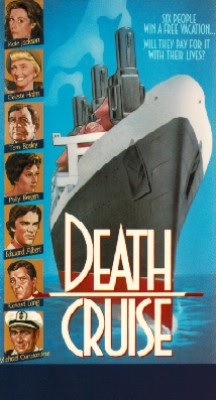
Retro Television Reviews: Death Cruise (dir by Ralph Senesky)


Welcome to Retro Television Reviews, a feature where we review some of our favorite and least favorite shows of the past!  On Sundays, I will be reviewing the made-for-television movies that used to be a primetime mainstay.  Today’s film is 1977’s Death Cruise!  It  can be viewed on Tubi and YouTube.

The thing with the Love Boat is that it promises something for everyone.  It’s a place where you set a course for adventure and put your mind on a new romance.

The same cannot be said of the Death Cruise.

Death Cruise opens with three couples winning an all-expenses paid trip on a luxury liner.  None of the couples are in a happy marriage.  Sylvia Carter (Polly Bergen) is tired of her husband, Jerry (Richard Long), and his philandering ways.  Elizabeth Mason (Celeste Holm) is frustrated with David Mason (Tom Bosley) and his loud dinner jackets.  Mary Frances Radney (Kate Jackson) is fed up with James (Edward Albert) and his smug refusal to start a family.  Of course, it’s not just martial problems that connects these passengers.  It’s also the fact that someone on the boat is stalking and killing them, one-by-one.  Can Dr. Burke (Michael Constantine) and Captain Vettori (Cesare Danova) track down the killer before it’s too late?

Death Cruise is an enjoyably twisty little murder mystery.  It aired in 1974, a good two years before the first Love Boat pilot film appeared on television.  However, both Death Cruise and The Love Boat were produced by Aaron Spelling so the two productions definitely have a shared DNA.  The Love Boat is basically Death Cruise with the addition of a laugh track and considerably less murder.  That said, I have my doubts as to whether Doc Bricker would have been as effective a detective as Dr. Burke.

One of the most interesting things about Death Cruise is how little anyone on the boat really seems to care about the fact that the passengers are turning up dead.  In fact, one widower is asking a widow to be his date to dinner within a few hours of the deaths of their spouses.  Of course, the murderer makes sure that dinner date is canceled but it’s still hard not to wonder whatever happened to an appropriate time of grieving.  Then again, I guess if you’re on a boat for a weekend, you just do whatever feels right at the moment.

(And certainly, if they were on The Love Boat, the walking HR nightmares that was Doc Bricker wouldn’t have wasted any time asking the widows to come by his office for a examination.)

Of the victims and suspects, Richard Long and Edward Albert are memorably sleazy while Tom Bosley plays up just how annoyed he is with the whole situation.  Michael Constantine is a good detective and the movie’s final twist is nicely executed.  Personally, when it comes to cruises, I will always prefer the safety and romance of The Love Boat but Death Cruise was an entertaining nautical diversion.

Retro Television Reviews: International Airport (dir by Don Chaffey and Charles S. Dubin)


Welcome to Retro Television Reviews, a feature where we review some of our favorite and least favorite shows of the past!  On Sundays, I will be reviewing the made-for-television movies that used to be a primetime mainstay.  Today’s film is 1985’s International Airport!  It  can be viewed on YouTube!

It’s not easy working at an international airport!

At least, that’s the message of this made-for-television film.  Produced by Aaron Spelling and obviously designed to be a pilot for a weekly television series, International Airport details one day in the life of airport manager David Montgomery (Gil Gerard).  Everyone respects and admires David, from the recently graduated flight attendants who can’t wait for their first day on the job to the hard-working members of the airport security team.  The only person who really has a problem with David is Harvey Jameson (Bill Bixby), the old school flight controller who throws a fit when he learns that a woman, Dana Fredricks (Connie Sellecca), has been assigned to work in the tower.  Harvey claims that women can’t handle the pressure of working the tower and not having a personal life.  He demands to know what Dana’s going to do during that “one week of the month when you’re not feeling well!”  Harvey’s a jerk but, fortunately, he has a nervous breakdown early on in the film and Dana gets to take over the tower.

Meanwhile, David is trying to figure out why an old friend of his, Carl Roberts (played by Retro Television mainstay Robert Reed, with his bad perm and his retired porn star mustache), is at the airport without his wife (Susan Blakely).  David takes it upon himself to save Carl’s troubled marriage because it’s all in a day’s work for the world’s greatest airport manager!

While Carl is dealing with his mid-life crisis, someone else is sending threatening letters to the airport.  One of the letters declares that there’s a bomb on a flight that’s heading for Honolulu.  David and Dana must decide whether to allow Captain Powell (Robert Vaughn) to fly to Hawaii or to order him to return to California.  And Captain Powell must figure out which one of his passengers is the bomber.  Is it Martin Harris (George Grizzard), the sweaty alcoholic who want shut up about losing all of his friends in the war?  Or is it the woman sitting next to Martin Harris, the cool and aloof Elaine Corey (Vera Miles)?

Of course, there are other passengers on the plane.  Rudy (George Kennedy) is a veteran airline mechanic.  Rudy is hoping that he can talk his wife (Susan Oliver) into adopting Pepe (Danny Ponce), an orphan who secretly lives at the airport.  Unfortunately, when Pepe hears that Rudy’s plane might have a bomb on it, he spends so much time praying that he doesn’t realize he’s been spotted by airport security.  Pepe manages to outrun the security forces but he ends up hiding out in a meat freezer and, when the door is slammed shut, it appears that Pepe may no longer be available for adoption.  Will someone hear Pepe praying in time to let him out?  Or, like Frankie Carbone, will he end up frozen stiff?

International Airport was an attempt to reboot the Airport films for television, with the opening credits even mentioning that the film was inspired by the Arthur Hailey novel that started it all.  As well, Gil Gerard, Susan Blakely, and George Kennedy were all veterans of the original Airport franchise.  George Kennedy may be called Rudy in International Airport but it’s easy to see that he’s still supposed to be dependable old Joe Patroni.  Unfortunately, despite the familiar faces in the cast, International Airport itself is a bit bland.  It’s a disaster film on a budget.  While the viewers gets all of the expected melodrama, they don’t get anything as entertaining or amusing as Karen Black flying the plane in Airport 1975 or the scene in Concorde: Airport ’79 where George Kennedy leaned out the cockpit window (while in flight) and fired a gun at an enemy aircraft.  Probably the only thing that was really amusing (either intentionally or unintentionally) about International Airport was the character of Pepe and that was just because young Danny Ponce gave perhaps the worst performance in the history of television.

International Airport did not lead to a television series.  Watching it today, it’s a bit on the dull side but, at the same time, it is kind of nice to see what an airport was like in the days before the TSA.  If nothing else, it’s a time capsule that serves as a record of the days when the world was a bit more innocent.

Retro Television Review: Fantasy Island (dir by Richard Lang)


Welcome to Retro Television Reviews, a feature where we review some of our favorite and least favorite shows of the past!  On Tuesdays, I will be reviewing the original Fantasy Island, which ran on ABC from 1977 to 1996.  The entire show is currently streaming on Tubi!

Ah, Fantasy Island!

There have been several versions of Fantasy Island.  In the late 90s, there was a version that featured Malcolm McDowell as the somewhat aloof owner of the island.  More recently, there was a movie that featured Michael Pena as the owner of the Island and which tried to turn the whole thing into a horror franchise.  It wasn’t very good.  And right now, there’s a show on Fox that features Roselyn Sanchez as the grand niece of the island’s original owner.  The Fox series is about to start its second season.  It’s a bit silly, which is why I kind of love it.

And then there’s the Fantasy Island that started it all, the Aaron Spelling-produced series that ran from 1977 to 1984 on ABC and which has lived on in reruns and on streaming platforms like Tubi.  Both the original series and all of its subsequent spin-offs took place on a mysterious tropical island where people would pay to live out their fantasies.  In the original series, the island was run by Mr. Roarke (Ricardo Montalban), who wore a white suit and encouraged everyone to smile whenever the guests arrived.  Serving as Mr. Roarke’s second-in-command was Tattoo (Herve Villechaize), who was 3’11, always wore a matching white suit, and announced the arrival of the plane by ringing a bell and shouting, “The plane, the plane!”  Of course, each week would bring in a different group of guest stars.  They would come to the island with a fantasy and, hopefully, they would learn that reality was the only fantasy that they needed.

All seven seasons of the original Fantasy Island are currently streaming on Tubi.  However, if you want to see the 1977 pilot film that started it all, you have to go to YouTube.

In many ways, the 90-minute pilot film feels like a typical episode of Fantasy Island.  It’s interesting to see that the show’s basic premise and format was already set in stone when the pilot was filmed.  (Pilots are notorious for often being dramatically different from the shows that they were created to sell.)  The pilot opens with the plane arriving (and yes, from the start, Tattoo rings the bell and shouts, “The plane!”) and three guests meeting Mr. Roarke.  Our three guest stars are Bill Bixby, Hugh O’Brian, and Eleanor Parker.  Bixby plays Arnold Greenwood, a former war correspondent who wants to be reunited with Francesca (Sandra Dee), the woman with whom he fell in love during World War II.  O’Brian is Paul, a famous big game hunter who wants to be hunted for once.  Eleanor Parker is Eunice Hollander Barnes, one of the world’s richest women.  She wants to fake her death so she can see who, from her life, would actually mourn her and who would just try to steal her fortune.

If the pilot’s format is the same as the series that followed, the general tone is somewhat different.  Mr. Roarke is an almost sinister figure, one who doesn’t really seem to think much of his guests and who is quick to point out that no one gets a fantasy until they’ve paid him the required $50,000.  (That’s $50,000 in 1970s money.  I have to admit that when Mr. Roarke first mentioned how much the fantasies cost, I was like, “Hey, I could afford this place!”)

Consider the story of the hunter.  Paul wants to be hunted because he’s suicidal.  His real fantasy is to die.  The night before Paul’s fantasy is to begin, Michelle (Victoria Principal) shows up at Paul’s room.  Michelle explains that Mr. Roarke has hired her to provide Paul with companionship during the night.  Unfortunately, Michelle ends up handcuffed to Paul and, as a result, she’s hunted along with him!  Now, you could argue that Mr. Roarke did this to teach Paul to think about someone other than himself.  But what if Paul hadn’t learned the lesson?  Then Michelle would be dead too!  What would Mr. Roarke do then?  Just have Tattoo dump the bodies in the lagoon?  “To hell with you, Roarke!” Paul yells and who can blame him?

And then there’s our war correspondent, Arnold.  Arnold’s fantasy seems simple enough but then it turns out that the reason he lost contact with Francesca is because he murdered her!  As a result of his fantasy, Arnold not only relives the first time he met Francesca but also how their relationship ended.  The entire experience leaves Arnold laughing like a madman as his sanity slips away.

As for Eunice’s story, it’s pretty stupid.  She dresses up like a maid so that she can listen to what people have to say about her once they think she’s dead.  It’s like an episode of Undercover Boss.  At least former Kennedy in-law Peter Lawford makes an appearance as Eunice’s husband.  Eunice ends up far less traumatized than either Paul or Arnold but she still had to fake her death to come to peace with her life.

The pilot is entertaining.  One can understand why it would lead to a series.  The island is lovely to look at.  Even with the somewhat sinister tone of two of the stories, it’s still impossible to watch the pilot without wondering what type of fantasy you would pursue if you went to the Island.  For me, that’s always been the main appeal of all of the various versions of Fantasy Island.  Still, it’s interesting that the fantasies themselves are less comforting than what I think many would expect on account of the show’s reputation.  For all the criticism that Blumhouse received for their reinterpretation of Fantasy Island, they were not the first to imagine Mr. Roarke as being somewhat less than benevolent.  Of course, when the actual series started, Mr. Roarke was a far friendlier host.

Next week, the series begins and hopefully, no further guests are traumatized to the point of catatonia.

Wyoming Renegades (1955, directed by Fred F. Sears)


Brady Sutton (Philip Carey) used to be one of the most feared members of the Hole in the Wall Gang.  He robbed banks with Butch Cassidy (Gene Evans) and the Sundance Kid (William Bishop) and he developed a reputation for being a ruthless outlaw.  But that’s in the past.  Brady has spent three years in prison and now, he’s ready to return home, marry Nancy (Martha Hyer), and go straight.  Though most of the townspeople don’t trust Brady, he’s managed to find a sponsor in newcomer Charlie Veer (Douglas Kennedy), who has given Brady the money to open his own blacksmith shop.

Unfortunately, Brady might be done with the Hole in the Wall Gang but they’re not done with him.  When Brady spots some members of the gang in town, he realizes that they’re casing the bank.  Despite Brady’s attempts to warn the sheriff, the town assumes that Brady must be in on the plot.  Brady grows so frustrated that he finds himself tempted to go back to his old ways.  Meanwhile, Charlie is suddenly very interested in being introduced to the infamous Butch Cassidy himself.

Wyoming Renegades is a straight-forward, B-western.  The plot is nothing special but Philip Carey and Douglas Kennedy both give good Western performances and Gene Evans is memorably evil as Butch Cassidy.  For those who only know the characters as Paul Newman and Robert Redford’s performances in Butch Cassidy and the Sundance Kid, the most interesting thing about Wyoming Renegades will be seeing Cassidy and Sundance portrayed as being sadistic and humorless villains.  The truth about Cassidy and his gang is probably somewhere in-between the fun-loving rogues played by Newman and Redford and the unforgiving bastards presented in Wyoming Renegades.  In reality, it’s said that Butch Cassidy always tried to avoid killing people while Sundance rarely hesitated to draw his gun and start firing.

As for Wyoming Renegades, the ending does feature an unexpected twist, with Nancy proving herself to be more than just a docile love interest.  Fans of classic television will want to keep an eye out for a young Aaron Spelling, playing a loathsome outlaw named Petie Carver.

The TSL’s Grindhouse: Satan’s School For Girls (dir by David Lowell Rich)


Have you ever wanted to enroll in a private school so that you could investigate a murder and maybe uncover some sort of occult conspiracy?  Sure, we all have!  Well, don’t worry …. there’s a place for you!  Welcome to Salem Academy, an exclusive all-girl’s college where students learn all the basic subjects, along with taking courses in art and human sacrifice!

Salem Academy is overseen by the feared and intimidating Mrs. Williams (Jo Van Fleet), who keeps a close eye on her students and tries to make sure that they aren’t distracted or corrupted by any outside influences. However, not even Mrs. Williams can keep Martha Sayers (Terry Lumley) from fleeing the school and going to her sister’s house in Los Angeles. When Martha’s sister, Elizabeth (Pamela Franklin), returns home, she discovers that Martha has been hanged. The police say that it was suicide. Elizabeth believes that it’s something else.

So, Elizabeth does what any vengeance-seeking sister would do. Using an assumed name, she enrolls in Salem Academy herself. She meets and befriends three other students (played by Kate Jackson, Jamie Smith Jackson, and Cheryl Ladd). She gets to know two rather suspicious teachers, Prof. Delacroix (Lloyd Bochner) and Dr. Clampett (Roy Thinnes). She also manages to raise the concerns of Mrs. Williams, who doesn’t like the fact that the new girl keeps asking so many questions about why so many students at Salem Academy have died recently.

Still, Elizabeth continues to investigate. Perhaps the secret can be found in a mysterious painting that she comes across, one that appears to be of Martha? Perhaps the teachers and the students know more than they’re telling. But who can Elizabeth trust?

A made-for-television film from 1973, Satan’s School For Girls is frequently as silly as its name.  Fortunately, the film, which was produced by Aaron Spelling and directed David Lowell Rich, seems to understand just how ludicrous it is and it totally embraces both the melodrama and the silliness of its plot. This film is totally product of the time in which it was made, from the dialogue to the hairstyles to the fashions to the ending that you’ll see coming from a mile away. At the same time, that’s also why this film is a lot of fun. It’s such a product of its time that it doubles as a time capsule. Do you want to go back to 1973? Well, go over to YouTube and watch Satan’s School For Girls.  After you’ve watched it, step outside and ask anyone who the president is and they’ll probably say, “Richard Nixon.”  And if you ask them who they’re favorite Brady is, they’ll look at you like your crazy because everyone know that Marcia is the best Brady.  If you even have to ask, it’s obvious that you don’t really watch the show.  After that, you should probably try to find a way to get back to 2021 before you change the future or something.  You know how tricky time travel can be.

As for Satan’s School for Girls, it’s just a really fun movie so check it out and be sure not to be late for class!

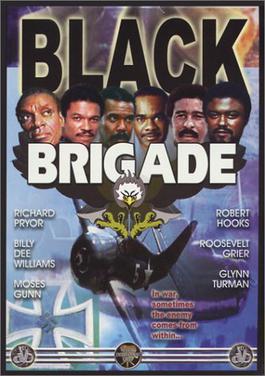
Black Brigade (1970, directed by George McCowan)


During the closing days of World War II, General Clark (Paul Stewart) wants to capture a Nazi-controlled dam and he thinks he’s found just the man for the job.  Captain Beau Carter (Stephen Boyd) is a tough and good with a knife and a gun.  Carter is sent to take command of a ragtag group of soldiers who have spent the last three years waiting for combat.  The only catch is that the soldiers are all black and Captain Carter is a racist redneck.

This was an Aaron Spelling-produced television movie that was originally broadcast under the name Carter’s Army.  When it was released on video, the name was changed to Black Brigade, probably in an effort to fool viewers into thinking that it was a cool blaxploitation film instead of a simplistic TV movie.  The film has gotten some attention because of the cast, which is full of notable names.  Roosevelt Grier plays Big Jim.  Robert Hooks is Lt. Wallace while Glynn Turman is Pvt. Brightman (who keeps a journal full of the details of the imaginary battles in which he’s fought) and Moses Gunn brings his natural gravitas to the role of Pvt. Hayes.  Probably the two biggest names in the cast are Richard Pryor as the cowardly Crunk and Billy Dee Williams as Pvt. Lewis, who says that he’s from “Harlem, baby.”

Don’t let any of those big names fool you.  Most of them are lucky if they get one or two lines to establish their character before getting killed by the Germans.  The movie is mostly about Stephen Boyd blustering and complaining before eventually learning the error of his ways.  The problem is that Carter spends most of the film as such an unrepentant racist that it’s hard not to hope that one of the soldiers will shoot him in the back when he least expects it.  The other problem is that, for an action movie, there’s not much action.  Even the climatic battle at the dam is over in just a few minutes.

There is one daring-for-its-time scene where Lt. Wallace comes close to kissing a (white) member of the German Resistance, Anna Renvic (Susan Oliver).  When Carter sees him, he angrily orders Wallace to never touch a white woman.  Anna slaps Carter hard and tells him to mind his own goddamn business.  It’s the best scene in the movie.  Otherwise, Black Brigade is forgettable despite its high-powered cast.

The Ballad of Andy Crocker (1969, directed by George McCowan)


Andy Crocker (Lee Majors) is a earnest young Texan who enlists in Vietnam, is injured in a firefight, and returns home with a purple heart.  Upon landing in California, he discovers that America has changed.  A group of hippies (led by Stuart Margolin, who also wrote this film’s script and the folk-style song that’s played throughout the action) taunts him for wearing his uniform.  After Andy steals a motorcycle from them and makes his way back down to Dallas, he discovers that his girlfriend, Lisa (Joey Heatherton), has left him for another man and that his best friend (played by singer Jimmy Dean) has sold Andy’s business.  Lisa’s mother (Agnes Moorehead) orders Andy to stay away from her family while she’s skeet shooting.  Even though everyone tells him how proud they are of him, no one seems to want Andy around.  Finally, Andy ends up back in California without any direction home.

This made-for-television movie (which was produced by Aaron Spelling) was important in that it was the first film to attempt to explore the issues that would face servicemen as they returned home after serving in an unpopular war.  It was actually meant to be a pilot for a series called Corporal Crocker, which would have followed Andy Crocker as he traveled across the country, Route 66-style.  Since the series wasn’t picked up, The Ballad of Andy Crocker instead becomes a downbeat look at a man discovering that he no longer has any place in the world.  It’s only 72-minutes long so it doesn’t examine any issues in depth but it’s still sincere in its intentions and Lee Majors gives a good performance in the lead role.  Andy Crocker is an interesting character.  Despite the fact that he just returned from fighting in it, he doesn’t seem to have any strong opinion about the war in Vietnam.  He’s hardly a pacifist and he does steal a motorcycle but, at the same time, he’s not a gung ho warrior either.  He’s just an ordinary man who is trying to figure out where he fits in.  By the end of the movie, he’s more scarred by society’s indifference than he has been by the war.

Keep an eye out for Marvin Gaye, who has a small role as Crocker’s best friend from Vietnam.

The Conquering Hero: Baby Blue Marine (1976, directed by John D. Hancock)


The year is 1943 and America is at war.  All young men are expected to join the Marines and fight for their country but the Corps is not willing to accept just anyone.  Marion (Jan-Michael Vincent) wants to continue a family tradition of service but, as his drill sergeant (Michael Conrad) puts it, Marion just is not pissed off enough to be a Marine.  Marion is kicked out basic training and told to go home.  He is given a blue uniform to wear on his jury so that anyone who sees him will know that he couldn’t cut it.

Ashamed of his failure and in no hurry to confront his family, Marion takes the long route home.   While having a drink in California, he meets a Marine (Richard Gere) who did not get kicked out of basic training.  Though not yet 30, this shell-shocked Marine already has a head of gray hair, which he says he got from the horrors of war.  The Marine is due to return to the fighting in Europe but, upon meeting Marion, he sees a way out. When Marion gets drunk, the Marine knocks him out, switches uniforms with him, and goes AWOL.

When Marion comes to, he discovers that everyone that he meets now judges him by his new uniform.  Strangers buy him drinks.  Other servicemen try to pick fights with him.  When he stops off in a small Colorado town, a local waitress (Glynnis O’Connor) falls in love with him and nearly everyone that he meets assumes that he must be a hero.  Marion doesn’t exactly lie about his past.  Instead, he simply allows people to believe whatever they want to believe about him.  It seems like an idyllic situation until three prisoners from a nearby Japanese internment camp escape and the towns people expect Marion to help capture them.

Loosely plotted and sentimental, Baby Blue Marine is a dramatic version of Preston Sturges’s Hail The Conquering Hero.  Though the film has a gentle anti-war message, it’s actually more about nostalgia for a simpler and more innocent time.  If the film had been made at height of the Vietnam War, it might have been more angrier and more cynical.  But, instead, this is one of the many post-Watergate films that wistfully looked back upon the past.  When Marion settles into the town, he finds what appears to be a perfect and friendly home.  Only the nearby internment camp and the town’s hysteria over the escape prisoners serve as reminders that things are never as ideal as they seem.  Jan-Michael Vincent gives one of his best performances as the well-meaning Marion and actors like Richard Gere, Bert Remsen, Katherine Helmond, Dana Elcar, Michael Conrad, Bruno Kirby, and Art Lund all make strong impressions in small roles.

One of the few films to be produced by television mogul Aaron Spelling, Baby Blue Marine is not easy to find but worth the search.