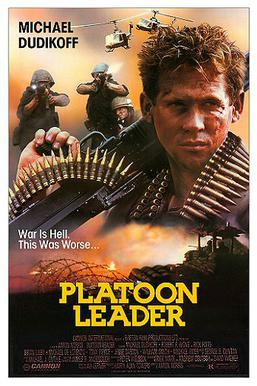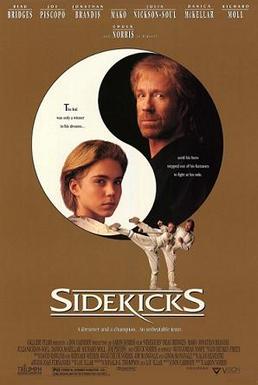
Sidekicks (1992, directed by Aaron Norris)


Barry Gabrewski (Jonathan Brandis) is a teenager living in Houston with his father (Beau Bridges).  Barry has asthma and has a hard time at school, being picked on by everyone from the school bully (John Buchanan) to the athletics coach (Richard Moll) to the clueless principal (Gerrit Graham).  Barry has only one ally and his name is Chuck Norris!  Whenever Barry is having a hard time, he imagines taking part in an exciting mission with Chuck Norris.  In his imagination, he and Chuck recreate scenes from all of Chuck’s movies even though Barry is really too young to be watching anything that violent.

Barry wants to learn karate but is turned down by an arrogant dojo owner (Joe Piscopo, channeling Martin Kove).  Barry finally finds a teacher (Mako) who uses Barry’s love of all things Chuck Norris to train him.  Barry enters the local karate tournament and wouldn’t you know it, there’s Chuck!  He’s attending as a guest and he’s hoping to see Joe Piscopo taught a lesson in humility.  When Barry and his sensei are told that they don’t have enough members for their team, Chuck volunteers to fight with them.  No one objects to the world’s most famous martial artist deciding to take part in a local, largely amateur karate tournament.  Can Barry win the tournament with the help of his hero?

Chuck Norris famously turned down a role in The Karate Kid.  Some sources say that he was offered the John Kreese role while others say that Norris was offered the sensei role that eventually become Mr. Miyagi.  Chuck has always said that his agent turned down the script and he didn’t even know it had been offered to him until years later but Sidekicks sticks so close to the Karate Kid plot that it does sometimes feel like it was made so that we could see what Karate Kid would have been like if Chuck Norris had accepted a role.  The movie follows the Karate Kid formula while lacking the edge that made Karate Kid stand out.  Karate Kid was a coming-of-age movie with a lot of karate.  Sidekicks is a blatant celebration of Chuck Norris.

Fortunately, Chuck Norris has always had the moves to back up his high self-regard and, in this film, he actually seems to be relaxed and having fun playing a version of himself.  Sidekicks is predictable and ego-driven but it has a likable energy and Chuck shows a willingness to poke fun at his earlier movies.  Whatever else you might say about Sidekicks, there were a lot of bullied kids would have loved to have had a friend like Chuck Norris.  Sidekicks is also the only place where you can see Chuck Norris fight Joe Piscopo and there’s something to be said for that.
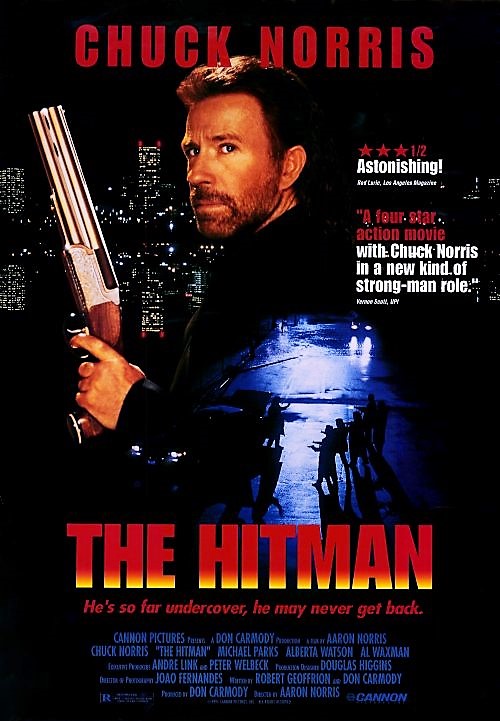
The Hitman (1991, directed by Aaron Norris)


When cop Cliff Garrett (Chuck Norris) gets shot by his corrupt partner, Ronny Delaney (Michael Parks), he dies and nearly gets to go to heaven.  However, at the last minute, the doctor’s manage to bring Cliff back to life.  Since everyone believes Cliff to be dead, his superiors come up with a brilliant plan.  What if Cliff changes his name to Grogan, grows his hair long, and goes undercover as a hitman?

Cliff’s up for it and is soon working for an Italian mobster named Marco Luganni (Al Waxman).  Marco wants to eliminate all of the other mobsters in town but he also has to deal with a bunch of drug-dealing Iranians who are trying to move in on his territory.  Cliff soon works his way into the inner circle and plays all sides against each other.  What’s strange is that Cliff manages to fool everyone into thinking that he’s Grogan despite the fact that all he’s really doing is wearing his hair long.  In fact, the only person who he doesn’t fool is his former partner, Delaney.  Delaney is not happy to discover that Cliff is still alive and sets out to take him out once and for all.

Because this is a Chuck Norris film, there’s a subplot where Cliff helps a bullied youth named Tim (Salim Grant) learn how to stick up for himself.  One thing that set Chuck Norris apart from other 80s action heroes is that Chuck always tried to teach all the kids in the audience of his R-rated films a good lesson about staying off drugs, standing up to bullies, and not doubting the American way.  I always have mixed feelings about this aspect of Chuck’s films because the message scenes usually don’t fit in with the rest of the narrative and it’s always questionable if a film featuring Chuck killing people is the right place for a wholesome life lesson but, at the same time, Chuck is so sincere that these scenes usually feature his best acting.  When Tim beats up a bully and then Chuck beats up the bully’s father, it really makes you realize that someone missed an opportunity by not making a movie where Chuck Norris played a computer science teacher who prepared his students not just for a career in STEM but also taught them how to put the members of football team in their place.  In the case of The Hitman, the crime subplot and the bullying subplot come together when Delaney decides to use Tim to strike at Cliff.

The Hitman is one of Chuck’s later films, which means the budget is lower than the films he did for Cannon and the action scenes are not as elaborate.  Chuck’s brother, Aaron, directs and he does okay but he’s no Joe “Missing In Action” Zito or Menahem “Delta Force” Golan.  The fight scenes are competently done in a workmanlike manner but they’re never as exciting as what we’ve come to expect from the Norris brand.  The main appeal here is to see Chuck Norris and Michael Parks in the same movie.  Chuck, as always, underplays while Parks, as always, overplays and it’s always entertaining to watch them go at each other.  Otherwise, The Hitman is for Chuck completists only.

Delta Force 2: The Colombian Connection (1990, directed by Aaron Norris)


Cocaine is flooding the United States and only one man is to blame!  Ramon Cota (Billy Drago) is so evil that, after killing a group of DEA agents, he appears on closed-circuit television just so he can taunt their superior, John Page (Richard Jaeckel).  When Ramon drives through his home country of San Carlos, he kills the peasants, rapes their women, and murders their babies, just because he can.  He’s one bad dude.

Ramon is untouchable as long as he stays in San Carlos but occasionally he does have to leave the country so he can conduct business.  A frequent flyer, Ramon always buys every seat in first class so that he and his bodyguards can have privacy.  However, what Ramon didn’t count on, was Delta Force’s Col. Scott McCoy (Chuck Norris!).  McCoy and his partner, Maj. Chavez (Paul Perri), aren’t intimidated by that curtain separating first class from the rest of the plane.  As soon as Ramon’s flight enters American air space, they burst out of coach, knock out Ramon’s bodyguards, and then toss Ramon out of the plane.  Being an experienced skydiver (not to mention that he’s also Chuck Norris), Col. McCoy is able to catch up to Ramon and grab him before he plummets all the way to the Earth.

Unfortunately, arresting Ramon in America means that you run the risk of a liberal, Carter-appointed judge setting a low-enough bail that Ramon can go free.  Having taken advantage of America’s own legal system, Ramon murders Chavez and returns to San Carlos, leaving Col. McCoy and the rest of the Delta Force to seek vengeance for their fallen comrade.

Only Chuck Norris returns for this sequel to the greatest movie ever made.  Unfortunately, Lee Marvin died shortly after the release of the first Delta Force.  Even though John P. Ryan (as General Taylor) and Richard Jaeckel both seem to be attempting to channel Marvin’s grim, no-nonsense spirit in their performances, it’s just not the same.  What made the first Delta Force so memorable was the mix of Marvin’s cool authority and Chuck Norris’s general badassery.  Norris is as tough as always but the film still has a Lee Marvin-size hole in the middle of it and, without Marvin glaring at the bad guys and barking at the Washington pencil pushers who think they know how to keep America safe, Delta Force 2 could just as easily be a sequel to one of Norris’s Missing In Action films.  This is a Chuck In The Jungle movie, with drug dealers replacing the usual Vietnamese POW camp commandants.

If you can see past the absence of Lee Marvin, Delta Force 2 is an okay Chuck Norris action movie.  It’s typical of the movies that he made for Cannon but the fight scenes are well-directed by Chuck’s brother and Billy Drago is a loathsome drug lord who gets what he deserves.  Chuck gets a few good one-liners and you’ve got to love the film’s final shot.  Delta Force 2 never comes close to matching the original but at least it’s got Chuck Norris doing what he does best.

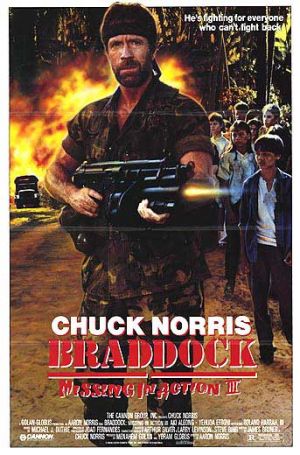
A Movie A Day #306: Platoon Leader (1988, directed by Aaron Norris)


Having just graduated from West Point, Lt. Jeff Knight (Michael Dudikoff, the American Ninja himself) is sent to Vietnam and takes over a battle-weary platoon.  Lt. Knight has got his work cut out for him.  The VC is all around, drug use is rampant, and the cynical members of the platoon have no respect for him.  When Lt. Knight is injured during one of his first patrols, everyone is so convinced that he’ll go back to the U.S. that they loot his quarters.  However, Knight does return, determined to earn the respect of his men and become a true platoon leader!
Though Cannon was best known for making B action movies (many of which starred either Chuck Norris or Charles Bronson), they occasionally tried to improve their image by releasing a prestige film.  Platoon Leader is somewhere in the middle between Cannon’s usual output and their “respectable” films.  It is based on a highly acclaimed memoir and, though the film was made in South Africa, it does a good job of recreating the look of Vietnam.  For instance, Platoon Leader‘s version of Vietnam is more convincing than what Cannon later presented in P.O.W.: The EscapePlatoon Leader also spends some time developing its characters.  Lt. Knight is more than just a stoic action hero, which already distinguishes it from 90% of Cannon’s usual output.  At the same time, Platoon Leader was directed by Chuck Norris’s brother, Aaron, and he doesn’t hold back on the explosions and the gunfire that everyone had come to expect from a Cannon war film.  The end result is an enjoyably hokey film that has a few more layers than the typical Cannon production but not too many.

This film was originally titled Nam but, after the success of Platoon, the title was changed to Platoon Leader.  In typical Cannon fashion, Platoon Leader plays like a more jingoistic and even less subtle version of Stone’s film.  The main difference is that Platoon‘s Lt. Wolfe never won the respect of his men and ended up getting killed with almost everyone else while Lt. Knight beats back the VC and shares a celebratory embrace with his sergeant.

One final note: keep an eye out for genre vet William Smith, who starred in The Losers (a film about a group of bikers who are recruited by the CIA and sent to Vietnam), in the role of Dudikoff’s superior officer.  If Platoon Leader had been made in the 70s, Smith would have played Dudikoff’s role so his appearance here is almost a passing of the B-movie torch.

A Movie A Day #137: Braddock: Missing in Action III (1988, directed by Aaron Norris)


Chuck Fucking Norris, dude.  Chuck Norris is so cool that continuity bends to his will and thanks him for the opportunity.

Need proof?

Just watch Braddock: Missing in Action III.

The third Missing in Action film starts in 1975, with the fall of Saigon.  The communists are taking over.  The Americans are fleeing Vietnam.  Colonel James Braddock (Chuck FUCKING Norris) is determined to bring his Vietnamese wife to America with him but, when she loses her papers and is not allowed to make her way to the American embassy, Braddock believes that she had been killed. (Keep an eye out for Keith David as the Embassy guard.  Only Chuck Norris could overshadow Keith David in a movie.)  Heartbroken, Braddock returns to the United States.

Every fan of the Missing in Action franchise knows better.  We all know that Chuck was in a POW camp when Saigon fell.  In Missing in Action 2, he and his fellow prisoners did not even know if the war had ended.  Also, Chuck mentioned having a wife waiting for him back in the United States.  What gives?

I can think of only two possible explanations.

Either Chuck Norris and Cannon Films did not care about continuity

or

Chuck Norris is so cool that, in order to prevent his collected coolness from knocking the Earth off of its axis, the U.S. Army split Chuck’s coolness in half by creating a clone.  One clone spent ten years in a POW camp.  The other clone escaped during the Fall of Saigon but had to leave behind his wife.

Thirteen years later and back in the U.S., Chuck is contacted by Reverend Polanski (Yehuda Efroni), who tells him that his wife is still alive in Vietnam and that he has a 12 year-old son.  Chuck’s boss at the CIA tells him that, under no circumstances, is Chuck to go to Vietnam.

Anyone who thinks they can tell Chuck Norris what do is a fool.

Chuck goes to Vietnam and is reunited with his wife and son.  Unfortunately, when Chuck tries to get his new family out of the country, they are captured by sadistic General Quoc (Aki Aleong).  Again, Braddock must escape from a Vietnamese prison camp.

Braddock: Missing in Action III was co-written by Chuck Norris and it was directed by his brother, Aaron.  It’s a Norris production all the way, which means a lot of heroic shots of Chuck and a lot of bad guys wondering why Chuck is so much better than them.

Braddock was released four years after the first Missing in Action but, more importantly, it was released two years after Oliver Stone’s Platoon changed the way that movies dealt with the war in Vietnam.  By the time that Braddock came out, films in which lone American refought and single-handedly won the war were no longer in fashion.  Braddock was a flop at the box office and it ended the franchise.  However, continuity errors aside, Braddock is actually the best of the Missing in Action films.  It features Chuck’s best performance in the series and Chuck searching for his wife and child gives Braddock more emotional weight than the first two Missing in Action films. Maybe Chuck should have co-written and selected the director for all of the films he made for Cannon.

Chuck Norris, dude.

Chuck Fucking Norris.