Horror Review: 28 Weeks Later (dir. by Juan Carlos Fresnadillo)


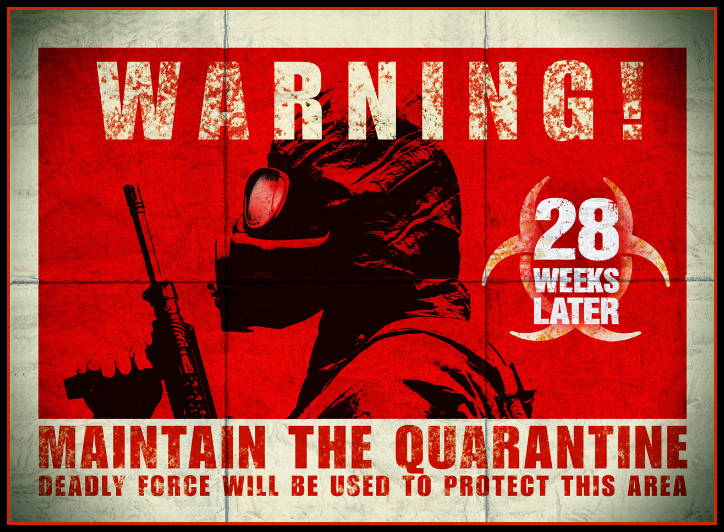
Danny Boyle and Alex Garland’s 28 Days Later was made in such a way that any sequel was almost destined to struggle in its shadow. Their film was not only one of the most influential horror films of the early 2000s, but also an exercise in experimental filmmaking and cinematic reinvention. It fused realism and terror through its digital photography, unconventional pacing, and minimalist score. Any follow-up would have to contend not just with its fresh twist on the zombie mythos (despite the infected not technically being zombies) but also its unique atmosphere, music, and stripped-down aesthetic. Against those odds, 28 Weeks Later manages to stand as an impressive and worthy successor—one that in some respects even surpasses the original.

Spanish director Juan Carlos Fresnadillo approaches the material with a clear reverence for Boyle and Garland’s vision while imprinting his own stylistic and emotional signature on the sequel. From the very first scene, Fresnadillo establishes a tone that blends despair and dread with human frailty. The film opens on a stunningly tense prologue in which Don (a gaunt and haunted Robert Carlyle) and Alice (Catherine McCormack) are living with several others in a rural cottage outside London during the first weeks of the Rage virus outbreak. In this sequence, Fresnadillo distills the central moral dilemma that runs through both films: whether to preserve one’s humanity through compassion or to surrender to pure survival instinct. When Don is forced to choose between rescuing his wife and saving himself, his decision—while horrifying to watch—feels horribly plausible. The following chase through open fields as he flees dozens of Rage-infected attackers captures the raw panic that made Boyle’s original so memorable, yet Fresnadillo shoots it with a sharper sense of chaos and movement. It sets the tone for a story that is both intimate in its human tragedy and apocalyptic in its reach.

Following this intense opening, the film transitions through an introductory credits montage that fills in the aftermath. Don’s escape was not the end of the story but the beginning of a grim reconstruction effort. The British Isles, we are told, were swiftly quarantined when it became clear the infection could not be contained. Twenty-eight weeks later, with the infected population presumed dead from starvation, a U.S.-led NATO force spearheads an ambitious effort to repopulate and rebuild. Led by General Stone (played with austere calm by Idris Elba), the military has converted London’s Isle of Dogs into a heavily fortified safe zone. This enclave represents both restoration and repression—a fragile bubble of civilization built atop the bones of horror.

Within this environment lives Don, now employed as a maintenance manager and struggling to suppress the guilt from his past. The arrival of his two children, Tammy (Imogen Poots) and Andy (Mackintosh Muggleton), who were abroad in Spain during the initial outbreak, reopens emotional wounds he had hoped were sealed. Their reunion, though heartfelt, carries an undercurrent of deception. Don’s explanation of their mother’s fate does not align with what the audience has already witnessed. This dishonesty propels the children into dangerous territory when they decide to sneak out of the Green Zone to retrieve personal belongings from their old cottage. While this act of recklessness fits with youthful impulses and emotional longing, it also feels like the film’s only contrived lapse in logic—an inevitable but frustrating horror trope that sets off the story’s next catastrophe.

What the children discover at the cottage reintroduces the virus in a shocking way. Without realizing it, they bring the Rage infection back into the supposedly secure refuge of London. As soon as containment is broken, the military response escalates with brutal efficiency. General Stone declares a “Code Red,” authorizing the use of extreme measures to eradicate the infected—including indiscriminate firebombing of civilian areas. These scenes echo not only classic apocalyptic tropes but also resonate as a grim reflection of post-9/11 militarism. Many viewers and critics interpreted this act of mass destruction as allegory for the United States’ War on Terror and the ethical corruption of occupation forces. Fresnadillo’s direction, while hinting at this reading, avoids heavy-handed political critique. His portrayal of military overreaction feels less ideological than tragic—a manifestation of fear, confusion, and the blunt-force nature of institutional power. The armed forces are not villains so much as desperate men trapped in an impossible moral quagmire. As in George A. Romero’s The Crazies, which 28 Weeks Later strongly recalls, the destructive consequences stem not from malice but from the futility of trying to maintain order amid chaos.

Where 28 Days Later focused on a small group of survivors and the intimate erosion of morality under crisis, 28 Weeks Later expands the scale dramatically. Fresnadillo transforms Boyle’s compact nightmare into a large-scale urban apocalypse. The sweeping aerial shots of a deserted London—bridges empty, streets silent—hammer home the desolation. When the city is engulfed in flames and gas clouds during the firebombing sequence, the imagery becomes both terrifying and grimly beautiful, a vision of civilization consuming itself. The sequel’s tone is darker and more nihilistic than Boyle’s film, which allowed a trace of optimism in its ending. Here, even innocence becomes a catalyst for doom: it is the children’s actions, driven by love and loss, that inadvertently reignite the infection and condemn the survivors to another wave of horror. This subversion of the “innocent child” trope underscores Fresnadillo’s bleak worldview—where sentiment and humanity, however noble, can still create destruction.

In several ways, 28 Weeks Later aligns more closely with Romero’s Living Dead films than with Boyle’s original. Though Boyle borrowed some of Romero’s thematic DNA, Fresnadillo fully embraces it. The infected may not be reanimated corpses, but the societal collapse, moral ambiguity, and recurring cycles of violence all trace back to Romero’s legacy. One of the sequel’s most striking qualities is its unflinching pessimism: even individuals acting out of love or duty become agents of devastation. The so-called survivors are reduced to primal instincts—running, hiding, killing—in a landscape where institutional power and human decency dissolve together. Fresnadillo makes the action kinetic without glamorizing it. His camera work, switching between chaotic handheld intensity and precise, panoramic destruction, keeps the viewer off balance, mirroring the unpredictability of the apocalypse itself.

The performances elevate the material beyond genre expectations. Robert Carlyle’s portrayal of Don is both gut-wrenching and terrifying. His character’s transformation—from remorseful father to infected embodiment of pure rage—serves as the film’s emotional and thematic anchor. Imogen Poots, in an early standout role, conveys resilience and vulnerability in equal measure, while Jeremy Renner delivers a strong supporting turn as Sergeant Doyle, the soldier torn between obedience and morality. Their performances, though sometimes confined within the film’s relentless pace, enrich its exploration of guilt, loyalty, and the futility of control.

Despite sacrificing some character depth for momentum, the film’s taut editing and grim atmosphere sustain tension throughout. Fresnadillo’s direction never loses sight of his central message: that humanity’s efforts to rebuild are perpetually haunted by its capacity for self-destruction. Even as the few surviving characters reach supposed safety, the final scenes undermine any hope of resolution. The closing image—infected sprinting through the streets of Paris—reminds viewers that, although the city itself appears intact and bustling in daylight, the Rage virus has now breached mainland Europe. This ending shifts the scale of threat from the quarantined British Isles to the broader continent, making containment and redemption feel like dangerous illusions.

As a sequel, 28 Weeks Later earns its place alongside 28 Days Later by honoring the original’s DNA while pushing its boundaries. It retains the visceral dread and societal commentary but broadens the lens to encompass collective failure rather than individual struggle. Fresnadillo’s approach feels colder and more apocalyptic, transforming the story into a study of fear’s infectious nature—social, political, and biological. While his film might not achieve the same creative purity as Boyle’s indie landmark, it succeeds in redefining the tone, expanding the mythology, and pushing the series toward a darker, more cinematic landscape.

In the end, 28 Weeks Later is both a continuation and an escalation—a relentless, despairing study of human fragility under crisis. Its pacing, performances, and imagery combine to create an experience that’s not only horrifying but profoundly unsettling in its realism. If 28 Days Later showed us the collapse of civilization, its sequel reveals the hopeless struggle to rebuild it. Few horror sequels accomplish that much, and fewer still end with such haunting inevitability.

Horror Review: 28 Days Later (dir. by Danny Boyle)


For decades, the zombie film genre has been defined by the rules established by the grandfather of the modern zombie story, George A. Romero. His 1968 landmark horror film Night of the Living Dead transformed what had once been a gothic creature rooted in the voodoo folklore of Haiti and the Caribbean into an apocalyptic force symbolizing social collapse and human weakness. The film not only terrified audiences but also laid the foundational blueprint for every zombie movie that followed. Romero’s zombies weren’t merely monsters — they were a reflection of humanity’s fears, prejudices, and inner decay. His influence has remained so pervasive that, even today, filmmakers working in horror are inevitably responding to his legacy, whether they realize it or not.

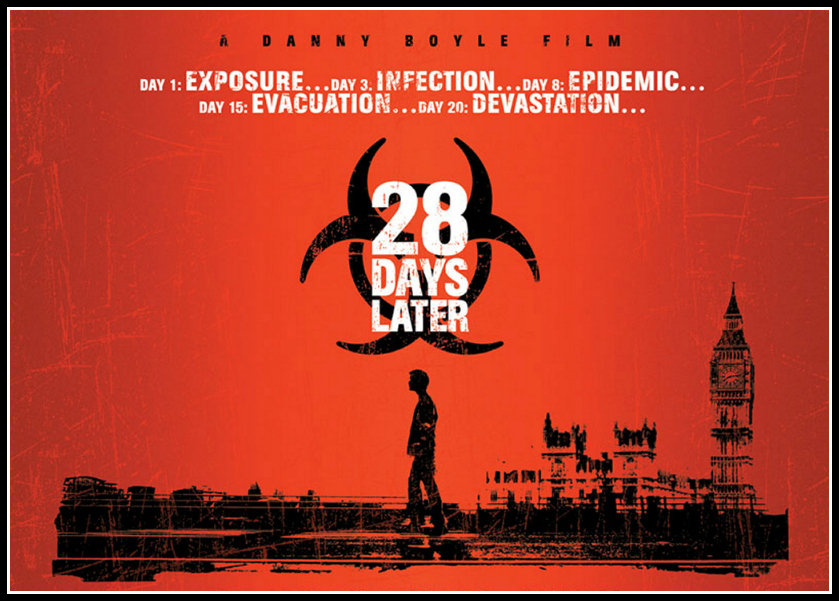
Through the years, there have been numerous attempts to deviate from Romero’s formula. The most prominent early success came in the 1980s with the Return of the Living Dead series — a clever horror-comedy franchise that infused dark humor and punk aesthetics into the genre. Yet even that beloved cult entry eventually lost steam. True reinvention did not arrive until 2002, when British filmmaker Danny Boyle and screenwriter Alex Garland collaborated on 28 Days Later, a project that both revitalized the zombie genre and split its devoted fan base down the middle. Was it truly a “zombie” film, or something else entirely? That very debate remains unresolved more than twenty years later.

Boyle’s film begins not with a supernatural curse or the reanimation of the dead, but with a catastrophic act of human arrogance. A group of naïve animal-rights activists break into a research laboratory to rescue chimpanzees subjected to bureaucratic cruelty. However, they find that these animals have been injected with a rage-inducing virus — the product of bioengineering rather than black magic. One of the activists, horrified by what she witnesses, ignores the pleas of a desperate scientist and frees a chimp, unleashing a pandemic that will decimate Britain within weeks. This opening sequence is both economical and horrifying: the origins of the apocalypse come from compassion twisted into recklessness. Boyle establishes his tone immediately — quick editing, grainy digital video, and an oppressive sense of realism create a world that feels disturbingly possible.

The narrative then leaps forward twenty-eight days. In a now-iconic sequence, the protagonist Jim (played by Cillian Murphy) awakens from a coma in an abandoned London hospital. His disorientation mirrors that of the audience: sterile hallways littered with trash, flickering lights, a haunting silence broken only by the hum of wind through the empty city. When Jim emerges into the sunlight, the camera captures a London entirely devoid of people, its majestic landmarks standing as hollow monuments to civilization’s sudden collapse. This is one of cinema’s most unforgettable depictions of isolation. The haunting score by John Murphy and the use of Godspeed You! Black Emperor’s instrumental “East Hastings” heighten the apocalyptic stillness, transforming London into a ghost metropolis.

Jim’s bewilderment only deepens when he seeks refuge in a church — a setting traditionally associated with salvation — only to find it desecrated by carnage. His presence awakens a horde of infected individuals who charge at him with terrifying speed. Unlike Romero’s slow, lumbering undead, Boyle’s infected are human beings transformed by a virus that amplifies their aggression to animalistic extremes. They move like predators, sprinting at prey with berserk fury. Jim narrowly escapes thanks to two survivors, Selena (Naomie Harris) and Mark (Noah Huntley), who introduce him to the brutal new rules of existence: infection spreads through blood contact, turning victims within seconds, and hesitation means death.

The trio’s uneasy alliance soon crumbles after Mark becomes infected, forcing Selena to kill him without hesitation. This harrowing moment establishes her as one of the film’s strongest and most pragmatic characters — a refreshing departure from the damsel archetype that has long haunted horror cinema. Jim and Selena later encounter Frank (Brendan Gleeson), a good-natured taxi driver, and his teenage daughter Hannah (Megan Burns), who have been surviving in a fortified apartment building. Together they form a fragile surrogate family and travel in search of a military broadcast promising safety and a potential cure.

Boyle deftly blends moments of human warmth amid horror. Scenes like the group’s scavenging trip through an abandoned grocery store — a darkly comic echo of Dawn of the Dead’s consumer satire — offer glimpses of joy and normalcy. The countryside sequences, shot with a painterly eye, contrast the urban decay of London with the serene beauty of a world reclaiming itself from human control. Nature, the film quietly suggests, endures long after people have vanished.

Their journey leads them to a fortified mansion commanded by Major Henry West (Christopher Eccleston), a British officer whose soldiers claim to have “the answer to infection.” The supposed sanctuary quickly reveals a darker truth. West’s band of men have descended into moral depravity, promising their commander that the promise of “women” will restore morale. The film shifts from survival horror to psychological thriller as the real threat emerges — not the infected outside, but the monstrousness within human beings when order collapses. In this descent into militaristic patriarchy and madness, Boyle channels the spirit of Romero’s Day of the Dead, where the military’s illusion of control becomes the true source of terror.

Boyle and Garland’s reinvention of the zombie mythos was revolutionary. Longtime fans of Romero’s shambling undead initially resisted the notion that 28 Days Later even qualified as a zombie movie. After all, its creatures weren’t reanimated corpses but living people overtaken by an uncontrollable virus. Yet their function within the story — relentless, dehumanized embodiments of contagion and rage — served the same thematic role as zombies always had: mirrors for society’s breakdown. The debate over whether the infected “count” as zombies is less important than the fact that Boyle redefined the genre’s emotional and kinetic language. His infected didn’t just pursue victims; they hunted them. Their blistering speed and screams injected pure chaos into what had once been slow, creeping dread.

The technical and artistic choices heightened the film’s intensity. Shot largely on digital video with handheld cameras, 28 Days Later looked raw and immediate, more like found footage than polished fiction. This realism bridged the gap between old-school horror and the new century’s fixation on viral outbreaks and global instability. Coming in the post-9/11 era, its images of deserted cities and military lockdowns felt eerily prescient, foreshadowing later fears of pandemics and authoritarian control.

The performances ground the film emotionally. Cillian Murphy’s portrayal of Jim evolves from bewildered innocence to hardened survivor, serving as the audience’s emotional compass. Naomie Harris delivers one of the genre’s most capable female performances, blending vulnerability with ferocity. Brendan Gleeson, always magnetic, brings compassion and tragedy to Frank — a man whose paternal instincts ultimately lead to heartbreak. Christopher Eccleston’s Major West stands as a chilling embodiment of human corruption in crisis: the soldier who insists he is saving civilization while replicating its worst impulses.

Despite being produced on a modest budget of roughly eight million dollars, Boyle’s film achieved a scale and impact far greater than its resources suggested. The empty London shots — achieved by closing key streets at dawn for only minutes at a time — remain astonishing feats of logistical precision and cinematic audacity. More importantly, the film’s minimalist production enhanced its believability. Everything about 28 Days Later feels lived-in, grimy, and plausible.

Two decades on, 28 Days Later continues to stand as one of the most influential horror films of the 21st century. Its success reinvigorated a genre that had grown stale and inspired a wave of imitators across film, television, and video games, from Zack Snyder’s Dawn of the Dead remake to AMC’s The Walking Dead. Beyond its cultural impact, it remains a haunting meditation on rage — personal, societal, and political. Boyle and Garland transformed horror into a canvas for existential dread, exploring how quickly civility unravels when survival becomes the only law.

Whether one calls it a zombie film or not hardly matters anymore. 28 Days Later breathed new life into the undead myth, shattering old rules and redefining what modern horror could be. The debate it sparked continues, but one truth is undeniable: the genre has never been the same since Jim first walked through that silent, ruined London — a world devoured not by the dead, but by the terrifying rage of the living.

Song of the Day: East Hastings (by Godspeed You! Black Emperor)


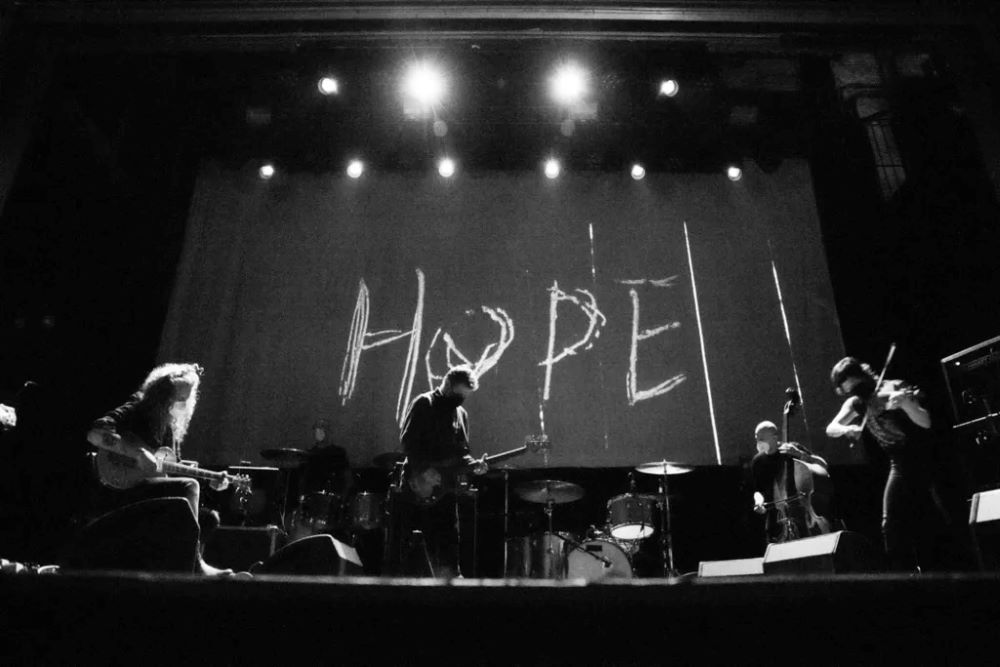
We’re now halfway through the week-long horror-themed “Song of the Day” feature and the first three days has been all Italian composers. Two of them were known for working in the grindhouse film scene while the other has been more well-renowned for having worked in spaghetti westerns and more mainstream, albeit very artful, film projects. The fourth selection in this fourth day of the series is the epic song “East Hastings” by the Montreal-based eclectic band Godspeed You! Black Emperor.

“East Hastings” was chosen because of not just its apocalyptic sound and tone, but also how it was used in an excellent way to highlight the desolation in Danny Boyle’s “zombie-faux” film, 28 Days Later.

The song begins after a brief prologue and shows Cilliam Murphy’s character walk the deserted and silent streets of London after waking up from a coma. His lost and dazed travel through the empty streets and by-ways of England’s capital was quite haunting and the song by GY!BE just added to the tension building up on the screen. If there ever was a song that typified the British viewpoint about how the world ends it would be “East Hastings”.

10 Best Film Scores/Soundtracks of the Past Decade


Listed below in no particular order of importance are the film soundtracks I consider as being the best of the 2000’s. All of these soundtracks have the distinction of not just great pieces of music in their own right, but also adding another layer to the film they’re scoring. Most are orchestral soundtracks with a couple a mixture of both orchestral work and licensed songs. For franchises which contain repeating music cues and motifs I’ve decided to combine as one entry.

I’ve added a video link of a favorite track from each soundtrack.

1. O, Brother Where Art Thou?

2. Almost Famous

3. Gladiator

4. Kill Bill Vol 1 & 2

5. Requiem for a Dream

6. 28 Days Later

7. Pan’s Labyrinth

8. Batman Begins/The Dark Knight

9. The Fountain

10. The Lord of the Rings Trilogy