14 Days of Paranoia #6: The Player (dir by Robert Altman)


1992’s The Player tells the story of Griffin Mill (Tim Robbins).

It’s not easy being Griffin Mill.  From the outside, of course, it looks like he has the perfect life.  He’s a studio executive with a nice house in Hollywood.  He’s young.  He’s up-and-coming.  Some people, especially Griffin, suspect that he’ll be the president of the studio some day.  By day, he sits in his office and listens to pitches from respected screenwriters like Buck Henry.  (Henry has a great idea for The Graduate II!)  During the afternoon, he might attends dailies and watch endless takes of actors like Scott Glenn and Lily Tomlin arguing with each other.  Or he might go to lunch and take a minute to say hello to Burt Reynolds.  (“Asshole,” Burt says as Griffin walks away.)  At night, he might go to a nice party in a big mansion and mingle with actors who are both young and old.  He might even run into and share some sharp words with Malcolm McDowell.

But Griffin’s life isn’t as easy as it seems.  He’s constantly worried about his position in the studio, knowing that one box office failure could end his career.  He fears that a new executive named Larry Levy (Peter Gallagher) is after his job.  Two new screenwriters (Richard E. Grant and Dean Stockwell) keep bugging him to produce their downbeat, no-stars anti-capitol punishment film.  His girlfriend (Cynthia Stevenson) wants to make good movies that mean something.  Even worse, someone is sending Griffin threatening notes.

It doesn’t take long for Griffin to decide that the notes are coming from a screenwriter named Dave Kahane (Vincent D’Onofrio).  Griffin’s attempt to arrange a meeting with Dave at a bar so that Griffin can offer him a production deal instead leads to Griffin murdering Dave in a parking lot.  While the other writers in Hollywood mourn Dave’s death, Griffin starts a relationship with Dave’s artist girlfriend (Great Scacchi) and tried to hide his guilt from two investigating detectives (Whoopi Goldberg and Lyle Lovett).  Worst of all, the notes keep coming.  The writer, whomever they may be, is now not only threatening Griffin but also seems to know what Griffin did.

After spend more than a decade in the industry wilderness, Robert Altman made a critical and commercial comeback with The Player.  It’s a satire of Hollywood but it’s also a celebration of the film industry, featuring 60 celebrities cameoing as themselves.  Everyone, it seems, wanted to appear in a movie that portrayed studio execs as being sociopathic and screenwriters as being whiny and kind of annoying.  The Player both loves and ridicules Hollywood and the often anonymous men who run the industry.  Largely motivated by greed and self-preservation, Griffin may not love movies but he certainly loves controlling what the public sees.  In the end, only one character in The Player sticks to her values and her ideals and, by the end of the movie, she’s out of a job.  At the same time, Griffin has a social life that those in the audience can’t help but envy.  He can’t step out of his office without running into someone famous.

The Player is one Altman’s most entertaining films, with the camera continually tracking from one location to another and giving as a vision of Hollywood that feels very much alive.  Tim Robbins gives one of his best performances as Griffin Mill and Altman surrounds him with a great supporting cast.  I especially liked Fred Ward as the studio’s head of security.  With The Player, Altman mixes melodrama with a sharp and sometimes bizarre comedy, with dialogue so snappy that the film is as much a joy to listen to as to watch.  That said, the real attraction of the film is spotting all of the celebrity cameos.  (That and cheering when Bruce Willis saves Julia Roberts from certain death.)  Altman was a director who often used his films to explore eccentric communities.  With The Player, he opened up his own home.

Previous entries in 2025’s 14 Days Of Paranoia:
  1. The Fourth Wall (1969)
  2. Extreme Justice (1993)
  3. The Lincoln Conspiracy (1977)
  4. Conspiracy (2007)
  5. Bloodknot (1995)

14 Days of Paranoia #5: Bloodknot (dir by Jorge Montesi)


In 1995’s Bloodknot, we are introduced to a grieving family.

Evelyn (Margot Kidder) and Arthur (Allan Royal) are mourning the death of their oldest son, who was in the military and who died during a military operation in the Middle East.  Their other son, Tom (Patrick Dempsey), spends his time working on cars and helping out local racecar driver Mike (Craig Sheffer).  Youngest daughter Gail (Ashleigh Ann Wood) doesn’t really have much of a personality but she’s definitely worried about her mother.

Suddenly, Connie (Kate Vernon) shows up in town.  Wearing a uniform that is slightly too large for her, Connie claims that she served with Evelyn’s dead son and that they eventually became more than just friends.  That’s strange, Evelyn says, he never mentioned you.  Connie replies that she encouraged him to write more but, for whatever reason, he didn’t.  Everyone agrees that what’s important now is that Connie has introduced herself to the family.  Soon, Connie is living at the mansion and making flirtatious eye contact with both Arthur and Tom.  One might expect Evelyn to be concerned about this but instead, Evelyn is too busy walking around in a depressed daze and blaming her “sinful” past for all the recent tragedy.

You probably already guessed that Connie is not who she says she is.  Indeed, Connie has come to the family with an agenda of her own.  She’s looking for vengeance and I won’t spoil it by revealing what she’s upset about but I will say that it’s fairly dumb and makes less sense the more that you think about it.  Tom’s girlfriend, Julie (Krista Bridges), suspects that Connie is a liar but can she prove it?  Julie even talks to the officer from whom Connie stole her uniform after Connie met and seduced her at a bar.  Why would Connie, who seems to be willing to kill anyone, leave that one person alive?  Obviously, it’s so Julie can learn the truth but still, it’s an oversight on Connie’s part that makes little sense.

(Julie isn’t a very interesting character but she does get to wear a really nice pair of boots so at least she’s got that going for her.)

Looking at the members of this film’s cast — Patrick Dempsey, Craig Sheffer, Kate Vernon — and you have to wonder if someone specifically said, “Let’s make an paranoia-themed, erotic thriller with the least interesting actors of the 90s.”  (Yes, Dempsey got better but, in this film, he was still doing the goofy awkward thing.)  This film goes through all the usual steps.  Connie starts out as being friendly and then progressively reveals herself to be more and more unhinged.  The men are reduced to stuttering incoherence by the sight of Connie smiling at them.  For this type of film to work, the actors have to be fully willing to embrace the melodrama but instead, both Kate Vernon and Patrick Dempsey give oddly lowkey performances, with Vernon’s attempt at a seductive smile instead coming across like a smirk that should have clued everyone in to the fact that she was not to be trusted.  If you’re appearing in a film like this, you should at least have a little fun.  As for Craig Sheffer, he’s as mind-numbingly dull as ever.

The film does improve a bit towards the end, largely because Connie’s secret reason for harassing the family is so implausible that it can’t help but be a bit entertaining to listen to the characters discuss it.  Overall, though, this was pretty boring.  Let this film be a lesson to all — embrace the melodrama!

Previous entries in 2025’s 14 Days Of Paranoia:

  1. The Fourth Wall (1969)
  2. Extreme Justice (1993)
  3. The Lincoln Conspiracy (1977)
  4. Conspiracy (2007)

14 Days of Paranoia #4: Conspiracy (dir by Adam Marcus)


2008’s Conspiracy opens in Iraq.

A group of American soldiers are searching for militants.  Amongst them is the grim-faced William “Spooky” MacPherson (Val Kilmer).  When an adorable little girl with a teddy bear approaches the soldiers, MacPherson barely notices.  His mind is on adult threats.  But when the girl reveals that she has a bomb in her backpack, the majority of the soldiers are blown up with her. MacPherson survives, though he loses a leg and ends up with such severe PTSD that he can no longer carry a gun or even make a fist.  Helping him recover from his wounds is his best friend and fellow soldier, Miguel (Greg Serano).

A year or so later, MacPherson is back home.  He lives in a run-down apartment in New York and spends most of his time with a naked woman who speaks Russian.  (Whether she was meant to be his girlfriend or just someone he hired is unclear.)  Miguel continually calls him up and asks him to come down to New Mexico and work on his ranch.  MacPherson refuses at first.  He wants to remain isolated from the world.  But when his flashbacks of the explosion become too intense, MacPherson finally decides to accept Miguel’s offer.  MacPherson pawns a gun so that he’ll have enough money to get a bus ticket.  And then, he heads for New Mexico.

The only problem is that, once MacPherson arrives in New Mexico, Miguel is nowhere to be seen.  Walking through a town that appears to have recently been constructed, MacPherson meets a lot of people who insist that they’ve never heard of Miguel and that there is no ranch at the address that Miguel gave MacPherson.  The police carefully watch MacPherson as he makes his way from business to business, searching for his friend.  No one in town is friendly.  No one seems to want MacPherson around.  Eventually, MacPherson is approached by Rhodes (Gary Cole), the businessman who is building the town and who apparently controls everything that happens within the town limits.  Rhodes is friendly.  Rhodes says that MacPherson, with his white skin and blonde hair, is exactly the type of person that he likes to see in his town.  Can you tell where this is going?

You probably already guessed that Rhodes is an evil businessman who is involved in human trafficking and who smuggles Mexicans across the border to work for his company before then sending back to their home country with next to no money.  You’ve also probably figured out that Miguel was killed by the corrupt police force.  If you haven’t figured that out, you’ve never seen a movie before.  MacPherson teams up with the only kind person in town, Joanna (Jennifer Esposito), and they try to stop Rhodes’s operation.  The entire movie seems to be building up to a scene where MacPherson and Joanna take on the whole town but instead, somewhat anticlimactically, everyone just stands around and watches Rhodes battle MacPherson.  Conspiracy promises a lot but it doesn’t really deliver.

This was one of Val Kilmer’s first straight-to-video roles and he gives a rather detached performance, which is a shame because an actor of Kilmer’s talent could have really done something with this role if he had been in the mood to do so.  But I don’t blame Kilmer for not seeming to be that invested in Conspiracy.  It’s not a very interesting film.  Even the usually dependable Gary Cole just seems to be going through the motions.  The film’s attempt to comment on the pressing political issues of 2008 — illegal immigration, the war in Iraq, the burst of the housing bubble, the recession — only serve to reinforce how shallow and heavy-handed the film actually is.  Watching Conspiracy in 2025, the most interesting about it is that the issues it deals with are the issues that, 17 years later, Americans are still dealing with.

With its portrayal of an isolated town and a scarred war veteran looking for a missing friend, Conspiracy has a lot in common with the classic 1955 film, Bad Day At Black Rock.  Now, that’s a film that is definitely worth seeing!

Previous entries in 2025’s 14 Days Of Paranoia:

  1. The Fourth Wall (1969)
  2. Extreme Justice (1993)
  3. The Lincoln Conspiracy (1977)

14 Days of Paranoia #3: The Lincoln Conspiracy (dir by James L. Conway)


When it comes to conspiracy theories involving presidential assassinations, the theories surrounding JFK may get all the attention but it’s the theories surrounding the death of Abraham Lincoln are usually far more plausible.

Unless, of course, it’s the theories that are pushed in the 1977 docudrama, The Lincoln Conspiracy.

A mix of documentary-style narration and really cheap-looking historical reenactments, The Lincoln Conspiracy essentially indicts almost everyone who was alive in 1865 as being a part of either the conspiracy or the subsequent cover-up.  Really, it’s remarkable how many historical figures are implicated in this film.

With the Civil War coming to a close, President Lincoln (John Anderson) hopes to pursue a generous reconstruction policy for the former Confederate States.  Secretary of War Edwin Stanton (Robert Middleton), Senator Ben Wade (Dick Callinan), and a host of other are all opposed to this plan, both because they want vengeance and they also want to make as much money as possible off of the Southern cotton fields.  They come up with a plan to impeach Lincoln but, in order to draw up the articles, they have to make sure that Lincoln is not seen for a few days.  When Col. Lafayette Baker (John Dehner) discovers that an actor named John Wilkes Booth (Bradford Dillman) is planning on kidnapping Lincoln, Stanton and his conspirators decide to give Booth their unofficial support.  However, when the plan changes at the last minute and Stanton decides that it would actually be a bad idea to kidnap Lincoln, an angry Booth decides to just kill Lincoln, Andrew Johnson, and William Seward.

Booth succeeds in shooting Lincoln and making his escape.  The other members of Booth’s group all fail in their assignments.  Andrew Johnson becomes president.  Though grievously wounded, William Seward survives.  Booth flees to Canada and …. oh, you thought Booth died?  No, that was just a look alike who was shot by a bizarre soldier named Boston Corbett.  By allowing everyone to believe that Booth was killed, Stanton is able to cover up any role he and his allies played in inspiring the assassination.  Unfortunately, Col. Baker keeps a diary and it seems like he might be planning on revealing the truth but he dies mysteriously before he can.

(And, to give the film some credit, Col. Baker’s sudden death at 41 was an odd one.  And, though it’s not really explored in the film, Boston Corbett, the man who shoot Booth, really was a weirdo who was described by contemporaries as being a religious fanatic who castrated himself and claimed to hear the voice of God.)

It’s a big conspiracy theory that is presented in The Lincoln Conspiracy.  In fact, it’s a bit too big to really be taken seriously.  The film pretty much accuses everyone in Washington of having a part in the assassination.  The film itself has the cheap look of a community theater production and the use of Dr. Samuel Mudd as a narrator only adds to the film’s silliness.  If you’re a fan of gigantic and thoroughly implausible conspiracy theories, as I am, the film is entertaining in its way.  If nothing else, Bradford Dillman certainly looks like how most people probably imagine John Wilkes Booth to have looked.  Otherwise, The Lincoln Conspiracy is far-fetched and not at all realistic, which is why I assume that a lot of people in 1977 probably believed every word of it.

Previous entries in 2025’s 14 Days Of Paranoia:

  1. The Fourth Wall (1969)
  2. Extreme Justice (1993)

14 Days of Paranoia #2: Extreme Justice (dir by Mark L. Lester)


What type of justice?

Extreme justice, y’all!

In this 1993 film, Lou Diamond Phillips stars as Jeff Powers.  Who is Jeff Powers?  He’s a cop!  He wants to keep the street safe!  Sometimes, he knows that you have to be willing to break the rules!  He’s a cop who does things his way!

Okay, is that enough exclamation points?  I’m not just using them to be obnoxious.  The film is pretty much just one big exclamation point.  The action is hyperintense and the film is full of characters who always seem like they’re just one step away from exploding.  No one in this film is particularly calm or laid back.  From the start, everything is dialed to eleven and it just keeps going higher and higher.

After Jeff is put on probation for roughing up a suspect, he receives an invitation to join an elite squad of detective.  Led by the charismatic Detective Dan Vaughn (Scott Glenn, giving a performance that is so over-the-top that he yells straight at the camera at one point), the Special Investigative Section is the best of the bed.  Upon joining, Jeff finds himself a member of a sacred fraternity of law enforcers.  Working with men like the always amused Detective Larson (Yaphet Kotto) and the somewhat paranoid Angel (Andrew Divoff), Jeff finds himself tracking some of the biggest criminals in the city.

What Jeff also discovers is that SIS does more than just arrest criminals.  The SIS has been given an unofficial license to kill and they end up executing as many people as they take to jail.  Often times, Vaughn will tells the men to allow a crime to be committed so that they can then dispense their own brand of justice.  In the film’s most disturbing scene, the members of SIS wait until after a woman has been raped in an alley before they move to neutralize her attackers.  When Jeff finally decides that he can’t be a part of all this and tries to reveal what’s going on, he discovers that the SIS has some support in some very high places.  Who cares if the SIS is allowing crimes to be committed or if an innocent person occasionally gets caught in the crossfire?  At least they’re taking care of the criminals!

Extreme Justice is a crude and energetic film and one that is based on some of the stories that spread about the LAPD’s RAMPART division in the 90s.  That the film works is a testament to the performances of Phillips, Kotto, and Glenn and also the direction of Mark L. Lester.  An exploitation vet who occassionally made big studio action films as well, Lester keeps the pace moving at breakneck speed and, even more importantly, he allows both sides to have their say.  While Jeff is upset about SIS’s methods, Detective Vaughn is correct when he says that his unit is targeting the worst of the worst.  It makes for an unusually intelligent exploitation film, one that leaves the audience with a lot to consider.  How far would you go to keep your neighborhood safe?

Previous entries in 2025’s 14 Days Of Paranoia:

  1. The Fourth Wall (1969)

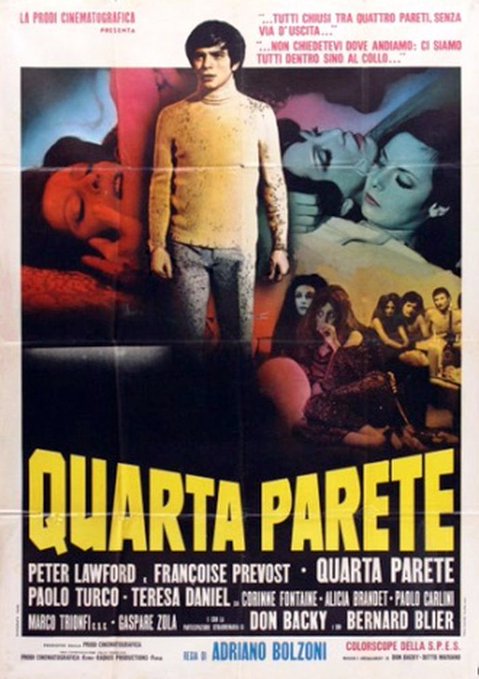
14 Days of Paranoia #1: The Fourth Wall (dir by Adriano Bolzoni)


First released in 1969, The Fourth Wall opens with a series of photographs.

The grainy photographs all appear to have been taken at a political protest in London.  The protestors are holding signs that say something about leaving Nigeria alone but the exact cause that is being supported is still left vague.  Eventually, after viewing several photographs of long-haired college students holding signs, we reach some photographs of the police violently breaking up the protest and carting several of the protestors off to jail.

Amongst the protestors is a young Italian named Marco Baroni (Paolo Turco).  Marco has spent the past four years in London, studying and apparently becoming politically active.  However, it is time for him to return to Italy.  When he reaches his home, we discover that, for all of his talk of protest and revolution, Marco comes from a wealthy, upper class family.  Papa Baroni (Peter Lawford) is a businessman who is willing to bankrupt even his best friends and who openly flaunts the affair that he’s having with his Swedish secretary.  Marco’s mother, Christiana (Francoise Prevost) spends her time in a haze of alcohol and ennui.  Marco’s younger sister, Marzia (Tery Hare), is a fashion model who has become infamous for a serious nude photographs that were taken by the enigmatic Lona (Corraine Fontaine).  Marzia’s room is full of picture of herself.  When Marco returns home, she greets him more as if he were long-distance boyfriend than her brother.  As the film progresses, it becomes clear that there is more to Marco and Marzia’s relationship than just sibling closeness.

It’s an odd and meandering film.  Marco, having had his consciousness raised in London, is disgusted by his family’s decadence and hates the fact that his father seems to represent everything that he was arrested for protesting in the UK.  At the same time, as much as Marco whines about the sins of his family, he finds himself repeatedly drawn to Marzia and her wild lifestyle.  At one point, Marco finds himself observing a group of student radicals who can’t even agree on what they want to protest.  At another point, he walks in on one of Marzia’s parties and watches as a rather tame orgy breaks out.  This is the type of film where Marco spends a lot of time complaining about Marzia being more interested in hedonism than politics but the camera itself lingers on the nonstop nudity and the sight of Lona and Marzia kissing.  For all of the film’s political pretensions, director Adriano Bolzoni obviously understood that sex sells better than speeches.

Bolzoni, himself, was not primarily a political filmmaker.  The majority of his films were a mix of giallo thriller and spaghetti westerns.  There are hints of the giallo genre in this film, with its vibrant colors and its shots of Marco slowly losing his mind as the full extent of his family’s decadence becomes clear to him.  (That said, it’s hard not to laugh at the scene in which Marco runs through the rain while screaming, “NO!” over and over again.)  The instrumental score is pure Spaghetti western, leading to some unintentionally funny moments.  When Marco spots his father with his mistress, the mix of a zoom lens and a musical sting that sounds like it was lifted from a Sergio Leone showdown is more likely to leave you laughing than gasping.  There are other scenes that are scored to songs that were apparently written to sound like Simon & Garfunkel’s contributions to The Graduate soundtrack.

As pretentious as the film is — and make no mistake, this is a very pretentious film — The Fourth Wall does do a good job of capturing Marco’s growing sense of unease as he returns home convinced that he’s figured out the world just to discover that no one else really cares about his politics, his ideals, or his outrage.  Marco goes from being stridently idealistic to drowning in his own paranoia and it’s hard not to regret that Paolo Turco was a bit of a dull actor because, with better casting, the character’s descent would have been truly heartbreaking.  Peter Lawford plays Papa Baroni with just the right amount of ruthless charm.  He might be the epitome of everything that Marco is against but just watching him, you know that Papa Baroni is always going to get exactly what he wants.  It doesn’t matter how much Marco whines or how many meetings Marco goes to or even how the film’s final burst of violence plays out.  Papa Baroni will always thrive and survive.