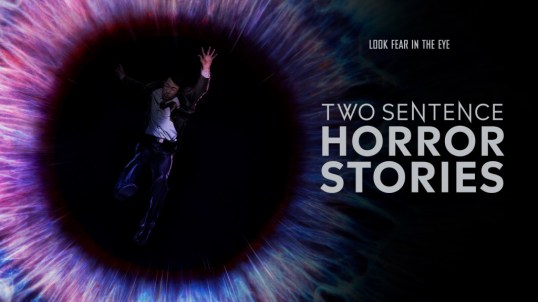
Two Sentence Horror Stories, Series Review By Case Wright (Dir/Created by Vera Miao) – The New Coke of Horror


2sents.jpg

Happy Horrorthon! Being lectured to by Two Sentence Horror Stories is as fun as going to an office meeting, at 4 pm, on Friday, December 24th, there are 102 slides, and you have to pee.  In short, I watched this so you don’t have to.  It’s really been awhile since I watched something so mediocre that it only excelled at being hamfisted trash. 

I’ve written many times that horror and science fiction can be great at making political points and raising awareness: Twilight Zone wove great stories with salient issues to America’s living rooms, Night of the Living Dead looked civil rights right in the eye, and Friday the 13th exposed how hockey goalies had taken over the Summer Camp industry.

What do all of the above have in common that Two Sentence Horror Stories does not? They were entertaining and good stories first.  I get that some people are angry, but that is no excuse for making terrible television.  You have an opportunity to use great stories and subtlety to express yourself and CHANGE people’s minds, but if all you have is a political statement and a boring story- you devolve into lecture and people tune out. The point of using political messages in Horror is BECAUSE your goal is to get through to the other half of the country who disagrees with you.

The greatest example of horror with a message is Night of the Living Dead.  Wes Craven discussed Night of The Living Dead and “At the end you realized [George Romero] made a political statement.”  AT….THE….END!!!

People have their views.  People have views that are different. People have views that are straight up wrong. Now, we are totally and openly polarized so getting people to see your point of view takes the MOST care and effort.  It is not the time for hamfisted mediocrity.  It’s the time for brilliance!

Two Sentence Horror Stories starts with the social evil right out of the gate and hammers us endlessly with their point of view.  Every single episode has the worst mixture of terrible dialogue, confusing plot points, and amateurish camera shots.  In essence, it is a failure and shouldn’t even be watched on the elliptical.

Two Sentence Horror Stories- begins with the first sentence of a horror cliche’.  Then, you see someone beleaguered by a social evil.  No one supports them until it’s almost too late.  Then, the social evil is easily smacked in the face.  The second sentence of the horror cliche’ appears.  Lastly, we get a take home assignment and have to watch Ken Burns’ lesser known works.

The show puts the dilemma right in your face without nuance. I agree with the social message, but it’s as subtle as a brick to the face and the messages in this show aren’t even ground breaking.

They build the story around the message instead of the message around the story. You need to entertain first, get the audience to identify with your protagonist, and then get us to think. This is never done. Lastly, the messages they’re spoon-feeding us aren’t even new ideas and everyone is on board with these ideas. Therefore, the show fails to even break new ground when it’s haranguing us. It’s like they’re shouting at the Mayo Clinic to stop using leeches.

In summary, this show is boring, not scary, and preachy about issues that no one is disputing! Maybe, next week’s episode will be on how we all have to start drinking water and stop drinking bleach.

Weekly Reading Round-Up : 09/29/2019 – 10/05/2019


Ryan C. (fourcolorapocalypse)'s avatarRyan C.'s Four Color Apocalypse

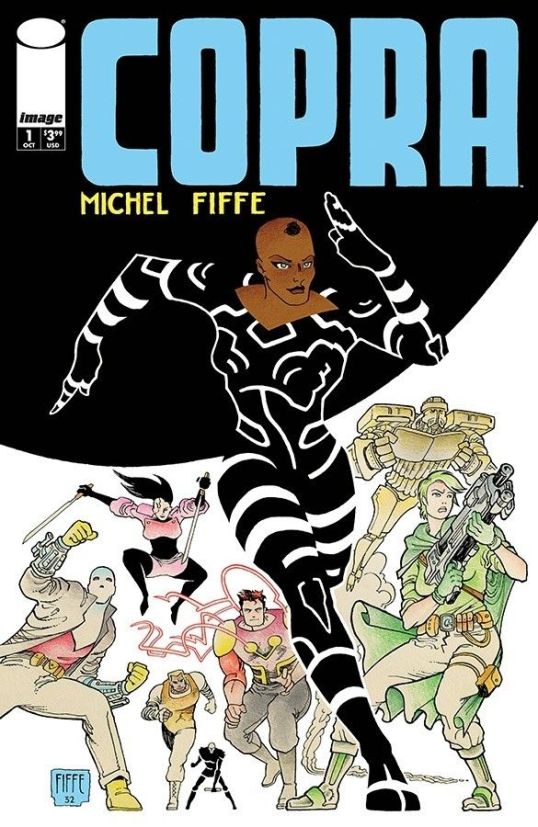
And we’re back! After taking a month (-ish) off to finish some other writing projects (including my first-ever comic book story!) while still keeping my “regular” review schedule on track, the Round-Up is ready to get off the mat, dust itself off, and step back into the ring! As is Michel Fiffe, so let’s get to that first —

Copra (Vol. 2) #1 is the 32nd issue of the formerly-self-published series, as the cover signature makes clear, but what could be a lot more clear is just what the fuck is happening — for new readers, at any rate. And there should be plenty of those given that new publisher Image Comics has a much greater “reach” than a Brooklyn cartoonist toiling away on his own. Which isn’t to say that there’s not a nice recap of all that’s come before on offer in this 36-page debut issue (a real…

View original post 653 more words

The Rap On “Kap Trap”


Ryan C. (fourcolorapocalypse)'s avatarRyan C.'s Four Color Apocalypse

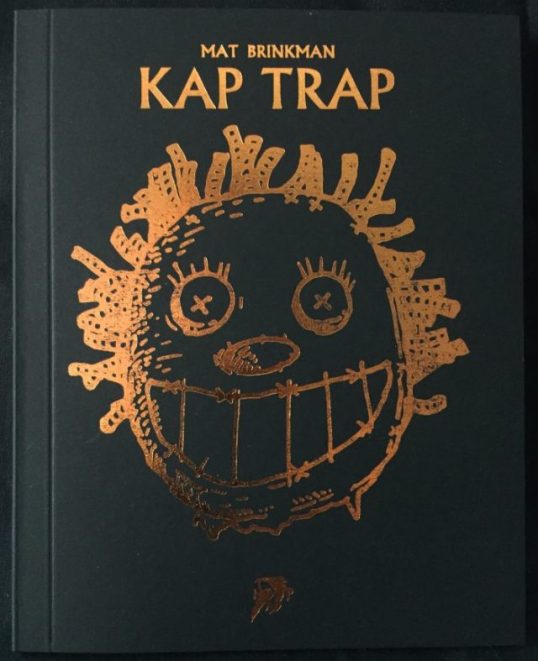
In the spirit of fairness from the outset, Mat Brinkman’s recently-reissued Kap Trap is a fascinating, if curiously uneven, beast — but here’s the more significant part of the deal : as a historical artifact, it’s absolutely invaluable.

Nearly 30 years old now, this early-days effort from a future founding member of the legendary Forth Thunder collective shows a cartoonist in fairly full possession of all his artistic faculties right out of the gate, even if it’s a little more tentative in terms of its execution than later efforts such as Teratoid Heights or Multiforce.  The  line from the one to the others is fairly clear, however — and I defy you to find  another cartoonist who had this clear and singular a vision of what they were looking to accomplish at age 18. Or at least another one not named Tillie Walden, who likewise arrived on “the…

View original post 510 more words

Joker (dir. by Todd Phillips)


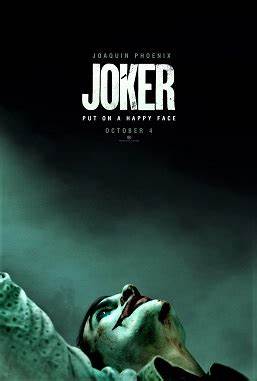
JokerPosterWhen I used to play games like Vampire: The Masquerade, they had this disclaimer that said: “You are not really a Vampire. If you can’t distinguish between fantasy and reality, you need to put this book down.”

I think the same can be said of Todd Phillips Joker, and it may be the source of a lot of the fear associated with it.

I believe the big fear that everyone has with Joker is that it’s going to incite people to violence and/or mimicry. It’s the same kind of fear that probably happened with films like Death Wish and Taxi Driver. It’s also the kind of thing that did happen with 1993’s The Program, a film that contained a scene with kids laying down in the middle of a busy road. Someone actually tried it, and ended up dying. As a result, people get a little nervous when Hollywood produces something that could lead to someone mimicking what they see on screen. In that sense, any film has the potential to have an idiot try it out, despite all of the warnings.

If that makes you in any way uncomfortable, the movie will be out on VOD in 3 months time, not a long wait. Still, Joaquin Phoenix’s performance is easily worth the price of admission.

Looking past all that, Joker is actually very good. The Crow, The Dark Knight and Conan the Barbarian are comic book films, but are so serious that you wouldn’t really associate them with a comic unless you knew it beforehand. Joker falls into the same category for me. This might be a little off putting for some who are expecting a more “comic action” like performance along the lines of say, Batman Forever. It’s the kind of film where if you stripped the credits from it and sat someone down to watch it, they might not figure it all out until 3 quarters of the way in. It feels like just another film, save that happens to be dropped in Gotham City.

Joker is the story of Arthur Fleck, a man with a variant of Tourettes that causes him to laugh at inappropriate moments, among other issues. Working as a clown and hoping to become aThrough a series of events, Arthur falls and is pushed until he reaches a breaking point. That is the quickest way to explain Joker without divulging too much. Let’s focus on the particulars.

Todd Phillips’ direction is good here. We move from scene to scene with ease, and as far as I could tell, there didn’t appear to be any editing issues (which is more than what I can say with The Dark Knight). Gotham is a dark, gritty city, reminiscent of NYC during the late 70’s. The film also manages to make connections to DC Lore in some great ways, My only complaint there is that while it’s a city that could use the Batman, it wasn’t exactly screaming for help. Personally, I thought it would be better if you saw that Gotham had more issues of corruption or crime. Nothing bad, just a nitpick.

From a casting standpoint, Phoenix is the heart and soul of Joker. Having dropped some weight for the role, Phoenix throws himself fully into the role of a man trying to keep it together while his world slowly crumbles. Come awards season, I would be shocked if he wasn’t at least in talks for nominations. Between the moments of laughter, there’s a lot of pain being expressed. Granted, this isn’t entirely new to Joaquin Phoenix, who had a similar role in The Master, but he definitely takes it to some new levels here.


Zazie Beetz (Deadpool 2) is okay here as a woman living in the same apartment complex as Arthur, but isn’t given too much to do here. The same could be said of Frances Conroy (Six Feet Under), who plays Arthur’s mother, who tries to keep him on the right path. Robert DeNiro also stars as a late night tv show host who Arthur admires, which will remind some viewers of Martin Scorcese’s The King of Comedy. Of particular note is the score of the film, handled by Hildur Gudnadottir (Sicario: Day of the Soldado), which ties in nicely to every scene with its haunting themes.

If I had any problems with Joker, it would be that the film makes it sound like being a loner automatically qualifies you for crime. There are tons of people who prefer solitude to companionship (or at least in short doses).  It showcases both Mental Illness and firearms in such a way that could scare some audiences, suggesting that if you are medicated and stop, you will eventually cause someone some harm. If you own a gun, someone will probably be harmed. Having grown up around cops, guns, and family members with Bipolar Disorder, I don’t agree with that. This didn’t make the film bad in any way for me. In the context of the film, however, Joker is bound to raise some concerns.

Again, it’s mainly nitpicks, but for a story that shows the rise of a villain, it does work.  There’s nothing mystical about Joker’s rise, and perhaps that’s scarier than finding out he was irradiated by gamma rays or some other superpower. I will say that watching Phoenix have these strange moments of slow tai chi like movements had me wondering what was up with him. That was strange, indeed.

Joker is also a film that doesn’t have a whole lot in the way of action. If you’re expecting a major third-act action sequence, it’s not exactly there. As a dramatic piece, Joker excels at moving the story forward, and as someone who was originally tired of the idea of yet another Batman related story (with all of the heroes /villains DC has at their disposal), this film was quite the surprise.

Overall, Joker is definitely worth the watch for Joaquin Phoenix’s performance, though if you’re not ready for it at the theatre, you can always wait for it on Digital / VOD.


“In The Tall Grass” Review by Case Wright


gt

Happy Horrorthon! With all the streaming services that I review, you’d think one of them would comp me for a month! Feel bad for me… What do you get when you mix: Religious ferver, sacrifice, cannabalism, a soon to be baby daddy, a really skinny dirty kid/oracle, a dog, alien influenced grass, and A LOT of REALLY stupid choices? Yep, you get “In the Tall Grass”.  This sounds really convoluted, but the tall grass is just that, but it’s also evil or controlled by an alien spaceship.  I’m guessing spaceship.  The story is basically Tommyknockers, but without any inventions and far less math.

Let me explain, Becky is unmarried, pregnant by a musician of sorts, and on her way to give up her baby to a family in San Diego.  Cal, her brother, is driving her cross country to do it. Why are they driving and not flying?  I don’t really know because the adoptive family would’ve definitely paid for a flight, but the adoptive parents make remote bad choices like everyone else in this story.  Let’s call this Bad Decision #1.  They decide to stop and they hear a boy yelling for help who is purportedly lost in the tall grass and needs emergency services.  Becky and Cal do not have EMS training, supplies, or even a compass- so they decide to enter the tall grass because they are stupid..really.  This is Bad Decision #2.  Really what did they think that they would do other than get lost?  They didn’t even think to call the police first! The police by the way would’ve said DON’T GO IN THE GRASS or pay a lot for that muffler.  The two of them rapidly realize that they are lost and not really in normal grass.

Later, the soon to be Baby Daddy- Travis- shows up at the cornfield.  He finds his girlfriend’s abandoned car.  It’s been there a while.  Does he call the police? Nope.  Now, I get some folks want to be their own first-responder and that’s respectable if you are basically competent.  Travis is not call police – Bad Decision #3. Travis then decides to also trounce around in the grass …. and gets lost. Bad Decision #4.

Travis finds Tobin the boy that called Becky into the grass and he knows A LOT about everyone: Travis, Becky, Cal, and all the other people in the grass. Yes, there is another family in there, BUT the dad in the family has gone full on EVIL.  That man is Ross (Patrick Wilson).  Ross was a normal person until he went into the grass and touched the monolith rock at the grass maze’s center.  The rock tells you to do things like how to get out of the grass, how to smash your wife’s skull – yep that happened, and whether or not Keto is just plain bullshit.

I’d like to take a second to write about Patrick Wilson’s performance. I liked it. Granted, I’m a fan of his work, but it was fun to see him play a villain. He had the phony real estate thing down and he could really turn up the rage. Also, his character was the only one not to make stupid choices.

The story shifts into a cat and mouse game of Ross hunting Becky and the rest of the people down to kill them over and over again.  Over and over again? Yes, there’s a time loop created by the rock.  So, you get lost in the grass a lot and killed a lot by Ross.  Bummer.  Their only hope is to kill Ross and stop the cycle. Will they kill Ross? Will they remain in the tall grass? Will I get up to benching 315Lbs (142 Kg)?

Is this movie worth watching? Well…the constant bad decisions really make it hard to sympathize with the characters.  I feel like the grass could’ve been more choosy or maybe the grass is a rescuer alien entity likes chaos like ALL of my ex-girlfriends.  The movie also really reminded me of Cube and it turns out it was written by Vincenzo Natali – the writer and director of Cube. Well, it basically was Cube meets evil Field of Dreams.  What is old is new again and again and again…wait I just wondered into some grass. No…wait, it’s just the kitchen. Do you want anything as long as I’m up?

For all you Stephen King nerds there were some Easter eggs In The Tall Grass, See Below:


A Josh Bayer Two-Fer : “Black Star”


Ryan C. (fourcolorapocalypse)'s avatarRyan C.'s Four Color Apocalypse

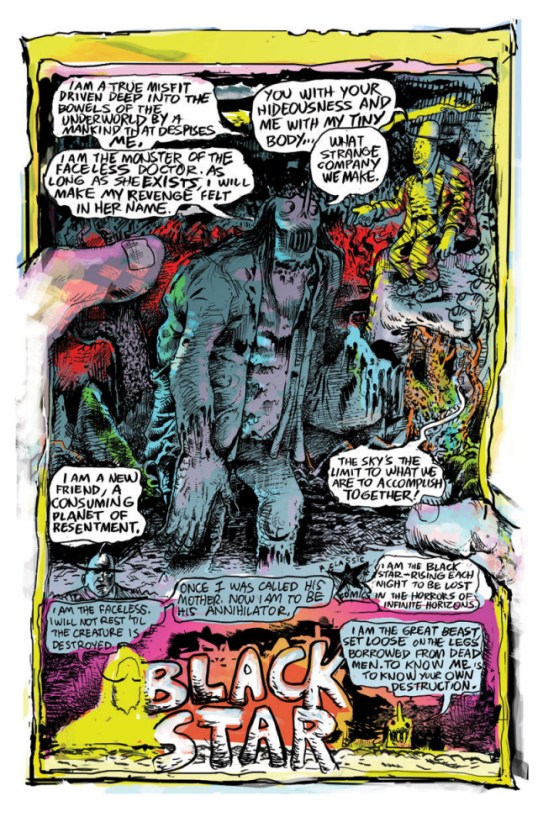
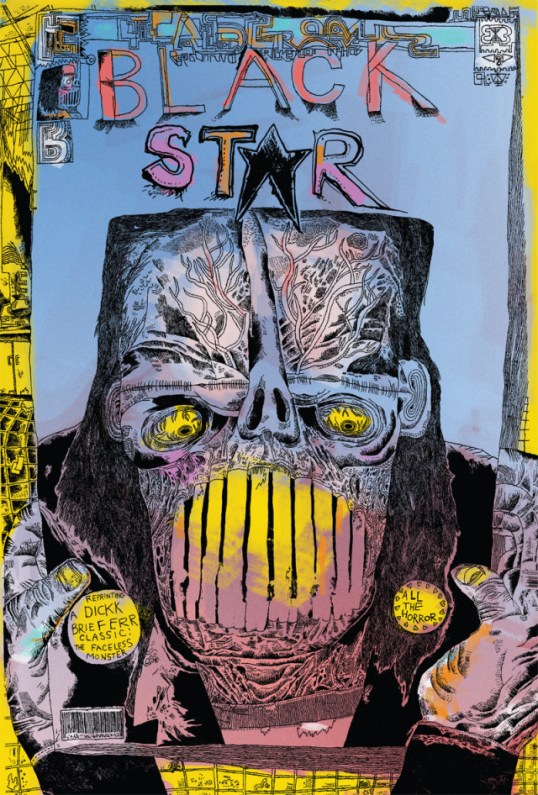
The task facing Josh Bayer’s new Tinto Press comic, Black Star, is both twofold and daunting : to add depth, texture, and significance to the “main work” it refers back to and, in a very real sense, occurs within — that being the just-reviewed Theth : Tomorrow Forever  — and to justify its own existence as an individual, self-contained work.

Which, for the record, it isn’t — but that needn’t necessarily prevent it from functioning as one. If you’re confused by this review right about now, that’s okay — if you’re confused by the comic itself, considerably less so.

Adapted from the classic Dick Briefer Frankenstein story “The Faceless Monster,” this richly-drawn (and even more richly-colored) book is also a “book-within-a-book,” a meta-textual narrative sprung from the mind of Theth “himself” metaphorically, his creator literally — and one that calls into question to an even greater degree the separation…

View original post 502 more words

A Josh Bayer Two-Fer : “Theth : Tomorrow Forever”


Ryan C. (fourcolorapocalypse)'s avatarRyan C.'s Four Color Apocalypse

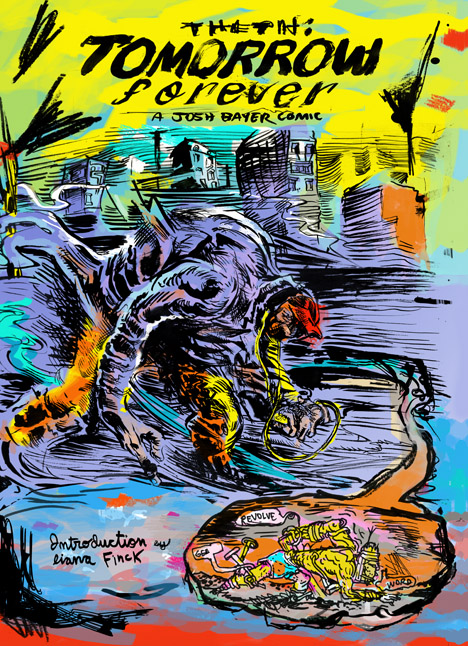
A tidal wave of memories real and imagined, meticulously haphazard (here we go with the contradictions) pencil, pen, and brush strokes, kaleidoscopic colors, steam-of-consciousness observations, mixed genre tropes, and weighty foreboding, Josh Bayer’s latest Tinto Press-published comic/”graphic novel,”  Theth : Tomorrow Forever, may be a sequel to its shorter-titled 2014 predecessor literally and thematically, but it’s also very much a “stand-alone” work — and one that leaves a pretty damn indelible mark upon the reader, at that.

Most of us have been where protagonist/authorial stand-in (to one degree or another) Theth finds himself in Columbus, Ohio circa 1990 : 20 years old, at loose ends, burning to make a mark upon the world, unsure of what form that mark should — or even could — take, the future appearing equal parts formless void and open wound. It’s probably trickier for those with an artistic inclination to navigate this period…

View original post 695 more words

Creepshow, S1 Ep 1, “Gray Matter” “The House of the Head” Review by Case Wright


Creepshow

Happy Horrorthon! We are in the thick of it and it is AWESOME! Yes, I got another streaming subscription service, but I draw the line at Disney and CBS because they’re boring.  In 1982, Creepshow was a film written, produced, and directed by horror masters, including Stephen King.  The stories were an homage to the EC Horror Comics from the 1950s and 1960s.  The show has become reincarnated on the Shudder streaming service and I will review all of the episodes as they are released.

What’s great about these shows (except for Two Sentence Horror, which is a steaming pile of garbage) is that they give talented people a chance to direct or write when they haven’t had the opportunity prior. Also, because Greg Nicotero (Executive Producer Of The Walking Dead and friend to everyone in horror) is helming it, the show has tremendous access to great stories by Stephen King and actors like Tobin Bell (Saw) and Giancarlo Esposito (Breaking Bad).

The two stories in the premiere were Gray Matter – a Stephen King short story from Night Shift, Directed by Greg Nicotero and The House of the Head was the second story and was Directed by John Harrison, written by Josh Malerman.  The two stories and direction were completely different.

Gray Matter was what I expected: an over the top story with lots of gore that would have been totally at home in a Tales From the Crypt episode.  The House of the Head, on the other hand was genuinely TERRIFYING! I had trouble watching this story because it was so intense that I really worried about the characters and the figurines- I’ll explain later.

Gray Matter is about a son who’s trying to live with his alcoholic single dad.  Everyday the Dad promises to stop drinking and everyday it ends with both of them disappointed.

One day, the father drinks some tainted beer and turns into a slime monster with a craving for beer and people.  The son who enabled his father’s drinking now enables his father’s thirst for human flesh.

This enabling dooms mankind. In essence, the disease of alcoholism consumed the alcoholic and destroyed everyone around him. Sounds about right.

At this time in the 1980s, Stephen King was in the worst period of his cocaine and alcohol addiction and many of his stories revolve around the enabling and tragedy that followed his disease.  In an interview, he described how he put cotton balls up his nose from the frequent bleeds and he kept a sugar bowl filled with cocaine next to him while he wrote.

The symbolism in the episode was not that obvious; it was much into dramatic performances and gore. The monster was a classic Tom Savini art work.

The House of the Head was amazingly unexpected.  It was tense, subtle, and had you on the edge of your seat for the entire episode.  Evie, the central protagonist in The House of the Head, is a nine year old girl whose father got her a dollhouse. Screenshot (98).png

The dollhouse is adorable with cute figurine parents and a child.

Screenshot (103).png

Unfortunately, the dollhouse is also haunted by a severed head!!!! Yikes!

Screenshot (102).png

The writing and direction ramps up the tension as we see that reality is being blurred by this supernatural entity.  The figurines in the dollhouse get terrorized and murdered by the severed head.  It’s real nightmare fuel.

The suspense/thriller writing and directing was also unexpected.  I thought it was going to be a Tales From the Crypt style story; instead John Harrison (Dir) and Josh Malerman (Writer) relentlessly pull the viewer into the haunted dollhouse where every shot is filled with uncertainty and terror.

Screenshot (101).png

The dollhouse itself becomes a character and the viewer is forced to wonder if our protagonist and her parents are in fact figurines themselves with shots like this.

Screenshot (105).png

The parents are laying in an doll-like manner and the furniture also looks like a dollhouse’s accessories. Is the Head pulling them into a dollhouse world? Is it pushing its way into our reality? Much like the episode itself, you never really know. Every time Evie looks from one room to another, the camera pans back and the figurines have changed and it’s rarely good.

This show was a lot of fun and it’s great to see a horror anthology story done well!

It’s not really enough to recommend this show without recommending Shudder itself. It’s not a lot of money per month and has a lot of original programming.

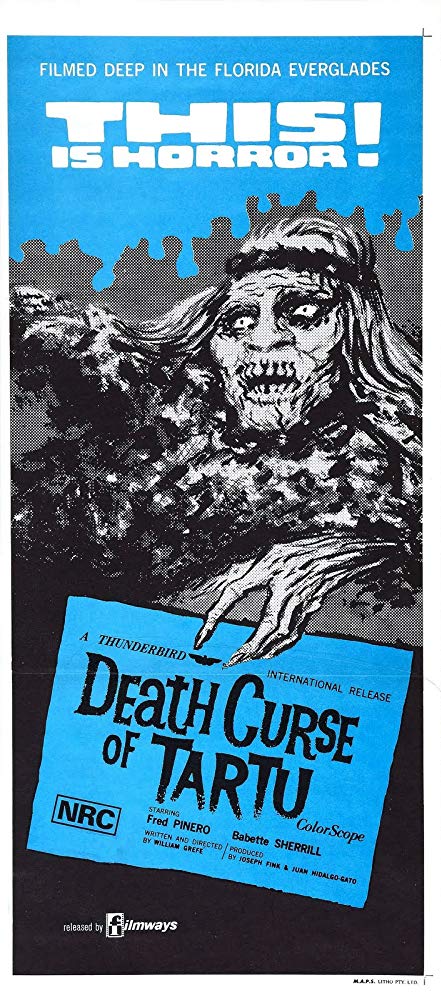
Halloween Havoc!: DEATH CURSE OF TARTU (Thunderbird International 1966)


gary loggins's avatarcracked rear viewer

Welcome to the weird world of low-budget Florida-based filmmaker William Grefe, whose Everglades-lensed movies are always interesting. Not necessarily good mind you, but interesting. Still, the man did the best he could with what little resources he had. One of his most famous (or infamous, depending on your point of view) films is the 1966 shocker DEATH CURSE OF TARTU.

DEATH CURSE OF TARTU concerns a husband-and-wife team of archeologists and their students searching for a missing colleague. The teens want to “go down to the lake and roast marshmallows” (and engage in some energetic frugging and heavy necking!), when they stumble on the crypt of Tartu, an ancient Indian “witch doctor”, and his curse. Soon, teens begin to drop like swamp flies as shape-shifting Tartu turns into a snake, shark and alligator, until the lead archeologist translates the ancient tablet, and discovers the only way to break the curse…

View original post 307 more words

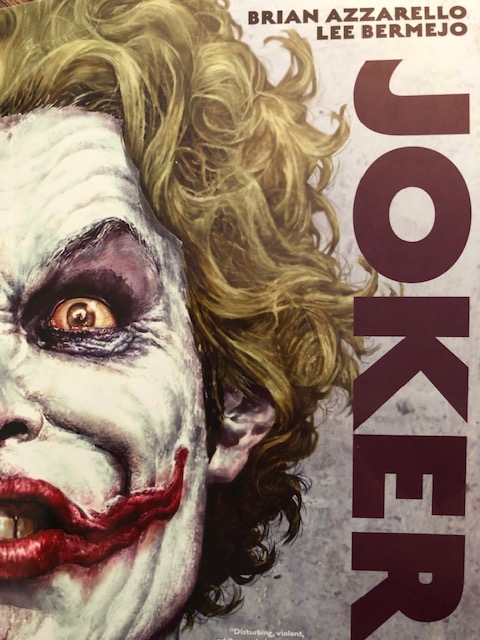
Joker, Book Review, By Case Wright


IMG_1908

Happy Horrorthon! 2008 – Barack Obama was becoming a household name, I still had some hair, and Heath Ledger’s Joker brought the absolute evil of clowns to the silver screen.  I understand that some of you might think that the comic Joker is not a horror comic, but guys it’s got a clown right there on the cover; they are ALL trying to kill you. IT COUNTS!

Brian Azzarello and Lee Bermejo sought to bring Ledger’s Joker into a comic form and dig a little deeper into the psychology of Joker and why someone would follow him.  The story is narrated by Jonny Frost – a small time gangster- who wanted to be big.  Jonny figures that he himself is not larger than life, but by being near bright evil, he too could shine like the moon does with the earth.  He picks the Joker.

Christopher Nolan described the Joker as an absolute. He is an id of Corruption and destruction.  In this story, the Joker has gotten out of Arkham….again.  SIDE NOTE: what’s with Gotham?! They must have the single party liberal governing that we have in Seattle because you’d think they’d have a Three Strikes Rule or the Death Penalty by now.  I mean, why let the Joker continue to keep breathing? I get how Batman has this weird code- he wears rubber, cape, lives in a cave, and is all kinds of weirdo, but why do the rest of Gotham’s citizens have it? Do they not vote? Do they have only one ballot choice? So, the Joker meets Jonny Frost the second that he leaves Arkham and Jonny works as a toady and hanger on for the majority of the book.

Jonny narrates the Joker’s return to power as he reaps through the underworld, but he burns most of his possessions down and kills all of his own henchmen and even shoots Jonny at the end.  Really, the story depicted the Joker as a force of Anti-Creation.  While it was a deeper dive into this Super Villain, it left me wanting because it was told through the lens of this mediocrity Jonny Frost.  It says Joker right there on the cover so you’d think it would be all about the Clown Prince of Crime, but instead it was this tangential view of him.  I would’ve been more captivated by a story just about the Joker without a go-between.

The story was strong and depicting LOTS AND LOTS of gore.  In fact, the Joker kills more people than the Spanish Flu.  He’s Lucifer and Death combined to cause havoc.  In the end, we get the obvious conclusion that he’s just this disease of evil and that Batman is really just a treatment, but not a cure.  It seems that Gotham’s real disease is a soft on crime public policy.