4 Shots From 4 Films is just what it says it is, 4 shots from 4 of our favorite films. As opposed to the reviews and recaps that we usually post, 4 Shots From 4 Films lets the visuals do the talking!
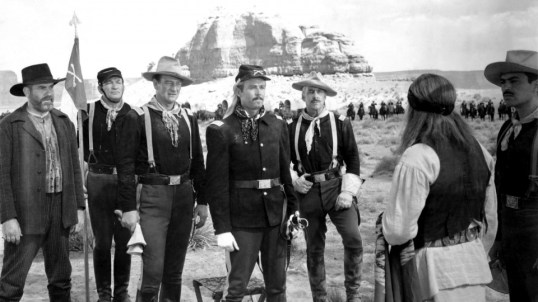
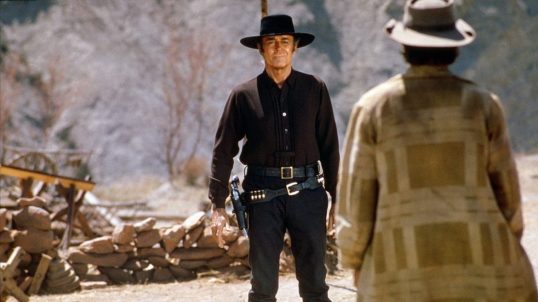
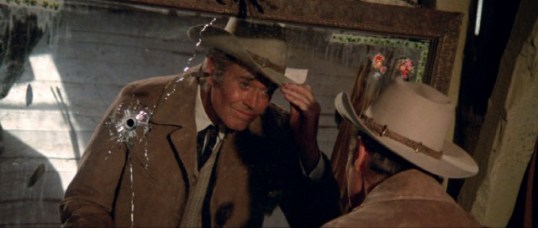
Today, we celebrate the birthday of Henry Fonda! Fonda was born 115 years ago today and, over the course of his long career, he was often cast in role the epitomized everything great about America. It’s rare to find a Henry Fonda film in which he played an out-and-out villain, though he did just that in Sergio Leone’s Once Upon A Time In The West. (Leone, in fact, cast Fonda as the evil Frank because he knew audiences would be shocked to see Fonda coldly gunning down settlers and their families.)
In honor Henry Fonda’s legacy, here are….
4 Shots From 4 Films
My Darling Clementine (1946, dir by John Ford)
Fort Apache (1948, dir by John Ford)
Once Upon A Time In The West (1968, dir by Sergio Leone)
Today’s music video of the day features Danny Trejo riding a motorcycle through the desert and doing other badass, Danny Trejo-type things. I know that a lot of people will watch this video and think to themselves, “My God, he can sing too!” However, believe it or not, Trejo is just lip-syncing. I know. I was shocked to find that out, too. That said, Trejo does a pretty good job lip-syncing and it’s possible that he may have been singing during the filming.
Seriously, who doesn’t love Danny Trejo? Not only is he a good actor who appears to sincerely want to improve the lives of other people but he’s got a pretty inspiring personal story too. So today, we happily wish the best of birthdays and we invite you to….
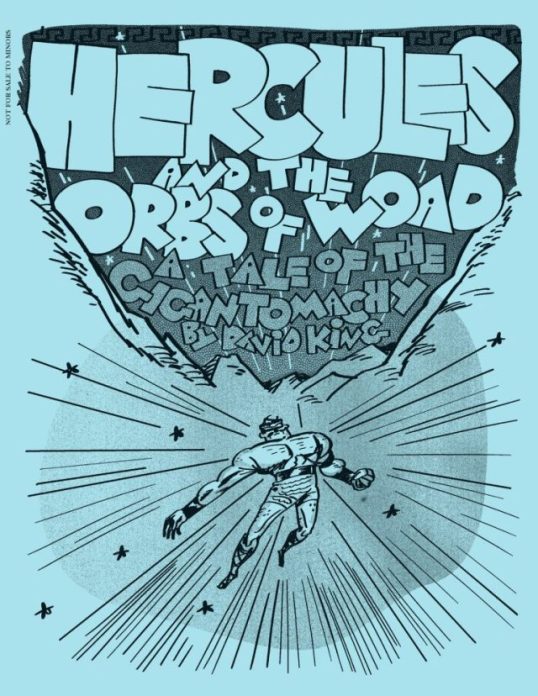
After knocking it out of the park with his flawless all-ages comic Yellow Flag Intelligence Squadron, cartoonist and self-publisher David King came back in the latter part of last year with a decidedly more — mature, I guess? — offering in the form of the magazine-sized Hercules And The Orbs Of Woad, a smartly contemporary take on the hero of ancient Greek mythology that takes what we know about the character to logical, if extreme, conclusions in service of something of an old-school illogical romp.
If that seems a bit vague, I apologize, and since I’d hate to be accused of tiptoeing around the issue, I’ll just lay it out in plain English : we all know that, like his daddy Zeus, Herc would pretty much fuck anything that moved, but what would happen if he got “blueballed”? If you’ve always wondered, here’s the answer you’ve been…
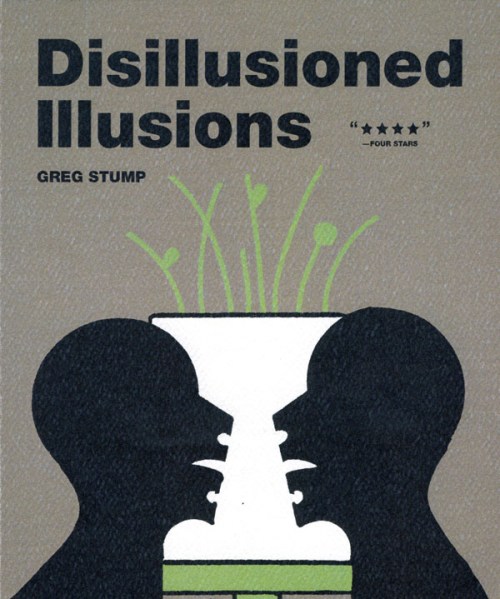
If there’s one comic that’s taken me a damn long time to wrap my head around, it’s Greg Stump’s singularly bizarre Disillusioned Illusions, originally self-published by the cartoonist in 2009 and later re-issued by Fantagraphics Underground in 2015. Folks are fond of saying that Seinfeld was a show about nothing, but this goes a step further — it’s a 356-page book about being about nothing.
Told via a strict, minimalist grid that shows its two principal characters (and later a third) in silhouette in front of a blank background with various inanimate objects and accessories making their way in and out of the narrative as necessary, each page is a short strip in and of itself in old-school “Sunday funnies” tradition, complete with either a concrete or vague “gag” ending, but — as with newspaper strips again — each builds upon the other to tell a long-form, overarching story…
One of those books that take all of 15 minutes to read, hours to look at, and days to fully absorb, it’s almost easier to catalogue what Niv Bavarsky and Michael Olivo’s handsomely-produced new Fantagraphics Underground hardback, Old Growth, isn’t about rather than what it is — but if we were about taking the easy way out around these parts, then this book wouldn’t find itself under the ol’ metaphorical microscope in the first place. It’s a challenging and multi-faceted work, then — but it’s also cleverly disguised in such visually arresting and tonally “light” trappings that it doesn’t necessarily feel like anything other than an utter delight.
Don’t, then, let anyone tell you that fun and hard intellectual work are necessarily mutually exclusive, because they’re certainly not — but it’s well beyond interesting to note how Bavarsky and Olivo almost use the former to lull you into the…
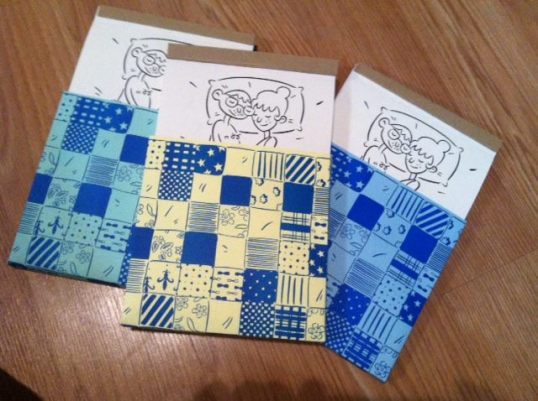
Billing itself as a “micro graphic novella,” 2016’s Twin Bed was the first published cartooning from Paper Rocket Mini Comics proprietor Robyn Chapman in a good number of years, and there’s a fun air of formal experimentation to it throughout : the publication comes packaged in a paper “slipcase” illustrated to look like a quilt that the reader “uncovers” to get at the book itself, and the story is constructed as a series of roughly 100 single-panel-per-page images that feature a static background (that being a guy’s bedroom) with Chapman’s two unnamed protagonists positioned differently over/within said unchanging space. It’s a choice that no doubt saved the cartoonist a little bit of time when it came to drawing the thing, sure, but it’s also a bold and risky one — after all, if the narrative and the characters’ actions aren’t interesting, the whole thing could get pretty old pretty fast.
4 Shots From 4 Films is just what it says it is, 4 shots from 4 of our favorite films. As opposed to the reviews and recaps that we usually post, 4 Shots From 4 Films lets the visuals do the talking!
Today is the 81st birthday of the great Italian director, Ruggero Deodato! And that, of course, means that it’s time for….
4 Shots From 4 Films
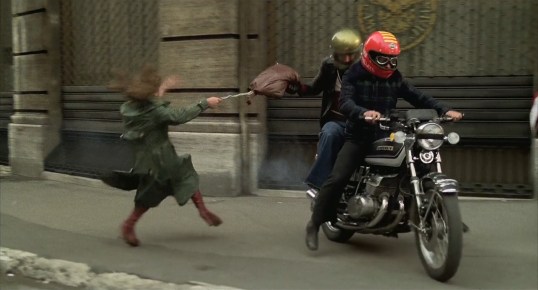
Live Like A Cop, Die Like A Man (1976, dir by Ruggero Deodato)
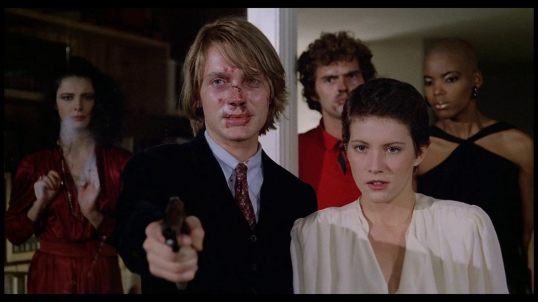
The House on The Edge of The Park (1980, dir by Ruggero Deodato)
Raiders of Atlantis (1983, dir by Ruggero Deodato)
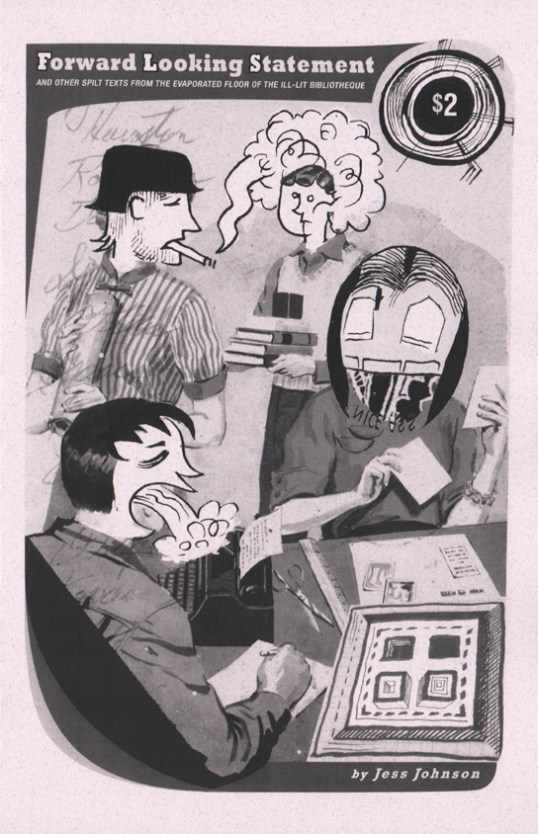
Back in the murky, distant past, one of the first reviews I did for this blog was a retrospective look back at Jess (then Jeff) Johnson’s Nurture The Devil, a short-lived series that continues to mystify and haunt me to this day, so it’s only fitting that I should also take a look at one of the late cartoonist/mixed-media artist/author’s final works, as well, I suppose — that being Forward Looking Statement, subtitled And Other Split Texts From The Evaporated Floor Of The Ill-Lit Bibliotheque, a decidedly experimental and idiosyncratic mini published back in 2014 by Robyn Chapman’s Paper Rocket Mini Comics that maps and limns a concrete physical reality (indeed, a structure) that is nevertheless impermanent in all ways and at all times.
Combining collage, found and/or appropriated text, diagrams, and sketches to make a kind of subtly bold statement about life and and identity and…
If there’s one nominal “positive” to come from the current COVID-19 pandemic, it’s the fact that I’m getting a good chance to catch up on stuff I should have read, like, ages ago — although “read” isn’t exactly the word for Jess Rullifson’s Characters : Fifty Portraits Of Contemporary Cartoonists, a handsome full-color mini that was part of publisher Robyn Chapman’s 2014 Kickstarter for her Paper Rocket Mini Comics imprint and is a collection of portraiture done for a gallery show collected herein between two covers. Yes, I really am that late to the party.
That being said, wordless as the bulk of this particular ‘zine may be, it’s nevertheless a difficult item to review without resorting to some serious “inside baseball”-type referencing. This is a nice-looking publication, to be sure, and Rullifson’s illustrations are well-rendered, emotive, and expressionistic — all very good things — but the project itself…
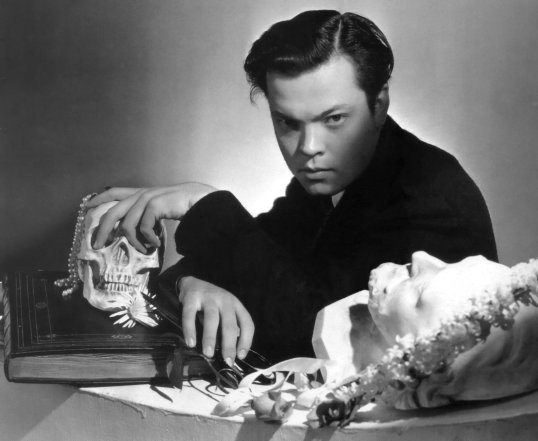
Today is the 105th anniversary of the birth of the great Orson Welles. As those of you who have been reading us for a while know, Orson Welles is a bit of patron saint around here. With this year being the 10th anniversary of the creation of Through the Shattered Lens (and wow, what a year to celebrate that moment, right?), there was no way that we couldn’t pay tribute to Orson Welles on his birthday.
The scene below comes form the 1965 film, Chimes at Midnight. Based on several of Shakespeare’s history plays (Henry IV, Part 1 and Henry IV, Part 2, and also Richard II, Henry V, and The Merry Wives of Windsor), Chimes at Midnight was one of Welles’s dream projects. Though it was initially dismissed by critics, it has since been rediscovered and is now regularly cited as one of the greatest Shakespearean films of all time.
Welles not only directed this film but he also played the key role of Falstaff, the knight who loves good food, good drink, and low company. Falstaff acts as a mentor to Price Hal and, when Hal is finally ready to make his move and assume the throne of England as Henry V, Falstaff supports him. Falstaff believes that Hal will remember his friends once he is king. Sadly, Falstaff turns out to have been far too trusting.
In the poignant scene below, Falstaff greets the newly crowned King Henry V (played by Keith Baxter), just to be coldly rebuffed by his former friend. Now that Henry is king, he no longer has time for the loyal Falstaff. In Shakespeare’s time, this scene was probably meant to reflect that, now that he was king, Henry V was prepared to set aside childish games and devote himself to ruling England. Seen, today, it just comes across as being a betrayal of a good man who deserved better.
It’s a heart-breaking scene. Critic Danny Peary has speculated that, in this scene, Prince Hal/Henry V is a stand-in for every director who Welles mentored in Hollywood who later refused to help Welles when the latter was struggling to get his projects off the ground. Peary may be right because Welles was betrayed by quite a few people during his lifetime. As Welles himself put it, “They’ll love me when I’m dead,” and indeed, it wasn’t until after Welles was dead that his post-Citizen Kane work was truly appreciated.





 Through the Shattered Lens