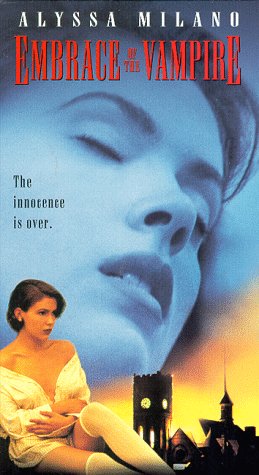
The TSL’s Horror Grindhouse: Embrace of the Vampire (dir by Anne Goursaud)


In this incredibly silly film from 1995, Martin Kemp plays The Vampire.  He doesn’t get a name but he does get a backstory.  Back when he was mortal, the Vampire pursued a secret and forbidden affair with a princess.  One day, after making love, the man who would became the Vampire was laying down next to a stream when he was approached by three naked women who proceeded to bite his neck and vampirize him.

Centuries later, the Vampire is sickly and approaching the end of his existence.  He only has three days to convince the reincarnation of his former lover to allow him to drink her blood so that he can continue to exist.  And apparently it won’t work unless she’s a virgin and unless she rejects all others and loves only him.  That sounds like a lot of rules to me and, to be honest, most of them seem to be kind of arbitrary.  Not only does The Vampire have to find the reincarnation of the Princess but he has to find her before she loses her virginity or otherwise, what?  She’ll cease to be the reincarnation?  Her love will somehow be devalued?  Her blood will no longer be worth drinking?  If this vampire has had to spend centuries only drinking blood from virgins who were in love with him, no wonder he looks so sickly.  I really think that maybe the other vampires were playing a practical joke when they explained the rules to him.  Hazing the new guy, it has consequences!

Anyway, the princess has been reincarnated as Charlotte (a young Alyssa Milano).  Fortunately, for the Vampire, Charlotte was raised in a convent and, even though she is now a college student, she’s still a virgin who blushes when she even hears the word sex.  Unfortunately, Charlotte has a boyfriend named Chris (Harrison Pruett) and she’s thinking about losing her virginity if she can convince herself that she loves Chris more than any other person that she will ever possibly meet.  So, the Vampire not only has to convince Charlotte to fall in love with him but he also has to make sure that she doesn’t have sex beforehand.  It’s going to be difficult because everyone on campus is determined to get Charlotte laid.  This has all the makings of Italian sex comedy but Embrace of the Vampire instead takes its plot very seriously.

The Vampire starts to appear in Charlotte’s dreams.  He gives her an ankh to replace the cross that Chris gave her.  Because the Ankh is a symbol of desire, just wearing it makes Charlotte more sexually aggressive and soon, she’s wearing short skirts, low-cut tops, and white stockings.  She’s also making out with Sarah (Charlotte Lewis), the photographer who lives in the dorm room next to hers.  (As played by Charlotte Lewis, Sarah is actually an interesting character and it’s a shame that the film pretty much just uses her for titillation.)  But since the Vampire’s whole thing is keeping Charlotte from losing her virginity, why would he give her something that would make her more open to sexual experiences?  Again, it’s hard not to think that the Vampire is just the victim of an elaborate practical joke.

As I said at the start of the review, Embrace of the Vampire is incredibly silly.  It’s also a film that seems to be a bit popular with viewers of a certain age.  I’m assuming that’s because of the frequent Alyssa Milano nudity and that one scene with Charlotte Lewis.  For the most part, Alyssa Milano gives a bland performance in Embrace of the Vampire.  It’s not so much that she’s bad as everything about her performance is on the surface.  One gets the feeling that there’s really not much going on with Charlotte’s inner life, both before and after she starts dreaming about The Vampire.  As The Vampire, Martin Kemp appears to be absolutely miserable.  He comes across as if he’d rather be anywhere than appearing in this movie.

That said, the film’s director got her start working with Francis Ford Coppola and she has a good eye for gothic scenery and atmosphere.  A scene where Charlotte imagines a frat party turning into a Hellish orgy is effectively done.  Jennifer Tilly has a small role as a vampire and she has said that Quentin Tarantino approached her at the Oscars to tell her that he enjoyed the movie.  It’s a silly movie (yes, third time I’ve used that specific term and that should tell you just how silly it is) but, for better or worse, it epitomizes an era.

The TSL’s Grindhouse: Steele Justice (dir by Robert Boris)


“You don’t recruit him!  You unleash him!”

That’s what they say about John Steele, the man who Martin Kove plays in 1987’s Steele Justice.  John Steele served in Vietnam and he was one of the best and most fearless members of the special forces.  On the final day of the war, he was on the verge of arresting the corrupt General Kwan (Soon-Tek Oh) until Kwan suddenly announced that the war was over and the Americans were leaving.  Steele laughed, shrugged, and turned his back on Kwan and started to walk away.  Was Steele planning on just walking back to America?  Well, regardless, Kwan shot Steele and his friend in the back.  Fortunately, Steele survived.  Steele may be stupid but he’s strong.

Years later, both Steele and Kwan are now living in California.  Kwan is a prominent businessman who is also the secret leader of the Vietnamese mafia.  Naturally, his main henchman is played by Al Leong.  If Al Leong’s not working for you, are you even evil?  John Steele has not been quite as successful.  He was a cop until he got kicked off the force.  Then he got a job transporting horses across California.  Despite his cool guy name, John Steele doesn’t seem to be that good at anything that doesn’t involve killing people.

But then Kwan murders Steele’s best friend and former partner, Lee (Robert Kim).  In fact, Kawn not only murders Lee but he also kills Lee’s entire family.  The only survivor is Lee’s daughter, Cami (Jan Gan Boyd), a piano prodigy who is supposed to be 14 years old even though she’s being played by someone who is in her 20s.  Steele and Lee’s former boss, Bennett (Ronny Cox), gives Steele permission to track down the people responsible for Lee’s death.

John Steele sets out to destroy Kwan.  The film gives us a lot of reasons to be on Steele’s side but it’s hard not to notice that a lot of innocent people end up getting killed as a result of Steele’s vendetta.  Any time that Steele goes anywhere, Kwan’s people attack and a bunch of innocent bystanders get caught in the crossfire.  For example, Steele’s ex, Tracy (Sela Ward), agrees to look after Cami.  It turns out that Tracy is a music video director and, of course, she takes Cami to work with her.  The video shoot turns into a bloodbath, with even the members of the band getting gunned down.  And yet, not even Tracy seems to be particularly disturbed by that.  One might think that Tracy would at least sarcastically say something like, “Hey, John, thanks for getting the band killed before I got paid,” but no.  Tracy just kind of laughs it all off.  At no point does Steele or Bennett or really anyone seem to feel bad about all of the people who get killed as a result of the decision to unleash John Steele.  Those people had hopes and dreams too, you know.

I really like Martin Kove on Cobra Kai.  I love how his portrayal of the over-the-hill and burned-out John Kreese manages to be both intimidating and pathetic at the same time.  I’ve also seen a number of interviews with Kove, in which he’s discussed his career as an exploitation mainstay and he always comes across as being well-spoken and intelligent.  That said, Martin Kove appears to be totally lost in Steele Justice, unsure if he should be playing John Steele as a grim-faced avenger or as a quick-with-a-quip action hero.  Whenever Steele is angry, Kove looks like he’s on the verge of tears.  Whenever Steele makes a joke, Kove smiles like an overage frat boy who, while cleaning out his old storage unit, has just discovered his long lost copy of Bumfights.  It’s a confused performance but, to be honest, no one really comes out of Steele Justice looking good.  This is a film that features a lot of talented actors looking completely and totally clueless as to why they’re there.

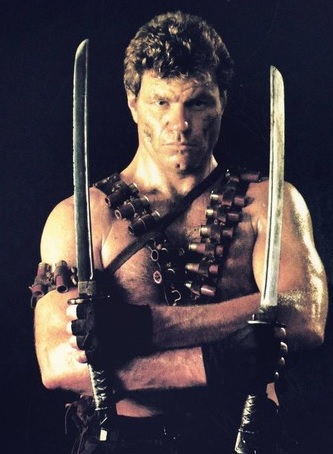
On the plus side, Steele Justice did give this world this totally intimidating shot of Martin Kove, preparing to be get and give justice.  Recruit him?  No, just unleash him!

6 Classic Trailers For Umberto Lenzi’s Birthday


This week’s edition of Lisa Marie’s Favorite Grindhouse trailers is dedicated to Umberto Lenzi, who was born, on this date, in 1931.  Lenzi was one of the most prolific of the Italian directors who came to prominence in the 60s, 70s, and 80s.  A craftsman at heart, he directed films in every genre.  Admittedly, he was never quite the critical favorite that Argento, Margheriti, Deodato, Bava, Fulci, and Soavi were.  That’s a polite way of acknowledging that Umberto Lenzi was responsible for a few very bad films.  But he directed some good ones, as well.  Even if he’s not as acclaimed as some of his contemporaries, I think every Italian horror fan has at least one or two Lenzi films that they will happily defend to the grave.

Today, in honor of Lenzi’s life and work, here are 6 trailers for 6 Umberto Lenzi films!  These trailers, by the way, could be considered NSFW so watch them at your own discretion.

  1. Spasmo (1974)

I will be the first to admit that I have shared this trailer quite often on this site.  What can I say?  I just love the way everyone keeps going, “Spasmo!  Spamso!”  Spasmo is giallo, one with the a plot that will keep you guessing.

https://youtu.be/uY3AIPR-Mhs

2. The Tough Ones (1976)

Though Lenzi is probably best-remembered for his horror films, he also directed his share of violent, French Connection-inspired crime films.  The Tough Ones is a good example.

3. From Corleone to Brooklyn (1979)

From Corleone to Brooklyn is another one of Lenzi’s crime films.  While Corleone is a town in Sicily, there’s little doubt that the main purpose of the title was to trick people into thinking that this film was somehow connected to The Godfather.

4. Eaten Alive (1980)

Eaten Alive was one of the many cannibal films that Lenzi directed.  This is actually one of the better examples of that rather icky genre.  It’s certainly superior to Lenzi’s own Cannibal Ferox.  Ivan Rassimov as Jim Jones turns out to be perfect casting.  The trailer below is actually an edited version of the original trailer.

5. Nightmare City (1980)

This was Lenzi’s best-known contribution to the zombie genre.  Uniquely, for the time, Lenzi’s zombies were fast and clever.  The film was not acclaimed when it was originally released but it has since been cited as an influence on many recent zombie films.  This is probably Lenzi’s most effective film as a director, even if the ending will probably have you rolling your eyes.

6. Nightmare Beach (1989)

Finally, in one of his final films, Lenzi brought together the spring break genre with the slasher genre.  There’s some debate over how much of this film was directed by Lenzi and how much by a mysterious figure known as Harry Kirkpatrick.  When I reviewed this film and mentioned the controversy, the film’s star, Nicolas De Toth, replied that Lenzi was definitely the one who directed.  As he would definitely be in the best position to know, that’s good enough for me!

The TSL’s Grindhouse: Blood Games (dir by Tanya Rosenberg)


First released in 1990, Blood Games opens with a birthday celebration gone terribly wrong.

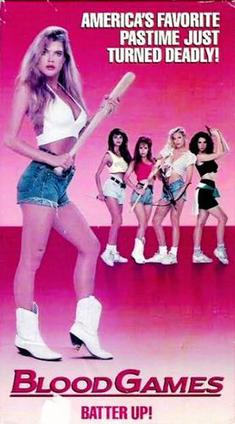
Somewhere in the rural South (at least, I assume it’s meant to be the South if just because of the big Confederate flag that appears in one scene), Roy Collins (Gregory Cummings) is celebrating his birthday.  Roy’s father, Mino (Ken Carpenter), has invited Babe and the Ball Girls, a women’s softball team, to come to town to play an exhibition game against Roy and the local boys.  When Babe (Laura Albert) and her team not only beat but also thoroughly humiliate the hometown team, Mino doesn’t take it well.  He yells at Roy and Roy and his idiot friend, Holt (Don Dowe), decide to get revenge.  After Roy is killed while trying to assault one of the girls, Mino gathers all of the rednecks together and declares, “I WANT JUSTICE!”  Everyone in town grabs a shotgun, jumps in a pickup truck, and heads off in pursuit of the Babe and the Ball Girls tour bus.

It shouldn’t come as a surprise to anyone that the bus itself breaks down in the middle of the woods and the team is forced to hike to safety while being pursued by Mino, Holt, and all of the rest of the shotgun toting locals.  It turns out that Mino is a deadly shot with a crossbow and Holt, at times, seems to be close to indestructible.  However, it also turns out that Babe and the Ball Girls are far tougher than any of the men expected.  The film reaches its bloody conclusion at a deserted farm, complete with a dramatically-scored flashback montage that reminds us of everyone whose life was lost during Roy’s birthday weekend.

Just to state the obvious, Blood Games is just as exploitive as it sounds.  This is the type of film where, early on, the action stops so the camera can linger on Babe and the Ball Girls in the locker room after they win their game.  (George “Buck” Flower shows up as the redneck who inevitably ends up peeking in at them.)  The team’s uniforms were probably popular with the film’s target audience but short shorts and crop tops don’t really seem practical for a game that would involve sliding through the dirt and the weeds on the way to home plate and, as a Southern girl who spent many a summer in the country while growing up, I cringed a bit when I thought about all the bugs that were probably in the grass and the dirt, waiting for a chance to hop onto a bare leg.  (It didn’t help that the game was apparently just being played in some random field.)

And yet, as exploitive as many viewers will undoubtedly find Blood Games to be, the film definitely works.  The rednecks are so loathsome and they overreact so severely to losing one game to a team of girls that it’s impossible not to cheer when Babe and the Ball Girls turn the tables on their pursuers.  “Batter up!” the film’s trailer announces and it is true that the Ball Girls use the same teamwork that won them the game to survive in the wilderness.  At the same time, they also use baseball bats, ropes, guns, and anything else they can get their hands on.

The acting is a bit inconsistent, though Don Dowe and Ken Carpenter are both well-cast as the main villains.  Dowe plays Holt as being someone who knows that he’s in over his head but who is too weak-willed to go against the mob.  The fact that he’s weak makes him all the more dangerous because a weak man will do anything to try to convince others that he’s strong.  Carpenter, meanwhile, is chillingly evil as Mino, who quickly goes from mourning his son to taking a sadistic pleasure out of hunting down human beings.  The film’s real strength is to be found in Tanya Rosenberg’s direction.  Along with keeping hte movie moving at a fairly steady pace, Rosenberg also captures the atmosphere of being lost in the country in the summer.  Watching the film, you can literally feel the heat rising from the ground and hear the cicadas in the distance.

Incidentally, I convinced my sister to watch this film with me because I assumed it was a baseball movie.  However, as Erin quickly pointed out to me, it instead turned out to be a softball movie.  I have no idea what exactly the difference is between baseball and softball but Erin assures me that there is one.  Well, no matter!  Whether it was softball or baseball, Babe and the Ball Girls did a good job striking out the hometown boys.

Batter up!

The TSL’s Grindhouse: World Gone Wild (dir by Lee H. Katzin)


“World Gone Wild!?  What’s that about?”

Don’t ask me.  I just watched the movie and I’m not particularly sure what the point of it all was.  Released in 1987, World Gone Wild is one of those films that was made to capitalize on the post-apocalypse boom of the 70s and 80s.  Basically, imagine a Mad Max film that sucks and you’ll have a pretty good idea of what World Gone Wild is like.

There’s been a nuclear war.  Civilization has collapsed and now, there are just tiny outposts of humanity who are trying to survive.  It hasn’t rained in decades.  Old-timer Ethan (Bruce Dern) is in charge of a town called Lost Wells.  He remembers what rain was like and he also remembers what rock music used to sound like, too.  As for Lost Wells, it’s one of those dreary little desert communities that always tend to pop up in movies like this.  Angie (Catherine Mary Stewart) teaches the community’s children in an abandoned school bus.  They have a bunch of books on etiquette.  One little girl can recite every word ever written by Emily Post.  That gets annoying fast.  Emily Post didn’t live on a school bus in the desert.

That etiquette doesn’t do much good when it comes to protecting Lost Wells from Derek Abernathy (Adam Ant), a cult leader who dresses in all-white and who wants to take control of Lost Wells away from Ethan.  (In a somewhat clever twist, it turns out that Ethan learned how to become a cult leader by reading a book about Charles Manson.)  Knowing that the majority of the people in his town are too obsessed with Emily Post to fight off Derek and his army, Ethan recruits a group of mercenaries led by George Landon ( who is played by Michael Pare, who looks like he was absolutely miserable while shooting this movie).  George and his men agree to protect Lost Wells from Derek and, in the process, they regain some of their lost humanity and they start to believe in the possibility of rain.  Or something like that.  Fortunately, one of George’s mercenaries is played by the supercool character actor Anthony James.  He doesn’t get to do much but hey, it’s still Anthony James and Bruce Dern in the same movie!  Yay!

For a film called World Gone Wild, this is a strangely low-key affair.  Even the most unimpressive of Mad Max rip-offs will usually have an exciting car chase or two.  At the very least, there’s usually a big battle where people sacrifice their lives for the future of humanity.  In World Gone Wild, the mercenaries pretty much just go to Lost Wells and then wait for Derek to come back.  And when Derek returns, there’s a few explosions and some gunfire but that’s pretty much it.  Neither side really puts up much of a fight, which leads me to wonder if Derek really even cared about Lost Wells.

On the plus side, the film has got Bruce Dern, doing his wild-eyed old-timer bit.  That’s always fun to watch and, if nothing else, Dern appears to be having fun in this movie.  At the very least, he’s having more fun that Michael Pare and Catherine Mary Stewart, both of whom seem to spend the majority of the movie looking for a way to make a quick escape.  And I suppose the film does win some novelty points for casting Adam Ant as the main villain, even though Derek ultimately turns out to be not much of a threat.

In the end, World Gone Wild‘s greatest strength is Bruce Dern.  He’ll make you believe in the rain again.

The TSL’s Grindhouse: Bad Georgia Road (dir by John Broderick)


This 1977 film is, for the most part, set in Alabama so I don’t know why it opens with a shot of a car driving down a country road while someone on the soundtrack sings about running moonshine down a “bad Georgia road.”  Then again, I’ve been to both Alabama and California and it’s pretty obvious that, while the film may be set in the former, it was filmed in the latter.  Those hills and mountains in the background definitely belong more to Hollywood than anywhere in the South.

As for the film itself, it’s about Molly Golden (Carol Lynley), a spoiled New York fashion designer who inherits an Alabama farm from an uncle that she barely knew.  When Molly finds out that the land is worth $100,000, she promptly quits her job and moves to Alabama, accompanied by her friend and assistant, Larch (John Kerry and no, not that politician with the private plane).  Molly is planning on selling the land and then heading back north with her money.  Unfortunately, it turns out that her uncle died owing everyone in the county money so, as a result, his farm is worthless and Molly is now in debt.

What is Molly to do?  Fortunately, her uncle’s two farmhands — Leroy (Gary Lockwood, who once co-starred in 2001: A Space Odyssey) and Arthur (Royal Dano) — are onhand to explain to her that her uncle was a moonshiner.  Molly decides to become a moonshiner, too!  Her plan is for Leroy and Arthur to do all the work and for her to make all the money.

While all of this is going on, Molly is also falling for Leroy.  She doesn’t want to admit because she’s a sophisticated New Yorker while Leroy is a redneck slob.  This leads to some conflict between the two of them, as she’s always talking down to Leroy and trying to deny that she’s totally in love with him.  Eventually, in a deeply uncomfortable scene (all the more so because the films attempts to play it for laughs), Leroy literally forces himself on her and Molly realizes that she could be totally happy runnin’ moonshine with a barely literate hick.

I’m a Southern girl and, perhaps even more importantly, I’m enough a country girl that I usually enjoy a good moonshine and car chase film.  And Bad Georgia Road gets off to a good start with an enjoyable chase scene, even if the road that the cars are roaring down is clearly located on the West Coast instead of the Deep South.  But things go off the rails as soon as Molly and Larch show up in Alabama.  What there is of a plot plays out at a painfully slow pace and there’s absolutely zero romantic chemistry between Gary Lockwood and Carol Lynley.  On the plus side, Royal Dano is enjoyable eccentric as Arthur, an old-timer who may not be educated but who knows everything that needs to be known about both the Bible and moonshine.

Bad Georgia Road is the type of 70s film that was specifically made to play in Southern drive-ins, where audiences would undoubtedly appreciate the film’s portrait of a clueless Yankee getting outsmarted by a bunch of country folk.  (For me and probably most other people, that’s actually the main appeal of the moonshine genre.)  But even if you think that Molly is a totally smug and self-righteous New Yorker, she still deserves better than to get stuck with Leroy, a man who looks like he probably reeks of chicken feed and spilled beer.  Especially if you’ve seen his personable performances in films like Model Shop and 2001, it’s hard not to feel bad for Gary Lockwood while watching this film.  What did that bad Georgia road do to him?

https://www.youtube.com/watch?v=KNjEmGJWq2Y

6 Classic Trailers For May 31st, 2022


The Delta Force (1986, directed by Menahem Golan)

93 years ago, on this date, Menahem Golan was born in Israel.  After serving in the Israeli Air Force, Golan would attend the Old Vic Theater School in London before returning to Israel and launching his legendary career in film.  With his cousin, Yoram Globus, and using Roger Corman as both a mentor and a inspiration, Golan would go on to producer and direct some of the most successful films in Israeli history.  Eventually, Golan and Globus would purchase Cannon Films and would be responsible for some of the greatest (in a fashion) films of the 80s.

Though Golan was best-known as a producer, he never stopped directing.  Today, on what would have been his birthday, Lisa Marie’s Favorite Grindhouse Trailers presents 6 trailers for 6 Golan films!

  1. Lepke (1975)

After finding great success in Israel, Golan first attempted to break into the American market with this biopic about the head of the Mafia’s Murder, Inc., Louis “Lepke” Buchalter.  Though the budget was low, Golan managed to get a name — in this case, Tony Curtis — to play the lead role.  As you can tell, the trailer wanted to make sure that you knew that this film was about Lepke.

2. Enter the Ninja (1981)

This was, I think, the first film that Golan directed after buying Cannon Films.  How great is Enter the Ninja?  It stars Franco Nero as a ninja!  Seriously, you don’t get much greater than that.  Anyway, as I think I’ve stared on this site before, Enter the Ninja is a lot of fun and Franco Nero was the sexiest ninja of the 80s.

3. The Delta Force (1986)

Chuck Norris was a Cannon mainstay and it seems appropriate that he starred in The Delta Force, a film that was very important to Golan.  The Delta Force was essentially a remake of an 1977’s Operation Thunderbolt, an Israeli film that earned Golan his only Oscar nominations when it was nominated for Best Foreign Language Film.  The Delta Force did not receive any Oscar nominations but it has a legion of fans.  Our own Jedediah Leland has frequently described this film as being the greatest ever made.  I don’t know if I’d go that far but still, it is always satisfying to see Chuck blow up the bad guys at the end of the movie.

4. Mack the Knife (1989)

Menahem Golan directs a musical!  Unfortunately, this film has never received a proper DVD or Blu-ray release.  Though it was a Cannon production, Golan and Globus had a falling out (one that was, at least partially, caused by Golan spending money on films like Mack The Knife) and Golan ended up distributing this film himself.  I find the trailer to be intriguing.  The film itself is on YouTube so I’ll watch it someday …. maybe.

5. Hit The Dutchman (1992)

Much like Lepke, this film is about a real-life gangster.  In this case, the gangster was Dutch Schultz.  Interestingly enough, the trailer suggest that Al Capone was active in New York whereas everyone knows that, though Capone did get his start in New York, he didn’t become a prominent gangster until he relocated to Chicago.

6. Crime and Punishment (2002)

Finally, this adaptation of the great novel was a bit of passion project for Golan.  He filmed it in Russia in 1993 but, because of financial difficulties, it was not given a release until 2002.

https://youtu.be/Qig3f7PjChs

The TSL’s Grindhouse: The Incredible Melting Man (dir by William Sachs)


What goes up must come down
What goes ’round must come ’round
What’s been lost must be found

As the song says, what goes up must go down.  The 1977 film, The Incredible Melting Man, is about a man who went up and then came back down and …. AGCK!  What a mess!

The Incredible Melting Man opens with the launch of the first manned spaceflight to Saturn.  That’s right, Saturn.  The film takes place in the 70s, when mankind was still lucky to just be able to make it to the Moon and back.  But somehow, this rocket and its three passengers are going to fly all the way to Saturn, land, and then return to Earth.  And speaking of landing, how exactly do you land on a planet that doesn’t have a solid surface?  And, even more importantly, why do all of the shots of Saturn look like the sun?  How come there aren’t any rings?  WHAT IS GOING ON!?  Could it be that the rocket went off track and went to the sun instead?  It’s possible, I suppose.  Mistakes cannot be avoided, much like a spinning wheel turning around.

Anyway, the rocket eventually returns from Saturn or the sun or wherever it went.  Unfortunately, most of the crew is dead.  The only survivor is Steve West (played by Alex Rebar).  Apparently, West was so physically strong that he was able to survive whatever killed the other astronauts.  Unfortunately, West was still infected with Saturn microbes and now he’s slowly melting.  Steve doesn’t react well to that news so he escapes from the hospital and goes on a poorly-defined rampage.  He kills a nurse.  He rips the head off a fisherman.  He kills two old people who were trying to steal oranges.  Steve loses an eye.  His arm falls off.  He leaves behind a trail a radioactive goo.  Apparently, Steve has to consume human flesh to slow down the melting process but make no mistake, there’s no way he’s not going to end a puddle of goo.

Steve’s friend, Dr. Ted Nelson (Burr DeBenning), decides to try to track down Steve so that he can get Steve to stop eating people and just melt away in peace.  Ted can’t even tell the local authorities what he’s doing because that information is classified and Ted’s boss is like a total jerk.  Ted does tell his wife, Judy (Anne Sweeny).  Judy and Ted then get into an argument because Judy forgot to buy crackers the last time she went to the grocery store.  Some may scoff that the lengthy and not very relevant cracker discussion was included just to pad this film’s running time but I think it adds a level of reality to the proceedings.  People like crackers, even when they’re looking for a friend who is melting.

Anyway, The Incredible Melting Man is a weird little movie but I always kind of enjoy it.  As played by Burr DeBenning, Dr. Ted Nelson is one of the least likable heroes to ever show up in a movie.  He always seems to be annoyed about everything.  Even when Steve West is killing people, Ted mostly just seems to be annoyed by the fact that he’s having to go outside to deal with it.  Fortunately, Ted’s unlikability makes it fun to watch as absolutely nothing goes right for him over the course of the film.  Ted is beyond surly and Steve is beyond melty.  As bad as most of the dialogue and the acting may be, the melting man makeup is actually really effective and Alex Rebar does about as good a job as anyone cast as a melting man could.  Let’s give this one two and a half star and wonder how many people in 1977 saw it on a double bill with Saturday Night Fever.

The TSL’s Grindhouse: Fast Company (dir by David Cronenberg)


Released in 1979, Fast Company is a Canadian film about fast cars and the fast-living people who drive them.  Lonnie Johnson (William Smith) is a veteran drag racer who is so good at his job that his nickname is “Lucky Man.”  He rarely loses a race.  He’s never without an adoring fan or two, though he always remains loyal to his girlfriend, Sammy (Claudia Jennings).  Lonnie is so lucky that, even when one of his cars explodes, he walks away without even a scratch.

Lonnie and his protégé, Billy (Nicholas Campbell), are being sponsored by Fast Company, an international oil consortium.  The money is okay but Lonnie is getting old and he would like to step back and spend some more quality time with Sammy.  Unfortunately, the team boss is Phil Adamson (John Saxon) and the viewers knows that Phil is a bad guy because he’s played by John Saxon and, instead of driving to the races, he pilots his own private plane.  When Lonnie starts to rebel against Phil’s management, Phil schemes to not only replace him and Billy with rival driver Gary Black (Cedric Smith) but he also plots to repossess Lonnie’s prized car!

Okay, so it’s kind of a silly and predictable film.  In fact, there’s really only two reasons why Fast Company is remembered today.  

One is because it was the last film to feature B-movie star Claudia Jennings before her death in a traffic accident. Jennings was nicknamed the “Queen of the B movies” and, over the course of her brief career, appeared in a lot of films about fast cars.  She gives a likable performance as Sammy, even if the film’s script doesn’t really give her much to do.

Secondly, this film was directed by David Cronenberg.  This was Cronenberg’s first time to direct a film that he hadn’t written.  This was his first job as a “director for hire” but, interestingly enough, it was while directing this film that Cronenberg first worked with some of his most important future collaborators, including cinematographer Mark Irwin and actor Nicholas Campbell.  Cronenberg directed Fast Company in between Rabid and The Brood and Fast Company might as well take place in a different universe from either of those films.  To be honest, there’s not much about this film that would lead anyone to suspect that it had been directed by Cronenberg if they hadn’t already seen his name in the credits.  Cronenberg’s signature style is really only evident when the camera lingers over the scenes of the mechanics working on the cars.  In those scenes, there’s a hint of the Cronenberg that everyone knows, the Cronenberg who is fascinated by both the relationship between man and machine and how things work inside the body of both the driver and the car.

For the most part, Fast Company is a typical 70s racing film, one that was made for drive-in audiences and which makes no apologies for that fact.  (Nor should it.)  There’s a lot of shots of denim-clad Canadians cheering as their favorite driver crosses the finish line.  William Smith brings a world-weary dignity to the role of Lonnie Johnson but, while John Saxon is always fun to watch, Phil Adamson is so evil that he threatens to throw the tone of the film out of whack.  The light-hearted scenes of Lonnie, Billy, and head mechanic Elder (Don Francks) don’t always seem to belong in the same movie with scenes of John Saxon scheming to cheat and risk the lives of his drivers.  

In the end, though, the important thing is that the cars are fast and so is this quickly paced movie.  I’m enough of a country girl that I have to admit that I have a weakness for fast cars that leave a cloud of dust behind them.  On that level, I enjoyed the film and really, that’s the only level that matters when it comes to a film like Fast Company.

6 Classic Trailers For May 13th, 2022 (RIP, Fred Ward)


Originally, I was going to devote this latest edition of Lisa Marie’s Favorite Grindhouse Trailers to all of the Friday the 13th films but then I heard the sad news that the great character actor Fred Ward had passed away at the age of 79.  Needless to say, I changed my plans.  There will be many Friday the 13ths but there was only one Fred Ward.

Fred Ward lived a life that could have been a movie.  He ran away from home at a young age.  He spent three years in the Air Force.  He spent some time as a boxer.  He worked as a lumberjack in Alaska.  He worked as a cook.  He worked as a janitor.  He spent some time in Rome, dubbing Italian films for the American market.  Much like Lance Henriksen, someone from Fred Ward’s tough background may have seemed like an unlikely actor but he proved himself to be one of our most memorable.  Ward brought an authenticity to even the wildest of parts.  He was a smart actor who could play dumb and, by most accounts, a down-to-Earth nice guy who could be totally intimidating on screen.  He was one of the best.  Here are 6 Fred Ward trailers.

  1. Time Rider (1983)

After appearing in a few supporting roles (most memorably as a trigger-happy redneck in Southern Comfort), Fred Ward had his first starring role in Time Rider.  In this film, Ward plays a dirt bike rider who travels through time.

2. Remo Williams: The Adventure Begins (1985)

After playing tragic astronaut Gus Grissom in 1983’s The Right Stuff, Ward was cast as Remo Williams in Remo Williams: The Adventure Begins.  Ward performed all of his own stunts and, if the film had been a success, he would have had a chance to be an American James Bond.  Unfortunately, Remo Williams bombed at the box office and was only later appreciated by fans of action cinema.

3. Tremors (1990)

Perhaps the most beloved of all of Fred Ward’s films, this horror comedy featured Ward, Kevin Bacon, and a bunch of killer worms.  What could have been a standard B-movie was elevated by a witty script, energetic direction, and Bacon and Ward’s playful performances.  The way that Ward and Bacon bounced dialogue off of each other was almost as fun as all the monster mayhem.

4. Miami Blues (1990)

The same year that Tremors came out, Ward co-starred with Alec Baldwin and Jennifer Jason Leigh in Miami Blues, a film that showed all three of those performers at their best.

5. Cast a Deadly Spell (1991)

In this film, which was made for HBO, Fred Ward plays a role that was perfect for him.  He’s a tough, hard-boiled P.I. working the mean streets of Los Angeles in 1948.  The catch?  In this version of 1948, everyone uses magic!  This is a fun movie and I recommend it to everyone.

6.  Full Disclosure (2001)

Even though Ward’s career as a leading man slowed down a bit in recent years, he still appeared in movies and often, he was the best (any maybe only) reason to watch them.  I’ve never seen Full Disclosure but if I ever do track it down, it will be because of Fred Ward.

Fred Ward, R.I.P.