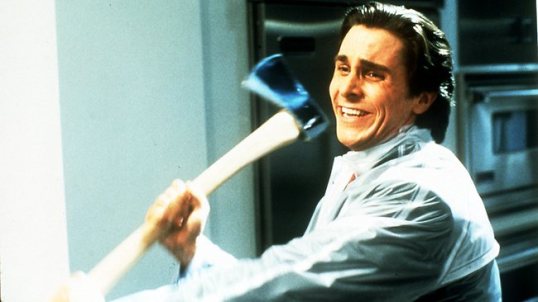
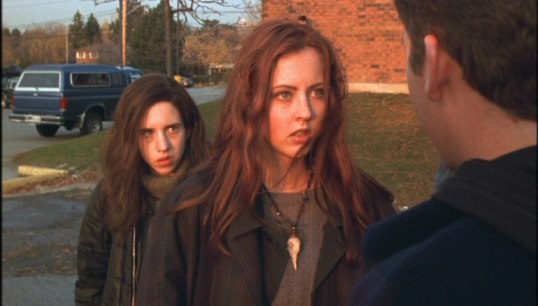
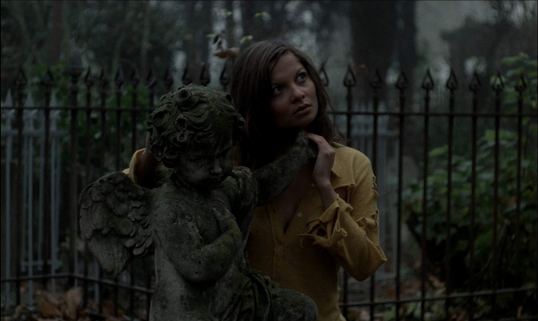
4 Shots From 4 Films is just what it says it is, 4 shots from 4 of our favorite films. As opposed to the reviews and recaps that we usually post, 4 Shots From 4 Films lets the visuals do the talking!
This October, we’re using 4 Shots From 4 Films to look at some of the best years that horror has to offer!
4 Shots From 4 2000 Horror Films
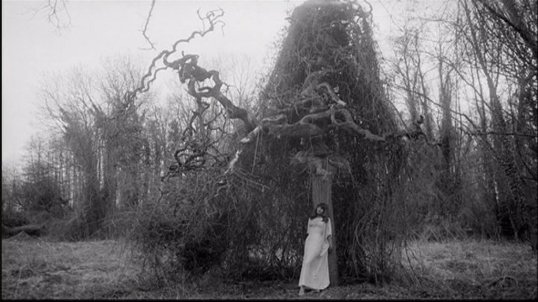
American Psycho (2000, dir by Mary Harron)
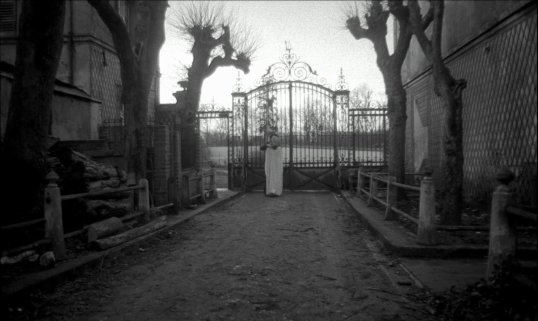
Final Destination (2000, dir by James Wong)
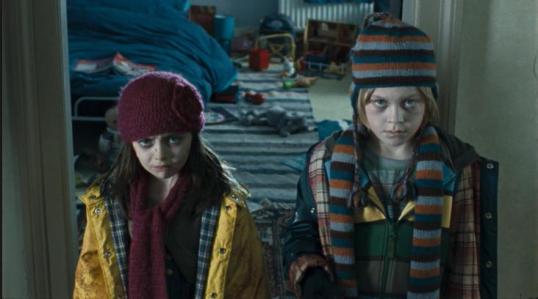
Ginger Snaps (2000, dir by John Fawcett)
Shadow of the Vampire (2000, dir by E. Elias Merhige)
Along with The Haunt of Fear and Tales From The Crypt, The Vault of Horror was a horror anthology comic book that was published, from 1950 to 1955, by EC Comics. Hosted by The Vault-Keeper, The Vault of Horror featured adaptations of classic horror stories along with totally original tales of terror and fright. The Vault of Horror was so popular among young readers that eventually a psychiatrist named Fredric Wertham claimed that it, along with other comics, was responsible for juvenile delinquency and every other social ill facing 1950s America. Congress investigated and, because of all the bad publicity, EC canceled all of their horror titles.
However, the jokes on Wertham and Congress because The Vault of Horror is now eagerly sought after by collectors and is viewed as a high point in comic book history. Below are a few covers from The Vault of Horror, all done by artist Johnny Craig.
Today’s horror on the lens is 1966’s Curse of the Swamp Creature!
Probably the best thing about Curse of the Swamp Creature is that it was filmed in the town of Uncertain, Texas, which is right near the Texas/Louisiana border. Uncertain, which sits on the shores of Caddo Lake, was incorporated in 1961. Reportedly, when filling out the paperwork, the town’s founders wrote “Uncertain” in the blank for the name because they genuinely hadn’t come up with a name. And …. well, you know what happens when you try to make a joke on an official document.
Anyway, this film was directed by Larry Buchanan and that’s really all you need to know about it. Buchanan specialized in making low-budget remakes of other films, though he always claimed that Curse of the Swamp Creature was a totally original idea on his part. The film is about a mad scientist who lives in the swamp and is trying to reverse evolution. Things don’t always work out the way that they should and occasionally, the mad scientist has to feed his alligators. John Agar’s in the movie, of course.
Needless to say, the part with the dancer being controlled and then transformed into something else totally freaked me out, mostly because I’ve had nightmares like that.
And then, of course, you have the tentacles and the graffiti, which feels like something that H.P. Lovecraft would have come up with if he had lived in New York City in the 1970s and had to travel on the subway everyday. It’s easy to imagine old Howard Lovecraft, heading to an accounting job while staring at the graffiti all around him and wondering what type of monster was responsible for it. Cthulhu tags his territory.
As for the wizard with the eyes — well, glowing eyes are always freaky.
Hi, everyone. As I type this, we’ve got a tornado moving through my hometown so I’m going to go ahead and schedule this to post now, just in case we lose power. If today’s list is incomplete, just assume I lost power before I could complete it and I will complete it when the power returns!
For this year’s horrorthon’s final episode of One Step Beyond, we have the …. final episode of One Step Beyond!
In this, the series’s very last episode, a Boston newspaper reporter in 1883 somehow manages to write a firsthand account of one of the greatest natural disasters in human history, the volcanic eruption of Krakatoa. Making his accomplishment all the more amazing is that he not only filed the story the day before it happened but he also says that he has no memory of writing it! What’s going on? Take one step beyond and find out!
This episode originally aired on July 4th, 1961.
Enjoy and tomorrow, we start a new series here on the Shattered Lens!
Isn’t it just awkward when you’re trying to make friends and people run away because unbeknownst to you, you are an inter-dimensional-hell-beast? It’s right up there with telling people that you’ve had the best barbecue ever and you’ve only ever been to Smokey Bones or having Nickelback as your ringtone or quoting “The Notebook”. It’s just …GAH!
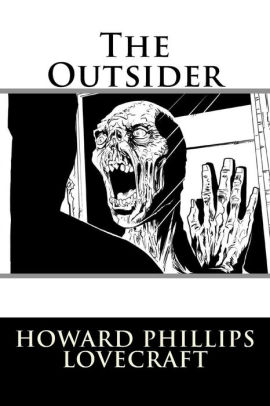
In “The Outsider”, Lovecraft tells the story from the monster’s POV. Shelley did it for the first time in Frankenstein, but it is rarely done; we don’t want to put ourselves into the Devil’s shoes. Even today, the Devil’s POV is scorned – see Joker reviews. The creature in “The Outside” actually seems kinda nice, but lonely. The monster-beast crawls and claws its way out of a crypt and goes up people in a church and wonders what must be chasing him because everyone is running for their lives. This goes on for A WHILE! People flee and he has no idea what’s going on.
Finally, he sees the monster, he goes to touch the horrible creature, and his outstretched finger touches a mirror. I enjoyed the twist. If done right, the Devil is always appealing. Breaking Bad made Bryan Cranston a total badass and he did terrible things, but we rooted for him. Like Walter White who only felt akin to his blue meth at the end, this creature is scorned so he flees into the night doing whatever Hell-Beasts do; my guess it has something to do with making robocalls or working for Ticketmaster.
This Halloween season I’ve been strung out on short-stories for days because I’m amazed at the ability to convey a story in limited space like a Haiku.
I had a few reasons for watching the 1972 slasher film, The Flesh and Blood Show.
First off, the film was directed by Pete Walker. Though Pete Walker may not be as well-known as some of his contemporaries and his overall cinematic output is dreadfully uneven, he was still responsible for enough memorable films that I will always give him a chance.
Secondly, it’s a British film and the British were responsible for some of the best horror films of the late 60s and early 70s.
Third, speaking as a horror fan, that title is just irresistible. The Flesh and Blood Show? Well, there’s nothing subtle about that! Looking at that title, you find yourself wondering, “How much flesh and how much blood is actually in this film?”
Well, having watched the film, I can tell you that there’s very little blood and a good deal of flesh. The Flesh and Blood Show was Walker’s first horror film. Before moving into the horror genre, Walker specialized in making sexploitation movies and it’s kind of obvious that, when he directed this film, he was still more comfortable asking people to undress than asking them to play dead. As opposed to other slasher films, the majority of the young cast survives and the almost all of the murders occur off-screen. Every couple of minutes or so, someone else is getting undressed. The constant nudity actually starts to get pretty funny after a while. One could very easily use The Flesh and Blood Show to construct a drinking game.
As for the film’s plot, it deals with a group of actors who receive invitations to an abandoned theater. An unseen producer apparently wants them all to perform an infamous play, perhaps the same play that is rumored to have led to tragedy back in 1945. If it seems rather odd that the film’s characters would willingly go to an abandoned theater in the middle of nowhere and perform a possibly cursed play, no one is ever going to accuse anyone in this film of being smart. Why ask why when there’s so much dancing and undressing to do?
There’s also an elderly major (Patrick Barr) hanging out around the theater. He was actually one of my favorite characters in the movie because he approached everything with this very British, very stiff upper lip attitude. Of course, the major himself has a secret. That said, the secret isn’t that surprising. I figured it out as soon as he showed up.
Naturally, all the murders at the theater are linked back to a tragedy in the past. The final 15 minutes of the movie are made up of an extensive flashback to that tragedy and I will say this: it’s the best part of the film. The flashback was originally filmed in 3-D and Walker uses this as an excuse to indulge in some surreal flourishes.
There are a few positive things to be said about The Flesh and Blood Show. Pete Walker was a talented director and that talent comes through in even his weaker films. There are a few scenes where Walker manages to maintain a properly ominous atmosphere and the movie’s score is so melodramatic and over the top that it’s kind of hard not to love it.
But, for the most part, The Flesh and Blood Show is a rather forgettable film. If you want to see a good Pete Walker film, track down Frightmare.
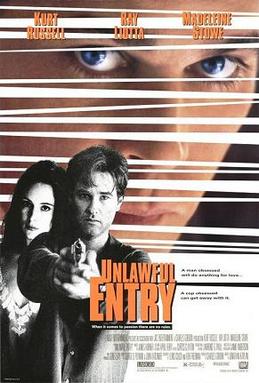
The upscale and complacent life of Michael and Karen Carr (Kurt Russell and Madeleine Stowe) is interrupted one night when a burglar breaks into their home via their skylight. The intruder briefly holds a knife to Karen’s throat before taking off. Shaken by the encounter, the Carrs are very happy when a seemingly friendly cop, Officer Pete Davis (Ray Liotta). offers to help them cut through all the red tape and get a security system installed in their house.
At first glance, Pete seems like the perfect cop but actually, he’s a mentally unstable fascist who quickly becomes obsessed with Karen. When Pete offers Michael his nightstick so that Michael can use it on the man who earlier broke into his house, Michael refuses. That’s all that Pete needs to see to decide that Michael’s not a real man and that Karen would be better off with him. Even after Michael orders Pete to stay away from his home, Pete continues to drop by so that he can spy on the couple. When Michael complains, Pete frames him by planting cocaine at his house. When Michael says that he’s innocent, no one believes him. Why would they? Pete’s a decorated cop who is keeping the streets safe. Michael is just a homeowner. While Michael sits in jail, the increasingly violent and unhinged Pete makes plans to make Karen his own.
“Who watches the watchmen?” as the old saying goes. Unlawful Entry is an efficient and no-nonsense thriller that was ahead of its time as far as its portrayal of a policeman abusing his authority is concerned. Jonathan Kaplan was trained in the Roger Corman school of filmmaking so he doesn’t waste any time getting to the story and he even finds a role for Dick Miller. Ray Liotta, fresh off of his performance in Goodfellas, is perfectly cast as the manipulative and misogynistic Pete while Kurt Russell is once again the ideal everyman. Madeleine Stowe, who was one of the best actresses of the 90s, does not get to do much beyond be menaced but she does it well. Whatever happened to Madeleine Stowe? Kurt Russell’s career is still going strong and Ray Liotta still appears regularly in gangster movies and Chantix commercials. Isn’t it about time for a Madeleine Stowe comeback?
Eat Me is both one of the strangest and most delicious text adventures that I’ve ever played.
You are a very hungry child being held captive in a dungeon. Fortunately, your manacles are very tasty. For that matter, so is the door to your cell, probably because it’s made out of a cheesecake. If you want to go for a more minimal meal, the skeleton of the prisoner who was in the cell before you is also available for snacking. In fact, as the player soon discovers, everything in this dungeon can be eaten. That includes the doors, the instruments of torture, the bodies of the other prisoners, and the guards. If you’re going to escape you better start eating.
There are a few things that stand out about Eat Me. One thing is that the solution to almost every problem is to eat. Some things are easier to eat than others but eating is always the safest way to go. The other is that it’s a very well-written game, with very tasty descriptions of each room, each object, each person, and, of course, each bite. Some of the descriptions are downright tasty while others are not something you should read on a full stomach. None of the NPCs in the game really want to be eaten but, in the end, it’s either you or them.