Today’s horror scene that I love comes from 1975’s Trilogy of Terror, directed by Dan Curtis and starring Karen Black.
In this scene, Karen Black discovers that the doll she recently purchased as a birthday gift has a mind of its own.
Today’s horror scene that I love comes from 1975’s Trilogy of Terror, directed by Dan Curtis and starring Karen Black.
In this scene, Karen Black discovers that the doll she recently purchased as a birthday gift has a mind of its own.
1973’s The Norliss Tapes begins with a disappearance.
David Norliss (Roy Thinnes), a California-based journalist, has vanished. Before he disappeared, he had started work on a book that would have detailed his own adventures investigating the paranormal. Though Norliss vanishes, he leaves behind several audiotapes in which he discusses some of the frightening things that he has seen. Searching for clue about Norliss’s disappearance, his editor, Sanford T. Evans (Don Porter), sits down and listens to the tapes.
(Incidentally, Sanford T. Evans is a wonderful name for an editor. It’s a name that just says, “My father knew Hemingway and I went to the University of Pennsylvania as a legacy.’)
As Evans listens to each tape, we watch the story unfold from Norliss’s point of view. In this film, we watch as Norliss investigates an incident in which Ellen Sterns Cort (Angie Dickinson) claims that she was recently attacked by her dead husband, James Cort (Nicki Dimitri). James was an artist who, in his final days, became obsessed with the occult and fell under the influence of the Mademoiselle Jeckiel (Vonetta McGee), a mysterious woman who claimed to appreciate James’s art and who gave him a scarab ring that he insisted on being buried with.
Norliss interviews Ellen and investigates her story. He’s far more sympathetic to the idea of James having returned from the dead than the local sheriff (Claude Akins) is. Of course, the sheriff has problems of his own. Dead bodies keep turning up in his county, their skin gray and their bodies drained of blood. Hmmm …. I wonder if that could have anything to do with James Cort and his scarab ring….
The Norliss Tapes is a pretty simple film. Norliss shows up and then basically waits around until James Cort makes an appearance. The film only runs 72 minutes and it’s very much a pilot for a television series that never went into production, Apparently, each episode would have featured Stanford listening to a different tape and hearing about David Norliss and a weekly guest star dealing with some sort of supernatural occurrence. Director Dan Curtis was also responsible for the cult television series, Kolchak: The Night Stalker, and The Norliss Tapes feels very much like a dry run for that show. The main difference is that Roy Thinnes’s David Norliss is nowhere near as nervous as Darren McGavin’s Carl Kolchak.
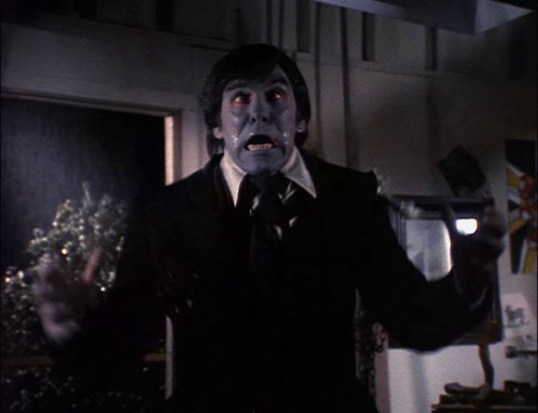
That said, the exact details for what’s going on with James Cort are almost ludicrously complicated. It turns out that James Cort is not only trying to cheat death but he’s also helping an ancient Egyptian deity invade our world. It’s best to ignore the nonsense about the Egyptian Gods and instead just focus on how creepy the undead James Cort is. With his hulking frame, his gray skin, and his nearly glowing eyes, Cort is a truly frightening monster and he’s certainly the most impressive thing about this movie. What makes Cort such an effective villain is how angry he seems to be. Whenever he’s on screen, he’s either bursting through a door or chasing someone. He’s pure nightmare fuel.
The Norliss Tapes never became a series but it did do well in Europe, where it was released in theaters. The Norliss Tapes still has a cult following, not bad for a failed pilot. Who knows what other adventures David Norliss could have had?

In 1948, one of the richest men in Georgia committed a murder.
John Wallace was a landowner, back when that title actually meant something. He was known as the boss of Meriweather County. Everyone in the county seemed to work for Wallace in one way or another. He controlled the county officials. The sheriff enforced the law only as far as John Wallace would allow him. The bootleggers had to pay Wallace for protection. When one bootlegger, a sharecropper named Wilson Turner, failed to do so, he was fired and kicked off of Wallace’s land.
Turner retaliated by stealing two of Wallace’s cows.
Wallace responded by murdering Turner.
Because Turner attempted to flee and Wallace chased after him, Wallace committed the murder not in Meriweather County but in neighboring Coweta County. What Wallace didn’t realize was that this meant the investigation didn’t fall under the jurisdiction of his hand-picked sheriff. Instead, Sheriff Lamar Potts of Coweta County headed up the investigation. John Wallace was eventually arrested by Sheriff Potts and he was eventually convicted of murdering Wilson Turner. At the time, the case drew a lot of attention both because of Wallace’s wealth but also because two of the main witnesses for the prosecution were the two black men who Wallace forced to help him dispose of Wallace’s body.
It’s an interesting story, largely because the history of America is full of men like John Wallace, people who set up their own little dictatorships. It’s often portrayed as being a Southern phenomena but John Wallace really wasn’t that much different from the crude political bosses who, for decades, dominated politics in city like New York and Chicago, the type who held onto power through a combination of intimidation and patronage. In my home state of Texas, George Berham Parr inherited the political machine that controlled Duval and Jim Wells County. Parr committed numerous crimes during his time as the “Duke of Duval” but he had important friends. He was the one who “found” the votes necessary for Lyndon Johnson to win a senate seat in 1948. (In return, Johnson got Harry Truman to pardon Parr for failing to pay his taxes.) Parr is also suspected of having been involved in at least one murder but it wasn’t until LBJ himself retired from politics that anyone truly investigated Parr’s activities. In 1974, he was again convicted of failing to pay his taxes and Parr was later found dead at his ranch. Suicide was the official police ruling.
As for the story of John Wallace, it was turned into a made-for-TV movie in 1983. Murder in Coweta County stars Andy Griffith as John Wallace and Johnny Cash as Sheriff Potts. Griffith, playing a soulless villain, is chilling as John Wallace. Wallace is all-smiles and good ol’ boy charisma whenever there’s a crowd around but, once it’s just him and his cronies, a different side comes out. Wallace thinks that he can get away with murder because he’s been able to get away with everything else. Sheriff Potts is determined to see that justice is done. Murder in Coweta County is an atmospheric Southern crime story, one that is so full of atmosphere that you can feel the humidity. While Johnny Cash was definitely a better singer than an actor, Andy Griffith’s villainous turn makes the film worth watching.
This October, I’m going to be doing something a little bit different with my contribution to 4 Shots From 4 Films. I’m going to be taking a little chronological tour of the history of horror cinema, moving from decade to decade.
Today, we reach the end of the 50s and the rise of British horror.
4 Shots From 4 Horror Films
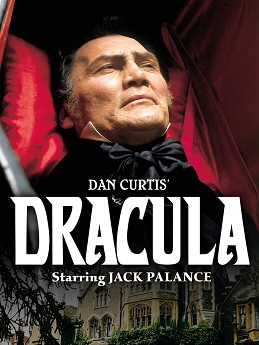
1974’s Bram Stoker’s Dracula opens with a familiar sight.
British solicitor Jonathan Harker (Murray Brown) is in Transylvania, where he has an appointment with a mysterious man named Dracula. The local villagers are superstitious and seem to be frightened of Dracula’s very name. When Harker reaches Dracula’s castle, he discovers that Dracula (Jack Palance) is a courtly but enigmatic man. When Dracula sees a photograph of Jonathan’s fiancée, Mina, and her best friend, Lucy, something about it seems to capture his attention. Later, that night, Jonathan is attacked by several female vampires. After Dracula saves Jonathan’s life, he forced Jonathan to write a letter home, saying that he will be staying in Transylvania for month. Jonathan attempts to escape but is instead dragged off to the crypt, where Dracula’s brides await….
Soon, Dracula is in England. Lucy (Fiona Lewis), who looks exactly like Dracula’s long-dead wife, is taken mysteriously ill and dies. Dr. Abraham Van Helsing (Nigel Davenport), called in when Lucy was showed signs of being sick, suspects that there is a vampire at work. Lucky’s fiancé, Arthur Holmwood (Simon Ward), doesn’t believe it until he sees, with his own eyes, Lucy raised from the dead and calling for him to come and join her….
Not to be confused with the Francis Ford Coppola film, 1974’s Bram Stoker’s Dracula was directed by horror impresario Dan Curtis. It’s a rather loose adaptation of Bram Stoker’s novel. For one thing, Jonathan Harker does not return to England. Dracula is, from the start, more interested in Lucy than in Mina. Lucy’s other suitors — Quincy Morris, John Seward — are not present. And Dracula himself does not get younger as the result of drinking blood. In fact, it’s such a loose adaptation that it’s actually difficult to justify calling it Bram Stoker’s Dracula. (In fact, the film is also known as Dan Curtis’s Dracula, which is a far more appropriate title.)
That said, it’s still an entertaining vampire movie. Jack Palance, who previously worked with Dan Curtis in The Strange Case of Dr. Jekyll and Mr. Hyde, gives a properly intense performance as Dracula. He doesn’t try to adopt any sort of Eastern European accent or anything like that. Instead, he delivers his lines through clenched teeth (or, perhaps, fangs) and he fixes his victims with a powerful stare that hints at the animalistic urges behind his controlled demeanor. Palance plays Dracula as being arrogant and convinced that no mere mortal can defeat him. At the same time, there’s a vulnerability to Palance’s Dracula. Watch how his face briefly lights up when he sees Lucy’s picture and is reminded of his long-dead wife. Watch his fury when he discovers that Van Helsing and Arthur have gotten to Lucy before him. His love for his wife is the one shred of humanity that Dracula still has within him. When he loses her a second time (in the form of Lucy), he’s prepared to go to war.
Bram Stoker’s Dracula was originally meant to air in October of 1973 but the showing was pre-empted by the announcement that Vice President Spiro Agnew had resigned. As a result, this film — so clearly meant for Halloween — did not air until February of 1974. That doesn’t seem fair. Poor Dracula.
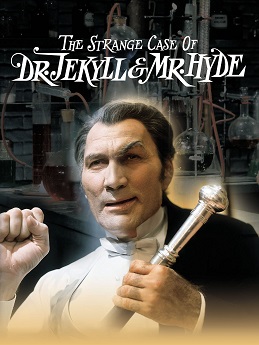
First released in 1968, The Strange Case of Dr. Jekyll and Mr. Hyde is a somewhat loose adaptation of the famous novella by Robert Louis Stevenson.
Jack Palance stars as Dr. Henry Jekyll, a mild-mannered and respected doctor who lives in Victorian-era London and who is convinced that there is a good and dark side lurking in every single person. The dark side is what forces people to break the law and fight with each other. Jekyll feels that his experiments will allow people to get closer to their dark side and, in doing so, defeat it. When Dr. Jekyll explains his theories to a medical association, he is violently jeered and booed. Jekyll returns to his home, enters his laboratory, and takes a drink of the serum that he’s been developing.
The next morning, Dr. Jekyll wakes up with a hangover and no memory of how he spent the previous night. Trying to retrace his steps, Jekyll finds himself in a dance hall where everyone is talking about a well-dressed but ugly man named Edward Hyde. Hyde showed up the previous night, spent a lot of money on a woman named Gwyn (Billie Whitelaw), and then got into a fight with two men. Hyde broke a window to make his escape. Jekyll, sensing what must have happened, pays for the window on behalf of his “friend,” Edward Hyde.
Jekyll continues to drink the serum and he continues to indulge in all of the forbidden vices as Edward Hyde. Eventually, we get to see Palance as Hyde. Unlike a lot of other actors who have played the role, Palance uses a minimum of makeup to suggest his transformation. Instead, he hunches over, scrunches up his face, and he has a unibrow. One of the stranger things about this production is that we are continually told that Hyde looks nothing like Jekyll but we know that’s not true. Instead, Hyde looks exactly like Jekyll making a funny face.
Palance gives one of his more eccentric performances as Jekyll and Hyde. Somewhat surprisingly, he’s far more convincing as the kindly and troubled Dr. Jekyll than as the villainous Mr. Hyde. (As Hyde, Palance is often trying to so hard to maintain his facial paralysis that it’s hard to understand exactly what it is that he’s saying.) With each drink of the serum, Jekyll becomes a bit more confident in himself. However, he also finds himself losing the ability to control the transformations. One morning, he wakes up in his bed and is shocked to discover that he is still Hyde. That same morning, he learns that Hyde is suspected of committing a senseless and brutal murder. Jekyll has no memory of it but he knows that Hyde is guilty. And if Hyde is guilty, so is Jekyll. (Those who make the argument that Dr. Jekyll and Mr. Hyde is ultimately about drug addiction will find plenty to back up that argument in this production,) Jekyll’s anguish as he realizes what he has become is rather poignant to watch.
Produced by horror impresario Dan Curtis, The Strange Case of Dr. Jekyll and Mr. Hyde can seem a bit creaky today. It was apparently highly acclaimed when it first aired but, seen today, it can feel rather stagey and talky. That said, the film has a strong supporting cast, with Denholm Elliott especially giving a good performance as Jekyll’s best friend. Jack Palance’s performance is so bizarre that it transcends the usual standards used to determine good and bad. It’s definitely a film worth watching.

Once again, I have been thwarted from putting a title card from IMDB in my post. In this case, I think they are kind of shy. I was not even able to provide a link.
It’s called The Killer and it was created by OTP_tv.
The premise is what if a killer really needs to go to the bathroom after the murder? Funny things happen – that’s what! I would almost describe this short as pure comedy, until the end. I was the first person to watch the short because it dropped today and I coincidentally was around at the time. The short is simple and does not try to be too many things, but it does achieve humor and that’s a good thing.
The short begins with a couple bantering about wine and poo….as you do. Then, it appears the wife is bothered by the joke. The husband is stabbed in the bathroom and hilarity ensues. This is a fun short and does not take itself too seriously. If you have 3 or 4 minutes to spare, let it be The Killer.
I reached out to the creators on YouTube and if they get back to me, I will update the review with additional details.

For today’s horror on the lens, how about a little werwolf action?
In the 1974 made-for-TV movie, Scream of the Wolf, Peter Graves is a writer who is asked to help solve a series of mysterious murders. The fact that both human footprints and wolf tracks have been found at each murder scene has led some people to assume that the killer must be a werewolf! Will Graves be able to prove them wrong or will it turn out that they are right? Graves calls in a famous hunter (Clint Walker) to help track down the killer but it turns out that the hunter has secrets of his own.
Scream of the Wolf features a screenplay from Richard Matheson and it was directed by television horror specialist, Dan Curtis. It feels like it was probably meant to be a pilot in which Peter Graves would deal with a supernatural mystery on a weekly basis. Even if the movie didn’t lead to a series, it’s still enjoyably atmospheric.

by Rafael DeSoto
This pointed cover is from 1936.
Back in the day, this music video was banned by MTV for what the channel considered to be “senseless and excessive violence.” Lemmy driving and giving everyone the finger really upset them.
Director Ron Swenson was best-known for being the manager of the Plasmatics.
Enjoy!