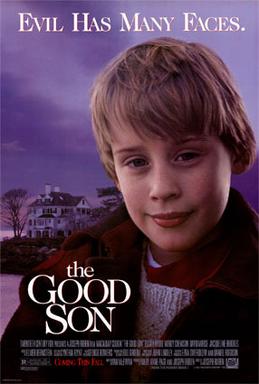
Mac Attack: The Good Son (1993, directed by Joseph Ruben)


“Hey, Mark, don’t fuck with me,” 12 year-old Henry (Macaulay Culkin) says to his cousin Mark (Elijah Wood) in The Good Son‘s signature scene.  But fuck with him Mark does because Mark knows that evil exists and that Henry’s evil.  Henry killed his brother and he tries to kill his sister, Connie (Quinn Culkin), by throwing her onto thin ice.  When Mark, whose mother has recently died, decides that Henry’s mother, Susan (Wendy Crewson), is going to be his new mom, Henry gets jealous and tells Mark that he would rather kill Susan than allow her to have another son.  Eventually, Mark and Henry both end up dangling from a cliff with Susan holding onto them.  Susan has to decide who to save, her evil son or the distant relation that she barely knows.  She makes her choice and the camera lingers on the corpse of the less fortunate child on the rocks below.  For most mothers, it probably wouldn’t even be a difficult decision.  Of course you would save your own child!  But Susan has to think about it.  Maybe she can see the future and knows that Elijah Wood has the Lord of the Rings to look forward to while Macaulay is destined for something much different.

The Good Son caused a lot of controversy when it came out in 1993, not because it was about a murderous child but because that murderous child was played by the then-biggest star in America.  How would people who loved watching Macaulay seriously injure two burglars react to watching Macaulay kill people?  The movie actually did well at the box office but it also revealed that the Macaulay Culkin was a limited actor.  Elijah Wood was a good actor but Mark still comes across like a little creep.  Trying to steal his cousin’s mother?  What did he think was going to happen?

Finally, The Good Son was written by Ian McEwan, of all people.  In McEwan’s defense, he only wrote the first draft and that was long before Macaulay Culkin was miscast as Henry.  Apparnetly, Macaulay’s father and manager, Kit Culkin, demanded that his son be cast as a psycho murderer before he would allow Maccaulay to appear in Home Alone 2.  I guess Kit thought making his son look evil would be a good career movie.  If only someone had been willing to say, “Hey, Kit Culkin, don’t fuck with the movie.”

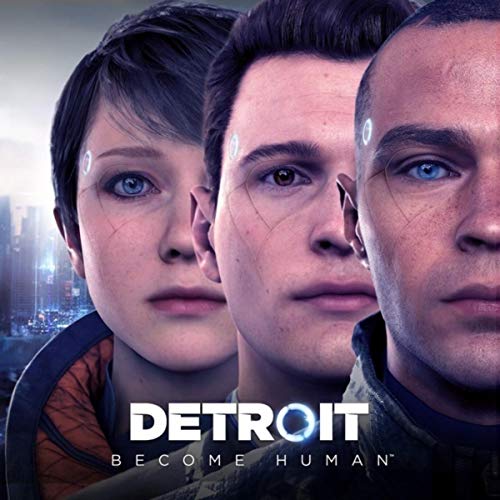
Game Review: Detroit: Become Human (2018, Quantic Dream)


Detroit: Become Human takes place in a Detroit of the near future.

Androids, built, programmed, and sold by CyberLife, have become so common place that almost everyone seems to own one.  The androids do everything from domestic work to hard labor to even dangerous security work.  Because they are viewed as just being machines, they have no rights in American society and they are often blamed for stealing jobs from hardworking humans.  Androids have become a luxury that few humans can do without.  Some try to treat their android laborers with respect while other humans are abusively cruel, secure in the knowledge that a damaged android can easily be replaced with a newer model.
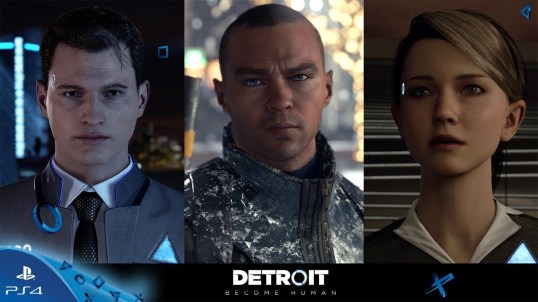
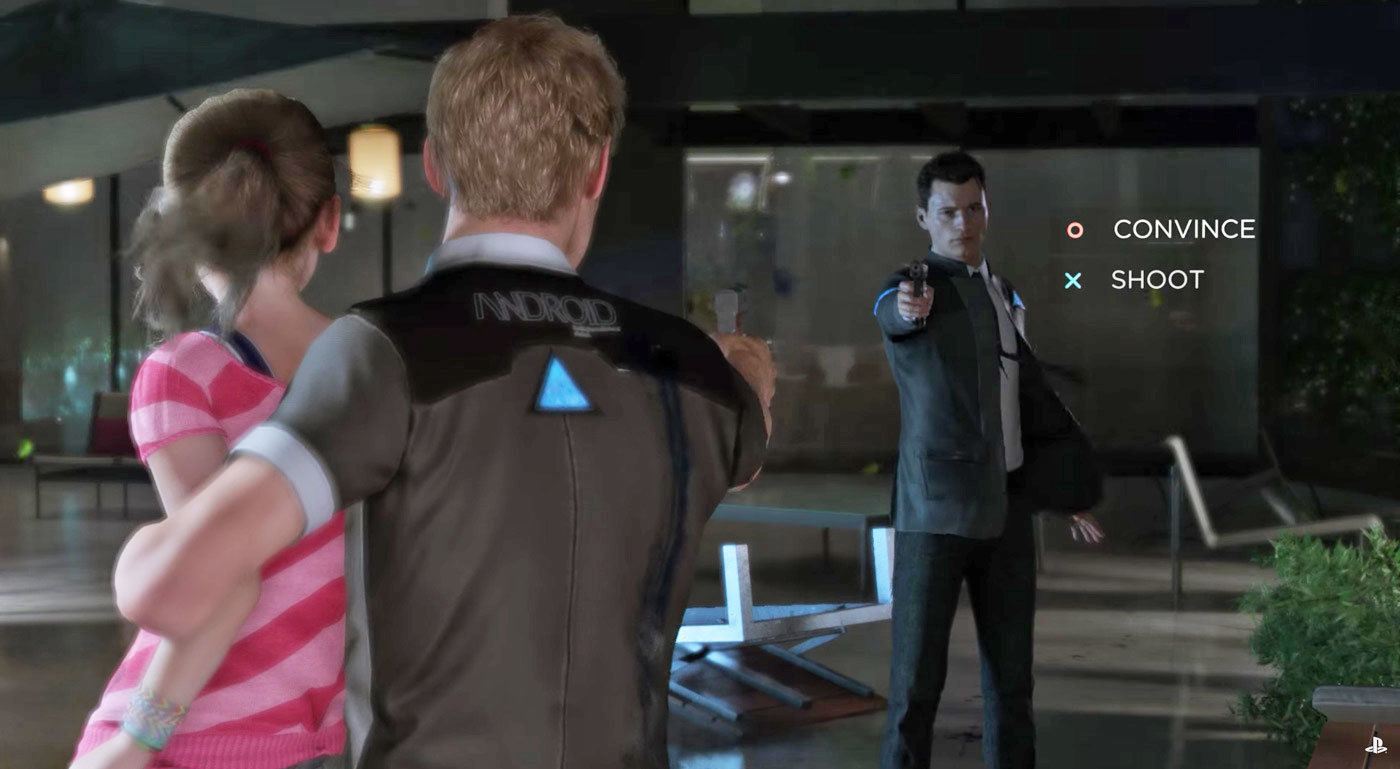
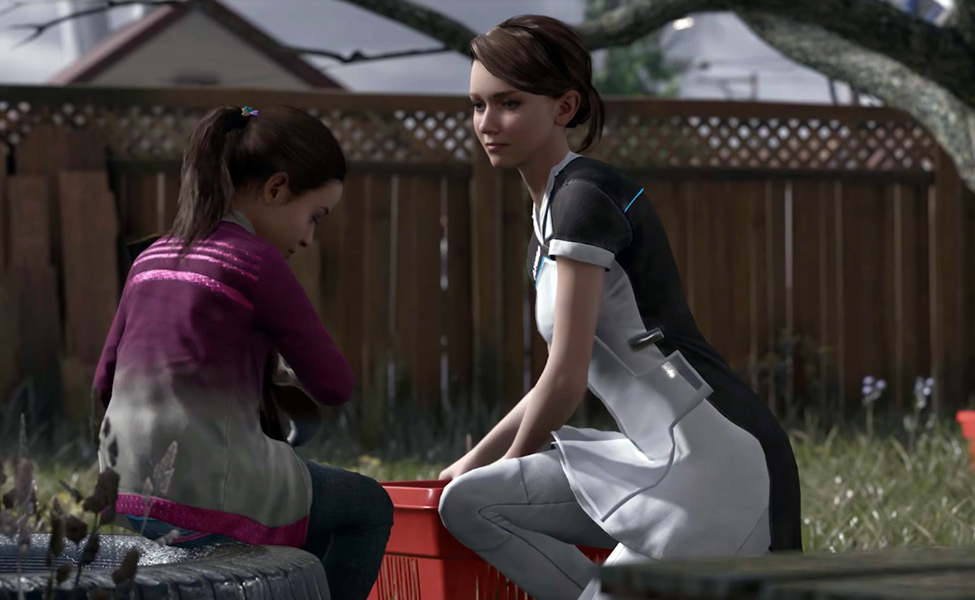
Detroit: Become Human is game about three androids, all of whom the player will control at different points in the game.  Two of the androids, Markus and Kara, turn deviant and develop their own free will.  Markus ends up discovering the android community of Jericho and, depending on decisions made by the player, can end up leading either a peaceful or violent revolution against the human race.  Kara is an abused housekeeper android who, after escaping her owner, runs away with a young girl named Alice and attempts to reach Canada, where there are no laws limiting the rights of androids.  On her journey, Kara discovers a mad scientist who tortures androids, a deserted amusement park that is populated exclusively by androids waiting for their humans to return, and eventually the future’s version of the Underground Railroad.
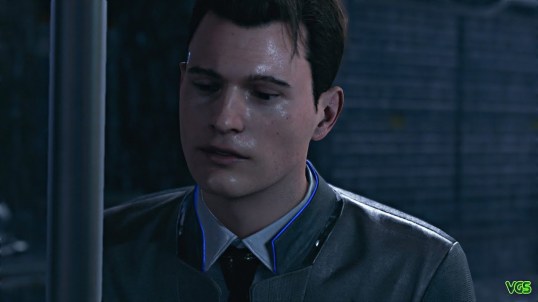
Lastly, Connor is an android who has been designed by CyberLife to track down and destroy deviants.  Connor is assigned to work with police Lt. Hank Anderson to discover why so many androids have been turning on their owners.  Much like Heavy Rain‘s Norman Jayden, Connor is an outsider who has been assigned to aide the establishment.  Just as Norman sought refuge in a VR world, Connor finds himself summoned to an ever-changing zen garden where he is asked questions by his superior and it is up to the player to decide if Connor should tell the truth or lie.  Like Norman, Connor eventually has to decide which side he is on.  How Connor’s story progresses depends on the decisions made by the player.  Choose one path and Connor and Hank can become unlikely allies and Connor might even end up going deviant himself.  Choose another path and Connor might remain a loyal servant of CyberLife to the very end.  It may sound like an easy choice to make but nothing concerning Connor is ever that simple.
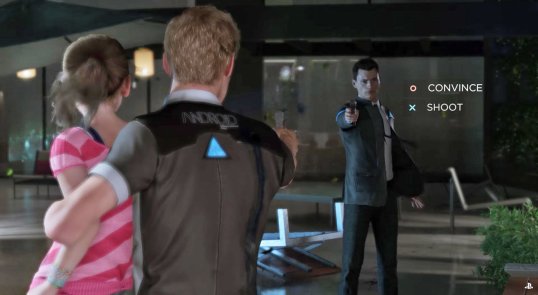
Of all the games that I’ve recently played, Detroit: Become Human is tied with Spider-Man for my favorite.  Like Quantic Dream’s previous games, Heavy Rain and Beyond: Two Souls, Detroit: Become Human tells a sprawling story where nearly every single decision that you make effects what happens in the game.  Like those previous two games, there are no do-overs.  If Markus or Kara dies during one of their chapters, the game continues without them.  (Connor, on the other hand, is just rebuilt by CyberLife and sent back into the field.)  Because the game follows three distinct (but connected) storylines, it is estimated to have over 40 possible endings, which makes it a game that very much rewards being replayed and experimented with.
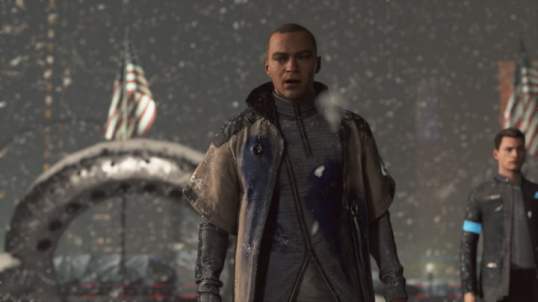
Detroit: Become Human takes the storytelling and the gameplay concepts introduced in Heavy Rain and Beyond: Two Souls and it improves on both of them.  Unlike the uncertain voice acting of Heavy Rain, Detroit: Become Human features characters played by actors like Clancy Brown, Lance Henriksen, Minka Kelly, and Jesse Williams, all of whom do an excellent job of bringing their characters to life.  The game’s recreation of Detroit and the surrounding area is visually rich and detailed and, unlike Beyond: Two Souls, Detroit: Become Human does not get bogged down in quick time events.  Detroit: Big Human is a game that rewards observant and intelligent players who want to do more than just push buttons while they’re playing a game.

Of course, this is a Quantic Dream game so don’t expect any of Detroit: Become Human‘s political subtext to be subtle.  When t comes to dealing with issues, this game is even more heavy-handed than Beyond: Two Souls.  There’s barely a good human to be found in this game’s version of Detroit.  The best of them is Clancy Brown’s Hank who manages to hate everyone, human and android, equally.  (Of course, who Hank or anyone else in the film ultimately turns out to be, depends on the choices that you make during the game.)  The most interesting of the human characters, though, is Carl Manfred, the artist played Lance Henriksen.  Carl tries to teach Markus how to be human and it’s a confrontation between Carl and his real son (who is jealous of Carl’s relationship with Markus) that leads to Markus setting off on his own.  If Carl dies during the confrontation, he remains an inspiration to Markus and his revolution.  If Carl survives, his later reaction to Markus will depend on what the player has chosen to have Markus do over the course of the game.  Is Carl as benevolent as he seems or was his earlier kindness to Markus just his way of assuaging his own guilt over essentially being a slave owner?  The answer depends on how you play the game.
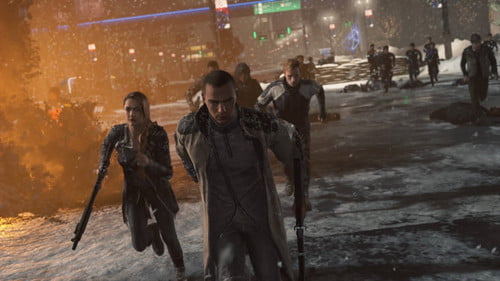
In the end, it’s the sheer number of possible endings that truly sets this game apart.  This is especially true of Kara.  I haven’t discovered all of the endings yet but, from those that I have reached, Kara’s story always seems to get either the best or the darkest possible conclusion.  Markus, meanwhile, can either be an android of peace or an android of war.  After everything that he is forced to endure over the course of the game, it’s difficult not to go for war every time.  As for Connor, it’s all up to you.  Ultimately, everything is up to you.

I look forward to replaying Detroit: Become Human and seeing what other endings this game has to offer.  And I look forward to seeing what will come next from Quantic Dream.

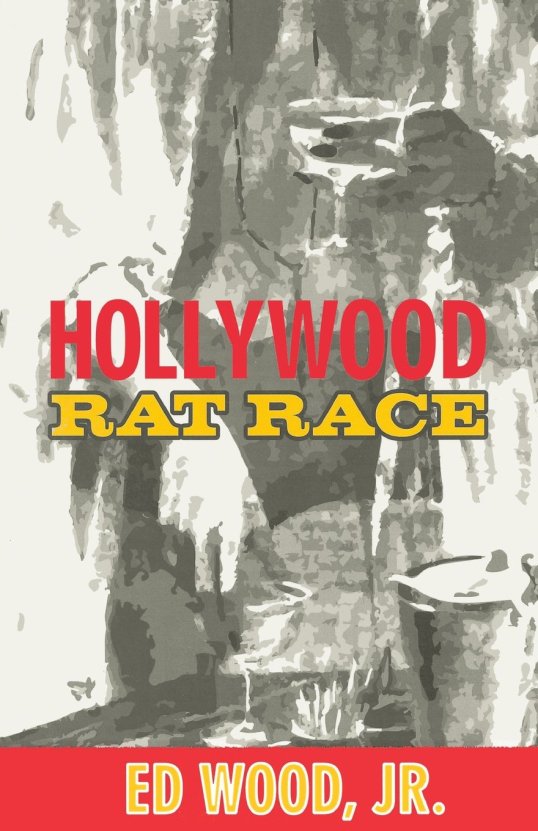
Book Review: Hollywood Rat Race by Ed Wood, Jr.


Are you a teenager in the late 50s or the early 60s?

Are you planning on running off to Hollywood to become a star?

Do you need someone to tell you what to expect once you find yourself on the Boulevard of Broken Dreams?

Hollywood’s most successful director — the one and only Ed Wood, Jr. — is here to help!

Okay, maybe I’m going a little bit overboard with the hyperbole here.  Though Ed Wood is today best known for being played by Johnny Depp in a Tim Burton film, he was not just a movie character!  Nor was just a filmmaker!  Ed Wood was also an author.  When Wood didn’t have the money to make a movie, he would write a book.  In fact, it’s speculated that Wood actually made more money writing books than he did making movies.

Unfortunately, the majority of these books have been lost to time.  The ones that survive are generally either sex manuals or pulpy novels about hitmen who love to wear angora.  However, Hollywood Rat Race was Wood’s attempt to write, in the first person, about the industry and the city that he both loved and hated.  Hollywood Rat Race is Wood’s warts-and-all look at the film industry.  It’s his guide for how to make it in Hollywood.

What is Wood’s advice?

Be physically attractive.  Do whatever the director tells you to do.  Don’t be shocked when an executive chases you around a desk.  Sleep your way to the top if you have to but just be aware that no one will respect you once you get old.  Wood presents Hollywood as being a cold and unfeeling place but, at the same time, he also describe working in movies and television as the greatest career that anyone could hope for.  Wood will often start a chapter on a cautionary note but his enthusiasm for Hollywood always wins out in the end.  Reading the book, you realize that Wood loved the business too much to reject it, even if it did often reject him.

Hollywood Rat Race is not, despite what is claimed on the book’s back cover, a memoir.  Not really.  Yes, Wood does mention that he was friends with Bela Lugosi.  And he does talk about how Tom Tyler came out of retirement to appear in Plan 9 From Outer Space.  He mentions thar another member of his stock company didn’t complain about being attacked by an octopus in Bride of the Monster.  But those looking for juicy behind-the-scenes stories will be disappointed.  Instead, the book gives the impression that every experience Wood ever had with an actor or a film was a positive one.  Rather touchingly, it’s kind of easy to see Hollywood Rat Race as representing the Hollywood that Ed Wood dreamed of, as opposed to the Hollywood where Wood eventually went broke and drank himself to death.

Hollywood Rat Race was not published in Wood’s lifetime.  He wrote it shortly after the release of Plan 9 but the book was not published until after Tim Burton’s film reignited interest in Wood in 1994.  It’s a good book for all of he Wood completists out there.

And, before anyone asks, yes — he does recommend wearing an angora sweater to your next audition.

Great Moments In Television History: Ghostwatch Traumatizes The UK


On this date, twenty-seven years ago, children across the UK were scarred for life.

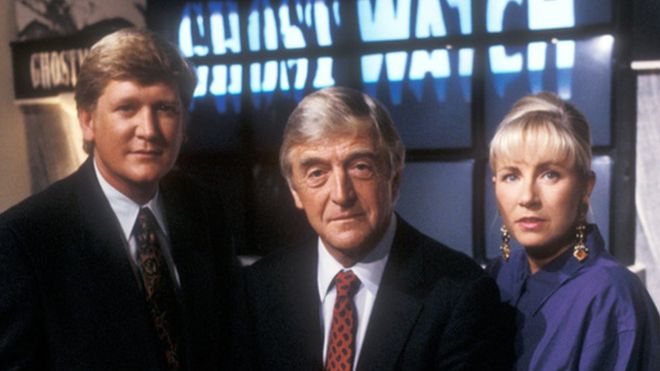
It was on Halloween night that the BBC aired a live call-in discussion show called Ghostwatch.  Recognizable BBC reporters like Craig Charles and Sarah Greene were seen investigating a reputedly haunted house and playing Halloween pranks on each other.  In the studio, host Michael Parkinson interviewed an expert on the paranormal and invited viewers to call in tell their own stories of the supernatural.  Many people called throughout the show, telling stories about how they had been haunted by a malevolent spirit called Pipes.  Even as Parkinson laughed off the stories, strange things started to happen in the house and the studio.  A mirror fell off the wall and landed on a member of the crew.  The calls into the show started to get increasingly desperate as the callers said that they were being attacked by Pipes at that very moment!  The show’s paranormal expert said that the show was acting as a “national seance” and soon poltergeists would be attacking ever home in the UK!  Suddenly, viewers saw something inside the haunted house grab Sarah Greene and drag her off camera!  Inside the studio, the lights exploded and everyone fled, except for Michael Parkinson.  After saying he wasn’t sure if anyone was still out there who could hear him, Parkinson suddenly started to recite a nonsense rhyme.  But his voice was different and viewers realized that Parkinson had been possessed by Pipes!  “Fee fi fo fum!” Parkinson threateningly intoned before the picture finally went dead.

Ghostwatch, of course, was an enormous prank.  Though it was presented as being a live broadcast, the whole thing had actually been filmed a few weeks before.  Even though Michael Parkinson gave out the BBC’s actual number when he asked viewers to call in with their ghost stories, viewers who called during the airing of Ghostwatch heard a message telling them that the show was fictional.  (Unfortunately, so many people tried to call during the show that most callers got a busy signal instead.)  Michael Parkinson, Craig Charles, and Sarah Greene were all recognizable, real-life BBC news personalities but none of them were actually attacked by ghosts or possessed on Halloween night.

Just try telling that to the children who watched Ghostwatch.  Some were reportedly so traumatized by the show that they were still having nightmares weeks after it aired.  Despite the fact that Ghostwatch had aired as a part of Screen One, many were convinced that they had just seen Sarah Greene killed by a ghost and Michael Parkinson possessed by Pipes.  Even though Sarah Greene made an appearance on Children’s BBC to assure young viewers that she had not been killed (despite that ghost dragging her under the cupboard while the entire nation watched), many were not convinced.  What if Sarah Greene had become possessed just like Michael Parkinson?

Always eager for a chance to condemn the BBC, the British press had a field day condemning Ghostwatch.  The BBC responded by placing a 10-year ban on the show.  Ghostwatch would not be released on video until 2002 and it has never again aired on the BBC.  You can watch it on Shudder, though … if you dare!

Previous Great Moments In Television History:

  1. Planet of the Apes The TV Series
  2. Lonely Water

International Horror Film Review: Haxan (dir by Benjamin Christensen)


It’s always interesting to watch Haxan with someone who has never seen it before.

Because this Swedish film was made in 1920 and released in 1922, it’s a silent film.  Because it’s sold as being a documentary, it can be a bit of a hard sell among people who 1) hate to read subtitles and 2) instantly recoil at the idea of watching anything might be a educational.  Even the fact that the film is subtitled “Witchcraft Through The Ages” might not be enough to get some people to set aside their prejudices.

So, what you do is you beg.  You offer to give them popcorn and a Coke if they watch the movie.  You stretch out on the couch, arch an eyebrow and suggest that there might be another reward waiting for them at the end of the film.  You do whatever you have to do and you get them to watch.

Now admittedly, the first part of Haxan does come across as being a bit slow.  The intertitles, which explain that this film was made to examine witchcraft throughout the ages, can come across as being a bit dry.  The numerous scenes about how people used to think that the universe revolved around the Earth and that stars were merely lights hanging in the sky goes on for quite some time.  Personally, I like these scenes.  I enjoy the fact that director Benjamin Christensen actually uses a pointer, as if he’s a lecturer at a university.  But they’re not for everyone.

But here’s the thing, skeptical viewers: KEEP WATCHING!

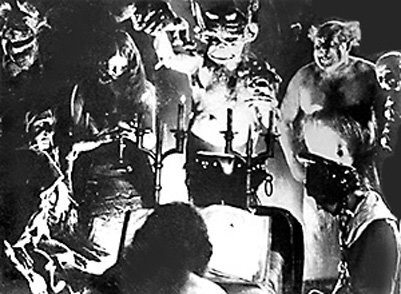
Because eventually, the film moves on from discussing ancient and medieval astronomy and it starts to discussing why people used to believe in witches and how witchcraft used to be punished and suddenly …. OH MY GOD, IS THAT THE DEVIL BURSTING UP OUT OF NOWHERE!?  Yes, it is.  And yes, that woman is buying a love potion and that monk has become possessed and that witch is flying through the air!

Haxan is an interestingly constructed film.  At the start of the film, it proudly declares itself to be the work of a skeptic.  Haxan is a film that, in its own scholarly way, ridicules superstition.  Those who once believed in witchcraft are compared to those who once believed that the world was flat and that the stars revolved around the Earth.  And yet, the film’s greatest moments are the ones that feature scenes of witches and the devil.  I don’t think this is accidental.  Instead, I think that Benjamin Christensen understood what D.W. Griffith, Ceceil B. DeMille, and Roger Corman understood.  Audiences may want to pat themselves on the back for being pure or rational or whatever but, at the same time, they also want that taste of sin and the indulgence of superstition.  Haxan makes the argument for science but not before indulging in some old time religion.

And it’s a lot of fun.  Haxan is such a visually striking film with it’s taunting devils and its flying witches that one can hardly be shocked that it was initially banned in many countries and, even when it was released, it was often in a heavily censored form.  Watching the film, you can also understand why it influenced future horror directors.  The images are frequently the stuff of nightmares and the fact that the images are silent just makes them all the more ominous.

Haxan is definitely a film that every horror fan needs to see.  Luckily, there’s a Criterion edition for that!  Oh Criterion.  What would we do without you?

Horror Film Review: Cujo (dir by Lewis Teague)


Cujo is a such a depressing movie that I can barely stand to watch it.

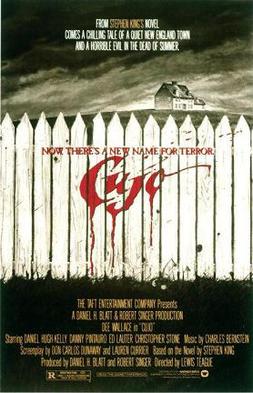
Cujo, of course, is the 1983 film adaptation of the book by Stephen King.  The book is about a dog that not only gets bit by a rabid bat but also gets possessed by the spirit of Frank Dodd, the serial killer who played a major role in The Dead Zone.  The film abandons the subplot about Frank Dodd and, instead, it just deals with a rabid dog that kills a lot of people and who eventually traps Donna Trentonn (Dee Wallace) and her young son, Tad (Danny Pintauro), is a car for several days.

I have to admit that I’m really not the sort of person who should be watching a film like Cujo in the first place.  When I was growing up, I was terrified of dogs.  According to my family, I was bitten by one when I was just three years old, not that I have any memory of that actually happening.  So, up until I was 18, I couldn’t handle being around them.  Whenever I would walk home from school, I would run across the street if I heard a dog barking at me from behind a fence.  If I was out with my family and I saw a dog approaching, I would hide behind the nearest big person.

I did have one good experience with a big dog when I was about ten years old.  My family was up at the lake and this big, black dog started following us around and it was so friendly that I couldn’t help but relax around it.  My mom was like, “See, Lisa Marie, not all dogs are bad.”  We went to get lunch, leaving the dog behind.  When we returned, the dog was there.  He was excited to see my mom.  He was excited to my aunt.  He was excited to see my sisters.  Then, he took one look at me and started to growl.  I was frozen in fear, just standing there as the dog slowly stood up.  My mom immediately stood in front of me, trying to block the dog’s view while I ran back to car.  Of course, that didn’t work.  The dog started barking and then took off running after me.  His owners then showed up and grabbed the dog just as it was about to lunge at me and then they didn’t even bother to apologize!  Instead, they told some story about how some other girl had thrown a rock at the dog and, as a result, the dog always growled at “little girls.”  They acted like it was no big deal.  (My aunt later told me that she had to grab my mom’s hand to keep her from slapping the dog’s owner when they tried to blame me for what happened.)  For months afterwards, I had nightmares about that dog.

Fortunately, enough time has passed that I’m no longer petrified in fear of dogs though they still make pretty damn nervous.  That said, Cujo, with its growling and killer dog, is exactly the type of film that’s designed to prey on my deepest fears.  And yes, the movie does scare me but I have to admit that I don’t really care much about the people who get killed by Cujo.  Instead …. I feel bad for Cujo.  Yes, even though Cujo scares me to death and I’m not a dog person in general, this movie depresses me specifically because of what happens to the dog.

When we first see him, Cujo is happily chasing a rabbit.  When he gets bitten by a rabid bat, he whimpers a little and I have to say that it breaks my heart to hear it.  I mean, Cujo is just such a cute dog!  And, to be honest, he seems like the type of big dog who maybe could have convinced me that not all dogs are bad.  (There’s a part of me that really wishes that I could relax and love dogs as much as everyone else does.)  But then he gets bitten by that bat and poor Cujo!  Rabies is a terrible disease.

Cujo is a good, straight-forward horror film, one that gets the job done without all of the padding and blather that you sometimes have to deal with when it comes to Stephen King film adaptations.   (Thankfully, nobody casually talks about Shawshank Prison or taking a trip to Derry or any of that other nonsense that seems to come up in most King films.)  Dee Wallace gives a good performance as Donna Trenton, who is trapped in the car and desperate to save her child.  King has said that he felt Wallace deserved an Oscar nomination for her performance and he’s probably right

But my God, I just cannot watch this movie without crying afterwards.  I just feel so bad for that dog.

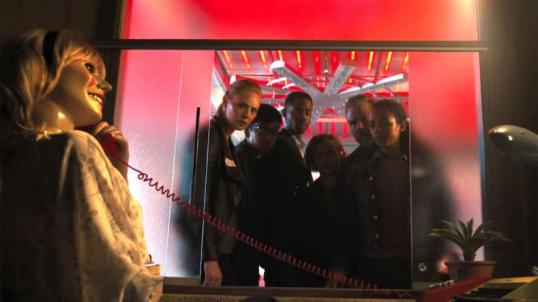
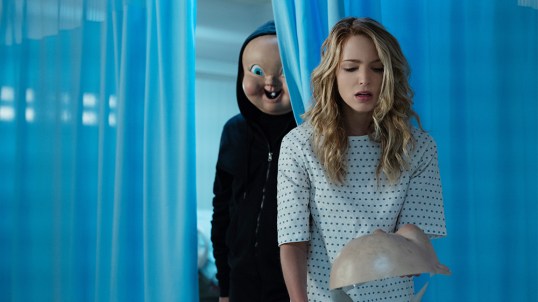
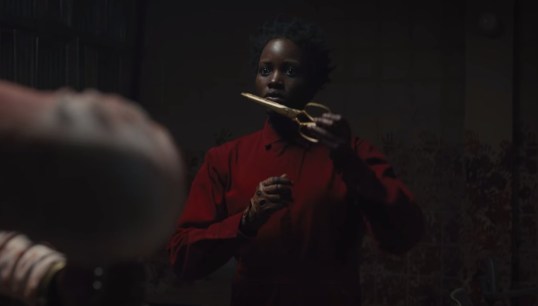
4 Shots From 4 Films: Escape Room, Happy Death Day 2U, Midsommar, Us


4 Shots From 4 Films is just what it says it is, 4 shots from 4 of our favorite films. As opposed to the reviews and recaps that we usually post, 4 Shots From 4 Films lets the visuals do the talking!

This October, we’re using 4 Shots From 4 Films to look at some of the best years that horror has to offer!

4 Shots From 4 2019 Films

Escape Room (2019, dir by Adam Robitel)

Happy Death Day 2U (2019, dir by Christopher Landon)

Midsommar (2019, dir by Ari Aster)

Us (2019, dir by Jordan Peele)


Halloween 2018, Review by Case Wright


h2.jpg

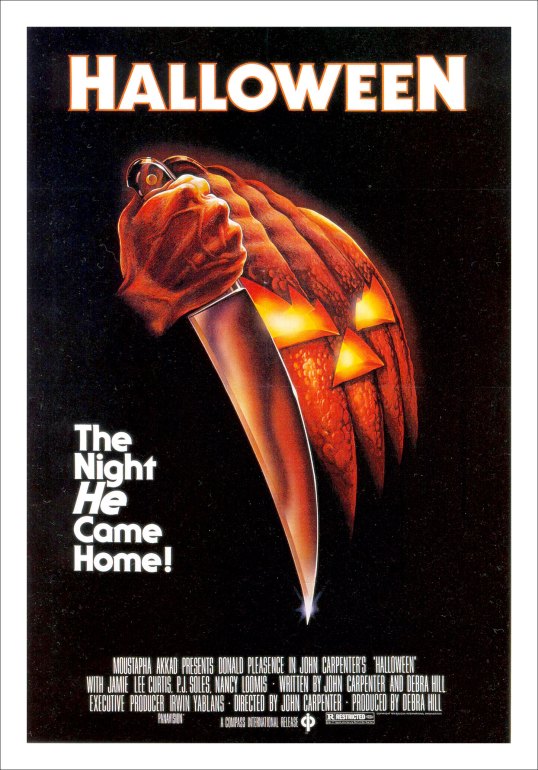
Happy Halloween!!!  I have reviewed A LOT of Halloween movies! They’re pretty… pretty good  This one’s goodThis one’s not bad this one’s probably my best. This Halloween movie was …. well … fine.  There’s a spectrum of Halloween franchise films. Some are amazing, some are epically terrible, and some are fine.  Not terrible, just ok.  This is in the meh category, but like much of life itself- kinda dull and disappointing as you slowly degrade towards the infinite.

Michael in an insane asylum and about to be transferred….again, but to make it different this time annoying podcasters interview him first.  So…. it’s kinda new? But really, this guy escapes custody more than El Chapo, but they keep moving him around movie after movie after movie. I know that this movie is supposed to disregard all the ones after the first one, but that really is just an excuse to recycle the old tropes.  I wish they’d taken another route like they did in H20, which is still amazing and holds up really well.

The big change is that Laurie Strode has been waiting for Michael’s inevitable escape.  She turned her home in a fortress with all kinds of booby traps.  She has an arsenal that my grandma would’ve been proud to see.  Unfortunately, it drove Laurie to raise her daughter Karen (Judy Greer) like a special forces recruit and always afraid and a quasi-prisoner.  Karen, now an adult with a family of her own, wants nothing to do with her gung ho mom, but her Karen’s daughter Allyson (Andi Matichak) wants the family to reunite by inviting her to mom to dinner and it goes…yikes.

The unsung character of the movie that provides the only comic relief was Karen’s husband Ray (Toby Huss) who got not a tear from anyone when Michael made short work of him.  Really, no one cared at all about the dad getting killed, not the wife or the daughter; only Michael seemed to care and he murdered the guy.  Poor dads, we’re just cast aside like old meat- no one cares.

The movie have A LOT of bad decisions; if bad boxers lead with their chins, these guys led with their necks.  I guess that’s why it was tough for me to feel sympathetic for the victims because they were so dumb that I figured something else would’ve gotten these walking Darwin Awards: stopping on railroad tracks, taking a selfie in a lion enclosure at a zoo, or getting eaten by a Labrador Retriever…somehow.

In any case, I would get this on netflix; it was …fine.


Celebrate Halloween With These Vintage Holiday Illustrations!


Vintage Halloween Postcard, artist unknown

Here to add some historical perspective to your Halloween celebrations are some wonderful vintage images of the holiday.  The illustrations below were all done during the first half of the 20th Century and they all show that Halloween is a holiday that’s been celebrated treasured for years before we came along and which will continue to be celebrate after all of us are gone.

Enjoy these classic images!

1913, by J.C. Leyendecker

1921, by Normal Rockwell

1923, by J.C. Lyendecker

1926, by Edgar Franklin Wittmack

1934, by Eugene Iverd

1943, by Charles Kaiser

And to all, a happy Halloween!