International Horror Film Review: Dark Forces (dir by Bernardo Arellano)


How one reacts to this film from Mexico will depend on what one prioritizes when it comes to watching movies.  Do you watch movies for their plot or do you watch them for their style?  Do you care about what the filmmaker has to say or do you just want to see how they say it?

Of course, this doesn’t have to be an either/or situation.  Just because a film is heavy on style, that doesn’t mean that it’s thematically shallow.  At the same time, just because a film has something to say, that doesn’t mean that it has to be dry and boring.  It’s just that, in the case of Dark Forces, the film is almost all style and that seems to be by design.

The plot of Dark Forces is not always easy to follow and what can be followed is often pure nonsense.  A former (or maybe current, it’s never really clear) criminal named Max (Mauricio Aspe) is searching for his sister, who is being held hostage by a gangster.  Max checks into a hotel and searches for clues to where he sister is being held.  There are a variety of eccentric people living in the hotel, some of whom appear to be supernatural in origin and some of whom are probably just sleazy hotel denizens.  There’s a mysterious, femme fatale-style waitress.  There’s an albino who is also a psychic because movies like this always seem to feature an albino psychic.  And then there’s this mysterious man played by transgressive filmmaker Nick Zedd.  Zedd’s character is named Demonio and he says that he can help Max for a price and can you guess what’s going on?

So, if you’re watching for a coherent plot, you’ll probably be disappointed.  If you allow yourself to get in any way emotionally invested in Max’s quest, you’ll probably be disappointed.  Narratively, Dark Forces somehow manages to be both totally incoherent and totally predictable at the same time.  That’s such an accomplishment but I can’t help but think that it was somewhat intentional on the part of the filmmakers.

Where Dark Forces succeeds is as an exercise in pure style.  Between the Argento-inspired lighting scheme, the combination of neon and shadows, the constantly skewed camera angles, and the dream-like mix of flashback and the present (or, at least, I assumed some of what I saw in the movie was meant to be a flashback), Dark Forces plays out like an extremely flamboyant dream.  Visually, it’s enjoyable to take in and, at 81 minutes, it ends right before all of the stylistic excesses gets exhausting.  Unfortunately, all of that style doesn’t make it any easier to follow the plot but at least there’s always something to look at.

Anyway, Dark Forces is a film that I obviously had mixed feelings about.  The plot annoyed me but the film’s visual style held my attention.  At its best, the film is vibrant pop art.  At its worse, it’s an empty exercise in tilting the camera.  As to whether or not you enjoy this film, it all depends on what matters the most to you, style or coherence.

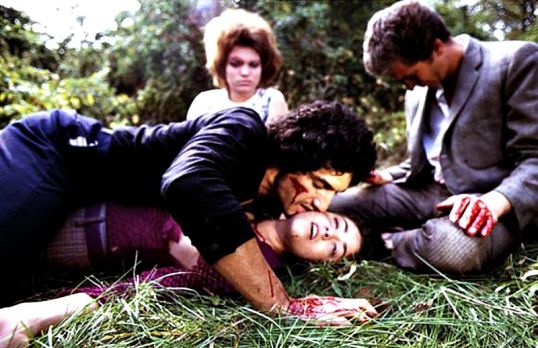
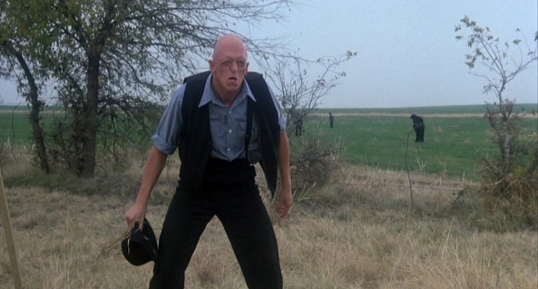
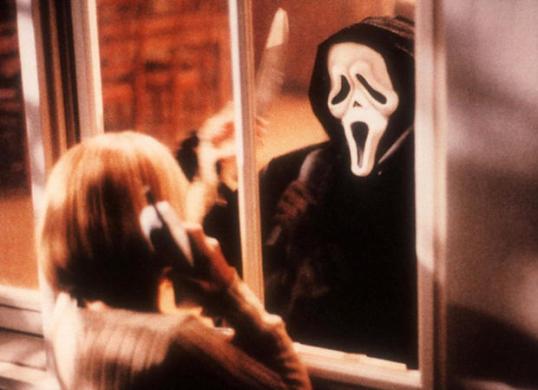
4 Shots From 4 Wes Craven Films: Last House on the Left, Deadly Blessing, A Nightmare on Elm Street, Scream


4 Shots From 4 Films is just what it says it is, 4 shots from 4 of our favorite films. As opposed to the reviews and recaps that we usually post, 4 Shots From 4 Films lets the visuals do the talking!

This October, we’ve been using 4 Shots From 4 Films to pay tribute to some of our favorite horror directors!  Today, we recognize the father and master of modern horror, Wes Craven!

4 Shots From 4 Films

The Last House on the Left (1972, dir. by Wes Craven)

Deadly Blessing (1981, dir by Wes Craven)

A Nightmare on Elm Street (1984, dir. by Wes Craven)

Scream (1996, dir by Wes Craven)


Horror Film Review: Night of the Lepus (dir by William F. Claxton)


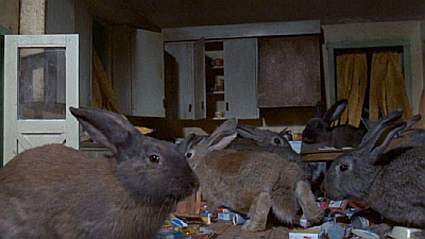
There’s really only one lesson to be learned from the 1972’s Night of the Lepus.

There is absolutely no way to make a rabbit look menacing.

Oh sure, you can film them in slow motion.  And you can add a lot of weird sound effects and you can do a lot of extreme close-ups to make them look bigger than they actually are.  You can do a lot of stuff as a part of your effort to make a rabbit into a scary monster but you’ll pretty much be wasting you time.  Rabbits are simply not intimidating.  There’s a reason why the idea of a killer rabbit was so funny in Monty Python and The Holy Grail.

Now, don’t get me wrong.  I’m enough of country girl that I know the damage that wild rabbits can do.  They eat crops.  They eat bark.  They chew on irrigations lines.  If you’re a farmer or even just someone who wants to maintain a nice garden, you know that rabbits can be a nuisance.

However, that doesn’t change the fact that there’s nothing really menacing rabbits.  Rabbits are cute and, for the most part, they’re fairly timid.  They’re aware that, in the brutal world of nature, they’re designated prey and, as a result, they try to stay out of the way.  Rabbits are shy and they hop around and there’s absolutely nothing frightening about them.

(We actually have quite a few rabbits in my neighborhood.  It’s not unusual for me to see one hopping through the front yard.  Whenever I go for a run in the early evening hours, it’s not unusual for me to see several rabbits hopping through a nearby park.)

Night of the Lepus is a strange film that attempts to make rabbits frightening.  It takes place in the southwest and it features a bunch of mutated, giant rabbits who hop around the desert in slow motion and who savagely kill everyone that they meet.  The plot makes it sound like a spoof but Night of the Lepus takes itself very seriously, which needless to say is a mistake.  It even opens with documentary footage that’s designed to make sure that we understand that rabbits are actually very dangerous.  It’s all very odd and you have to wonder why, out of all the wild animals in the southwest, the filmmakers decided to go with the least intimidating creature possible.  I mean, there are coyotes and Gila monsters in the desert.  Imagine having a giant coyote coming at you.  That would be scary!

Instead, we get giant rabbits, attacking a cast of actors who definitely deserved better.  Stuart Whitman, Janet Leigh, Rory Calhoun, DeForest Kelly, they’re all talented actors and, in this film, they’re reduced to fighting a bunch of giant rabbits.  No one comes across particularly well, though just about everyone in the cast does manage to keep a straight face.  Still, the problem is that the rabbits are just too damn cute.  Even after they’ve killed half the cast, you still don’t want anything to happen to them.  When Whitman and Calhoun opened fire on a group of rabbits and killed a few of them, I actually found myself getting mad at the humans.  Leave the rabbits alone! I thought.  You humans have had your chance!  This the land of rabbits now!

Anyway, Night of the Lepus is silly but it’s kind of fun, just because the giant rabbits are cute.  They’re kind of like the giant guinea pigs that attacked South Park a few seasons ago.  They’re murderous but they’re adorable!


Horror on the Lens: Satan’s School for Girls (dir by David Lowell Rich)


For today’s horror on the lens, we have a 1973 made-for-TV movie called Satan’s School For Girls.

After her sister turns up dead, Elizabeth (Pamela Franklin) refuses to accept that official conclusion that it was a suicide.  Instead, Elizabeth is convinced that it was murder and that it has something to do with the exclusive school that her sister attended, the Salem Academy for Women.

Well, honestly, the Salem part is a dead giveaway.  I think we can all agree on that.

Anyway, this movie features a Satanic cult, an old school clique, and plenty of early of 70s fashion choices.  It may be silly but it’s also definitely entertaining.

Enjoy!

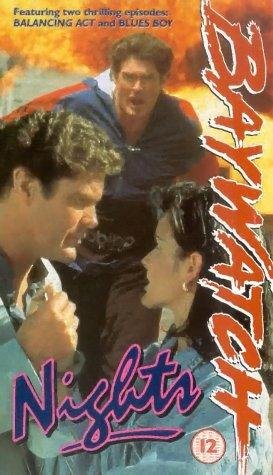
Horror on TV: Baywatch Nights 2.12 “Frozen Out Of Time”


On tonight’s episode of horror on TV, we have an episode of Baywatch Nights that originally aired on February 9th, 1997.  In this one, two 900 year-old Vikings are causing chaos in Los Angeles!  Who can stop them?

David Hasselhoff, of course!

Witchcraft III: The Kiss of Death (1991, directed by Rachel L. Feldman)


After being a baby during the first Witchcraft and a horny high school student during the second Witchcraft, William Spanner becomes a public defender in the third Witchcraft movie.

William (Charles Solomon) is still trying to hide from his heritage as a warlock.  He refuses to discuss his family with his girlfriend, Charlotte (Lisa Toothman) and instead tries to concentrate on helping underprivileged people who have run afoul of the legal system.  His latest client, a teenager named Rubin Carter (Ahmad Reese), claims that he didn’t commit the murder that he’s been accused of.  William is determined to make sure that Rubin gets a fair trial, despite the machinations of the ruthless DA, Vivian Hill (Nicole Lauren).  William has found a way to be useful to society without having to use his magical powers.

However, events are conspiring to force William to embrace his warlock heritage.  Louis (Dominic Luciana) is hitting the bar scene and picking up women so he can give them the “kiss of death” and transfer their lifeforce to his girlfriend, Roxy (Lena Hall).  After Louis arranges to befriend William, he focuses his attentions on Charlotte.  In order to save his girlfriend, William is going to have use the same powers that he’s spent years trying to deny.

Particularly when compared to some of the films that would come after it, Witchcraft III isn’t bad.  William’s motivations for hiding from his past actually make sense and Louis is an enjoyably cheesy villain.  The film features William getting advice from a witch doctor, which introduces the idea that there’s all sorts of different magic in the world.  It’s an intriguing idea, or at least it is when compared with what usually passes for a deep thought in a Witchcraft movie.  That’s the whole key to enjoying Witchcraft III.  Don’t compare it to a real movie.  Compare it to the other Witchcraft films.

I like the idea of a warlock lawyer.  It seems like it could have been a good TV show.  Instead, it would just be a part of horror’s longest-running franchise.  Witchcraft III was enough of a direct-to-video success that Witchcraft IV soon followed.

Game Review: Trusting My Mortal Enemy?! What a Disaster! (2020, Storysinger Presents)


This TWINE game is an entrant in the 2020 Interactive Fiction Competition.  Because it’s October, I’m currently concentrating on only playing the horror and fantasy-based entries but I hope to have played and reviewed all of the entries by November 29th.

In this game, you are Lightbearer, Garden City’s greatest hero.  And you are also Promethium, Garden City’s most nefarious villain.  You play both roles in this unusual text adventure.  When Lightbearer finally defeats Promethium, it might mean that she’ll have to leave Garden City and, for a lot of reasons, she’s not ready to uproot her family and make that move.  So, Lightbearer and Promethium make a deal.  Lightbearer will let Promethium go free on the condition that they continue to have regular “staged” battles.  Lightbearer and Promethium meet regularly at a coffeeshop to choreograph their fights ahead of time.  Depending on the choices that the player makes, the hero and the villain can bond over their unexpected similarities or, as the title suggests, trying to trust your enemy can be a complete disaster.

I enjoyed this game.  It took me by surprise and both Lightbearer and Promethium were interesting and well-written characters.  This game explored why a hero needs a villain and vice versa and the story led to some very unexpected places.  It’s not a short game but it is a rewarding one.  It’s well worth the time required to play it.

It can be played here.

Horror Scenes That I Love: The Dance From Prom Night


In honor of Canadian Thanksgiving, today’s horror scene that I love comes from one of the greatest of the Canadian slasher films, 1980’s Prom Night!

Remember everyone …. Prom Night!  Everything is alright!