October Hacks: Silent Night, Bloody Night (dir by Theodore Gershuny)


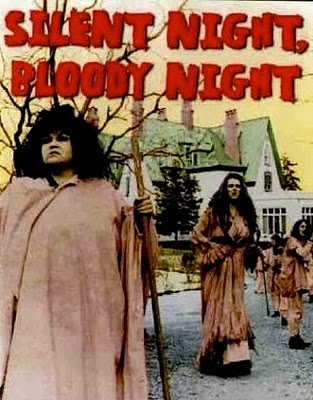
Filmed in 1972 and subsequently released in 1974, Silent Night Bloody Night is a real treat, an atmospheric thriller that has a wonderfully complicated plot that will keep you guessing.

Silent Night Bloody Night opens with attorney John Carter (Patrick O’Neal) arriving in a small town on Christmas Eve.  He’s traveling with his assistant and mistress, Ingrid (Astrid Heeren).  He’s been hired by Jeff Butler (James Patterson) to oversee the sell of his grandfather’s home.  When Carter arrives, he finds that the town is run by a group of elderly eccentrics, including the mute Charlie Towman (John Carradine).  Charlie communicates by ringing a bell and he’s the editor of the town newspaper.  Carter convinces the town council to buy the Butler mansion.  Then, Carter and Ingrid go to the mansion, make love, and are promptly brutally hacked to death by an unseen assailant with an axe.  It’s a shocking moment because, up until their death scene, Carter and Ingrid seemed to be our main characters.  Much as with Marion Crane’s shower in Psycho, their murder leaves an absence at the heart of the film.

That night, our new hero, Jeff Butler (James Patterson) comes to the isolated town to check on how the sale is going.  He finds the mansion locked up and no one willing to talk about John Carter.  With the help of local girl Diane (Mary Woronov), Jeff investigates his grandfather’s death and discovers that the town is full of secrets and people who are willing to kill to maintain them.  As we discover through some wonderfully dream-like flashbacks, Jeff’s grandfather died nearly 40 years ago when he was set on fire in his own home.  Those aren’t the only flashbacks to the film.  In an extended sepia-toned flashback, we learn about the previous inhabitants of the house.  They are all played by former Warhol superstars, including Candy Darling, Ondine, Tally Brown, Charlotte Fairchild, Lewis Love, Harvey Cohen, George Trakas, Susan Rothenberg, and Jack Smith.  (Mary Woronov was, herself, a former member of Warhol’s entourage.)

Silent Night Bloody Night has a terrible reputation.  Mary Woronov, who was married to director Theodore Gershuny at the time she made the film, later described it as being “lousy.”  Personally, I think the film’s reputation has more to do with all of the grainy, bad copies of the film that have turned up in various Mill Creek box sets over the years than the quality of the film itself.  (Silent Night Bloody Night is in public domain.)  The film itself is atmospheric, memorably bloody, and — for those who have the patience to deal with the occasional slow spot — effectively creepy.  Mary Woronov is a likable lead and the Warhol superstars definitely make an impression.  The film plays out at its own deliberate pace and, at its best, it duplicates the feeling of a particularly macabre holiday dream.

Director Theodore Gershuny uses the low budget to his advantage and the sepia-toned flashbacks are truly disturbing and haunting.  Ultimately, Silent Night Bloody Night feels like a dream itself and the mystery’s solution is less important than the journey taken to reach it.

The TSL Horror Grindhouse: Messiah of Evil (dir by Gloria Katz and Willard Huyck)


I can still remember the first time that I saw the 1973 film, Messiah of Evil.

It was on a Monday night, many years ago. I had recently picked up a 10-movie DVD box set called Tales of Terror and I was using the movies inside to try to deal with a bout of insomnia. I had already watched The Hatchet Murders (a.k,a. Deep Red) and The House At The Edge of the Park and, at two in the morning, I was faced with a decision. Should I try to sleep or should I watch one more movie?

Naturally, I chose to watch one more movie and the movie I picked was Messiah of Evil. So, there I was at two in the morning, sitting at the edge of my bed in my underwear and watching an obscure horror movie while rain fell outside.

And, seriously — this movie totally FREAKED me out!

Messiah of Evil opens with a man (played by future director Walter Hill) stumbling through the night, obviously trying to escape from something.  A mysterious woman appears and kills him.  We’re left to wonder who the man was supposed to be as the film doesn’t ever really return to his murder.  In most films this would be a weakness but it feels appropriate for Messiah of Evil, a film that plays out with the visual style and fragmented logic of a particularly intense nightmare.

The rest of the story tells the story of Arletty (Marianna Hill), a neurotic woman who drives to an isolated California town in order to visit her father. Her father is an artist who specializes in painting eerie pictures of large groups of black-clad people. However, once she arrives at his home, Arletty discovers that her father has vanished and left behind a diary where he claims that a darkness has overtaken the town.  Meanwhile, it sometimes appear as if the people in the paintings are moving or threatening to come out of the walls.

Meanwhile, one crazed man (Elisha Cook, Jr.) explains that “the dark stranger” is returning.  An albino (Bennie Robinson) drives a truck up and down the street and talks about how he likes to listen to “Wagner.”  The back of the truck is full of blank-faced people staring at the sky and the Albino eats a rat.  Finally, a mysterious man named Thom (Michael Greer) is wandering about town with two groupies (played by Anitaa Ford and Joy Bang) and interviewing random townspeople.  After meeting Arletty, they all end up moving into her father’s house.

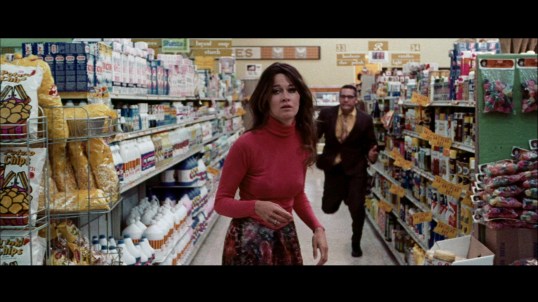
Messiah of Evil is literally one of the strangest films that I’ve ever seen. It’s shot in a dream-like fashion and the much of the film is left open to the viewer’s interpretation.  Joy Bang goes to see a Sammy Davis, Jr. western and doesn’t notice as the theater slowly fills up with pale, red-eyed townspeople.  Anitra Ford goes to a grocery store late at night and discovers the townspeople indulging in their appetites.  If the film was only distinguished by those two scenes, it would still be worth saying.  However, Messiah of Evil is a total and complete experience, a film where every scene matters and the audience is tasked with putting the puzzle together.

This film was directed by Gloria Katz and Willard Huyck, two longtime associates of George Lucas.  (They wrote the screenplay for American Graffiti and Huyck directed Howard The Duck.)  There’s absolutely nothing else in their filmography that is as surreal as Messiah of Evil, leading me to suspect that the film itself might be a very fortunate accident.  Apparently, the production ran out of money before Katz and Huyck finished principal photography, which is what led to the film’s disjointed nature.  Accident or not, Messiah of Evil is a masterpiece of surreal horror.

Messiah of Evil (1973, directed by Willard Huyck and Gloria Katz)

Doctor Who — The Three Doctors (1972-1973, directed by Lennie Manye)


For the tenth season of Doctor Who, the BBC knew that they needed to start things off with a bang.  The first serial of season ten, The Three Doctors, brought together the first three actors who had played the Doctor.

A crisis was needed to explain why the Time Lords would decide to break their owns laws by bringing the Second Doctor and then the First Doctor out of their respective time zones.  Writers Dave Martin and Bob Baker came up with a story about the Doctor’s homeworld having its energy drained through a black hole.  If Gallifrey is destroyed then all of time and space will unravel.  (Everyone who has seen an episode of the original Doctor Who knows the drill.)  The villain is Omega (Stephen Thorne, who also played Azal in The Daemons), the first Time Lord, who has never forgiven his fellow Time Lords for abandoning him in an anti-matter universe that looks like a quarry.  The story is silly in the way that Doctor Who often could be but I think anyone watching will understand that the story is not that important.  Omega, the black hole, the energy blob that is sent to Earth to capture the Third Doctor, all of it was really just an excuse to bring back Patrick Troughton and William Hartnell.

Hartnell does not get to do much.  He was in increasingly poor health when he returned as the First Doctor and was also suffering from memory problems.  Sadly, this prevented him from sharing the same physical space as Troughton and Jon Pertwee.  Instead, it’s explained that the First Doctor is caught in a time eddy and can only communicate via the TARDIS’s viewscreen.  Even if he isn’t physically present, the First Doctor reveals himself to be the smartest of the three Doctors.  When he isn’t scolding the Second and Third Doctors, he’s figuring out how to enter Omega’s universe.  It’s not always easy to watch Hartnell looking frail and clearly reading some of his lines from cue cards but, even when ill, he still had the natural authority that he brought to the first two and a half  seasons of Doctor Who.

Patrick Troughton and Jon Pertwee are a delight to watch.  Their bickering is one of the highlights of the serial and both Troughton and Pertwee appear to have really enjoyed their scenes together.  The show also gets mileage from including the Brigadier (Nicholas Courtney) and Sgt. Benton (John Levene) along with the three Doctors.  I’ve always enjoyed how both of them come to accept the strangest of things with barely a shrug.  This is the episode where Benton enters the TARDIS and, when the Third Doctor asks if Benton’s going to point out that it’s bigger on the inside than the outside, replies, “It’s pretty obvious, isn’t it?”

The Three Doctors is hardly a perfect Doctor Who adventure.  (If any adventure needed the presence of the The Master, it was this one.)  It is, however, a tribute to the men who played the first three Doctors and the role they all played in making the show an institution.  The Three Doctors was also the final acting role of William Hartnell, who passed away two years after the serial was broadcast.

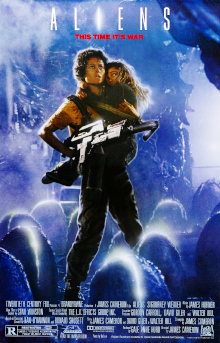
Aliens (1986, directed by James Cameron)


When I learned that today was Sigourney Weaver’s birthday, I flashed back to the first time I saw Aliens.

I was just a kid, probably too young for the movie.  My father rented Aliens from the local Blockbuster.  It had been years since the movie had first come out but my father, who went to every Star Trek movie premiere and who still knows the lore of Star Wars better than I do, had never seen it and he was planning on correcting that oversight.  My family gathered in the living room.  We turned out all the lights.  The tape was slipped into the VCR.  Play was hit.  Our boxy television turned into a movie screen and Aliens began.

And it scared the Hell out of me.

Today, I think people forget just how scary both Alien and Aliens are the first time that you watch them.  After the first time, you at least know when the aliens are going to jump out at people and you also know who is going to survive.  Today, if I rewatch Aliens, I know not to get to attached to the any of the Colonial Marines.  I also know not to trust Carter Burke, even if he is played by Paul Reiser.  I watch the movie in anticipation of Bill Paxton’s “Game over, man,” instead of dreading it.  When I first watched it, all I knew is that the screen suddenly went dark, the soundtrack was full of screeches and the deaths of the Marines, and that the only thing scarier then being confronted with one alien was being confronted with a hundred of them at once.  When I watch today, I know Bishop (Lance Henriksen) is going to prove to be a good android.  I didn’t have the assurance when I first watched the movie.  For all I knew, he was going to just abandon Ripley (Weave), Newt (Carrie Henn),and Hicks (Michael Biehn) on the planet.

Sigourney Weaver was the heart of that film.  She went from being angry and bitter over what happened during then first Alien to still being angry and bitter but willing to risk her life to save Newt.  From the start, she alone understood the Xenomorph threat and she was ultimately victorious because she was not only as determined and ruthless as the Queen but she actually had the heart that her opponent lacked.  Ripley won because she was actually fighting for something more than just conquest.  She was fighting to save Newt from becoming an incubator.

I usually think of Aliens as being the last Ripley film.  I don’t acknowledge the third film because I find the idea of killing Newt and Hicks to be a betrayal of what made the first Aliens more than just a scary action movie.  The fourth film, I don’t acknowledge because it asks me to believe that Winona Ryder would still be acting like Winona Ryder in the 23rd century.  Aliens is a scary movie but it’s also a movie that ends with the promise of hope.  After all that she’s been through, Ripley finally has a chance to start again with Newt, Hicks, and Bishop.   That hope is something that is too often missing from the follow-ups.

Happy birthday, Sigourney Weaver!  I’m going to go watch Aliens.

Horror Scenes That I Love: Ripley’s Last Stand in Alien


Since today is Sigourney Weaver’s birthday, I think it’s probably a given that today’s scene of the day would feature her defeating an alien.  In this scene from 1979’s Alien, Ripley shows why she is the last human survivor of the Nostromo.

(As cool as Ripley is, she’s still nowhere close to being as much of a badass as Jonesy the Cat.  Jonesy just had to hiss and the alien knew better than to mess with the ship’s cat.)

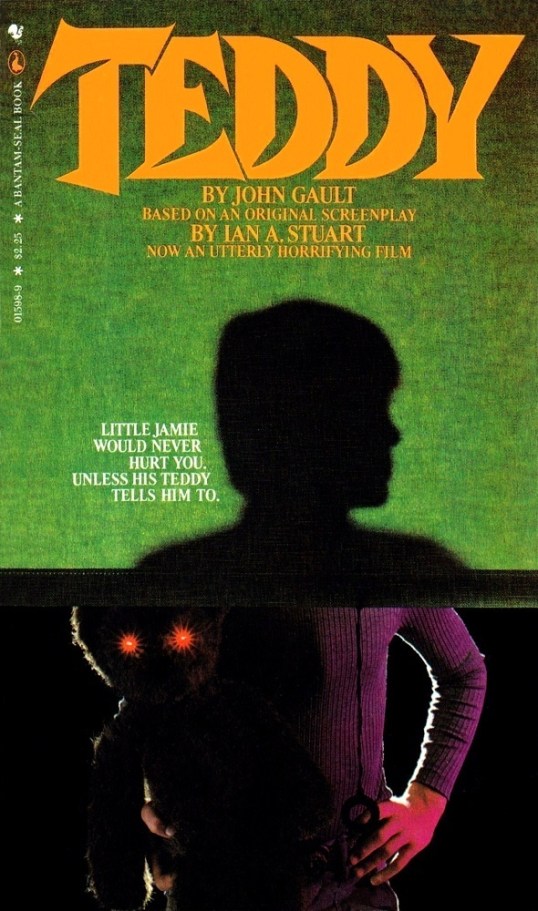
Horror Novel Review: Teddy by John Gault


Yesterday, I wrote about a Canadian horror film called The Pit.  I mentioned that it was a film about a creepy 12 year-old named Jamie who had conversations with his teddy bear, developed a not-so-innocent crush on his babysitter, and who regularly fed the people he disliked to a bunch of underground monsters who lived in a pit in the woods.

Yesterday, I also read Teddy, the 1980 novelization of The Pit.

(The Pit was originally titled Teddy.)

Teddy is even more creepy than The Pit, largely because it includes all of the disturbing details that were either cut from the finished film or perhaps dropped when the script was rewritten.  Jamie is still a creepy 12 year-old who talks to his teddy bear.  Unlike the film, the novel makes it clear that Teddy is actually a living force of evil and that his words are not just a figment of Jamie’s imagination.  The book actually suggests that Teddy moves from child to child, corrupting each of its owners.  Teddy in the book is also a hundred times more pervy than Teddy in the movie, making some rather crude comments about Jamie’s mom and later encouraging Jamie to join him in checking out some porno magazines.

The book also delves into the investigations surrounding the disappearance of Jamie’s many victims.  As a result, we get to know the victims a bit better in the book than we did in the movie.  Also as a result, Jamie also comes across as much more deliberately evil in the book than he does in the movie.  Even if he is under the possible demonic influence of Teddy, Jamie still seems to take way too much pleasure in people dying.  This is especially true of the scene where his babysitter falls into the pit.  In the movie, Jamie tries to help her escape.  In the book, Jamie not only pushes her but smiles afterwards as he listens to her screams.

Agck!  What a creepy kid!

Teddy is a pretty effective little horror novelization.  It’s also not easy to find a physical copy.  However, you can read it at Open Library.

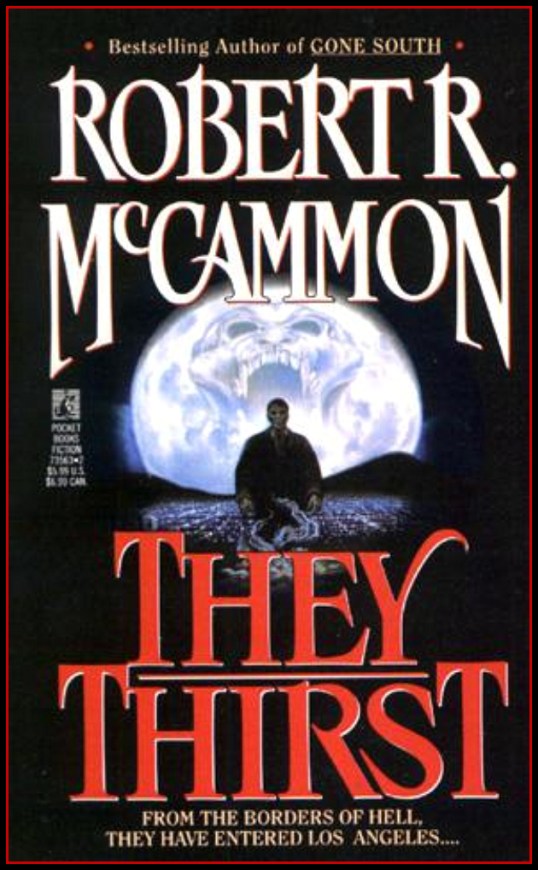
Horror Book Review: They Thirst (by Robert R. McCammon)


Robert McCammon’s 1981 novel They Thirst stands as a significant yet often overlooked contribution to the vampire horror genre and to modern horror literature more broadly. The novel deftly marries Gothic vampire traditions with contemporary anxieties surrounding urban decay, societal collapse, and the limitations of scientific reasoning. McCammon’s approach—transforming vampirism from a supernatural curse into a viral, apocalyptic force—presents a fresh perspective that elevates the narrative beyond conventional monster fiction. The result is a richly detailed and thought-provoking story that explores not just the nature of evil, but humanity’s fragile relationship with belief, knowledge, and survival.

The novel’s geographical and thematic scope is ambitious from the outset. It begins in Eastern Europe, grounding the story firmly in vampire mythology, before making a dramatic shift to Los Angeles, California. This transition is more than a change of location; it serves as a potent narrative device. While Stephen King’s ’Salem’s Lot confines the vampire threat to the insular setting of a small New England town, They Thirst imagines an entire sprawling metropolis consumed from within. Los Angeles—with its sprawling excesses, cultural contrasts, and complicated history—becomes a perfect backdrop for the ancient evil of McCammon’s story. In many ways, the city and the novel’s antagonist are made for one another: Vulkan, a 13th-century Hungarian prince turned vampire, and his undead legion prey on humanity’s vulnerable underbelly, just as Los Angeles has often been depicted as a city feeding off the dreams—and the desperation—of its most naive and downtrodden residents.

This parallel between city and vampire empire is one of the novel’s strongest thematic elements. Both embody forms of false promise: Los Angeles offers fame, wealth, and a kind of modern immortality through celebrity culture, while Vulkan offers literal immortality through vampirism. Yet both promises are double-edged. The city’s glittering surface conceals poverty, violence, and spiritual emptiness; Vulkan’s offer of eternal life masks the curse of undeath and loss of humanity. In that sense, Vulkan and Los Angeles mirror each other, feeding off hope and desperation alike. This symbiotic relationship deepens the horror: it’s not just that vampires invade the city, but that they thrive there because the city, in its essence, is already broken and hungry.

The antagonist, Prince Vulkan, represents the archetypal vampire lord but is also reimagined as a force of apocalyptic renewal. His ambition is to establish a vampiric empire within Los Angeles, turning the city into a dark kingdom under his rule. The irony of this choice is palpable; Los Angeles is a city obsessed with youth, image, and perpetual reinvention, and Vulkan exploits those cultural values by offering something seemingly eternal. His infiltration begins subtly—with grave robberies, disappearances, and escalating violence—until the infestation becomes impossible to ignore. The city’s sprawling nature, its labyrinthine neighborhoods, and its social divides become the perfect terrain for an epidemic to spread unchecked.

McCammon stays true to Bram Stoker’s legacy, incorporating essential vampire lore: vulnerability to sunlight, the necessity of native soil in coffins, and the insatiable craving for blood remain central to the story. But he sets these paranormal elements against a starkly modern world, making their impact feel immediate and unavoidable. One striking subplot involves a wealthy coffin manufacturer whose industrial-scale production unwittingly supports Vulkan’s legion by supplying coffins in large quantities. This detail reinforces the novel’s critique of modernity: progress and capitalism, while often celebrated, can be co-opted by darkness when divorced from awareness and wisdom.

Central to the narrative is the novel’s sharp examination of science and superstition. McCammon critiques modern rationalism’s limits when confronted with the inexplicable. As the vampire epidemic grows, institutions built on evidence and strict rationality—police departments, medical professionals, the press—are shown to be inadequate. Police officers demand forensic proof; scientists dismiss eyewitness accounts as hysteria or fabrication; journalists prioritize sensationalism over truth. This widespread skepticism, while understandable in a culture founded on empiricism, ironically becomes what allows the vampires to thrive. McCammon suggests that humanity’s overreliance on logic and denial is itself a fatal vulnerability. The story implies that what civilization labels “superstition” may hold the very keys to survival against threats outside the realm of science.

This tension—between modern science and the supernatural—gives the novel a distinctively unsettling atmosphere. The city’s collapse is not solely due to the vampires themselves but also because humanity’s intellectual arrogance leaves it vulnerable. The horror grows as reason twists into denial, and disbelief becomes as lethal as the vampires’ bite. McCammon doesn’t dismiss science but critiques a worldview that excludes anything it can’t measure or rationalize. The vampires are, in a way, as much the product of this intellectual blindness as they are physical monsters.

From this thematic core comes one of the novel’s most compelling characters: Detective Andy Palatizin. A man haunted by his past in Hungary, Palatizin has already faced these same creatures in his youth. His instincts and knowledge make him an outlier in the modern police force, where skeptics and bureaucrats dismiss his warnings as superstition. Palatizin’s struggle embodies the tension between ancient wisdom and modern disbelief. Alongside him are characters who represent various facets of Los Angeles life: Wes Richer, a hopeful comedian whose life is upended by the chaos; Solange, his psychic partner who senses the darkness; Tommy Chandler, a youth thrust unwillingly into the fight against evil; and Kobra, a dangerous albino gang leader whose alliance with Vulkan underscores the novel’s bleak view of human nature. Through these characters, McCammon presents a cross-section of humanity reacting to incomprehensible horror in ways both brave and flawed.

The novel’s pacing builds steadily, escalating from subtle unease to urban apocalypse. McCammon’s detailed descriptions of Los Angeles falling apart—freeways clogged with abandoned vehicles, entire neighborhoods burned out, power grids failing—create a vivid portrait of a civilization unraveling. It is in this progression that They Thirst transcends the conventional vampire tale, transforming into a mythic story of apocalypse. The battle grows beyond individual survival into a symbolic contest between light and darkness, belief and denial.

In this way, They Thirst invites comparison not only to ’Salem’s Lot but also to Stephen King’s The Stand. Both novels begin with localized catastrophe but evolve toward apocalyptic narrative arcs that weigh heavily on the theme of good versus evil. Palatizin’s final confrontation with Prince Vulkan mirrors the spiritual and philosophical duels seen in The Stand—a struggle not only between man and monster but between faith and nihilism. This heightened mythic tone gives They Thirst a resonance that extends beyond its genre, engaging with questions about human nature, belief, and the limits of reason.

The novel’s themes also echo the Japanese vampire tale Shiki, which similarly explores a community’s devastating response to supernatural infection and the corrosive effects of denial. Although Shiki is set in a small rural village as opposed to a vast city, both stories articulate the dangers of refusing to confront inconvenient truths, particularly when those truths conflict with scientific rationality or cultural blindness. McCammon’s choice of Los Angeles as a setting magnifies this theme, illustrating how sprawling urban environments—with their anonymity, social stratification, and competing belief systems—become fertile ground for supernatural and existential threats alike.

Moreover, They Thirst represents a crucial moment in Robert McCammon’s development as a writer of expansive horror fiction. The novel’s sophisticated interplay between individual characters and large-scale disaster foreshadows the narrative techniques he would later perfect in Swan Song. If They Thirst can be considered McCammon’s ’Salem’s Lot—an exploration of vampirism growing into an epic struggle—then Swan Song stands as his The Stand—a sweeping post-apocalyptic saga combining horror, hope, and human resilience on a grand scale. Seen in this light, They Thirst is not only a memorable and impactful vampire narrative but also the author’s foundational work in epic horror storytelling.

In sum, They Thirst is a novel of considerable ambition and thematic richness. It successfully unites Gothic vampire mythology with contemporary social concerns, delivering a story that is both thrilling and intellectually engaging. The interplay of science and superstition, the vivid portrayal of Los Angeles as a city on the brink, and the moral complexity of its characters elevate the book beyond simple genre fare. This novel offers a challenging and unforgettable journey — a reminder that some darkness is older than reason and that even the brightest city lights may hide the longest shadows.
Would further assistance be welcome in preparing this review for publication or tailoring it to a specific format or audience?Robert McCammon’s 1981 novel They Thirst stands as a significant yet often overlooked contribution to the vampire horror genre and to modern horror literature more broadly. The novel deftly marries Gothic vampire traditions with contemporary anxieties surrounding urban decay, societal collapse, and the limitations of scientific reasoning. McCammon’s approach—transforming vampirism from a supernatural curse into a viral, apocalyptic force—presents a fresh perspective that elevates the narrative beyond conventional monster fiction. The result is a richly detailed and thought-provoking story that explores not just the nature of evil, but humanity’s fragile relationship with belief, knowledge, and survival.

The novel’s geographical and thematic scope is ambitious from the outset. It begins in Eastern Europe, grounding the story firmly in vampire mythology, before making a dramatic shift to Los Angeles, California. This transition is more than a change of location; it serves as a potent narrative device. While Stephen King’s ’Salem’s Lot confines the vampire threat to the insular setting of a small New England town, They Thirst imagines an entire sprawling metropolis consumed from within. Los Angeles—with its sprawling excesses, cultural contrasts, and complicated history—becomes a perfect backdrop for the ancient evil of McCammon’s story. In many ways, the city and the novel’s antagonist are made for one another: Vulkan, a 13th-century Hungarian prince turned vampire, and his undead legion prey on humanity’s vulnerable underbelly, just as Los Angeles has often been depicted as a city feeding off the dreams—and the desperation—of its most naive and downtrodden residents.

This parallel between city and vampire empire is one of the novel’s strongest thematic elements. Both embody forms of false promise: Los Angeles offers fame, wealth, and a kind of modern immortality through celebrity culture, while Vulkan offers literal immortality through vampirism. Yet both promises are double-edged. The city’s glittering surface conceals poverty, violence, and spiritual emptiness; Vulkan’s offer of eternal life masks the curse of undeath and loss of humanity. In that sense, Vulkan and Los Angeles mirror each other, feeding off hope and desperation alike. This symbiotic relationship deepens the horror: it’s not just that vampires invade the city, but that they thrive there because the city, in its essence, is already broken and hungry.

The antagonist, Prince Vulkan, represents the archetypal vampire lord but is also reimagined as a force of apocalyptic renewal. His ambition is to establish a vampiric empire within Los Angeles, turning the city into a dark kingdom under his rule. The irony of this choice is palpable; Los Angeles is a city obsessed with youth, image, and perpetual reinvention, and Vulkan exploits those cultural values by offering something seemingly eternal. His infiltration begins subtly—with grave robberies, disappearances, and escalating violence—until the infestation becomes impossible to ignore. The city’s sprawling nature, its labyrinthine neighborhoods, and its social divides become the perfect terrain for an epidemic to spread unchecked.

McCammon stays true to Bram Stoker’s legacy, incorporating essential vampire lore: vulnerability to sunlight, the necessity of native soil in coffins, and the insatiable craving for blood remain central to the story. But he sets these paranormal elements against a starkly modern world, making their impact feel immediate and unavoidable. One striking subplot involves a wealthy coffin manufacturer whose industrial-scale production unwittingly supports Vulkan’s legion by supplying coffins in large quantities. This detail reinforces the novel’s critique of modernity: progress and capitalism, while often celebrated, can be co-opted by darkness when divorced from awareness and wisdom.

Central to the narrative is the novel’s sharp examination of science and superstition. McCammon critiques modern rationalism’s limits when confronted with the inexplicable. As the vampire epidemic grows, institutions built on evidence and strict rationality—police departments, medical professionals, the press—are shown to be inadequate. Police officers demand forensic proof; scientists dismiss eyewitness accounts as hysteria or fabrication; journalists prioritize sensationalism over truth. This widespread skepticism, while understandable in a culture founded on empiricism, ironically becomes what allows the vampires to thrive. McCammon suggests that humanity’s overreliance on logic and denial is itself a fatal vulnerability. The story implies that what civilization labels “superstition” may hold the very keys to survival against threats outside the realm of science.

This tension—between modern science and the supernatural—gives the novel a distinctively unsettling atmosphere. The city’s collapse is not solely due to the vampires themselves but also because humanity’s intellectual arrogance leaves it vulnerable. The horror grows as reason twists into denial, and disbelief becomes as lethal as the vampires’ bite. McCammon doesn’t dismiss science but critiques a worldview that excludes anything it can’t measure or rationalize. The vampires are, in a way, as much the product of this intellectual blindness as they are physical monsters.

From this thematic core comes one of the novel’s most compelling characters: Detective Andy Palatizin. A man haunted by his past in Hungary, Palatizin has already faced these same creatures in his youth. His instincts and knowledge make him an outlier in the modern police force, where skeptics and bureaucrats dismiss his warnings as superstition. Palatizin’s struggle embodies the tension between ancient wisdom and modern disbelief. Alongside him are characters who represent various facets of Los Angeles life: Wes Richer, a hopeful comedian whose life is upended by the chaos; Solange, his psychic partner who senses the darkness; Tommy Chandler, a youth thrust unwillingly into the fight against evil; and Kobra, a dangerous albino gang leader whose alliance with Vulkan underscores the novel’s bleak view of human nature. Through these characters, McCammon presents a cross-section of humanity reacting to incomprehensible horror in ways both brave and flawed.

The novel’s pacing builds steadily, escalating from subtle unease to urban apocalypse. McCammon’s detailed descriptions of Los Angeles falling apart—freeways clogged with abandoned vehicles, entire neighborhoods burned out, power grids failing—create a vivid portrait of a civilization unraveling. It is in this progression that They Thirst transcends the conventional vampire tale, transforming into a mythic story of apocalypse. The battle grows beyond individual survival into a symbolic contest between light and darkness, belief and denial.

In this way, They Thirst invites comparison not only to ’Salem’s Lot but also to Stephen King’s The Stand. Both novels begin with localized catastrophe but evolve toward apocalyptic narrative arcs that weigh heavily on the theme of good versus evil. Palatizin’s final confrontation with Prince Vulkan mirrors the spiritual and philosophical duels seen in The Stand—a struggle not only between man and monster but between faith and nihilism. This heightened mythic tone gives They Thirst a resonance that extends beyond its genre, engaging with questions about human nature, belief, and the limits of reason.

The novel’s themes also echo the Japanese vampire tale Shiki, which similarly explores a community’s devastating response to supernatural infection and the corrosive effects of denial. Although Shiki is set in a small rural village as opposed to a vast city, both stories articulate the dangers of refusing to confront inconvenient truths, particularly when those truths conflict with scientific rationality or cultural blindness. McCammon’s choice of Los Angeles as a setting magnifies this theme, illustrating how sprawling urban environments—with their anonymity, social stratification, and competing belief systems—become fertile ground for supernatural and existential threats alike.

Moreover, They Thirst represents a crucial moment in Robert McCammon’s development as a writer of expansive horror fiction. The novel’s sophisticated interplay between individual characters and large-scale disaster foreshadows the narrative techniques he would later perfect in Swan Song. If They Thirst can be considered McCammon’s ’Salem’s Lot—an exploration of vampirism growing into an epic struggle—then Swan Song stands as his The Stand—a sweeping post-apocalyptic saga combining horror, hope, and human resilience on a grand scale. Seen in this light, They Thirst is not only a memorable and impactful vampire narrative but also the author’s foundational work in epic horror storytelling.

In sum, They Thirst is a novel of considerable ambition and thematic richness. It successfully unites Gothic vampire mythology with contemporary social concerns, delivering a story that is both thrilling and intellectually engaging. The interplay of science and superstition, the vivid portrayal of Los Angeles as a city on the brink, and the moral complexity of its characters elevate the book beyond simple genre fare. This novel offers a challenging and unforgettable journey — a reminder that some darkness is older than reason and that even the brightest city lights may hide the longest shadows.

October True Crime: Murder So Sweet (dir by Larry Peerce)


1993’s Murder So Sweet, also known a Poisoned By The Love: The Kern County Murders (seriously, try to say that ten times fast), tells the story of Steven David Catlin.

Steven David Catlin lived in Bakersfield, California.  Catlin was a career criminal who was married six times and who found some personal redemption for himself as a member of the pit crew for a professional race car driver in Fresno.  Trust me, I’ve lived in enough small, country towns to know that people will overlook a lot as long as someone knows how to work on a car.

One thing that people noticed about Catlin is that the people around him had a habit of dying of mysterious illnesses.  Multiple wives, his adoptive parents, they all died with fluid in their lungs and they left behind not only a medical mystery but also quite a bit of money for Steven David Catlin.  Catlin would always insist on holding a cremation just days after his loved ones passed away.  Not only did that allow Catlin to move on but also kept anyone from being able to do a thorough autopsy.

Eventually, the police figured out that Catlin was just poisoning anyone who got on his nerves or threatened to divorce him.  He wasn’t even a particularly clever poisoner.  He used paraquet, a highly toxic herbicide and he kept the bottle sitting in plain view in his garage.  He might as well have just labeled it his “Poisoning Thermos.”  Catlin was convicted of multiple murders and he was sentenced to die in 1990.  Of course, this being California, Catlin is sill alive and sitting in San Quentin.  This really is a case of “If you lived in Texas, you’d be dead by now.”

In Murder My Sweet, Catlin is played Harry Hamlin, who steals the film as a dumb but charming redneck who walks with a confident swagger and has no fear of hitting on his ex-wife, even after he realizes that she’s trying to convince the police that he’s a murderer.  Helen Shaver played Edie Bellew, the ex who knows better than to trust Catlin.  Her current husband is played by Terence Knox and there’s plenty of scenes of him telling Edie that she needs to back off and that everyone knows that Steve Catlin isn’t a murderer.  In many ways, this is the ultimate Lifetime film in that Edie Bellew not only gets to put her ex-husband in prison but she also proves that her current husband doesn’t know what he’s talking about.

Murder My Sweet takes place in rural California and, as a result, everyone in the film speaks with a shrill country accent and we spend a lot of time in a really tacky beauty parlor.  Indeed, the film portrayal of country eccentricity is so over-the-top that I was tempted to say that it seemed as if the director was trying to rip-off David Lynch.  However, Lynch may have made films about eccentric characters but he never portrayed them as being caricatures.  Lynch loved his eccentrics while this film takes a bit of a condescending attitude towards them.  Still, it’s worth watching for Harry Hamlin’s sleazy turn as Steve Catlin, a guy who enjoys fast cars and making ice cream.

Just don’t eat that ice cream….

Horror Song of the Day: Main Title Theme From Alien By Jerry Goldsmith


Today, the Shattered Lens wishes a happy birthday to the one and only Sigourney Weaver.  Seen here with Jonesy the Cat, Weaver will always be best-remembered for bringing to life Ellen Ripley and totally revolutionizing both horror and science fiction!

Today’s song of the day comes from Jerry Goldsmith’s iconic score for Alien.

4 Shots From 4 Horror Films: 1930s Part Three


This October, I’m going to be doing something a little bit different with my contribution to 4 Shots From 4 Films.  I’m going to be taking a little chronological tour of the history of horror cinema, moving from decade to decade.

Today, we complete the 1930s.

4 Shots From 4 Films

Dracula's Daughter (1936, dir by Lambert Hillyer)

Dracula’s Daughter (1936, dir by Lambert Hillyer)

Revolt of the Zombies (1936, dir by Victor Halperin)

Revolt of the Zombies (1936, dir by Victor Halperin)

Sweeney Todd: The Demon Barber of Fleet Street (1936, dir by George King)

Sweeney Todd: The Demon Barber of Fleet Street (1936, dir by George King)

Son of Frankenstein (1939, dir by Rowland V. Lee)

Son of Frankenstein (1939, dir by Rowland V. Lee)