The latest “Song of the Day” comes from my latest obsession that should take up much free time I have when not blogging or working. It’s the main theme from the latest entry in the Elder Scrolls rpg franchise from Bethesda, Elder Scrolls V: Skyrim. The theme has been unofficially called “Song of the Dragonborn” and I’m more than fine with that unofficial title.
“Song of the Dragonborn” was written and composed by this franchise’s longtime music composer in Jeremy Soule. He has done the orchestral score in this series’ previous two titles and this latest one looks to continue the quality work he’s done in the past. The song is a combination of Wagnerian-style orchestral music with the martial chanting by the male chorus. The chorus itself is from the fictional language of the Nord (the Viking like race in the game) created just for this game.
All I can say is that this song has been on constant repeat since I started playing this game and it’s such a great backdrop to slaying people and things in the game with my Nord Warrior, Berek Thunderfist.
Song of the Dragonborn
(Chorus)
Dovahkiin, Dovahkiin, naal ok zin los vahriin,
Wah dein vokul mahfaeraak ahst vaal!
Ahrk fin norok paal graan fod nust hon zindro zaan,
Dovahkiin, fah hin kogaan mu draal!
Huzrah nu, kul do od, wah aan bok lingrah vod,
Ahrk fin tey, boziik fun, do fin gein!
Wo lost fron wah ney dov, ahrk fin reyliik do jul,
Voth aan suleyk wah ronit faal krein!
Ahrk fin zul, rok drey kod, nau tol morokei frod,
Rul lot Taazokaan motaad voth kein!
Sahrot Thu’um, med aan tuz, vey zeim hokoron pah,
Ol fin Dovahkiin komeyt ok rein!
(Chorus)
Dovahkiin, Dovahkiin, naal ok zin los vahriin,
Wah dein vokul mahfaeraak ahst vaal!
Ahrk fin norok paal graan fod nust hon zindro zaan,
Dovahkiin, fah hin kogaan mu draal!
Ahrk fin Kel lost prodah, do ved viing ko fin krah,
Tol fod zeymah win kein meyz fundein!
Alduin, feyn do jun, kruziik vokun staadnau,
Voth aan bahlok wah diivon fin lein!
Nuz aan sul, fent alok, fod fin vul dovah nok,
Fen kos nahlot mahfaeraak ahrk ruz!
Paaz Keizaal fen kos stin nol bein Alduin jot,
Dovahkiin kos fin saviik do muz!
(Chorus)
Dovahkiin, Dovahkiin, naal ok zin los vahriin,
Wah dein vokul mahfaeraak ahst vaal!
Ahrk fin norok paal graan fodnust vok zin dro zaan,
Dovahkiin, fah hin kogaan mu draal!
* * * * *
(Chorus)
Dragonborn, Dragonborn, by his honor is sworn,
To keep evil forever at bay!
And the fiercest foes rout when they hear triumph’s shout,
Dragonborn, for your blessing we pray!
Hearken now, sons of snow, to an age, long ago,
And the tale, boldly told, of the one!
Who was kin to both wyrm, and the races of man,
With a power to rival the sun!
And the voice, he did wield, on that glorious field,
When great Tamriel shuddered with war!
Mighty Thu’um, like a blade, cut through enemies all,
As the Dragonborn issued his roar!
(Chorus)
Dragonborn, Dragonborn, by his honor is sworn,
To keep evil forever at bay!
And the fiercest foes rout when they hear triumph’s shout,
Dragonborn, for your blessing we pray!
And the Scrolls have foretold, of black wings in the cold,
That when brothers wage war come unfurled!
Alduin, Bane of Kings, ancient shadow unbound,
With a hunger to swallow the world!
But a day, shall arise, when the dark dragon’s lies,
Will be silenced forever and then!
Fair Skyrim will be free from foul Alduin’s maw,
Dragonborn be the savior of men!
(Chorus)
Dragonborn, Dragonborn, by his honor is sworn,
To keep evil forever at bay!
And the fiercest foes rout when they hear triumph’s shout,
Well, the time that seems to arrive once every year around November has finally arrived. The latest iteration of the Call of Duty first-person shooter franchise from Activision will see a midnight release starting 12:01 am on November 8, 2011. Already there are lines numbering in the hundreds in major cities. Parties being held at stores such as Best Buy and Gamestop as hundreds of thousands, if not, millions of gamers flock to get the game in their hands. This game is Call of Duty: Modern Warfare 3 and it’s one of those rare video games which actually lowers work productivity the week of it’s release. It will be safe to assume that the morning of November 8, 2011 will see a high amount of sick calls and last minute PTO requests.
I won’t be one of them but I will still get this game in a week or two. Until then I’ll just continue to watch this funny and creative trailer for the game starring Jonah Hill, Sam Worthington and Dwight Howard.
It looks like the Grand Theft Auto franchise from Take-Two Interactive and Rockstar Games will continue onward with a new title that was recently announced through a debut trailer.
Grand Theft Auto V looks to be a sort of sequel to Grand Theft Auto: San Andreas which was set in the fictional west coast state of San Andreas and the city of Los Santos. While not much else about this upcoming have been released to the public the reaction to the trailer has been extremely positive. This franchise remains one of the cornerstone of the console gaming industry. As more and more information becomes available from Take-Two Interactive, Rockstar Games and Rockstar North I am sure the hype for Grand Theft Auto V will continue to just go up.
There hasn’t been an announcement as to which gaming platform the title will come out on, but it would be a major surprise if this title doesn’t get a multiplatform release onto the Xbox 360, PS3 and maybe the PC and the upcoming new Nintendo console, Wii U.
So, anyone else excited by the prospect of another new Grand Theft Auto title?
I left off yesterday having discussed Blizzard’s initial overview of the Pandaria zone, the race of Pandaren, and the new Monk class. As with any expansion, World of Warcraft: Mists of Pandaria will feature much more than simply new quest and raiding content, however. Here is a look at some of the major additions and changes:
Talents 2.0
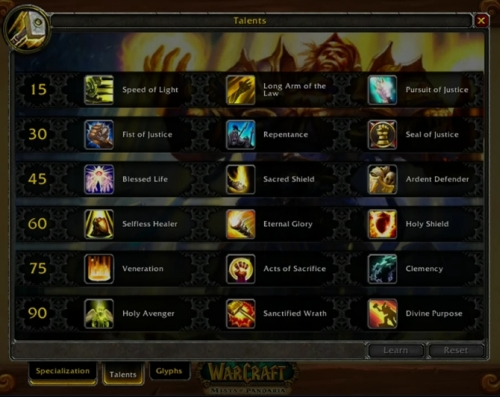
First of all, the talent system is getting a major overhaul, far beyond the changes it received in past expansions. There will now be only six talent points. That’s it. Blizzard made a big to do about Cataclysm’s failure to revamp talent builds, resulting in only 1-5 realistic choices out of 41 (the rest being pretty much mandatory for any given spec.) The idea in MoP will be to do away with every mandatory talent and instead create a system which should cater to a variety of playing styles without drastically influencing your dps. Or as I understand it, if you use them correctly every possible talent combination should peak for about the same overall benefit.
If that seems like high expectations, note that there will only be six talent points per class, not per spec. Your options will be the same whether you’re healing, tanking, dpsing, pvping, or whatever. Here’s a look at the tentative paladin talent screen:
If you are hoping to load up on all of the healing talents, think again. Your six points are not to be spent as you please, but can only be used once per row. If you get Blessed Life, Sacred Shield and Ardent Defender are gone, no getting around it. Don’t expect to waste thousands of gold checking them all out though. Talents will now function like glyphs, and rather than having to start from scratch you will be able to reset any particular row at any point in time outside of combat. Blizzard suggested this would be necessary for raiding, certain talents being more beneficial for certain bosses, so expect opportunities to put them all to a bit of use. As for those “ability” talents necessary for your spec, they will now just be given outright like other abilities.
Scenarios
Scenarios seem to me the most dubious of the new additions. They will be very short queuable events designed to replace the group quests of old, and they will not have any specific role requirements, so queues will be instant. They will be available at various levels, each should have a level 90 version rewarding a few valor points, and you will be able to queue for them while in dungeon queue. So far so good–it sounds like a pretty nice way to collect extra valor while waiting for those tedious 40 minute queues to pop. Here is a basic example of what the objectives of a Scenario might look like:
But aside from the fact that something that short could get really old really fast, here is the major drawback: Blizzard described a number of them as “pve battlegrounds.” What does this mean? Well, WoW Game Director Tom Chilton was fairly explicit in talking about them as battleground for people afraid to pvp. Does that mean they’ll reward honor? Does that mean the more sheepish players who don’t know what they’re doing–the ones I love graveyard camping oh so very much–will be able to get geared through these? Or even if they don’t, will this actually succeed in keeping bad players out of real battlegrounds? That, to me at least, would be a terrible disappointment.
But it gets worse. I first started to think Blizzard hated pvp servers when they updated village guards to prevent camping. My glorious days of sitting outside Grom’gol Base Camp picking off lowbie horde like flies are dead and gone; may they rest in peace. Scenarios seem to be further pushing towards refusing to reward dedicated pvpers for getting gear. The biggest catch though, really the biggest disappointment in all of Mists of Pandaria, I might as well throw at you now:
Resilience will be a base stat.
No, really. If you stand outside of your enemy faction’s city naked, you will have resilience. Oh, there will still be pvp gear, giving you more resilience, but I’m going to propose right now it will be useless. Right now going up against a raider in world pvp, my 4500 resilience means I win. And it should, because I joined a pvp server to pvp, and the guy I am fighting apparently didn’t. Narrow the gap to say, a 1000 resilience difference, and do you really think my measly Ruthless set is going to hold up against a full Firelands-equipped player?
As a hunter, I am well familiar with the lack of balance in WoW pvp. I win 1 on 1 because I am geared to the hilt. You take that away from me, and I’m just a fish out of water, dying to anyone who actively plays the game whether they care about pvp or not. Part of the idea is to make it so that players can jump into arena sooner–to prevent a block from progression. But isn’t honor already dirt cheap? Doesn’t it only take what, a week, to get fully geared for arena? Maybe it makes no difference, if you play on a pve server, but for me all this is doing is ruining world pvp–my favorite aspect of the game. Low blow Blizzard.
People have been complaining about how it’s too easy to get geared for raiding for ages now. I guess the idea with Scenarios and an overwhelming nerf to resilience is to give us pvpers something to gripe about too. Anyway, enough of that, let’s look at a more positive addition:
World of Pokemon
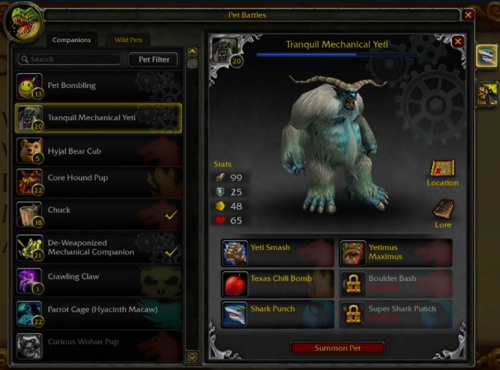
Lord only knows what has compelled me to so desperately seek out that 150 vanity pet achievement (I’m sitting around 135 at the moment), because I don’t even like the damn things. But it’s all going to pay off now in an addition sure to be both cheesy and addicting: vanity pet arena (I believe Pet Battle System is the official working title). You will now be able to level your pets (up to 25), form teams of between 1 and I believe 3 pets, and square off in turn-based battles both against other collectors and against new world pets that you can catch and add to your collection by defeating.
It’s looking to be a pretty complex process. You can visit trainers all over Azeroth to learn new abilities for your pets, you can trade them, you can auction them at high level, and they will be shared across your account. Imagine a pimped out White Kitten selling for 20k. I will be that man robbing you.
Without going into too much detail, pet stats will be randomly generated, so you might have to catch one multiple times to get the build you want. Pets will be seasonal, so certain ones might only appear in the summer or winter, and some will only appear in the day, at night, in the rain, in the night in rain in September, you get the idea. It’s going to be a whole game within a game, and it might sound silly right now, but I suspect this will soon stand alongside raiding and pvp as a third way to play World of Warcraft.
Other Features
* Dungeons will have a third form: “Challenge Mode”. They will consist of time trial runs in scaled-down gear, so they will never get easier as you gear up. There will be Bronze, Silver, and Gold times to beat, with different gear rewards (including statsless transmogrification sets) depending on your time. There will also be an in-game stats keeper showing your best time for each dungeon compared to other players on your server. I’m not sure how to take this. I play on one of the lowest population servers in Warcraft; we are pvp, and everyone knows everyone, so the competition to be on top is personal. I could see myself getting a bit obsessed over this one.
* Raids will also have a third form: Raid Finder. Breathe a sigh of relief; DF Raiding will be a tier below regular raiding. You won’t be able to just pug your way into a cross-server 25 man heroic run. It’s more a means to learn the mechanics while getting geared for normal raids, and I’m pretty excited about it. On servers like mine where low population means frequently bringing along one to two inexperienced players for progression attempts, there will be no more excuses. If you haven’t downed the boss through Dungeon Finder 10-man, you aren’t coming. I like it.
* There will be 9 new dungeons: six completely new ones, a heroic version of Scholomance, and a heroic version of Scarlet Monastery condensed into two dungeons. There will be three launch-ready raids, similar to Cataclysm.
* Blizzard failed miserably in Cataclysm by creating a lot of compelling world raid bosses and giving none of them any gear worth a damn. MoP is supposed to reintroduce world raiding proper. You can look for me ganking your healer half way through the fight.
* Expect 2-3 new battlegrounds, tentatively titled Stranglethorn Diamond Mines, Valley of Power, and Azshara Crater. If Twin Peaks and Battle for Gilneas were my two biggest disappointments in Cataclysm, these look to compensate thoroughly. Stranglethorn Diamond Mines is going to consist of transporting resources out of a mine down a whole mess of different passageways–the first team to successfully transfer the required amount wins. That means a lot of hiding, sneaking around, scouting ahead, and outsmarting rather than overpowering. It seems perhaps too complex to be 10 on 10, but I’m going to be disappointed if it isn’t, because it sounds perfect for rateds. Valley of Power is much more simplistic–a small square room with few opportunities to evade combat. Yet Blizzard managed to make it refreshingly unique. There will be an orb in the center of the room which any one player can hold, and so long as a faction is holding it they gain points, scaled to go up faster the closer you are to the center of the map (and thus to your enemies). But I don’t expect this to be a 2 minute fight followed by a 10 minute wait like Battle for Gilneas. There is an additional mechanic: whoever holds the orb will take periodic damage increasing over time. If there are no healers, it will eventually drop even if your team never touches the carrier. As for the third proposed battleground, Azshara Crater, Blizzard has said nothing.
* There will be a new arena: Tol’vir Proving Grounds. It looks identical to Nagrand Arena except the four pillars are diamonds rather than squares. Really? For as long as we’ve been waiting, it looks downright pathetic.
* There will be valor from daily quests. Thank god. Daily quests will also give you buffs that allow you to gain extra loot in dungeons. I’m not quite sure what to make of that.
* Many achievements will be account bound. They did not go into too many specifics on this, but I’m pretty damn excited. Achievements are my gig in WoW, even more so than pvp. I’m pushing 11,000 without hardly any from raids, and if this means I can roll a level 29 twink hunter and knock out all of the more insane pvp ones I’m going to be in the money. Not all achievements will be account bound however, and whether that means obvious ones like say, the level 90 achievement, won’t be, or if not all raid/pvp accomplishments will be either, is still up in the air. There will also be multi-toon achievements, like maxing out every profession.
* A few major class/stat changes were mentioned. The epic resilience nerf stands out as the worst, and maybe the worst idea Blizzard have for all of MoP. They will also be doing away with the range weapon slot. Relics will be gone, rogues and warriors will throw their main hand, and hunter bows/guns will become the main hand. Wait, how will hunters survive without a melee weapon? Ah, the most relevant buff of all for me: hunter minimum range is gone. Gone! No more frost mages locking me in place and taking me down without ever so much as taking damage. Hunters will finally be a viable dueling and 2s pvp class. Warlocks will also get a major overhaul to better distinguish the three specs, and the way they described Destruction I suspect they’re going to be pretty op, with a stacking damage buff that hopefully resembles Arcane Blast. Hopefully because I have an idle 85 warlock, that is. Shamans will no longer have buff totems, and lastly, druids will finally be recognized as officially having four specs.
There was one major question left in my mind when all was said and done. I play on one server exclusively. There are ten classes and ten toon slots, so I am full. As it stands, I will never actually get to play a monk. Will that change? Will they finally add an eleventh slot? WoW lead producer J. Allen Brack was asked this in the post-presentation interview, and his answer wasn’t promising: They’ve thought about it, but they’re not quite sure.
If you look at the main stage schedule for BlizzCon 2011, attention to World of Warcraft: Mists of Pandaria isn’t so much dominant as nearly exclusive, getting six and a half hours of discussion and demonstration, compared to two for Diablo 3 and not a minute for Starcraft 2: Heart of the Swarm. With that in mind, I imagine everything presented in the initial general overview of Mists of Pandaria will be granted much more thorough detail down the road. But, if you’ll allow me to take this one step at a time, here are the key points I took out of the overview.
The first thing you’re going to encounter in WoW 5 is the level grind from 85 to 90, so let’s take a look at that first.
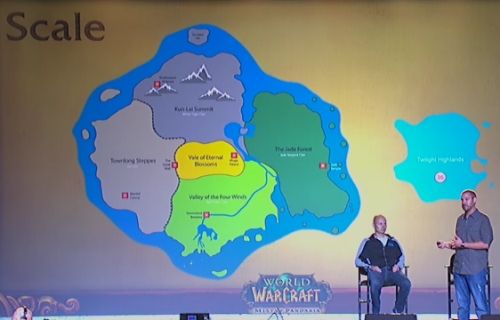
The first thing you might notice is that Pandaria looks pretty small. It’s only five zones, for one thing (ignore the blob on the right for the moment), and I certainly would hope at least one of them, probably the middle, is a world battleground akin to Wintergrasp and Tol Barad. Blizzard did not actually make any mention of server battlegrounds in the introduction, and cryptically listed and dually ignored a third “Azshara Crater” battleground when detailing MoP’s two normal bgs, so perhaps this is not the case, but at any rate, Cataclysm’s five questing zones and one pvp zone felt small to me, and here only five are listed in total.
But there are a number of features to take into consideration. This scale compares Pandaria’s five zones on the left to Twilight Highlands on the right. Twilight might not seem that big, dashing around with master riding skill and the like, but if you expand your in-game map you’re going to realize Pandaria is well over half the size of Eastern Kingdoms. And there is a further catch: You can’t fly there until level 90.
This comment met with a great deal of applause from the audience, and I will gladly join them. Aside from my great distaste for the revamped lower level zones of Eastern Kingdoms and Kalimdor, what really made Cataclysm feel so weak quest-wise for me was level 60 flying. No more pick up, fly, kill something, fly, turn in, repeat here. No more complete disregard for terrain, either. Can you imagine hopping on a ground mount and waltzing the whole way across Twilight Highlands five times? Pandaria will feel huge.
Yet there are still only five zones. I loved the diversity of having ten in Wrath of the Lich King, but with only a 5 levels I suppose their options here are a bit more limited. They do try to account for this though, giving at least the second leveling zone, Valley of the Four Winds (bottom zone on the map), two distinct quest lines that will make leveling at least your first alt a more unique experience. In this case there will be both a northern “farmlands” region and a southern “coastal jungle” region, both of which should cover about the same level/exp range independently.
There was not much more information on particular zones available at this point, but names always indicate something. Here is what I know of the map breakdown:
The Jade Forest (level 85 starting zone, to the east)
Valley of the Four Winds (second zone, to the south)
Vale of Eternal Blossoms (central zone)
Townlong Steppes (western zone)
Kun-Lai Summit (northern zone)
As you may have guessed from the preview video I posted earlier, they will all have an Asian flavor about them. Another cool feature, for me at least, is that Blizzard will try to make the dungeons more visible. Valley of the Four Winds’ dungeon, Stormstout Brewery, should be visible to scale within the zone proper, not simply as a portal (though I’m sure you still have to “zone in”), and WoW Lead Content Designer Cory Stockton’s comments lead me to believe the others will generally follow suit. Whether this will amount to something new or will merely reflect a continued effort similar to Lost City of Tol’vir in Uldum remains to be seen, but it was certainly emphasized in the overview.
There will be one final zone of course: the Pandaren starting zone. Worgen and goblin starting zones were something of a complete joke in Cataclysm, in so far as they were completely irrelevant to the game if you weren’t the relevant class. Already having ten toons on my server, I have not caught the slightest glimpse of either. I get the bad feeling the Pandaren starting zone will be equally disappointing, but in the meantime it at least looks pretty cool.
This zone, The Wandering Isle, is a giant turtle. No, really. There will be a giant turtle floating around off the coast of Pandaland with a whole mess of forests and mountains and civilizations thriving on its posterior. The reason I suspect it will be as inaccessible to those of us with 10 toons as the worgen and goblin zones?: Pandaren start off neutral.
As in, they start off neither alliance nor horde. You don’t actually choose your faction until level 10, and that answers another question: MoP will introduce only one race, available to either faction. I’m pretty confident Blizzard will keep them isolated with this in mind, because I could see an unwelcome (on their part–harmless and entertaining on mine) cross-faction black market emerging otherwise.
This starting zone is actually playable at BlizzCon, so expect most of the non-official images of MoP appearing over the next few weeks to be of The Wandering Isle.
While I am on the subject of Pandaren, here’s the information you’re probably most interested in in a nutshell:
Tentative Pandaren Racials:
Epicurean – Increase stat benefits from food by 100%
Gourmand – Cooking skill increased by 15
Inner Peace – Your Rested experience bonus lasts twice as long
Bouncy – You take 50% less falling damage
Quaking Palm – You touch a secret pressure point on an enemy target, putting it to sleep for 3 sec.
Monks are the next order of business. Allow me to start with a video of one in action:
Did that leg spin look cool at the end? WoW Lead Systems Designer Greg Street quoted one of his colleagues as saying “If we don’t do gnome monks, monks aren’t worth doing.” Yes, gnome monks will be an option, kicking in the faces of all enemies willing to get within half an inch of them. … Actually, the class will be available to every single race except worgen and goblins.
As for what exactly a monk consists of, at face value they pan out to be much like druids without a Boomkin option–leather wearers with the following specs:
Brewmaster – Tank
Mistweaver – Healer
Windwalker – Melee DPS
But as far as how they function, I am a bit confused. Street described them using a combination of energy (chi) and a dual point system:
Monks will use two basic abilities, “Jab” and “Roll”, to build up Light Force and Dark Force, with which they can release higher abilities. Ok, ok, fair enough for tanks and dps. But what about healers? Nothing was said directly, but monks were described as “melee healers” and compared to disc priests for their ability to dish out some dps in the process. Does that mean we’re going to have a healing spec without mana? I am lead to believe so. Will this be raid-functional or strictly pvp? That question remains unanswered.
Well, it’s getting late here, and I didn’t get as far in my BlizzCon coverage as I’d hoped, but I’ll try to pick up where I’ve left off tomorrow. So far I’ve only scratched the surface.
Better late than never, I just picked up my live feed of BlizzCon 2011. The event kicked off at 2pm my time, so I only have seven hours of catching up to do really, and they’ve improved their online feed tremendously this year: No lag whatsoever for the first time I can remember, and an easily accessible archive of past events. I’m hoping to make a number of posts today and tomorrow relaying some of the news. Just to give you an idea of what I’ll be focusing on, World of Warcraft is my primary interest, followed by Starcraft. Diablo I’ll be giving little if any attention to.
As usual, Blizzard threw out a few big surprises in the opening ceremony. Let me just start by detailing a few of the most important points in brief:
The first thing they announced, and really the thing I’m most excited about for the event proper, is a high-profile Starcraft 2 tournament. No more 30 second asides to show a few random segments of tournament between conference coverage–BlizzCon 2011 will feature a tournament broadcast in full. And while I am not as knowledgable in e-sports as I would like to be, it looks like they did a solid job of bringing in the pro commentators rather than using people inside the company. Day[9], whose Starcraft 2 strategies I talked about at length when the game first launched, will be involved in much of the commentary, along with a number of other names I recognized.
But that’s just what I’m looking forward to in the next two days. The long-term announcements are what you’re more likely to take interest in. Here’s a big one. I noted that Diablo 3 does not interest me much. As it turns out, I will be playing it anyway. Why? Because it is free.
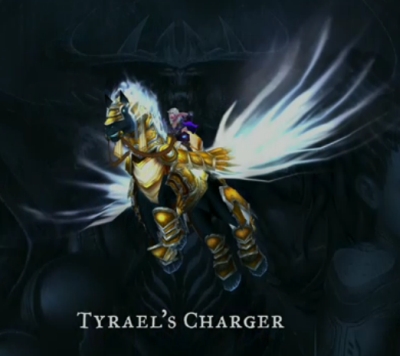
Check this out. Blizzard CEO Michael Morhaime announced right off the bat that Diablo 3 will be free for World of Warcraft subscribers (and that the release date is still undetermined). A free trial? A demo version of the game? Not at all. The only catch is that you’ll have to pick up a one year subscription to WoW–not a heavy commitment if you’re interested in Warcraft to begin with. On top of a free digital download of the game in full, you’ll additionally get guaranteed access to the next World of Warcraft beta. Oh, and a flying horse mount that puts the celestial steed to shame: Tyrael’s Charger.
Not bad, eh? I’m still curious whether the one-year pass will be at the current discount rate you get for long-term subscriptions or if they will charge the single month rate for 12 months, but either way, count me in.
Following Michael Morhaime’s introductory announcement, the “slightly” more outspoken vice-president Chris Metzen took the stage in rock-star fasion, Dalaran theme blasting overhead. The upcoming game preview cuts came rolling in, starting with Diablo 3 and then preceding to “Blizzard Dota”, a game I have never heard of which looks awesome. Apparently they’re creating a cross-over fighting game which will pit Starcraft, Warcraft, and Diablo characters against each other and incorporate pvp elements of all three. The preview included Arthus fighting a siege engine and ended with “Coming Soon… Seriously.”
Starcraft 2: Heart of the Swarm got its trailer too, looking par for the course–that is, pretty awesome. The new units glimpsed in brief didn’t stand out to me much, though I’m sure they’ll be gone over in detail later in the convention. One that did catch my eye was a zerg unit that had… how should I describe it… a DK Death Grip.
But what I was really here for–what I really wanted to see–that came last. We all knew it was coming. It had to be coming. But until now I’d not heard a word about it: World of Warcraft 5.
The description Chris Metzen had to offer for the premise of WoW 5 excites me, as a major pvper, to no end. No super villians this time. No joint effort against a common foe. WoW 5 will focus on alliance against horde, straight up. The video certainly doesn’t reflect it though:
Remember the Pandaren pet Blizzard was selling a few months back? It is now a race, accompanied by some awesome Japanese-themed landscapes that will apparently comprise an entire continent: Pandaria. (Apparently Blizzard almost made Pandaren the alliance race in Burning Crusade in place of Draenei.) We can look forward to a new class I’d been expecting for a while now–monks–and the level 90 cap raise everyone expected. Is only the alliance getting a new race, will there be evil pandas too, or is there a new horde race yet to be revealed? That was my biggest question, and Metzen announced early in the post-ceremony interview that they would be more or less neutral–not only available to both factions, but as I understand it identical in racial abilities and appearance.
That’s it for the opening ceremonies. I’ll do my best to catch up and keep up from here on out.
I received an email from Electronic Arts this week, letting me know that the Beta for Battlefield 3 was available to play about 48 hours from the main release. Everyone should be able to play it today, and from what I can tell, it’s well worth it for Battlefield Fans. This is just a quick synopsis of playing the game.
I feel like someone out there has been paying attention to the shortcomings of the Bad Company games, and it looks like it’s coming across nicely.
So far, the Beta works off of one huge map. As always, the battle is broken down into three areas within this map. The first of these is a large park. The second moves into a subway system and the third expands out to a city square. It almost feels larger than what was available in Bad Company 2, but is roughly the same size. It seems that a number of changes were implemented, particularly in the explosions in the game. A lot of changes have been implemented, particularly in some of the movements of your character. You now have the ability to go prone and vault over low obstacles. Going Prone has already proven effective in a number of game sessions as fireteams now lie in wait near the foliage close to the demolition targets. It’s become much harder to be able to see anyone when making your way into a situation. That’s a very nice touch, considering that in the past, the most one could do was kneel.
The game still works off of the Class system from previous BF games, but the graphics have been updated considerably. While it may not be very noticeable in the first part of the battle, once you reach the subway, it’s nice to see how large the world you’re in is and what you can do with it. When you throw down a package, it’s a very large box, compared to the small ones in Bad Company Two.
The guns in the game are interesting. The opening gun for the Assault Class remains the M16, but the Specialist class has the M4 as a starting rifle. Additionally, playthroughs on this map will allow you to unlock various attachments such as scopes and new weapons. Though I haven’t seen it first hand, the game explains that laser attachments and flashlights will actually blind a person when shined at them. The guns (the shotgun in particular) appear to be a little overpowered, though that could be my playing a little too much Gears of War before starting BF3. It’s tactical, as always.
One thing I would like to see (unless I missed it) was Night Vision. There is one area of the game, where it’s almost completely dark and is really almost impossible to see anything. You have to pause and look for where the shots are come from and just fire in that general direction. It would be nice to see, if it’s there.
Overall, Battlefield 3 is really shaping up to look like an intense game. I’m eager to see what other maps they’ll have in store later on.
The time for the final push to hype up the upcoming first-person shooter from EA and DICE has begun.
Battlefield 3 gets a brand-new TV ad spot which touts the title’s actual gameplay and the strength of it’s new graphics engine with Frostbite 2.0. To better give the ad a particular hook it uses Jay-Z’s “99 Problems” track to some great effect. The video shows the three different gameplay choices a player can have during single-player and multiplayer gaming: foot soldier, helicopter gunship and fighter pilot and tank driver.
As the tv spot has pointed out — plus the video below showing some multiplayer gameplay — Battlefield 3 has been the consensus best shooter to be seen by industry people at all the gaming shows and conventions this year. Whether the title will knock Activision’s Call of Duty franchise off it’s lofty perch still has to be seen, but if there’s a game that could begin the process of doing it then Battlefield 3 may just be it.
Battlefield 3 slated for an October 25, 2011 release date for the Xbox 360, Windows PC and PS3.
Well, we’ve finally reached the end of the 33-day marathon which saw 32 dream-memories penned by renowned Japanese author Shigematsu Kiyoshi for the rpg title Lost Odyssey. For Day 33 (despite what the video may say it’s the 33rd dream and not 32nd) we have quite an appropriate memory from Kaim, the immortal warrior, who has seen 1000-plus years of war and experiences both good and bad. “An Old Soldier’s Legacy” speaks very much to the times we’re having now.
The memory ends this series on a down note. We see through Kaim’s reminiscing eyes how war creates a cycle of hate that never seems to end. Victor will punish the defeated. The defeated will rise up generations later to bring down their oppressors and begin the cycle of hate and violence anew.
It’s always the young men who have seen war strip them of their humanity and the men who led from safety who never seem to get the lesson needed to finally bring peace after years of war. It’s always the old soldier’s who have survived countless battles and have learned the lesson of compassion for one’s enemies who know how to stop the cycle. But in the end no one ever listens to these old warriors who only want peace.
As we look at the wars happening now across the globe are we just sowing the seeds for future generations who will rise up and do the same to their enemies or will the leaders and young men now fighting learn the lesson the old soldiers before them have learned through blood and tears: when the fighting ends let peace rule and not vengeance.
An Old Soldier’s Legacy
Kaim spent the entire summer surrounded by a fence that towered over him.
He was trapped in a prisoner of war camp.
It was a terrible mistake – not his but the dimwitted, cowardly commander’s. Kaim was a mercenary attached to the man’s regiment. They were invading the enemy’s main port city when the officer miscalculated at the end and the unit’s line of retreat was cut off. While the troops were prepared for an all-or-nothing charge, the commander almost casually opted for surrender.
“Don’t worry,” he had said to his men before they were locked up.
“Whatever happens now, the ultimate victory in this war will be ours. Instead of making a stand and dying for nothing, we’ll be much better off if we just quietly let them take us as prisoners of war. We’ll be liberated right away in any case.”
This made perfect sense.
But the officer completely misread the feelings of an enemy on the brink of defeat.
Having survived hundreds of battles, Kaim knew better than anyone how people felt towards prisoners of war after the hated enemy had taken the lives of their friends and loved ones and torched their hometowns.
To the members of his platoon at least, as they were preparing to enter the camp, he whispered,
“You’d better forget about any rosy pictures. This could be worse than the battlefield.”
His words proved all too accurate.
Life in the POW camp was bitterly harsh. Day after day, the men were forced to do backbreaking labor on a diet of scraps. The sick and injured went untreated and were not even allowed to rest. To collapse on the job was to die. Indeed, several of the prisoners died not by collapsing on the job but from brutal beatings for minor infractions.
Everyone with access to the camp – both the soldiers assigned to guard duty and ordinary citizens with business there – looked upon the prisoners with hatred in their eyes. Some guards would wave swords at them and boast, “I can kill you bastards any time I like,” and certain officers slaughtered one prisoner after another, disguising the killings as accidents.
Even as they tormented the prisoners, such men were suffering the deaths of their families and friends in the war, and spending their days in fear of the coming invasion. The camp was a place ruled by hatred and revenge, but also a place shrouded in uncertainty and fear of the day when the captives would become their captors. This tense, complicated atmosphere ate away at the spirits of all, friend and foe alike.
The horror of war lay not only in the mutual killing of enemies clashing on the battlefield but even more so in places such as this that were far from the front lines.
Kaim knew this with every bone in his body.
A month passed after the platoon entered the POW camp.
The enemy troops were thoroughly exhausted.
The fall of the capital was said to be imminent.
In spite or because of that, life in the camp was worse than ever.
The tasks assigned the prisoners were even crueler than before, and their diet, which was meager enough to begin with, fell below the level needed to sustain life.
The military guards bullied the prisoners as if for their own amusement, wounding them, and mistreating them with fatal consequences. All kinds of civilians did their part, too, hurling human waste over the fence into the camp. And even if secret stashes of food might be left for them, none of the prisoners dared eat them for fear they might be poisoned.
Hatred climbed to unseen heights.
To one prisoner who moaned “Why are you doing this to us?”
A guard spat out the answer, “It’s just what your country is doing to us.”
And it was true.
All the young men of the enemy country were being sent into battle, where most of them were being killed. Whole towns had been burned down and transformed into rubble.
While the soldiers assigned to guard duty knew that defeat in the war itself was certain, they continued to be victors where the POWs were concerned.
And while the captured soldiers believed in the victory of their fatherland and waited for the day when their comrades would resuce them, they continued to be vanquished among victors.
The moans of the POWs could be heard throughout the camp:
“When is the war going to end?”
“The war doesn’t have to end. Just let them get us out of here!”
“Have we been abandoned by the fatherland?”
Kaim kept offering the same advice to them again and again:
“Be patient,” he would say, “Don’t give up hope.”
Kaim knew everything there was to know about war, and so he realized what was happening now. The fatherland’s supreme commanders were trying to bring down the capital first and leaving the fall of this military port city for later. The POWs had, in fact, been abandoned.
The commander in chief would no doubts say, “For the sake of a great victory, we cannot let ourselves be concerned by a small set back.”
And he would be right.
But precisely because he would be right, Kaim could not convey this to the prisoners, who firmly believed that their side was trying their best to rescue them.
One POW after another made plans to escape, and for every one of those there was an informant who exposed his plan to the guards.
Both types of prisoner had the same thing in mind: to save himself alone. No one could be trusted. THere were even some “informants” who made up phony escape stories about perfectly innocent men just to put themselves in a little better position with the guards. The only thing awaiting such traitors when the war finally ended would be the revenge of their comrades. As much as they understood this, all they could do was ingratiate themselves with the guards so as to secure their momentary safety.
The fence was not the only thing surrounding the POWs. It was not just their bodies but their minds that had been taken captive. In addition to the ones who died from illness and injury were increasing numbers of those who ended their own lives after a period of mental suffering.
Be patient.
Don’t give up hope.
Kaim’s word gradually ceased to make an impression on anyone.
After the men had been prisoners of war for two months, a new guard took charge of Kaim’s barrack.
In place of the young warrior who had been guarding them came an old soldier.
His name was Jemii.
When he introduced himself to the men, he remarked with a grim smile,
“Things must be getting pretty desperate if they’re calling up an old goat like me.”
The young guard had been sent to the front lines. This probably meant that the battle for the capital had entered its final phase.
“I tell you, this war is almost over. In another month, you young fellows will be on the other side of the fence, and we’ll be locked in here. Our positions will be completely reversed.”
Jemii needed no prompting from the POWs, and his vocie contained none of the hate-filled agitation of the young guard’s.
“All you fellows have to do is hang in there a little longer, be patient, and not give up hope.”
His words were almost identical to Kaim’s, which meant that Jemii, like Kaim, had experienced many a battle over the years.
“We may be in different positions, but deep down we’re the same. You men are unarmed prisoners, and we’ll be under your control as soon as you come to occupy the country. I’m what you will be tomorrow, and you’re what I will be tomorrow. I don’t know how long we’re going to go on like this, but if you stop and think about it, isn’t it stupid for us to keep hating each other and snarling at each other? Let’s at least try to get along.”
He twisted his wrinkled face into a big grin and laughed aloud.
His smile deeply affect the mentally and physically exhausted men.
Before they knew it, they were smiling, too. THis was the first carefree smile that any of them had managed since their capture, or, rather, since their time on the battlefield.
Jemii’s kindness was not limited to words. Of course, the change of a single guard was not enough to substantially improve the prisoners’ treatment. The hard labor and meager food were the same as before. But Jemii would speak to them with real feeling.
“Sorry for working you so hard, but there aren’t any young men left in this town to do the muscle work. We’re not making you do these jobs to punish or discipline you but because the town needs your help with these constructing projects.”
“I’m sorry we can’t give you anything decent to eat. I really am. But everybody outside the fence is starving, too. We’re all in this together, so try to put up with it.”
Jemii would try to order somewhat easier jobs for prisoners who had taken ill, and he would sneak them extra food. THat is the kind of guard he was.
The prisoners started calling him “Uncle Jemii,” and would even joke around with him sometimes.
“We’d be way better off if the other guards were like you, Uncle Jemii,” said one prisoner, to which Jemii nodded sadly.
“I’ll tell you what, Uncle Jemii,” said another prisoner. “If I had known that there were people like you in this country, I never would have volunteered. I’m not forgetting my place as a POW, but let me shake your hand once.”
Jemii allowed himself the faintest of smiles at this and gave the man his hand.
“You know something, Kaim…” Jemii said, sitting down beside Kaim during a break in the heavy lifting.
It was a clear, beautiful day, but the sunlight pouring down on them had lost its midsummer glare. The season was shifting to autumn.
“I’d say you’re a little different from these other young prisoners.”
“Am I?”
“I know you’ve seen your share of battles. I can smell it on you.”
Kaim’s only reply to Jemii was a strained smile. Jemii seemed to have known what Kaim’s response to his remark would be, and he wore the same kind of smile as he carried on the conversation.
“Why haven’t you escaped?” It would be easy for a man like you to break through the flimsy security they have here.”
“You give me too much credit.”
“You could make it by yourself, but taking everybody with you would be tough. Is that why you stayed?”
Kaim gave him another strained smile, saying nothing.
Jemii was right. If he decided to escape on his own, it would be easy for him to climb over the fence. If, however, he manged to gain his freedom, the prisoners he left behind would be punished or, at the very least, would have to live with increasingly harsh security measures. The young soldiers abandoned in the camp would feel only despair.
If he was going to escape, it would have to mean getting everyone over the fence. Most of the others, however, were so wasted away that they were beginning to lose even the strength to go on living. Men like that could only be a drag on his own flight to freedom.
“You’re a kind-hearted fellow, aren’t you?” Jemii said.
“And you’re a smart one, too, I’ll bet.”
“What do you mean by that?”
“Any soldier with as much experience as you has already seen the handwriting on the wall. The war is over. Another three days, maybe a week, and our side is going to announce a total surrender. Right now, we’re just making our last stand out of sheer stubbornness. The second the war ends, you prisoners will go free, and we’ll take your place.”
“Yes. And?”
“It’ll just be a little longer. Really, all you have to do is hold on a little longer. You must know that as well as I do. So you’re probably not even thinking of making the effort to escape.”
When Kaim nodded, Jemii smiled and said, “That’s fine. I’m just as fed up as you are with all the pointless fighting and hatred.”
He looked up at the autumn sky, his profile marked by a number of deep wrinkles. On closer inspection, Kaim realized that some of those wrinkles were scars left by sword cuts.
“Let me tell you something, Kaim.”
“All right.”
“Our country doesn’t have the strength left to make it through another hard winter. I knew that when summer was still here.”
“I see…”
“I just wish we had given up sooner. Then there wouldn’t have been so many young men killed in battle, and so many towns burned.”
Jemii released a deep sigh and added, “When this war is over, we’re going to have to do whatever your country tells us to do. We can’t complain if we’re enslaved or tortured to death by the young men who are now our prisoners of war.”
Kaim could not assure him that would never happen.
As a mercenary, he would just go off seeking new employment when this war ended, but this was not true of the other prisoners of war. As the conquerors, they would now have peace. They would return to the lives they led before. But how many among them would be able to treat the vanquished people with kindness and respect?
“I think you’ll know what I mean, Kaim, when I say you can be as cruel as you like to us old folks when the fighting ends, but please, I’m begging you, be decent to the young men and to the women and to the children. Don’t do anything to them that will make them hate your country. Otherwise, there’ll just be another war sometime in the future. Ten years, twenty years, thirty years, maybe even a hundred years from now. I don’t want any more of this. Countries fighting each other, people hating each other…”
It happened that very moment.
The violent ringing of a bell began to echo throughout the camp. It was the bell in the watchtower, signaling an emergency meeting of the guards.
“Oh, well, gotta go,” Jemii said, standing up. “Don’t bother going back to work right away. Tell the other fellows everybody can have a little break.”
He took a few steps before turning to say to Kaim with a smile, “You know, if we weren’t enemies, I would’ve liked to have a drink with you sometime.”
That was the last Kaim saw of Jemii as a guard.
The sun was overhead when Jemii left, but he did not come back even after it had begun sinking in the west.
The next time someone came into the enclosure it was to the cheers of the POWs welcoming the arrival of their countrymen.
“You’re going to be all right now, men! The war is over! It’s a huge victory for our side!”
Jemii’s country had agreed to a total surrender.
The guards assembled in the tower were stripped of their weapons, and anyone who resisted was killed on the spot.
“Get a move on there! Hurry up!”
The soldiers who, until a short time ago, had ruled the camp were herded into the enclosure with whips and under the threat of drawn swords.
The POWs, who until only moments ago had been under their rule, now lined up to stare at their former guards, and before anyone knew it, the guards were being cursed and stoned.
Hands tied, the soldiers could not ward off the stones, and before long they were drenched in blood.
Jemii was among them.
He started at Kaim, blood gushing from his forehead. His eyes showed no hatred or resentment. He simply gave Kaim a little nod, looking straight at him as if to say, “Remember what I asked you to do.”
Kaim shouted to the men surrounding these new prisoners,
“Stop it! Stop it! They’ve surrendered! Leave them alone!”
But, liberated from the fear of death and from days of humiliation, his young comrades, wild-eyed and screaming like animals, went on stoning their former guards.
“Can’t you see who this is? It’s Uncle Jemii! Stop it!”
One of the soldiers gave him a contemptuous snort and all but spit out the words, “The old bastard was just sucking up to us for when our side won.”
Another soldier – the young man who had asked to shake Jemii’s hand that day – shouted, “He might act like a good guy, but an enemy’s an enemy! And besides, he’s just some old geezer from a country we pounded into the dirt.” He threw another stone at Jemii.
Kaim’s shouts did no good. He started grabbing hands that were readying to hurl stones and smashing people in the face, but no one would listen to him.
The commander of the troops that had galloped to the rescue just grinned and said, “Good! Good! Get it out of your system!” and he handed swords to the unarmed men.
“Kill them all, and raise some victory cries while you’re at it! Think of the humilation you endured as prisoners. Now’s the time to get even!”
“No, stop it!” Kaim shouted. “The war is over!”
“Wait, I know you. You’re a mercenary.
You’re just spouting a lot of nonsense. A few good sword thrusts could shut that mouth of yours!”
The commander’s aides took this as a signal to surround Kaim.
“Don’t waste your time on him, men! Warriors of our beloved fatherland! Kill these soldiers first, and then we can attack the town. Set fires! Take the women! We won this war! This town, this country, everything belongs to us now!”
The commander laughed aloud, but in the next moment, his smile turned into a grimace. His aides were falling to the ground. Kaim had grabbed a sword from one of them, and now it flashed in his hand.
“Traitor! Somebody take him down!”
Kaim swung around and started for Jemii.
But it was too late.
The soldiers were already slashing wildly at the former guards, who had no means to defend themselves.
Standing amid the hellish scene of human butchery, Kaim saw it happen.
The old soldier, who had been kind because he knew all too well the link between war and hatred, fell to the ground without uttering a word, a hateful blade thrust into his back.
Kaim made a break for the camp gate.
He ran for all he was worth, a soundless roar reverberating inside him.
Why did people have to hate each other so?
Why did people have to fight each other so?
And why was it impossible for people to stop fighting and stop hating?
He did not know the answers to these questions.
Saddened and frustrated by his own incomprehension, Kaim ran at full speed through the rubble of the town.
A hundred years pass by.
“This is it, Kaim,” the commander says with a smile. “I am enormously grateful for the magnificent job you’ve done. You can name your own reward when this war is over.”
The last great offensive is about to begin.
This should bring the war to a close.
It has taken a hundred years.
After all these long, long years as a vassal state, the country that lost the war the year Kaim was a prisoner has raised its banner against the ruling power under which it endured such suffering in the last war.
The defeated country has spent a hundred years nurturing its hatred for the ruling power, passing the hatred down from parent to child to grandchild. The country that won the war a hundred years ago was too filled with a ruler’s arrogance and insensitivity to notice what was happening. The only things that it has handed down from parent to child to grandchild are the scorn and contempt for the “inferior country” under its sway.
This war ends with almost disappointing ease.
The results are the exact opposite of the war a hundred years earlier.
No one knows on which side the goddess of victory will smile if yet another war occurs a hundred years from now.
“All right, Kaim, name your reward.”
Kaim answers the commander’s question softly: “I don’t need a thing.”
“Why not? It’s true that you’re a mercenary, but you far outdid the regular troops. Our country wants to show its appreciation for your efforts.”
“If that’s how you really feel, I’d like you to promise me one thing.”
“What’s that?”
“Don’t make your enemy hate you.”
“What are you talking about?”
“I’m talking about treating the people of the defeated country with kindness and respect.”
A shocked expression on his face, the commander laughs and says, “Aren’t you the softhearted one!”
Kaim, however, is deadly serious.
“This is the legacy an old man from your own country left me a hundred years ago.”
“Enough,” says the commander, still looking shocked. “Dismissed.”
Kaim himself has no hope that Jemii’s legacy will be fulfilled. The hundred-year journey he has taken since that fateful day in the camp has shown him only the selfishness and stupidity of the human race. It will be the same from here on out as well. Indeed, nothing has changed since long before he met Jemii.
And yet.
Back at his post, Kaim grips his sword and holds his breath.
It will change someday.
They will see someday.
I want to believe that.
Unless I believe it, I can’t go on with my endless journey.
You know what I mean, don’t you, Uncle Jemii?
Eyes closed, he can see Jemii’s face smiling sadly.
The order goes out to the entire assembled force: “Charge!”
Within the rising clouds of dust, Kaim grips his sword and starts to run.
We’re now down to the final two dream-memories on what has been the 33-day marathon. This penultimate entry is called “Samii the Storyteller” and this one makes a strong statement about what Churchill called the one of the first casualties of war: The truth.
War will always remain the main and perfect calling for man. It’s what we’re best whether we care to admit it or not. Cormac McCarthy said it best:
“It makes no difference what men think of war, said the judge. War endures. As well ask men what they think of stone. War was always here. Before man was, war waited for him. The ultimate trade awaiting its ultimate practitioner. That is the way is was and will be. That way and not some other way.”
Does this mean we’ll never stop ourselves from this cycle? The answer to that will always lie on how those who never see the battlefield and never fight the wars are told how it truly is. War has always been chronicled for the masses as something glorious. Something righteous and for the greater good of all when it’s never so simple as that. Yes, sometimes wars have to be fought and people will have to die, but how those in power keep the masses fired up is why the truth is always the first casualty of war.
Civilians will always be the fuel which drive wars. No matter how powerful a government is or how great an army can be on the battlefield they both cannot continue to do so without the consent of the very public they govern and protect. Dictator and autocrats know this and why they spin the truth of what war truly is into lies to keep them from learning the honest and brutal truth. Democracies and republics will always walk a fine line of how to tell the truth to it’s people. Give enough of the truth, but never so much that morale flags.
There will always be a need for people such as Samii the Storyteller, but whether it’s the Samii who starts the dream-memory or the one who finishes it will depend on the listener.
Samii the Storyteller
Samii was an outstanding storyteller, one of the best official reciters of the national history there had ever been.
And he was far and away the most popular of the storytellers in the country’s army.
Samii was not a soldier himself, but he always moved with the troops, and always with the units on the most hotly contest battle lines.
Whenever a battle ended and Samii came back to town, his head was filled with countless stories – stories of soldiers who had performed heroic deeds on the battlefield, stories of soldiers who had faced the enemy gallantly, stories of soldiers who had saved their buddies, stories of soldiers who had used their bodies as shields to protect their unit’s position., stories of daring soldiers who had broken into the enemy camp single-handedly, stories of soldiers who had fought fairly to the end against the most devious of enemies.
It was Samii’s job as a storyteller to depict events on the battlefield for the people of the town.
That year, Kaim was always by his side It was Kaim’s mission, as a particularly capable mercenary, to accompany Samii to the front and make sure that nothing happened to this nationally beloved storyteller.
Samii liked Kaim from the moment they teamed up.
Not only did they appear to be about the same age, but with the eye of an outstanding storyteller, Samii was able to perceive the long past – the too long past – that this quiet warrior carried with him.
Samii said, “I could tell the minute I saw you that you had more military experience than any of the others in the regular army. Your head is packed with even more battlefield stories than mine.
Am I right? The only difference between you and me is that you can’t put yours into words as well as I can. Am I right?”
Samii spoke in the professional reciter’s ringing, rhythmic tones.
“Come on Kaim, tell me something. I don’t care if it’s a scrap of a scrap. Just give me a hint of something you’ve seen on the battlefield, and leave the rest to me. I’ll turn it into a terrific story.”
This was probably true, Kaim thought.
If Kaim were to put himself in Samii’s hands, his never-ending life would surely be extolled in the form of a never-ending narrative poem.
And this was precisely why Kaim merely shook his head in silence.
The townspeople knew nothing of the actual battlefield – how soldiers fought on the front, how they killed their enemies, or how they themselves died in action. The people could only imagine these things upon hearing them celebrated in Samii’s stories.
Conversely, the soldiers fighting on the front had no way of knowing how their stories were being told in the town.
The only ones who knew both sides were Samii himself and his bodyguard Kaim, who clung to him like a shadow.
As soon as he returned from the battlefield to the town, without even pausing to catch his breath, Samii would head directly to the square in front of the castle gate. The people would be waiting for him there – not just the residents of the capital where the castle was located but many who had traveled for days from distant villages to get there.
They were hungering for his stories. They wanted to know how their husbands and sons and fathers and lovers and friends had fought and died on the battlefield.
For these people, Samii would mount the stage in the square and recount the drama of the battlefield in ringing tones, accompanying his stories with gestures and flourishes and, sometimes, even tears.
Samii’s stories of the battlefield, however, were by no means composed of unadorned fact. He beautified many parts.
He cleverly concealed elements that could be embarassing to the army.
And he acted out and embellished his stories in ways that were sure to set his listeners’ hearts to throbbing.
If a soldier happened to do something that was relatively helpful to his unit, in Samii’s hands it would be transformed into an amazing military exploit.
But that was just the normal level of exaggeration he introduced into his stories. At times, a soldier killed after a panicked escape from an enemy attack would be turned into a gallant warrior who died bravely without yielding an inch of soil.
A man who lost his life to a raging epidemic would be described as having met a glorious end after challenging an enemy general in hand to hand combat.
Even a soldier who had lost his mind out of sheer terror and breathed his last after a period of hallucinating, in Samii’s hands, could be refashioned into a hero who gave his life in exchange for turning the tide of battle.
In other words, Samii’s stories were almost all lies.
It could be said that he was deceiving the people.
But that was the mission of the storyteller.
In the square stood a number of soldiers carrying swords.
If Samii ever said anything that ran counter to the intentions of the military, they would have immediately arrested him, made it impossible for him ever to speak again by cutting his tongue out with a hot iron poker, and imprisoned him for whatever remained of his life.
Kaim knew well enough that Samii’s duty as a national reciter was to whip up the people’s fighting spirit.
While accomplishing that, his stories also served to comfort those who had lost their friends and family members in battle.
People would often ask Samii, “What was it like when my son died?” or “How was my boyfriend on the battlefield?” or “How about my father?”
Samii would ask the soldier’s name, answer, “Oh, him, yes, I remember him well.” and speak movingly of the death of a nameless soldier of whom he had no recollection whatever.
Before long, from here and there amid the throng crammed into every corner of the square, would come the sound of sobbing. These were not tears of sorrow, however. Rather, they were the hot tears of pride and gratitude for soldiers who had died fighting for the fatherland, tears of anger toward the enemy troops, tears filled with a determination to win this war at all costs, come what may, in the name of justice.
“And what’s wrong with that?” Samii would say in affirmation.
“The families of soldiers killed in action have grieved enough already from hearing the news that their loved ones have died. After that, it’s just a matter of how much meaning they can find in the person’s death, how much pride they can feel at the way it happened.
Am I right? Nobody wants to believe his or her loved one died for nothing. Nobody wants to face the fact that the person died in an embarrassing way. So I tell them lies, I make everybody into a hero. If it’s a choice between actual fact that can only cause sorrow and lies that raise people’s spirits, I’ll take the lies every time. It’s not for the army, it’s for the families that I go on telling these beautiful lies.
I’m absolutely committed to this as a storyteller.”
This was the kind of man that Samii was.
And this was why Kaim continued to protect him on the battlefield. Beyond his bodyguard duties, he would also go for a drink with him whenever Samii suggested it.
But then there were those times when Samii started pestering him for stories.
“Come on, Kaim, tell me what you remember from the battlefield. Share those stories with me. I’m sure you’ve got hundreds of them.”
No matter how much Samii begged, Kaim kept his mouth shut.
“It’s not as if I would use them for story material. If you don’t want me to tell anybody, I won’t. I swear. I just want to know, I have to know. Call it part of my nature as a storyteller. I have this incredible need to know your stories.”
Kaim said nothing.
“You know, Kaim, you look young, but you’re actually five or six hundred years old, aren’t you? I’ll bet you’ve got more stories packed inside you than a roomful of thick history books. I can tell. That’s why I’m so curious about you. Who are you? What are you? What have you been doing all these years? I’m dying to find out.”
Still Kaim said nothing.
Samii headed out once again to the front. This time it was for a major battle that was likely to determine the outcome of the war.
Samii and Kaim were sharing a drink in their barrack the night before a major confrontation when a young soldier, just a boy, paid them a visit.
“It’s me, Uncle Samii! Aran, the tailor’s son.”
Samii instantly broke into a warm nostalgic smile. Wrapping an arm around Aran’s shoulders, he expressed his joy at their reunion before turning to Kaim.
“Aran is from my home town.” he explained. “I’ve known him since he was an infant. He’s like a little brother to me.”
Turning back to Aran, he asked, “How’s your mother?”
“She’s well, thanks. You should hear her boasting about you, though, Uncle Samii. She tells everyone she’s so amazed how that mischievous little Samii turned out to be one of the most popular figures in the whole country!”
“I owe her a lot, Aran. She told me so many stories when I was a kid, that’s what helped me to be come a storyteller.”
“Really?”
“It’s true. She made me what I am today.”
Samii said this with a big smile, which suddenly gave way to a stern expression.
“But tell me Aran,” he said, “what are you doing here?”
“I enlisted. I’m in the army now.” he said, puffing out his chest.
“That’s what everybody does when they hear your stories.”
“You heard me telling stories?”
“Sure. I had to come into town for something and I saw this big crowd in the square. I looked to see what it was all about, and it was you! I stayed and heard every last story. I couldn’t stop crying at the end. Out of nowhere, I suddenly felt the courage to fight for the fatherland. As soon as you were through, I went to the castle and volunteered.”
Aran had not been the only one, apparently. The young men in the square had enlisted en masse.
“No wonder you’re so popular! The man in the enlistment office was saying the number of volunteers jumps every time you perform.”
Aran innocently sang Samii’s praises, but Samii’s stern expression never changed.
“Aran, you’re the only son in your family, aren’t you?”
“Sure, but that doesn’t matter.”
“Don’t you know this is the very front line?”
“Of course I know that much.”
“So what did your mother say?”
“Well, she tried to stop me of course, but so what? It was my decision. And besides, it was you, Uncle Samii, who taught me that fighting to protect the fatherland is more important than anything you can do for your parents.”
Suddenly the bugle sounded for nighttime roll call.
“Uh-oh, I’d better get to my post.” Aran said, and after a quick goodbye he hustled out of the barrack.
His conversation with Aran having been cut short, Samii sat up straight and gulped down his cup of liquor.
Kaim said nothing as he refilled Samii’s empty cup.
“You know, Kaim, starting tomorrow, you don’t have to protect me anymore.”
“What are you talking about?”
“I want you to protect Aran instead of me.”
He gulped down another cup of liquor in a single breath. Kaim refilled it again without comment.
“I can’t let him die. His mother really did do a lot for me from the time I was a little kid.”
Samii pounded his fist against the wall. “Stupid, stupid, stupid.” he moaned.
The battle started at dawn. The fighting was intense.
Soldiers on both sides died in great numbers. Kaim stationed himself besides Samii, protecting him from the enemy blades that came slashing his way.
“I told you Kaim, forget about me! Protect Aran! He’s the one you should be guarding!”
“I can’t do that.”
“Of course you can. You’re the only one who can keep him alive!”
“If I move away from here, I can’t be sure of keeping you alive.”
“I told you, it doesn’t matter about me!”
“I’ve been ordered to keep you alive. It’s my job.”
“No, I told you! Guard Aran!”
Samii stood there shouting when an enemy soldier charged in from the side, swinging his sword.
Kaim swept the sword aside and stabbed the soldier in the belly.
It was a close call.
If anyone other than Kaim had been assigned to guard duty, Samii would surely have been killed.
“I can’t let you die.” Kaim said.
“Is your duty that important to you? Or are you looking for a reward?” Samii taunted Kaim.
Just then another enemy soldier charged at him.
“Neither!” Kaim replied, as he cut the man down with a single slash and hid Samii behind him.
“So then, why?”
“Because there’s something left for you to do – something only you can do!”
Samii screamed at him “Don’t be stupid!” and came out from behind Kaim, exposing himself to the enemy.
“Something only I can do? What, tell another bunch of lies? Make up more stories about phony heroes? Excite more little kids like Aran to enlist?”
“No!”
Kaim shot back, shielding Samii again and cutting down another charging enemy soldier.
“That’s not your real duty.”
“What are you talking about?”
“Not the duty the army assigned you. Your duty as a human being.”
“Now you’re talking nonsense.”
“No. I’m telling you, it’s something only you can do.”
Kaim continued swinging his sword, cutting down enemy soldiers to protect Samii.
Eventually the enemy attack ended.
Kaim grabbed Samii’s hand and started running.
They rushed toward the position of Aran’s unit.
Kaim had no intention of standing by and allowing the under age soldier to be killed, but abandoning Samii on the battlefield was out of the question.
His only option now was to guard them both at the same time.
But he was too late.
Aran was lying on the ground, drenched in blood, moaning in pain, weeping.
His guts had been gouged out.
He was done for.
Barely conscious, Aran caught sight of Samii and managed the faintest of smiles.
“Uncle Samii . . . I couldn’t do anything to serve the country . . . I’m sorry . . .”
Samii, in tears, shook his head.
“I messed up.” Aran continued. “I couldn’t even kill one enemy soldier . . . and now look at me . . .”
Samii tried to speak through quivering lips, but his words were drowned out by his own sobbing.
“I never knew . . . how scary it is to fight . . . how much it hurts to die . . .”
Aran vomited blood.
Convulsions wracked his entire body.
His eyes had lost their focus, and his breathing came only in snatches.
“Mama . . . Mama . . . oh, it hurts so much . . . my stomach hurts . . . Mama . . .”
Bloody tears poured from his empty eyes.
“Mama . . .”
That was the last word that Aran spoke.
Samii came back to town a few days later. The square was already filled with people anxiously waiting to hear his latest stories.
There were more people dressed in mourning than usual, evidence of the ferocity of the recent battle.
Samii took a long, deep breath before entering the square.
“You know, Kaim . . .”
“What?”
“You said those strange things to me the other day. That I have a real duty to perform, that it’s my duty as a human being and only I can do it.”
“I remember.”
“If, today, I do a good job at performing what you call my ‘real’ duty, will you tell me those stories of yours?”
Samii added that he had a vague idea of what Kaim was talking about.
Then, lowering his voice almost to a whisper, he said,
“Tell me, Kaim, how many men are standing guard in the square today?”
Kaim did a quick surver and reported that there were five guards.
Samii mumbled, “Can’t get away from all of them, I suppose . . .”
When he heard this, Kaim realized that Samii’s “vague idea” of what he was talking about was right on the mark.
“I’m sure I can get you out of here, Samii.” Kaim said with conviction.
“Forget it.” Samii answered with a grave expression.
“I don’t want to get you in trouble.”
“You know what they’ll do to you if they catch you . . . “
“Sure. I’m ready for that.”
Yes, without a doubt, Samii understood what his “real duty” was.
He not only understood but he intended to carry it out in exchange for his life as a storyteller.
“You know, Samii, you may be the one person who can stop this war.”
Kaim thrust out his right hand, and Samii grasped it shyly.
“It took me too long to realize it.”
“Not really.” Kaim said.
“You think there’s still time?”
“I do.”
“I’m glad to hear that.” Samii said with a smile and, releasing Kaim’s hand, he strode into the square. Amid cheers and applause, he made his way to the stage.
He never looked back at Kaim.
When Samii mounted the stage, a woman dressed in mourning called out to him.
“Samii, tell me what it was like when my sweet little Aran died. I’m sure he gave his life proudly, nobly for our dear country. Tell me, tell everyone, about Aran’s final moments.”
Eyes red and swollen from crying, she stared up at Samii, all but clinging to him.
Samii took heed of the look in her eyes.
Without a hint of a smile, he gave her a curt nod.
And then, he began to tell the story in a soft and gentle voice.
“Aran was in tears as he died. He was calling for you, his mother, and crying out in pain. His guts were hanging out of his body, he was smeared with blood, and he vomited blood at the end.”
A stir went through the crowded square.
Not wanting to believe what she had just heard, Aran’s mother covered her ears.
Samii did not let this stop him.
“Aran wasn’t the only one. They’re all like that. They’re in pain when they die. Some of them die soon after the pain begins, but for others it’s not so easy. Their wounds just barely miss a vital organ, so they die after tremendous agony that goes on and on and on. Bodies lie on the battlefield exposed to the weather. They get trampled and rained on and baked under the sun, covered with flies and maggots, rotting and giving off a foul stench that would make you sick.”
The stir in the crowd changed to angry shouts.
The guards on duty turned pale.
Samii went on quietly.
“I’ve been to dozens of battlefields and I’ve seen more deaths than I can count. I have learned one thing from it, and I’ll tell you honestly what that is. There are no beautiful deaths in war. It’s true for our enemies and it’s true for us. Everybody is afraid to die, they miss their home towns, they want to see their families again, and they want the damn war to end so badly they-“
“Enough! Stop right now!” shouted one of the military men standing guard.
“Have you gone mad?” another soldier yelled.
Samii went on talking without a glance in their direction.
“Nobody really wants to kill another person. They just have to do it because they’ve been ordered to. That’s what war is. If you hesitate to kill the enemy, he kills you first. I’m telling you, that’s what war is!”
The shouts of “Traitor!” “Arrest him!” that had been coming from the soldiers in the crowd gradually stilled as Kaim circulated through the audience, knocking one after another with well-placed blows.
Kaim was determined to do this much for Samii whether the storyteller liked it or not.
Of course, there was a limit to how much extra time he could buy for Samii.
But he would protect him to the end – until Samii had his final say.
“Listen, everybody! Why do you think I’ve been making the rounds of the battlefields? It was a terrible mistake on my part. What I have seen out there . . . my stories about what I have seen out there . . . I should have used to bring a halt to this stupid war!”
The commotion in the square had given way to utter silence, such power did the words of the peerless storyteller have over the crowd.
“Listen to me everyone! Let’s end this war. Let’s end all war. Don’t you see how crazy it is to call a man a hero for killing another man? Don’t you see how sad it is to call a man a hero for being killed by another man? Think of the people who have died in agony and tears. The one thing that we, their survivors, can do for them is not to venerate and glorify them but to stop producing more victims like them.”
Soldiers outside the square came charging in when they heard the commotion.
“Let’s stop having wars. Let each of us lend his or her own power to an effort to bring back the peace!”
A soldier leaped onto the stage and smashed into Samii with his massive shield.
Sprawling on the stage, blood gushing from his head, Samii gave a deeply satisfied smile.
“Cut my tongue out with a hot poker! Do it for the way I’ve been deceiving the people all these years! Go ahead, do it!”
The soldier kicked him in the stomach until he vomited blood, but still he went on.
“It’s wrong for people to kill people. It’s wrong for people to be killed by people. The nation has no right to make murderers out of us!”
Soldiers surrounded the stage.
Behind the wall of soldiers, Samii was pinned to the floor, his mouth pried open, and his tongue cut out with a red-hot glowing poker.
Even so, he kept up his appeal.
No longer capable of producing words, he continued his desperate appeal with groans.
Before long, the groans took the form of a melody – a song so beautiful and sorrowful, so frail and yet so powerful, that it was unforgettable after a single hearing.
The soldiers pounded Samii with their clubs, shouting, “Shut up, you traitor! Take that!”
Even so, the song did not end. Though it had no lyrics, it took on words as it reverberated inside each listener.
No more.
No more.
No more war.
“Shut him up! Kill him if you have to!”
In response to his superior’s order, a young soldier drew his sword.
Even after Samii had been stabbed in the chest and had taken his last breath, the song did not end.
The crowd filling the square went on singing.
Everyone was crying and singing, and as they sang they threw stones at the soldiers.
According to the history books, this was the beginning of the revolution.
Many years passed by.
There was no one left in the country who knew the living Samii.
Many more years passed by.
By then only the scholars of history knew that there once lived a storyteller named Samii who primed the pump of the revolution so long ago.
Now Kaim is here, on his first visit to this country in several hundred years. In a back alley in a far corner of the city, he hears a familiar melody.
A little girl is humming to herself as she bounces a ball. Yes, without a doubt, it is the song that Samii was singing after the soldiers cut out his tongue.
“What’s the name of that song you’re singing?” Kaim asks the little girl.
Still bouncing her ball, she answers “It’s called ‘Give Us Peace.'”
“Do you know who made it?”
“Uh-uh,” she says in all innocence, “but everybody sings it.”
Kaim gives her a gentle smile and says, “It’s a nice song, don’t you think?”
The little girl catches her ball in both hands and, hugging it, says with a beaming smile, “Yes, I just love it!”
Kaim pats her on the head and begins to walk away.
Before he realizes it, he is humming “Give Us Peace.”
When it finally dawns on him what he is doing, he thinks,
Humming? That’s not like me at all!
His grim smile is accompanied by a warm glow in the chest.