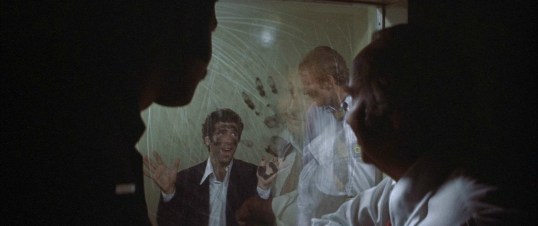
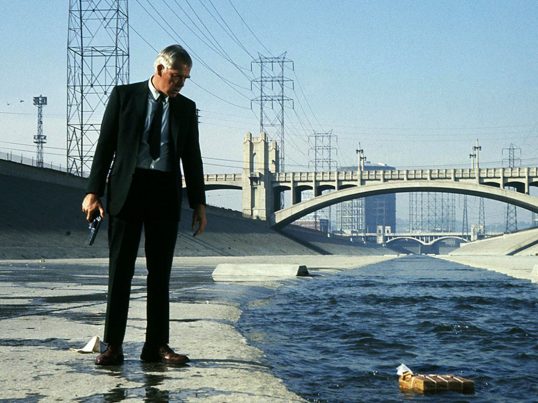
4 Shots From 4 Films is just what it says it is, 4 shots from 4 of our favorite films. As opposed to the reviews and recaps that we usually post, 4 Shots From 4 Films lets the visuals do the talking!
Today, we celebrate what would have been the 100th birthday of the great director, Robert Altman! It’s time for….
4 Shots From 4 Robert Altman Films
MASH (1970, dir by Robert Altman, DP: Harold E. Stine)
The Long Goodbye (1973, dir by Robert Altman, DP: Vilmos Zsigmond)
Nashville (1975, dir by Robert Altman, DP: Paul Lohmann)
3 Women (1977, dir by Robert Altman, DP: Charles Rosher, Jr.)
In 1995’s Bloodknot, we are introduced to a grieving family.
Evelyn (Margot Kidder) and Arthur (Allan Royal) are mourning the death of their oldest son, who was in the military and who died during a military operation in the Middle East. Their other son, Tom (Patrick Dempsey), spends his time working on cars and helping out local racecar driver Mike (Craig Sheffer). Youngest daughter Gail (Ashleigh Ann Wood) doesn’t really have much of a personality but she’s definitely worried about her mother.
Suddenly, Connie (Kate Vernon) shows up in town. Wearing a uniform that is slightly too large for her, Connie claims that she served with Evelyn’s dead son and that they eventually became more than just friends. That’s strange, Evelyn says, he never mentioned you. Connie replies that she encouraged him to write more but, for whatever reason, he didn’t. Everyone agrees that what’s important now is that Connie has introduced herself to the family. Soon, Connie is living at the mansion and making flirtatious eye contact with both Arthur and Tom. One might expect Evelyn to be concerned about this but instead, Evelyn is too busy walking around in a depressed daze and blaming her “sinful” past for all the recent tragedy.
You probably already guessed that Connie is not who she says she is. Indeed, Connie has come to the family with an agenda of her own. She’s looking for vengeance and I won’t spoil it by revealing what she’s upset about but I will say that it’s fairly dumb and makes less sense the more that you think about it. Tom’s girlfriend, Julie (Krista Bridges), suspects that Connie is a liar but can she prove it? Julie even talks to the officer from whom Connie stole her uniform after Connie met and seduced her at a bar. Why would Connie, who seems to be willing to kill anyone, leave that one person alive? Obviously, it’s so Julie can learn the truth but still, it’s an oversight on Connie’s part that makes little sense.
(Julie isn’t a very interesting character but she does get to wear a really nice pair of boots so at least she’s got that going for her.)
Looking at the members of this film’s cast — Patrick Dempsey, Craig Sheffer, Kate Vernon — and you have to wonder if someone specifically said, “Let’s make an paranoia-themed, erotic thriller with the least interesting actors of the 90s.” (Yes, Dempsey got better but, in this film, he was still doing the goofy awkward thing.) This film goes through all the usual steps. Connie starts out as being friendly and then progressively reveals herself to be more and more unhinged. The men are reduced to stuttering incoherence by the sight of Connie smiling at them. For this type of film to work, the actors have to be fully willing to embrace the melodrama but instead, both Kate Vernon and Patrick Dempsey give oddly lowkey performances, with Vernon’s attempt at a seductive smile instead coming across like a smirk that should have clued everyone in to the fact that she was not to be trusted. If you’re appearing in a film like this, you should at least have a little fun. As for Craig Sheffer, he’s as mind-numbingly dull as ever.
The film does improve a bit towards the end, largely because Connie’s secret reason for harassing the family is so implausible that it can’t help but be a bit entertaining to listen to the characters discuss it. Overall, though, this was pretty boring. Let this film be a lesson to all — embrace the melodrama!
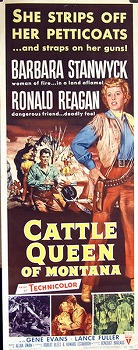
Pop Jones (Morris Ankurm) and his daughter Sierra Nevada (Barbara Stanwyck) leave their ranch in Texas and head up to Montana to take over some land that Pop has inherited. Evil Tom McCord (Gene Evans) wants the land for himself and conspires with a member of the local Blackfoot tribe, Natchakoa (Tony Caruso), to take it over. After a surprise attack leaves Pop dead, Sierra is nursed back to health by Colorados (Lance Fuller), the son of the Blackfoot chief. Sierra tries to reclaim her land from McCord, with the eventual help of the mysterious gunslinger Farrell (Ronald Reagan).
There are a lot of reasons why this B-western doesn’t really work, a huge one of them being that Barbara Stanwyck was several years too old to be playing Morris Ankrum’s innocent daughter. The biggest problem though was casting Ronald Reagan as a mysterious gunslinger. Farrell is a character who is supposed to keep us guessing. We’re not supposed to know if he’s a good guy or a bad guy. But as soon as Ronald Reagan shows up and starts to speak, we know everything we need to know about Farrell. There was nothing enigmatic or even dangerous about Ronald Reagan’s screen persona. He came across as being more open and honest as just about any other actor from Hollywood’s Golden Age. For the role of Farrell, it appears that he went a day without shaving and he tried not to smile while on-camera but he’s still good old dependable Ronald Reagan. That pleasantness and lack of danger may have kept him from becoming an enduring movie star but it did serve him very well when he moved into the political arena.
Cattle Queen of Montana was one of the 200 westerns that Allan Dwan directed over his long career. It’s not one of his more interesting films, though he does manage a few good action sequences. A far better Dwan/Reagan collaboration was Tennessee’s Partner, which was released four years after this film.
Wil Hunter (James Maslow) wanted to be a painter in New York but instead, he ended up working for his Dad’s storage unit business with his brother, aspiring filmmaker Orrie (Jesse Pepe). When Wil’s ex-girlfriend, Susan (Lillian Solange Beaudoin), arranges for Wil to have a tent at a local art show, it revives Wil’s dreams of making his living as an artist. While Orrie films a documentary about what’s goes on behind-the-scenes at an art show, Wil gets to know fellow artists like Chief (Robert Wilson Seymone) and Vic (Jason Kypros). He also falls in love with the owner of tent-next-door, Rachel (Ella Lentini).
Art Show Bingo is a sweet movie, a love story with an edge of authenticity. I get the feeling that it was made by people who actually have experience with art fairs and “starving artist” shows because all of the little details feel true, like the customers who try to set their own prices, the kids who don’t often understand that are should be looked at but not touched, and the snooty judges who dislike everything they see. I’ve been to enough amateur art fairs that I immediately recognized a lot of the situations and the characters in Art Show Bingo. (After seeing this movie, I’m definitely going to be nicer the next time I go to one.) Personally, I was not really that impressed by Wil’s paintings but art is often in the eye of beholder and his work did get better as the movie went on. Orrie got on my nerves but I liked both Wil and Rachel and I really wanted to see them get together.
I liked Art Show Bingo a lot more than I thought I would. It wasn’t perfect but it still left me smiling.
Today is the anniversary of the birth of one of the greatest of the screen tough guys, Mr. Lee Marvin! Today’s scene that I love comes from the 1967 film, Point Blank. In this short but emotionally exhausting scene, Angie Dickinson hits Lee Marvin’s career criminal, over and over again. Marvin, for his part, barely reacts. This scene is the epitome of Lee Marvin’s mystique. He played men who only showed emotion when it was necessary. Dickinson hits Marvin to try to make him feel something but Marvin’s career criminal in beyond such concerns.
From Point Blank, here is today’s scene that I love:
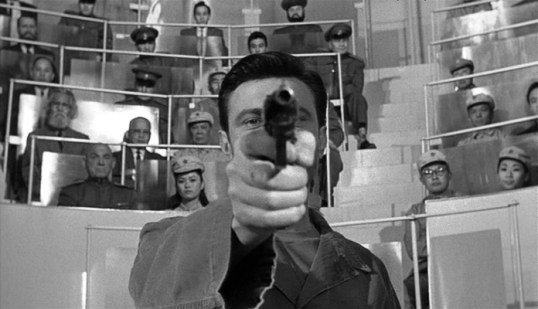
4 Shots From 4 Films is just what it says it is, 4 shots from 4 of our favorite films. As opposed to the reviews and recaps that we usually post, 4 Shots From 4 Films lets the visuals do the talking!
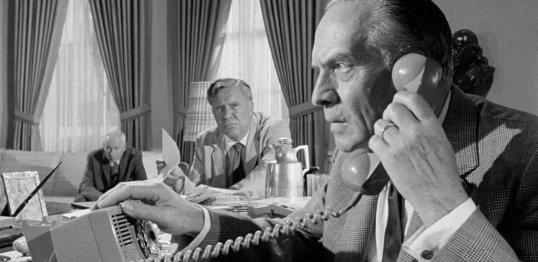
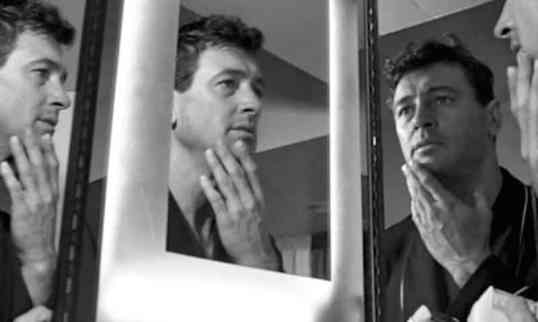
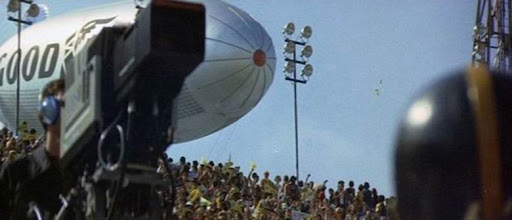
John Frankenheimer was born 95 years ago today, in New York City. He got his start working in live television and went on to become one of the best directors of thrillers around. After getting off to a strong start in the 60s, directing several classic films (many of which had a political subtext), Frankenheimer struggled in the 70s (though even that decade saw him directing the classic Black Sunday) before making a comeback in the 90s. (1998’s Ronin is regularly cited as having one of the best car chases ever captured on film.) He was also one of the first film directors to make the transition to regularly working for cable channels like TNT and HBO. Indeed, the films that he made for HBO played no small part in establishing HBO’s reputation as being a “prestige” network.
It’s time for….
4 Shots From 4 John Frankenheimer Films
The Manchurian Candidate (1962, dir by John Frankenheimer, DP: Lionel Lindon)
Seven Days In May (1964, dir by John Frankenheimer, DP: Ellsworth Fredericks)
Seconds (1966, dir by John Frankenheimer, DP: James Wong Howe)
Black Sunday (1977, dir by John Frankenheimer, DP: John A. Alonzo)
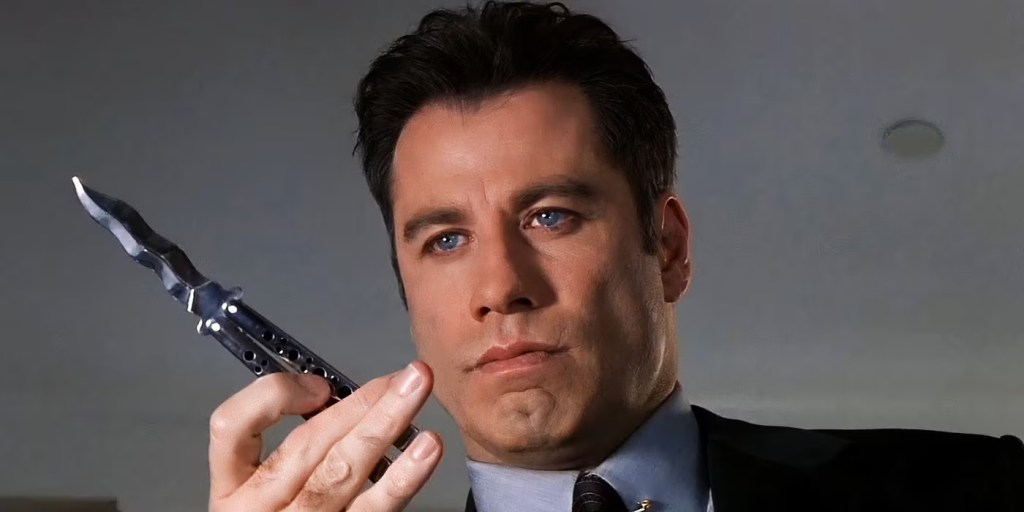
I couldn’t let today go by without recognizing John Travolta. I’ve enjoyed so many of his films over the years, especially movies like GREASE, BLOW OUT, PULP FICTION, and GET SHORTY. But the movie I probably love the most is FACE/OFF. I remember watching it at the movie theater back in 1997 and thinking it was the best movie ever. It came out at a perfect time when I was obsessed with John Woo, and I was still enjoying Travolta’s mid-90’s comeback. I still watch FACE/OFF at least once every year.
Enjoy this excellent scene from John Woo’s FACE/OFF!
A group of American soldiers are searching for militants. Amongst them is the grim-faced William “Spooky” MacPherson (Val Kilmer). When an adorable little girl with a teddy bear approaches the soldiers, MacPherson barely notices. His mind is on adult threats. But when the girl reveals that she has a bomb in her backpack, the majority of the soldiers are blown up with her. MacPherson survives, though he loses a leg and ends up with such severe PTSD that he can no longer carry a gun or even make a fist. Helping him recover from his wounds is his best friend and fellow soldier, Miguel (Greg Serano).
A year or so later, MacPherson is back home. He lives in a run-down apartment in New York and spends most of his time with a naked woman who speaks Russian. (Whether she was meant to be his girlfriend or just someone he hired is unclear.) Miguel continually calls him up and asks him to come down to New Mexico and work on his ranch. MacPherson refuses at first. He wants to remain isolated from the world. But when his flashbacks of the explosion become too intense, MacPherson finally decides to accept Miguel’s offer. MacPherson pawns a gun so that he’ll have enough money to get a bus ticket. And then, he heads for New Mexico.
The only problem is that, once MacPherson arrives in New Mexico, Miguel is nowhere to be seen. Walking through a town that appears to have recently been constructed, MacPherson meets a lot of people who insist that they’ve never heard of Miguel and that there is no ranch at the address that Miguel gave MacPherson. The police carefully watch MacPherson as he makes his way from business to business, searching for his friend. No one in town is friendly. No one seems to want MacPherson around. Eventually, MacPherson is approached by Rhodes (Gary Cole), the businessman who is building the town and who apparently controls everything that happens within the town limits. Rhodes is friendly. Rhodes says that MacPherson, with his white skin and blonde hair, is exactly the type of person that he likes to see in his town. Can you tell where this is going?
You probably already guessed that Rhodes is an evil businessman who is involved in human trafficking and who smuggles Mexicans across the border to work for his company before then sending back to their home country with next to no money. You’ve also probably figured out that Miguel was killed by the corrupt police force. If you haven’t figured that out, you’ve never seen a movie before. MacPherson teams up with the only kind person in town, Joanna (Jennifer Esposito), and they try to stop Rhodes’s operation. The entire movie seems to be building up to a scene where MacPherson and Joanna take on the whole town but instead, somewhat anticlimactically, everyone just stands around and watches Rhodes battle MacPherson. Conspiracy promises a lot but it doesn’t really deliver.
This was one of Val Kilmer’s first straight-to-video roles and he gives a rather detached performance, which is a shame because an actor of Kilmer’s talent could have really done something with this role if he had been in the mood to do so. But I don’t blame Kilmer for not seeming to be that invested in Conspiracy. It’s not a very interesting film. Even the usually dependable Gary Cole just seems to be going through the motions. The film’s attempt to comment on the pressing political issues of 2008 — illegal immigration, the war in Iraq, the burst of the housing bubble, the recession — only serve to reinforce how shallow and heavy-handed the film actually is. Watching Conspiracy in 2025, the most interesting about it is that the issues it deals with are the issues that, 17 years later, Americans are still dealing with.
With its portrayal of an isolated town and a scarred war veteran looking for a missing friend, Conspiracy has a lot in common with the classic 1955 film, Bad Day At Black Rock. Now, that’s a film that is definitely worth seeing!
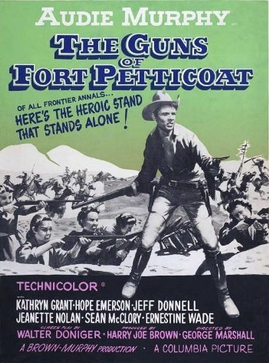
During the waning days of the Civil War, Lt. Frank Hewitt (Audie Murphy) is a man without a country. A Texan, he joined the Union Army even as his home state was voting to secede from the United States. In the Army, Hewitt is viewed with distrust by his autocratic superior, Col. John Chivington (Ainslie Pryor). When Hewitt learns that Chivington has ordered a surprise attack on an unarmed local Indian tribe in order to drive them into Texas where they will attack the nearest settlement for revenge, Hewitt deserts the Army to warn the people left in his hometown.
When Hewitt arrives, he discovers that all of the men in town have left to join the Confederate Army. Only their wives, mothers, and sisters remain. Though Hewitt is, at first, accused of being a traitor, he sticks around and trains the women on how to fight not only the incoming Comanches but also any outlaws who ride into town looking to take advantage of the situation.
The Guns of Fort Petticoat is an interesting B-western that holds up well today. Even though the film ends with a Comanche attack, it’s made clear that the attack would not have happened if not for the actions Col. Chivington. Chivington, who doesn’t care that the victims of his actions would not be Confederate soldiers but instead just helpless woman and children, is the film’s true villain, even if he only appears in the first and final scenes. Audie Murphy, who was America’s most decorated World War II veteran, not only starred in but produced the movie. Murphy was a stiff actor but he looked believable in uniform and obviously knew how to convincingly shoot a rifle and that’s all this role really demands of him. Kathryn Grant plays the woman who goes from distrusting Hewitt to falling in love with him and she and Murphy work well together. The final battle between the women and the Comanches is exciting and well-shot by veteran western director George Marshall. The movie’s final scene may not be totally believable but it’s still very satisfying.
Fans of the western genre and Audie Murphy will find much to enjoy about The Guns of Fort Petticoat.
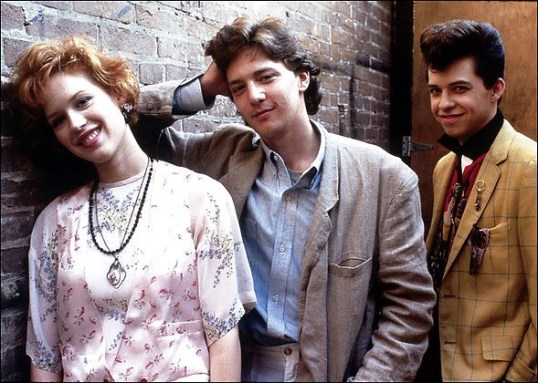
Today’s scene that I love comes from 1986’s Pretty In Pink, starring Molly Ringwald, Andrew McCarthy, Jon Cryer, and James Spader and written by John Hughes.
In the final scene, we discover Andie at prom with Duckie. Fortunately, Blaine shows up. Listen, I know that there are a lot of people who think that Andie should have ended up with Duckie. That’s how the script was originally written and the film’s ending was reshot after test audiences literally booed the idea of Andie going to prom with her best friend. In this case, though, the test audience was correct. Duckie was sweet but he wasn’t a prom date. Andie and Blaine belonged together.