The forces of the evil Lord Arrakur (Arman Chapman) raid a peaceful Barbarian village, disrupting the wedding of Queen Amethea (Lana Clarkson) and Prince Argan (Frank Zagarino). Along with slaughtering almost the entire village, Arrakur also kidnaps Amethea’s sister, Taramis (Dawn Dunlap). Amethea survives the attack and, with her handmaiden Estrild (future director Katt Shea) and the warrior Tiniara (Susana Traverson), sets out for Arrakur’s realm to rescue her sister and to take vengeance on him.
In Barbarian Queen, there’s much violence, much nudity, and much time spent in a dungeon with a pool of acid. This may sound like pretty standard fantasy stuff and it is, except for the fact that almost all of the warriors are women and Arrakur and his forces are even nastier than the typical sword-and-sorcery villain. Arrakur uses rape to terrorize his enemies and his subjects and, while that may be historically correct, it’s not easy to watch. By the time Arrakur and Amethea are facing off in the gladiatorial arena, most viewers will be ready to see Arrakur defeated in the most extreme way possible.
BarbarianQueen was released by Roger Corman’s Concorde Picture and it was filmed in Argentina. Today, it is best-remembered for the presence of the tragic Lana Clarkson in the role of Amethea. Lana Clarkson starred in several Corman-produced fantasy films before she was murdered by Phil Spector in 2003. At the time of her death, the media often dismissively described Clarkson as being a “former B movie starlet” but anyone who caught Clarkson’s movies on late night Cinemax knows that she was always the best thing about the films she was in and that she had a likable and sincere screen presence that made you root for her, whether she was fighting off an army with a sword and hiding in a tree with a bow-and-arrow. Lana Clarkson’s performance in Barbarian Queen is always strong and sympathetic. She endures even the movie’s most exploitive scenes without sacrificing her dignity and when she fights back, she refuses to surrender. Her determination to have her vengeance and to free the people from a tyrant is the thing that makes Barbarian Queen worth watching.
RIP, Lana Clarkson. She was so much more than just “a B movie starlet.”
Today is a significant day for fans of Friday the 13th Part II. Today is the birthday of both Warrington Gillette and Tom McBride. Gillette was one of two actors to play Jason Voorhees in that film (he plays Jason without the mask while stuntman Steve Daskewisz played Jason whenever he was wearing a mask) and he is 65 years old today. Tom McBride, who passed away in 1995, played Mark, whose death was one of the films most shocking moments. Today, he would have been 72 years old.
Today’s scene that I love comes from Fridaythe13thPartII, which I think is a genuinely underrated horror film. Whenever I see this scene, I roll my eyes at Vicki (Lauren-Marie Taylor) running outside in her underwear just to look for something in her car but then I remember all of the times that I’ve done the exact same thing and I realize that I probably wouldn’t survive a horror film.
On July 10th, 1981, Kenneth Rex McElroy was gunned down in Skidmore, Oklahoma. He was shot while sitting in his truck. Over 40 bullets were fired into the truck but only two actually hit McElroy. His fourth wife, Trena (who Kenneth first met when she was 12 and he was 35), was sitting beside him at the time but was not hit by any bullets. McElroy was 47 years old when he was gunned down in broad daylight. There were reportedly 46 witnesses who saw the shooting occurred. When interrogated by the police, not a single one said that they saw anything. Quite a few did mention that Ken McElroy had gotten exactly what he deserved.
Ken McElroy was a high dropout, a barely literate career criminal who rustled cattle, burned down houses, raped his fourth wife when she was just 12, and then killed her family’s dogs in order to intimidate them into not pressing charges against him. He was known as the town bully, a surly man who had 17 children with 6 different women and who would shoot anyone who disagreed with him. Whenever he was charged with a crime, he would intimidate the witnesses into not testifying against him. In 1980. he got angry at a store owner after one of his kids was accused of shoplifting candy. McElroy shot the man and was put on trial for attempted murder. For once, he was convicted but he was freed on bail while awaiting appeal. When it become apparent that McElroy would not be going to prison for a while, the citizens of Skidmore….
Well, I should probably chose my words carefully. The truth of the matter is that no one has even been charged with or convicted of killing Ken McElroy. It is known that several citizens did have a meeting a few night before McElroy’s death and that they discussed what they could best do to keep McElroy from hurting anyone else. It’s also knoqn that, a week before he was shot, McElroy walked into the local bar with his rifle and dared anyone who wanted him dead to come get him. Does that mean that a group of concerned citizens took it upon themselves to dispense vigilante justice? That’s what Trena always claimed but again, no one was every charged, indicted, or convicted. The death of Ken McElroy remains officially unsolved.
Perhaps that’s why the names were changed for the 1991 made-for-television movie InBroadDaylight. Brian Denney may be playing a character named Len Rowan but, for anyone familiar with the case, it’s obvious that he’s playing Ken McElroy just as Marcia Gay Harden is obviously playing Tena McElroy, even if her character is called Adina. The film doesn’t change the name of the town and it doesn’t change the circumstances that led to McElroy’s death. W watch as McElroy intimidates the owners of a grocery store (played by Cloris Leachman and John Anderson) and even attempts to bully the local police (represented here by Chris Cooper). The film features a gun-toting crowd surrounding Len Rowan’s vehicle but it’s shot in such a way that their faces are blurry.
InBroadDaylight was filmed in Texas and it definitely captures both the beauty and the potential danger that comes with living in a rural community. Everyone in town knows everyone else. There’s a strong sense of community but, because the community is so small and isolated, it’s easy for a man like Len Rowan to bully the entire town. Some of the actors lean a bit too hard into their country accents. (Lord protect us from Yankees trying to sound Southern.) But the main members of the supporting cast — Cloris Leachman, John Anderson, Chris Cooper, Marcia Gay Harden — all give convincing performances. As for Brian Dennehy, he’s absolutely horrifying as the astoundingly cruel Len Rowan. Dennehy plays Len as being a man who might not exactly intelligent (the real Ken McElroy dropped out of school early) but who is positively brilliant at intimidating people. Dennehy plays Rowan as if he has a death wish. All of his threats and his speeches make it clear that he’s just daring someone to shoot him. Even when he realizes he’s about to get shot while sitting in his truck, he sit there and accepts the inevitable. Perhaps even he was getting sick of dealing with himself.
After watching In Broad Daylight, it’s easy to understand why no one came forward as a witness. By his own actions, Ken McErloy was destined to die violently. A few people just decided to speed things up a little. Who knows who?
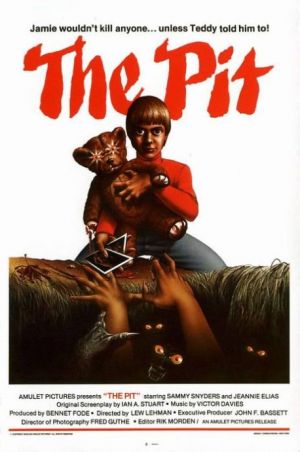
The 1981 Canadian film, ThePit, tells the story of a creepy little jerk named Jamie Benjamin (Sammy Snyders).
Now, admittedly, Jamie is only twelve years old and, usually, I make allowances for bad behavior from people who aren’t old or mature enough to know better. But there’s just something off about Jamie. He comes across as creepy from the first minute he shows up, with his intense stare and his blonde bowl cut. He spends a lot of time in the woods, where he has discovered a hole in the ground. The hole is full of hungry creates that Jamie calls Trogs. Jamie regularly takes raw meat to the hole and tosses it in. Unlike all of the kids at school and his own parents, the Trogs are always happy to see Jamie.
It may sound like a bad idea to give meat to a bunch of monsters that you just happened to find in the woods but Teddy thinks it’s a good idea. Teddy is Jamie’s teddy bear. Teddy talks. Teddy has all sorts of ideas for how Jamie can get back at everyone who has ever made fun of him or left him feeling insecure. Why not just toss them into the pit? Is Teddy real or is he just in Jamie’s mind? The film tries go for some ambiguity. That said, the Trogs are definitely real so it’s not that difficult to go from accepting the idea of carnivorous monsters to buying into a talking teddy bear.
Jamie is entering puberty and his hormones are going crazy. When his parents leave for a trip, they hire a psychology student named Sandy O’Reilly (Jeannie Elias) to keep an eye on Jamie. Jamie develops a crush and soon becomes obsessed with Sandy. Jamie is the type of kid who pretends to drop something just so he can look up Sandy’s skirt. (Bad Jamie!) Despite Jamie’s crush on Sandy, he still steals money from her so that he can buy raw meat for the Trogs. When he can’t get any more meat, he starts tempting real people out to the woods and pushing them in. When he tells Sandy about the Trogs, she doesn’t believe him. He takes her to the pit and that’s when things really start to get bad….
ThePit is an odd little film, one that never quite settles on a tone. In the original script, the Trogs and Teddy’s advice were all meant to be in Jamie’s head and Jamie himself was only meant to be 9 years old. The horror elements were meant to be products of Jamie’s disturbed imagination and one can still see elements of that in the completed film. However, director Lew Lehman decided to make Jamie older, to leave no doubt that the Trogs were real, and to add a small amount of humor. As such, The Pit is a film that veers from being a horror film to being a somewhat depressing coming-of-age film to a somewhat mean-spirited comedy. Sammy’s behavior, which might have been understandable for a 9 year old, becomes even more creepy now that he’s a twelve year-old who still takes orders from a teddy bear.
It’s a confused film but Sammy Snyders gives one of the best creepy kid performances of all time and there’s something undeniably satisfying about the ending. As Jamie discovers, he’s not the only kid with a pit and teddy bear can only protect him for so long.
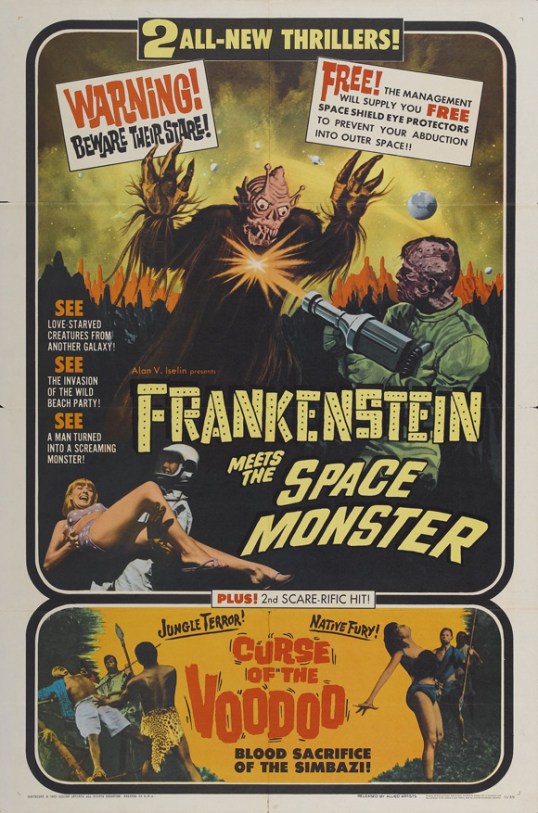
Despite the title, 1965’s Frankenstein Meets The Space Monster is not actually about Frankenstein or his monster.
Instead, the Frankenstein of the title is Frank Saunders (Robert Reilly), an astronaut who happens to be an android. Frank was created by Dr. Adam Steele (James Karen, in one of his first film roles). Frank is designed so that he can go into space without making any of the mistakes that a human astronaut might make. He’s the next stage in the space program! With Frank sitting in a rocket, America will have rightfully conquered the Moon in no-time flat!
(Don’t waste my time with any of the international treaty crap. I don’t care how many other countries go to the Moon, it belongs to America because we landed their first. It’s the 51st State and someday, we’ll probably end up moving the federal government to the moon. Hopefully, we’ll just leave it there.)
Unfortunately, no sooner has Frank gone into space then he gets shot down by the Martians. Frank crashes in Puerto Rico and, with his face horrifically disfigured, starts to malfunction, Soon, he’s creating chaos all over the island and it’s up to Dr. Adam Steele — what a name! — to put a stop to it. However, before Frank is deactivated, he needs to meet the Space Monster (a mutant named Mull) and defeat the Martians.
Why are the Martians on Earth? According to a short, pointy-eared dwarf Martian named Dr. Nadir (Lou Cutell), an atomic war has led to the death of all the women on Mars. Personally, I think Dr. Nadir is lying because he came to Earth with a Martian woman named Princess Marcuzan (Marilyn Hanold). I think it’s more a case of almost all of the Martian women faking their own deaths so that they could get out of having to talk to Dr. Nadir. Seriously, Dr. Nadir is a little creep. Add to that, his Martian name actually sounds like an insult in English. Personally, I think he should come up with a new name if he wants people to listen to him. I would suggest calling himself Adam Steele but that name is already taken.
Soon, Martians are abducting bikini-clad women off of beaches in Puerto Rico. Can the Martians be stopped? Can Frank be restored? Will James Karen go on to have a distinguished career as a beloved character actor? Spoiler alert: the answer to the third question is yes. Indeed, one of the joys of this film is getting to see James Karen in a rare leading role. He commits to giving as good performance, even though the film itself is pretty silly.
Another joy of this film is the soundtrack, which is surprisingly good for a film of this budget and caliber. Just try to get That’s The Way It’s Got To Be out of your head! (In the film, this song plays as Frank prepares to go into space.)
That’s the way it’s got to be!
As for Frankenstein Meets The Space Monster …. I just can’t help it. I like the damn thing. It’s just so ludicrous and silly that it’s impossible for me not to enjoy. The film’s producers decided that they didn’t just want a robot terrorizing an island. They also wanted Martians and a mutant, as well! And we’re all better off for it.
It is fun to review a Chris McInroy short film. They are great horror comedy with copious gore. The actors are obviously friends of his that know how to deliver a joke. Chris also knows how to use a brief silence for a bigger laugh. He’s the Anti-Alex Magana. If you watch more than two Alex Magana films in one sitting, you wonder if humankind should really keep going. Whereas, these are a pleasure to watch and review. Side note the amount of blood and gore are Sam Raimi levels.
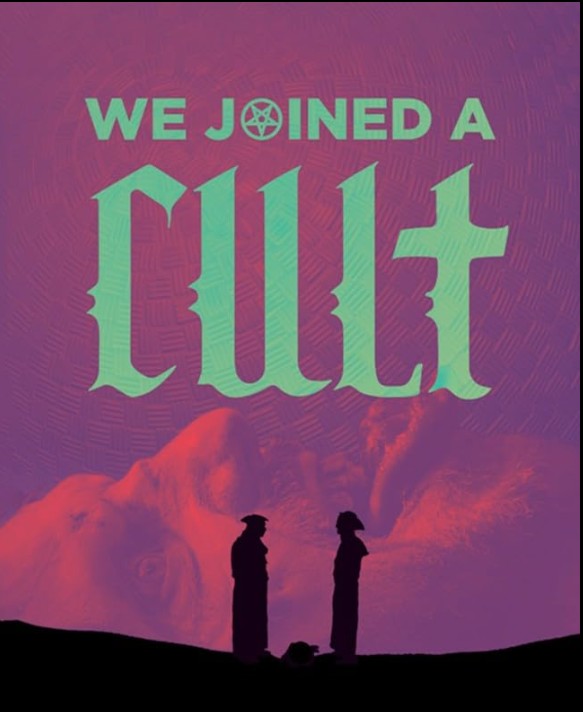
Two bros are meeting a fellow bro for kickball, but their comrade has joined a satanic cult. Here’s the twist, all of the cultist are terrible at their job. What is refreshing is that there are no Mary Sues or Mike Sues- EVERYONE in this cult is a moron! Black, white, asian, libertarian, or vegetarian ALL are equally stupid and it is hilarious! There is a kickball decapitation that is priceless! I highly recommend this short!
Filmmaking in Japan has always thrived on extremes—but not in one uniform direction. On one end lies the haunting, gothic atmosphere of horror steeped in shadows, ritual, and psychological dread; on the other lies the explosion of ultra-violence, pushed to grotesque and sometimes cartoonish heights. This duality mirrors the country’s broader cultural and artistic history, from the impressionistic ritualism of Noh theater and kabuki to the stark contrasts found in ukiyo-e prints. It was inevitable that such traditions would shape Japanese cinema, inspiring films that swing between meditative stillness and overwhelming sensory assault. Few modern filmmakers embody this radical spectrum more vividly than Miike Takashi, the ever-provocative and unapologetically eclectic mad genius of Japanese film.
Trying to find a Western counterpart to Miike often feels impossible. He refuses to be pinned down, leaping from genre to genre with the same restless energy as a filmmaker like Steven Soderbergh, but with far darker, more transgressive tendencies. Yet even in his eclecticism, Miike tends to operate at the polar extremes of Japanese genre filmmaking. One year he delivers chillingly restrained, gothic atmosphere—as seen in Audition or One Missed Call, both sustained by mood, dread, and psychological unease. The next, he unleashes pure ultra-violence, as in Dead or Alive or Ichi the Killer, films that seem designed to push cinematic violence far beyond socially tolerable thresholds. He’s made yakuza dramas, samurai fantasies, children’s stories, westerns, thrillers, and even musicals. To watch Miike is to surrender to unpredictability—but always to expect extremity.
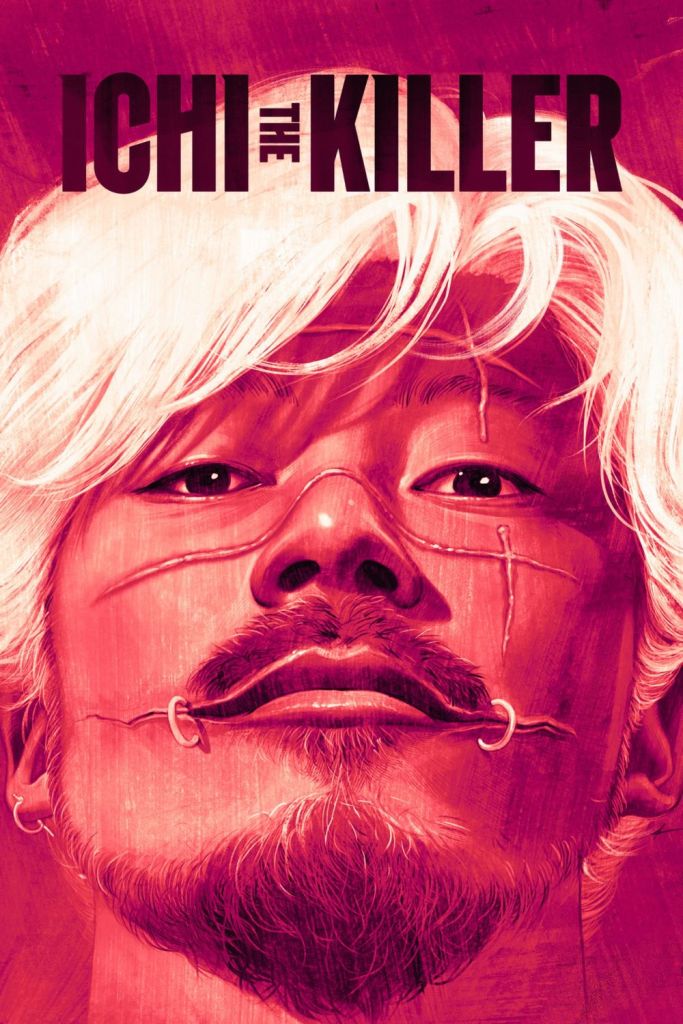
And nowhere is Miike’s fascination with the violent pole more vividly captured than in his infamous 2001 adaptation of Hideo Yamamoto’s manga Ichi the Killer (Koroshiya 1 in Japan). The film remains one of his boldest and most grotesque provocations: hallucinatory, hyper-violent, and defiantly sadomasochistic. If Audition showed Miike at his gothic and restrained, building terror through silence and stillness, then Ichi the Killer does the opposite—it blasts the viewer with sensory chaos, arterial spray, and sadomasochistic spectacle. The result pushes beyond gore into nightmare surrealism, so extreme it resembles Peckinpah’s The Wild Bunch refracted through a carnival mirror.
On its surface, the narrative is deceptively straightforward: at its core lies the hunt between two men. Ichi, an emotionally fragile vigilante manipulated into becoming a weapon of destruction, and Kakihara, a flamboyant, sadistic yakuza enforcer who thrives on pain both given and received. While Miike alters aspects of the manga, he retains the dual narrative thread of these two figures spiraling toward an inevitable rooftop showdown high above Tokyo’s neon chaos. Yet to describe the plot too literally is pointless. Miike warps Yamamoto’s crime saga into something closer to a fever dream, a delirious collage of violence and grotesquerie where linear logic is slowly dissolved, leaving behind only sensation.
Where Ichi the Killer separates itself is in its layered subtext of body horror and sadomasochism. Miike is not content with gore alone; he explores the intimate psychology of pain and pleasure, showing their fusion in ways that unsettle. This is established from the film’s beginning, in one of its most infamous moments, when Ichi—lonely, voyeuristic, and lost in disturbing fantasies—masturbates while watching a prostitute being assaulted, climaxing onto a balcony railing. The explicitness shocks, but more importantly, it plants the film’s thematic flag: eroticism polluted by brutality, desire inseparable from cruelty. Miike ensures the audience feels implicated, not just as witnesses but as voyeurs who cannot look away.
Kakihara embodies the other side of this sadomasochistic spectrum. He lives for violence, both inflicting and enduring it. His Glasgow smile—cut into his cheeks years before Ledger’s Joker canonized the image—is carved symbol of his philosophy: rebellion scarred into flesh, grotesque yet strangely glamorous. Much of this impact rests on Tadanobu Asano’s performance. Watching him in this role today, it’s startling to compare Kakihara to his later mainstream work in the Marvel Cinematic Universe (Thor films) or the prestige Shōgun remake. The actor who once played measured dignity and stoicism there is here unchained, flamboyant, and feral. His Kakihara is rockstar-like, charismatic, terrifying, and magnetic; the performance feels like a primal howl that stands in stark contrast to his more restrained global roles. By the finale, one could argue Kakihara comes closer to the film’s “hero” than Ichi himself, embodying violence not merely as cruelty but as pure identity.
The film unfolds as a series of violent tableaux, each more outrageous than the last, somewhere between grotesque cartoon and waking nightmare. Bodies are mangled, organs splatter, arterial spray bursts like abstract expressionist brushstrokes. Miike pushes the imagery so far it sometimes tips into slapstick, calling to mind Peter Jackson’s Dead Alive. It’s violence past the point of horror, collapsing into absurdist comedy: as if Tom and Jerry were redrawn with box cutters and razor wire. Tarantino’s famous “House of Blue Leaves” sequence in Kill Bill clearly draws inspiration from Miike’s operatic bloodletting.
And yet Ichi the Killer is not mere shock and gore. Beyond its chaotic excess, the film probes violence as spectacle—something audiences recoil from but also consume with fascination. Miike refuses to let the audience off the hook. He doesn’t desensitize; he implicates. Watching Ichi means simultaneously condemning its cruelty and acknowledging our own morbid curiosity. That tension—between gothic atmospheres of dread and gaudy ultra-violence—is where Miike thrives.
This duality makes Ichi the Killer one of the most notorious entries in modern cult cinema. It isn’t for everyone, and was never intended to be. Some audiences will find it unwatchable, others mesmerizing. But what is undeniable is its extremity, one end of the spectrum of Japanese genre filmmaking stretched to breaking point. If Audition embodies Miike’s gothic restraint, Ichi represents his carnival of brutality. Together, they capture the twin poles of his artistry and of Japanese extremity itself. Violence here is more than gore—it is body horror, sadomasochism, and spectacle fused together, a dark carnival Miike dares us to enter and dares us not to look away.
In this 1953 film, a gorilla wearing a diving helmet uses the Calcinator Death Ray to wipe out almost all human life on Earth. Only 8 people survive, among them a professor, his family, and Roy (future Eurospy star, George Nader). Ro-Man (George Barrows) is hounded by his superior to track down and destroy the survivors. Ro-Man does his best, though the humans prove to be …. well, they’re not really that resourceful. In fact, they’re pretty dumb. But Ro-Man is pretty dumb himself.
Regularly (and incorrectly) cited as being one of the worst films ever made, RobotMonster is an enjoyably absurd hybrid of horror and science fiction. Earth is destroyed through a combination of bad lighting effects and stock footage and the arguments between Ro-Man and his superior have to be heard to be believed. RobotMonster is actually a bit more self-aware than a lot of people realize. This is a low-budget Z-movie that realizes that it’s a low-budget Z-movie and which cheerfully embraces its identity. RobotMonster is a personal favorite and it’s a bit of Halloween tradition around these parts.
And now, enjoy RobotMonster in all of its black-and-white glory!
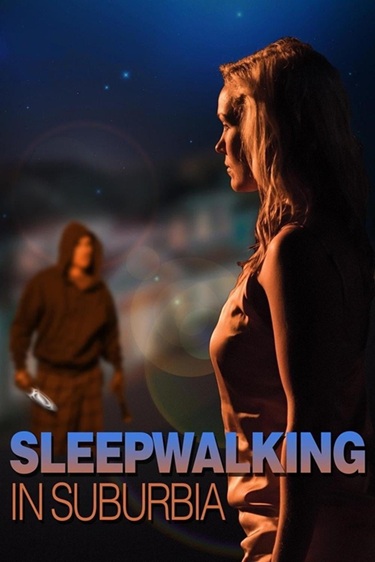
Last night, I watched the classic 2017 Lifetime film, Sleepwalking In Suburbia.
Why Was I Watching It?
I was watching it as a part of the #MondayMania watch party! We’ve been watching the Stalked By My Doctor films and Sleepwalking In Suburbia, along with being a stand-alone film, leads into the fourth Stalked By Doctor film. While I watched, I realized that I hadn’t reviewed this film yet so I decided to get on it.
What Was It About?
Michelle Miller (Emillie Ullerup) has a nice house in the suburbs and a successful husband (Giles Panton) but she also has a sleepwalking problem. At night, she’ll get out of bed, leave the house, and, while in trance, go inside someone else’s house and either have sex in the living room or join them in bed. She’s been diagnosed with “sexsomia.”
One sleepwalking incident leads to her having sex with her neighbor, Luke (Carlo Marks). Now, every time that Luke sees Michelle, he’s like, “When are you coming by again?” and Michelle is like, “What are you even talking about, weirdo?”
Michelle’s pregnant! Her husband is all excited but is he the father or is it Luke? And when Luke’s wife seemingly vanishes, Michelle suspects that there might be murder in suburbia as well!
What Worked?
What worked? The entire movie, that’s what worked! Seriously, this was one of the greatest Lifetime films ever made. It embraced the melodrama. The plot featured twist after implausible twist. The performances were enjoyably over-the-top and I defy anyone not to smile when the kindly doctor announces that Michelle has “sexsomia.”
Here’s the thing: sexsomia is a real thing. Now, if you look it up on Wikipedia, it redirects to “sleep sex” but this is a Lifetime film and it’s obvious that it was understood that “sexsomia” just sounds better than “sleep sex.” Was this film a realistic portrayal of sexsomia? Who knows and who cares?
The title was absolutely brilliant. Anytime you see the word “suburbia” in the title of a Lifetime movie, you know you’re about to see something special. And I have to say that the film made the suburbs look very nice. All the houses were big and well-decorated. No one in the Lifetime universe lives in a small house (unless they’re living in a trailer parker, which does happen on occasion.) That’s the way things should be.
Emillie Ullerup gave a great performance as Michelle. Her intense sleepwalking stare was one of the thing that made this film so entertaining. Giles Panton and Carlo Marks also gave good performance as two of the men in her life in her waking and sleeping life. The scene where Panton, as Michlle’s husband, reveals that he wants to handcuff Michelle in bed so that she won’t leave is both horrifying and slightly funny. “Not kinky!” her husband assures her.
Finally, the film ended with one of those out-there twists that Lifetime is known for. Seriously, when you’re in a Lifetime film, trust no one! The film’s ending was also open-ended enough that it allowed Michelle to return for Stalked By My Doctor: A Sleepwalker’s Nightmare.
What Did Not Work?
It all worked! This is a film that relentlessly and unapologetically embraced the melodrama in the best Lifetime tradition! When I talk about the best Lifetime films being self-aware without being too in-your-face about it, this is the type of film that I’m talking about.
“Oh my God! Just like me!” Moments
Wandering around in your night clothes in the middle of the night? Hey, I’ve been there! Of course, in my case, I was actually awake and I was checking on a cat. I have never broken into a house while just wearing a slip. I usually at least put on a robe before doing something like that.
Lessons Learned
Lock the door before you go to sleep. And the windows!
Parkour was quite a thing for a while, though I’m not sure if it’s as big a deal now as it used to be. Back in the day, YouTube was full of videos of people jumping off of roofs, skipping up walls, jumping over tables, and rolling around in the dirt. The main thing I remember about parkour was that, whenever anyone jumped over a bench, everyone watching had to go, “Whoa! HE JUMPED OVER A BENCH!” I also remember that the Divergent films were an attempt to present parkour as the key to surviving a dystopian future.
2010’s Leap opens with a college student spotting a guy named Shane (Alexander J. Bonda) leaping over a railing on campus. When Shane is asked what he’s doing, Shane replies, “Parkour. It’s from France.”
Now, really, that should have been a red flag right there. It’s from FRANCE! You know, the same France that surrendered to the Nazis and then spent years whitewashing the activities of the Vichy government? French is a beautiful language and the country has given us some of the greatest films ever made. Actually, to be honest, I love visiting France but still, when it comes to self-defense, they’re perhaps not the the best role model.
Soon, Shane is teaching a group of college students how to do parkour. There’s a lot of parkour in this movie and, for the most part, it’s scored to some of the mellowest heavy metal out there. When Shane’s students invite him to Bible Study, it upsets Shane’s girlfriend, Crystal (Chelsea Raugast). When Shane and his students decide to build a Christian outreach program around parkour, they start getting threatening letters. “Who could be threatening us?” one of the student asks. “Atheists,” comes the reply. Soon, Crystal is chasing Shane across campus and the two of them get to show off their parkour skills.
I really do have to mention the chase scene because it goes on for several minutes and it really doesn’t make much sense. (Crystal, who is apparently looking to kill Shane, drops her gun just so she can chase him.) What’s funny about it is that, even while running for his life, Shane still has to show off his parkour skills. For instance, when he sees a picnic table in front of him, he doesn’t simply run around it. Instead, he jumps on top of it and then rolls off. It reminded me a bit of the classic 80s action film Gymkata, in which a city in Eastern Europe was full of random pommel horses so that the gymnast hero could show off his moves while fighting the bad guys.
Leap was made for $200 and the cast was largely made up of volunteers. I have a weakness for low budget passion projects and I was willing to cut this film a bit of slack but then I reached the Bible Study scene where a youth minister explained that HIV was God’s way of punishing the nonbelievers for failing to follow him and that was such an icky statement that I can’t overlook it. The film ends with the end times approaching and the promise of a sequel. Can parkour defeat the Beast? We’ll find out, I guess.
 The forces of the evil Lord Arrakur (Arman Chapman) raid a peaceful Barbarian village, disrupting the wedding of Queen Amethea (Lana Clarkson) and Prince Argan (Frank Zagarino). Along with slaughtering almost the entire village, Arrakur also kidnaps Amethea’s sister, Taramis (Dawn Dunlap). Amethea survives the attack and, with her handmaiden Estrild (future director Katt Shea) and the warrior Tiniara (Susana Traverson), sets out for Arrakur’s realm to rescue her sister and to take vengeance on him.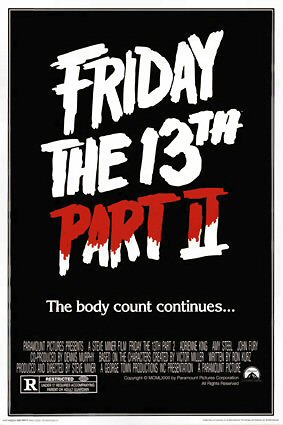



 Through the Shattered Lens