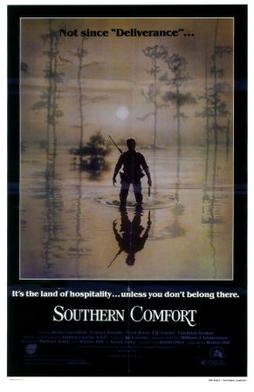
The Unominated #21: Southern Comfort (dir by Walter Hill)


Though the Academy of Motion Picture Arts and Sciences claim that the Oscars honor the best of the year, we all know that there are always worthy films and performances that end up getting overlooked.  Sometimes, it’s because the competition too fierce.  Sometimes, it’s because the film itself was too controversial.  Often, it’s just a case of a film’s quality not being fully recognized until years after its initial released.  This series of reviews takes a look at the films and performances that should have been nominated but were, for whatever reason, overlooked.  These are the Unnominated.

1981’s Southern Comfort takes place in 1973.  While America tries to wind down its presence in Vietnam, a squad of nine National Guardsmen take part in war games in the Louisiana bayous.  The squad is led by the ineffectual Sgt. Crawford Poole (Peter Coyote) while other members include the trigger-happy Lonnie Reece (Fred Ward), the weed-smoking Tyrone Cribbs (T.K. Carter), the cowardly Private Simms (Franklyn Seales), and the tightly-wound Coach Bowden (Alan Autry).  Poole may be in charge but most of the members of the squad seem to look up to the laid-back and friendly Private Spencer (Keith Carradine).  The newest member of the squad is Charles Hardin (Powers Boothe), a sober-minded transfer from Texas who doesn’t seem to get along with anyone but Spencer.

With the exception of Poole and Hardin, no one takes the weekend maneuvers seriously until they find themselves lost in the bayou and it becomes obvious that Poole has no idea what he’s doing.  When they come across some canoes that belong to some Cajun trappers, they decide to “borrow” them.  When the trappers protest, Reece fires his weapon at them.  Reece’s gun is loaded with blanks but the trappers don’t know that.  They fire back, killing Poole.

The national guardsmen now find themselves lost and being stalked by the trappers, a largely unseen force that always seems to attack out of nowhere.  The men have no idea where they are.  The trappers, on the other hand, have lived in the swamps their entire lives.  The guardsmen bicker and argue over the best way to respond.  Some want to fight back and some just want to get back to civilization.  One-by-one, the men are picked off until only two remain.

Though the film is a somewhat heavy-handed metaphor for the Vietnam War, Southern Comfort is still a deeply affecting and suspenseful mix of horror and action.  Director Walter Hill keeps the action moving at a quick pace and the film, which was shot on location and featured scenes shot during an actual Cajun celebration, perfectly captures the languid yet ominous atmosphere of the bayous.  As soon as the men see those canoes unattended, we know that they’re going to steal them and that they are making the biggest mistake of their lives.  Keith Carradine and Powers Boothe both give powerful performances in the lead roles and the members of the supporting cast — especially Alan Autry and Fred Ward — make a strong impression as well.  I especially liked the performance of Brion James, who has a small role as a one-armed Cajun who is more crafty than he looks.

Being a mix of horror and action, it’s probably not a shock that Southern Comfort was ignored by the Academy.  At the very least, I would have found room for Ry Cooder’s original score and Andrew Laszlo’s haunting cinematography.
Previous Entries In The Unnominated:

  1. Auto Focus 
  2. Star 80
  3. Monty Python and The Holy Grail
  4. Johnny Got His Gun
  5. Saint Jack
  6. Office Space
  7. Play Misty For Me
  8. The Long Riders
  9. Mean Streets
  10. The Long Goodbye
  11. The General
  12. Tombstone
  13. Heat
  14. Kansas City Bomber
  15. Touch of Evil
  16. The Mortal Storm
  17. Honky Tonk Man
  18. Two-Lane Blacktop
  19. The Terminator
  20. The Ninth Configuration

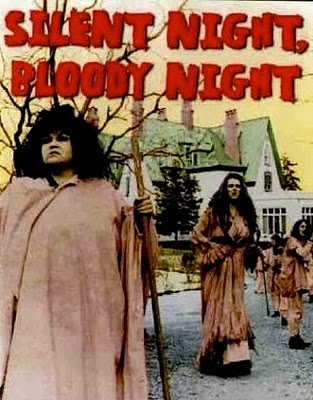
October Hacks: Silent Night, Bloody Night (dir by Theodore Gershuny)


Filmed in 1972 and subsequently released in 1974, Silent Night Bloody Night is a real treat, an atmospheric thriller that has a wonderfully complicated plot that will keep you guessing.

Silent Night Bloody Night opens with attorney John Carter (Patrick O’Neal) arriving in a small town on Christmas Eve.  He’s traveling with his assistant and mistress, Ingrid (Astrid Heeren).  He’s been hired by Jeff Butler (James Patterson) to oversee the sell of his grandfather’s home.  When Carter arrives, he finds that the town is run by a group of elderly eccentrics, including the mute Charlie Towman (John Carradine).  Charlie communicates by ringing a bell and he’s the editor of the town newspaper.  Carter convinces the town council to buy the Butler mansion.  Then, Carter and Ingrid go to the mansion, make love, and are promptly brutally hacked to death by an unseen assailant with an axe.  It’s a shocking moment because, up until their death scene, Carter and Ingrid seemed to be our main characters.  Much as with Marion Crane’s shower in Psycho, their murder leaves an absence at the heart of the film.

That night, our new hero, Jeff Butler (James Patterson) comes to the isolated town to check on how the sale is going.  He finds the mansion locked up and no one willing to talk about John Carter.  With the help of local girl Diane (Mary Woronov), Jeff investigates his grandfather’s death and discovers that the town is full of secrets and people who are willing to kill to maintain them.  As we discover through some wonderfully dream-like flashbacks, Jeff’s grandfather died nearly 40 years ago when he was set on fire in his own home.  Those aren’t the only flashbacks to the film.  In an extended sepia-toned flashback, we learn about the previous inhabitants of the house.  They are all played by former Warhol superstars, including Candy Darling, Ondine, Tally Brown, Charlotte Fairchild, Lewis Love, Harvey Cohen, George Trakas, Susan Rothenberg, and Jack Smith.  (Mary Woronov was, herself, a former member of Warhol’s entourage.)

Silent Night Bloody Night has a terrible reputation.  Mary Woronov, who was married to director Theodore Gershuny at the time she made the film, later described it as being “lousy.”  Personally, I think the film’s reputation has more to do with all of the grainy, bad copies of the film that have turned up in various Mill Creek box sets over the years than the quality of the film itself.  (Silent Night Bloody Night is in public domain.)  The film itself is atmospheric, memorably bloody, and — for those who have the patience to deal with the occasional slow spot — effectively creepy.  Mary Woronov is a likable lead and the Warhol superstars definitely make an impression.  The film plays out at its own deliberate pace and, at its best, it duplicates the feeling of a particularly macabre holiday dream.

Director Theodore Gershuny uses the low budget to his advantage and the sepia-toned flashbacks are truly disturbing and haunting.  Ultimately, Silent Night Bloody Night feels like a dream itself and the mystery’s solution is less important than the journey taken to reach it.

The TSL Horror Grindhouse: Messiah of Evil (dir by Gloria Katz and Willard Huyck)


I can still remember the first time that I saw the 1973 film, Messiah of Evil.

It was on a Monday night, many years ago. I had recently picked up a 10-movie DVD box set called Tales of Terror and I was using the movies inside to try to deal with a bout of insomnia. I had already watched The Hatchet Murders (a.k,a. Deep Red) and The House At The Edge of the Park and, at two in the morning, I was faced with a decision. Should I try to sleep or should I watch one more movie?

Naturally, I chose to watch one more movie and the movie I picked was Messiah of Evil. So, there I was at two in the morning, sitting at the edge of my bed in my underwear and watching an obscure horror movie while rain fell outside.

And, seriously — this movie totally FREAKED me out!

Messiah of Evil opens with a man (played by future director Walter Hill) stumbling through the night, obviously trying to escape from something.  A mysterious woman appears and kills him.  We’re left to wonder who the man was supposed to be as the film doesn’t ever really return to his murder.  In most films this would be a weakness but it feels appropriate for Messiah of Evil, a film that plays out with the visual style and fragmented logic of a particularly intense nightmare.

The rest of the story tells the story of Arletty (Marianna Hill), a neurotic woman who drives to an isolated California town in order to visit her father. Her father is an artist who specializes in painting eerie pictures of large groups of black-clad people. However, once she arrives at his home, Arletty discovers that her father has vanished and left behind a diary where he claims that a darkness has overtaken the town.  Meanwhile, it sometimes appear as if the people in the paintings are moving or threatening to come out of the walls.

Meanwhile, one crazed man (Elisha Cook, Jr.) explains that “the dark stranger” is returning.  An albino (Bennie Robinson) drives a truck up and down the street and talks about how he likes to listen to “Wagner.”  The back of the truck is full of blank-faced people staring at the sky and the Albino eats a rat.  Finally, a mysterious man named Thom (Michael Greer) is wandering about town with two groupies (played by Anitaa Ford and Joy Bang) and interviewing random townspeople.  After meeting Arletty, they all end up moving into her father’s house.

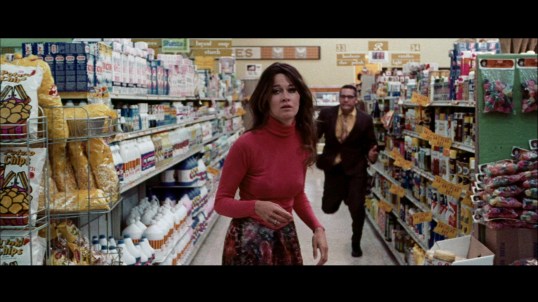
Messiah of Evil is literally one of the strangest films that I’ve ever seen. It’s shot in a dream-like fashion and the much of the film is left open to the viewer’s interpretation.  Joy Bang goes to see a Sammy Davis, Jr. western and doesn’t notice as the theater slowly fills up with pale, red-eyed townspeople.  Anitra Ford goes to a grocery store late at night and discovers the townspeople indulging in their appetites.  If the film was only distinguished by those two scenes, it would still be worth saying.  However, Messiah of Evil is a total and complete experience, a film where every scene matters and the audience is tasked with putting the puzzle together.

This film was directed by Gloria Katz and Willard Huyck, two longtime associates of George Lucas.  (They wrote the screenplay for American Graffiti and Huyck directed Howard The Duck.)  There’s absolutely nothing else in their filmography that is as surreal as Messiah of Evil, leading me to suspect that the film itself might be a very fortunate accident.  Apparently, the production ran out of money before Katz and Huyck finished principal photography, which is what led to the film’s disjointed nature.  Accident or not, Messiah of Evil is a masterpiece of surreal horror.

Messiah of Evil (1973, directed by Willard Huyck and Gloria Katz)

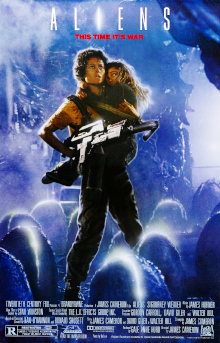
Aliens (1986, directed by James Cameron)


When I learned that today was Sigourney Weaver’s birthday, I flashed back to the first time I saw Aliens.

I was just a kid, probably too young for the movie.  My father rented Aliens from the local Blockbuster.  It had been years since the movie had first come out but my father, who went to every Star Trek movie premiere and who still knows the lore of Star Wars better than I do, had never seen it and he was planning on correcting that oversight.  My family gathered in the living room.  We turned out all the lights.  The tape was slipped into the VCR.  Play was hit.  Our boxy television turned into a movie screen and Aliens began.

And it scared the Hell out of me.

Today, I think people forget just how scary both Alien and Aliens are the first time that you watch them.  After the first time, you at least know when the aliens are going to jump out at people and you also know who is going to survive.  Today, if I rewatch Aliens, I know not to get to attached to the any of the Colonial Marines.  I also know not to trust Carter Burke, even if he is played by Paul Reiser.  I watch the movie in anticipation of Bill Paxton’s “Game over, man,” instead of dreading it.  When I first watched it, all I knew is that the screen suddenly went dark, the soundtrack was full of screeches and the deaths of the Marines, and that the only thing scarier then being confronted with one alien was being confronted with a hundred of them at once.  When I watch today, I know Bishop (Lance Henriksen) is going to prove to be a good android.  I didn’t have the assurance when I first watched the movie.  For all I knew, he was going to just abandon Ripley (Weave), Newt (Carrie Henn),and Hicks (Michael Biehn) on the planet.

Sigourney Weaver was the heart of that film.  She went from being angry and bitter over what happened during then first Alien to still being angry and bitter but willing to risk her life to save Newt.  From the start, she alone understood the Xenomorph threat and she was ultimately victorious because she was not only as determined and ruthless as the Queen but she actually had the heart that her opponent lacked.  Ripley won because she was actually fighting for something more than just conquest.  She was fighting to save Newt from becoming an incubator.

I usually think of Aliens as being the last Ripley film.  I don’t acknowledge the third film because I find the idea of killing Newt and Hicks to be a betrayal of what made the first Aliens more than just a scary action movie.  The fourth film, I don’t acknowledge because it asks me to believe that Winona Ryder would still be acting like Winona Ryder in the 23rd century.  Aliens is a scary movie but it’s also a movie that ends with the promise of hope.  After all that she’s been through, Ripley finally has a chance to start again with Newt, Hicks, and Bishop.   That hope is something that is too often missing from the follow-ups.

Happy birthday, Sigourney Weaver!  I’m going to go watch Aliens.

October True Crime: Murder So Sweet (dir by Larry Peerce)


1993’s Murder So Sweet, also known a Poisoned By The Love: The Kern County Murders (seriously, try to say that ten times fast), tells the story of Steven David Catlin.

Steven David Catlin lived in Bakersfield, California.  Catlin was a career criminal who was married six times and who found some personal redemption for himself as a member of the pit crew for a professional race car driver in Fresno.  Trust me, I’ve lived in enough small, country towns to know that people will overlook a lot as long as someone knows how to work on a car.

One thing that people noticed about Catlin is that the people around him had a habit of dying of mysterious illnesses.  Multiple wives, his adoptive parents, they all died with fluid in their lungs and they left behind not only a medical mystery but also quite a bit of money for Steven David Catlin.  Catlin would always insist on holding a cremation just days after his loved ones passed away.  Not only did that allow Catlin to move on but also kept anyone from being able to do a thorough autopsy.

Eventually, the police figured out that Catlin was just poisoning anyone who got on his nerves or threatened to divorce him.  He wasn’t even a particularly clever poisoner.  He used paraquet, a highly toxic herbicide and he kept the bottle sitting in plain view in his garage.  He might as well have just labeled it his “Poisoning Thermos.”  Catlin was convicted of multiple murders and he was sentenced to die in 1990.  Of course, this being California, Catlin is sill alive and sitting in San Quentin.  This really is a case of “If you lived in Texas, you’d be dead by now.”

In Murder My Sweet, Catlin is played Harry Hamlin, who steals the film as a dumb but charming redneck who walks with a confident swagger and has no fear of hitting on his ex-wife, even after he realizes that she’s trying to convince the police that he’s a murderer.  Helen Shaver played Edie Bellew, the ex who knows better than to trust Catlin.  Her current husband is played by Terence Knox and there’s plenty of scenes of him telling Edie that she needs to back off and that everyone knows that Steve Catlin isn’t a murderer.  In many ways, this is the ultimate Lifetime film in that Edie Bellew not only gets to put her ex-husband in prison but she also proves that her current husband doesn’t know what he’s talking about.

Murder My Sweet takes place in rural California and, as a result, everyone in the film speaks with a shrill country accent and we spend a lot of time in a really tacky beauty parlor.  Indeed, the film portrayal of country eccentricity is so over-the-top that I was tempted to say that it seemed as if the director was trying to rip-off David Lynch.  However, Lynch may have made films about eccentric characters but he never portrayed them as being caricatures.  Lynch loved his eccentrics while this film takes a bit of a condescending attitude towards them.  Still, it’s worth watching for Harry Hamlin’s sleazy turn as Steve Catlin, a guy who enjoys fast cars and making ice cream.

Just don’t eat that ice cream….

Horror Film Review: The Seduction (dir by David Schmoeller)


Get to know your neighbors, people!

That’s really the main message that I took away from the 1982 film, The Seduction.  In The Seduction, Morgan Fairchild stars as Jamie Douglas.  Jamie is a anchorwoman for a local news channel in Los Angeles.  She has an older boyfriend named Brandon (Michael Sarrazin).  She has a sex-crazed best friend named Robin (Colleen Camp).  She has a beautiful home in the Hollywood Hills.  She’s doing wonderfully for someone whose main talent is the ability to read what’s on the teleprompter.  Much like Ron Burgundy, she’ll read whatever is put on that teleprompter without even thinking about it.  Some might say that indicates that Jamie is a fairly vacuous character and …. well, they’re right.  She is.

Jamie starts receiving flowers at work and mysterious phone calls from someone named Derek.  Derek (Andrew Stevens) is a fashion photographer.  He’s young.  He’s handsome.  He’s charismatic.  His assistant, Julie (Wendy Smith Howard), is absolutely in love with him.  In fact, Derek would seem to have it all but he’s obsessed with Jamie.  Soon, he’s breaking into Jamie’s house so that he can watch her undress and then confronting her at the mall.  At one point, he shows up in her living room and starts taking pictures of her.  Jamie screams.  Brandon beats him up.  After Derek leaves, Jamie and Brandon go to the police and ask if there’s something that they can do about Derek.  The police say that there are not many options because Derek has not technically broken the law …. uhm, what?  I get that things were different in the 80s but I still find it hard to believe that showing up in someone else’s living ro0om without an invitation and then refusing to leave would have been considered legal back then.  As you probably already guessed, Derek’s obsession soon turns lethal.

Perhaps the weirdest thing about The Seduction is that Derek is basically Jamie’s neighbor but she doesn’t ever seem to realize it.  Watching this film, there were time when I really had to wonder if maybe Jamie was just an idiot.  As well, throughout the film, Jamie reports on an unknown serial killer who is terrorizing Los Angeles.  The killer is dubbed the Sweetheart Killer and, when I watched this film, I wondered if the Sweetheart Killer and Derek were one in the same.  I don’t think that they were but, still, why introduce an unknown serial killer without providing any sort of resolution?  It’s all indicative of just how sloppy the plotting on The Seduction truly was.  That’s especially true of the ludicrous ending of the film.  A murder is committed in Jamie’s hot tub and when Jamie calls the police to report it, she’s put on hold.  Meanwhile, Derek buries the body in Jamie’s backyard and somehow manages to do it without really breaking a sweat or being noticed by anyone.  Derek’s big secret turns out to be not that much of a shock.

Morgan Fairchild’s performance isn’t great but that’s largely because she’s stuck with a character who is never allowed to behave in a consistent manner.  Andrew Stevens is a bit more convincing as Derek, playing him as a photographer who doesn’t need cocaine because he’s already get his obsessive personality keeping up at nights.  Michael Sarrazin, as Brandon, bellows nearly all of his lines and gives a performance that just shouts out, “Why did I agree to do this movie!?”  He’s amusing.  As for director David Schmoeller, he did much better with both Tourist Trap and Crawlspace.

Seriously, though, a lot of the horror and drama in this film could have been avoided by Jamie just getting to know her neighbors.  I’ve been very lucky to have some very good neighbors over the years.  When my Dad passed away, my neighbors Hunter and Hannah checked in on my nearly every day afterwards and let me use their hot tub whenever I wanted to.  Neighbors, they can be pretty special.

Horror Film Review: It! The Terror From Beyond Space (dir by Edward L. Cahn)


“Another name for Mars is …. DEATH!”

The 1958 sci-fi/horror hybrid, It!  The Terror From Beyond Space, opens with a NASA press conference.  The assembled reporters are reminded that, earlier in the year, America’s first manned mission to Mars was presumed to have been lost.  However, a second mission was sent to Mars and they discovered that the commander of the first mission, Edward L. Carruthers (Marshall Thompson), was still alive.

Unfortunately, all of Carruthers’s crewmates were dead.  Carruthers claimed that the murders were committed by a monster.  The commander of the second mission, Col. Van Heusen (Kim Spalding), instead suspected that Carruthers killed his crewmates when he realized they were stranded on Mars.  The ship had enough provisions to last the entire crew for one year or ten years for just one man.

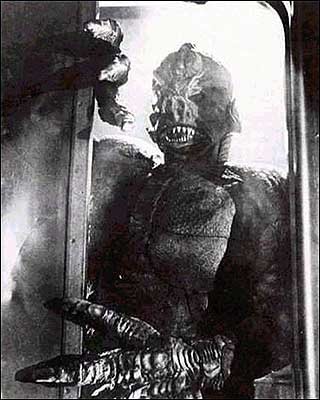
The second mission is now on their way back to Earth, with Carruthers under house arrest.  While one crewman does believe that Carruthers’s story could be true, the others are convinced that Carruthers is a murderer.  What they don’t know is that the monster from Carruthers’s story is not only real but that it also snuck onto their ship during lift-off.  Tall and scaly with huge claws and a permanently angry face, the Monster — It, for lack of a more formal name — is lurking in the lower levels of the ship and hunting for food.

To state what is probably already obvious, It! is not a film that worries much about being scientifically accurate.  While it does explain how living on the surface of Mars caused It to develop into the predator that it is, this is also a science fiction film from 1958.  It’s a film where, instead of going to the Moon, the first manned spaceflight is to Mars.  It’s also a film where there’s no weightlessness in space, the two women on the ship serve everyone coffee, and a nuclear reactor is casually unshielded at one point in an attempt to destroy It.  Bullets are fired on the spaceship.  Grenades are tossed.  Airlocks are rather casually opened.

Fortunately, none of that matters.  Clocking in at a mere 69 minutes, It! is a surprisingly suspenseful horror film, one that makes good use of its claustrophobic locations (a lot of the action takes place in an air duct) and which features a surprisingly convincing and, at times, even scary monster.  It may be a man in a rubber suit but that doesn’t make it any less shocking when its claw bursts out of an an open hatch and starts trying to grab everything nearby.  The cast of It! are all convincing in their roles.  Watching them, you really do believe that they are a crew who have seen a lot together and it makes the subsequent deaths all the more effective,

It! was a troubled production,  The monster was played by veteran stuntman Ray Corrigan, who reportedly showed up drunk a few times and also managed to damage the monster suit.  Many members of the cast were not happy about being cast in a B-movie.  (Fortunately, their resentment probably helped their performances as the similarly resentful crew of the second mission to Mars.)  Marshall Thompson, who played Carruthers, was one of the few cast members who enjoyed making It! and, perhaps not surprisingly, he also gives the best performance in the film.

Troubled production or not, It! was not only a box office success but, along with Mario Bava’s Planet of the Vampires, it was later cited as one of the inspiration for Alien.  At its best, It! has the same sort of claustrophobic feel as Alien.  The scene where one of the crewman is found in an air duct brings to mind the fate of Tom Skerritt’s character in Alien.

It! is still a very effective work of sci-fi horror.  Remember, another name for Mars is …. DEATH!

The Laundry, Short Film Review by Case Wright


We are NOT powerless! We don’t have to let Alex Magana films happen. Alex Magana films being created is not a requirement of life, unless we permit it! I know that many of you think that he is inevitable like Thanos or getting herpes, BUT it is not! Thanos, herpes, and Alex Magana films don’t have to be part of your life!

Speaking of herpes, we need to go into a deeper dive of our cultural heroes sleeping with Aliens! Whatever they evolved from, it wasn’t on Earth!

You’re gonna give all COVID 1000! They probably have sapient cold sores! Cut it out!
The green alien especially because just wait until the Jolly Green Giant gets home! Yes, I did hold myself back from the obvious she is a

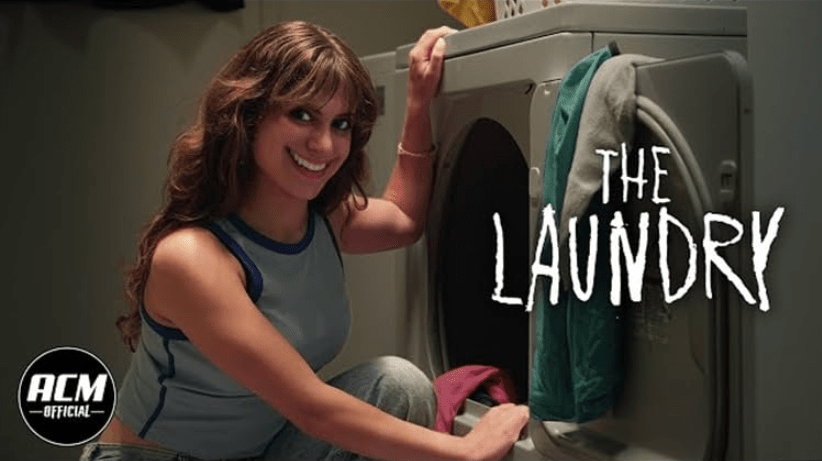
Yes, this was a tangent, but it delayed my review and that is a good thing. The story is very simple a woman does her laundry, the laundry alarm buzzes, and…..nothing just a high pitched boyfriend. The boyfriend investigates the laundry and is eaten by a monster hiding the dryer.
She also investigates and the monster is her laundry.
I do not understand the monster’s lifecycle or why this movie had to be. We could stop Alex Magana! Think on this, if 100 guys can stop a gorilla, 20 guys could stop Alex!
If you want to see something terrible, see below.

Horror Review: Visitor Q (dir. Miike Takashi)


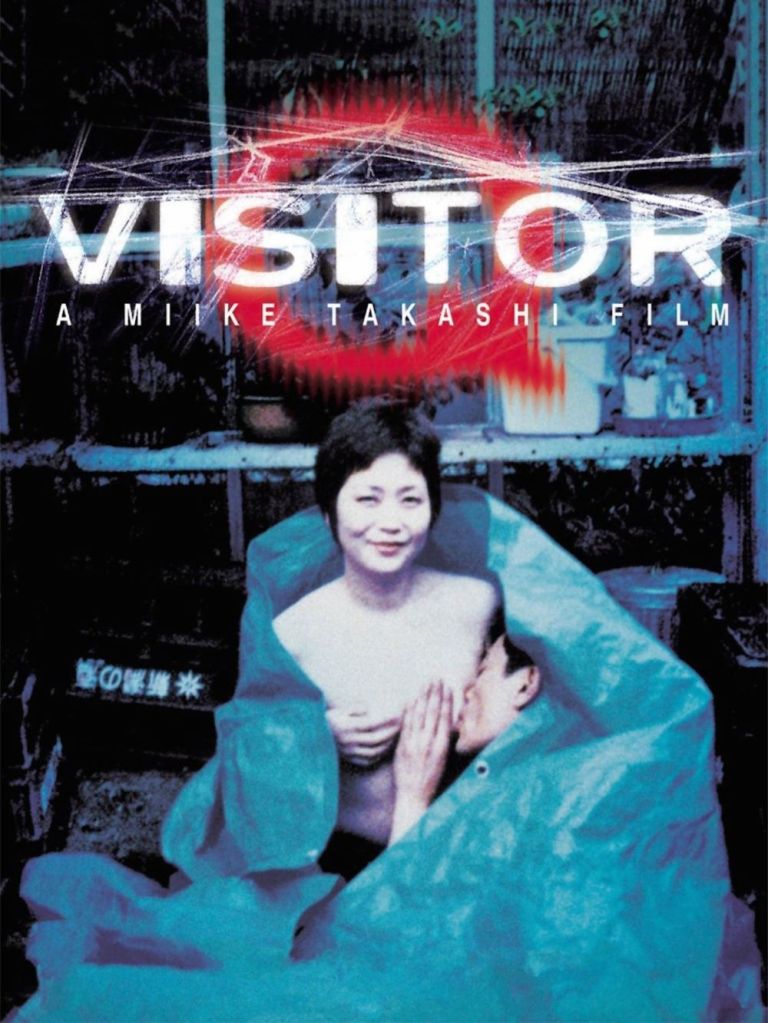
Miike Takashi’s 2001 film Visitor Q (called Bizita Q in Japan) is definitely one of the most bizarre and disturbing movies out there. It often gets compared to the work of Quentin Tarantino, but that comparison really doesn’t do Miike justice. Tarantino’s style is all about showing violence in a flashy, stylized way that sometimes feels more like entertainment or homage than outright shock. Miike, on the other hand, takes a very different approach—his films are much more raw, unfiltered, and transgressive. Where Tarantino’s violence can almost feel like a performance, Miike’s hits you in a way that’s meant to provoke and unsettle on a deeper level.

Visitor Q is a wild, surreal ride that dives headfirst into the messy mix of violence and sex that’s so common in today’s media, with a cheeky nod toward reality TV culture. The film came out of Japan at a really interesting time, when the culture was pretty conflicted about Western influences. Japan often points fingers at the West for “decadence” and moral decline, but at the same time, it produces some of the most intense and boundary-pushing entertainment around—like anime and manga filled with everything from weirdly sexualized creatures (yes, tentacles, lots of tentacles) to ultra-violent stories that Western media would blush at.

The plot itself is maybe the simplest part of the whole thing. It’s about a down-on-his-luck former TV reporter named Q Takahashi who’s trying to support his dysfunctional family by filming a documentary about how violence and sex in media affects young people today. From there, the story quickly spins into something much darker and more uncomfortable, focusing on his family’s raw problems: drug abuse, emotional numbness, incest, necrophilia, and other twisted stuff that’s hard to even put into words.

What really makes Visitor Q stand out is how Miike doesn’t hold anything back. This film isn’t trying to make you comfortable or distract you with flashy effects. Instead, it confronts you with some very real, very uncomfortable issues. Miike has a fearless way of showing violence and sex that feels totally unfiltered and even brutal, forcing you to face parts of human nature and society that most movies would shy away from or sugarcoat.

It’s easy to see how this movie channels the spirit of the Marquis de Sade, that infamous figure known for embracing taboo and shock to criticize societal hypocrisy. Miike takes this spirit and uses it to spotlight the way media—and especially the voyeuristic culture of reality TV—turns personal pain and dysfunction into public spectacle. The movie asks us to think about how watching violence and sex over and over might warp not just society’s values, but how people actually relate to one another.

One thing Visitor Q pokes at pretty hard is voyeurism, the idea of watching other people’s lives like it’s entertainment. The former TV reporter filming his family for the documentary is both an observer and a participant, and the film forces viewers to question the ethics of watching intimate, often tragic moments unfold just for the sake of entertainment. It’s a powerful reminder of what media voyeurism can do to real lives.

Another theme that hits home is how desensitized people have become to violence and sex. The family in the movie often reacts to brutal, horrible things with complete indifference—almost like they’re numb from being exposed to this stuff all the time. Miike seems to be saying that when we see violence and sex as everyday entertainment, it dulls our emotions and disconnects us from the human suffering behind those images. This is especially relevant for young people growing up in a media-saturated world, which is exactly what the film’s documentary narrator is trying to get at.

Some of the film’s more extreme themes, like incest and necrophilia, are obviously shocking, but Miike uses them to highlight just how broken the family is. These aren’t just there for shock value—they’re symbols of how far relationships can fall apart when love, respect, and communication break down entirely. The film uses these taboos as metaphors for emotional neglect and societal decay, asking us to look hard at the dark corners of family life and human nature that most media avoids.

Watching Visitor Q is definitely not an easy ride. At first, most people find themselves looking away or flinching because the content is so wild and graphic. But it’s interesting how, over time, viewers start watching the movie without turning away, even if what they see is still deeply disturbing. The film somehow pulls you in with its surreal style and brutal honesty, making you confront just how far you’re willing to go in understanding these messed-up family dynamics and cultural critiques.

Stylistically, the film bounces between stark realism and surreal, almost absurd imagery. This gives it a rollercoaster tone that keeps you off balance—one moment it’s brutally raw, the next it’s almost darkly comedic or bizarre. This mix mirrors the instability of the family and the unpredictable nature of their world. Miike really embraces both the artistic and the extreme exploitation sides of filmmaking here, unapologetically pushing boundaries with each scene.

Despite all the shocking stuff, the film comes with a clear message about the relationship between media, sex, and violence. It’s not just reflecting society’s problems; it’s suggesting that media actually shapes how we think, feel, and behave—especially for kids. The film also takes a swipe at reality TV, highlighting how people get a twisted sense of pleasure from watching others’ suffering and humiliation. This is even more relevant today with social media and constant livestreams making all aspects of life a public show.

Miike’s gritty and unfiltered take makes it clear he isn’t just copying Western transgressive directors—he’s got his own voice and style that’s as challenging as it is unique. Where Tarantino’s films entertain and provoke with wit and style, Miike’s work disturbs and pushes, asking viewers to get uncomfortable and reflect. Comparisons to Pasolini, the Italian filmmaker known for his raw and provocative films, fit well here. Like Pasolini, Miike straddles the line between art and exploitation, using shock to force deeper questions about society.

In the end, Visitor Q isn’t a movie for casual watching or easy enjoyment. It’s intense, often repugnant, and demands a tough kind of attention. But for those willing to dive into its messy, surreal, and disturbing world, it offers a powerful look at how media influences family, society, and morality. Miike Takashi is definitely not Japan’s Tarantino—he’s a far more transgressive filmmaker who dares to challenge audiences by taking them into the most uncomfortable and raw parts of human experience. If one has the courage and curiosity, Visitor Q is an unforgettable, provocative film that forces us to think hard about voyeurism, media excess, and just how dark and strange life can get behind closed doors.

Horror On The Lens: The Clones (dir by Lamar Card and Paul Hunt)


“Today it is science fiction, tomorrow it will be science fact….”

So declared the trailer from 1973’s The Clones.  

One of the first films to be made about cloning, this movie tells the story of Dr. Gerald Appleby (Michael Greene), who discovers that there’s another version of him living his life.  Dr. Appleby and his clone both find themselves being pursued by two government agents (Gregory Sierra and Otis Brown) and a mad scientist (Stanley Adams).

The Clones requires some patience.  It moves at its own deliberate pace and there’s quite a few scenes of Dr. Appleby running through the desert.  That said, the film builds up to wonderfully twisted conclusion and the final roller coaster shoot-out makes everything more than worth it.

Ever since I first saw this ennui-drenched film in 2012, I’ve been recommending it to people.  I’m happy to share it with you today!